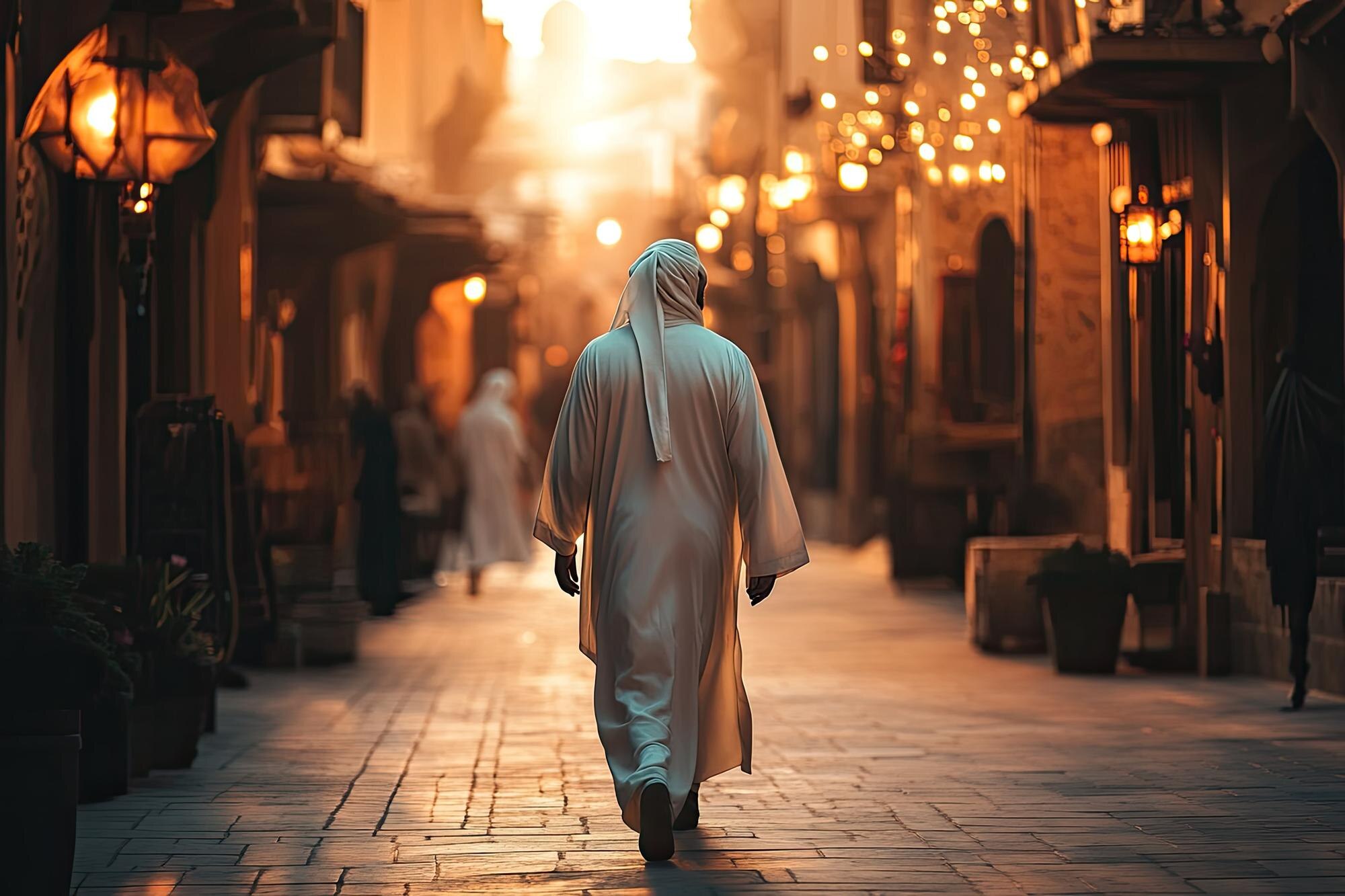
Somewhere over the deserts of Arabia, or on a quiet road outside Madinah, the journey changes its nature. The traveller becomes a pilgrim. That moment is marked by the Miqat, a boundary set not by airlines or governments but by the guidance of the Prophet (peace be upon him), beyond which no one intending Umrah may pass without first entering the sacred state of ihram. Understand the Miqat and you understand where the pilgrimage truly begins. Prepare for it properly and you cross that line with your heart already turned to Allah, instead of scrambling at the last minute in an aircraft aisle.
This guide explains the Miqat plainly and practically: the five boundaries with their modern names and distances, how they work when you’re flying, how to enter ihram and make the intention, what the talbiyah actually says, and what to do if something goes wrong. The aim is accuracy without anxiety. The mechanics matter, because a valid Umrah depends on them, but they’re not complicated once you’ve seen them laid out.
What the Miqat Is
The word miqat means an appointed place or time. In the hadith recorded by both al-Bukhari and Muslim, Ibn Abbas (may Allah be pleased with them both) relates that the Prophet (peace be upon him) fixed the stations for the people of Madinah, of Syria, of Najd, and of Yemen, and said they are for the people of those lands and for whoever passes through them from elsewhere, intending Hajj or Umrah. That last clause is the one that governs your journey: your Miqat is determined by the route you travel toward Makkah, not by your passport. A British pilgrim flying via Madinah takes the Madinah Miqat; the same pilgrim flying direct to Jeddah crosses a different boundary, in the air, before landing.
Inside the boundaries lies the region around the Haram; outside lies ordinary ground. Crossing inward with the intention of Umrah obliges you to be in ihram — the garments for men, and the state of consecration for everyone. Crossing without it isn’t a catastrophe, as we’ll see, but it does create an obligation, so the whole art of this chapter is simple: know your boundary, and be ready before you reach it.
The Five Boundaries, Then and Now
The classical names sit alongside modern ones, because every Miqat is a real place you can drive to today, with mosques, wash facilities, and parking. Distances below are approximate road figures as commonly cited; the exact number matters far less than knowing which boundary is yours.
- Dhul Hulayfah (Abyar Ali) — the Miqat for Madinah and all who travel through it. It sits about 9km from the Prophet’s Mosque on the southern edge of the city, and roughly 450km from Makkah, making it the most distant Miqat of all.
- Al-Juhfah — the Miqat for those approaching from the direction of Syria, Egypt, and the north-west. The original settlement faded centuries ago, so pilgrims today enter ihram at nearby Rabigh, around 183km north-west of Makkah.
- Qarn al-Manazil (As-Sayl al-Kabir) — the Miqat for Najd and those coming from the east, including most pilgrims arriving by road from Riyadh or Taif. It lies roughly 75–80km east of Makkah.
- Yalamlam (Al-Sa’diyyah) — the Miqat for those approaching from Yemen and the south, around 92–100km south of Makkah depending on the route taken.
- Dhat Irq — the Miqat for those approaching from the direction of Iraq and the north-east, roughly 90–94km from Makkah. It was designated in the era of Umar (may Allah be pleased with him) for the people of the newly opened eastern lands, in line with the Prophet’s instruction that travellers take the Miqat on their route.
For most pilgrims today the five boundaries collapse into two scenarios. Fly into Madinah first and travel on to Makkah by road or rail, and your Miqat is Dhul Hulayfah, crossed in calm and comfort. Fly straight into Jeddah intending Makkah, and your boundary is crossed at cruising altitude — usually the line extending from Al-Juhfah or Yalamlam, depending on your approach path — and the preparation has to happen before you land.
The Madinah-First Advantage
There’s a quiet logistical mercy in visiting Madinah before Makkah, and the Miqat is the heart of it. You arrive in Madinah in ordinary clothes, with no ritual clock ticking — ihram is simply not your concern yet. You rest, you pray in the Prophet’s Mosque, you recover from the flight. Then, on the day you travel to Makkah, you prepare unhurried: ghusl in your hotel that morning, the garments folded in your day bag or already worn, and a stop at the Miqat mosque at Abyar Ali — a vast, beautiful complex with hundreds of wash rooms and changing areas built precisely for this moment. You enter ihram on solid ground, in space and daylight, then continue by coach or taxi, or board the Haramain high-speed railway, which pilgrims commonly board already in ihram since the train crosses the Miqat line en route. The practical choreography of that journey is in our guide to getting to Madinah and onward travel; the point here is simply that a Madinah-first itinerary turns the most delicate moment of the trip into the easiest.
One clarification travellers often ask about: if you fly into Madinah’s airport intending Madinah first, you do not need ihram on that flight at all, because you aren’t yet travelling to Makkah. The obligation begins only when you set out from Madinah toward the Haram.
Crossing the Miqat in the Air
For the direct traveller to Jeddah, modern aviation means the boundary is crossed at around eleven kilometres of altitude, and often twenty minutes or more before landing. That is perfectly valid — the Miqat is a line on the earth, and the airspace above it counts — but it changes when you must prepare. You cannot wait until you see the boundary; there is nothing to see. The rule is simple: before the aircraft crosses the line, you must be in the garments and you must have made the intention.
Here a distinction saves a great deal of fuss. Wearing the two white cloths does not, by itself, put you in ihram — the state begins with the niyyah, the intention. So it is entirely valid, and strongly sensible, to dress in the ihram garments at home, at the departure airport, or during a layover, and travel for hours in them without any restriction applying, then make the intention shortly before the Miqat. Many pilgrims wear the garments from departure, or change at the gate; our guide to wearing ihram covers the folding and securing, and the layovers guide explains why a hub airport — with space, showers, and time — is often the ideal changing room. What you want to avoid is the alternative everyone regrets: queueing for a cramped aircraft lavatory during a bumpy descent with the boundary approaching.
Airlines flying into Jeddah know all this, and crews on pilgrim routes make a cabin announcement as the aircraft nears the Miqat — typically thirty to forty-five minutes beforehand. Treat that announcement as a final nudge, not your first warning. Announcements are occasionally missed, mistimed, or lost in the hum of a night flight; the pilgrim who is already dressed, with the intention planned, has nothing riding on the public address system. If you want extra certainty, note your route’s Miqat before you fly and watch the moving map: when the aircraft is well outside the line — say an hour from landing — make your intention then. Entering ihram somewhat before the Miqat is valid in all schools; entering it after crossing is the thing to avoid.
Garment Logistics at 38,000 Feet
A few cabin realities are worth planning for. Aircraft run cold, and the ihram is two pieces of towelling: you may wrap an airline blanket around your shoulders and body, though a man in ihram keeps his head uncovered, so resist pulling it up over your ears as you doze. The seatbelt fastens over the garments without any issue, and the waist belt or money pouch that keeps your passport and cash secure is permitted by mainstream scholarship, since it isn’t a fitted garment. Men’s footwear should already be sandals; keep socks off once the intention is made, according to the more careful view for men. If you plan to change mid-flight, go early — two or three hours out, when the lavatories are free and the seatbelt sign is dark — and carry the cloths in your cabin bag, never the hold, with a small spare in case of spills. Decline the scented hot towel after the niyyah is made, skip perfumed wipes, and eat the meal without worry; food, water, and sleep are all untouched by ihram. If you entered the state before boarding, all of this simply applies from take-off.
The Niyyah and the Talbiyah
At its core, ihram is a state of intention, not just a set of clothes. For men it’s marked outwardly by two unstitched white cloths; women have no mandated uniform and enter ihram in ordinary modest dress, with the specific rule that the face is not covered by a garment fastened to it (niqab) nor the hands by gloves — mainstream scholarship allows a woman to draw a covering loosely over her face in front of unrelated men if she normally observes that. Before entering the state, it is sunnah to perform ghusl, trim the nails, and tidy the hair and moustache, since grooming is restricted once ihram begins. It is also recommended to enter ihram after a prayer — a fard prayer if one is due, otherwise two rak’ahs, which the Abyar Ali mosque and every airport prayer room make easy.
The intention itself is made in the heart, and it is common and well-grounded to voice it simply: Labbayka Allahumma ‘Umratan — here I am, O Allah, for Umrah. If you fear illness or obstruction may prevent you completing the rites, the sunnah of Duba’ah bint al-Zubayr (recorded in al-Bukhari and Muslim) is to add a condition: that if you are prevented, you exit ihram where you are halted, without penalty. Scholars particularly commend this for the elderly and unwell.
With the intention comes the talbiyah, the pilgrim’s answering call, in the wording preserved in the hadith of Ibn Umar (al-Bukhari 1549; Muslim 1184): Labbayka Allahumma labbayk. Labbayka la sharika laka labbayk. Inna al-hamda wa-n-ni’mata laka wa-l-mulk. La sharika lak — Here I am, O Allah, here I am. Here I am; You have no partner; here I am. Truly all praise, favour, and sovereignty are Yours. You have no partner. Men raise their voices with it; women say it softly. It is repeated often — on the road, in the cabin, at each rise and fall of the journey — until the tawaf begins. From the moment the intention is made, the well-known restrictions apply: no perfume or scented products, no cutting hair or nails, no hunting, no marriage contracts or intimacy, and for men no stitched garments or covering the head. Keep the intention front and centre; the clothes will draw glances, but it’s the quiet resolve within that has placed you among the pilgrims.
If You Cross Without Ihram
Mistakes happen, and they don’t have to become disasters. If a pilgrim crosses the Miqat without having entered ihram — through sleep, confusion over timing, or a missed announcement — the first and best remedy, agreed across the schools, is to go back to the Miqat, enter ihram there, and continue; a pilgrim who returns before beginning the rites has, in the majority view, nothing further owed. In practice this is more feasible than people assume: a traveller who lands at Jeddah having forgotten can take a car back out to the Miqat line on the Madinah road or to As-Sayl al-Kabir and enter ihram correctly, and drivers at Jeddah airport know these runs well.
Where returning genuinely isn’t possible and the pilgrim goes on to perform Umrah having entered ihram inside the boundary, the mainstream position across the four madhhabs is that a compensatory sacrifice — a dam, typically a sheep slaughtered in the Haram with its meat distributed to the poor of Makkah — becomes due. The schools differ in details: on whether returning after ihram has begun lifts the penalty, and on cases of ignorance and forgetfulness, where some scholars are more lenient. This guide gives you the shape of the issue, not a verdict on your case. If it happens to you, ask a qualified scholar or a knowledgeable guide on the ground, describe your route honestly, and follow what you’re given. Arranging a dam in Makkah is straightforward through established charitable offices, and the amounts involved, while not trivial, are manageable. Above all, don’t let worry over a procedural slip swallow the spirit of your worship; the door of ease in this religion is wide.
Repeat Umrahs: Masjid Aisha at Tan’im
Once you’re inside Makkah and have completed your Umrah, a different rule applies for any further Umrah you wish to perform: you don’t return to the distant Miqats. Instead you go out to the nearest point outside the Haram boundary and enter ihram there. The customary place is Masjid Aisha at Tan’im, about 7.5km from the Grand Mosque on the Madinah road, named for the Mother of the Believers Aisha (may Allah be pleased with her), whom the Prophet (peace be upon him) sent there with her brother to begin her Umrah. The mosque is large and well equipped with wash and changing facilities, taxis and local buses run there constantly, and the round trip can take under an hour outside peak times. Do note the mainstream scholarly counsel that quality outweighs quantity — and the practical rule, as of mid-2026, that each Umrah requires its own Nusuk permit, booked in the app before you set out. Our guide to performing Umrah after arrival picks up the rites themselves from this point.
Before you fly, then, three small actions settle everything this page describes: identify your route’s Miqat tonight, pack the ihram and unscented toiletries in your cabin bag as our packing guide shows, and decide now where you’ll change — home, the departure airport, a layover, or Abyar Ali. The pilgrim who has answered those three questions crosses the boundary the way it deserves to be crossed: unhurried, dressed, and already calling the talbiyah.
Leave A Comment