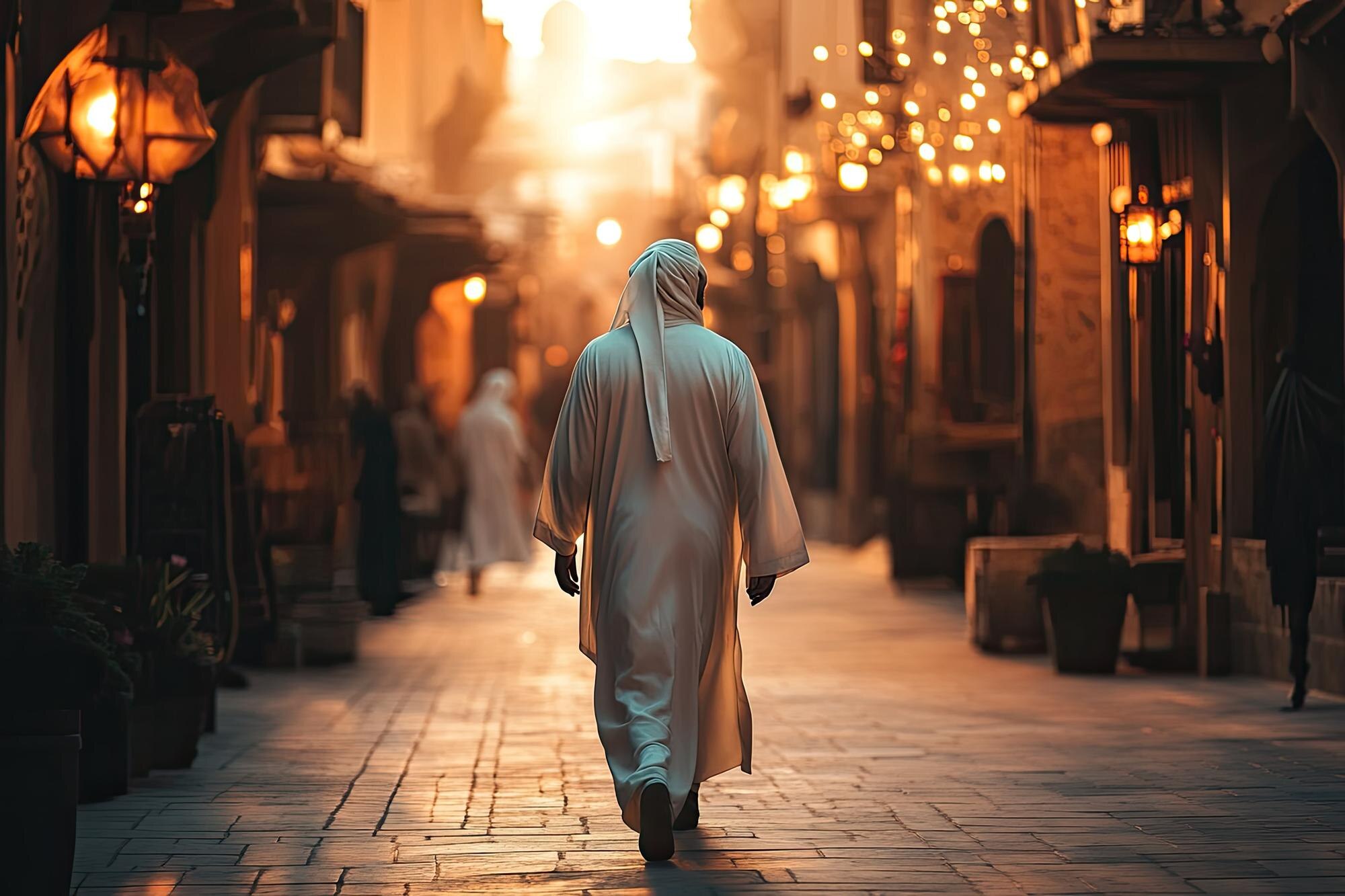
For most of living memory, the question of whether a woman could make Umrah on her own answered itself: she couldn’t, at least not officially. Saudi visa rules required a mahram — a husband or close male relative — at her side, and generations of women postponed the journey for years, sometimes forever, waiting for a man’s diary to line up with their longing. That requirement ended in October 2022, and the change has quietly become one of the most consequential shifts in modern pilgrimage. Women now arrive in Makkah alone from Lagos, Luton and Lahore, having booked their own flights, arranged their own permits and answered to no itinerary but their own.
Whether you should is a different question from whether you can, and this guide takes both seriously. It covers what Saudi law actually says, how the fiqh discussion sits alongside it, and what solo travel looks like hour by hour — the airport queue, the midnight taxi, the hotel desk, the table for one — so you can decide honestly whether travelling alone suits you, and do it well if it does.
What changed in October 2022 — and what it means in practice
In October 2022 the Saudi Ministry of Hajj and Umrah confirmed that a mahram is no longer required for women performing Umrah. The current position is simple: a woman aged 18 or over may apply for an Umrah or tourist eVisa, enter the Kingdom, and complete the pilgrimage entirely on her own. Earlier easings had limited the concession to women over 45 travelling with organised groups; those conditions are gone at the level of Saudi government policy, and nobody at the visa stage, the airline desk or Saudi immigration will ask who is travelling with you or ask for a document for a mahram to sign.
One genuinely important caveat, and it trips people up every season: policy on paper and practice at your local visa channel are not always the same thing. Several national Umrah-visa agents, particularly those processing applications from South Asia and parts of Africa, continue to apply the older conditions administratively u2014 a 45-plus age threshold, a mandatory group booking, or a written no-objection letter from a mahram u2014 regardless of what the Ministry’s own rules say. If you’re applying through the Nusuk platform or a general tourist eVisa yourself, the age-18 rule above is what governs you. If you’re applying through a third-party agent, ask them in writing, before you pay, whether they impose any such condition, because some do and will not mention it until you’re mid-application.
The systems downstream of the visa have caught up too. Hotels in Makkah and Madinah check in solo women with nothing more than a passport — a change that dates back to 2019, when the Kingdom formally allowed women to book rooms alone. Umrah permits and Rawdah slots are issued individually through the Nusuk app to your own account, not to a group or a guardian. Ride-hailing apps take bookings from anyone with a working card. In short, every practical step of the journey now works for a woman on her own; there is no hidden stage where a male companion is quietly assumed.
One seasonal caveat, since rules move: as of mid-2026, the new Umrah season opened on 1 June 2026 after the usual pause for Hajj, with visa issuance resuming at the end of May and running deep into the following spring. Confirm current dates and requirements on Nusuk before booking anything, and see our guide to Umrah visa options for the differences between the Umrah eVisa and the tourist eVisa — for many solo women the tourist eVisa is the simpler route.
The fiqh question, handled honestly
Saudi law and Islamic law are not the same thing, and it would be a disservice to pretend the 2022 announcement settled a discussion scholars have carried on for fourteen centuries. The classical position in the Hanafi and Hanbali schools is that a woman does not travel beyond a set distance — commonly reckoned at around 48 miles, or three days’ journey in the old measure — without her husband or a mahram, and that this applies even to pilgrimage. Scholars in these schools ground the ruling in well-known hadith and understand it as protective rather than restrictive.
The Maliki and Shafi’i schools took a different route. They permit a woman to travel for the obligatory pilgrimage in the company of trustworthy women — or, in the Shafi’i articulation, wherever her safety is genuinely assured — reasoning that security is the thing the ruling exists to protect. A number of contemporary scholars extend that logic to modern travel: a woman moving through international airports, on scheduled flights, met by regulated transport, is arguably safer than any medieval traveller in any caravan. Others respond that the texts say what they say, and that changed circumstances do not rewrite them. Both camps contain serious, sincere scholarship; this is not a story of enlightened reformers against stubborn traditionalists, and it deserves better than a comment-section verdict.
What should you do with all that? Not crowdsource it. Ask a qualified scholar you actually trust — ideally one who knows your school, your circumstances and your route — and then act on the answer with a settled heart. If the answer leaves you uneasy, or your teacher holds the stricter view, there is a well-trodden middle path: women-only Umrah groups, which satisfy Saudi law without a mahram while ensuring you are never actually alone, often with a female scholar on hand for precisely these questions. Many women who are legally free to travel solo choose this route for reasons of conscience, and there is no embarrassment in that. Equally, if your scholar has given you a clear answer permitting solo travel, nobody in a departure lounge has standing to overrule it.
The paperwork all works solo
Your requirements are the same as any other pilgrim’s: a passport with at least six months’ validity, the meningococcal ACWY vaccination certificate, insurance (bundled into the Umrah eVisa fee), and confirmed accommodation. As of the 2026–27 season the Ministry requires hotel and transport bookings to be verified on the Nusuk platform before an Umrah visa is issued, which in practice steers you towards Nusuk-listed providers or a licensed agent — and a solo woman can use either without anyone else’s signature.
Once you land, the permits are yours alone to manage. The Umrah permit is booked in the Nusuk app against your own passport; so is the women’s Rawdah slot in Madinah, which is free and disappears quickly for Friday sessions. Set up your Nusuk account before you fly, while you still have familiar wifi and patience, and screenshot every confirmation. Keep paper copies of your passport photo page, visa, vaccination certificate and hotel booking in your hand luggage; phones fail at the least convenient moments.
Landing alone: the first two hours
Decide before you fly exactly how you will cover the ground between the airport and your hotel bed, because arrival is when you are most tired, most visibly new and most likely to accept a bad offer. If you land at Jeddah, the Haramain high-speed rail runs from its own airport station to Makkah in under an hour; if you land at Madinah, the airport sits a short, cheap taxi ride from the central hotels. Pre-booking a transfer through your hotel or a licensed operator costs a little more than arranging a car on arrival, and buys you a name board and a fixed price at the precise moment those are worth the most.
If you prefer app-based taxis, order from inside the terminal and walk out only when the car is close — the arrivals kerb is where unlicensed drivers look for tired pilgrims. Buy a SIM or activate an eSIM before leaving the airport so the apps, the maps and your family all work from the first minute. Then send the message home: landed, safe, on the way to the hotel. Start as you mean to go on.
Getting around, especially after dark
App-based rides are the solo woman’s friend in both cities: the route is tracked, the fare is fixed, and the driver’s name and plate are on your screen before you open the door. Uber and Careem both operate in Makkah and Madinah, and both have introduced options in Saudi Arabia that let women request female drivers where available — coverage varies city by city, but as of mid-2026 it exists and is growing. Sit in the back, share your trip status from inside the app, and end any ride that feels wrong at the next busy, well-lit place. Our full guide to taxis, Uber and Careem covers fares, pickup points and airport runs in detail.
Night movement deserves its own word, because Umrah is nocturnal worship in practice — the coolest tawaf happens at two in the morning and the Haram courtyards are genuinely busy at all hours. Around the mosques you are rarely alone even at 3am; crowds, floodlights and security staff are constant. The riskier gap is the quiet stretch between a distant hotel and the Haram perimeter, which is one more argument for paying for proximity. If your budget puts you further out, take a car after dark rather than walking twenty empty minutes to save a few riyals.
Hotels, meals and the ordinary business of being alone
Hotel check-in as a solo woman is unremarkable: passport, booking reference, done. Front desks in the pilgrimage cities process thousands of unaccompanied women a week and will not blink. The sensible room habits are the same ones that apply everywhere in the world — use the deadlock, don’t announce your room number aloud at the desk, keep valuables in the safe — and we cover them properly in our women’s safety guide, which is the companion piece to this one.
Eating alone bothers people far more in anticipation than in fact. The food courts of the towers around both Harams are full of women eating by themselves at every hour, and a hotel buffet breakfast is the easiest solo meal in the world. Where restaurants still keep traditional family sections, they work in your favour: they exist precisely so that women and family groups can eat undisturbed. Keep simple provisions in your room too — dates, fruit, nuts, laban, water — so that hunger never forces you out at an hour you’d rather stay in.
Women-only queues, sections and spaces
Both mosques are easier for a solo woman than first-timers expect, because so much of the infrastructure is already arranged around women’s spaces. There are dedicated women’s prayer areas in Masjid al-Haram and large women’s sections at the Prophet’s Mosque, staffed by female security officers who answer questions all day. Women’s queues form at the busier gates, and the Rawdah runs on women-only scheduled slots booked through Nusuk, with its own entrance in Madinah. Inside these spaces you are surrounded by women — a striking number of whom are also travelling alone — and conversation starts easily. Our guide to women’s prayer areas and the Rawdah maps the gates, timings and booking steps.
A check-in routine that keeps everyone at home calm
The single best gift you can give an anxious family is predictability. Agree the routine before you fly rather than improvising it across time zones, and make it light enough that you’ll actually keep it up. A workable pattern looks like this:
- Live location on for one trusted person for the whole trip, through WhatsApp or your phone’s built-in sharing;
- One scheduled message a day at a fixed time — after Fajr works well, since you’ll be awake anyway;
- A named backup contact — your hotel’s front desk number and your booking references, written down and left at home;
- An agreed miss-window — what family should do, and not do, if a check-in runs a few hours late, so a flat battery never triggers a consulate call.
The apps and settings are covered in our guide to staying findable, and the numbers worth saving — 911 works across Saudi Arabia — are in our emergencies guide.
Building a day you can sustain
Groups have schedules; you have freedom, which is both the gift and the trap. With nobody to match your pace to, you can follow your energy to the Haram at midnight — and nobody will notice you’ve overdone it until you’re the one feeling faint on the marble. Anchor the day on the five prayers and build loosely around them: worship in the cool hours around Fajr, sleep or rest through the punishing middle of the day, one errand or visit in the late afternoon, then the long, unhurried evening in the mosque. Decide each morning what the day’s single priority is, and hold everything else lightly.
Being alone also means supplying your own discipline: drink water on a schedule rather than on thirst, eat proper meals rather than grazing on dates, and take a genuine rest day if your feet demand one. There is no group leader to insist on any of this. Be your own.
Loneliness, and what it’s for
It will come — usually at a mealtime, or in the hotel room in the early evening when the worship is done and the silence arrives. Let it be two things at once. Practically, it is manageable: greet the woman praying beside you (the question of where you’re each from starts half the friendships in the Haram), call home at a set hour, and accept the invitations to share food that will come more often than you expect. Spiritually, it may be the point. Pilgrims in groups spend surprising stretches of the trip coordinating, waiting and compromising; you will spend those same hours in undistracted conversation with your Lord. Women who travel alone consistently describe a directness in their worship that they struggle to find again at home. The solitude is not the price of the trip. For many women, it turns out to be the product.
First solo trip, or first Umrah? Be honest about which
Two different challenges hide inside travelling alone, and it pays to name them separately. If you’ve done Umrah before in a group, going solo mostly means taking over logistics you’ve already watched someone else perform — a manageable step up. If you’ve travelled internationally on your own but never done Umrah, your gap is the rites, and study fills it: learn tawaf, sa’i and the rules of ihram thoroughly enough that you don’t need a guide at your elbow. The heavy combination is both at once — first Umrah and first solo international trip — because you would be learning the rites, the country and yourself simultaneously. It has been done, plenty of times. But if that’s you, read our comparison of group versus independent travel before you commit, and give the group option a fair hearing.
When going alone isn’t the right call
Solo Umrah is not a badge to earn, and there are honest reasons to choose otherwise. If you have a health condition that could need help quickly — unstable diabetes, a heart condition, seizures — the arithmetic of being alone in a crowd of millions changes, and a companion or a well-run group becomes a precaution rather than a compromise. The same applies if several kilometres a day on hard marble is doubtful for your knees, if the trip would be your first time ever outside your home country, or if the fiqh question still sits unresolved in your chest. Age cuts both ways, incidentally: an experienced seventy-year-old traveller can be a far better solo candidate than an anxious twenty-five-year-old. The test is not courage. It is honesty.
The alternatives are good ones. A women-only group gives you female company, a guide for the rites and the fiqh reassurance many women want — frequently for less than the cost of bringing a reluctant relative along. No version of this journey earns extra reward for being harder than it needed to be.
Before you book
Start with the scholar conversation if you need one, because everything else waits on it. Then check the current season dates on Nusuk, price the tourist eVisa against the Umrah eVisa, and book accommodation as close to the Haram as money allows — proximity solves half of a solo traveller’s problems before she lands. Set up Nusuk, a ride-hailing app and your location sharing before departure; brief your family on the check-in routine; and pack with our women’s packing guide open in the other tab. The first woman ever to do this had nobody to ask. You have millions who’ve gone before you, and every one of them started the same way: by booking the flight.
Leave A Comment