What you pack for Umrah quietly governs every day of it. The right clothing and the right shoes are the difference between a journey of focused worship and one spent managing blisters, sweat and a suitcase that fights you at every hotel lift. And the principle worth fixing in your mind before you open the wardrobe is this: modesty and physical comfort are not in tension. Islam does not ask a woman to suffer in order to be covered. The goal is complete, dignified covering achieved through garments chosen for the realities of intense heat, freezing air conditioning and long days on foot — and once you see packing that way, it becomes an act of mercy towards yourself that frees your attention for tawaf, sa’i and prayer.
This chapter covers the women-specific side of the suitcase. For documents, electronics, medicines and the shared essentials, see the general Umrah packing guide; for what the state of ihram itself requires of your clothing, see women and ihram. Here, we deal with what actually goes in the bag.
Start with the laundry maths
The single biggest packing error is planning for a fresh outfit every day. Don’t. Makkah and Madinah are full of laundries that cater to pilgrims, and the numbers make the case by themselves: independent laundries near the Haram typically charge in the region of SAR 13–18 per kilogram for a wash, dry and fold or iron service, many offer free hotel pickup and delivery, and express same-day options exist at a premium — some advertise a one-hour service at around SAR 35 per kilogram. Hotel in-house laundry is usually priced per piece and costs noticeably more, but even that beats hauling a second suitcase across two cities.
So work the capsule wardrobe maths instead. For a seven-day trip, three complete outfits are enough: one worn, one fresh, one at the laundry, with a single wash mid-trip. For ten days, four outfits and two laundry runs keep you comfortably ahead. Even a fourteen-day trip needs no more than four or five outfits with a wash every third or fourth day. To make the sums concrete: a woman’s full outfit — abaya, underlayers, hijab and underscarf — weighs somewhere around a kilogram, so a mid-trip wash of three outfits costs less than a coffee-shop breakfast and comes back the same evening. Lay everything out before you travel, apply the maths, and remove what exceeds it. You will move this luggage through airports, on and off the Haramain railway, and in and out of hotels, often without help and always in heat.
Sink washing, for the in-between days
Between laundry runs, the hotel sink handles the small stuff. Underwear, underscarves and hijabs in jersey or modal wash in two minutes with a travel-sized detergent sheet or a hotel shampoo sachet, roll dry in a towel, and hang overnight on the shower rail — in Saudi air they are dry by Fajr. This is exactly why the fabrics below matter twice over: what breathes on your body also dries on a hanger. Pack a handful of detergent sheets (lighter and flight-safer than liquid), a universal sink plug if you want certainty, and three or four pegs, and the sink becomes your second laundry at no cost at all.
Abaya or two-piece? Both work — choose for function
The abaya remains the default outer garment for good reasons: it is one decision instead of three, it forgives a multitude of what’s underneath, and in the Haramain it blends in completely. If you go this route, choose simple, loose, A-line cuts without beading or heavy embellishment, and hunt for a front-opening design with a zip or buttons — far easier to manage in transit, in washrooms and when changing than anything that must be wrestled over the head. Three breathable abayas, on the laundry rotation above, will carry you through most trips.
But the abaya is not a requirement of the religion, and a practical two-piece serves just as well: a long, loose tunic or knee-length dress over wide-legged trousers or a full skirt, with a generous hijab. Many women find the two-piece cooler — air moves through it better — and easier for wudu, since sleeves and hems can be managed independently. It also converts: swap the tunic and the same trousers serve another day. Some women from South and Southeast Asia pack a one-piece prayer dress or telekung as well, which pulls on over anything in seconds when a prayer catches you resting at the hotel; it is a comfort item rather than an essential, but a genuinely useful one. Whichever route you choose, the fabric decides your comfort. Cotton, viscose, modal, soft crepe and good-quality nida breathe and release heat; polyester satin and thick synthetics sit on the skin like a greenhouse. Saudi summer temperatures regularly exceed 40°C, and the marble courtyards radiate stored heat well into the night, so every garment earns its place by breathing.
Underscarves: the unglamorous essential
If one item separates comfortable women from frazzled ones on sixteen-hour mosque days, it is the underscarf. A soft jersey or modal underscarf anchors the hijab so it survives crowds, wind and repeated wudu without constant adjustment; it absorbs sweat that would otherwise soak the scarf itself; and it lets you rotate two or three outer hijabs across many days while washing the underscarves nightly in the sink — they dry in hours. Pack two or three, in breathable fabric rather than heavy ribbed cotton, and pair them with two or three soft jersey hijabs that stay put without pins. Long days in hijab also take a toll on the hair and scalp beneath, which has its own chapter in hair care during Umrah.
Layers: dressing for two climates at once
First-time pilgrims pack for the heat and are then astonished to find themselves genuinely cold. The interiors of the Grand Mosque and the Prophet’s Mosque are air-conditioned with real conviction, and two hours of night prayer under the vents in a sweat-damp abaya is a fast route to a chill. Buses, trains and hotel lobbies are the same story. The answer is a light layer that lives permanently in your bag: a soft shawl or a thin cardigan that adds warmth indoors, doubles as shade or a pillow in transit, and weighs next to nothing.
If you are travelling in the cooler months, roughly November through February, the layering question extends outdoors too. Madinah in particular turns properly cool after sunset in winter, and desert nights can surprise pilgrims who packed only for legendary Saudi heat. One warmer layer — a fleece-lined shawl or a light packable jacket that fits under or over the abaya — covers those evenings without claiming real luggage space. Think of your wardrobe as a system: breathable base, loose modest outer layer, packable warm layer. Both climates, and both seasons, are handled with the same few pieces.
What Saudi Arabia actually expects of visitors in 2026
The legal picture is worth stating plainly, because much online advice is years out of date. Saudi Arabia removed the requirement for foreign women to wear the abaya in 2019, and as of mid-2026 the standard is a public decorum code built on modesty rather than uniformity: shoulders and knees covered, clothing loose and not sheer, and no hijab obligation for visitors in general public spaces. Enforcement is light-touch and corrective rather than punitive. That is the law of the land as tourism authorities present it.
Makkah and Madinah, though, are not general public spaces, and the practical reality there is more conservative than the letter of the rules. Around the Haramain, virtually every woman is fully covered with hijab, and you will feel far more at ease dressed the same way — quite apart from the fact that you are there to pray, and the mosques themselves expect full modest dress including head covering. So read the relaxed national rules as good news for stopovers in Jeddah or Riyadh, not as a packing instruction for the holy cities. For Makkah and Madinah, pack as the previous sections describe and you will be both correct and comfortable.
The unscented kit for ihram
Ihram’s prohibition on scent turns certain toiletries from preference into necessity, because nearly everything in your usual washbag is perfumed. Before you travel, buy fragrance-free versions of the basics: soap or body wash, deodorant, moisturiser, lip balm, sunscreen and ideally shampoo, plus a couple of packs of unscented wet wipes for freshening up in busy washrooms. Keep them together in one pouch that becomes your ihram kit, entirely separate from your ordinary scented toiletries, so a half-asleep reach for the familiar bottle at 3 a.m. never happens. Unscented products are findable in Saudi pharmacies, but hunting for them jet-lagged in an unfamiliar shop is exactly the errand your packing should prevent. The full list of ihram’s dos and don’ts for women — including why your ordinary clothes are already valid ihram wear — is in the women and ihram chapter.
Menstrual supplies: bring what you rely on
Here honesty matters more than reassurance. Sanitary pads are genuinely everywhere in Saudi Arabia — every supermarket, hypermarket and pharmacy carries familiar international brands in full ranges, and you could arrive with nothing and be fine within an hour. Tampons are a different story. They are stocked far less widely, the market remains dominated by pads, and while larger pharmacies and hypermarkets in the big cities may carry a limited range, availability near the Haram is patchy and your preferred absorbency or brand is the first thing you won’t find. Menstrual cup users should assume they will find nothing and bring everything.
So the rule is simple: pack a full trip’s supply of whatever you actually rely on, and pack it even if you don’t expect your period. Travel, jet lag and stress shift cycles with unhelpful timing, and the moment to discover a shortage is not mid-tawaf. Add a small supply to your handbag and the rest to your case. The religious questions — entering ihram while menstruating, what waits and what doesn’t — are answered fully in the chapter on menstruation during Umrah, which every woman should read before departure regardless of her dates.
Feet first: shoes, socks and the humble shoe bag
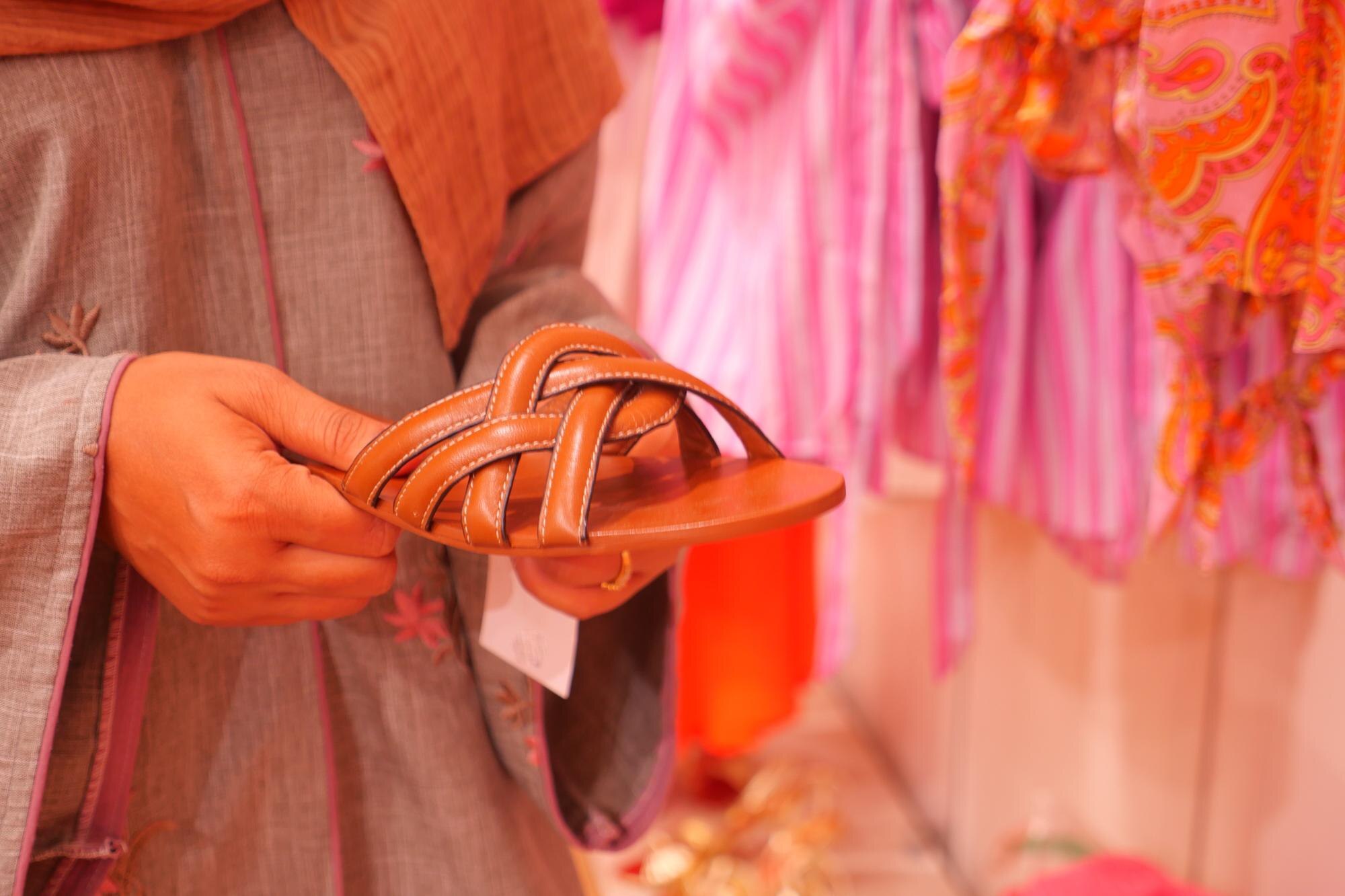
No packing decision repays thought like footwear. Pilgrims commonly walk ten to fifteen kilometres a day, and tawaf and sa’i together add roughly five more, almost all on hard marble that returns every step through your feet, knees and back. Bring one pair of broken-in, cushioned, slip-on walking shoes or supportive sandals — slip-on because shoes come off and on many times a day at mosque thresholds, cushioned because flat thin soles turn marble into punishment by day three, and broken-in because new shoes reveal their pressure points at precisely the wrong moment. Add cheap water-resistant sandals or flip-flops for wet washroom floors, and grip socks for praying inside the mosque if you prefer your feet covered on cold marble.
Two additions earn their place. Compression socks, worn on the flight and on the heaviest walking days, help with the swelling that long-haul travel and hours of standing inflict on many women’s feet and ankles — unglamorous, and worth it. And a drawstring shoe bag, one per person, solves a genuine problem: you carry your shoes with you inside the Haram rather than trusting them to the vast exterior racks, where pairs go missing daily. A fold-flat fabric bag weighs nothing and spares you the classic first-week experience of exiting a beautiful prayer into a barefoot search. Blister care, taping and recovery have their own chapter in foot care for pilgrims.
The bag you carry every day
Your day bag matters more than your suitcase. The right choice is a small crossbody bag worn at the front of the body, not at the hip or back — in dense crowds a bag behind you is effectively unattended. It should hold a phone, hotel key card, a modest amount of cash, your unscented wipes, a small supply of sanitary products and little else; a zipped main compartment is essential and an inner zip pocket better still. Keep your hands free: you will want them for drinking Zamzam, holding a du’a book, steadying yourself in the crush. Anything irreplaceable — passport, the bulk of your money — stays in the hotel safe. Moving confidently and securely through the crowds as a woman, including where the women’s sections are and how to plan quieter timings, is covered in women’s safety in Makkah and Madinah.
Small comforts that repay their weight
A few grams here and there buy disproportionate relief. A refillable water bottle refills endlessly at the Zamzam dispensers. A compact mist spray or small handheld fan takes the edge off courtyard heat while you wait for prayer. Electrolyte sachets dissolved in water replace what long hot days sweat out of you. A dozen safety pins and a few hijab magnets fix wardrobe emergencies in seconds. Ziplock bags corral wet wipes, damp underscarves and sandy sandals. Plasters and a small tube of blister gel live in the day bag, not the suitcase. And a lightweight foldable prayer mat means an overflow courtyard or a hotel corridor is always a clean place to pray. None of these is essential; together they are the difference between enduring the days and being at ease in them.
The list, kept short
Pulled together, a comfortable trip fits in one modest case and one day bag:
- Clothing: 3–4 outfits (abayas or tunic-and-trouser sets, front-opening where possible), 2–3 jersey hijabs, 2–3 underscarves, one warm shawl or cardigan, modest sleepwear, ample breathable underwear.
- Feet: broken-in cushioned slip-ons, washroom flip-flops, grip socks, compression socks, drawstring shoe bag.
- Ihram kit: unscented soap, deodorant, moisturiser, sunscreen, lip balm, shampoo and wet wipes, in their own pouch.
- Hygiene: full supply of your preferred menstrual products, plus a handbag-sized reserve.
- Day kit: crossbody bag worn at the front, refillable water bottle, foldable prayer mat, small Qur’an or app, mist spray or small fan, plasters, safety pins, electrolyte sachets.
Pack the first 48 hours into your carry-on
Finish with the discipline that rescues trips: assume your checked bag arrives two days late, and pack your carry-on so it wouldn’t matter. That means one complete outfit, your medications, documents, the ihram toiletry pouch, a hijab and underscarf, a basic supply of sanitary products, and — if there is any chance you will enter ihram on the plane as it crosses the miqat line — the clothes you intend to wear into the sacred state, since the intention won’t wait for a delayed suitcase. Details of where and how ihram begins are in the guide to the miqat. Do this, weigh your case, remove one more thing you don’t need, and zip it shut: the packing is finished, and everything you’ve chosen now works for your worship instead of against it.
Leave A Comment