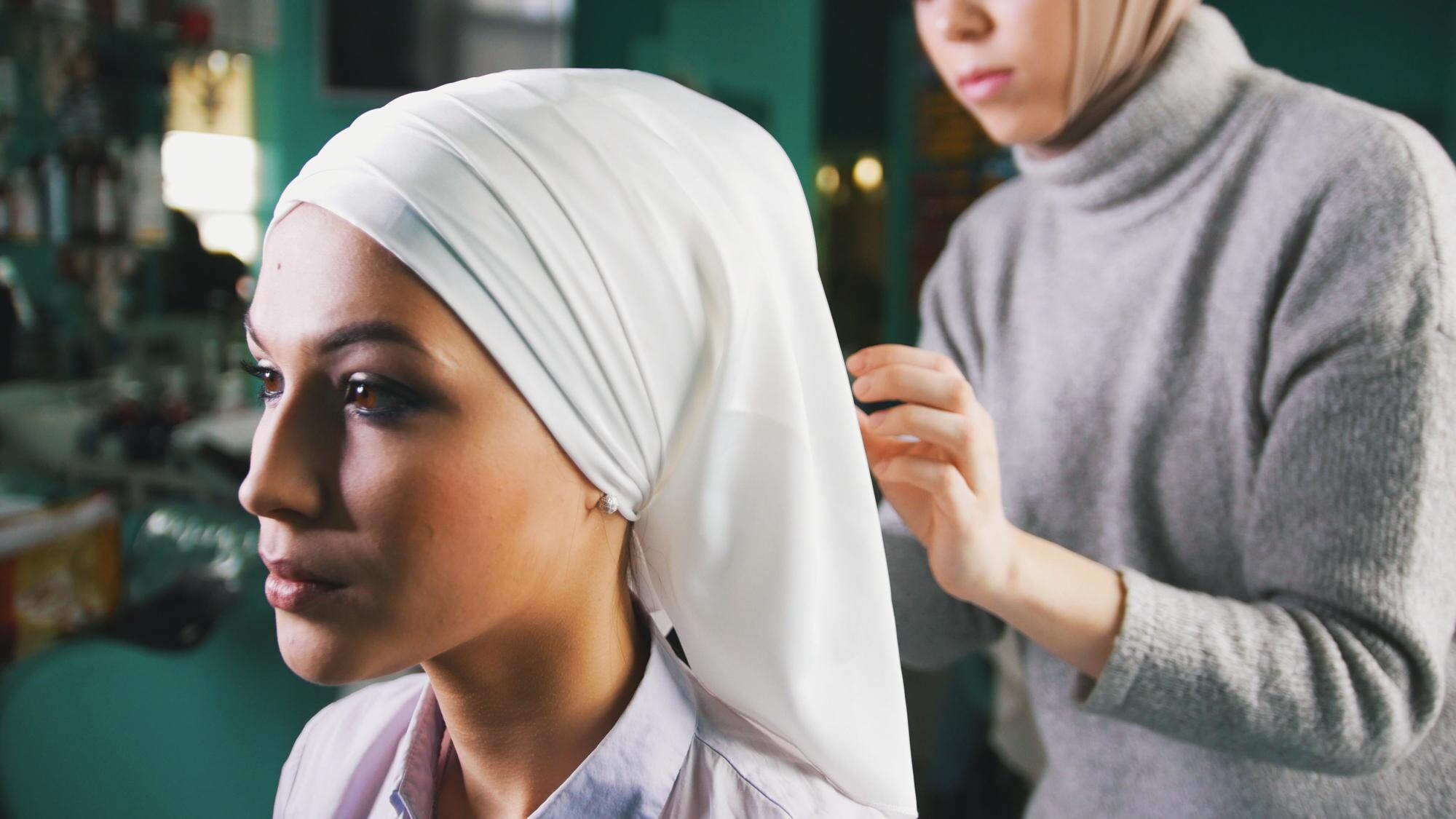
Hair looks like a small subject next to the great rites of Umrah, and in one sense it is. But it touches three things that matter enormously on this journey: your comfort through long, hot days under a hijab; your peace of mind inside the rules of Ihram; and, at the very end, the act that releases you from the sacred state altogether. A woman’s Umrah is not complete until she has trimmed her hair. That single fact promotes hair care from vanity to fiqh — and makes it worth twenty minutes of proper planning before you fly.
There is also a stubborn myth to clear away at the start, because it causes real distress: the belief that a woman in Ihram may not wash her hair at all. She may. What Ihram restricts is the deliberate removal of hair and the use of scent — not cleanliness. Once that is understood, almost everything else in this guide becomes a matter of comfort rather than anxiety, which is exactly where hair belongs.
Before Ihram: set your hair up to be ignored
The best hair care during Umrah is the kind you finish before you enter Ihram. Wash your hair thoroughly the day you travel or the day you assume the sacred state — with whatever scented products you love, since the restriction has not yet begun — and give it a proper condition, because it will be working under a scarf in heat for days. Then put it into a style built to survive: secure, low-tension, and boring.
Low tension is the operative phrase. A punishingly tight bun feels tidy on day one and becomes a headache generator by day three, and constant pulling at the hairline over a week is exactly how traction damage starts. A single loose braid, a soft low bun at the nape secured with a fabric scrunchie rather than a metal-clasped elastic, or two loose plaits for very thick hair will hold all day without strain. Women with curly or coily textures often do best with a loose protective plait or twist that can stay in for several days, needing nothing but a smoothing hand each morning. The goal is a style you can forget about from Fajr to midnight — every minute spent fixing your hair in a crowd is a minute taken from the reason you came. A few spare ties, a couple of soft clips and a wide-tooth comb, packed where you can reach them, complete the kit; our women’s packing guide covers where all this fits in your luggage.
If you were planning a haircut anyway, have it before you travel. A salon cut in the weeks before departure tidies split ends that would otherwise tangle under the hijab, and it has no bearing on the rite to come — a cut made before Umrah is simply a haircut, not taqsir, which only counts when performed after Sa’i with the intention of exiting Ihram. Freshly trimmed ends also make the eventual fingertip snip cleaner and easier to gather.
Washing your hair in Ihram: permitted, with two conditions
Let it be said plainly: a woman in Ihram may shower and wash her hair. The mainstream position across the schools is comfortable with this, and it rests on a simple distinction — Ihram prohibits the intentional removal of hair, not ordinary cleansing. The Prophet’s companions bathed in Ihram, and scholars through the centuries have permitted washing the head gently with water and unscented cleanser.
The two conditions are easy to honour. First, the product must be unscented — perfumed shampoo falls under the scent prohibition, so your usual bottle waits until the trip’s end. Second, wash gently: let water run through the hair, cleanse the scalp with soft fingertips, and skip the vigorous scrubbing and rough towel-drying you might do at home. This is not because water is dangerous but because aggressive handling pulls hair out, and deliberate roughness with predictable shedding is what the jurists caution against.
What about hair that falls out anyway?
This is the question that keeps conscientious women awake, so here is the mainstream answer. Hair sheds naturally — everyone loses a certain amount of hair a day, washed or not — and hair that falls of its own accord during Ihram carries no blame and no penalty. If strands come away as you wash, towel-dry, change your underscarf or sleep, nothing is owed. Combing is likewise permitted: the scholars allow a woman in Ihram to comb her hair, with the caution that someone who knows combing will rip out living hair should comb lightly or leave it, as a precaution rather than a prohibition. In practice: use a wide-tooth comb, work from the ends upward on damp hair, stop if you meet resistance, and give the matter no further anxiety. Dead hair that was already loose — the kind that slides out at a touch — incurs nothing according to the generality of scholars. If your own school’s position matters to you in fine detail, ask a scholar you trust; but do not let a handful of strands on a comb cast a shadow over your worship.
Living under the hijab in serious heat
Makkah’s heat changes what covered hair needs. Your scalp will sweat — steadily, all day — and damp hair pinned under fabric for sixteen hours is how you get itching, odour and a miserable scalp by the week’s end. Three habits prevent nearly all of it.
First, dry before you cover. After a wash, give your hair as much air time as your room and company allow — even fifteen minutes with it loose in the air conditioning helps — and never trap a soaking bun under a hijab for the day. If mornings are rushed, wash at night instead and sleep with hair loosely braided so it dries as you rest. Second, choose breathable layers: a light cotton or bamboo underscarf wicks sweat far better than polyester, and rotating two or three of them — a fresh one each day, yesterday’s washed in the sink and dried by morning — keeps the layer against your scalp clean even when you have no time to wash your hair itself. Third, air your scalp at day’s end. Back in your room, take everything down, let your hair breathe, and comb through gently before bed. Women prone to scalp irritation find this single evening ritual makes the difference between a comfortable trip and a week of itching — and it pairs naturally with the wind-down routine in our guide to managing fatigue and pacing your energy.
If your shedding seems heavier than usual mid-trip, take a breath before you worry. Travel compresses several known triggers into one week — heat, disrupted sleep, a changed diet, hard water and the simple fact that hair tied up all day releases its accumulated loose strands all at once when you finally take it down. What looks alarming on the comb at midnight is usually two days’ normal shedding arriving together. It carries no penalty in Ihram, and it settles when your routine does. Persistent, genuinely excessive loss after you return home is a conversation for your doctor, not a souvenir of the Haram.
The water is different, and honesty helps
Much of the tap water in Makkah and Madinah is desalinated seawater, blended with groundwater and chlorinated for safety. It is clean and perfectly fine to wash with — but it is not the soft water many visitors are used to, and over a week some women notice their hair feeling drier, duller or more tangle-prone than at home. This is a real effect, not a travel myth, though it is also a modest one: a short trip will not ruin your hair, and most women notice little at all.
If your hair is already dry, colour-treated or prone to brittleness, two cheap precautions cover it. Bring a small unscented leave-in conditioner or a light unscented oil to smooth through the ends after washing — permissible in Ihram provided it is genuinely fragrance-free — and consider a final rinse with a bottle of still water over the ends if your hair reacts badly to hard or chlorinated water. That is the whole protocol. Anything more elaborate belongs to a beach holiday, not a pilgrimage.
Finding unscented products when you land
The simplest plan is to bring travel-sized unscented shampoo and conditioner from home, decanted and labelled, so nothing depends on shopping. But if you run out or forget, you are not stranded: Saudi pharmacy chains — Nahdi and Al-Dawaa are everywhere in both cities, including within walking distance of the Haramain — stock fragrance-free baby ranges, sensitive-skin cleansers and unperfumed soaps, and pharmacists generally speak enough English to understand “no perfume, for Ihram”. It is a request they hear constantly. Check the label yourself even so; “baby” does not always mean unscented. Our guide to medication and pharmacies maps out the chains, hours and what else they carry.
Taqsir: the trim that completes your Umrah
Now the part that is worship rather than grooming. After Tawaf and Sa’i, a woman exits Ihram by cutting her hair — and for women this is always taqsir, the shortening, never the shaving that is an option for men. The Prophet, peace be upon him, exempted women from shaving; a woman’s taqsir is a trim of roughly a fingertip’s length — an inch or so — taken from the ends of her hair. That small snip is what releases her from the sacred state. It applies to every woman regardless of hair length or style: short hair is trimmed at its ends just the same.
Do it properly, and do it privately. A woman’s hair is her awrah before non-mahram men, so the cutting belongs in your hotel room, not at the barber stalls around the Haram that serve the men. The moment itself is simple and rather lovely: still in your ihram restrictions, you return to your room, gather the ends of your hair — braided hair makes this effortless, one reason the travel braid earns its keep — and you or another woman, or your husband or a mahram, snips about a fingertip’s length from the gathered ends. Many women have a roommate or daughter do it; some prefer their own hand. Both are fine. The schools discuss finer points — whether the trim should ideally take in all the ends or whether a portion of the hair suffices, and the Hanafi school’s preference for at least a quarter of the head’s ends is well known — so if precision according to your madhhab matters to you, confirm the position you follow with a scholar. The broad, widely accepted practice of trimming a fingertip’s length from the gathered ends is sound and within everyone’s reach.
One person can cut for another — with a small caution
A common hotel-room scene: several women back from Sa’i, all still in Ihram, taking turns with the scissors. This is acceptable to the generality of scholars — a person still in Ihram may cut another’s hair at the point of exiting, since this is the commanded release — though some prefer that each woman first trims her own or is trimmed by someone already out of Ihram, as the neater sequence. If your group wants the cautious order: one woman snips her own ends first, exits Ihram, then cuts for the others. Either way, keep the scissors in your washbag — small grooming scissors are permitted in checked and usually in cabin luggage, but a cheap pair bought in Makkah spares you the airport question.
What to do with the cut hair: nothing in particular
There is no ritual requirement for the trimmed hair. It does not need to be buried, kept, or disposed of in any special way — the Shariah attaches no ceremony to it, and the widespread idea that cut hair must be buried is custom, not obligation. Some scholars note burial as simply a courteous way to dispose of human traces, and if that appeals to you it is harmless; but the hotel bin is entirely acceptable, and no part of your Umrah depends on it.
If your period arrives before Tawaf
One timing note belongs here, because it affects when the scissors come out. Taqsir follows Tawaf and Sa’i — so a woman whose menstruation delays her Tawaf also delays her trim, remaining in Ihram until she can complete the rites and then cutting as normal. Nothing about the trim itself changes; only its date moves. The full rulings, options and reassurance for this situation are set out in our guide to menstruation and Umrah.
Doing more than one Umrah on the same trip
Many women perform a second or third Umrah during their stay, entering Ihram afresh from Masjid Aisha at Tanim or another point outside the Haram boundary. Each Umrah is its own complete cycle, and each one ends with its own taqsir — a fresh fingertip-length trim every time, even if the last one was yesterday. Your hair does not need to have “grown back”; there is always an end to cut from, and women doing several Umrahs simply take each small trim from the gathered ends as before, or from a different section if they prefer. It is worth knowing this in advance, because a woman planning four Umrahs in ten days may want to weigh that against how protective she feels of her length — a consideration the fiqh leaves entirely to her.
Afterwards: the scented celebration
The moment the trim is done, Ihram’s restrictions fall away — and this is where hair care becomes pure pleasure. Shower with your favourite scented shampoo, work in the perfumed conditioner that has been waiting in your bag all week, oil your hair, wear your perfume. Many women describe that first scented wash after taqsir as one of the sweetest small joys of the whole journey, a physical marker that the sacred state has closed and the Umrah is complete. It is also the moment to repair the week: a deep-conditioning mask, a patient detangle, and — once home — a trim at the salon if the heat and water have left your ends thirsty. Henna, by the way, is not merely permitted outside Ihram but beloved in the Sunnah as a dye; if you coloured your hair before travel, it affected nothing.
The hair kit, in one paragraph
Everything above compresses into a washbag corner: travel-sized unscented shampoo and conditioner for the Ihram days, your normal scented set for after, a small unscented leave-in or oil, a wide-tooth comb, fabric scrunchies and soft clips, two or three cotton underscarves, and small scissors for taqsir. Braid your hair before you enter Ihram, wash gently and without fear, dry before you cover, air your scalp at night, and keep the trim for the privacy of your room — a fingertip from the gathered ends, cut by any woman or mahram you trust. That is the entire discipline. Pack it once, and your hair will not ask for your attention again until the moment it completes your Umrah. For the wider routine your body will thank you for, read our companion guide to women’s health, hygiene and managing fatigue.




Leave A Comment