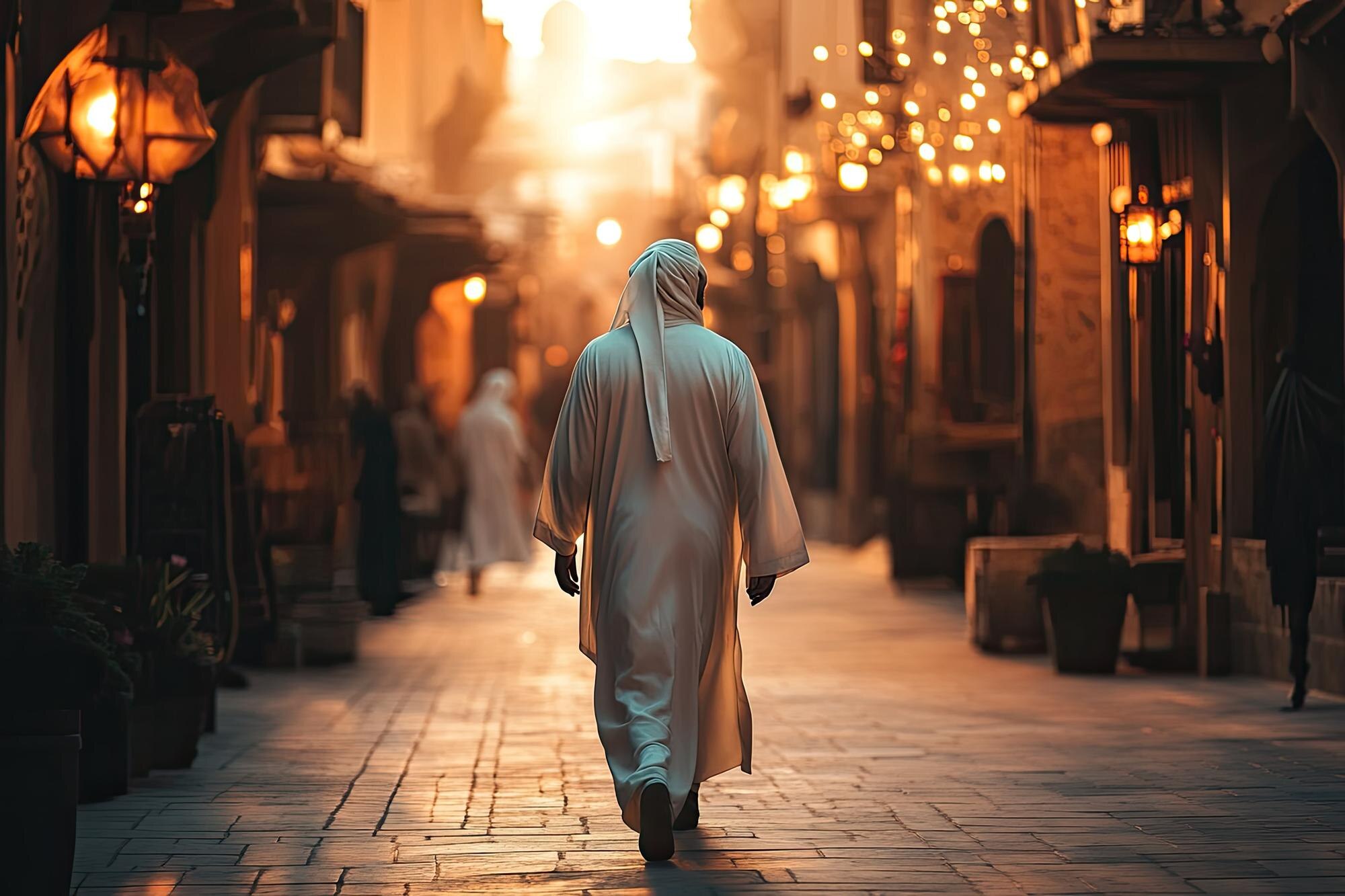
Somewhere over the Red Sea, it dawns on most parents that they’re not travelling with a child any more. The fourteen-year-old in the next seat has opinions about the airline, a group chat that hasn’t stopped buzzing since check-in, and — this is the part that changes everything — a pilgrimage of their own to perform. Umrah with teenagers is a different undertaking from Umrah with children, and the families who thrive at it are the ones who notice the difference early and plan for it deliberately.
This guide covers the ground that matters at this age: why puberty changes the fiqh, how to hand over real ownership before you fly, what to actually do about phones, the conversations that land and the lectures that don’t, and how to use the one asset teenagers have in absurd surplus — energy — instead of fighting it. If you’re also travelling with younger ones, our guide to bringing children to Umrah covers the family-wide picture.
A Pilgrim, Not Luggage
Start with the fiqh, because it reframes everything. Once a young person reaches puberty, they are fully accountable in the Shariah: their prayers are their own, their ihram binds them exactly as yours binds you, and the Umrah they perform is the real thing — valid, weighed, and capable of discharging the Umrah of Islam. This is not a child being towed around a parent’s worship. This is a pilgrim standing before the Ka’bah on their own account, quite possibly for the worship that will be remembered on their scale of deeds for the rest of their life.
Say this to them, plainly, before the trip: your Umrah counts — not through us, not attached to ours, yours. Teenagers have exquisite radar for being managed, and equally sharp radar for being taken seriously. The practical consequences follow naturally: they should learn the rites properly rather than absorb them second-hand mid-tawaf, understand the ihram prohibitions because the responsibility is now theirs, and make their own intention in their own words. A sixteen-year-old who knows why the talbiyah says what it says walks through the Haram gates differently from one who was handed a laminated card in the taxi.
Two age-specific matters deserve a quiet word each. For boys, the first ihram is a rite of passage in itself — two unstitched cloths, no pockets, a knot he’ll worry about for the first hour — and it goes far better with a practice run at home than with a first attempt in an airport toilet. Show him how to secure the izar properly and he gains a small, real competence on day one. For girls, one conversation spares enormous private anxiety: if her period arrives during the trip, nothing is ruined. She still enters ihram, still makes the talbiyah, still does everything except tawaf, which simply waits until she is able — established fiqh from the Prophet’s ﷺ own instruction to A’ishah during her pilgrimage. A teenage girl who knows this in advance, from a calm conversation at home, is spared the fear of somehow spoiling the family’s Umrah; itineraries with a spare day or two build in exactly this flexibility.
Ownership Starts Before Booking
Engagement on the ground is mostly decided months earlier, at the kitchen table. The single most effective move is to hand your teenager a genuine piece of the trip to own. Let them plan one full day — not a token hour, an actual day: which ziyarah sites, where the family eats, what time everyone leaves and how you get there. They’ll research harder for their own itinerary than for any worksheet, and on the day itself you’ll watch a teenager herd their own parents with unmistakable satisfaction.
Bring them inside the logistics too. Teenagers need their own visa like every pilgrim, and as of mid-2026 the Nusuk app is where permits such as the Rawdah visit are booked — so rather than quietly adding them as a companion on your account, sit down together and let them handle their own slot, check the family’s permit times, and get familiar with the app they’ll be using on the ground. Give one teen the job of prayer-time keeper for the trip, another a slice of the meals budget to manage — our budgeting guide makes a surprisingly good homework assignment. None of this is busywork. It’s the difference between a passenger and a participant, announced before the plane ever boards.
Phones, Honestly
Let’s skip the fantasy where the phone stays in the hotel safe for ten days. The device is their camera, their Qur’an app, their map, their prayer times and their lifeline to you in a crowd of a hundred thousand people — confiscating it is neither realistic nor wise. It is also, unmanaged, a portal that can keep them emotionally in their bedroom at home while their body does tawaf. Both things are true, and pretending otherwise in either direction is how families end up fighting about screens at the gates of the Haram.
The approach that works is negotiated norms, agreed before travel, binding on everyone — parents emphatically included. A workable family code looks something like this: phones away completely during tawaf, sa’i and the obligatory prayers; filming allowed at agreed moments rather than continuously, because an Umrah experienced through a viewfinder is barely experienced at all; meals screen-free; and a daily window that is genuinely theirs to message friends without commentary or sighing from the front seat. Write it down if your family is that kind of family; shake hands on it if it isn’t. The parent scrolling through a feed while telling a fifteen-year-old to be present is teaching exactly one lesson, and it isn’t the intended one. For what’s appropriate to film and post inside the mosques — and the etiquette the authorities and scholars actually ask for — hand them our guide to phones and social media in the Haramain and let them read it themselves; it carries more weight arriving from a website than from a parent.
Meaning That Lands at Fifteen
Adolescence runs on two questions — who am I? and where do I belong? — and Makkah answers both in ways no Sunday school ever managed. Don’t oversell the mysticism; point at what’s literally in front of them. The crowd around the Ka’bah contains Nigerians, Indonesians, Bosnians, Canadians and Uzbeks, dressed identically, doing the same thing, distinguishable by nothing that matters — the global ummah stops being an abstraction from a khutbah and becomes something a teenager can stand inside. For a young Muslim who has spent years being the only one fasting at school, the experience of being unremarkable — of belonging by default — can be quietly seismic.
The stories help most when tied to their world. Sa’i lands differently when they realise Hajar was a mother alone in a desert running between two hills for her child — and that Allah enshrined a woman’s desperate effort as a rite for all humanity until the end of time. The Prophet ﷺ began receiving revelation in a cave they can see from the streets; the first Muslims their own age — Ali was a boy, many companions were teenagers — carried the religion when it was dangerous to. Offer these as observations, not sermons, and then do the hardest thing: stop talking and let the place work.
The Energy Asymmetry — Use It
Here is the open secret of travelling with teenagers: by day four, they have more left in the tank than you do. The same creature who cannot be extracted from bed for school at seven will be entirely awake at midnight in Makkah, and fighting this is a waste of a superpower. Channel it instead. The night tawaf — ideally after midnight, when the mataf breathes again — is the single best parent-and-teenager activity this journey offers: cooler air, thinner crowds, and the strange, easy intimacy of walking side by side with nothing to do but talk and circle the House of Allah. Some of the best conversations a parent will ever have with their adolescent happen at 1 a.m. between Safa and Marwah. Let them stay up for it; let them set the pace for once; buy the karak tea on the way back and don’t rush the walk. Meanwhile, surrender the mornings — a teenager allowed to sleep after Fajr is a far better companion at Isha.
Modesty Without Drama
The dress conversation goes wrong in one predictable way: it happens too late, at too high a temperature, usually in an airport. Have it weeks early, and frame it as what it actually is — the dress code of a place, not a referendum on your child’s character. Every venue they respect has one; this one belongs to the holiest site on earth. For girls, go shopping together and let her choose abayas and scarves she actually likes — ownership over the garments defuses most of the resistance, and comfort in 35-degree heat is a legitimate selection criterion, not a vanity. For boys, the conversation is shorter but real: shorts above the knee, football-shirt culture and the ihram cloths all deserve five minutes each. Then — and this is the discipline for parents — stop. A teenager policed daily about their scarf or their sagging izar learns to associate the Haram with surveillance. State the standard once, model it yourself, correct quietly and privately if you must, and trust the environment: nothing recalibrates a young person’s sense of dress like being surrounded by two million people in white.
Friends Back Home, Watching
Your teenager is not only on Umrah; they’re on Umrah in front of an audience, because their friends know where they are and their feeds are waiting. Handle this with realism rather than alarm. For some teens the trip is social capital — the Ka’bah photo does numbers, and there’s no shame in a young person being proud of where they are. For others, especially those in schools with few Muslims, there’s quiet anxiety about seeming too religious, and they may post nothing at all. Both are fine. Let them control their own narrative; nothing curdles a teenager’s experience faster than a parent directing their Instagram (“post the du’a one, tag the family”). What deserves an actual conversation is the pull homeward: the group chat carries on without them, and a fear of missing out can leach the trip of presence. Name it gently, once — and then trust the agreed phone windows to hold the line you negotiated together.
The Boredom Pockets
Be honest with yourself about the shape of an Umrah day: intense worship at the prayer times, and long, flat stretches between them in which an under-occupied teenager will melt into a hotel bed with a phone. Plan the pockets. Makkah and Madinah between prayers offer more than parents remember to look for — the museums and exhibitions around the two mosques, the markets, the walk to significant sites, the unhurried exploration of streets that have hosted pilgrims for fourteen centuries. Our guide to making the journey educational is written with exactly these hours in mind, and much of it works better for a sixteen-year-old than for a six-year-old. Assign the teenager to find and lead one between-prayers outing themselves — ownership again — and grant real downtime too, without guilt: an hour of genuine rest is not a spiritual failure, it’s what makes the night tawaf possible. Families who worship together at set anchors and roam loosely in between — a rhythm our family worship guide maps out — get the best of both.
Conversations That Land, Lectures That Don’t
Every parent on this trip is tempted by the Captive Audience Fallacy: they’re here, the setting is sacred, surely now is the moment for the Big Talk about prayer habits. Resist it. Teenagers detect an incoming lecture from remarkable range, and the Haram will not save a monologue that would have died at home. What works instead is side-by-side rather than face-to-face: the best exchanges happen walking to the mosque, waiting for food, leaning on the sa’i railing — moments with shared focus and no eye contact, where a question can be light. Ask theirs before offering yours: what surprised you today? beats do you understand how blessed you are? every single time. And when a doubt surfaces — about the crowds, the rituals, why everyone seems moved when they feel nothing — treat it as the door it is. A teenager who admits they didn’t feel anything at the Ka’bah has just trusted you with something real; the answer that keeps the door open is honesty about your own uneven heart, not alarm. Some of what this journey plants doesn’t flower for years, and it grows better unexamined.
Let Them Struggle a Little
A quiet word against over-smoothing. The instinct to shield your child from every discomfort — carry their bag, shorten their walk, apologise for the heat — robs the journey of half its formative power. Umrah is supposed to cost something: the early start, the thirst before you reach the water, the ihram that itches, the ache in the legs at the fifth circuit. Teenagers are built for exactly this kind of measured hardship, and they come away from it with something modern adolescence rarely offers — evidence of their own capability in service of something that matters. Keep them safe and hydrated, obviously; the sensible precautions in our safety guide and a season chosen with our best time for Umrah guide take care of genuine risk. But within those limits, let the trip be a little hard, and let them hear you struggling alongside them rather than curating their comfort. That was a tough walk — you did it well is worth fifty motivational speeches.
The Long Arc
Talk to adults who went to Umrah as teenagers and a pattern emerges: many drifted through parts of the trip, some sulked through whole days of it, and nearly all of them, decades later, name it among the hinges of their lives. The teenager who seemed to feel nothing at the Ka’bah returns at twenty-six with their own savings and their own longing; the girl who argued about the abaya keeps it folded in a drawer through university and knows exactly where it is. You are not planting a tree you’ll watch flower this fortnight. So play the long game, and set it up practically: agree the phone code and the modesty standard weeks before you fly, hand over one full day and one Nusuk booking to each teen, protect one night tawaf together as non-negotiable, ask your questions side by side, and when you get home, say yes immediately the first time they mention going back. That last one matters most — because for a teenager who owned even a piece of this journey, the question is rarely whether they’ll return, only when.
Leave A Comment