The Rawdah and the Sacred Chamber: The Complete History, Story and Ziyarah Guide to the Prophet’s Grave in Madinah
In the south-eastern corner of Masjid an-Nabawi, behind a screen of gold mesh and green curtains, lies a room no living person has entered in over five hundred years. It has no door that opens and no window that admits light. Its walls have been rebuilt, reinforced, and encased inside at least three further walls since the first one was raised from sun-dried mud brick in the earliest year of the Hijrah. Pilgrims who stand before it today see none of this directly. They see a wall of dark stone, a line of gold lattice, three small apertures cut for greeting, and the great Green Dome rising above it all, visible from almost every point in the mosque and from much of the city beyond. What lies behind that screen is the single most consequential room in Islamic history: the house of Aisha bint Abi Bakr, where the Prophet Muhammad ﷺ lived out much of his life in Madinah, where he died, and where he was buried beneath the very bed on which his soul departed — joined later by his two closest companions and successors, Abu Bakr al-Siddiq and Umar ibn al-Khattab.
This guide tells the full story of that room and the ground around it: the humble houses of the Prophet’s ﷺ wives that once stood where the mosque’s carpeted floor now runs; the sacred stretch nearby that the Prophet ﷺ himself called “a garden from the gardens of Paradise”; the moment the Companions argued over where to bury him and Abu Bakr settled it with a hadith no one else had remembered; the Umayyad decision, a lifetime later, to wall the chamber into the body of the mosque forever; the pentagon-shaped wall built so that no worshipper could ever pray facing a grave; the domes that rose, burned, and rose again across seven centuries; the last scholar recorded to have entered the chamber and what he said he saw; the story, still told today but never fully traced to a classical chronicle, of a plot to steal the Prophet’s body and the ruler who is said to have stopped it; and the centuries-old, still-live dispute among the greatest scholars of Islam over how — and whether — a Muslim should travel to visit this grave at all. Where sources disagree, this guide presents both positions and names who holds them. Where a story is beloved but weak, it is told, and then the weakness is stated plainly. Nothing here is invented. This is one of the most sacred and most legally sensitive locations in the Islamic world, and it deserves to be handled with precision as much as with love.
A note on scope before beginning: this article is about the Sacred Chamber itself — the house, the burial, the walls, and the fiqh of visiting the grave. Companion articles in this series cover the broader building history of Masjid an-Nabawi across the caliphates, and the visiting experience of the Rawdah proper as a place of prayer. Where those subjects touch this one, this guide cross-references rather than repeats them in full.
Historical Background
Where the Chamber Sits Today
The Sacred Chamber — al-Hujrah al-Sharifah, also called al-Hujrah al-Nabawiyyah, and sometimes simply al-Qabr al-Sharif, “the Noble Grave” — sits in the south-eastern quadrant of Masjid an-Nabawi in Madinah. It occupies what was originally the private house (hujrah) of Aisha bint Abi Bakr, one of the Prophet’s ﷺ wives, built directly against the eastern wall of the first mosque so that a door opened straight from her room into the place of prayer. It did not become part of the mosque’s interior by original design. For roughly ninety years after the Hijrah it stood as a separate, small residential structure immediately outside the mosque’s eastern wall, and only entered the mosque’s interior footprint during the great Umayyad expansion of the early second century AH, a transformation this guide examines in detail below (see Historical Development).
The chamber today is a small, irregular, five-sided (pentagonal) enclosure, itself nested inside at least two further protective walls, screened from the mosque floor by a tall barrier of gold-coloured mesh grille interwoven with dark green curtains. Nothing of the interior is visible to the eye. The Madain Project, a reference project cataloguing Islamic historical sites, states this plainly: the burial chamber itself is not accessible, and any photograph online claiming to show the actual graves inside is not genuine — the chamber has been completely sealed from view for over five centuries (Madain Project, “Tomb of Prophet Muhammad”). What the visitor actually sees is the outer face of this nested enclosure and, cut into its eastern wall, a viewing screen called the Mawajaha al-Sharifah, through which pilgrims direct their greeting.
Classical and modern sources give slightly different figures for the chamber’s dimensions, and all of them should be read as approximate, since the structure has been rebuilt and reinforced repeatedly across fourteen centuries. Al-Samhudi, the fifteenth-century historian of Madinah whose work remains the standard classical reference for the site, measured the inner original chamber at roughly 10⅔ dhira’ (about 4.8 metres) east to west along the qiblah side, about 10⅓ dhira’ (about 4.69 metres) on the northern side, and about 7⅝ dhira’ (about 3.43 metres) north to south, with inner walls roughly 0.68 metres thick, thinner (about 0.62 metres) on the rebuilt eastern side (Guide to Medina, citing al-Samhudi). The outer copper and brass railing visible to pilgrims today — the enclosure most people mean when they say “the tomb” — measures roughly 16 metres on its northern and southern sides and about 15 metres on its eastern and western sides, with the Green Dome above it rising to approximately 8.88 metres (Arabic Wikipedia, Masjid an-Nabawi). A French-language reference gives the covered chamber itself as roughly 17.75 square metres with walls about two metres thick, plus an uncovered forecourt bounded by thinner, 1.6-metre walls (Saudipedia, “Le tombeau du Prophète Mohammed”). WikiShia separately records the two original wives’ chambers nearest the mosque as roughly 4.5 by 3.5 metres each (WikiShia, “Prophetic Chamber”). These figures do not perfectly agree with one another, and that disagreement is itself instructive: this was never a monumental structure built to fixed royal specifications. It began as a modest mud-brick home, and its measurements have always been reported with the imprecision that follows from that humble origin.
The chamber has four historic doors, though only one now functions. Bab al-Tahajjud lies on the north, Bab al-Tawbah on the south, and Bab Aisha — also called Bab al-Wufud, “the Gate of Delegations,” near the column marking where tribal delegations were received — on the west. The fourth, Bab Fatimah on the east, is the only one still used for authorised entry into the enclosure by mosque staff (TakeMeToUmrah.com, “Grave and Tomb of the Prophet Muhammad”; Madain Project). The Mawajaha, the viewing wall on the chamber’s eastern side that pilgrims actually stand before, has three small apertures cut through it, positioned precisely to align with the three graves inside: the leftmost and largest aligns with the grave of the Prophet ﷺ, the second with Abu Bakr, and the third with Umar (TakeMeToUmrah.com; Madain Project).
Immediately west of the chamber lies the Rawdah, the area the Prophet ﷺ himself described as a garden of Paradise, discussed fully in its own section below. The Rawdah today is marked out as a roughly rectangular space, its accessible portion around 22 metres long by 15 metres wide, though the full length from the minbar to the chamber’s inaccessible western wall runs to roughly 26.5 metres (Saudipedia, “The Prophet’s Mosque”; Al Madinah official tourism site, “The Blessed Rawdah”; Hajj and Umrah Planner). The full geography, layout and visiting protocol of that space belong to this series’ companion article on the Riyad ul Jannah; this guide touches it only where the Rawdah’s boundary meets the chamber wall itself.
Geography and Setting Before the Mosque Existed
Before it was a mosque or a mausoleum, this ground was simply a plot within the settled part of Yathrib, the oasis town that would become Madinah. When the Prophet ﷺ arrived after the Hijrah in 622 CE, he did not build his mosque and his own house on land that had stood empty and unclaimed. The plot belonged, according to the seerah accounts, to two orphan boys of the Banu al-Najjar, and the Prophet ﷺ insisted on paying for it rather than accepting it as an outright gift, a detail the companion article on the mosque’s founding treats in full. What matters for this article is narrower: once the mosque’s outer wall was raised, small private rooms — hujurat, the plural from which “hujrah” derives — were built directly against its eastern side for the Prophet’s ﷺ wives, opening onto the mosque courtyard through low doors. Aisha’s room was one of these, built close by the mosque’s southeastern corner. It was in this room, among these modest walls, that history’s most significant single burial would eventually take place.
No Confirmed Pre-Islamic Use of This Exact Plot
It is worth being exact about what is, and is not, known of this specific patch of ground before Islam. No source consulted for this guide provides direct archaeological or textual evidence describing what stood on this precise plot before the Hijrah, beyond its being part of the land purchased and built upon for the mosque and its adjoining houses. The standard modern academic study of pre-Islamic Madinah’s sacred topography is Harry Munt’s The Holy City of Medina (Cambridge University Press, 2014), but no specific citation from that work addressing this exact plot could be located in preparing this guide. This should be stated plainly rather than papered over with speculation: there is no reliable record of any shrine, grave, or ritual significance attached to this ground before the Prophet ﷻ arrived in Yathrib. Its sanctity, like that of so many sites in this series, is entirely a matter of what happened here after Islam — not an inheritance from what came before it.
Importance Before and After Islam
Before Islam, then, this plot carried no distinct religious meaning that any source can confirm. It was ordinary residential ground in an oasis town of fortified clan compounds and palm groves. After the Hijrah, it became, in swift succession, the private home of one of the Prophet’s ﷺ wives; the room in which the Prophet ﷺ received revelation on many occasions; the room in which he fell fatally ill; the room in which he died; and the room in which he was buried. Within a century it had been absorbed into the walls of the mosque itself, and within two centuries it had become, alongside the Ka’bah in Makkah and the Dome of the Rock in Jerusalem, one of the most visited and most argued-over sacred sites in the Islamic world. Few plots of ground anywhere on earth have travelled so far, in spiritual weight, from such humble physical beginnings.
Changes Through History — A First Overview
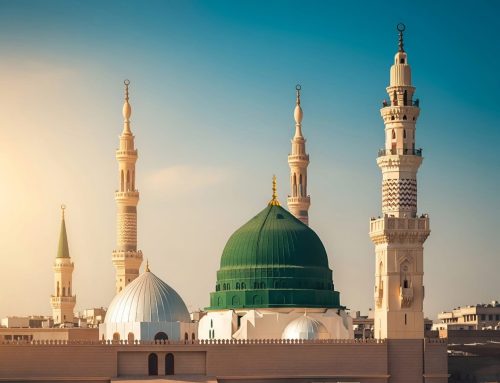
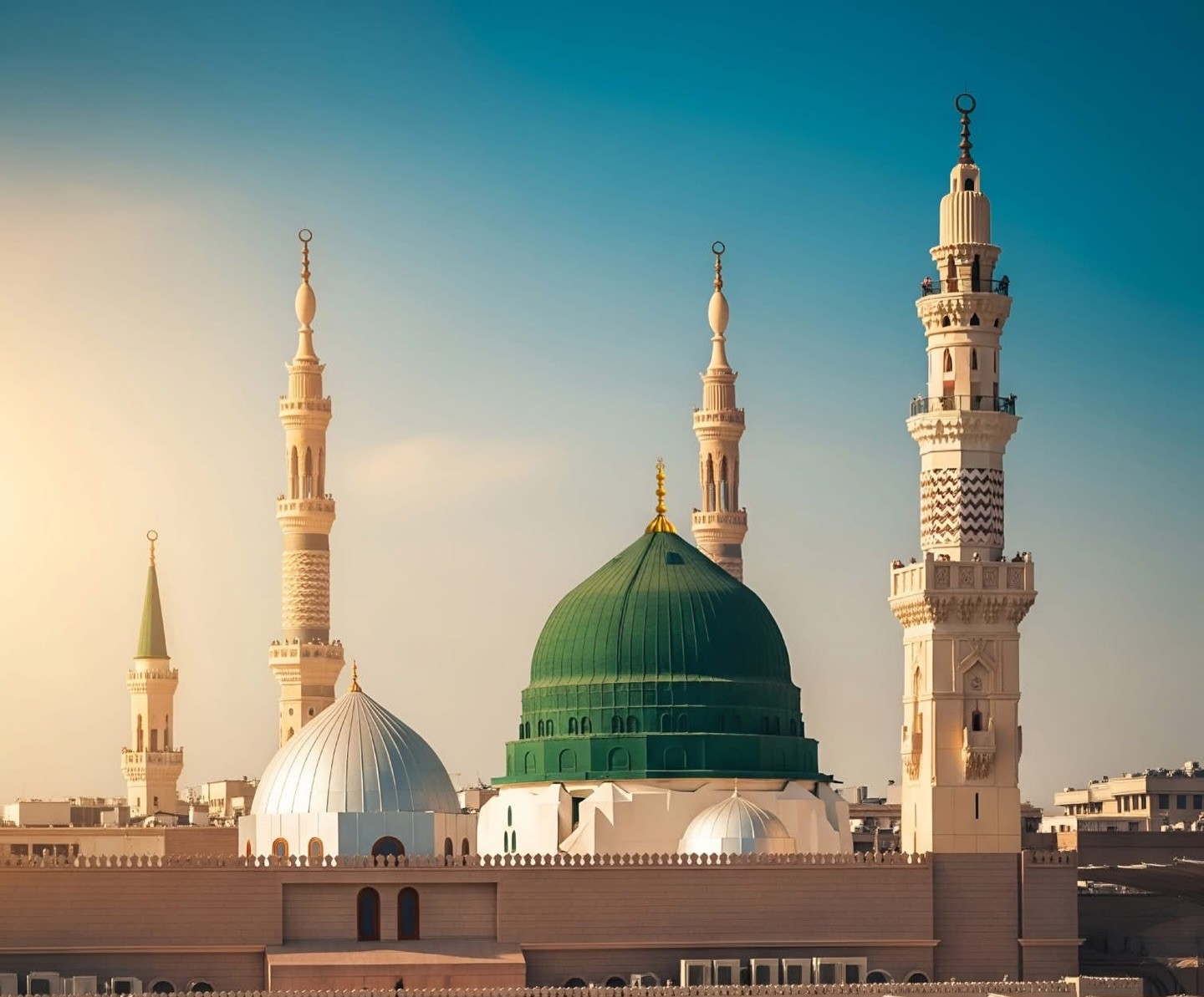
The chamber’s physical history can be summarised here in outline; each stage receives full treatment later in this guide (Historical Development and Architecture). The original mud-brick house of Aisha, with its low palm-branch roof and hair-cloth door curtain, stood as an ordinary dwelling for roughly eleven years before the Prophet’s ﷺ death and burial transformed it. It continued as an unremarkable house — visited, but not monumentalised — for about eighty more years, until the Umayyad governor (and future caliph) Umar ibn Abd al-Aziz demolished the surrounding wives’ houses during the great mosque expansion of the early second century AH and built a pentagonal wall around the three graves, absorbing the chamber into the mosque’s interior for the first time. Centuries later, a wooden lattice enclosure was added under the Mamluk sultan Baybars; then a dome; then, after a catastrophic fire in 886 AH, a new metal grille and a rebuilt dome, eventually painted green under the Ottomans in the nineteenth century — the origin of the name by which thirteen centuries of visitors have never actually called it until fairly recently: the Green Dome.
The Story Behind the Place
A House Built for a Bride
To understand the Sacred Chamber, it helps to first strip away everything it later became and see it as what it was: one room among nine or so, built quickly and cheaply, for a household that had almost nothing. Ibn Sa’d, the great early biographer, preserves a description — transmitted through Abd Allah ibn Yazid, who reportedly saw the houses shortly before their demolition — of what these rooms actually looked like:
“There were four houses of mud-bricks, with apartments partitioned off by palm branches, and five houses made of palm branches plastered with mud and not divided into rooms. Over the doors were curtains of black hair-cloth. Each curtain measured three by three cubits. One could reach the roof with the hand.”
— cited in a modern secondary compilation of early Islamic architectural history that attributes the description to Ibn Sa’d via Abd Allah ibn Yazid (Al-Islam.org, “Chapter 55: Architecture”). This report should be understood as a historical description rather than a graded hadith; the strength of Abd Allah ibn Yazid’s transmission as an eyewitness has not been independently assessed in the sources consulted for this guide, and it is presented here as an early historical account, not as prophetic tradition. The same source describes the Prophet’s ﷺ own mosque enclosure as roughly a hundred cubits square of mud brick, with a portico of palm-trunk columns on its southern side, roofed with palm leaves and mud — and the wives’ small huts built against its outer eastern wall, each with a door opening directly into the courtyard.
Other secondary sources converge on similarly humble figures for the individual hujrah: some put a typical room at roughly five metres by five metres, others at about 4.5 by 3.5 metres, and a Russian-language pilgrim-guide summary gives “approximately 5 by 4 metres and a small backyard” (“History of the Sacred Chamber”; WikiShia, “Prophetic Chamber”; Hajj and Umrah Planner, Russian edition). These popular figures should be treated as approximate rather than as primary-source measurements; the Ibn Sa’d description above is the more directly attributable classical report, even allowing for its undetermined isnad strength.
What all these figures agree on, regardless of the exact number of metres, is the essential fact: this was not a palace. A grown man could reach the roof of Aisha’s house by standing and stretching his hand upward. The door was not wood but a curtain of coarse black hair-cloth, three cubits by three. The walls were sun-dried mud brick or, in some of the nine houses, simply plastered palm branches. This was the home of the household in which the final revelation to humanity, according to Islamic belief, continued to be received for a decade, and in which the man receiving it chose to live in exactly this way even as his community’s fortunes rose around him. The deliberate simplicity of the Prophet’s ﷺ own dwelling is a detail that later generations of Muslims would return to again and again as a lesson in zuhd, worldly detachment, even though no single hadith in the sources consulted for this guide draws that moral explicitly from the architecture itself — it is a conclusion drawn naturally from the plain historical description, not a stated prophetic teaching.
Aisha’s Room and a Marriage of Books and Questions
Aisha bint Abi Bakr رضي الله عنها was among the youngest of the Prophet’s ﷺ wives and became, across the decades after his death, one of the most important single sources of hadith in Islamic history — the companion most frequently asked about the Prophet’s ﷺ private life, his prayer, his character, and the ordinary texture of his days, precisely because so much of that life had unfolded within the walls of her small room. It was in this room that he prayed voluntary prayers at night while she lay near him; it was here he received guests and delegations who sat just outside; and it was from the doorway of this house, according to the sources examined in the section on his final illness below, that his condition was watched with mounting anxiety by his household and his companions alike as Ramadan gave way to the tenth year and then the eleventh year after the Hijrah.
The Illness That Would Not Lift
The Prophet’s ﷺ final illness developed after his return from the Farewell Pilgrimage, and its course is described across many hadith narrations concentrated in Aisha’s own reports, since she was his primary companion and nurse throughout it. He suffered fever and severe headache; he asked, with a kind of restless repetition that Aisha herself later recalled with evident tenderness, which of his wives’ turns it would be on any given day, until his other wives gave their permission for him to remain in Aisha’s room for the duration of his illness. This detail — the wives collectively agreeing that he should stay in Aisha’s house — is itself part of why the Rawdah hadith’s “my house” language and the burial location converge specifically on her room and not on the houses of the other wives, a point the Qur’anic and hadith sections below examine closely.
“Where Am I Today? Where Will I Be Tomorrow?”
Aisha’s own testimony about these final days is preserved directly in the hadith literature, and it is worth presenting in her words before anything else is said about it, because nothing written since captures the moment as she did:
“During his sickness, Allah’s Messenger ﷺ was asking repeatedly, ‘Where am I today? Where will I be tomorrow?’ And I was waiting for the day of my turn. Then, when my turn came, Allah took his soul away between my chest and arms, and he was buried in my house.”
This is recorded in Sahih al-Bukhari 1389, in the chapter on the graves of the Prophet ﷺ, Abu Bakr, and Umar (Sunnah.com/Sounah.com, Bab 872). Grade: Authentic (sahih). The question — “where am I today, where will I be tomorrow” — is usually understood by commentators as the Prophet ﷺ, aware his time was ending, asking which of his wives’ turns fell next, so that he might be nursed in the house where he would rather spend his final hours: Aisha’s. Whatever the precise reasoning behind the question, its answer determined the geography of Islamic history. Had the rotation fallen differently, this entire guide would be describing a different room.
A Fear That Shaped Everything After
Aisha also preserved a second statement from this period, one that would govern how every later generation of Muslims approached this very room:
“Allah’s Messenger ﷺ in his fatal illness said: ‘Allah cursed the Jews and the Christians, for they built places of worship at the graves of their prophets.’ And if that had not been the case, then the Prophet’s grave would have been made prominent before the people. So he was afraid, or the people were afraid, that his grave might be taken as a place of worship.”
This is Sahih al-Bukhari 1390 (Sunnah.com, Bukhari 1390). Grade: Authentic (sahih). This single hadith, spoken in the last days of the Prophet’s ﷺ life, is the reason the chamber has never been given a shrine’s monumental prominence within the mosque’s design, and it is the anchor text for the entire body of fiqh on grave visitation examined later in this guide. The most important room in Islamic sacred geography was, by design, kept deliberately obscure — walled in rather than raised up, screened rather than displayed.
The Dispute Over Where to Bury Him
When the Prophet ﷺ died, on the day usually dated to the twelfth of Rabi’ al-Awwal, 11 AH (632 CE), the community he left behind was not united on where his body should rest. Different Companions proposed different sites: his mosque, considered by some the most fitting; Makkah, his birthplace; Jerusalem, where earlier prophets were believed to be buried; and al-Baqi’, Madinah’s own cemetery, where so many of his followers already lay. Grief and uncertainty pulled in several directions at once, until Abu Bakr al-Siddiq — recently confirmed as the community’s leader — recalled a hadith that, by his own account, no one else present had remembered:
“When the Messenger of Allah ﷺ died, they disagreed over where to bury him. Abu Bakr said: ‘I heard the Messenger of Allah ﷺ say something I never forgot: “Allah does not take the soul of a Prophet except in the place where He wants him to be buried.” Bury him in the place of his bed.'”
This account is preserved across several collections: Jami’ al-Tirmidhi, Book of Funerals (Sunnah.com, Tirmidhi Book 10), and Sunan Ibn Majah 1628, which supplies the fuller narrative — that some had proposed the mosque, others proposed burial among the Companions, before Abu Bakr’s recollection settled the matter — and adds that the Prophet ﷺ was buried in the middle of Tuesday night, with Ali ibn Abi Talib, al-Fadl ibn al-Abbas, his brother Qutham, and Shuqran, the Prophet’s freed servant, descending into the grave to lower him (Hamariweb.com, Ibn Majah 1628). On grading: the specific chain through Abd al-Rahman ibn Abi Bakr al-Mulayki is criticised by al-Tirmidhi himself as weak in memory — his own note appended to the hadith calls it “gharib… da’if min qibali hifzihi” — but the core meaning is corroborated through other chains. A parallel version in Musnad Ahmad (no. 27), transmitted via Ibn Jurayj, is described by its modern editors as sound in substance because of supporting chains, even though this particular isnad is broken (munqati’) (Sunnah.com, Musnad Ahmad 27); a related wording in Mukhtasar al-Shama’il is graded Authentic (sahih) by the hadith scholar Muhammad Nasir al-Din al-Albani (surahquran.com, citing al-Albani’s grading). Grade for this report overall: Hasan (sound in meaning through corroborating chains, though the specific isnad quoted above is criticised).
The grave was accordingly dug beneath the very bed on which the Prophet ﷺ had died, inside Aisha’s own hujrah — a decision that would later matter enormously to the scholars debating the exact wording of a separate, and far more famous, hadith about this same location (see Qur’anic Connections and Hadith References below).
Two Companions Join Him
The chamber did not remain a single grave for long. Abu Bakr al-Siddiq died two years later, in 13 AH (634 CE), and was buried in the same room, beside the Prophet ﷺ. Nine years after that, in 23 AH (644 CE), Umar ibn al-Khattab — mortally wounded by an assassin’s blade while leading the dawn prayer — sent his son Abdullah ibn Umar to ask Aisha’s permission to be buried there as well, “with my companions.” Her reply, preserved in the hadith literature, carries a quiet and moving generosity:
“I had the idea of having this place for myself, but today I prefer him to myself.”
When Umar heard her answer, he said: “Nothing was more important to me than to be buried in that place.” This exchange is recorded in Sahih al-Bukhari 1392 (Sunnah.com/Sounah.com, Bab 872). Grade: Authentic (sahih). Aisha’s own words reveal that the fourth space in the room — the space that had been, in effect, reserved for her own eventual burial as the house’s owner — was the very space she gave up for Umar. Years later, at the end of her own life, she confirmed this choice permanently. In her will to Abdullah ibn al-Zubayr, she instructed:
“Do not bury me with them, but bury me with my companions in al-Baqi, as I would not like to be looked upon as better than I really am.”
This is recorded in Sahih al-Bukhari 1391 (Sunnah.com/Sounah.com, Bab 872). Grade: Authentic (sahih). A caution for readers cross-checking references: this Bukhari 1391 is a different hadith from the Sahih Muslim narration also commonly cited as “1391” in connection with the Rawdah hadith discussed in the next section — the two collections’ numbering happens to overlap on this figure, and they should not be confused with one another.
The layout inside the chamber, as preserved in multiple classical descriptions, places the Prophet’s ﷺ grave nearest the qiblah wall, Abu Bakr’s grave behind him with his head aligned to the Prophet’s ﷺ shoulders, and Umar’s grave behind Abu Bakr’s with his head aligned to Abu Bakr’s shoulders — described in one classical wording as: “The Messenger of Allah is forward, Abu Bakr is near his head, and Umar is near his feet. His head is at the feet of the Messenger of Allah” (TakeMeToUmrah.com, citing classical descriptions). This is the arrangement pilgrims follow today when they step to the right after greeting the Prophet ﷺ at the first aperture of the Mawajaha, to greet Abu Bakr, then step right again to greet Umar.
A separate, academically documented account preserves an alternate description of the layout, transmitted through Urwa ibn al-Zubayr, Aisha’s own nephew and one of the most careful early transmitters of Madinan history: “The Messenger of God was buried in the alcove. Abu Bakr was buried behind the Messenger of God, and Umar ibn al-Khattab was buried near the feet of Abu Bakr. The eastern alcove has remained empty, and in it, it is said — but God knows best — that Isa ibn Maryam is buried there” (quoted and translated in Brill, Journal of Material Cultures in the Muslim World, “Material Images and Mental Ziyāra: Depicting the Prophet’s Rawḍa,” 2020). This report, and the empty fourth space it describes, is treated in full — with the caution it requires — later in this guide (see The Empty Fourth Grave and the Tradition of Isa ibn Maryam).
The graves themselves, according to the hadith literature, were not built flat but left humped and convex — musannam. Sufyan al-Tammar, reported through Abu Bakr ibn Ayyash, said he had seen the grave of the Prophet ﷺ “elevated and convex.” This is recorded as Sahih al-Bukhari 1390b (Sunnah.com, Bukhari 1390b). Grade: Authentic (sahih). This detail matters to the fiqh of grave construction discussed later: the Sunnah-sanctioned shape for an ordinary Muslim grave is a modest, raised hump, not a flat slab and certainly not a monument — and the graves of the three men buried in the holiest room in Madinah were, by explicit report, built no differently.
The Prophet ﷺ and This Place
A Home, Not a Monument, During His Lifetime
It is essential to state plainly what the chamber was during the Prophet’s ﷺ own lifetime: an ordinary, lived-in home. This was not a shrine-in-waiting. It was the room where he ate simple meals, where his wife ground grain, where he mended his own sandals and patched his own clothes according to reports preserved across the hadith literature describing his general habits, where he prayed the greater part of his voluntary night prayers, and where, according to Aisha’s own testimony, he would sometimes lie with his head in her lap while she was menstruating and recite Qur’an. None of these details are exclusive to this article — they belong to the wider seerah literature on the Prophet’s ﷺ domestic life — but they matter here because they establish the character of the room before its transformation. Whatever reverence later generations attached to this space, it began as the plainest possible setting for the plainest possible acts of a shared life.
Revelation Received in This Room
Because Aisha’s hujrah adjoined the mosque directly, and because the Prophet ﷺ spent so much of his private time there during the Madinan period, a substantial portion of the Qur’an’s Madinan revelation is traditionally associated with having come to him while he was in or near this house. The seerah and tafsir literature record particular verses — including, notably, verses connected to the incident of “the slander” (hadith al-ifk) involving Aisha herself — as having been revealed while he sat in this room, at a moment of visible physical strain that Aisha described as resembling the onset of severe cold, with sweat forming on his brow even in a Madinan winter, followed by the recitation of the verses that cleared her name. That specific episode belongs properly to Aisha’s own biography rather than to this article’s scope, but it stands as one of the clearest examples of revelation arriving to the Prophet ﷺ within the physical space this guide is describing.
The Final Sermon From Within These Walls
In his last days, too weak to lead the congregation standing, the Prophet ﷺ asked to be helped to the mosque to pray behind Abu Bakr, who had been leading in his place. Aisha describes supporting him, with another companion, as his feet dragged along the ground between her house and the prayer row. This is one of the last recorded times the Prophet ﷺ crossed the short distance between the room in which he would die and the mosque in which he had led the community in prayer for a decade — a journey of perhaps a dozen steps that the hadith literature preserves with striking physical detail: a man so weak that two people had to bear his weight, insisting nonetheless on reaching the row of worshippers one final time.
The Death of the Prophet ﷺ
The Prophet ﷺ died in this room on a Monday, in the last third of the morning, in the year 11 AH (632 CE), his head resting, in Aisha’s words, “between my chest and arms” (Sahih al-Bukhari 1389, discussed in full above). The household around him in these final hours included Aisha herself, and — in the wider seerah record beyond this article’s narrower hadith-focused scope — members of his family and closest companions moving in and out of the small space. Umar ibn al-Khattab, upon hearing the news, is reported in multiple early accounts to have refused to believe it and to have stood in the mosque threatening anyone who said the Prophet ﷺ had died, until Abu Bakr entered the very room this article describes, uncovered the Prophet’s ﷺ face, kissed his forehead, and said: “Sweet were you in life, and sweet you are in death.” He then went out and addressed the community, reciting the Qur’anic verse that had, years earlier, addressed the false rumour of the Prophet’s ﷺ death at the Battle of Uhud: “Muhammad is not but a messenger. Other messengers have passed on before him…” (Surah Aal Imran 3:144). Umar himself later said of hearing this verse recited that day: “By Allah, it was as if I had never read it before. My legs would not carry me and I fell to the ground” (Sahih al-Bukhari 1241, 3667). This episode belongs more fully to the companion articles on the mosque’s history and on the Companions’ lives, but its geography is this room and the mosque immediately outside it, and it is impossible to tell the story of the chamber without this moment standing at its centre.
The Burial, and the Room’s Transformation
The community’s grief, the dispute over burial location, Abu Bakr’s recollection of the hadith that settled it, and the digging of the grave beneath the Prophet’s ﷺ own bed have already been narrated in full above, in The Story Behind the Place section. What matters to state here, in the section devoted specifically to the Prophet’s ﷺ own relationship to this site, is the completeness of the transformation: a room in which he had lived an ordinary domestic life for roughly a decade became, within a single day, the room in which the most significant burial in Islamic history took place. Nothing about the physical structure changed that day — the same mud-brick walls, the same low roof, the same hair-cloth curtain across the door. What changed entirely was what the room now contained, and what every subsequent generation of Muslims would understand it to mean.
Qur’anic Connections
“A Garden From the Gardens of Paradise”
The single most important textual connection between the Qur’an-adjacent hadith corpus and this specific site is not, in fact, a Qur’anic verse but a hadith so widely transmitted that scholars have long classified it as mutawatir — narrated through so many independent chains that fabrication or error across all of them is considered practically impossible. Because of its centrality to this entire guide, it is presented here in full, with the same rigour the Qur’anic sections of this series apply to ayat.
“Between my house and my pulpit there is a garden of the gardens of Paradise, and my pulpit is on my fountain tank.”
Arabic: مَا بَيْنَ بَيْتِي وَمِنْبَرِي رَوْضَةٌ مِنْ رِيَاضِ الْجَنَّةِ، وَمِنْبَرِي عَلَى حَوْضِي. This is recorded as Sahih al-Bukhari 1196, in the Book of the Virtue of Prayer in Masjid Makkah and Madinah, narrated by Abu Hurairah, with a chain running from Musaddad through Yahya, Ubaydullah, Khubayb ibn Abd al-Rahman, and Hafs ibn Asim (Sunnah.com, Bukhari 1196). A parallel narration appears as Sahih Muslim 1391, cited universally alongside Bukhari 1196 as the twin primary reference for this hadith (IslamQA #115693). Grade: Authentic (sahih), and — per the scholarly assessment cited by IslamQA, drawing on a version preserved in al-Tabarani’s al-Mu’jam al-Awsat — mutawatir. Note again the caution already flagged in the previous section: this Sahih Muslim reference number should not be confused with the unrelated Sahih al-Bukhari 1391 concerning Aisha’s burial will, discussed above; the two collections’ numbering happens to coincide on this figure by pure chance.
Why “My House,” Not “My Grave”
This hadith circulates today, especially in popular devotional retellings, with a variant wording: “between my grave and my minbar” rather than “between my house and my minbar.” This variant is widespread enough that it deserves direct and careful treatment, because getting it right matters both historically and legally.
The table below, compiled from the scholarly survey given by IslamQA, sets out the main wordings and how they have been graded:
- “Between my house and my minbar” — the wording of the majority of reports, including Bukhari 1196 and Muslim 1391, both narrated by Abu Hurairah. Authentic (sahih) — judged the correct and preserved wording by Ibn Taymiyyah, al-Qurtubi, and Ibn Hajar al-Asqalani.
- “Between my grave and my minbar” — a report attributed to Ibn ‘Asakir’s transmission of Sahih al-Bukhari, also used in places by al-Nawawi. Weak (da’if) according to the scholarly majority, judged an error or a loose paraphrase rather than the Prophet’s ﷺ exact words.
- “Between my chamber (hujrah) and my minbar” — another version cited by al-Nawawi, generally treated as an equivalent paraphrase of “house,” not a separate authentic wording in its own right.
- “Between the minbar and the house of Aisha” — narrated by al-Tabarani in al-Awsat, cited by Ibn Hajar as clarifying precisely which house is meant.
Source for this comparative table: IslamQA #115693.
Two converging arguments explain why “my grave” is judged the weaker wording. First, it simply contradicts the wording transmitted by the majority of narrators, and is therefore treated as a later paraphrase of the meaning rather than the Prophet’s ﷺ verbatim utterance. Second — and this argument carries real historical weight — when the Prophet ﷺ spoke these words during his lifetime, he had not yet died, and certainly had not yet been buried. Ibn Taymiyyah makes this point directly: “When the Prophet ﷺ said these words, he had not yet been buried. Therefore none of the Sahabah quoted this as evidence when they disputed as to where he should be buried” (IslamQA #115693, citing Ibn Taymiyyah). If the Prophet ﷺ had literally said “my grave,” the Companions would already have known exactly where to bury him, and the dispute recorded in the hadith literature — settled only by Abu Bakr’s separate recollection — would never have occurred. The very existence of that dispute, discussed above, is itself indirect evidence for the “house” wording being the authentic one.
Al-Qurtubi and Ibn Hajar both reconcile the two wordings by observing that, since the grave was ultimately dug inside the house, “my house” and “my grave” converge on the very same physical spot without any real contradiction — what is specifically meant by “my house” is Aisha’s house alone, not the collective houses of all the Prophet’s ﷺ wives (IslamQA #115693, citing al-Qurtubi and Ibn Hajar, Fath al-Bari). Al-Tabari expresses the same reconciliation succinctly: “The two views are close in meaning, because his grave is in his apartment, which is his house” (IslamQA #115693). For the purposes of this guide, the primary quoted wording throughout is “house,” as the sahih and majority-transmitted text, with the “grave” variant noted here as a widely circulated but weaker paraphrase — precisely the approach this guide’s companion misconceptions section returns to.
What Kind of “Garden of Paradise”
A separate and long-running scholarly conversation concerns not the wording of the hadith but the meaning of its central image: in what sense is this specific stretch of ground “a garden from the gardens of Paradise”? This is a dispute over interpretation (tafsir and sharh al-hadith), not over the hadith’s authenticity — the “house” wording is agreed sahih by all sides of this conversation. IslamQA, drawing on classical commentators, presents three broad positions, given in the order the commentators themselves tend to present them:
- Literal/eschatological reading: the physical spot itself will, at the Resurrection, be transported to or become part of Paradise. This is reported as held by al-Qadi Iyad, and recorded as one live option within the commentary of al-Nawawi and Ibn Hajar.
- Metaphorical, reward-based reading: worship performed at this spot is rewarded with entry into Paradise — the “garden” language describes the reward attached to the place, not a claim about the physical substance of the ground itself. This reading is recorded from al-Qadi Iyad, Ibn Abd al-Barr, al-Nawawi, and Ibn Hajar, each of whom records it as one of several live possibilities within his own commentary.
- Metaphorical, spiritual-atmosphere reading: the spot is “like” a garden of Paradise because of the mercy, tranquility, and sustained remembrance of Allah — dhikr, and the study of the Qur’an — that historically filled this exact space during the Prophet’s ﷺ lifetime. This is Ibn Hajar’s third suggested meaning, and is also attributed in part to Ibn Abd al-Barr.
Source for this full breakdown: IslamQA #115693. IslamQA’s own summary conclusion, offered as a scholarly opinion rather than a settled ruling, is that the site carries “an evident virtue” that should draw Muslims to pray there eagerly, but that ultimately taqwa — consciousness and fear of Allah — rather than mere physical presence in the Rawdah is what secures a person’s entry to Paradise; why this particular place was singled out for such language is, in this view, a matter Allah alone fully knows, in the same way certain times, places, and people are singled out elsewhere in Islamic teaching for particular virtues (IslamQA #115693). This is a matter of scholarly opinion and interpretation, not a sahih/da’if dispute — every position summarised above is held by scholars operating from within the same accepted, authentic hadith text.
The Verse of the Believers Who Do Not Raise Their Voices
﴿يَا أَيُّهَا الَّذِينَ آمَنُوا لَا تَرْفَعُوا أَصْوَاتَكُمْ فَوْقَ صَوْتِ النَّبِيِّ وَلَا تَجْهَرُوا لَهُ بِالْقَوْلِ كَجَهْرِ بَعْضِكُمْ لِبَعْضٍ أَن تَحْبَطَ أَعْمَالُكُمْ وَأَنتُمْ لَا تَشْعُرُونَ﴾
“O you who have believed, do not raise your voices above the voice of the Prophet or be loud to him in speech like the loudness of some of you to others, lest your deeds become worthless while you do not perceive.” — Surah al-Hujurat 49:2
This verse, and the one following it (49:3), were revealed concerning the general etiquette of speech in the Prophet’s ﷺ presence during his life, addressing an incident in which visiting delegates called to him loudly from outside his private apartments rather than waiting for him to come out — an episode connected to the wives’ hujurat that give this entire complex, and this article’s subject, its name. Classical tafsir treats this as establishing a permanent principle of reverence toward the Prophet ﷺ, one that later scholars — across both sides of the grave-visitation dispute examined later in this guide — extend by analogy to how a visitor should conduct himself at the Prophet’s ﷺ grave after his death: quietly, without raised voices, without the casual loudness one might use address a companion of no particular standing. This application by analogy, not the verse’s original asbab al-nuzul, is what most directly connects Surah al-Hujurat 49:2 to the etiquette of the Sacred Chamber, and it is treated fully in the fiqh and etiquette section below.
The Verse Warning Against Making Graves Places of Worship
No single Qur’anic ayah addresses grave-worship as explicitly and by name as the hadith material already quoted above (Sahih al-Bukhari 1390, the Prophet’s ﷺ warning about the Jews and Christians building places of worship at their prophets’ graves). This is a point worth stating honestly rather than searching for a Qur’anic verse that does not exist in this precise form: the foundational textual warning against turning this specific grave into an object of worship comes from the hadith corpus, not from a directly on-point Qur’anic ayah. The Qur’an does address, in general terms, the danger of associating anything or anyone with Allah in worship — the broader doctrine of tawhid running throughout the text — and it is this general doctrine, applied through the specific hadith warning, that together form the basis for the restrictions on grave-veneration discussed at length in the fiqh section of this guide.
Hadith References
What follows consolidates, in one place, the hadith already introduced above and additional narrations connected specifically to the chamber, the burial, and its later history, with grading given for each. Where a well-known account rests on a weak or unclear chain, this guide says so plainly.
The Core “Garden of Paradise” Hadith
- “Between my house and my pulpit there is a garden of the gardens of Paradise.” — Sahih al-Bukhari 1196; Sahih Muslim 1391. Authentic (sahih), mutawatir. Narrated by Abu Hurairah (Sunnah.com, Bukhari 1196; IslamQA #115693).
- Variant “between my grave and my minbar.” Weak (da’if) — judged an erroneous paraphrase by the scholarly majority, including Ibn Taymiyyah, al-Qurtubi and Ibn Hajar (IslamQA #115693).
The Death and Burial
- “Where am I today? Where will I be tomorrow?” — and burial in Aisha’s house. — Sahih al-Bukhari 1389. Authentic (sahih). Narrated by Aisha (Sounah.com, Bab 872).
- The warning against taking graves as places of worship. — Sahih al-Bukhari 1390. Authentic (sahih). Narrated by Aisha (Sunnah.com, Bukhari 1390).
- Abu Bakr’s recollection settling the burial-place dispute — “Allah does not take the soul of a Prophet except in the place where He wants him to be buried.” — Jami’ al-Tirmidhi, Book of Funerals; Sunan Ibn Majah 1628; Musnad Ahmad 27. Hasan (sound through corroborating chains; the specific isnad through Abd al-Rahman ibn Abi Bakr al-Mulayki is criticised by al-Tirmidhi himself for weak memory, and the Ahmad version is munqati’/broken in this particular chain, but the meaning is corroborated elsewhere) (Sunnah.com, Tirmidhi Book 10; Hamariweb.com, Ibn Majah 1628; Sunnah.com, Musnad Ahmad 27).
- Umar’s burial beside the Prophet ﷺ, granted by Aisha. — Sahih al-Bukhari 1392. Authentic (sahih). Narrated by Amr ibn Maymun al-Awdi (Sounah.com, Bab 872).
- Aisha’s will not to be buried in the chamber but in al-Baqi. — Sahih al-Bukhari 1391. Authentic (sahih). (Note: distinct from the Sahih Muslim 1391 wording of the Rawdah hadith above — the collections’ numbering coincides by chance.)
- The graves described as raised and convex (musannam), not flat. — Sahih al-Bukhari 1390b. Authentic (sahih). Narrated via Sufyan al-Tammar, reported by Abu Bakr ibn Ayyash (Sunnah.com, Bukhari 1390b).
The Wall, the Foot, and Umar ibn Abd al-Aziz’s Building Works
- The wall’s collapse during al-Walid ibn Abd al-Malik’s caliphate and the exposed foot identified by Urwa ibn al-Zubayr as Umar’s, not the Prophet’s ﷺ. — Sahih al-Bukhari 1390c. Authentic (sahih). This is treated fully in the Historical Development section below (Sunnah.com, Bukhari 1390c).
Etiquette of Speech and Presence
- The prohibition on raising one’s voice above the Prophet’s ﷺ. — Surah al-Hujurat 49:2–3, with supporting hadith material on the etiquette of delegations calling from outside the hujurat. Abu Bakr’s own later application of this principle — “It is not right to raise one’s voice over the Prophet’s, whether he is dead or alive” — is widely cited in the etiquette literature discussed below (Dar al-Ifta al-Misriyyah). Scholarly application by analogy, not a hadith about the grave specifically.
- “Do not pray facing a grave and do not sit on one.” — narrated by Abu Marthad al-Ghanawi, related by Ahmad and Muslim (Fiqh-us-Sunnah 2.74). Authentic.
- “The people before you took graves as mosques; I prohibit this to you,” said five days before the Prophet’s ﷺ death — narrated by Jundub ibn Abdullah al-Bajali (Fiqh-us-Sunnah 2.74). Authentic (recorded in Sahih Muslim).
Narrations Commonly Repeated That Are Weak, Disputed, or Require Caution
- “Whoever visits my grave, my intercession becomes obligatory for him” and closely related wordings — reported by al-Daraqutni from Hatib, with an isnad containing an unnamed (majhul) narrator and the weak narrator Harun Abu Qaz’ah. Ibn Taymiyyah calls one such wording “obviously a lie that goes against Islam.” Al-Dhahabi records al-Bukhari’s verdict on the narrator as “not to be accepted or followed”; Ibn Hajar concurs it is weak; al-Albani, in al-Silsilah al-Da’ifah (no. 1021), grades it Fabricated (batil/mawdu’). This is treated fully in the fiqh section below (IslamQA #2534).
- The report of Isa ibn Maryam being buried in the empty fourth space of the chamber. — Transmitted through Urwa ibn al-Zubayr, with the transmitter’s own explicit hedge, “but God knows best.” Historical report with undetermined/weak chain — not an authenticated hadith. No sahih hadith locating Isa ibn Maryam’s future grave specifically in this chamber was found in the research behind this guide. Treated fully below (see The Empty Fourth Grave).
- The Nur al-Din Zangi grave-robbery narrative. — Not a hadith at all but a historical report, popular in devotional literature, that this guide’s research could not trace to a named citation in a classical chronicle. Treated fully below with its own dedicated caution (see The Nur al-Din Zangi Episode).
A note on authenticity: three separate items above — the “my grave” wording, the “obligatory intercession” wording, and the Isa ibn Maryam tradition — are all widely repeated in popular devotional literature about this site, and all three are graded weak, fabricated, or unverifiable by the classical and modern scholars cited. This guide tells all three stories, because they are part of the living tradition and memory surrounding this place, but it does not present any of them as established fact, and neither should the reader repeat them as such.
Historical Development
The Rashidun Period (11–40 AH / 632–661 CE): A Room Left Alone
For the entire span of the Rashidun caliphate, the chamber remained essentially as it had been at the moment of the Prophet’s ﷺ burial: a private house, still standing among the other wives’ hujurat, with its mud-brick walls and hair-cloth curtain, now containing a grave rather than a bed. Abu Bakr was buried there in 13 AH (634 CE); Umar in 23 AH (644 CE), as described above. During this entire period the room was not enclosed within the mosque, was not domed, and carried no monumental markers beyond what a modest family home would naturally have. Aisha continued to live in the house — now sharing it, in effect, with the graves of her husband and father — until her own death in 58 AH (678 CE), by which time the political centre of the Muslim world had already shifted decisively toward Damascus under the Umayyads.
The Umayyad Period (41–132 AH / 661–750 CE): The Chamber Enters the Mosque
The single most significant transformation in the entire physical history of the burial site took place under the Umayyads, during the reign of Caliph al-Walid I (r. 86–96 AH / 705–715 CE). The work was carried out by his governor of Madinah — and future caliph in his own right — Umar ibn Abd al-Aziz (d. 101 AH / 720 CE), as part of a wholesale expansion and rebuilding of Masjid an-Nabawi. The Madain Project dates this expansion to roughly 706–709 CE (Madain Project, “Tomb of Prophet Muhammad”). A peer-reviewed academic study gives a more specific year for the wall around the graves themselves: the pentagonal enclosure of the Rawdah’s three tombs was added by Umar ibn Abd al-Aziz in 88 AH / 707 CE, during al-Walid I’s reign (Brill, Journal of Material Cultures in the Muslim World, 2020, pp. 331–354). A number of popular and tour-guide sources instead round this date to 91 AH / 711 CE, describing Umar ibn Abd al-Aziz as replacing the original mud-brick walls “with stones similar to the black stones of the Ka’bah” (TakeMeToUmrah.com). Both datings circulate; this guide follows the peer-reviewed figure of 88 AH as the more citable source for a precise year, while flagging rather than silently erasing the discrepancy with the more commonly repeated 91 AH figure — a case, like several others in this guide, where two respectable strands of sourcing simply do not agree, and honesty requires saying so.
It was at this point — nearly ninety years after the Prophet’s ﷺ death — that Aisha’s house, and immediately to its north the house of Fatimah, were demolished along with the other wives’ hujurat described earlier in this guide, and the ground they had occupied was absorbed permanently into the enlarged mosque (Madain Project; Al-Islam.org, Chapter 55). Before this expansion, a visitor to Madinah walked into the mosque to pray and then, separately, walked outside its wall to the small house where the Prophet ﷺ was buried. After this expansion, both experiences happened under a single roof, within a single set of exterior walls, for the first time and permanently.
Why a Pentagon
The wall Umar ibn Abd al-Aziz built around the three graves was not a square or a rectangle. It was built as an irregular five-sided shape — a pentagon — and this choice was almost certainly deliberate. A regular rectangular enclosure aligned with the mosque’s own qiblah-facing rows would create the risk that a worshipper standing in prayer, facing the qiblah, might find himself also facing directly toward the grave — an alignment the hadith material already discussed above (Bukhari 1390, the warning against taking graves as places of worship) made every builder anxious to avoid. The five-sided, irregular geometry breaks any possibility of that unintentional alignment. This rationale is widely repeated in tour-guide and Islamic-heritage sources describing “the five-sided wall” built so that no one could ever pray “facing” the grave (YouTube, “Grave and Tomb of the Prophet Muhammad ﷺ inside Masjid Nabawi in Madinah”), and it is corroborated structurally by the Brill academic article’s own description of “the pentagonal wall of the Rawḍa” enclosing the three tombs (Brill, 2020). It should be stated honestly, however, that no primary classical text — al-Samhudi’s own writing, for instance — has been located in the research behind this guide that explicitly states the reason for the pentagon was to prevent qiblah-alignment, as opposed to this being a later architectural-historical inference drawn by modern writers looking back at the structure. The fact of the pentagonal shape itself is well attested; the precise, stated original intention behind it is not confirmed in a primary source, and this guide flags that distinction rather than asserting the popular explanation as settled classical doctrine. Scholarly/historical inference, not a confirmed primary-source statement of intent.
The Wall That Fell and the Foot That Frightened Everyone
During this same Umayyad building campaign, an accident occurred that is preserved directly in the hadith literature and offers one of the only authentically documented glimpses of what lay immediately behind the chamber’s walls during construction work. Urwa ibn al-Zubayr reports:
“When the wall fell on them during the caliphate of al-Walid ibn Abd al-Malik, the people started repairing it, and a foot appeared to them. The people got scared and thought that it was the foot of the Prophet ﷺ. No one could be found who could tell them about it till I said to them: ‘By Allah, this is not the foot of the Prophet ﷺ, but it is the foot of Umar.'”
This is recorded as Sahih al-Bukhari 1390c (Sunnah.com, Bukhari 1390c). Grade: Authentic (sahih). This account, dated to the same building campaign discussed above, is a rare and authentically documented instance of an accidental, partial exposure of the graves during construction — an episode settled calmly by Urwa’s own careful identification, rather than escalating into panic or superstition. It is worth pausing on the character of this account: even in a moment when a physical trace of the graves was suddenly, unexpectedly visible, the response recorded in the most rigorously authenticated hadith collection in Islam is not awe or veneration of the exposed limb, but a sober, factual clarification of whose foot it actually was, followed immediately by the wall’s repair. That restraint is itself instructive for everything that follows in this guide’s treatment of grave etiquette.
The Abbasid Period (132–656 AH / 750–1258 CE): Enrichment and the First Domes Elsewhere
Through the Abbasid centuries, Masjid an-Nabawi as a whole underwent further expansions and embellishments — treated fully in this series’ companion article on the mosque’s building history — but the chamber itself, protected within Umar ibn Abd al-Aziz’s pentagonal wall, appears to have remained architecturally stable relative to the wider mosque around it. It was during the later Abbasid period, in 579 AH (1184 CE), that the Andalusian traveller Ibn Jubayr visited Madinah and left one of the most detailed eyewitness descriptions of the pilgrimage ritual at the grave to survive from the medieval period, including his description of a silver marker on the qiblah-facing wall indicating the location of the Prophet’s ﷺ grave, and of the sequence pilgrims followed in greeting Abu Bakr and then Umar after greeting the Prophet ﷺ himself (Georgetown repository, Ibn Jubayr’s Rihla; Brill 2020, quoting Ibn Jubayr). Ibn Jubayr’s account, written centuries before any of the domes discussed below existed, is a valuable independent confirmation that the essential visiting ritual practiced today — greeting the Prophet ﷺ, then Abu Bakr, then Umar, in sequence — has a documented pedigree stretching back at least to the twelfth century CE, and very likely further still.
The Mamluk Period (656–923 AH / 1258–1517 CE): The First Domes and the Great Fire
It was under the Mamluks that the chamber first acquired a dome, and it was also under the Mamluks that the chamber came closest to total destruction. Before this period, only a waist-high brick enclosure marked the chamber’s location on the mosque’s roof; no dome of any kind had yet been built (SunnahWeb, “History of Green Dome”). In 678 AH, Sultan Qalawun al-Salihi built the first dome: a wooden structure with a square base and an octagonal upper section, raised on pillars around the chamber, with wood planking and lead plates layered over it, replacing the older brick enclosure (SunnahWeb). It was refurbished under al-Nasir Hasan ibn Muhammad Qalawun, and its lead plates were repaired in 765 AH under al-Ashraf Sha’ban ibn Husayn ibn Muhammad. It was renovated once more in 881 AH under Sultan Qaytbay.
Then, in Ramadan of 886 AH (1481 CE), catastrophe struck. Lightning hit one of the mosque’s minarets, causing it to collapse onto the roof and kill the mu’adhdhin on duty. The fire that followed spread rapidly across the wooden roof structures and into neighbouring houses, claiming several more lives and burning the chamber’s dome to the ground (TakeMeToUmrah.com; corroborated by SunnahWeb and a German-language heritage source, Nurtur.de). This fire, and its aftermath, receives its own full treatment below, because it produced both the last confirmed human entry into the chamber and one of the most important classical historical works on Madinah ever written.
Al-Samhudi and the Restoration After the Fire
Sultan Qaytbay ordered a complete restoration of the burned chamber and tasked the historian-jurist Ali ibn Ahmad al-Samhudi (also transliterated Nur al-Din al-Samhudi, 844–911 AH / 1440–1505 CE), a Shafi’i scholar and author of Wafa’ al-Wafa bi Akhbar Dar al-Mustafa — still the definitive classical history of Madinah — with cleaning and repairing the inner Sacred Chamber itself (TakeMeToUmrah.com; Wikipedia, “Nur al-Din al-Samhudi”). In a striking twist of fate, most of al-Samhudi’s other written works were themselves lost in this same fire (Wikipedia, Nur al-Din al-Samhudi) — meaning the man given unique access to record the chamber’s interior lost most of the rest of his life’s writing to the very disaster that gave him that access.
Because the chamber has no doors or windows in its innermost walls, al-Samhudi is reported to have entered through a structural gap opened during the repair works — described in one account as “a gap between the wall and the ground” — which makes him, by every source consulted for this guide, the last person recorded to have physically entered the inner chamber and seen the graves, now well over five hundred years ago (TakeMeToUmrah.com; corroborated by Nurtur.de and a heritage summary citing the same tradition on social media).
A more detailed account, drawn from a summary of what appears to be al-Samhudi’s own report in Wafa’ al-Wafa, describes what seems to be a distinct, slightly earlier entry episode:
- In 881 AH — before the 886 AH fire — worshippers felt a crash in the eastern outer wall around the chamber. A crack and partial collapse appeared, caused by the inner wall leaning against the outer one.
- The governor, scholars, and concerned officials convened, and ultimately decided to demolish and rebuild the cracked walls — described in this account as “the first entry into the Prophet’s chamber in more than 790 years.”
- Al-Samhudi was among the committee that entered.
- He reported that the chamber has no door and no trace of ever having had one. He described the soil inside as “moist, red, claylike earth that has no dust,” and said the graves themselves showed no visible trace, owing to the great span of time since their construction. He noted that the chamber’s floor sits about a cubit and a half below the level of the surrounding mosque floor.
- The committee rebuilt the walls solidly, without doors, and placed a dome of black stones and wood over the room. The work began on 27 Sha’ban 881 AH and finished on 7 Shawwal 881 AH.
- “From this date to the present, no one has entered the Prophet’s chamber,” with a buffer zone of roughly seven metres maintained between the well-known outer viewing window and the chamber itself.
Source: a summary, circulated on professional networking media, of a translated Arabic account presumed to derive from al-Samhudi’s own Wafa’ al-Wafa (LinkedIn/Uzma Bhatti). A note on authenticity: this is a secondary source paraphrasing what is presumably al-Samhudi’s primary text; the underlying original should ideally be checked directly against a print or digitised edition of Wafa’ al-Wafa before being treated as a verbatim quotation. Digitised copies exist through NYU’s digital library (NYU Digital Library, Wafa’ al-Wafa, vol. 4) and the Internet Archive (Internet Archive, Wafa’ al-Wafa) for anyone wishing to verify the primary Arabic text directly.
There is also a genuine discrepancy worth stating plainly rather than smoothing over: some sources describe the 881 AH structural-crack episode as the last entry, and others describe the 886 AH fire-restoration as the last entry — both involving al-Samhudi, occurring within five years of one another, and easily conflated in later, secondary retellings. This guide records both possible dates rather than asserting a single one as certain, while noting that every source agrees on the essential and remarkable fact: al-Samhudi is the last person recorded to have entered the chamber, and no entry has been credibly reported by anyone since, over five centuries ago. Al-Samhudi’s own description of what he saw of the graves themselves — “I saw that the room was now flat, so no longer could the graves be seen, except for one mound in the back which I assumed was the grave of Umar” — should likewise be treated as a secondary paraphrase pending primary-text verification (TakeMeToUmrah.com, attributing this quote to al-Samhudi).
Rebuilding After the Fire
Following the 886 AH fire, the dome was rebuilt in 887 AH under Sultan Qaytbay, with strong new brick pillars set into the mosque floor to support it. Cracks appeared in the upper section some years later, and in 892 AH Qaytbay ordered that section demolished and solidly rebuilt in white plaster (SunnahWeb). The wooden lattice enclosure originally built around the chamber by the earlier Mamluk sultan al-Zahir Baybars in 678 AH (sources differ slightly on the precise year, some giving 1279 CE and others 1281–82 CE) had itself needed replacing after the fire; in 886–892 AH, Sultan al-Ashraf Qaytbay built a metal grille and railing in its place, protecting the older pentagonal wall of Umar ibn Abd al-Aziz beneath it (TakeMeToUmrah.com; independently corroborated by a heritage summary describing this as “the third wall… erected in 886 AH by Sultan al-Ashraf Qaitbay to protect the pentagonal wall after fire damage — this is the wall seen today through the Mawajaha’s viewing holes” — Instagram heritage summary). Today, the chamber is cordoned off by at least three successive enclosure walls, plus green curtains and a gold mesh grille (Madain Project) — a layered history of protection, each layer a response to a specific historical threat or disaster, physically preserved inside the next.
The Ottoman Period (923–1337 AH / 1517–1918 CE): The Dome Becomes Green
Under Ottoman rule, the mosque as a whole received substantial embellishment, documented fully in this series’ companion article on the building’s architectural history. As far as the chamber and its dome specifically are concerned, the single most consequential Ottoman-era change came late in this period: in 1253 AH (approximately 1837–38 CE), Ottoman Sultan Abd al-Hamid ordered the dome painted green for the first time (SunnahWeb; corroborated independently by the Madain Project, which likewise records the dome as “first painted green in 1837 CE”). Before this, across the centuries described above, the dome had been known variously as the white dome, the fragrant dome (when it was simply bare, aromatic wood), or the blue dome — never the green one. The name by which the entire Islamic world now knows this structure is, relative to the fourteen centuries of history this guide surveys, a comparatively recent addition, dating back not even two centuries.
The Saudi Period (1344 AH / 1925 CE – Present): Modern Expansion Around an Unchanged Core
Under the modern Saudi state, Masjid an-Nabawi underwent two transformative expansions — the first begun under King Abd al-Aziz around 1372 AH (1952 CE), and the second, far larger expansion undertaken under King Fahd between roughly 1404 and 1414 AH (1984–1994 CE), bringing the total mosque area to approximately 98,500 square metres (Arabic Wikipedia, Masjid an-Nabawi). Both expansions are treated fully in the companion article on the mosque’s building history. What matters for this article is the striking constancy at its centre: throughout both these vast modern expansions — through electrification, air conditioning, marble flooring, retractable umbrellas, and a mosque capacity measured in the hundreds of thousands — the chamber itself, protected within its nested walls, has not been altered in its essential structure since the Mamluk-Ottoman rebuilding that followed the 886 AH fire. The world around it has been utterly transformed. The chamber has not.
Architecture
Layered Construction: Walls Within Walls
The chamber’s defining architectural feature, more than any single wall or dome, is its layered construction. What a pilgrim sees today is the outermost layer of a structure built up, generation after generation, in direct response to specific historical threats: fire, structural collapse, and — as the next section of this guide examines — an alleged attempt at desecration. Counting outward from the original burial: the innermost surviving structure is the pentagonal wall built by Umar ibn Abd al-Aziz in the early second century AH; around this stands the reinforcement and rebuilding carried out after the 886 AH fire and the 881 AH structural crack, largely the work overseen by al-Samhudi’s generation; around this again stands the metal grille and railing built by Sultan Qaytbay after the same fire, described by heritage sources as “the wall seen today through the Mawajaha’s viewing holes”; and finally, visible to every pilgrim, the gold mesh grille and green curtains that form the outermost screen inside the modern mosque. No single wall in this sequence was built all at once by a single architect with a single unified plan. Each layer was added in response to a specific need, by a specific ruler, in a specific century — which is precisely why the structure’s overall design reads, to a careful eye, less like a monument and more like a scar tissue of accumulated repairs, each one a historical event in its own right.
The Green Dome: Materials and Structure
The dome that crowns this entire structure — the most photographed and most immediately recognisable element of the whole complex — has gone through several complete architectural generations, detailed above in the Historical Development section: the original 678 AH wooden, square-based, octagonal-topped structure under Qalawun; its destruction in the 886 AH fire; its rebuilding in brick and wood under Qaytbay in 887 AH and again in 892 AH; and its eventual painting in green under Ottoman Sultan Abd al-Hamid in 1253 AH (1837–38 CE). The Madain Project separately dates “the current dome structure” to around 1279 CE as an originally unpainted wooden cupola — a date close to, though not identical with, the 678 AH (roughly 1279–80 CE) figure given elsewhere, the discrepancy falling well within the ordinary rounding differences between hijri and gregorian calendar conversions across different sources (Madain Project).
The Fiqh of the Dome Itself
The dome’s continued existence is not, in itself, free of controversy within Islamic legal scholarship, and this guide would be incomplete without stating that controversy fairly. Mainstream reformist and Salafi-oriented scholarship — represented here by the Saudi Standing Committee for Issuing Fatwas, drawing also on the earlier Yemeni scholar al-San’ani — holds a clear and specific position: the dome was not built by the Prophet ﷺ, his Companions, the generation after them (the Tabi’un), or the early imams of Islamic law. It was a state-ordered construction under Sultan Qalawun in 678 AH, built, in the words of al-San’ani’s Tathir al-I’tiqad, “on the orders of the state and not on the basis of shar’i evidence” (SunnahWeb, citing al-San’ani).
The Standing Committee holds that building domes over graves generally is haram, citing the hadith of Abu’l-Hayyaj al-Asadi in which Ali ibn Abi Talib commands: “Do not leave any image without erasing it, or any high grave without levelling it” (Sahih Muslim), together with the hadith from Jabir in which the Prophet ﷺ forbade plastering over graves, sitting on them, or building over them (Sahih Muslim) (SunnahWeb). The Committee states explicitly that the Green Dome’s continued standing today is not evidence that domes over the graves of righteous people are permissible in Islamic law — building it, in this view, was itself an impermissible act, and it has not been demolished only to avoid a greater social harm (fitnah) that its removal might now provoke, not because its original construction is considered to have been religiously sound. Shaykh Salih al-Usaymi is cited making the same argument (SunnahWeb).
This should be presented, and is presented here, as a stated modern reformist/Salafi legal position — one held by the very state that today maintains and protects the dome — and it stands distinct from the broader, more traditional acceptance of the dome across most of Islamic history, in which the great majority of Sunni scholars across the centuries described above did not campaign for its removal and, in many cases, wrote about it with evident reverence. No source consulted in preparing this guide located a formal classical Hanafi, Maliki, Shafi’i, or Hanbali fatwa specifically ruling the Green Dome itself haram, as distinct from the general fiqh principle against building over graves stated by scholars of every school; this is a genuine gap in the documentary record, and this guide flags it rather than filling it with assumption. Scholarly opinion; disputed, and asymmetric in its sourcing — the modern reformist position is well documented by name and by fatwa body, while a matching classical-era condemnation specifically targeting this dome by name has not been located.
The Mawajaha and the Three Apertures
The Mawajaha al-Sharifah — literally, “the place of facing” — is the wall pilgrims actually stand before today, cut with three small apertures precisely aligned with the three graves behind it: the largest and leftmost facing the Prophet ﷺ, the second facing Abu Bakr, and the third facing Umar (TakeMeToUmrah.com; Madain Project). This is the wall built by Sultan Qaytbay after the 886 AH fire, protecting the older pentagonal wall of Umar ibn Abd al-Aziz that stands behind it, and it is, in effect, the closest physical point any living person can now stand to the graves themselves — separated from them by, at minimum, this wall, the older pentagonal wall behind it, and whatever remains of the innermost chamber structure rebuilt after al-Samhudi’s fifteenth-century entry.
What Was Lost
Set against this long record of preservation and rebuilding stands an equally long record of loss. The original mud-brick walls of Aisha’s actual house — the walls that stood during the Prophet’s ﷺ lifetime — do not survive in any visible or accessible form; they were demolished under Umar ibn Abd al-Aziz in the early second century AH and built over. The original wooden dome of Qalawun, the refurbishments of al-Nasir Hasan and al-Ashraf Sha’ban, and the renovated version under Qaytbay’s earlier reign were all destroyed outright in the 886 AH fire, along with most of al-Samhudi’s other scholarly writings, an incidental casualty of the same disaster. The precise appearance of the chamber’s interior as al-Samhudi saw it in the fifteenth century is known only through a secondary paraphrase of his account, not a directly verified primary quotation, because his original description has not been definitively traced and cross-checked against a print edition of Wafa’ al-Wafa in the research behind this guide. What remains, layer upon layer, is a structure that has preserved the location and the essential arrangement of the three graves with total consistency across fourteen centuries, while losing almost everything about their immediate physical surroundings to fire, collapse, and the sheer passage of time.
Archaeological Findings
This guide’s brief requires plain honesty where evidence does not exist, and this section is the clearest example of that requirement in the entire article. There are, at the time of this guide’s preparation, no published archaeological excavation findings concerning the interior of the Sacred Chamber. This is not an oversight in the research behind this guide — it reflects the actual state of the historical and scientific record. The chamber has not been opened, excavated, or scientifically examined by any archaeological team, and every source consulted here — from the Madain Project’s own summary to the academic Brill article on the site’s visual and material culture — treats the interior as inaccessible and unexamined, stating flatly that photographs online claiming to show the graves are not genuine (Madain Project).
What exists instead, and what this guide has drawn on throughout, is a body of textual and eyewitness evidence: the hadith descriptions of the graves as raised and convex; the account of the exposed foot during the Umayyad building works, identified by Urwa ibn al-Zubayr; and al-Samhudi’s fifteenth-century description of the soil and floor level, transmitted through a secondary paraphrase rather than a directly verified primary quotation. These are valuable historical sources, and this guide has treated them with the seriousness they deserve, but they are not archaeological findings in the modern scientific sense — no soil samples have been dated, no ground-penetrating radar survey has been published, and no controlled excavation has taken place. Given the immense religious sensitivity of the site and the near-universal scholarly and governmental consensus against disturbing it, this is very unlikely to change, and this guide does not speculate about what such an excavation might find. No archaeological findings exist for this site; this should be stated plainly rather than inferred or invented.
One adjacent point deserves mention, since it is sometimes confused with archaeology proper: the 49 AH / 669 CE episode, well documented in the wider Madinah historical record and treated in this series’ companion article on Masjid an-Nabawi’s building history, in which canal-digging works during Mu’awiyah’s caliphate required the opening of some graves at Uhud’s martyrs’ cemetery — a different site entirely from the chamber this article describes — and found bodies reportedly undecayed after decades. That episode belongs to Uhud, not to the Sacred Chamber, and this guide notes it here only to be clear that it should not be conflated with anything concerning this site; no comparable exhumation of the chamber’s own graves has ever taken place or been documented.
Stories of the Companions
Aisha bint Abi Bakr — The Owner of the House
No Companion’s biography is more inseparable from this site than Aisha’s. It was her house; it was her lap in which the Prophet ﷺ died; it was her decision that opened the space for Umar’s burial; and it was her own explicit choice, recorded in her will, not to be buried there herself. Beyond the specific hadith already discussed above, Aisha’s decades of life after the Prophet’s ﷺ death were spent, in part, in continued proximity to this room — she remained the person most frequently consulted by the wider community on matters of the Prophet’s ﷺ private conduct, precisely because she alone had lived inside the walls this guide describes. Her insistence, late in life, on being buried among the Prophet’s ﷺ other wives at al-Baqi rather than in the chamber — “as I would not like to be looked upon as better than I really am” — stands as one of the more striking acts of personal humility recorded among the Companions: a woman who could have claimed, by right of ownership and by the Prophet’s ﷺ own death in her arms, the single most sought-after burial place in the Islamic world, and who chose instead to decline it.
Abu Bakr al-Siddiq — The One Who Remembered
Abu Bakr’s role in this story is threaded through nearly every stage of it. It was his recollection of a hadith no one else present had remembered that settled the community’s dispute over where to bury the Prophet ﷺ. It was he who, according to the wider seerah record, uncovered the Prophet’s ﷺ face after death and confirmed with his own eyes that he had truly died, then addressed the frightened community with the Qur’anic verse that steadied them. And it was he who was buried, two years later, in the same room — the first of the two companions to join the Prophet ﷺ in the chamber, positioned, according to the classical descriptions given earlier in this guide, with his head aligned to the Prophet’s ﷺ shoulders. Abu Bakr’s own recorded practice at the grave — “one should say salam and move on,” as preserved in the fiqh literature discussed in the etiquette section below — reflects a restraint that later generations of scholars would repeatedly cite as the model for how a visitor ought to conduct himself there.
Umar ibn al-Khattab — The Companion Who Asked Permission
Umar’s connection to the chamber is defined by a single, deeply human moment: a dying man, stabbed while leading the dawn prayer, sending his son to ask a woman’s permission to be buried beside his two predecessors. The exchange recorded in Sahih al-Bukhari 1392 — Aisha’s admission that she had wanted the space for herself but preferred it for him, and Umar’s declaration that nothing mattered more to him than this — is among the most quietly moving passages in the entire hadith corpus connected to this site. It is worth noting, too, that Umar’s own foot was the one mistakenly identified as the Prophet’s ﷺ during the Umayyad building works discussed above (Sahih al-Bukhari 1390c) — meaning that even in a moment of construction-site alarm decades after his death, it was Umar’s physical remains that briefly, accidentally, surfaced into view before Urwa ibn al-Zubayr’s calm correction settled the matter.
Urwa ibn al-Zubayr — The Careful Historian on the Scene
Urwa ibn al-Zubayr, Aisha’s own nephew through her sister Asma, occupies an unusual position in this story: not a participant in the founding events, since he was born after the Prophet’s ﷺ death, but a careful transmitter of testimony from those who were there, and — in the account of the exposed foot — a direct eyewitness to one of the only physical disturbances of the graves ever recorded. His calm identification of the foot as Umar’s rather than the Prophet’s ﷺ, at a moment when a crowd of workers was reportedly frightened, reflects the same instinct for sober verification that made him one of the foundational figures of the earliest generation of hadith transmission and Madinan legal scholarship (the fuqaha of Madinah, of whom he was one of the seven most prominent). His separately preserved account of the graves’ layout — the Prophet ﷺ forward, Abu Bakr behind him, Umar near Abu Bakr’s feet, and the fourth space left empty — is one of this guide’s key sources for the chamber’s internal arrangement, discussed above and revisited below.
Companions Who Were Not Present, or Not Yet Muslim
In keeping with this guide’s commitment to historical honesty, it is worth naming who was not part of these events. Many senior Companions who feature prominently elsewhere in the seerah were not present at the Prophet’s ﷺ death and burial in the specific sense of being named in the primary narrations discussed above: figures such as Khalid ibn al-Walid, who had only recently accepted Islam by this point in the historical timeline and who is not named among those specifically recorded washing or lowering the Prophet’s ﷺ body. Abu Sufyan ibn Harb and his household, whose story belongs so centrally to this series’ companion article on the Battle of Uhud, had by 11 AH accepted Islam following the conquest of Makkah in 8 AH, but no source consulted for this guide places any of them at the burial itself. The men explicitly named as descending into the grave to lower the Prophet’s ﷺ body are Ali ibn Abi Talib, al-Fadl ibn al-Abbas, his brother Qutham ibn al-Abbas, and Shuqran, the Prophet’s ﷺ freed servant (Hamariweb.com, Ibn Majah 1628) — a small, specific group, not the entire community of Companions, however much later popular imagination sometimes pictures the whole of Madinah gathered around the grave at once. The historical reality, as the sources preserve it, was a smaller, more intimate, and more overwhelming scene than that.
Stories of Great Islamic Scholars
Malik ibn Anas — Salam, and Move On
Imam Malik ibn Anas, the founder of the Maliki school and a lifelong resident of Madinah who lived and taught within sight of this very chamber for decades, is recorded as holding a notably restrained position on how a visitor should behave at the grave: “I do not think that one should stand at the grave of the Prophet ﷺ and say du’a, rather one should say salam and move on” (cited via al-Mabsut, quoted in IslamQA #93858, “Is it permissible to face the grave when making du’a for its occupant?”). This is a striking data point precisely because it comes from the scholar most intimately and continuously connected, geographically and personally, to this site of any of the four great imams — a man who almost certainly visited the grave himself across a long lifetime in Madinah, and whose recorded instinct was toward brevity and restraint rather than elaboration.
Abu Bakr al-Tartushi al-Maliki — Against Wiping the Grave
A later Maliki jurist, Abu Bakr al-Tartushi (d. 520 AH), addressed a specific practice directly: “One must not wipe over the grave of the Prophet ﷺ, and likewise one must not wipe over the pulpit” (al-Hawadith wa’l-Bida’, p. 156, quoted in EBNHUSSEIN.COM, “Grave Veneration According to the Four Sunni Schools”). This ruling, from within the Maliki school itself, anticipates by many centuries a practice this guide’s later etiquette and misconceptions sections address directly: the touching or wiping of the screen and structure around the grave as an act of seeking blessing.
Al-Nawawi — Recommending Frequent Visitation, While Cautioning Against Touching
Imam al-Nawawi, the great Shafi’i jurist and hadith commentator, is recorded stating: “It is mustahabb to visit graves often and to frequently stop at the graves of the righteous and people of virtue” — a general statement of the Shafi’i position on grave visitation that scholars have long applied with particular emphasis to the Prophet’s ﷺ own grave (cited via Halaqa blog, “Hadith, Shafi’i Fiqh on Visiting Graves”). Yet the same broadly permissive Shafi’i tradition al-Nawawi represents draws a firm line at physical contact: touching, rubbing, or kissing a grave — even the grave of a prophet or a righteous person — is described as makruh (disliked) when done specifically to venerate the grave or the deceased, per the commentary of al-Sharwani on al-Tuhfah within this same school (Halaqa blog). Al-Nawawi is also recorded, in places, using the “chamber” (hujrah) variant wording of the Rawdah hadith discussed earlier in this guide, treated by later scholars as an equivalent paraphrase of “house” rather than a distinct and separately authenticated wording (IslamQA #115693).
Ibn Hajar al-Asqalani — The Great Reconciler of Wordings
Ibn Hajar al-Asqalani’s contribution to this site’s scholarly record runs through nearly every hadith discussed in this guide. His commentary in Fath al-Bari reconciles the “house” and “grave” wordings of the Rawdah hadith by noting that the grave lies within the house, so the two converge on the same physical point (IslamQA #115693, citing Ibn Hajar). In his separate biographical dictionaries, Lisan al-Mizan and al-Talkhis al-Habir, he assesses the narrators behind the fabricated “obligatory intercession” hadith discussed in the fiqh section below, concurring with earlier critics that the chain is weak and its central narrator unreliable (IslamQA #2534). A secondary compilation additionally attributes to Ibn Hajar al-Asqalani, in his al-Durar al-Kaminah, a report that Ibn Taymiyyah “said it is haram to set out on a journey to visit the grave of the Messenger of Allah” — presented in that source in a critical light. This particular attributed quotation, however, was found only in a polemical online compilation rather than a directly checked primary edition, and this guide flags it accordingly: the quotation should be verified against a primary edition of al-Durar al-Kaminah before being treated as a settled citation (Facebook compilation).
Al-Samhudi — The Historian Who Saw What No One Since Has Seen
Al-Samhudi’s role in this guide has already been treated at length in the Historical Development section above: the Shafi’i jurist and historian commissioned to restore the chamber after the 886 AH fire, and the last person credibly recorded to have entered it. His major written legacy, Wafa’ al-Wafa bi Akhbar Dar al-Mustafa, remains the single most important classical source for the physical history of Madinah as a whole, cited repeatedly throughout this guide even where his exact wording could only be confirmed through secondary paraphrase. It is worth restating here, in the section devoted to scholarly biography, the particular poignancy of his story: the fire that destroyed the chamber’s dome and gave him his singular access to its interior also destroyed most of the rest of his life’s scholarly output, so that the historian most responsible for preserving this site’s memory for later centuries did so at the direct cost of his own wider body of work.
Ibn Taymiyyah — The Restrictive Reading of Travel for Ziyarah
No scholar’s name is more closely, or more controversially, associated with the fiqh of visiting this site than Ibn Taymiyyah (d. 728 AH / 1328 CE). His position, reconstructed here from his own al-Tawassul wa’l-Wasilah as quoted at length by IslamQA, holds that the various hadith wordings specifically encouraging a visit to the Prophet’s ﷺ grave — as opposed to visiting his mosque — are, in his assessment, uniformly weak, “not to be relied upon in matters of religion,” which is precisely why the authors of the six major Sunni hadith collections did not include them; only compilers of weaker material, such as al-Daraqutni and al-Bazzar, transmitted such reports (IslamQA #2534). He goes further regarding one specific wording — “whoever visits my grave, my intercession becomes obligatory for him” — reported by al-Daraqutni from Hatib through a chain containing an unnamed narrator and the criticised transmitter Harun Abu Qaz’ah — grading it, in his own words, “obviously a lie that goes against Islam.” Al-Dhahabi records al-Bukhari’s own verdict on this narrator as “not to be accepted or followed”; Ibn Hajar concurs the report is weak; and the twentieth-century hadith scholar al-Albani, in al-Silsilah al-Da’ifah (no. 1021), grades it Fabricated (batil) (IslamQA #2534).
On this textual basis, Ibn Taymiyyah holds that it is forbidden to undertake a journey with the sole, exclusive intention of visiting a grave — including the Prophet’s ﷺ own — grounding this position in the well-known hadith: “La tushadd al-rihal illa ila thalathati masajid” — “Do not saddle your mounts for travel except to three mosques: this mosque of mine, al-Masjid al-Haram, and al-Masjid al-Aqsa” — which he reads as excluding travel undertaken specifically for worship at any location other than these three named mosques (alasys.ir, “Visiting Graves,” summarising Ibn Taymiyyah’s use of this hadith). It is essential, however, to state his position in full rather than in caricature: Ibn Taymiyyah explicitly affirms that travelling to Madinah to pray in the Prophet’s ﷺ mosque is itself mustahabb — recommended — precisely because the mosque is one of the three named in this same hadith, and that once a person is already present in Madinah, for that purpose or indeed for any purpose, visiting the grave is, in his own words, “perfectly acceptable” and indeed recommended, so long as the visit is not mixed with objectionable innovations (IslamQA #2534). His objection is narrowly targeted at making the grave-visit itself the sole, independent motive for undertaking a journey — not at visiting the grave once a person has arrived in Madinah for any legitimate reason.
Al-Subki — The Defence of Travelling to Visit
Ibn Taymiyyah’s position did not go unanswered in his own era. Taqi al-Din al-Subki (d. 756 AH), a Shafi’i jurist and Ash’ari theologian of considerable standing, wrote an entire work, Shifa’ al-Siqam fi Ziyarat Khayr al-Anam, specifically to rebut Ibn Taymiyyah’s restrictive fatwa and to argue that travelling to visit the Prophet’s ﷺ grave is a recommended, praiseworthy act rather than an impermissible innovation (cited by name and page in EBNHUSSEIN.COM, “Grave Veneration According to the Four Sunni Schools,” quoting Shifa al-Saqam, p. 312; this secondary source is itself polemical and Salafi-oriented in its overall framing, though it does quote al-Subki’s book directly by name and page).
What deserves particular emphasis, in the interest of presenting this dispute with genuine fairness rather than as a simple binary, is that al-Subki — despite defending the permissibility and merit of travelling specifically to visit the grave — is himself recorded condemning a range of specific physical practices at the grave in terms just as firm as anything found in Ibn Taymiyyah’s writing: “Wiping over the grave, kissing it, prostrating on it and similar actions are indeed only done by some of the ignoramuses. Whoever does something like that should be rebuked and taught the proper etiquette of visitation” (EBNHUSSEIN.COM, quoting Shifa al-Saqam, p. 312). The same source records al-Subki separately condemning tawaf around the grave and the wiping of garments on the grave’s construction as “evil heresies” (bid’ah). In other words: the two scholars most associated in popular imagination with opposing sides of this debate agree completely on what may not be done at the grave, and disagree specifically and narrowly on whether a journey may be undertaken with the sole purpose of visiting it. This distinction is treated in full, with both men quoted again, in the dedicated fiqh and etiquette section below.
Other Voices in the Dispute — and a Caution About Sourcing
Later polemical literature, on both sides of the Ibn Taymiyyah debate, attributes further criticism of his position to Ibn Hajar al-Haytami (in his al-Fatawa al-Hadithiyyah) and, as already noted, to Ibn Hajar al-Asqalani (in al-Durar al-Kaminah). These attributions appear in the research behind this guide only within openly advocacy-oriented sources — a polemical social-media compilation critical of Ibn Taymiyyah, and a counter-polemical blog defending him — and neither the precise wording nor the page citations behind these claims could be independently verified against primary print editions in the course of this guide’s preparation (Facebook compilation; salafiaqeedah.blogspot.com). Similarly, a claim that Ibn Taymiyyah was imprisoned in 726 AH specifically over a fatwa connected to this topic appears only in one of these same polemical sources and has not been checked here against a neutral academic biography. This guide flags both attributions as unverified pending confirmation against primary editions or a neutral academic biography — for instance, the work of Yahya Michot, Jon Hoover, or the relevant entry in the Encyclopaedia of Islam — rather than presenting them as settled fact. It is, separately and on much firmer general historical ground, well documented that Ibn Taymiyyah was imprisoned more than once in Damascus and Cairo over the course of his life for various doctrinal disputes; this guide simply cannot confirm, from the sources gathered for it, that the specific 726 AH imprisonment was tied to this particular fatwa on visiting the grave.
The Hanafi Position — Consensus of the Four Madhhabs
Beyond the specific Ibn Taymiyyah/al-Subki exchange, it is worth citing directly the broader Hanafi-oriented scholarly synthesis of where the four schools of Sunni law actually stand: “All four madhāhib agree that visiting the tomb of the Prophet ﷺ is mustahabb.” This source cites the later Hanafi scholar Mulla Ali al-Qari’s observation that, apart from a small number of scholars whose view is not considered authoritative within the school, the consensus of Muslims across history has treated visiting the Prophet ﷺ as an important act of piety, concluding that travelling to Madinah for this purpose is therefore also mustahabb (IslamQA.org/Hanafi Fiqh, “How do we visit the Prophet in Madina?”). This same Hanafi-oriented source, aware of the qiblah/grave-facing dispute this guide treats fully in the fiqh section below, recommends as a practical middle path that visitors “face the Qiblah and make du’a to Allah for Rasulullah ﷺ,” while also noting that some scholars within this tradition consider it disrespectful to turn one’s back fully to the Prophet ﷺ — offering a compromise stance between fully grave-facing and fully qiblah-facing positions.
The Scholars of This Series’ Wider Frame — Ahmad ibn Hanbal, Abu Hanifah, al-Shafi’i, Ibn Kathir
The remaining major names named in this guide’s brief connect to this site more through their general legal and hadith-transmission legacy than through site-specific rulings documented in the sources gathered here. Ahmad ibn Hanbal‘s own Musnad preserves the corroborating chain for Abu Bakr’s recollection of the burial-location hadith discussed above (Musnad Ahmad 27), making him, in effect, one of the transmitters responsible for preserving the very report that explains why the Prophet ﷺ lies in this specific room. Abu Hanifah‘s school produced the specific consensus-of-the-four-madhhabs synthesis on visiting quoted above, even though no source consulted for this guide attributes a direct personal ruling on this site to Abu Hanifah himself, who predates the developed fiqh-of-ziyarah literature by roughly a century. Al-Shafi’i‘s school, through al-Nawawi and later authorities including Ibn Hajar al-Haytami, al-Ramli, and al-Shirbini, developed the specific and carefully qualified position on visiting graves — recommended in general, but with physical touching treated as makruh — discussed above and revisited in the etiquette section. Ibn Kathir‘s core relevance to this site lies in his historical chronicle al-Bidayah wa’l-Nihayah and his Qur’anic commentary, both standard references for the wider seerah events surrounding the Prophet’s ﷺ death, though no site-specific ruling distinct from the broader scholarly consensus already described above was located for him in the research behind this guide.
Spiritual Reflection
Picture the distance for a moment: perhaps a dozen steps from where the Prophet ﷺ once slept to where he once led the prayer. That is the entire span of ground this guide has spent so many pages describing. You could walk it in the time it takes to draw two or three breaths. And yet within that small distance, in the room at one end of it, lies a man who reshaped the moral history of more than a fifth of the human race, buried beneath the very floor of the house where he lived, ate, prayed, and loved his family — and, when you stand near it today, still under a screen he asked, in effect, to have kept modest, so that no one would ever mistake this ground for something to be worshipped rather than someone to be honoured.
What does it do to you to know that the walls now standing there are not the walls he touched? That the room itself, the one his hand actually rested against, was demolished within a century of his death, precisely so that this site could never grow into something larger than what he wanted it to be? There is a kind of mercy in that erasure. It protects you from the temptation every human heart carries toward the physical relics of the people we love most — the temptation to touch, to keep, to elevate an object above the person it merely once belonged to. The Prophet ﷺ, dying in that room, worried aloud about exactly this. He named the specific danger — that his grave might become “a place of worship” — and the entire architectural history you have just read, wall after wall, century after century, is in large part a long, faithful response to that single fear.
Ask yourself what you are actually seeking when you imagine standing before that screen. Is it nearness to a man, or nearness to Allah through the example of a man? The scholars whose disagreements you have just read — Ibn Taymiyyah’s caution, al-Subki’s warmth, Malik’s brevity, al-Nawawi’s careful middle path — were not disagreeing about whether to love the Prophet ﷺ. Every one of them loved him without reservation. They were disagreeing, with real seriousness and real scholarship, about how love expresses itself without curdling into something the Prophet ﷺ himself feared and forbade. That is not a small or a merely academic question. It is one of the central spiritual questions a Muslim ever has to answer, and this small plot of ground in Madinah has been the site of that question, argued out loud, for fourteen centuries.
Consider, too, the humility woven through this story at every turn. Aisha, who could have claimed the fourth space in the chamber for herself by simple right of ownership, gave it to Umar instead, and then, at the end of her own life, gave up even the chamber itself, choosing to lie among ordinary believers at al-Baqi rather than be “looked upon as better than I really am.” Malik ibn Anas, living his entire life within walking distance of this room, taught his students: say salam, and move on. Al-Samhudi, given the rarest access any scholar has had in half a millennium, used it to clean and repair, not to linger or to marvel. Every figure who comes close to this room in the authentic record responds not with grandeur but with restraint. There is a lesson in that pattern worth sitting with, whether or not you will ever stand before that screen yourself: the people closest to true greatness are so often the ones least inclined to make a show of their nearness to it.
If you are preparing to visit, or remembering a visit you have already made, let your dua at that screen be simple. Ask Allah to gather you with the Prophet ﷺ in the next life in a nearness closer even than the few steps you may stand from his grave in this one. Ask forgiveness. Send blessings upon him, as you are commanded to do in the Qur’an itself whether or not you ever set foot in Madinah at all. And then, in the spirit of every scholar and every companion this guide has quoted, move on — carrying whatever you felt there back into the rest of your life, where it is meant to change how you live rather than only how you feel for the few minutes you stood at that wall.
Practical Visitor Guide
Getting There
The Sacred Chamber sits inside Masjid an-Nabawi itself, in the south-eastern quadrant of the mosque, so there is no separate journey to make once you are in Madinah: you are visiting it as part of your visit to the mosque as a whole. What requires planning is not the walk but the timing and the permit. Since 2025, access to the Rawdah and the area directly facing the chamber requires a free electronic permit booked through the official Nusuk app — not the Eatmarna app, which serves other purposes entirely (Audiala guide; umrahcompanions.com, 2025 update). Men typically enter via Bab al-Salam (Gate 1) or the area around the Makkah Gate/Gate 37; women typically enter via Gate 25 or other designated women’s entrances (Audiala guide; umrahcompanions.com). Entry to this specific area is restricted to Muslims (Audiala guide).
Booking is limited by the Presidency of the Affairs of the Two Holy Mosques to roughly once every 365 days per person under the standard system, though an “Instant Track,” geolocation-based option can allow a re-booking after as little as thirty days, or sooner depending on capacity, once you are physically near the mosque (umrahcompanions.com). As with any digital booking system tied to a government authority, these specific rules are subject to change without much notice; this guide describes the system as documented in a late-2025 update, and any visitor should verify current requirements directly on the Nusuk app or the Presidency’s own channels close to their travel date, since operational details of this kind fall outside what any published guide, including this one, can guarantee to keep current.
Timing Windows
Per the same late-2025 update, the general timing structure is as follows. For men, on normal days: from 2:00 AM until the Fajr adhan, and again from roughly 11:20 AM until Isha. On Fridays: 2:00 AM until Fajr, 9:20 to 11:20 AM, and after Jumu’ah until Isha. For women, on normal days: after Fajr until 11:00 AM, and after Isha until 2:00 AM. On Fridays: after Fajr until 9:00 AM only, plus the same night-time slot as other days (umrahcompanions.com). These windows exist because the volume of pilgrims wishing to stand at the Mawajaha vastly exceeds what the physical space can hold at any one time; the system is a practical crowd-management response to overwhelming demand for a very small area, not an arbitrary restriction.
What You Will Actually See
Set your expectations honestly before you go, because this guide’s entire architectural section exists precisely to prepare you for what you will and will not see. You will not see a grave. You will not see the inside of the chamber in any form. What you will see is the outer face of the Mawajaha wall, its gold-toned mesh grille, the green curtains behind it, and — depending on where the crowd allows you to stand — one or more of the three small apertures cut into that wall, the largest and leftmost of which is understood to align with the Prophet’s ﷺ own grave, the next with Abu Bakr’s, and the third with Umar’s. Above and around you, if you look up, is the Green Dome, though from directly beneath it inside the mosque you may see comparatively little of the dome’s exterior; its full visual impact is better appreciated from further back in the mosque courtyard or from certain vantage points in the city, where its distinctive green form rises clearly above the mosque’s white minarets and domes. Do not expect a moment of visual revelation at the screen itself. What you are given there is proximity and the opportunity for address, not sight.
Where to Stand and How to Move
The traditional sequence, documented as far back as Ibn Jubayr’s twelfth-century account and followed by the vast majority of pilgrims today, is to stand before the first and largest aperture to greet the Prophet ﷺ, then move a short distance to the right to greet Abu Bakr, then a further short distance to the right again to greet Umar. On the specific question of which direction your body should face while standing there — directly toward the grave, or toward the qiblah with the grave to your side — sincere scholarly opinion differs, and this guide sets out that difference fully in the etiquette section immediately below rather than picking a single instruction here. What can be said without controversy is this: move calmly, do not linger longer than the flow of pilgrims behind you reasonably allows, keep your voice low in line with the Qur’anic instruction not to raise one’s voice above the Prophet’s ﷺ (Surah al-Hujurat 49:2), and do not attempt to touch, kiss, or press yourself against the grille or the wall — a point of near-universal scholarly agreement discussed fully below.
Best Time to Visit
Within the permitted windows above, the quieter periods tend to fall in the deepest part of the night slots — closer to 2:00 AM for men, or the late-night women’s slot — when the general mosque crowd is thinner and the queue for the chamber itself moves with somewhat less pressure. The period immediately before Fajr carries its own spiritual weight for many visitors, arriving at the grave in the hour before dawn prayer, though this is a matter of personal preference rather than any specific ruling. Whatever time you choose, arrive with the expectation of controlled, marshalled movement rather than free wandering; mosque staff manage the flow of pilgrims through this specific area closely, for reasons of both safety and reverence, given how many people wish to stand in a very small space.
Etiquette: The Fiqh of Giving Salam at the Grave
This is the most theologically sensitive part of this entire guide, and it deserves to be treated with the same care given to it above in the scholarly section. Two broad approaches to the etiquette of visiting exist among sincere, mainstream Sunni scholars, and this guide presents both without declaring either the correct one.
The minimalist, reformist-oriented position holds: enter the mosque with the right foot, reciting the general mosque-entry supplication preserved in Bukhari and Muslim; pray two rak’ahs of Tahiyyat al-Masjid before sitting, per the hadith “If one of you enters the mosque, let him not sit until he prays two rak’ahs” (Bukhari, Muslim); stand facing the qiblah, with the grave to your side rather than directly in front of you, specifically to avoid any resemblance to worshipping toward it; and say simply, “al-salamu ‘alayka ya Rasul Allah” — “Peace be upon you, O Messenger of Allah” — followed by brief greetings to Abu Bakr and Umar in turn. This position explicitly discourages more elaborate formulas, such as addressing the Prophet ﷺ as “O intercessor of sinners,” viewing this as resembling supplication directed to someone other than Allah (Visitalmadinah.com, “Visiting the Prophet’s Grave: Based on Authentic Hadith”).
The traditional Ash’ari-Sufi position, represented here by Egypt’s Dar al-Ifta, sets out a longer and more elaborate ritual: bathing, wearing one’s best clothes, and perfuming oneself before entering the mosque; giving charity on entering the city, however small; a specific mosque-entry supplication; two rak’ahs of greeting in the Rawdah; standing at the head of the grave with one’s back to the qiblah — a position that differs directly from the minimalist stance above — described as bowing the head and standing “with great humility… confident that he is alive in his grave, listening and replying to him”; a long, elaborate salutation text addressing the Prophet ﷺ with titles including “O beloved of God” and “O intercessor”; moving roughly half a metre to the right to greet Abu Bakr, then a further arm’s length to greet Umar; returning to the original position and then, notably, stepping back specifically to face the qiblah for a final, extended supplication “seeking his intercession”; and, afterward, visiting al-Baqi cemetery daily, along with the martyrs of Uhud and Masjid Quba (Dar al-Ifta al-Misriyyah, “The Etiquette of Visiting the Tomb of the Prophet”).
It is worth noting precisely where these two positions actually converge and where they genuinely diverge, because the popular perception of an unbridgeable divide oversimplifies both sides. They agree that the Prophet ﷺ should be greeted first, then Abu Bakr, then Umar, moving rightward each time. They agree that one’s voice must never be raised near the grave, citing Surah al-Hujurat 49:2–3 and Abu Bakr’s own principle, recorded in the etiquette literature: “It is not right to raise one’s voice over the Prophet’s, whether he is dead or alive.” They agree, further, on supporting historical reports that Aisha would object to loud hammering or construction noise from neighbouring houses out of concern for disturbing the Prophet’s ﷺ rest, and that Ali ibn Abi Talib built a door for his own house outside Madinah rather than disturb him (Dar al-Ifta). Even the more elaborate traditional ritual, notably, ultimately directs the visitor to step back and face the qiblah for the final, extended supplication — meaning both traditions agree that formal, sustained du’a should, in the end, be offered facing the qiblah, not the grave. The genuine, unresolved disagreement concerns mainly the initial standing position during the salam itself — facing the grave with one’s back to the qiblah, as the traditional position holds, versus standing side-on and qiblah-facing throughout, as the minimalist position holds — and whether elaborate salutation formulas invoking the Prophet’s ﷺ intercession directly at the graveside represent recommended devotion or an unwarranted innovation. This is a live, unresolved difference of scholarly opinion, not a settled point, and this guide presents it as such rather than instructing the reader which to follow.
The Direction of Du’a — A Point of Wide Scholarly Agreement
On one specific and important sub-question — not whether to greet the grave, but which direction to face while making extended personal supplication — there is a stronger current of scholarly agreement than the general etiquette debate above might suggest. IslamQA, drawing extensively on Ibn Taymiyyah’s Majmu’ al-Fatawa (27/165), quotes him stating: “The Sunnah according to the Sahabah and the imams of the Muslims is, when a person sends salams upon the Prophet ﷺ and his two companions… to say du’a to Allah facing the qiblah, and not to say du’a facing the grave. I do not know of any imams who disputed the fact that the Sunnah is to face the qiblah at the time of saying du’a, and not to face the grave of the Prophet ﷺ” (IslamQA #93858, “Is it permissible to face the grave when making du’a for its occupant?”). Malik ibn Anas’s own recorded instinct — salam, then move on, rather than lingering to make extended du’a while facing the grave — is consistent with this same principle (IslamQA #93858). IslamQA further distinguishes two different things that can easily be confused: making du’a for oneself while facing a grave, seeking blessing from that specific orientation, which is treated as an innovation carrying real risk; and praying for the deceased occupant of a grave, as in an ordinary funeral supplication, which is a separate and permitted matter governed by different rulings (IslamQA #93858).
Do and Do Not
- Do keep your voice low, in line with Surah al-Hujurat 49:2 and the etiquette both traditions agree on.
- Do greet the Prophet ﷺ first, then Abu Bakr, then Umar, moving to your right in sequence.
- Do move promptly once you have completed your greeting, given the volume of pilgrims waiting behind you.
- Do direct any extended personal du’a to Allah alone, facing the qiblah, in line with the point of broad scholarly agreement discussed above.
- Do not attempt to touch, kiss, or press any part of your body or clothing against the grille, screen, or wall. This is discouraged or forbidden across every school of law cited in this guide, from Maliki (al-Tartushi) to Shafi’i (al-Nawawi’s tradition) to the position of al-Subki himself.
- Do not perform tawaf — circumambulation — around the chamber or any part of its enclosure. This is condemned even by al-Subki, Ibn Taymiyyah’s most prominent scholarly critic on the travel question, as bid’ah.
- Do not prostrate toward the grave under any circumstance. Prostration belongs to Allah alone; prostrating toward or at a grave falls under the general, unambiguous prohibition on sujud to anything other than Allah.
- Do not direct extended personal petitions or requests for provision, healing, or worldly need to the Prophet ﷺ himself at the grave, as opposed to asking Allah on the basis of the Prophet’s ﷺ status or via legitimate means of tawassul recognised in your own school of thought — a matter treated fully in the misconceptions section below, where the relevant scholarly positions are set out in more depth.
- Do not raise your hands in the gesture of formal supplication while facing the grave itself; if making extended du’a, turn to face the qiblah first.
Photography
Photography rules at the Rawdah and chamber area specifically change with some frequency and are enforced by mosque security on the ground; this guide could not confirm a single, stable, currently accurate photography policy from the sources gathered for it, and flags this plainly rather than asserting an outdated or unverified rule as current fact. Unverified — could not confirm current photography rules with confidence; verify with mosque signage and staff, or the official Nusuk app, at the time of your visit. As a general matter of etiquette regardless of the formal rule in force, most visitors regard the moments spent greeting the Prophet ﷺ as inappropriate for photography of any kind, out of the same spirit of reverence and restraint this entire guide has documented running through fourteen centuries of scholarly instruction on this site.
Accessibility
Mosque staff, identifiable by green vests, are available to provide wheelchair assistance on request throughout the mosque, including in the approach to the Rawdah and chamber area (umrahcompanions.com). Given the volume of pilgrims and the physical narrowness of the approach to the Mawajaha at busy times, visitors with mobility needs should identify themselves to staff in advance of entering the queue rather than attempting to navigate the crowd unassisted.
Visiting With Children
The chamber area is not a large open space; at busy times it can become a dense, slow-moving crowd in a confined corridor, which is a genuinely difficult environment for small children. Families visiting with young children should weigh whether a quieter timing window — one of the deeper night slots described above — might allow a calmer, less physically demanding experience, and should prepare children in advance for what they will and will not see, given how starkly the reality (a screen, a grille, three small holes) differs from what a child might imagine “the Prophet’s grave” to look like. This is also a valuable opportunity to teach, in simple terms appropriate to a child’s age, exactly the restraint this guide has documented among the Companions and the great scholars: quiet voices, no touching, a short greeting, and then making way for the next person.
Common Mistakes Visitors Make
- Assuming photographs online show the actual graves. They do not, and cannot; the chamber has been completely sealed from view for over five hundred years, per the Madain Project’s explicit statement addressed earlier in this guide.
- Reciting the “my grave” wording of the Rawdah hadith as though it were the primary authentic text. The sahih and majority-transmitted wording is “my house,” as this guide’s Qur’anic Connections section sets out in detail.
- Treating an elaborate personal petition addressed directly to the Prophet ﷺ as uncontroversially correct practice. As shown above, this is a genuinely disputed point among sincere scholars, not a settled matter either way.
- Touching or attempting to touch the grille “for blessing.” This is discouraged or forbidden across every school of thought surveyed in this guide.
- Lingering excessively at the screen, given the volume of pilgrims waiting their turn, out of a well-intentioned but ultimately inconsiderate desire to prolong the moment.
- Believing that visiting the grave is either religiously obligatory or, at the opposite extreme, an act of innovation to be avoided altogether. Neither position reflects the mainstream scholarly consensus documented in this guide: visiting is mustahabb — recommended — across all four Sunni madhhabs, a straightforward middle position between these two mistaken extremes.
Common Misconceptions
“The Fourth Grave Is Reserved for Isa ibn Maryam”
The chamber’s layout includes space for what is generally described as a fourth grave, currently empty, and two quite different explanations for this empty space circulate among Muslims. The first, more mundane explanation is straightforward and well documented: the space was understood to have been reserved for Aisha herself, as owner of the house, and she declined it, choosing instead to be buried among the Prophet’s ﷺ other wives at al-Baqi, as her own will (Sahih al-Bukhari 1391, discussed above) makes explicit. This explanation requires no further caution; it follows directly from an authentic hadith already examined in this guide.
The second explanation is the one that requires real care. A historical report attributed to Urwa ibn al-Zubayr states: “The Messenger of God was buried in the alcove. Abu Bakr was buried behind the Messenger of God, and Umar ibn al-Khattab was buried near the feet of Abu Bakr. The eastern alcove has remained empty, and in it, it is said — but God knows best — that Isa ibn Maryam is buried there” (quoted and translated in Brill, Journal of Material Cultures in the Muslim World, 2020, drawing on a manuscript tradition). Notice that the report’s own transmitter attaches an explicit hedge to it — “but God knows best” — a phrase classical scholars used precisely when relaying something they themselves were not prepared to youch for as certain. The academic article quoting this report presents it as a manuscript tradition, without independently evaluating the strength of its chain of transmission.
A note on authenticity: this tradition must be graded carefully, and this guide grades it as follows. It is best classified as a historical report with an unclear or weak chain — a widely circulated scholarly and popular tradition, not an authenticated hadith. No source consulted in preparing this guide provides a sahih hadith stating that Isa ibn Maryam will specifically be buried in this fourth space in the Prophet’s ﷺ chamber. The broader Islamic belief that Isa ibn Maryam will return before the End of Days, die a natural death, and be buried by or among the Muslims rests on a separate body of End Times hadith material, graded independently of this specific claim about this specific grave; that separate body of hadith is not the subject of this article and is not itself being questioned here. What this guide flags as unverified is narrowly the claim that this particular empty space in this particular chamber is the confirmed, sahih-attested resting place awaiting him. Treat this as a widely circulated historical and devotional tradition of uncertain isnad, not as established doctrine, and say so plainly if the subject comes up in conversation at the site itself.
“Nur al-Din Zangi Foiled a Plot to Steal the Prophet’s Body”
This is one of the most widely told stories in popular devotional literature about the chamber, and this guide tells it in full before addressing, with equal care, exactly how well it is or is not sourced.
The story, as commonly told: Nur al-Din Mahmud Zangi (also spelled Zengi or Zinki), the twelfth-century Seljuk-era ruler of Syria and mentor of Salah al-Din al-Ayyubi, reportedly experienced a recurring dream across three consecutive nights, in which the Prophet ﷺ pointed to two red-haired men and said: “Mahmud, save me from them.” Disturbed, Nur al-Din consulted his advisor, Shaykh Jamal al-Din, who counselled him to travel to Madinah immediately. He arrived with a caravan of gifts, which he distributed as charity to the city’s residents, then asked whether every household had received something. Two men were eventually identified who had refused all charity offered to them, despite otherwise displaying conspicuous outward piety — praying through the night, giving generously in charity themselves, and providing water to the thirsty. When brought before Nur al-Din, he recognised them as the men from his dream. Under questioning they fell silent, and their house — situated immediately beside the Sacred Chamber — was searched. Lifting a rug, Nur al-Din discovered a tunnel leading toward the Prophet’s ﷺ grave; the two men had reportedly been digging at night, disposing of the excavated soil in waterskins later dumped in the graveyard. Under further interrogation they confessed to being Christians from Iberia, paid to steal the Prophet’s ﷺ body, and had rented the house specifically to carry out the plot. Nur al-Din had them executed, and then, to prevent any future attempt of the same kind, ordered the area around and beneath the chamber filled with molten lead.
This account, dated to 557 AH (1162 CE) in the source that tells it, comes from a devotional blog focused on Islamic history (Islamic History Today, “Nur al-Din Zengi: The Just Leader who Rescued the Prophet ﷺ”) and, separately, from a recorded religious talk on video (YouTube, “They Tried to Steal the Body of Rasulullah ﷺ,” Ustadh Mohamad Baajour), which recounts substantially the same narrative and additionally claims two earlier, separate failed attempts under the Fatimid caliph al-Hakim bi-Amr Allah, said to have wanted to move the Prophet’s ﷺ body to Cairo to boost pilgrimage traffic there, plus a further attempt “around the year 578 AH” attributed to unnamed “Syrian Christians.” These additional claims about al-Hakim and the 578 AH attempt appear only in this single video source, with no citation of any kind offered for either.
A note on authenticity: the Nur al-Din Zangi grave-robbery narrative should be understood as a widely circulated historical report, popular in devotional and heritage literature, whose original chronicle source this guide’s research could not trace to a specific classical text or page citation. Neither of the two sources located for this account cites a named classical chronicle — such as Ibn al-Athir’s al-Kamil fi al-Tarikh under the events of 557 AH, Ibn Kathir’s al-Bidayah wa’l-Nihayah, a Madinah-specific chronicler such as Ibn al-Najjar, or al-Samhudi’s own Wafa’ al-Wafa, which would be the single most likely classical source to record an episode of this kind at this exact location — for this specific story, even though the devotional blog does cite Ibn al-Athir and Ibn Wasil by name elsewhere in the same article, for other, unrelated episodes of Nur al-Din’s career. This suggests the author had access to genuine classical chronicles but did not attach a specific citation to the grave-robbery story itself. This guide tells the story, because it is a real and significant part of the devotional memory surrounding this site, and because the brief behind this guide requires that beloved stories be told rather than silently dropped — but it does not present the story with the same evidentiary confidence as the Bukhari and Muslim hadith material quoted elsewhere in this guide. The related claims involving al-Hakim bi-Amr Allah and a separate 578 AH attempt by unnamed “Syrian Christians” are considerably less well sourced still, appearing in only one source with no citation offered at all, and should not be repeated as established history without further verification. Readers and future researchers wishing to verify the core Nur al-Din Zangi story are encouraged to consult Ibn al-Athir’s al-Kamil under the events of 557 AH or al-Samhudi’s Wafa’ al-Wafa directly, rather than relying on secondary devotional retellings, including this one.
“The Building of the Dome Proves It Is Religiously Approved”
As discussed at length in the Architecture section above, this is a genuinely disputed point rather than settled fact in either direction. The Saudi Standing Committee for Issuing Fatwas holds explicitly that the dome’s continued existence today does not constitute religious endorsement of its original construction, which it considers to have been an impermissible innovation preserved today only to avoid a greater social harm. Other Sunni scholars across the centuries treated the dome with a more accepting, even affectionate, attitude, without necessarily issuing a formal ruling on its permissibility either way. Neither position should be presented to a visitor as the single, uncontested Islamic view; this guide presents both, as it does throughout, and directs the interested reader back to the fuller treatment above.
“Scholarly Consensus Says You Should Address Personal Requests Directly to the Prophet ﷺ at His Grave”
This claim, made by some traditional sources including Dar al-Ifta’s own framing of “the consensus of the followed madhāhib,” is directly contested by the Salafi-oriented sources surveyed in this guide’s fiqh section, which instead stress asking Allah directly, facing the qiblah, and understand tawassul — seeking nearness to Allah through the Prophet’s ﷺ status — as something conceptually distinct from facing and addressing the grave itself. This is a live, unresolved point of disagreement among sincere scholars operating within the same broad Sunni tradition, not a matter on which one side can be said to represent unchallenged consensus. This guide has presented both positions in full above and does not adjudicate between them here.
“The Green Dome Has Always Been Green”
As the Historical Development section documents in detail, the dome went through phases of being unpainted wood (sometimes described as “fragrant” in that state), white, and even blue across the centuries, before finally being painted green under Ottoman Sultan Abd al-Hamid in 1253 AH (1837–38 CE) (SunnahWeb). For the majority of the dome’s actual history, it was not green at all.
“You Can See the Graves If You Know Where to Look”
Some visitors arrive believing that a particularly good vantage point, or a knowledgeable guide, can offer a glimpse of the actual graves through the apertures in the Mawajaha wall. This is not the case. The chamber is enclosed by at least three successive walls plus curtains and grillework, and the graves themselves have not been visible to any living person since al-Samhudi’s fifteenth-century entry, over five hundred years ago. The apertures in the Mawajaha allow directional address — a place to stand and face when greeting each of the three men buried within — not a line of sight to anything inside.
“The Prophet’s ﷺ Grave Is a Place Where Prayers Are More Likely to Be Answered Because of the Location Itself”
This conflates two genuinely distinct things this guide has taken care to separate throughout: the documented virtue of the nearby Rawdah, described in the sahih and mutawatir hadith discussed at length above as “a garden from the gardens of Paradise,” and the separate, disputed question of whether facing or addressing the grave itself carries any independent spiritual efficacy. The scholarly consensus captured in this guide’s fiqh section directs supplication to Allah, facing the qiblah, regardless of physical proximity to any grave; the Rawdah’s virtue, on the reading favoured by the majority of scholars surveyed here, lies in the reward attached to worship performed there, not in any special power of the ground itself to secure an answered prayer merely by proximity.
Lesser-Known Facts
- The chamber’s floor sits roughly a cubit and a half below the level of the surrounding mosque floor, according to al-Samhudi’s own fifteenth-century account of entering it — meaning a visitor descending into it, were that ever again possible, would step down several arm’s-lengths rather than climb up (LinkedIn, paraphrasing al-Samhudi).
- The three viewing apertures at the Mawajaha are aligned with such precision that the largest, leftmost hole faces the Prophet’s ﷺ grave and the other two face Abu Bakr and Umar respectively, exactly matching the internal layout preserved in classical sources across many centuries (Madain Project; TakeMeToUmrah.com).
- The dome was not always, or even mostly, green. It passed through phases described as white, “fragrant” (bare, aromatic wood), and blue, across roughly five and a half centuries, before Ottoman Sultan Abd al-Hamid ordered it painted green for the first time in 1253 AH (1837–38 CE) — meaning the “Green Dome,” one of the most recognisable structures in the Islamic world, has carried that specific colour and that specific name for less than two hundred of the roughly fourteen centuries this guide surveys (SunnahWeb).
- Mainstream Salafi-oriented fatwa bodies, including the Saudi Standing Committee, formally hold that the Green Dome’s original construction was a religiously impermissible innovation, and that its continued existence today reflects a pragmatic decision to avoid public disorder rather than any doctrinal endorsement — a striking juxtaposition, since the dome is simultaneously among the most photographed religious structures on Earth and a structure formally disapproved of, in its origin, by the very state that maintains and protects it today (SunnahWeb).
- Al-Samhudi’s own Wafa’ al-Wafa — the single most detailed and most frequently cited classical source for the entire history recounted in this guide — was itself largely destroyed in the same 886 AH fire that gave him his uniquely close access to the chamber’s interior. The scholar who preserved the most detail about this site’s history lost most of the rest of his own life’s written work to the very disaster that gave him his singular eyewitness opportunity (Wikipedia, Nur al-Din al-Samhudi).
- The pentagonal shape of the innermost wall — very likely chosen, though not confirmed in a primary classical source, specifically to break any possible qiblah-alignment between a worshipper’s prayer row and the grave — means that, in a very literal architectural sense, the floor plan of this structure encodes a piece of Islamic legal reasoning about the prohibition on praying toward graves directly into its five irregular walls.
- No two sources consulted for this guide give exactly the same figure for when the pentagonal wall was built — 88 AH (707 CE) in the peer-reviewed academic literature, or 91 AH (711 CE) in most popular tour-guide sources — a small but genuine discrepancy in the record that this guide has chosen to flag rather than silently resolve in favour of one figure.
- Two entirely separate hadiths — Bukhari 1391 concerning Aisha’s burial will, and the Rawdah hadith as numbered in Sahih Muslim — happen to share the identical reference number “1391” across their different collections, a coincidence of cataloguing that has, in the research behind this guide, required repeated and deliberate double-checking to avoid conflating the two.
Timeline
Before and During the Prophet’s ﷺ Lifetime
- Pre-1 AH / pre-622 CE — No confirmed pre-Islamic religious use of this specific plot of land within Yathrib; it is ordinary settled or building ground, part of the wider oasis later purchased and developed as the site of the Prophet’s ﷺ mosque and household.
- 1 AH / 622 CE — The Hijrah. The Prophet ﷺ arrives in Yathrib, which becomes Madinah. The mosque and adjoining wives’ hujurat, including Aisha’s, are built of mud brick, palm branches, and hair-cloth door curtains.
- 1–11 AH / 622–632 CE — The Prophet ﷺ lives in Madinah, spending much of his private life within Aisha’s small house adjoining the mosque; a portion of the Madinan Qur’anic revelation is traditionally associated with having come to him within or near this room.
- 11 AH / 632 CE, final illness — The Prophet ﷺ falls seriously ill after returning from the Farewell Pilgrimage. His wives agree he should remain in Aisha’s house for the duration of his illness. He is heard repeatedly asking “Where am I today? Where will I be tomorrow?” (Sahih al-Bukhari 1389).
- 11 AH / 632 CE — The Prophet ﷺ dies in Aisha’s house, his head resting between her chest and arms (Sahih al-Bukhari 1389). The Companions initially disagree over where to bury him; Abu Bakr recalls the hadith “Allah does not take the soul of a Prophet except in the place where He wants him to be buried,” and the community buries him beneath his own deathbed, inside Aisha’s hujrah (Tirmidhi, Book of Funerals; Ibn Majah 1628).
The Rashidun Period (11–40 AH / 632–661 CE)
- 13 AH / 634 CE — Abu Bakr al-Siddiq dies and is buried in the same chamber, beside the Prophet ﷺ, his head aligned with the Prophet’s ﷺ shoulders.
- 23 AH / 644 CE — Umar ibn al-Khattab, mortally wounded, sends Abdullah ibn Umar to seek Aisha’s permission to be buried in the chamber “with my companions.” She grants it, saying she had wanted the space for herself but preferred it for him (Sahih al-Bukhari 1392). He is buried there, his head aligned with Abu Bakr’s shoulders.
- 58 AH / 678 CE — Aisha bint Abi Bakr dies. Per her own will, she is buried not in the chamber but among the Prophet’s ﷺ other wives at al-Baqi (Sahih al-Bukhari 1391).
The Umayyad Period (41–132 AH / 661–750 CE)
- 86–96 AH / 705–715 CE — Caliph al-Walid I undertakes a major expansion of Masjid an-Nabawi, carried out by his governor of Madinah, Umar ibn Abd al-Aziz.
- 88 AH / 707 CE (per the peer-reviewed Brill academic source) or 91 AH / 711 CE (per popular tour-guide sources — the discrepancy is unresolved in the sources and flagged accordingly) — Umar ibn Abd al-Aziz demolishes the houses of Aisha and Fatimah, together with the other wives’ hujurat, absorbing the burial site into the enlarged mosque’s interior for the first time, and builds the pentagonal wall enclosing the three graves.
- During al-Walid I’s reign — A wall around the graves partially collapses during repair works; a foot is briefly exposed and mistaken for the Prophet’s ﷺ, until Urwa ibn al-Zubayr identifies it as Umar’s (Sahih al-Bukhari 1390c).
The Abbasid Period (132–656 AH / 750–1258 CE)
- 579 AH / 1184 CE — The Andalusian traveller Ibn Jubayr visits Madinah and records a detailed eyewitness description of the pilgrimage ritual at the grave, including a silver marker on the qiblah wall and the sequence of greeting Abu Bakr and Umar after the Prophet ﷺ.
The Mamluk Period (656–923 AH / 1258–1517 CE)
- 678 AH / c. 1279–1282 CE — Sultan Qalawun al-Salihi builds the first dome over the chamber: a wooden structure with a square base and octagonal top, raised on pillars, with wood planking and lead plates. Around the same period, al-Zahir Baybars builds a wooden lattice enclosure roughly 3 metres high around the chamber.
- 765 AH / 1364 CE — The dome’s lead plates are repaired under al-Ashraf Sha’ban ibn Husayn ibn Muhammad.
- 881 AH / 1476–77 CE — The dome is renovated under Sultan Qaytbay. Per one detailed secondary account, a structural crack in the outer wall around this time leads to the first entry into the chamber “in more than 790 years” by a scholarly committee including al-Samhudi, who records the soil, the absence of any visible grave markings, and the floor level relative to the mosque outside.
- 886 AH / 1481 CE — Lightning strikes a minaret of Masjid an-Nabawi in Ramadan, causing it to collapse and kill the mu’adhdhin; the resulting fire destroys the chamber’s dome and much of the mosque roof. Sultan Qaytbay commissions the historian al-Samhudi to clean and restore the inner chamber — an episode some sources treat as the definitive last entry into the chamber, alongside or instead of the 881 AH episode above. All sources agree al-Samhudi is the last person credibly recorded to have entered.
- 887 AH / 1482 CE — The dome is rebuilt under Qaytbay, with reinforced brick pillars set into the mosque floor.
- 886–892 AH / 1481–1487 CE — Sultan al-Ashraf Qaytbay builds a new metal grille and railing to replace the burned wooden lattice enclosure, protecting the older pentagonal wall of Umar ibn Abd al-Aziz beneath it — the wall visible today through the Mawajaha’s viewing apertures.
- 892 AH / 1487 CE — Cracks appear in the dome’s upper section; Qaytbay orders it demolished and solidly rebuilt in white plaster.
The Ottoman Period (923–1337 AH / 1517–1918 CE)
- 1253 AH / c. 1837–38 CE — Ottoman Sultan Abd al-Hamid orders the dome painted green for the first time, after centuries in which it had been known variously as the white, fragrant, or blue dome. This is the origin of the modern name “the Green Dome.”
The Saudi Period (1344 AH / 1925 CE – Present)
- 1372 AH / 1952 CE — King Abd al-Aziz begins the first Saudi-era expansion of Masjid an-Nabawi, treated fully in this series’ companion article on the mosque’s building history.
- 1404–1414 AH / 1984–1994 CE — The much larger King Fahd-era expansion brings the mosque to approximately 98,500 square metres, while the chamber’s own structure, protected within its nested walls, remains architecturally unchanged from its post-886-AH-fire rebuilding.
- 2025–2026 — Rawdah and chamber access requires a free electronic permit booked via the Nusuk app, with separate timing windows for men and women and designated entry gates, reflecting the modern crowd-management systems built around an unchanging sacred core.
A note on the dating discrepancies within this timeline: two separate points in this chronology carry genuinely unresolved date conflicts in the sources consulted for this guide — the year of the pentagonal wall’s construction (88 AH per academic sourcing versus 91 AH per popular sourcing) and the precise date of the last entry into the chamber (881 AH structural repair versus 886 AH fire restoration, both involving al-Samhudi). Both are presented above with both figures given, rather than resolved in favour of one at the expense of historical honesty.
Key Lessons
Historical Lessons
Sacred sites are rarely built as monuments from the start. This entire guide has traced the transformation of an ordinary mud-brick house — a curtain of hair-cloth for a door, a roof a grown man could touch by reaching up — into the most consequential burial site in Islamic history. Nothing about its original construction anticipated what it would become. Its sanctity arrived entirely through what happened within its walls, not through any grandeur it was built with.
Physical structures respond to specific historical events, not abstract planning. Every wall, dome, and grille examined in this guide’s Historical Development and Architecture sections exists because of a specific, dateable event: the Umayyad mosque expansion, an accidental collapse during construction, a catastrophic lightning-sparked fire, a later structural crack. The chamber’s layered architecture is, in a very real sense, a physical record of fourteen centuries of accidents and responses to accidents.
Even the most rigorously preserved historical sites carry genuine, unresolved gaps in the record. This guide has flagged, rather than concealed, several open questions: the exact year of the pentagonal wall’s construction, the precise circumstances of the last chamber entry, and the sourcing of the Nur al-Din Zangi episode. A site’s importance does not require that every detail about it be certain; it requires only that uncertainty be stated honestly where it exists.
Spiritual Lessons
The deepest reverence often expresses itself as restraint, not elaboration. Malik ibn Anas’s instruction — salam, and move on — and Aisha’s own choice to decline burial in the chamber both point toward the same spiritual instinct: that love for the Prophet ﷺ is most faithfully expressed by discipline and humility, not by maximal display.
A single hadith, spoken once, can govern fourteen centuries of architecture and law. The Prophet’s ﷺ warning about the graves of earlier prophets becoming places of worship (Sahih al-Bukhari 1390) is the direct cause of the deliberately modest, screened, pentagon-shaped enclosure examined throughout this guide. A fear expressed once, in a moment of illness, shaped how an entire civilisation would build around its most beloved figure’s grave for all the centuries that followed.
Scholarly disagreement, conducted honestly, is not a weakness in a tradition — it is evidence of a tradition being taken seriously. The Ibn Taymiyyah/al-Subki dispute over travelling to visit the grave has been argued, in good faith, by sincere scholars for seven centuries. Both men loved the Prophet ﷺ without reservation. Their disagreement was never about that love; it was about how, precisely, that love should be expressed without drifting into what the Prophet ﷺ himself feared.
Sincere scholars can agree on the destination while disagreeing on the details of the path. Every source surveyed in this guide’s fiqh sections — reformist and traditional alike — agrees that tawaf, prostration, and touching the grave in veneration are impermissible or at minimum strongly disliked, even while disagreeing sharply on questions such as which direction to face during the initial greeting.
Personal Lessons
Humility is available even at the height of privilege. Aisha could have claimed, by simple right of ownership, the single most sought-after burial place in the Islamic world. She gave the fourth space to Umar, and ultimately declined the chamber for herself entirely. Ask what “the fourth space” looks like in your own life — the privilege you could claim by right, but choose instead to set aside.
Grief and love do not require grand gestures to be genuine. The community’s mourning for the Prophet ﷺ, and the woman who asked only “what has happened to the Messenger of Allah ﷺ?” upon learning her husband, brother, and father were all dead, both point to a grief that reorders priorities rather than one that performs itself. The same instinct appears in this guide’s account of how the Companions treated the grave itself: quietly, briefly, without display.
Careful verification is itself an act of respect. Urwa ibn al-Zubayr’s calm identification of the exposed foot as Umar’s, not the Prophet’s ﷺ, prevented what could have become a moment of panic or superstition from spiraling into something worse. The instinct to verify before asserting — the same instinct this guide has tried to apply throughout to weak or unconfirmed reports — is not coldness. It is a form of care.
Practical Lessons
Plan around the permit system, not around assumption. Access to this specific area of the mosque is not automatic; it requires advance booking through the Nusuk app, and the rules governing that system are subject to change. A pilgrim who assumes they can simply walk up to the chamber without checking current requirements risks real disappointment on what may be a once-in-a-lifetime visit.
Know what you will not see before you arrive, so that what you do experience is not diminished by disappointed expectation. No visitor sees the graves themselves. Understanding this in advance — as this guide’s Architecture and Practical Visitor Guide sections have tried to make clear — allows the visitor to focus on what the moment actually offers: proximity, address, and the opportunity to send salam, rather than a visual experience that was never on offer to begin with.
When scholars disagree, defer to your own trusted teacher rather than to whichever position you encountered first online. The etiquette section of this guide has presented two genuinely different, sincerely held positions on how to stand and what to say at the grave. Neither is presented here as definitively correct. A visitor uncertain which to follow should consult a scholar within their own tradition rather than treat this guide, or any single online source, as the final word on a matter this contested.
Authentic Sources
Primary Islamic Sources
- The Noble Qur’an — Surah al-Hujurat 49:2–3 (etiquette of speech in the Prophet’s ﷺ presence, applied by scholarly analogy to conduct at the grave).
- Sahih al-Bukhari — 1196 (the Rawdah hadith); 1241, 3667 (Abu Bakr’s recitation of Surah Aal Imran 3:144 on the day of the Prophet’s ﷺ death); 1389, 1390, 1391, 1392 (the chapter on the graves of the Prophet ﷺ, Abu Bakr, and Umar); 1390b (the graves described as raised and convex); 1390c (the exposed foot identified by Urwa ibn al-Zubayr).
- Sahih Muslim — 1391 (parallel narration of the Rawdah hadith; note this reference number’s coincidental overlap with the unrelated Bukhari 1391, flagged throughout this guide).
- Jami’ al-Tirmidhi, Book of Funerals (Book 10) — Abu Bakr’s recollection of the burial-location hadith.
- Sunan Ibn Majah 1628 — the fuller narrative of the burial dispute and its resolution.
- Musnad Ahmad ibn Hanbal 27 — a corroborating chain for the burial-location hadith, graded sound in meaning despite a broken (munqati’) isnad in this specific version.
- Mukhtasar al-Shama’il (al-Tirmidhi), no. 326/390 — a related wording graded sahih by al-Albani.
- Fiqh-us-Sunnah (Sayyid Sabiq), 2.74 — the hadith of Abu Marthad al-Ghanawi (“do not pray facing a grave”) and of Jundub ibn Abdullah al-Bajali (“the people before you took graves as mosques”).
A caution on Ibn Ishaq, al-Waqidi, and al-Tabari: this article draws minimally on the early narrative-history tradition represented by these three foundational figures, since the chamber’s core events are unusually well documented in the rigorously graded hadith collections above. Where later historical detail beyond the hadith corpus has been used — for instance, in describing the wives’ houses or the sequence of building campaigns — it has been drawn instead from secondary academic and reference compilations that themselves draw on classical chronicles including al-Tabari’s Tarikh al-Rusul wa’l-Muluk and Ibn Sa’d’s al-Tabaqat al-Kubra. Readers should bear in mind that Ibn Ishaq’s chains are frequently mursal or incomplete, that al-Waqidi was criticised as a hadith transmitter by Ahmad ibn Hanbal, al-Bukhari, and al-Nasa’i, and that al-Tabari characteristically transmits multiple conflicting reports side by side without adjudicating between them — meaning material drawn from this broader tradition should be read as valuable historical record, not as a basis for religious rulings in its own right.
Classical Scholars and Commentators
- Al-Samhudi (Ali ibn Ahmad al-Samhudi, 844–911 AH / 1440–1505 CE), Wafa’ al-Wafa bi Akhbar Dar al-Mustafa — the definitive classical historical topography of Madinah, and the primary source, largely through secondary paraphrase in this guide, for the last recorded entry into the chamber. Digitised editions: NYU Digital Library, vol. 4; Internet Archive.
- Ibn Jubayr, Rihlah (579 AH / 1184 CE) — eyewitness description of the visiting ritual at the grave. Georgetown repository.
- Ibn Taymiyyah, Majmu’ al-Fatawa (27/165) and al-Tawassul wa’l-Wasilah — the primary texts behind his restrictive position on travelling specifically to visit graves, and his grading of the weaker visitation hadiths.
- Taqi al-Din al-Subki, Shifa’ al-Siqam fi Ziyarat Khayr al-Anam — the direct rebuttal of Ibn Taymiyyah’s position on travel, while independently condemning tawaf, prostration, and touching the grave.
- Ibn Hajar al-Asqalani, Fath al-Bari, Lisan al-Mizan, and al-Talkhis al-Habir — reconciliation of the “house”/”grave” hadith wordings and grading of the weaker visitation narrations.
- Al-Nawawi — commentary on the recommendation of grave visitation generally, and the Shafi’i qualification that touching or kissing a grave in veneration is makruh.
- Malik ibn Anas, cited via al-Mabsut — the instruction to give salam and move on, without lingering to make extended du’a facing the grave.
- Abu Bakr al-Tartushi al-Maliki, al-Hawadith wa’l-Bida’ — the explicit prohibition on wiping the grave or the minbar.
- Ibn Sa’d, al-Tabaqat al-Kubra — the description of the wives’ houses, transmitted via Abd Allah ibn Yazid.
Modern Academic and Reference Sources
- Harry Munt, The Holy City of Medina: Sacred Space in Early Islamic Arabia (Cambridge University Press, 2014) — the standard modern academic study of Madinah’s sacred topography; no specific citation addressing this exact plot’s pre-Islamic history was located, a gap this guide states plainly rather than filling with speculation.
- “Material Images and Mental Ziyāra: Depicting the Prophet’s Rawḍa,” Journal of Material Cultures in the Muslim World 1 (2020), Brill — brill.com
- Madain Project, “Tomb of Prophet Muhammad” — madainproject.com
- Saudipedia, “The Prophet’s Mosque” — saudipedia.com
- Saudipedia, “Le tombeau du Prophète Mohammed” — saudipedia.com
- Al Madinah official tourism site, “The Blessed Rawdah” — visitmadinahsa.com
- Guide to Medina (Arabic), “al-Hujrah al-Nabawiyyah,” citing al-Samhudi — guidetomedina.com
- Arabic Wikipedia, “المسجد النبوي” (Masjid an-Nabawi) — ar.wikipedia.org
- Wikipedia, “Nur al-Din al-Samhudi” — en.wikipedia.org
- WikiShia, “Prophetic Chamber” — en.wikishia.net
- SunnahWeb, “The History of Green Dome in Madinah and Its Ruling” — sunnahweb.com
- TakeMeToUmrah.com, “Grave and Tomb of the Prophet Muhammad ﷺ (The Sacred Chamber)” — takemetoumrah.com
- Islamic History Today, “Nur al-Din Zengi: The Just Leader who Rescued the Prophet ﷺ” — islamichistorytoday.com
- Al-Islam.org, “Chapter 55: Architecture” (Ibn Sa’d’s description of the wives’ houses) — al-islam.org
- Halaqa blog, “Hadith, Shafi’i Fiqh on Visiting Graves” — halaqa.home.blog
- EBNHUSSEIN.COM, “Grave Veneration According to the Four Sunni Schools” — ebnhussein.com
- Egypt’s Dar al-Ifta, “The Etiquette of Visiting the Tomb of the Prophet and Standing before his Blessed Grave” — dar-alifta.org
- IslamQA (islamqa.info) #115693, “The area between my house and my minbar…” — islamqa.info
- IslamQA (islamqa.info) #2534, “How sound is the hadeeth ‘Whoever visits my grave…'” — islamqa.info
- IslamQA (islamqa.info) #93858, “Is it permissible to face the grave when making du’a for its occupant?” — islamqa.info
- IslamQA.org (Hanafi Fiqh/AskImam), “How do we visit the Prophet in Madina?” — islamqa.org
- Visitalmadinah.com, “Visiting the Prophet’s Grave: Based on Authentic Hadith” — visitalmadinah.com
- Umrah Companions, “Latest Rawdah Visiting Rules and How to Book Your Slot” — umrahcompanions.com
- Audiala, “Sacred Prophetic Chamber Medina — Visiting Hours, Tickets, and Comprehensive Guide” — audiala.com
- Luton Islamic Centre, “Inauthentic Narrations in the Seerah” — PDF (a general seerah-wide compilation; the excerpt reviewed for this guide did not surface content specific to this site, and a fuller read-through is recommended for future revisions rather than assumed to be exhaustive here).
A Note on Method
This guide has tried, throughout, to distinguish clearly between several different kinds of claim: what is authentic — established in Sahih al-Bukhari, Sahih Muslim, or graded sahih or hasan by recognised hadith critics; what is historically reported but of undetermined or weaker chain — such as Ibn Sa’d’s description of the wives’ houses, or the detailed secondary account of al-Samhudi’s entry into the chamber, valuable as history but not offered here as prophetic tradition; what is disputed among sincere scholars — the exact date of the pentagonal wall, the correct etiquette of standing at the grave, the permissibility of travelling with the sole intention of visiting it, and the legal status of the Green Dome; and what is unverified or unconfirmed by this guide’s research — the reservation of the empty fourth grave for Isa ibn Maryam, and the classical chronicle pedigree of the Nur al-Din Zangi episode. Where the sources available did not permit certainty, this guide has said so directly rather than resolving the uncertainty by quiet omission or by silent assertion. Given the unusual theological sensitivity of this particular site — arguably the single most consequential few square metres of ground in Islamic history after the Ka’bah itself — that discipline has mattered more here than almost anywhere else in this series. A reader who finishes this guide should come away not only with the facts it has been able to establish, but with a clear sense of exactly where those facts end and where sincere, ongoing scholarly disagreement begins.