The Battle of Uhud: The Complete History, Story and Ziyarah Guide to Mount Uhud in Madinah
Three miles north of the Prophet’s Mosque, a wall of dark, iron-red granite rises abruptly out of the plain. It has no gentle foothills on its southern face. It simply begins — sheer, ancient, silent. Pilgrims arriving by coach in the early morning see it first as a shadow, then as a mass of red-brown rock catching the sun, and finally as what it truly is: the oldest witness in Madinah. Mount Uhud stood here long before the Aws and the Khazraj, long before the date palms of Yathrib, long before the Prophet Muhammad ﷺ was born. It was standing here on a Saturday morning in Shawwal of the third year after the Hijra, when seven hundred believers formed their ranks in its shadow against an army of three thousand, and it has been standing here ever since — the mountain about which the Messenger of Allah ﷺ said the most extraordinary thing ever said about a piece of geography: “This is a mountain that loves us, and we love it.”
This guide is written for the visitor who wants more than a photograph. It traces the history of Uhud from its pre-Islamic origins to the modern paved plaza that stands there today; it narrates the battle in full, hour by hour, with its personalities, its conversations, its sacrifices and its griefs; it examines every authentic hadith and Qur’anic verse connected to the site; it follows the development of the martyrs’ cemetery through fourteen centuries of Rashidun, Umayyad, Abbasid, Mamluk, Ottoman and Saudi hands; and it closes with practical advice on visiting, common mistakes, and the misconceptions that have grown around this sacred ground. Read it before you go, and Uhud will never again be simply a stop on an itinerary.
Historical Background: Mount Uhud Before Islam
The Geography of Uhud
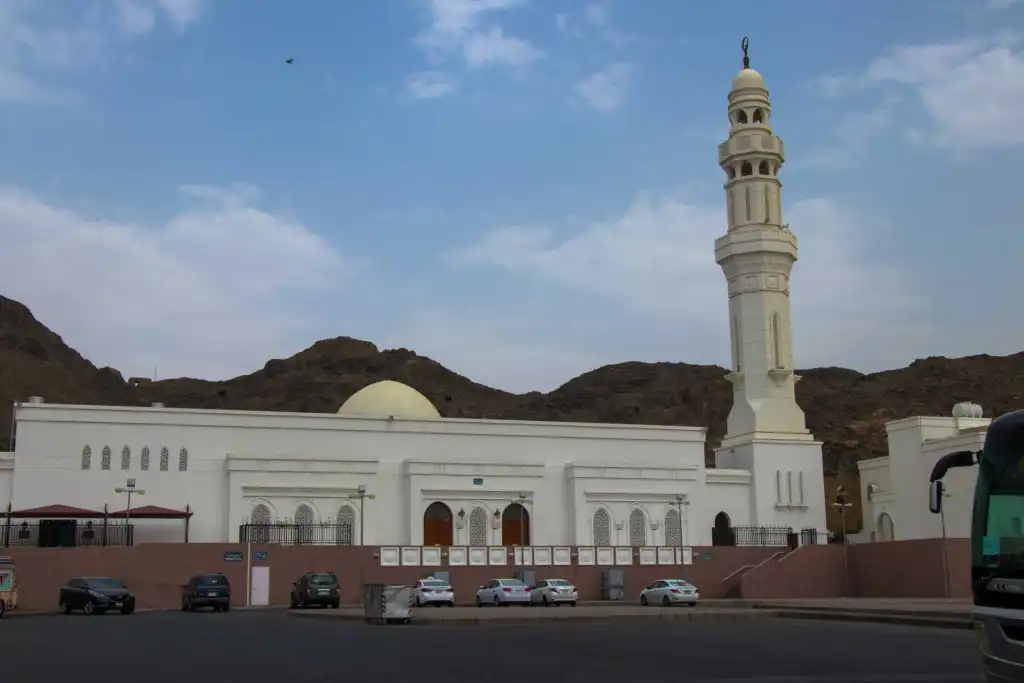
Mount Uhud is the largest mountain in the Madinah region. It runs roughly east to west for some seven and a half kilometres (about 4.6 miles), reaching its highest point at approximately 1,077 metres above sea level, and it lies around five kilometres — traditionally described as three miles — north of Masjid an-Nabawi. Its stone is a dark reddish granite streaked with veins of quartz and greenish rock, giving it a colour that shifts through the day: rust-brown at dawn, almost black at midday, and a deep glowing red in the last hour before sunset.
The mountain’s defining military feature is that its southern face is steep and largely unclimbable, while its flanks are cut by passes and gullies. Along its southern side runs the dry bed of Wadi Qanat, a seasonal watercourse flowing from the northeast past the mountain toward the northwest. Between the mountain and the plain, on the south-western side of the battlefield, stands a low, isolated rocky rise about thirty to forty metres high, known in the sources as Aynayn — “the two springs” — and known to every visitor today as Jabal al-Rumah, the Archers’ Hill. Its modest size is deceptive. In the topography of that day, Aynayn was the single point that controlled whether cavalry could pass around the Muslim rear. Everything that happened at Uhud turned on this small hill.
The Name and Its Meaning
The name Uhud derives from the Arabic root meaning “one,” “single,” or “isolated.” Classical geographers explained it in two ways: that the mountain stands alone, detached from the ranges around it, and that it stands as a single mass rather than a chain of peaks. Later scholars, including al-Samhudi in his great history of Madinah Wafa’ al-Wafa, noted the spiritual resonance that Muslims came to hear in the name — the mountain of the One, standing over the field where men died proclaiming Ahad, Ahad. That association is a beautiful reflection rather than an etymology, and it should be presented as such.
Yathrib Before Islam
Long before it was Madinah, the oasis was Yathrib: a scatter of fortified farmsteads and date groves fed by wells and seasonal floodwater, strung along the volcanic plain between two great lava fields, the harratayn. It was not a city in the Roman or Persian sense. It had no walls, no single ruler, no central market authority. It was a federation of neighbourhoods, each clustered around a fortress (utum) and a palm plantation.
Its earliest settled population that history can name with confidence was Jewish — the clans of Banu Qaynuqa, Banu Nadir and Banu Qurayza, together with smaller groups such as Banu Tha’labah. They were farmers, jewellers, armourers and moneylenders, literate in a largely oral society, and they held much of the best-watered land. Historians debate their origins: some accounts describe them as descendants of Israelite refugees fleeing Roman campaigns in Palestine, others as Arab tribes who had adopted Judaism, and modern scholarship generally accepts that both elements were present. What is not in dispute is that by the sixth century CE they were an established, wealthy and militarily capable part of the oasis.
Into this settled landscape came the Arab tribes of Aws and Khazraj, two branches of the southern Arabian Azd, said to have migrated north after the collapse of the Ma’rib dam in Yemen. Over generations they grew from clients into rivals of the Jewish clans and finally into the dominant force in the oasis — but they turned their strength inward. The century before Islam is remembered in Madinah as an age of exhausting civil war between these two cousin tribes, a cycle of raid and counter-raid that culminated in the ruinous Battle of Bu’ath, fought roughly five years before the Hijra. Bu’ath left both sides bled white, their leadership decimated, their alliances shattered. Aisha رضي الله عنها later observed that Bu’ath was a day Allah had prepared for His Messenger: it broke the old order so thoroughly that when the Prophet ﷺ arrived, the city had no strongman left to resist him and every reason to want a neutral arbitrator.
Uhud in the Pre-Islamic Landscape
The mountain itself was not a shrine or a sanctuary in pre-Islamic times. There is no reliable evidence of idol worship at Uhud, no pilgrimage to it, no temple in its passes. Its role was practical and constant: it was the northern boundary marker of the oasis, the landmark by which caravans coming down from Syria knew they had arrived. The land at its foot was farmed where water allowed, and grazed where it did not. Its passes were routes; its rocks were quarried for building; its shade was a stopping place.
This ordinariness matters. Uhud did not become sacred because of ancient superstition. It became beloved because of what happened there on one particular morning, and because of what the Messenger of Allah ﷺ said about it afterwards. Its sanctity in Islam is entirely historical and prophetic, not pagan and inherited — a point worth remembering when we come to the misconceptions later in this guide.
The Arrival of Islam and the Transformation of the Oasis
In 622 CE the Prophet Muhammad ﷺ completed the Hijra from Makkah to Yathrib. Within a short time the city had a new name — Madinat an-Nabi, the City of the Prophet — a new constitution binding Muslims, Jews and remaining pagans into a single defensive community, a new central mosque, and a new social order in which the warring Aws and Khazraj became a single body called the Ansar, the Helpers, bound by faith to the Makkan emigrants, the Muhajirun.
For the Quraysh of Makkah this was intolerable. Their authority in Arabia rested on two pillars: custodianship of the Ka’bah, and control of the caravan trade running north to Syria. Madinah sat astride that road. A hostile, organised, ideologically confident community in Madinah was not a religious irritation; it was a knife at the throat of Makkan commerce.
Badr: The Wound That Made Uhud Inevitable
The two forces collided in Ramadan of 2 AH (624 CE) at the wells of Badr. A Muslim force of just over three hundred, poorly armed and with almost no cavalry, destroyed a Quraysh army of around a thousand. Some seventy Makkans were killed and seventy captured. Among the dead were the great names of the Makkan aristocracy: Abu Jahl ‘Amr ibn Hisham, Utbah ibn Rabi’ah, his brother Shaybah, his son al-Walid, and Umayyah ibn Khalaf.
Nothing in Arabian experience had prepared the Quraysh for this. In a society where a chieftain’s standing was inseparable from his ability to protect his people and avenge his dead, Badr was not merely a lost battle. It was a public unmaking. Every tribe from Yemen to Syria now knew that Quraysh could be beaten. The road to Uhud began the day the survivors of Badr straggled back into Makkah.
The Road to Uhud: A Year of Vengeance in Makkah
The Humiliation of Quraysh: Revenge as a Driving Force
The defeat at Badr was a catastrophic and unprecedented blow to the prestige of the Quraysh. In a single day they had lost many of their most prominent chieftains and warriors. This loss against a much smaller, ill-equipped force created a profound sense of communal humiliation and ignited a burning thirst for revenge that reached into every household in Makkah.
Upon the death of Abu Jahl, leadership of the Makkans passed to Abu Sufyan ibn Harb, a shrewd and determined chieftain of the Banu Umayyah. Recognising the potent force of raw grief, Abu Sufyan made a calculated political move: he forbade the customary public wailing and lamentation for the dead of Badr. He understood that tears could wash away malevolence from the hearts and provide a catharsis that would dull the edge of vengeance. Instead, he commanded that this sorrow be preserved and channelled into an unyielding resolve to strike back. He himself took a solemn oath to abstain from all worldly pleasures — including intimacy with his wives and the use of perfumed oil — until he had exacted retribution.
This personal and public commitment transformed the desire for revenge from a mere emotion into a sacred tribal duty. Restoring their honour was not just a matter of pride; it was a political necessity, required to re-establish Makkan dominance and command respect among tribes whose perception of Qurayshi power had been severely damaged.
Economic Strangulation: Securing the Trade Routes
Beyond the emotional and political imperatives, the war was driven by stark economic necessity. Makkah’s wealth and influence were almost entirely dependent on its control of the caravan trade, particularly the vital artery running north to Syria. After the Hijra, the Muslims — dispossessed of their homes and property in Makkah — began to interdict these caravans. The victory at Badr effectively gave them strategic control over the primary coastal route, dealing a crippling blow to the Makkan economy.
The Quraysh’s desperation is visible in their attempt to open an alternative eastern route to Syria by way of Iraq. This too proved futile: a Muslim force led by Zayd ibn Harithah intercepted the caravan at al-Qaradah, capturing its goods and its guide, and confirming that the economic suffocation was comprehensive. The leaders of Quraysh concluded that their commercial survival depended on crushing Muslim power in Madinah and reopening their trade lifelines. Uhud was as much about commerce as about pride.
A Vow of Vengeance: The Mobilisation of Makkah
The Quraysh response was a testament to their unified resolve. A collective decision was made to finance the war with the entire profits of the great trade caravan that Abu Sufyan had skilfully saved from the Muslims just before Badr. This fund — reported in the classical sources as some fifty thousand gold dinars and a thousand camels — was dedicated wholly to equipping and training a new army.
﴿إِنَّ الَّذِينَ كَفَرُوا يُنفِقُونَ أَمْوَالَهُمْ لِيَصُدُّوا عَن سَبِيلِ اللَّهِ ۚ فَسَيُنفِقُونَهَا ثُمَّ تَكُونُ عَلَيْهِمْ حَسْرَةً ثُمَّ يُغْلَبُونَ﴾
“Indeed, those who disbelieve spend their wealth to turn people away from the path of Allah. They will continue to spend it — then it will become a source of regret for them, and then they will be overcome.”
— Surah al-Anfal 8:36
For an entire year Makkah was consumed by what the historical accounts describe as feverish activity. Messengers rode to the surrounding Arab tribes — the Kinanah, the Thaqif, the Ahabish of the Tihamah — calling them to join the expedition. The result was an army unlike any the Hijaz had seen: three thousand fighting men, of whom seven hundred were clad in mail armour, supported by two hundred cavalry and three thousand camels. To bolster morale and to declare the religious dimension of the campaign, they carried their chief idol Hubal with them, mounted on a camel. This was not a raid. It was an invasion force, designed to overwhelm and utterly destroy the Muslim community.
Hind bint Utbah: The Woman Who Drove the War
Among the most significant figures in the Quraysh mobilisation was Hind bint Utbah, the wife of Abu Sufyan. Hind was no ordinary woman of Makkah. She was a figure of fierce pride, sharp tongue and indomitable will. Her father Utbah ibn Rabi’ah, her uncle Shaybah and her brother al-Walid had all been slain at Badr, several of them at the hands of Hamzah ibn Abd al-Muttalib and Ali ibn Abi Talib.
For Hind, Badr was not merely a tribal humiliation; it was a personal devastation that had torn apart her family in a single afternoon. Her grief did not soften into quiet mourning. It hardened into a consuming desire for vengeance that became one of the defining forces behind the march to Uhud.
Hind became the emotional engine of the Quraysh war effort. She accompanied the army along with fourteen other women of prominent Makkan families, including Umm Hakim bint al-Harith ibn Hisham, Fatimah bint al-Walid ibn al-Mughirah, Barzah bint Mas’ud, Raytah bint Munabbih and Sulafah bint Sa’d. Their role was not passive. They stood behind the battle lines beating tambourines and chanting verse designed to shame any man who faltered:
“We are the daughters of Tariq — the morning star.
We walk upon soft carpets.
If you advance, we shall embrace you.
If you retreat, we shall leave you —
leave you with no love at all.”
They targeted the traditional standard-bearers directly, singing: “O Banu Abd al-Dar! O defenders of the rear! Strike with every sharp sword!” These words were a direct assault on the honour of the Quraysh warriors, making retreat unthinkable. Hind in particular is reported to have carried a needle and kohl-stick with her; whenever a warrior showed hesitation, she would hand them to him and say: “You are but a woman — take this and line your eyes.” As psychological warfare it was devastatingly effective.
But Hind’s deepest scheme was more personal and more sinister. She had a private arrangement with Wahshi ibn Harb, an Abyssinian slave famed for his deadly skill with the short javelin, the harbah. Wahshi’s master was Jubayr ibn Mut’im, who sought revenge for the death of his uncle Tu’aymah ibn Adiy at Badr and had promised Wahshi his freedom. Hind added her own reward on top of it, promising him her jewellery if he killed one of three men: the Prophet Muhammad ﷺ, Ali ibn Abi Talib, or Hamzah ibn Abd al-Muttalib. Freedom in exchange for blood. It was a transaction that reduced a human life to a bargain, and it revealed the moral darkness of the pre-Islamic world even as it hinted at the tragedy of Wahshi himself: a man whose only road to liberty ran through murder.
Wahshi’s Contract: A Private Assassination
Wahshi later narrated his own account, and it is preserved in Sahih al-Bukhari (4072) — a remarkable document, because it is the confession of the killer, told in his own voice, recorded by the community of the man he killed. He said:
“As for Muhammad ﷺ, I could never get to him, for he was always surrounded. As for Ali, I found him a man of great vigilance, constantly scanning around him with his weapon, so I had no hope with him. So I said: it will be Hamzah. I watched him, and he was cutting through men like a great grey camel, sparing nothing.”
This clinical assessment of his targets reveals the cold-blooded nature of the assignment. Wahshi did not come to Uhud as a soldier seeking combat. He came as an assassin waiting for a single opening. The tragedy of that arrangement would unfold on the battlefield with consequences that would mark the Prophet ﷺ for the rest of his life.
The Council of War: Events in Madinah
As the storm of the Quraysh army gathered and moved north, the Prophet ﷺ prepared his community not with unilateral commands but through consultation and spiritual fortification. The events in Madinah before the battle reveal a profound contrast between a divine model of leadership founded on shura and the autocratic Qurayshi model driven by pride and vengeance.
Warning and Vigilance
News reached Madinah that Quraysh was approaching. The seerah records a message associated with al-Abbas ibn Abd al-Muttalib, the Prophet’s uncle, who was still in Makkah and whose sympathies lay with his nephew. He is reported to have sent an urgent letter warning of the assembling army and its march on Madinah. Other accounts emphasise the Prophet’s own intelligence-gathering: scouts were dispatched to confirm the enemy’s size, composition and position, and they returned with detailed reports of the Makkan camp near the fields of Urwah, north-west of the city, where the Quraysh had let their animals loose to graze on the standing crops of Madinah.
The effect was immediate. Madinah became vigilant. Armed men stood guard around the Prophet ﷺ and at the approaches to the city. The mosque, usually the heart of worship, became also the heart of readiness. Families spoke in low voices about where the children should be kept and how the houses would be defended if the enemy broke in. This was no longer a distant threat; it was an army moving toward the city.
The Prophet’s Dream
Before the battle the Prophet ﷺ saw a dream, preserved in Sahih al-Bukhari (3622, 4081) and Sahih Muslim (2272). He said: “I saw in a dream that I moved my sword and its blade broke; that was the loss the believers suffered on the Day of Uhud. Then I moved it again, and it became better than it had ever been; that was the victory Allah brought about and the gathering of the believers. And I saw cattle being slaughtered — and by Allah, that was good; and they were the believers on the Day of Uhud.” In other narrations he mentions seeing himself wearing a strong coat of mail, which he interpreted as Madinah itself.
The Prophet ﷺ was not walking into Uhud blind. He sensed its cost before it arrived. This is one of the quiet, human details of the seerah that is easy to pass over: the leader who marches out knowing that the vision he has been shown includes his own dead.
The Consultation (Shura)
The Prophet ﷺ gathered the companions and put the question to them. It was a strategic question, but it carried the weight of fear, hope, pride and trust: should the Muslims defend from inside Madinah, or march out and meet Quraysh in the open?
The Prophet ﷺ himself initially preferred to remain in Madinah, using its buildings, palm groves and narrow lanes as a defensive advantage. Those who agreed with him — including senior figures such as Abu Bakr, Umar ibn al-Khattab and Uthman ibn Affan, and notably Abdullah ibn Ubayy — argued from practical wisdom. Madinah’s streets could become killing channels. The houses could become layered defences. Women and children could fight from the rooftops. If Quraysh entered, they would be fighting in unfamiliar terrain and paying for every step.
But many of the younger companions, especially those who had missed Badr and longed for the reward their elders had earned, urged marching out to meet Quraysh in the open field. Their motivation was sincere courage and a desire to show that Islam would not be intimidated. They feared that remaining behind walls would be read across Arabia as weakness. Among the most vocal was Hamzah ibn Abd al-Muttalib, who declared: “By the One who revealed the Book to you, I will not taste food until I fight them with my sword outside Madinah!”
The decision settled on marching out. The Prophet ﷺ entered his house, put on his armour — two coats of mail, one over the other — took up his sword and shield, and came out to the waiting men.
In that interval, something had shifted. Sa’d ibn Mu’adh and Usayd ibn Hudayr said to those who had pressed for battle: “You have forced the Messenger of Allah ﷺ to go out against his own view. The command comes down to him from heaven. Return the matter to him and do as he orders.” The young men came back, ashamed: “O Messenger of Allah, we compelled you against your wish. Stay if you prefer.”
But he ﷺ had already put on the armour, and he answered with a principle of leadership that has echoed through every Muslim consultation since: “It is not fitting for a Prophet, once he has put on his armour, to take it off until Allah judges between him and his enemies.”
This is a lesson worth pausing over. Consultation is obligatory before the decision. Unity is obligatory after it. A community that keeps re-opening a settled matter never actually acts.
The March and the Exposure of Hypocrisy
The Muslim force that left Madinah numbered one thousand men. They prayed Jumu’ah, the Prophet ﷺ addressed them, urging patience and promising victory to those who held firm, and then they marched north through the palm groves toward Uhud, camping overnight at al-Shaykhayn.
Along the route the Prophet ﷺ inspected the ranks. This inspection is remembered in the tradition not only as military organisation but as a window into the hearts of the young. Several boys came forward eager to fight, among them Rafi’ ibn Khadij and Samurah ibn Jundub, both about fifteen. The Prophet ﷺ initially turned them back as too young. But Rafi’ stood on tiptoe and demonstrated his skill with the bow, and he was allowed. Samurah then protested to his stepfather: “The Messenger of Allah has permitted Rafi’ and turned me back, and I can throw Rafi’ in wrestling!” The Prophet ﷺ had them wrestle; Samurah threw him, and he too was permitted. Others — Abdullah ibn Umar, Usamah ibn Zayd, al-Bara’ ibn Azib, Zayd ibn Thabit — were sent home, and Zayd’s disappointment at being turned away is preserved in his own words years later, when he had become the compiler of the Qur’an.
These small scenes show how the early community understood honour: not as the avoidance of danger, but as the right to stand beside the Prophet ﷺ when danger came.
The Desertion of Abdullah ibn Ubayy
Then came the moment that made hypocrisy visible.
Abdullah ibn Ubayy ibn Salul, chief of the Khazraj and the man who had come closest to being crowned king of Yathrib before the Prophet’s arrival, withdrew from the march with three hundred men — a full third of the army — reducing the force to seven hundred. On the surface he framed it as a disagreement over strategy: “He obeyed the boys and disobeyed me. Men, I do not know why we should get ourselves killed here.”
But the act exposed a deeper truth. When the cost becomes real, false loyalty collapses. Abdullah ibn Jubayr’s father and others tried to shame the departing men back into the ranks, calling after them, but they went. Two clans — Banu Salamah of the Khazraj and Banu Harithah of the Aws — wavered and nearly turned back with them. Allah steadied them, and the Qur’an records the moment with a tenderness that is easy to miss:
﴿إِذْ هَمَّت طَّائِفَتَانِ مِنكُمْ أَن تَفْشَلَا وَاللَّهُ وَلِيُّهُمَا ۗ وَعَلَى اللَّهِ فَلْيَتَوَكَّلِ الْمُؤْمِنُونَ﴾
“When two groups among you were about to lose heart — but Allah was their Protector. And in Allah let the believers put their trust.”
— Surah Aal Imran 3:122
Jabir ibn Abdullah, whose clan was one of the two, later said: “It was revealed about us, and I would not have wished that it had not been revealed, for Allah says: ‘and Allah was their Protector.'” (Sahih al-Bukhari 4051) There is enormous mercy in that verse. It names a moment of weakness and, in the same breath, claims the weak as His own.
The believers continued. Outnumbered more than four to one now, they entered Uhud already carrying a lesson: the strength of a community is not in its headcount but in its sincerity.
Amr ibn al-Jamuh: The Lame Man Who Yearned for Paradise
Among the most moving stories of the march is that of Amr ibn al-Jamuh, a chief of Banu Salamah, a man of noble character and open-handed generosity — and severely lame in one leg. He had four sons, all of them Muslims, all of them marching. They tried to hold their father back, telling him that Allah had excused him and that his sons would carry the family’s share of the fighting.
Amr would not have it. He went to the Prophet ﷺ and said: “My sons want to keep me back from this. By Allah, I hope to tread with this lame leg of mine in Paradise.” The Prophet ﷺ told him that Allah had excused him and that jihad was not obligatory upon him. But Amr insisted, and the Prophet ﷺ turned to the sons and said: “Do not prevent him. Perhaps Allah will grant him martyrdom.”
As he left his house, Amr raised his hands and prayed: “O Allah, do not return me to my family.”
He marched to Uhud with his sons and was killed there, along with his son Khallad and his brother-in-law Abdullah ibn Amr ibn Haram — the father of Jabir. Three men of one household, martyred on one morning.
Afterwards, his wife Hind bint Amr brought a camel to carry the bodies of her husband, her son and her brother back to Madinah for burial. Each time she turned the animal toward the city it knelt and refused to move; each time she turned it toward Uhud it walked eagerly forward. She went to the Prophet ﷺ and told him. He asked whether Amr had said anything when he left. She repeated his prayer. The Prophet ﷺ said: “That is why the camel will not go to Madinah.” He then said: “There are among you men who, if they swear by Allah, Allah fulfils their oath. Among them is Amr ibn al-Jamuh.” And in another narration: “I saw him walking in Paradise with the leg that had been lame, made whole.”
He then ordered: “Bury them where they fell.” That instruction is the origin of the cemetery you will visit today. The martyrs of Uhud were never moved into Madinah; Madinah came out to them.
Rabbi Mukhayriq and the First Waqf in Islam
The march to Uhud also produced one of the most extraordinary episodes of interfaith solidarity in the seerah.
Mukhayriq was a wealthy and learned rabbi of the Jewish Banu Tha’labah, a man described in the sources as the richest man in Madinah in date palms. He recognised the existential threat posed by the Quraysh advance, and he recognised something else: that the Constitution of Madinah, to which his people were signatories, obliged them to defend the city.
The battle fell on a Saturday. When Mukhayriq called on his tribesmen to march out with Muhammad ﷺ, they refused, citing the Sabbath prohibition on warfare. He answered them sharply: “You have no Sabbath!” — meaning that they had failed to grasp what the Sabbath was for, and that the defence of a city under attack overrides it. Then he took his sword and went out alone.
Before leaving he made a declaration before witnesses: if he were killed, his entire wealth — seven named date-palm orchards, recorded in the sources as al-A’waf, al-Safiyah, al-Dalal, al-Mithab, Barqah, Husna and Mashrabat Umm Ibrahim — was to pass to Muhammad ﷺ, to be used as Allah showed him.
Mukhayriq fought on the slopes of Uhud and was killed there. When the Prophet ﷺ was told, he said: “Mukhayriq was the best of the Jews.” He took the seven gardens and dedicated their produce to the poor and to the needs of the Muslim community — and the majority of scholars identify this endowment as the first waqf in Islamic history, the ancestor of every madrasah, hospital, well and library that Muslims have endowed since.
A rabbi who broke the Sabbath to defend the Prophet’s city, and whose orchards became the first charitable trust in Islam. It is a story that deserves to be far better known than it is.
The Battlefield of Divine Decree: Why Mount Uhud Was Chosen
The Prophet ﷺ moved his force in the last hours of the night, guided through the palm groves and past the fortress of Banu Harithah by a man of the Ansar who knew the ground, until he emerged in the valley on the southern side of Uhud at first light. The dawn prayer was performed within sight of the Quraysh campfires.
Then he arranged his line — and the arrangement itself was a work of tactical intelligence that modern military historians still admire.
He placed Uhud at the Muslims’ back. The mountain’s steep southern face could not be scaled by cavalry and could not be flanked at speed. Madinah lay in front of them. The Quraysh, with their two hundred horsemen — the arm in which they held total superiority — were reduced to a single approach.
Except for one gap. On the south-western side, between the mountain and the plain, the low hill of Aynayn left a pass through which cavalry could ride around into the Muslim rear.
Of this mountain the Prophet ﷺ said, in a hadith recorded in Sahih al-Bukhari (4083) and Sahih Muslim (1365): “This is Uhud — a mountain that loves us, and we love it.”
The Muslim Line
The Prophet ﷺ dressed the ranks with care, walking the line and straightening it with an arrow-shaft in his hand. The Muhajirun and the Ansar were placed in ordered formation rather than the loose tribal melee typical of Arabian warfare.
The standard of the Muhajirun was entrusted to Mus’ab ibn Umayr. The right wing was given to al-Zubayr ibn al-Awwam, the left to al-Mundhir ibn Amr. Across from them the Quraysh deployed in the wider plain: infantry in the centre under Abu Sufyan’s overall command; cavalry on both wings where horsemen had room to manoeuvre; and behind them the Makkan women with their drums, turning the field into a test not only of steel but of morale.
Before a single sword was drawn, both sides could already read the character of the battle. The Muslims were arranged for disciplined resistance and controlled striking. The Quraysh relied on numbers, mounted mobility, and the emotional fire of revenge.
The Archers’ Mount: The Command That Defines the Day
To close the one gap in his position, the Prophet ﷺ stationed fifty archers on the rise of Aynayn under the command of Abdullah ibn Jubayr, who wore a white garment so that his men could see him.
The instruction he gave them is preserved in Sahih al-Bukhari (3039, 4043) and is one of the most quoted orders in Islamic history:
“Guard our backs. If you see us being snatched away by birds, do not leave this position of yours until I send for you. And if you see that we have defeated the enemy and are trampling them, do not leave your position until I send for you.”
In another wording: “Protect our rear. If you see us killed, do not come to our aid; if you see us taking spoils, do not join us.”
The archers were the lock on the door. Without them holding the rise, the Muslim rear was open to two hundred horsemen. And this detail matters enormously for how we read what happened later: the mistake at Uhud was not caused by confusion about the orders. The command was explicit, repeated, and reinforced with the most extreme hypothetical the Prophet ﷺ could give — even if you see us being carried off by birds. The command was clear. What failed was the human heart under the pressure of temptation.
The Warriors of Quraysh
The Quraysh army of three thousand was led by Abu Sufyan ibn Harb as supreme commander, and it was organised with a military precision that shows how seriously Makkah took this campaign.
- Khalid ibn al-Walid commanded the right cavalry wing — a man who would, six years later, become the sword of the very faith he was fighting.
- Ikrimah ibn Abi Jahl commanded the left cavalry wing, carrying the memory of a father killed at Badr.
- Safwan ibn Umayyah and Amr ibn al-As were among the senior Makkan nobles present, both of them future Muslims.
- Abu Amir al-Rahib, a Medinan defector, served as scout and agitator.
- Talhah ibn Abi Talhah al-Abdari of Banu Abd al-Dar carried the banner, known as Kabsh al-Katibah — “the Ram of the Battalion.”
Abu Amir al-Rahib: The Neighbour Who Turned
Abu Amir had been a prominent chief of the Aws in Madinah before Islam, a man so known for asceticism that he was called al-Rahib, “the Monk.” He had expected to be the religious leader of Yathrib. When the Prophet ﷺ arrived, Abu Amir refused to accept him and left for Makkah with a handful of followers, promising the Quraysh that his own tribesmen would defect the moment they heard his voice.
At Uhud he stepped forward before the fighting began and called out to the Aws. They answered him with curses. “No welcome to you, O sinner!” He turned back muttering that evil had befallen his people after he left them.
His deeper contribution to the day was more sinister. Knowing the ground intimately, he had pits dug and concealed across the field to trap Muslim fighters. It was into one of these pits that the Prophet ﷺ himself would fall during the fighting — the betrayal of a former neighbour translated into a hole in the earth. The Prophet ﷺ renamed him al-Fasiq, the Corrupt One, and he died years later in exile in Syria, alone.
Reading the Quraysh Order of Battle
The distribution of command tells us that Quraysh did not treat Uhud as a reckless raid. Cavalry on both wings, infantry in the centre, a designated banner clan, a local guide who had sabotaged the terrain, a paid assassin with three named targets, and a chorus of women behind the lines to make retreat socially impossible. Uhud was a coordinated Qurayshi effort in which cavalry, infantry, morale, assassination and rumour all worked together. Understanding this is essential to understanding why the day went the way it did: the Muslims were not defeated by luck. They were defeated by a professional enemy who was waiting for exactly one mistake.
The Warriors of Islam
Against three thousand, the Muslim army of seven hundred contained some of the most extraordinary individuals in Islamic history.
Hamzah ibn Abd al-Muttalib — The Lion of Allah
Hamzah, the Prophet’s uncle and his foster-brother, was a man whose physical courage and spiritual devotion made him a pillar of the community. Known as Asad Allah wa Asad Rasulih — “the Lion of Allah and of His Messenger” — he had embraced Islam in the sixth year of the mission with a boldness that sent shockwaves through Makkah: he walked into the assembly of Quraysh, struck Abu Jahl across the head with his bow for insulting his nephew, and announced his faith in front of them all.
At Badr he had been among the most devastating warriors, killing Utbah ibn Rabi’ah and Shaybah in single combat and marking himself with an ostrich feather so the enemy would know exactly who was cutting them down. At Uhud he wore that feather again. His presence was both tactical and emotional. He was a shield for Islam, and everyone on both sides of the field knew it.
Mus’ab ibn Umayr — From Luxury to Martyrdom
Mus’ab was among the most beloved of the companions. Born into one of the wealthiest families of Makkah, he had been famous in his youth for his elegance; the Makkans said that no young man of the city was better dressed or more finely perfumed, and his mother clothed him in garments worth more than most men earned in a year. Ibn Sa’d records that when he walked through Makkah, the scent of him lingered in the street after he had passed.
When he embraced Islam his family imprisoned him, then disowned him and stripped him of everything. He went from the best-dressed young man in Makkah to a man in a patched cloak. The Prophet ﷺ once saw him in that state and wept.
He was sent to Yathrib as the first ambassador of Islam, and it was through his patient teaching that the leaders of the Aws and Khazraj accepted the faith — Islam entered Madinah through this one young man’s manners. At Uhud he carried the standard of the Muhajirun.
Abu Dujanah — The Man with the Red Headband
Simak ibn Kharashah, known as Abu Dujanah, was a warrior of legendary boldness. Before the battle the Prophet ﷺ raised a sword in his hand and said: “Who will take this sword and give it its right?” Several men reached for it and he withheld it. Then he said: “Who will take it with its right?” Abu Dujanah asked: “And what is its right, O Messenger of Allah?” He said: “That you strike the enemy with it until it bends.” Abu Dujanah said: “I will take it with its right.” (Sahih Muslim 2470)
He took it, tied his famous red headband around his head — among the Arabs a declaration that a man intended to fight to the death — and walked out between the lines with a distinctive strutting swagger. The Prophet ﷺ watched him and said: “This is a walk that Allah hates, except in a place like this.”
Nusaybah bint Ka’b (Umm Ammarah) — The Warrior Mother
Among the most remarkable figures at Uhud was Nusaybah bint Ka’b of the Banu Najjar, known as Umm Ammarah. She had come to the field with a waterskin, intending to tend the wounded, accompanied by her husband Ghaziyyah and her two sons.
When the line broke and the Muslims scattered, she threw down the waterskin, picked up a sword and a shield from a fleeing man, and placed herself between the enemy and the Prophet ﷺ. She fought at his side for the remainder of the day and took thirteen wounds, the worst of them a deep gash to the shoulder from the sword of Ibn Qami’ah — a wound that took a year to heal.
The Prophet ﷺ said of her: “I did not turn to my right or my left on the Day of Uhud without seeing her fighting in my defence.” And when he was told that she was superior to certain men that day, he agreed. Years later, when her son was mutilated and killed by Musaylimah the Liar, she went out to the Battle of Yamamah in her sixties, lost her hand there, and took eleven more wounds. She had asked the Prophet ﷺ to pray that she would be his companion in Paradise; he did, and she said afterwards that she no longer cared what befell her in this world.
Others on the Field
The seven hundred also included Ali ibn Abi Talib, who would take sixteen wounds that day; Talhah ibn Ubaydillah, who would take more than seventy; Sa’d ibn Abi Waqqas, the finest archer among them and the only man for whom the Prophet ﷺ is authentically reported to have combined both his parents in a pledge; Abu Talhah al-Ansari, whose voice in battle was said to be worth a hundred men; Abu Bakr, Umar, Uthman, Abu Ubaydah ibn al-Jarrah, al-Zubayr ibn al-Awwam, Sa’d ibn Mu’adh, Sa’d ibn al-Rabi’, Hanzalah ibn Abi Amir, and Anas ibn al-Nadr — men whose names would be carved into the day by what they did in the next six hours.
The Dawn of Battle
On a Saturday morning in Shawwal of the 3rd year after the Hijrah — March of 625 CE — the two armies faced one another across the plain at the foot of Mount Uhud. The exact day is disputed: the 3rd, the 7th and the 15th of Shawwal are all reported by the classical historians, corresponding to the 22nd or 23rd of March. The month and the year are certain; the day is not, and anyone who states one date without qualification is choosing among reports.
The battle opened in the traditional Arabian manner, with individual duels before the general engagement. Talhah ibn Abi Talhah, the Quraysh standard-bearer, rode out on a camel and challenged the Muslims to single combat, taunting them: “Who will make me taste the sword, or taste my sword?” He was a famous fighter, and men hesitated. Then Ali ibn Abi Talib stepped forward, and struck him down with a single blow that brought him to the ground with his leg severed. When Talhah’s covering fell away, Ali turned and walked back without finishing him. Asked why, he said: “He appealed to me by our kinship, and I felt ashamed to kill my cousin in that state.” The Prophet ﷺ said Allahu akbar, and the Muslims echoed it.
The Banner That Would Not Stay Down
After Talhah fell, the men of Banu Abd al-Dar came forward one after another to raise the fallen standard, because for an Arab clan the banner was identity itself. The tradition records that eleven men of that clan, and finally their Abyssinian servant, were killed in sequence holding it:
- Uthman ibn Abi Talhah, brother of Talhah — killed by Hamzah.
- Abu Sa’d ibn Abi Talhah — killed by Sa’d ibn Abi Waqqas (some reports say Ali).
- Musafi’ ibn Talhah and al-Harith ibn Talhah — both shot by Asim ibn Thabit.
- Kilab ibn Talhah — killed by al-Zubayr ibn al-Awwam.
- al-Jullas ibn Talhah — killed by Talhah ibn Ubaydillah.
- Artat ibn Sharahbil, Shurayh ibn Qarid, and the servant Sawab — all killed by Ali ibn Abi Talib.
Sawab’s death is remembered with a particular respect: an enslaved Abyssinian who had no stake in Qurayshi honour, he held the banner with his hands until both were cut off, then knelt and clasped it against his chest with the stumps of his arms and his neck, until he was killed over it. The Quraysh themselves said afterwards that they had never seen loyalty like it.
Each time the banner fell, another hand seized it; each time that hand was cut down. Banners were not mere cloth — they were the psychological spine of a pre-modern army. When the standard went down repeatedly and stayed down, Quraysh morale broke.
The First Pressure on the Quraysh Line
Once the standard-bearers had fallen one after another, the Muslim advance gathered momentum. The early Muslim attack was not a shapeless rush; it came as sustained pressure along the Quraysh front while the archers on Aynayn kept the cavalry from sweeping around the flank. Every time Khalid’s horsemen probed the side, arrows came down from the rise and denied them the room they needed for a mounted breakthrough.
This is why the first phase was so striking. The Muslims were outnumbered more than four to one, yet they had blunted the single most dangerous weapon the Quraysh possessed.
Abu Dujanah, with the Prophet’s sword and his red headband, cut through the Quraysh lines like a blade through standing wheat. Anas ibn Malik’s account records that he killed every man who stood before him, working steadily inward toward the Quraysh centre — until he came face to face with a figure in armour urging the men on, and raised the sword, and then lowered it. It was Hind bint Utbah. He said afterwards: “I honoured the sword of the Messenger of Allah ﷺ too much to strike a woman with it.”
Hamzah fought that morning with a ferocity the tradition preserves like a flame. He moved through the Quraysh ranks with a sword in each hand and none could stand before him. He came upon a Quraysh fighter named Siba’ ibn Abd al-Uzza and called out: “Come to me, O son of the woman who cuts flesh!” — a reference to Siba’s mother, who circumcised women in Makkah — and struck him dead. Wahshi, crouched behind a rock, watched him do it.
The Quraysh centre began to buckle. Men carrying the banner were cut down, pockets of infantry gave ground, and the Makkan women were seen scrambling toward the higher ground with their skirts lifted, in open flight. Qurayshi camp goods lay exposed on the field. To almost every man present, on both sides, the battle appeared to be over.
The Martyrdom of Hamzah
Wahshi told the story himself, decades later, to the Prophet ﷺ and then to others, and it is preserved in Sahih al-Bukhari (4072):
“I was a slave of Jubayr ibn Mut’im, whose uncle Tu’aymah had been killed at Badr. When Quraysh marched to Uhud, Jubayr said to me: ‘If you kill Hamzah, the uncle of Muhammad, in revenge for my uncle, you are free.’ So I went out with the people. I was an Abyssinian, and I used to throw the short spear the way the Abyssinians throw it, and I rarely missed.
When the two sides met, I went out looking for Hamzah. I saw him among the people like a great grey camel, cutting men down with his sword; nothing could stand in his way. By Allah, I was preparing myself for him, hiding behind a tree so that he would pass me or come near me — and Siba’ ibn Abd al-Uzza got to him before me. When Hamzah saw him he said: ‘Come here, O son of the cutter of clitorises!’ and he struck him a blow that was like nothing at all.
Then I balanced my spear until I was satisfied with it, and I threw it at him, and it struck him in the lower abdomen and came out between his legs. He came toward me but he was overcome, and he fell. I left him there until he died. Then I came and took my spear, and I went back to the camp and sat down, for I had no other business with anyone. I had only killed him to become free.”
Other narrations preserve the detail that Hamzah, mortally wounded, took several steps toward Wahshi with his eyes fixed on him, and that Wahshi found himself unable to move from the terror of that gaze until Hamzah fell.
Wahshi returned to Makkah and was freed. Years later, after the conquest of Makkah, he fled to Ta’if, then came with a delegation to Madinah and accepted Islam. The Prophet ﷺ asked him: “Are you Wahshi?” He said yes. He said: “Tell me how you killed Hamzah.” Wahshi told him. When he had finished, the Prophet ﷺ said: “Woe to you — keep your face away from me. Do not let me see you.”
For the rest of his life Wahshi avoided the Prophet’s presence. There is no cruelty in that instruction and no rejection of his Islam; it is a window into the human heart of the Messenger ﷺ, who could forgive a man completely and still not be able to look at the face that had taken his uncle. Wahshi lived long, and in the wars of the apostasy he killed Musaylimah the Liar with the same short spear. He used to say: “I killed the best of men with it, and then I killed the worst of men with it.”
The Turning Point: The Archers Leave the Hill
From the rise of Aynayn, the fifty archers watched the Quraysh break. They saw the spoils lying on the field. They saw the Muslims moving among the abandoned camp. And they made the calculation that seemed obvious: the battle is over; if we stay here we will have no share.
Al-Bara’ ibn Azib’s account is in Sahih al-Bukhari (4043): “When we met them, they fled until I saw the women of Quraysh running with their anklets and their legs showing. The archers began to say: ‘The spoils! The spoils!’ Abdullah ibn Jubayr said: ‘Have you forgotten what the Messenger of Allah ﷺ said to you?’ They said: ‘By Allah, we will go to the people and take our share of the spoils.'”
Forty of the fifty came down. Ten remained with Abdullah ibn Jubayr.
The lock on the door had loosened.
How Khalid ibn al-Walid Read the Field
Khalid ibn al-Walid’s greatness at Uhud lies as much in what he did before his famous strike as in the strike itself. He had been probing the Muslim left flank all morning, looking for a way past Aynayn, and finding none. A cavalry commander does not keep throwing horsemen at a guarded choke point. So Khalid waited. He watched. He read the battle until the field itself changed.
When the archers came down, the change was instantaneous and total. Khalid saw in one glance that the rise which had locked the Muslim flank was now held by ten men.
He wheeled his squadron around the rear of the hill and struck. Abdullah ibn Jubayr and the handful who had obeyed to the end fought until their arrows were spent, then with spears, then with swords, and every one of them was killed. Abdullah ibn Jubayr’s body was mutilated afterwards. He had done nothing wrong at all.
Khalid cleared the pass and came into the Muslim rear at the gallop, with Ikrimah’s wing behind him. And as he broke through from behind, the Quraysh infantry in front — who had been retreating — saw the dust and the banners and turned, and came back.
This was the decisive act. Khalid did not merely attack from behind: he first removed the one position that had been designed to prevent exactly that manoeuvre, and he synchronised the attack with a general re-advance. In military terms he converted a broken army into a functioning pincer. In human terms he turned certainty into panic in the space of a few minutes.
The Collapse
The Muslims were now caught between a renewed frontal assault and cavalry in their rear. The formation dissolved. Men turned at the sound of shouting behind them and found horsemen among them. Dust rose thick enough to blind. In the chaos Muslims struck Muslims, unable to tell friend from foe.
Among the bitterest incidents preserved in the sources: Hudhayfah ibn al-Yaman saw his own father, al-Yaman, an elderly man who had been left with the women and children and had insisted on coming out, being cut down by Muslim swords in the confusion. He cried out: “My father! My father!” But the blows had already fallen. Afterwards the Prophet ﷺ ordered the payment of blood money; Hudhayfah refused it and gave it in charity to the Muslims. The Prophet ﷺ prayed for him, and Hudhayfah carried that grace for the rest of his life.
﴿إِذْ تُصْعِدُونَ وَلَا تَلْوُونَ عَلَىٰ أَحَدٍ وَالرَّسُولُ يَدْعُوكُمْ فِي أُخْرَاكُمْ﴾
“When you were fleeing up the slope without looking back at anyone, while the Messenger was calling you from behind.”
— Surah Aal Imran 3:153
The Fall of Mus’ab and the Rumour
In the middle of the collapse, Mus’ab ibn Umayr held the standard.
The enemy concentrated on him, because bringing down the banner would finish the rout. A horseman named Ibn Qami’ah struck his right hand from his body. Mus’ab took the standard in his left. Ibn Qami’ah struck off the left. Mus’ab bent forward and clasped the standard against his chest with the stumps of both arms, reciting:
﴿وَمَا مُحَمَّدٌ إِلَّا رَسُولٌ قَدْ خَلَتْ مِن قَبْلِهِ الرُّسُلُ﴾
“Muhammad is no more than a messenger; messengers have passed away before him.”
— Surah Aal Imran 3:144
Then Ibn Qami’ah ran him through with a spear, and he died.
Mus’ab bore a physical resemblance to the Prophet ﷺ. Ibn Qami’ah, believing he had killed Muhammad ﷺ, rode back through the field shouting: “I have killed Muhammad!”
The rumour moved through the battlefield faster than any horse. Rumours in battle are not statements; they are weapons. This one struck the community at its centre. Some companions froze. Some sat down on the ground and let their swords fall. Some began to speak of sending to Abdullah ibn Ubayy to ask for safe conduct from Abu Sufyan. Anas ibn Malik reports that men simply stopped.
Anas ibn al-Nadr: Faith That Refuses to Collapse
Among those who answered the rumour with steel was Anas ibn al-Nadr, the uncle of Anas ibn Malik. He had missed Badr and had told the Prophet ﷺ: “If Allah lets me witness a battle against the idolaters, Allah will see what I do.”
He came upon a group of companions sitting on the ground and asked: “What is keeping you here?” They said: “The Messenger of Allah ﷺ has been killed.” He said: “Then what will you do with life after him? Get up and die for what he died for.”
Then he turned toward the enemy. Passing Sa’d ibn Mu’adh, he said the words that generations of Muslims have repeated since: “O Sa’d — by Allah, I can smell the fragrance of Paradise beyond Uhud!”
He charged alone into the Quraysh and fought until he was killed. Afterwards his body was found bearing more than eighty wounds from swords, spears and arrows, so disfigured that no one could identify him. His sister al-Rubayyi’ bint al-Nadr recognised him at last by the shape of his fingertips. (Sahih al-Bukhari 2805)
Anas ibn Malik said: “We used to think that this verse was revealed about him and men like him:”
﴿مِّنَ الْمُؤْمِنِينَ رِجَالٌ صَدَقُوا مَا عَاهَدُوا اللَّهَ عَلَيْهِ ۖ فَمِنْهُم مَّن قَضَىٰ نَحْبَهُ وَمِنْهُم مَّن يَنتَظِرُ﴾
“Among the believers are men true to what they promised Allah. Some of them have fulfilled their vow, and some are still waiting.”
— Surah al-Ahzab 33:23
The Attack on the Prophet ﷺ
As the line dissolved, the enemy pressed toward the one target that mattered.
The Prophet ﷺ was struck with stones by Utbah ibn Abi Waqqas — the brother of Sa’d — which broke his lower right incisor and split his lower lip. Abdullah ibn Shihab al-Zuhri wounded his forehead. Ibn Qami’ah struck him on the shoulder and on the side of the helmet with such force that two links of the mail helmet were driven into the flesh of his blessed cheek. And he fell into one of the concealed pits that Abu Amir al-Rahib had dug across the field. Blood ran freely down his face and into his beard.
Sahl ibn Sa’d was asked years later how the Prophet’s wound was treated, and answered: “His face was washed with water, and blood was poured out of his shield, and Fatimah burnt a piece of a straw mat and pressed the ash into the wound until the bleeding stopped.” (Sahih al-Bukhari 2911, 4075)
Wiping the blood from his face, he ﷺ said: “How can a people prosper who have wounded their Prophet and broken his tooth while he calls them to Allah?”
And then, when some of the companions urged him to invoke a curse upon the Quraysh, he raised his hands and prayed instead:
“O Allah, forgive my people, for they do not know.”
This narration is in Sahih Muslim (1791) and Sahih al-Bukhari (3477). Set it beside the wound: a broken tooth, a torn lip, iron in the cheek, and a prayer for the guidance of the men who did it. This is not decoration in the seerah. It is the standard. Pain does not license cruelty, and prophetic mercy does not switch off when mercy is not returned.
The Human Shield
A small group formed around him — the sources name between seven and fourteen at the worst moment. The Prophet ﷺ called out: “Who will sell himself for us?” and men of the Ansar came forward one at a time, knowing what the answer meant. Seven Ansaris fought and fell consecutively in that defence. (Sahih Muslim 1789)
Abu Dujanah stood over the Prophet ﷺ and turned his own back to the enemy, arching over him. Arrows struck his back until they stood out of him, and he did not move, because moving might expose the Prophet ﷺ to a single shaft.
Abu Talhah al-Ansari, one of the finest archers of the Ansar, shot from in front of him. He broke two or three bows that day. Whenever the Prophet ﷺ raised his head to look at the enemy, Abu Talhah said: “O Messenger of Allah, may my father and mother be your ransom — do not raise your head, lest an arrow of theirs strike you. My chest is before your chest.” (Sahih al-Bukhari 3811, 4064)
Sa’d ibn Abi Waqqas shot until his fingers bled, and the Prophet ﷺ knelt beside him gathering arrows from the ground and handing them to him, saying: “Shoot, Sa’d — may my father and mother be your ransom.” Ali said afterwards that he never heard the Prophet ﷺ combine both his parents in a pledge for anyone else. (Sahih al-Bukhari 4055; Sahih Muslim 2411)
Qatadah ibn al-Nu’man put his own face in front of the Prophet’s face and took an arrow in the eye. The eye came out of its socket and hung upon his cheek. The Prophet ﷺ took it in his blessed hand, replaced it, and prayed for him. Narrations report that the sight in that eye returned and was afterwards the sharper of the two — a report graded weak by some hadith specialists and accepted as established by others; it is widely transmitted in the seerah literature and among the reported miracles of the Prophet ﷺ, and we mention it here with that qualification.
Talhah ibn Ubaydillah absorbed blows meant for the Prophet ﷺ, parrying a sword-stroke with his open hand until the hand was permanently crippled and two of his fingers were paralysed. He took more than seventy wounds and fainted from blood loss. Abu Bakr, who had reached the Prophet ﷺ at the same moment, said for the rest of his life: “That entire day belonged to Talhah.” The Prophet ﷺ said of him: “Whoever wishes to look at a martyr walking upon the earth, let him look at Talhah ibn Ubaydillah.” (Tirmidhi 3739, graded hasan)
Abu Ubaydah and the Helmet Rings
When there was finally a pause, the two iron links from the helmet were still embedded in the Prophet’s cheek. Abu Bakr moved to pull them out; Abu Ubaydah ibn al-Jarrah begged him to let him do it instead. He gripped the first ring with his teeth and pulled; the ring came out and his front tooth came with it. He gripped the second and pulled; his second front tooth came out. He spent the rest of his life gap-toothed, and the companions said it only made him more beautiful.
A note on authenticity: this famous account is transmitted widely in the seerah literature, but hadith critics have graded its chains weak. That the rings were embedded in the Prophet’s cheek and were removed is well established; the detail of Abu Ubaydah using his teeth rests on the weaker material. It is told here because it is part of the received tradition, and flagged here because a reader deserves to know where the evidence stands.
Malik ibn Sinan, the father of Abu Sa’id al-Khudri, sucked the blood from the Prophet’s cheek and swallowed it. Told to spit it out, he refused. The Prophet ﷺ said: “Whoever wishes to look at a man of the people of Paradise, let him look at this one.” He was martyred later the same day.
A note on authenticity: al-Dhahabi graded the chain of this report munqati’ — broken. It is reported in the seerah sources and should be received as such, not as an authentic hadith.
Ubayy ibn Khalaf — A Promise Fulfilled
In Makkah, Ubayy ibn Khalaf had kept a horse which he fed carefully every day, telling the Prophet ﷺ: “I have a horse called al-Awd which I feed on grain, and I shall kill you when I ride it.” The Prophet ﷺ had answered calmly: “Rather, I shall kill you, if Allah wills.”
At Uhud, Ubayy came riding that horse through the melee, shouting: “Where is Muhammad? Let me not survive if he survives!” The companions moved to intercept him; the Prophet ﷺ said: “Leave him.” He took a short spear from al-Harith ibn al-Simmah, and as Ubayy closed, he struck him once in the neck above the collar of his armour.
The wound looked like nothing — a graze. Ubayy fell from the saddle bellowing like a bull. His companions carried him away saying: “It is only a scratch.” He answered: “By Allah, if what struck me had been spread over all the people of Dhu al-Majaz it would have killed them all. Did he not say, ‘I will kill you’?” He died at Sarif on the road back to Makkah.
The Withdrawal Toward the Slope
With the rumour spreading and the enemy converging, the Prophet ﷺ did not flee in disorder. He withdrew in stages, surrounded by men who refused to leave him. Each few yards of ground was contested — one group fought, another covered, until he was pulled out of the killing zone on the plain and onto the broken rocky ground at the foot of Uhud.
That movement was itself a recovery of command. Once the Prophet ﷺ reached higher, rougher ground, cavalry could not strike with the same freedom. Talhah is reported to have carried or hoisted him up the rock face after the fall into the pit; the Prophet ﷺ said afterwards: “Talhah has earned it” — meaning Paradise.
From below, the Quraysh could see that they had bloodied the Muslims severely. But they had failed at the one aim that had driven them out of Makkah: the Messenger of Allah ﷺ was alive.
Regrouping on the Mountain
Ka’b ibn Malik — “I Recognised Him by His Eyes”
In the dust and the noise, most of the surviving companions no longer knew whether the Prophet ﷺ was alive. That uncertainty was more frightening than the cavalry.
Then Ka’b ibn Malik — the same Ka’b whose repentance after Tabuk would occupy a passage of the Qur’an — caught sight of a pair of eyes shining beneath the visor of a helmet, and knew them instantly. He shouted with all the strength he had: “O Muslims! Glad tidings! This is the Messenger of Allah!”
The Prophet ﷺ signalled him to be quiet, because a shout like that would also tell the enemy where he was. But it was too late — and it was also exactly what was needed. The call carried. Men began to converge from all over the field, drawn uphill by the return of hope. Thirty men gathered, then more, and a defensive perimeter formed on the rock.
Hanzalah — The One Washed by the Angels
Hanzalah ibn Abi Amir — the son, by a bitter irony, of Abu Amir al-Rahib, the defector who had dug the pits — had married Jamilah bint Abdullah ibn Ubayy the night before the battle, and the Prophet ﷺ had given him permission to spend the night with her. His wife saw a dream in which the sky opened, Hanzalah entered, and the opening closed behind him. She understood what it meant.
When the call to arms came at dawn, Hanzalah went out immediately, without stopping to perform the ritual bath. On the field he fought his way to Abu Sufyan himself, unhorsed him, and had his sword raised over him — when Shaddad ibn al-Aswad struck him from behind and killed him.
Afterwards the Prophet ﷺ said: “Your companion — the angels are washing him. Ask his family.” They asked Jamilah, and she told them the circumstances of the night. He is known ever since as Ghasil al-Mala’ikah, the one washed by the angels. (Reported in Ibn Ishaq, al-Hakim’s Mustadrak, and Ibn Hibban; graded sahih by al-Hakim and al-Dhahabi.)
The Cave and the Wounds
The sources describe the Prophet ﷺ resting in a natural hollow in the rocks of Uhud’s foothills — the place called in the later tradition Shi’b Rasulillah, the Prophet’s ravine — while his wounds were tended.
Ali brought water in his shield from the pool of al-Mihras to wash the Prophet’s face, but the water was brackish and the Prophet ﷺ would not drink it; he used it to wash the blood away. The bleeding increased with the washing. It was then that Fatimah, who had rushed out from Madinah with the other women when the rumour reached the city, burnt a fragment of a straw mat and pressed the ash into the wound as a cauterising agent, and the bleeding stopped. (Sahih al-Bukhari 243, 2911)
It is among the most human scenes in the entire seerah: the daughter of the Prophet ﷺ, kneeling on the rocks of Uhud, treating her father’s face with the ash of a burnt mat.
The Prophet ﷺ prayed Zuhr that day seated, because he could not stand, and the companions prayed seated behind him.
The Aftermath: Grief on the Plain
By the closing phase of the day the Muslims were no longer fighting in a line. The formation was gone, but a hard core had gathered around the Prophet ﷺ on the slope, and the Quraysh could not break it. Their cavalry had achieved surprise and devastation on the flat, but the broken rock at the foot of Uhud blunted any possibility of a mounted finish.
The Quraysh had inflicted severe losses, killed leading companions, and recovered their standing in Arab eyes. But they had not killed the Prophet ﷺ, had not entered Madinah, and had not destroyed the Muslim community. For that reason the battle ended not with a clean triumph and a pursuit into the city, but with a grim pause. The Makkans moved across the field, counted their work, mutilated some of the slain, shouted their slogans — and then drew back rather than storming the heights or marching on Madinah.
The Martyrs on the Field
When the dust settled, the cost was visible in bodies scattered across the ground. Seventy Muslims had been killed; the overwhelming majority — around sixty-five of them — were Ansar.
Hamzah lay mutilated where he had fallen after cutting through the Quraysh ranks. Mus’ab ibn Umayr lay beside the fallen standard with both arms severed. Abdullah ibn Jubayr and his nine archers lay on the hill they had refused to leave. Hanzalah, Anas ibn al-Nadr, Abdullah ibn Jahsh, Amr ibn al-Jamuh, his son Khallad, Abdullah ibn Amr ibn Haram, Sa’d ibn al-Rabi’, Malik ibn Sinan, Mukhayriq the rabbi, and sixty more.
This is one reason Uhud is etched so deeply into the heart of Madinah. The martyrs were not anonymous losses. They were men whose courage marked specific moments in the day: Hamzah in the first breakthrough, Mus’ab in the crisis of the banner, the archers in the fatal pass, Anas ibn al-Nadr in the moment of collapse, and the Ansari defenders in the struggle to keep the Messenger of Allah ﷺ alive on the earth.
Quraysh losses were around twenty-two dead — a fraction of the Muslim toll, and a reminder that Uhud was, in narrow military terms, a defeat.
Hind’s Desecration of Hamzah
As the Quraysh moved across the field, Hind bint Utbah searched for one body in particular: the man who had killed her father at Badr.
When she found Hamzah, her vengeance was savage and methodical. She had his body opened, took out his liver, put it in her mouth and tried to chew it, and could not swallow it — she spat it out. She then had his ears and nose cut off, and made them into a necklace and anklets, strung together with the ears and noses of other Muslim dead, and she put them on. She stripped off her own jewellery and gave it to Wahshi as his promised reward.
A note on authenticity: that Hamzah’s body was mutilated is firmly established through multiple routes and is not in doubt. The specific episode of the liver comes through Ibn Ishaq and is mursal — the chain does not reach back to an eyewitness. It is reported by every major classical historian and is part of the received narrative, but it is history transmitted with a broken chain, not an authenticated hadith.
The Prophet ﷺ came upon his uncle’s body afterwards and stood over it. Ibn Mas’ud said: “We never saw the Messenger of Allah ﷺ weep more intensely than he wept for Hamzah.” He laid him facing the qiblah, stood over him and sobbed, then wailed aloud. He said: “I shall never suffer a loss like your loss.” He named him Sayyid al-Shuhada — the Chief of the Martyrs — and reported that Jibril had informed him that Hamzah is written in the heavens as “Hamzah ibn Abd al-Muttalib, the Lion of Allah and the Lion of His Messenger.”
In the first shock of grief some of the companions swore that if Allah gave them victory they would mutilate thirty Quraysh dead in return, and a verse is reported to have been revealed on the subject:
﴿وَإِنْ عَاقَبْتُمْ فَعَاقِبُوا بِمِثْلِ مَا عُوقِبْتُم بِهِ ۖ وَلَئِن صَبَرْتُمْ لَهُوَ خَيْرٌ لِّلصَّابِرِينَ﴾
“If you retaliate, retaliate only with the like of what you were afflicted with. But if you are patient — it is better for those who are patient.”
— Surah an-Nahl 16:126
The Prophet ﷺ then forbade mutilation absolutely and permanently. The prohibition of muthlah — the disfiguring of a corpse — is one of the firm rulings of Islamic law of war, and it was established on the day the Muslims had the strongest emotional case for breaking it. The believers were not permitted to become what they hated.
As for Hind: five years later, at the conquest of Makkah, she came to give the pledge of allegiance, veiled and unrecognised at first. When the Prophet ﷺ recited the conditions of the pledge — that they not steal — she said: “O Messenger of Allah, Abu Sufyan is a tight-fisted man. Am I sinning if I take from his money without his knowledge?” The Prophet ﷺ smiled and told her to take what was reasonable for herself and her children. She lived and died a Muslim. Her son Mu’awiyah became a scribe of revelation.
If you can hold both of those images at once — Hind on the field at Uhud, and Hind at the pledge in Makkah — you have understood something essential about Islam. No one is beyond the reach of Allah’s mercy. Not even her.
Safiyyah bint Abd al-Muttalib — A Sister’s Dignity
Among the most affecting scenes of that day was the arrival of Safiyyah bint Abd al-Muttalib, Hamzah’s full sister and the Prophet’s aunt, who had come out from Madinah.
The Prophet ﷺ told her son, al-Zubayr ibn al-Awwam, to turn her back, fearing that the sight of what had been done to her brother would break her.
Al-Zubayr went to her: “Mother, the Messenger of Allah ﷺ asks you to go back.”
She said: “Why? I have already been told what was done to my brother. And that is little enough for the sake of Allah. We will be patient, if Allah wills, and we will seek our reward.”
Al-Zubayr returned and reported her words. The Prophet ﷺ said: “Let her be.”
She went and stood over the body of her brother, looked at what Hind had done, and said only: “Inna lillahi wa inna ilayhi raji’un.” Then she prayed for him and asked forgiveness for him, and she did not cry out.
Two women stood over the same body that afternoon. One had mutilated it in a rage that had eaten her for a year. The other looked at the ruin of her only full brother and said, to Allah we belong. If you want the moral difference between the two Arabias meeting at Uhud, it is standing right there.
Sa’d ibn al-Rabi’ — Final Words
A note on authenticity before the story: the chain of this account is graded mu’dal — two or more narrators missing — and is therefore weak, although it is early and universally transmitted in the maghazi literature. Read it as the tradition’s memory of Sa’d, not as a documented hadith.
After the fighting the Prophet ﷺ asked: “Who will go and see what happened to Sa’d ibn al-Rabi’? Is he among the living or the dead?” A man of the Ansar — in most reports Ubayy ibn Ka’b, in others Zayd ibn Thabit — went out among the fallen calling his name.
He found him at his last breath, with seventy wounds in him. He said: “The Messenger of Allah ﷺ sent me to see whether you are among the living or the dead.”
Sa’d said: “I am among the dead. Convey my salaam to the Messenger of Allah ﷺ, and tell him: Sa’d ibn al-Rabi’ says, may Allah reward you on our behalf with the best that a Prophet was ever rewarded on behalf of his people. And convey my salaam to my people, and say to them: Sa’d ibn al-Rabi’ says to you — you will have no excuse before Allah if the enemy reaches your Prophet while one of you still has an eye that blinks.”
And then he died.
Abdullah ibn Jahsh — The Prayer That Was Answered
Sa’d ibn Abi Waqqas narrated that before the battle he and his friend Abdullah ibn Jahsh — the Prophet’s cousin, and the first man in Islam ever appointed as a commander — went aside to make du’a.
Sa’d prayed: “O Allah, when we meet the enemy tomorrow, let me face a fierce man of great strength; let me fight him and let him fight me, then give me victory over him so that I may kill him and take his spoils.”
Abdullah prayed: “O Allah, let me face tomorrow a man of terrible strength and fierce anger; let me fight him for Your sake and let him fight me; then let him take me and cut off my nose and my ears. And when I meet You tomorrow, You will say: ‘Abdullah, why were your nose and your ears cut off?’ and I will say: ‘For Your sake, and for the sake of Your Messenger,’ and You will say: ‘You have spoken the truth.'”
Sa’d said afterwards: “His prayer was better than mine. By the end of the day I saw him with his nose and his ears hanging on a thread.”
He was buried in the same grave as his maternal uncle Hamzah. His sister Zaynab bint Jahsh was a wife of the Prophet ﷺ.
Abu Sufyan’s Verbal Exchange
Before leaving the field Abu Sufyan climbed onto high ground and shouted across at the Muslims on the slope: “Is Muhammad among you?” The Prophet ﷺ said: “Do not answer him.” He called: “Is Ibn Abi Quhafah among you?” — Abu Bakr. Silence. “Is Ibn al-Khattab among you?” Silence.
Abu Sufyan turned to his men: “As for these three — they have been finished.”
Umar could not hold it in. He shouted back: “You lie, O enemy of Allah! Those you have named are all alive, and there remains for you what will grieve you!”
Abu Sufyan then cried: “Glory to Hubal! Glory to Hubal!” The Prophet ﷺ said: “Will you not answer him?” They said: “What shall we say?” He said: “Say: Allah is Higher and more Majestic.”
Abu Sufyan: “We have al-Uzza, and you have no Uzza!”
The Prophet ﷺ: “Say: Allah is our Protector, and you have no protector.”
Then Abu Sufyan said: “A day for a day — this day for the day of Badr. War goes in turns.” Umar replied: “They are not equal. Our dead are in Paradise and your dead are in the Fire.”
Abu Sufyan distanced himself from the mutilations, saying he had neither commanded them nor forbidden them. And finally he called out the appointment: “Your meeting with us is at Badr next year.” The Prophet ﷺ told a man to answer: “Yes — it is an appointment between us.” (This exchange is preserved in Sahih al-Bukhari 3039, 4043.)
Then the Quraysh mounted and rode south. That withdrawal is an important part of the story. They had taken satisfaction in blood and revenge, but they did not convert a tactical advantage into the destruction of Madinah. It is the single most consequential decision Abu Sufyan ever failed to make.
The Burial of the Martyrs
The Prophet ﷺ ordered that the martyrs be buried where they had fallen. This ruling — that the martyr is buried on the field of his martyrdom — comes directly from Uhud, and it is the reason the cemetery you visit today sits at the foot of the mountain rather than in Baqi’.
The community was poor and cloth was scarce. Khabbab ibn al-Aratt described Mus’ab’s shroud: a single cloak so short that when they covered his head his feet were bare, and when they covered his feet his head was bare. The Prophet ﷺ said: “Cover his head with it, and put idhkhir grass over his feet.” (Sahih al-Bukhari 1276, 4047)
Jabir ibn Abdullah narrated that the Prophet ﷺ would join two men of Uhud in a single garment, and then ask: “Which of them had more of the Qur’an?” and when one was indicated, he would place him first in the grave, and say: “I am a witness over these on the Day of Resurrection.” He ordered them buried in their blood, and they were not washed and no funeral prayer was offered over them at that time. (Sahih al-Bukhari 1343, 1346)
And he said: “No one is wounded in the path of Allah — and Allah knows best who is wounded in His path — except that he comes on the Day of Resurrection with his wound bleeding: the colour is the colour of blood, but the scent is the scent of musk.” (Sahih al-Bukhari 237; Sahih Muslim 1876)
Jabir’s Father and the Speech of Allah
Among the bereaved was Jabir ibn Abdullah, whose father Abdullah ibn Amr ibn Haram had been killed alongside Amr ibn al-Jamuh. Jabir was a young man with seven or nine sisters and now no father.
Jabir narrated: “The Messenger of Allah ﷺ met me and said: ‘O Jabir, why do I see you broken?’ I said: ‘O Messenger of Allah, my father was martyred at Uhud and left debts and children.’ He said: ‘Shall I not give you glad tidings of how Allah met your father? Allah has never spoken to anyone except from behind a veil, but He brought your father to life and spoke to him face to face. He said: My servant, ask of Me and I will give you. He said: My Lord, bring me back to life so that I may be killed in Your path a second time. The Lord said: I have already decreed that they shall not return. He said: My Lord, then convey this to those I have left behind.'”
And Allah revealed:
﴿وَلَا تَحْسَبَنَّ الَّذِينَ قُتِلُوا فِي سَبِيلِ اللَّهِ أَمْوَاتًا ۚ بَلْ أَحْيَاءٌ عِندَ رَبِّهِمْ يُرْزَقُونَ﴾
“And never think of those who have been killed in the cause of Allah as dead. Rather, they are alive with their Lord, receiving provision.”
— Surah Aal Imran 3:169
This narration is recorded by al-Tirmidhi (3010) and Ibn Majah (190, 2800) and is graded hasan. It is among the most powerful consolations ever given to a grieving family, and it was given to a teenager standing in the ruins of his household.
The Bodies That Did Not Decay
Jabir also narrated that some forty-six years later, during the caliphate of Mu’awiyah, a watercourse was dug through the burial ground at Uhud and some of the graves had to be opened and the bodies moved. Jabir said: “They were brought out as though they had died only yesterday. One of them was touched with a spade and blood flowed from him.”
This is recorded in Muwatta Malik (Book 21) and referenced in Sahih al-Bukhari (1351) in the account of Jabir moving his father’s body. The body of Hamzah was reportedly found in the same condition. Jabir’s own father was moved and buried apart, and he described him as untouched by the years except for a slight change in a few hairs of his beard.
Madinah’s Grief and the Believers’ Priority
When the news reached the city, grief moved through it street by street. People came out on the road asking about fathers, sons, brothers, husbands.
The seerah preserves an extraordinary priority in that grief. A woman of Banu Dinar of the Ansar was told that her husband, her brother and her father had all been killed at Uhud. She said: “What has happened to the Messenger of Allah ﷺ?” They said: “He is well, as you would wish.” She said: “Show him to me, that I may look at him.” When she saw him she said: “Every calamity after you is nothing.”
It is not that grief vanished. Grief was everywhere; the wailing over the dead of Uhud was so widespread that the Prophet ﷺ noticed that the households of the Ansar had women weeping for their dead while there was no one weeping for Hamzah — and the Ansar sent their women to weep at his door. It is rather that love reordered grief. The community had discovered what it could not live without.
Hamra al-Asad: The Wounded Who Marched
Uhud could have ended with the Quraysh leaving and the Muslims collapsing into sorrow. Instead, on the very next morning — Sunday, the 8th of Shawwal — the Prophet ﷺ ordered the army out again. And he made a stipulation that has no parallel in ordinary military practice: only those who had fought at Uhud the day before could come.
Around five hundred wounded, exhausted, bereaved men gathered. Men who could not walk were carried by their brothers. Abdullah ibn Jahsh’s clan, the Banu Abd al-Ashhal, had two men so badly wounded they could barely stand, and they took turns carrying each other. They marched eight miles south-west to a place called Hamra al-Asad.
﴿الَّذِينَ اسْتَجَابُوا لِلَّهِ وَالرَّسُولِ مِن بَعْدِ مَا أَصَابَهُمُ الْقَرْحُ ۚ لِلَّذِينَ أَحْسَنُوا مِنْهُمْ وَاتَّقَوْا أَجْرٌ عَظِيمٌ﴾
“Those who responded to Allah and the Messenger after injury had struck them — for those of them who did good and feared Allah, there is a great reward.”
— Surah Aal Imran 3:172
The march was strategic. The Prophet ﷺ knew that the greatest danger now was that Quraysh, camped south of Madinah, would realise how badly the Muslims were hurt and turn back to finish the work. By marching out the day after a defeat, the Muslims made a statement that no report could contradict.
He reinforced it with a masterstroke of psychological warfare. As night fell he ordered his weary men to light five hundred separate campfires across the hills, so that the glow was visible for miles and suggested an army far larger than five hundred wounded men.
At the same time, Ma’bad ibn Abi Ma’bad al-Khuza’i — a tribal chief who was not yet a Muslim but whose clan was allied to the Prophet ﷺ — arrived at the camp and offered his sympathy. The Prophet ﷺ let him continue on toward Makkah. Ma’bad met Abu Sufyan at al-Rawha’, where the Quraysh were in fact debating whether to turn back. Abu Sufyan asked him for news. Ma’bad answered:
“Muhammad has come out with his companions to pursue you, in a force the like of which I have never seen. They burn with rage against you. Those who stayed behind from the first battle have joined him, and they regret what they missed. I have never seen anything like it.”
Abu Sufyan said: “What are you saying?” Ma’bad said: “By Allah, I do not think you will leave here before you see the vanguard of their horses over that ridge.” Then he recited verses of poetry describing the earth shaking under their advance.
The Quraysh broke camp and rode hard for Makkah. Abu Sufyan sent a message with a passing caravan, telling the Muslims that Quraysh was returning to destroy them — a bluff intended to frighten them into scattering. Instead the believers answered:
﴿الَّذِينَ قَالَ لَهُمُ النَّاسُ إِنَّ النَّاسَ قَدْ جَمَعُوا لَكُمْ فَاخْشَوْهُمْ فَزَادَهُمْ إِيمَانًا وَقَالُوا حَسْبُنَا اللَّهُ وَنِعْمَ الْوَكِيلُ فَانقَلَبُوا بِنِعْمَةٍ مِّنَ اللَّهِ وَفَضْلٍ لَّمْ يَمْسَسْهُمْ سُوءٌ﴾
“Those to whom people said, ‘The people have gathered against you, so fear them,’ but it only increased them in faith, and they said: ‘Sufficient for us is Allah, and He is the best Disposer of affairs.’ So they returned with favour from Allah and bounty, no harm having touched them.”
— Surah Aal Imran 3:173–174
The Muslims stayed at Hamra al-Asad for three days and returned to Madinah. Uhud had cost them seventy of their best. Hamra al-Asad cost them nothing and recovered almost everything Uhud had lost in terms of deterrence. It is one of the finest examples of strategic recovery in early Islamic history, and it happened when every man involved had a reason to be lying down.
Qur’anic Connections: The Divine Commentary on Uhud
More than sixty verses of Surah Aal Imran (verses 121 to 179 and beyond) were revealed concerning the Battle of Uhud, making it one of the most extensively commented-upon events in the entire Qur’an. These verses do not merely narrate. They diagnose, they teach, and they heal.
The Promise That Was Kept, and the Order That Was Broken
﴿وَلَقَدْ صَدَقَكُمُ اللَّهُ وَعْدَهُ إِذْ تَحُسُّونَهُم بِإِذْنِهِ ۖ حَتَّىٰ إِذَا فَشِلْتُمْ وَتَنَازَعْتُمْ فِي الْأَمْرِ وَعَصَيْتُم مِّن بَعْدِ مَا أَرَاكُم مَّا تُحِبُّونَ ۚ مِنكُم مَّن يُرِيدُ الدُّنْيَا وَمِنكُم مَّن يُرِيدُ الْآخِرَةَ﴾
“And Allah had certainly fulfilled His promise to you when you were killing them by His permission — until you lost courage and fell to disputing about the order and disobeyed after He had shown you that which you love. Among you are some who desire this world, and among you are some who desire the Hereafter.”
— Surah Aal Imran 3:152
Context of revelation: This was revealed directly about the archers on Aynayn. Its precision is remarkable — it identifies three distinct failures in sequence: fashiltum (you lost your nerve / your resolve slackened), tanaza’tum fi’l-amr (you disputed about the order), and asaytum (you disobeyed). It then divides the archers themselves into two groups — those who wanted the world and those who wanted the Hereafter — without condemning either as disbelief.
Classical commentary: Ibn Kathir notes that the verse establishes that the initial victory was real and divinely granted, and that its reversal came from within. Al-Qurtubi draws from it the legal-ethical principle that a military order from a legitimate commander binds even when circumstances appear to have changed. Ibn Hajar, in Fath al-Bari, uses the verse to explain the hadith of al-Bara’ and to argue that the archers who descended were mujtahids who erred, not sinners who rebelled.
Lesson for today: Sincerity is not a substitute for discipline. The archers loved Allah and His Messenger; they still lost the battle for their community. Good intentions inside a broken process still produce catastrophe.
“Muhammad Is No More Than a Messenger”
﴿وَمَا مُحَمَّدٌ إِلَّا رَسُولٌ قَدْ خَلَتْ مِن قَبْلِهِ الرُّسُلُ ۚ أَفَإِن مَّاتَ أَوْ قُتِلَ انقَلَبْتُمْ عَلَىٰ أَعْقَابِكُمْ ۚ وَمَن يَنقَلِبْ عَلَىٰ عَقِبَيْهِ فَلَن يَضُرَّ اللَّهَ شَيْئًا ۗ وَسَيَجْزِي اللَّهُ الشَّاكِرِينَ﴾
“Muhammad is not but a messenger. Other messengers have passed on before him. So if he was to die or be killed, would you turn back on your heels? And he who turns back on his heels will never harm Allah at all; but Allah will reward the grateful.”
— Surah Aal Imran 3:144
Context: Revealed about the reaction to Ibn Qami’ah’s false cry. It confronts the community’s deepest emotional dependency and corrects it: your religion is attached to Allah, not to the physical presence of a man, however beloved.
Its second life: Eight years later, on the day the Prophet ﷺ died, Umar ibn al-Khattab stood in the mosque with his sword drawn threatening to kill anyone who said the Prophet was dead. Abu Bakr came in, uncovered the Prophet’s face, kissed his forehead, then went out and recited this verse. Umar said: “By Allah, it was as if I had never read it before. My legs would not carry me and I fell to the ground.” (Sahih al-Bukhari 1241, 3667) A verse revealed to steady the community at Uhud steadied it again at the greatest crisis in its history. That is what it means for the Qur’an to be a living book.
The Command to Be Gentle
﴿فَبِمَا رَحْمَةٍ مِّنَ اللَّهِ لِنتَ لَهُمْ ۖ وَلَوْ كُنتَ فَظًّا غَلِيظَ الْقَلْبِ لَانفَضُّوا مِنْ حَوْلِكَ ۖ فَاعْفُ عَنْهُمْ وَاسْتَغْفِرْ لَهُمْ وَشَاوِرْهُمْ فِي الْأَمْرِ﴾
“So by mercy from Allah you were lenient with them. And if you had been rude and harsh in heart, they would have dispersed from around you. So pardon them, and ask forgiveness for them, and consult them in the matter.”
— Surah Aal Imran 3:159
Context: This is perhaps the most astonishing verse of the whole passage. It comes after a defeat caused by disobedience to the Prophet’s explicit order. The natural human instinct after such a failure is to tighten control, punish the guilty and stop consulting anyone. Allah commands the exact opposite: pardon them, seek forgiveness for them — and keep consulting them.
Lesson: Consultation is not a reward for good performance. It is a permanent obligation, and it survives the failure it produced.
The Sifting
﴿مَّا كَانَ اللَّهُ لِيَذَرَ الْمُؤْمِنِينَ عَلَىٰ مَا أَنتُمْ عَلَيْهِ حَتَّىٰ يَمِيزَ الْخَبِيثَ مِنَ الطَّيِّبِ﴾
“Allah would not leave the believers in the state you are in until He separates the impure from the pure.”
— Surah Aal Imran 3:179
The hypocrites had been indistinguishable from the believers in Madinah for two years. One morning of real danger sorted them permanently. Trial is not only punishment or test; it is also clarification.
The Living Martyrs
﴿وَلَا تَحْسَبَنَّ الَّذِينَ قُتِلُوا فِي سَبِيلِ اللَّهِ أَمْوَاتًا ۚ بَلْ أَحْيَاءٌ عِندَ رَبِّهِمْ يُرْزَقُونَ فَرِحِينَ بِمَا آتَاهُمُ اللَّهُ مِن فَضْلِهِ وَيَسْتَبْشِرُونَ بِالَّذِينَ لَمْ يَلْحَقُوا بِهِم مِّنْ خَلْفِهِمْ أَلَّا خَوْفٌ عَلَيْهِمْ وَلَا هُمْ يَحْزَنُونَ﴾
“And never think of those killed in the way of Allah as dead. Rather, they are alive with their Lord, receiving provision — rejoicing in what Allah has bestowed upon them of His bounty, and receiving good tidings about those after them who have not yet joined them: that there will be no fear concerning them, nor will they grieve.”
— Surah Aal Imran 3:169–170
Muslim records in his Sahih (1887) the hadith of Ibn Abbas explaining these verses: the souls of the martyrs are in the bodies of green birds, with lamps suspended beneath the Throne, roaming Paradise as they wish and returning to those lamps. Their Lord asked them: “Do you wish for anything?” They said: “What could we wish for, when we roam in Paradise wherever we like?” He asked three times. When they saw they would not be left without asking, they said: “O Lord, we would like You to return our souls to our bodies so that we may be killed in Your cause once again.”
Stand at the fence of the martyrs’ cemetery and read those two verses. That is what they are describing — that ground, those seventy men.
Other Key Verses
- 3:121 — “And remember when you left your household in the morning to post the believers at their stations for battle.” The opening of the Uhud passage, describing the Prophet ﷺ dressing the ranks.
- 3:139 — “So do not weaken and do not grieve, for you will be superior if you are true believers.” Consolation immediately after the defeat.
- 3:140 — “If a wound should touch you, a similar wound has already touched the other people. And these days We alternate among the people.” A theology of history in a single sentence.
- 3:143 — “You had certainly wished for death before you encountered it, and you have now seen it, looking on.” Addressed to those who had pressed to march out.
- 3:154 — the drowsiness that fell over the believers on the mountain as a mercy, while the hypocrites among them thought wrongly of Allah. Abu Talhah said: “Sleep overcame us on the day of Uhud while we were in the ranks, and my sword kept falling from my hand and I kept picking it up.” (Sahih al-Bukhari 4068)
- 3:155 — “Indeed, those of you who turned back on the day the two armies met — it was Satan who caused them to slip… but Allah has already pardoned them.” The verse of pardon.
- 3:165–166 — “Why, when a calamity struck you, did you say: from where is this? Say: it is from yourselves.” The refusal to let the community externalise blame.
Hadith References: Uhud in the Authentic Collections
The Battle of Uhud is one of the most heavily documented events in the hadith literature. What follows is a working reference of the principal authentic narrations connected with the site, with grading. Where a well-known Uhud story rests on a weak or broken chain, we say so plainly; a beautiful story is not improved by pretending it is stronger than it is.
The Mountain Itself
- “Uhud is a mountain that loves us, and we love it.” — Sahih al-Bukhari 4083, 2889; Sahih Muslim 1365. Authentic (sahih), agreed upon. Narrated by Anas ibn Malik. In the Muslim wording it comes within the hadith of the sanctity of Madinah: “Uhud is a mountain that loves us and we love it. O Allah, Ibrahim declared Makkah sacred, and I declare what is between its two lava fields sacred.”
- The mountain shook — the Prophet ﷺ climbed Uhud with Abu Bakr, Umar and Uthman and it trembled beneath them. He struck it with his foot and said: “Be still, Uhud — upon you are a Prophet, a truthful one, and two martyrs.” — Sahih al-Bukhari 3675. Authentic. A prophecy of the assassinations of Umar and Uthman, given on the rock of Uhud.
- The gold of Uhud — “If I had gold equal to Mount Uhud, it would not please me that three nights should pass with any of it remaining with me, except something I keep to repay a debt.” — Sahih al-Bukhari 2389; Sahih Muslim 991. Authentic. Uhud became the Prophet’s standard unit of imagining vast wealth, which is why the mountain appears so often in hadiths about charity and about the reward of the companions.
- “Do not revile my companions” — “If one of you were to spend the equivalent of Uhud in gold, it would not equal a handful of theirs, nor even half of it.” — Sahih al-Bukhari 3673; Sahih Muslim 2540. Authentic.
The Battle
- The order to the archers — al-Bara’ ibn Azib’s full narration of the day, including the command, the descent for spoils, and Khalid’s counter-attack — Sahih al-Bukhari 3039, 4043, 4067. Authentic. This is the single most important primary source for the battle.
- The Prophet’s dream before Uhud — the broken sword, the cattle, the coat of mail — Sahih al-Bukhari 3622, 4081; Sahih Muslim 2272. Authentic.
- The Prophet’s wounds — the broken tooth and split lip — Sahih Muslim 1790. Authentic.
- “O Allah, forgive my people, for they do not know” — Sahih al-Bukhari 3477; Sahih Muslim 1792. Authentic. (Reported in Bukhari in a general form about a prophet struck by his people; the Uhud application is established in Muslim and in the seerah literature.)
- The treatment of the wound with mat-ash by Fatimah — Sahih al-Bukhari 243, 2911, 4075; Sahih Muslim 1790. Authentic.
- “Shoot, Sa’d — may my father and mother be your ransom” — Sahih al-Bukhari 4055, 6184; Sahih Muslim 2411. Authentic.
- Abu Talhah shielding the Prophet ﷺ — Sahih al-Bukhari 3811, 4064. Authentic.
- Abu Dujanah and the sword given “with its right” — Sahih Muslim 2470. Authentic.
- The sleep that fell upon the believers — Abu Talhah: “Drowsiness overcame us on the day of Uhud while we were in our ranks” — Sahih al-Bukhari 4068. Authentic.
- Wahshi’s account of killing Hamzah — Sahih al-Bukhari 4072. Authentic. Note that this authentic narration does not include the liver-chewing detail; see the grading note below.
- Anas ibn al-Nadr and the fragrance of Paradise — Sahih al-Bukhari 2805; Sahih Muslim 1903. Authentic.
- Abu Sufyan’s exchange with Umar (“Glory to Hubal… Allah is Higher”) — Sahih al-Bukhari 3039, 4043. Authentic.
The Martyrs and Their Burial
- Burial two to a grave, and “which of them knew more Qur’an?” — Sahih al-Bukhari 1343, 1345, 1346, 4079. Authentic.
- “I am a witness over these” — Sahih al-Bukhari 1343. Authentic.
- Mus’ab’s short shroud and the idhkhir grass — Sahih al-Bukhari 1276, 4047; Sahih Muslim 940. Authentic.
- The wound that bleeds musk on the Day of Resurrection — Sahih al-Bukhari 237, 5533; Sahih Muslim 1876. Authentic.
- The souls of the martyrs in green birds — Sahih Muslim 1887; al-Tirmidhi 3011. Authentic.
- Allah speaking to Jabir’s father without a veil — al-Tirmidhi 3010; Ibn Majah 190, 2800. Hasan. Graded hasan by al-Tirmidhi and accepted by later scholars.
- Jabir exhuming and moving his father’s body years later, finding him unchanged — Sahih al-Bukhari 1351, 4080. Authentic for the fact of the exhumation and the state of the body.
- The Prophet’s later visits to the martyrs — Uqbah ibn Amir narrated that the Prophet ﷺ went out after eight years and prayed over the martyrs of Uhud as one prays over the dead, then ascended the pulpit and said: “I am your predecessor and I am a witness over you…” — Sahih al-Bukhari 1344, 4042; Sahih Muslim 2296. Authentic. This is the firmest basis in the Sunnah for the practice of visiting the martyrs of Uhud.
Narrations Commonly Told at Uhud That Are Weak or Disputed
These stories are widely repeated by guides and in popular seerah books. Several of them appear earlier in this article because they are part of the received narrative tradition; they are listed here so that the reader knows exactly where they stand.
- Hind chewing Hamzah’s liver. Narrated by Ibn Ishaq and reproduced in Ibn Hisham, al-Tabari and al-Waqidi. The chain is mursal (broken). The mutilation of Hamzah’s body is well established from multiple routes; the specific liver episode rests on the weaker material. Present it as reported by the historians, not as a hadith.
- Abu Ubaydah pulling the helmet rings out with his teeth. Reported in the seerah literature; the chain is weak. Widely and lovingly transmitted, and it should be told with that caveat.
- Malik ibn Sinan swallowing the Prophet’s blood. Judged munqati’ (broken chain) by al-Dhahabi.
- Sa’d ibn al-Rabi’s dying message. The most commonly cited chain is mu’dal / weak, though the story is early and universally transmitted in the maghazi literature.
- Qatadah ibn al-Nu’man’s eye restored. Reported through several routes, all of them criticised; some later scholars accepted it as an established prophetic miracle, others graded it weak. Both positions are held by serious scholars.
- The “Cave of the Prophet” on Mount Uhud. No authentic basis. See the section on misconceptions below.
- Any claim of seventy thousand martyrs. Baseless. The figure is seventy.
A word on method. In the seerah, historians have always worked with a wider evidentiary net than hadith scholars do, because the purpose is different: a legal ruling requires a rigorous chain, while a historical narrative may reasonably use well-transmitted early reports that fall short of that bar. Ibn Kathir, Ibn Hajar and al-Dhahabi all worked this way. The rule that matters for the visitor is simple: never attribute a weak report to the Prophet ﷺ as though he definitely said it, and never build a religious practice on one.
Historical Development: Uhud Through Fourteen Centuries
The Rashidun Period (11–40 AH / 632–661 CE)
In the first generation the site was simply a burial ground in the open desert north of the city, with no structure over it. What it had instead was living memory. Umar ibn al-Khattab is reported to have passed Uhud and said: “Peace be upon you, O people of the graves — you have gone ahead and we are following.” The Prophet ﷺ himself, as recorded in Sahih al-Bukhari (1344), went out to the martyrs of Uhud near the end of his life, eight years after the battle, and prayed over them “like a farewell to the living and the dead.”
The companions who survived Uhud came back to it throughout their lives. Sa’d ibn Abi Waqqas, Jabir ibn Abdullah, Anas ibn Malik and others transmitted the battle to the Successors on the ground where it happened. The earliest form of ziyarah at Uhud was oral history taught in situ.
The Umayyad Period (41–132 AH / 661–750 CE)
The most significant Umayyad-era event at the site is the episode of the canal of Mu’awiyah, discussed above, which required part of the burial ground to be opened around forty-six years after the battle. Al-Waqidi reports that a crier went through Madinah calling on anyone with a relative among the martyrs to come and attend to the body — and that the bodies were found soft and unchanged, one of them bleeding when struck by a spade. Waqidi also records that by that date only three graves could be identified with certainty: those of Hamzah, Abdullah ibn Amr ibn Haram, and Sahl ibn Qays.
That last detail is one of the most important and least known facts about this site. Even in the first century, the individual graves of most of the martyrs were no longer identifiable. Anyone who tells you today, pointing at a patch of ground behind the fence, that a specific stone marks a specific companion, is speaking beyond the evidence.
The Abbasid Period (132–656 AH / 750–1258 CE)
Madinah under the Abbasids was a scholarly city rather than a political capital, and imperial patronage tended to flow toward buildings. It is in this period that a mosque and domed structure over Hamzah’s grave first clearly enters the record. The rebuilding is attributed to the mother of the caliph al-Nasir li-Din Allah (r. 575–622 AH / 1180–1225 CE). An earlier structure is said in some traditions to have been washed away by flooding from Wadi Qanat — a persistent hazard at this site, since the cemetery sits directly in the path of the wadi’s flood plain.
The Andalusian traveller Ibn Jubayr, who reached Madinah in 579 AH (1184 CE), gives us our first solid eyewitness description: Hamzah’s grave lay inside a mosque, visited by pilgrims, on the plain beneath the mountain.
The Mamluk Period (656–923 AH / 1258–1517 CE)
Under the Mamluks of Egypt, who assumed the guardianship of the Holy Places after the fall of Baghdad, Madinah received sustained architectural attention, chiefly directed at the Prophet’s Mosque. At Uhud the pattern was maintenance rather than transformation: the Hamzah mosque was kept in repair, endowments supported its custodians, and the visit to the martyrs became a fixed part of the Madinah ziyarah circuit described in the pilgrimage manuals of the period.
It is at the very end of this era that Madinah produced its greatest historian, Nur al-Din al-Samhudi (d. 911 AH / 1506 CE), whose Wafa’ al-Wafa bi-Akhbar Dar al-Mustafa remains the single most important topographical study of the city ever written. Samhudi walked the ground, measured distances, weighed conflicting reports, and recorded which claims about which sites he considered unfounded. Much of what we can say responsibly about Uhud’s built history comes from him — including his placement of Hamzah’s grave within the mosque of his own day, and his citation of Ibn al-Najjar’s rejection of the “cave” tradition.
The Ottoman Period (923–1337 AH / 1517–1918 CE)
The Ottomans inherited the Holy Places in 1517 and held them, with one violent interruption, for four centuries. Their architectural signature is visible across Madinah: whitewashed domes, slender minarets, carved stone, and a general policy of marking every site of prophetic memory with a small structure.
At Uhud this produced two buildings that no longer exist:
- The mosque and domed tomb over Hamzah’s grave, maintained and renovated repeatedly, described in 1325 AH (1907 CE) by the Egyptian pilgrimage official Ibrahim Rif’at Pasha as a plain building surmounted by a dome.
- Qubbat al-Thanaya — the “Dome of the Incisor” — a small commemorative dome built over the spot traditionally identified as where the Prophet’s tooth was broken.
The interruption came in 1220 AH (1805–6 CE), when the forces of the First Saudi State, acting on the theological position of the reform movement of Muhammad ibn Abd al-Wahhab against structures built over graves, took Madinah and demolished the domes at Baqi’, at Uhud and elsewhere. Ottoman authority was restored by the Egyptian campaign of Muhammad Ali Pasha, and his son Ibrahim Pasha rebuilt the Uhud structure in 1222 AH (1807–8 CE). It stood for another century.
The Saudi Period (1344 AH / 1925 CE – Present)
After Abdulaziz ibn Saud took the Hijaz in 1924–25, the question of the domes returned. A fatwa was sought from the chief judge Abdullah ibn Bulayhid and endorsed by fifteen scholars of Madinah, holding that building over graves is impermissible. On 8 Shawwal 1344 AH (April 1925), the structures at Baqi’, at Jannat al-Mu’alla in Makkah, and at Uhud — including the Hamzah mosque-tomb and Qubbat al-Thanaya — were demolished.
This remains one of the most painful and contested episodes in modern Islamic history. Muslims differ about it sincerely and deeply. The Saudi and Salafi position rests on authentic hadiths prohibiting the raising of structures over graves, most notably the report of Jabir in Sahih Muslim (970) that the Prophet ﷺ forbade plastering a grave, sitting on it, or building over it, and the instruction of Ali to Abu al-Hayyaj to level every raised grave (Sahih Muslim 969). Those who opposed the demolitions — including many Sunni scholars of the Hanafi, Shafi’i and Maliki schools as well as the Shia — argued that these texts address the graves of ordinary people and the danger of veneration, not the preservation of the heritage of the Prophet’s family and companions, and that the loss of these structures destroyed irreplaceable historical fabric. Both positions are argued from evidence by serious scholars, and a visitor’s guide should present them as such rather than pretend the question is settled.
What is not disputed is this: the graves themselves were not disturbed. The demolition removed the buildings above ground. The martyrs of Uhud lie today exactly where the Prophet ﷺ ordered them buried in 3 AH.
The modern development of the site has been substantial and rapid:
- For most of the twentieth century, a plain walled enclosure with an iron grille, open desert around it, and a dirt car park.
- 2012 — the so-called Cave of Uhud is sealed with a concrete wall by the municipality and the religious authority, to end visitation to a site with no authentic basis.
- 2017 — the new Masjid Sayyid al-Shuhada opens: one dome, two minarets, capacity for around 15,000 worshippers, at a cost of roughly SR 42 million.
- 2017–2018 — a 340-hectare redevelopment of the whole Sayyid al-Shuhada district: roads, parking for coaches, service buildings, a school, and the formal “Uhud Martyrs Square.”
- 2022–2025 — a Madinah-wide programme rehabilitating more than a hundred sites connected with the seerah, plus “Uhud Avenue,” a 2,700-metre landscaped pedestrian and cycle route linking the Prophet’s Mosque district toward the mountain.
Architecture: What Stands at Uhud Today
Uhud is not an architectural site in the way that the Prophet’s Mosque is. Its architecture is deliberately restrained, and understanding why is part of understanding the place.
The Martyrs’ Enclosure
The burial ground of the seventy is a broadly rectangular walled compound at the southern foot of the mountain, close to the mouth of Wadi Qanat. The perimeter is a low masonry wall topped by a green-painted metal grille, allowing the interior to be seen but not entered. The ground inside is bare gravel and stone. There are no headstones, no inscriptions, no individual markers. A single low mound within the enclosure is traditionally pointed out as the grave of Hamzah, and another for Abdullah ibn Jahsh, who was buried with him.
The absence of ornament is not neglect. It is a deliberate architectural statement, made in 1925 and maintained since: that these men are honoured by being remembered and prayed for, not by being built over. Whether one agrees with that position or mourns what was lost, the visual effect is undeniably powerful. There is nothing between the visitor and the bare earth of the grave.
Masjid Sayyid al-Shuhada
The modern congregational mosque stands a short distance from the enclosure and is the dominant built element of the site today. Its architecture is in the contemporary Saudi-Islamic idiom: a large single dome over a square prayer hall, two slender minarets, cream stone cladding, arched arcades, and extensive open marble courtyards designed to absorb coach-loads of visitors at prayer times. The interior is spacious and plain, lit by clerestory windows around the dome drum. It accommodates roughly 15,000 worshippers with the courtyards in use.
It replaced a much smaller older mosque on the site. Its name — “the Mosque of the Master of the Martyrs” — carries Hamzah’s title.
Masjid al-Fash (Masjid al-Fasah / Sha’b al-Jarrar)
About 800 metres from the battlefield, at the foot of the mountain, stands a small stone mosque of great antiquity, known variously as al-Fash, al-Fasah, or the mosque of Sha’b al-Jarrar. Tradition holds that the Prophet ﷺ prayed Zuhr here after the battle — the prayer he performed seated. Its first documented mention dates to around 850 CE. The structure most likely originated during the governorship of Umar ibn Abd al-Aziz over Madinah and was rebuilt in the Ottoman period; the Saudi Heritage Commission completed a conservation project here in 2025, adding a wooden roof, a stone floor, seating and interpretive signage. It is small, austere, and easily missed — and it is one of the oldest continuously identified structures in the region.
Jabal al-Rumah
The Archers’ Hill has no architecture at all, and this is fitting. It is a bare rocky knoll of dark stone, roughly 175 metres long and around 20 to 30 metres high, standing alone in the plain about a kilometre from the mountain’s base. A rough path leads up its southern side. From the top, the whole battlefield lays itself out beneath you — the plain where the Quraysh formed up, the mountain at the Muslim back, the pass around the hill through which Khalid rode.
No building has ever been placed on it. It teaches by geography alone.
What Is No Longer There
The visitor should know what has been lost, because guides rarely mention it: the Abbasid-era and Ottoman-era mosque and dome over Hamzah’s grave, standing in some form from the twelfth century until 1925; the Qubbat al-Thanaya; and the older small mosque replaced by the current one. Photographs from the early twentieth century, including those in Ibrahim Rif’at Pasha’s Mir’at al-Haramayn, show the domed tomb as it stood before demolition.
Archaeological Findings and Modern Research
Here we must be careful, because there is more speculation online about Uhud archaeology than there is archaeology.
What is established: Uhud is a mass of Precambrian volcanic and igneous rock — dark green, black and red granite, grey dacite, pink rhyolite and andesite — with some formations dated by the Saudi Geological Survey to roughly 690–800 million years. The mountain contains natural rock cisterns known locally as maharis that hold rainwater through the year. A 2023 GIS-based geomorphological study published in the Journal of Qena Faculty of Arts mapped the slope characteristics of the mountain in detail — the reddish tone that pilgrims notice at sunset is a genuine property of the iron-bearing rock, not a trick of the light.
What has not been done: there is no publicly documented archaeological excavation of the Uhud battlefield or the martyrs’ cemetery. Saudi heritage authorities have conducted major excavation campaigns elsewhere — al-Ukhdud in Najran, al-Mahd in the Madinah region, where Islamic-era inscriptions bearing the name of Umar ibn al-Khattab were recorded — but no equivalent Uhud project appears in the public record. This is unsurprising: excavating a burial ground of companions of the Prophet ﷺ is religiously sensitive in the extreme, and the modern development of the district has been urban and infrastructural rather than archaeological.
Absence of published work is not proof of absence of work, and it is certainly not evidence for any claim that “nothing is there.” It simply means that the honest answer to “what have archaeologists found at Uhud?” is: the geology is well studied, the historical topography is well mapped, and the ground itself has not been dug.
Historical-geographical scholarship has, by contrast, been substantial:
- Muhammad Hamidullah, The Battlefields of the Prophet Muhammad — the standard reconstruction of the terrain and troop dispositions of the early Islamic battles, based on field survey, and still the starting point for any serious study of the Uhud battlefield.
- Michael Lecker, Muslims, Jews and Pagans: Studies on Early Islamic Medina (Brill, 1995) and “Muhammad at Medina: A Geographical Approach” — the most rigorous modern reconstruction of the settlement geography of Madinah, including the location of clan territories and the boundaries of the sacred precinct.
- Harry Munt, The Holy City of Medina: Sacred Space in Early Islamic Arabia (Cambridge University Press, 2014) — examines how Madinah’s sacred geography was constructed, and finds no firm evidence that Uhud or the surrounding mountains carried pre-Islamic cultic status.
- W. Montgomery Watt, Muhammad at Medina (Oxford, 1956) — the classic Western reconstruction of the battle; useful for its military analysis, and read critically by Muslim scholars for its reductive treatment of prophetic motivation.
A note on the conservation front: the restoration of Masjid al-Fash in 2025 is the most concrete heritage intervention at the Uhud site in recent years, and it signals a broader shift in Saudi policy toward documenting and presenting seerah sites rather than simply managing crowds at them.
Stories of the Companions at Uhud
A word of honesty before the stories. Not every famous companion was at Uhud, and a guide that quietly implies otherwise does the reader no service. Salman al-Farisi had not yet joined the community as a free man; his moment comes two years later at the Trench. Abu Hurairah did not accept Islam until 7 AH, four years after the battle. Abdullah ibn Abbas was an infant in Makkah. Abdullah ibn Umar and Zayd ibn Thabit came to the muster and were sent home as too young. Aisha and Umm Salamah were on the field carrying water, but not fighting.
What follows distinguishes clearly between those who were there and those whose connection to Uhud came later.
Abu Bakr al-Siddiq
Abu Bakr had counselled remaining inside Madinah. When the decision went the other way, he put on his armour and marched, and when the line broke he was among the small group who fought their way back to the Prophet ﷺ and stayed. His son Abd al-Rahman, still a polytheist at the time, was fighting on the Quraysh side that day. Years later Abd al-Rahman, by then a Muslim, mentioned that he had seen his father at Uhud and turned away from him; Abu Bakr answered: “But if I had seen you, I would not have turned away.”
His most quoted line about the day is a piece of pure self-effacement. Whenever Uhud was mentioned in his presence, Abu Bakr would say: “That whole day belonged to Talhah.” The closest companion of the Prophet ﷺ, describing the greatest crisis of his life, and giving the credit to someone else.
Umar ibn al-Khattab
Umar fought at Uhud, was among those separated in the rout, and returned. His defining contribution came at the end of the day, in the shouting match with Abu Sufyan across the rocks, when he refused to let a false claim of victory become the accepted account. “They are not equal. Our dead are in Paradise and your dead are in the Fire.”
Umar also carried a wound from Uhud that had nothing to do with iron. He was among those who had pressed for marching out. He never forgot it, and it shaped his later insistence on consultation and on listening to those with experience.
Uthman ibn Affan
Uthman was one of those who fled in the rout, and the Qur’an addresses this group directly in 3:155: “Indeed, those of you who turned back on the day the two armies met — it was Satan who caused them to slip, because of some of what they had earned. But Allah has already pardoned them.”
Ibn Umar narrated that when people later criticised Uthman for this, he answered them with that verse and said: “As for his flight on the day of Uhud, I testify that Allah has pardoned him.” (Sahih al-Bukhari 3698, 4066)
This is one of the most instructive passages in the whole of the seerah. A man who would become the third caliph, who financed the army of Tabuk and compiled the Qur’an into a single recension, ran away at Uhud — and Allah pardoned him in the Book, and Ibn Umar defended him with it. Uhud is where the community learned that failure is survivable.
Ali ibn Abi Talib
Ali fought through the entire day and took sixteen wounds. He killed the first standard-bearer and most of those who succeeded him. When the line collapsed he was among the handful who did not leave the Prophet ﷺ. He carried water in his shield from the pool of al-Mihras for the Prophet’s wounds. His sword, al-Zulfiqar, is associated in the tradition with this day, and with the words the Muslims are reported to have heard: “There is no sword but Zulfiqar, and no young warrior but Ali.” — a report widely transmitted but graded weak by hadith critics; it belongs to the poetry of the day rather than to its documentation.
Bilal ibn Rabah
Bilal was present at Uhud, as he was at every major engagement. There is no dramatic single incident recorded for him that day, and the honest guide should not manufacture one. What the sources give us instead is his ordinary presence — the freed Abyssinian slave, the mu’adhdhin of the Prophet ﷺ, standing in the line with everyone else. Sometimes faithfulness leaves no anecdote.
Fatimah bint Muhammad ﷺ
Fatimah came out from Madinah with the women when the rumour of her father’s death reached the city. She found him alive, bleeding heavily, and it was she who burnt the fragment of straw mat and pressed the ash into the wound until the bleeding stopped (Sahih al-Bukhari 243, 2911).
The reports also describe her washing the blood from his face while Ali poured water, and weeping. There is a particular quality to this scene: the entire drama of Uhud — armies, cavalry, prophecy, revelation — narrows for a moment to a young woman kneeling on rock, treating her father’s face with the ash of a burnt mat because there is nothing else.
Aisha bint Abi Bakr and Umm Sulaym
Anas ibn Malik narrated: “On the day of Uhud, I saw Aisha bint Abi Bakr and Umm Sulaym with their garments tucked up so that I could see the anklets on their legs, carrying waterskins on their backs and pouring water into the mouths of the men, then going back to refill them.” (Sahih al-Bukhari 2880, 2902; Sahih Muslim 1811)
This is an authentic hadith in the two most rigorous collections, and it is worth quoting in full to anyone who imagines that the women of the early community were absent from the hardest moments.
Nusaybah bint Ka’b, Umm Ammarah
Her story is told above. It bears repeating here that the Prophet ﷺ said of her: “I did not turn right or left on the day of Uhud without seeing her fighting in front of me.” She took thirteen wounds. When she asked him to pray that she be with him in Paradise, he prayed: “O Allah, make them my companions in Paradise” — for her and her family.
Abdullah ibn Umar and Zayd ibn Thabit
Both were fourteen and both were turned away at the muster. Ibn Umar narrated it himself: “The Prophet ﷺ inspected me on the day of Uhud when I was fourteen years old, and he did not permit me; and he inspected me on the day of the Trench when I was fifteen, and he permitted me.” (Sahih al-Bukhari 2664)
Zayd was sent home too. He went on to become the compiler of the Qur’an under Abu Bakr and Uthman. The boy who was too small for Uhud carried the Book.
Companions Who Were Not There
Salman al-Farisi was still working out his contract of manumission at the time of Uhud; the Prophet ﷺ and the companions helped him buy his freedom, and he first fought at the Trench in 5 AH — where his advice to dig a ditch was, in effect, the strategic lesson of Uhud applied.
Abu Hurairah accepted Islam in 7 AH, at Khaybar. He nevertheless transmits several hadiths about Uhud and about the martyrs, received from other companions.
Abdullah ibn Abbas was a small child in Makkah. His great contribution to Uhud is exegetical: much of the classical tafsir of the Uhud passage in Surah Aal Imran comes down through him.
What the Great Scholars Said About Uhud
Imam Malik ibn Anas (d. 179 AH), the imam of Madinah, lived his entire life a short ride from the mountain. His Muwatta preserves the Madinan practice regarding the martyrs of Uhud — that they were buried unwashed, in their clothes, without a funeral prayer at the time — and this became the basis of the Maliki (and largely the Hanbali and Shafi’i) ruling on the burial of the battlefield martyr. Malik’s transmission matters more than most because he was recording the unbroken practice of the city where it happened.
Imam Abu Hanifah (d. 150 AH) and the Hanafi school differ on one point: they hold that the funeral prayer is offered over the martyr, citing reports that the Prophet ﷺ prayed over the dead of Uhud. The other three schools hold it is not offered, relying on the narration of Jabir in Bukhari. The disagreement is old, principled, and resolved differently in each school — a good example of how the same event generated legitimate juristic difference.
Imam al-Shafi’i (d. 204 AH) studied in Madinah under Malik and treated the Uhud burial as the paradigm case of the martyr’s ruling in his Kitab al-Umm: the one killed in battle with the disbelievers is buried in his blood and his garments.
Imam Ahmad ibn Hanbal (d. 241 AH) records the largest body of Uhud material outside the two Sahihs in his Musnad, including the narrations about Hamzah, about Amr ibn al-Jamuh’s camel, and about the Prophet’s grief.
Ibn Taymiyyah (d. 728 AH) discussed Uhud both theologically and practically. Theologically he treated it as the classic case of divine wisdom in permitting defeat, arguing that Allah decreed the setback to distinguish the sincere from the hypocrite and to purify the believers of pride. Practically, he was the most prominent classical voice against structures over graves and against travelling to a grave for the purpose of seeking intercession — positions that shaped the modern appearance of this site. He nonetheless affirmed the legitimacy of visiting graves in the Sunnah manner: greeting the dead, praying for them, and reflecting on death.
Ibn Kathir (d. 774 AH) provides the fullest classical synthesis of Uhud, in both his Tafsir (on Aal Imran 3:121–180) and al-Bidayah wa’l-Nihayah. His method is the model for this article: he narrates the story, then names his sources, then tells you which reports he considers sound.
Imam al-Nawawi (d. 676 AH) treats the Uhud hadiths in his commentary on Sahih Muslim, and his rulings on the martyr’s burial in al-Majmu’ derive directly from them. He also wrote on the etiquette of visiting graves — that one greets the dead, prays for them, does not touch or kiss the grave, and does not circumambulate it.
Ibn Hajar al-Asqalani (d. 852 AH), in Fath al-Bari, gives the most careful analysis available of the hadiths of Uhud: he reconciles the differing accounts of the number of archers, the sequence of the Prophet’s wounds, and the identity of those who stood firm. On the archers he offers the merciful reading that has since become standard — that they were mujtahids who interpreted the order as bound to its purpose and erred in the interpretation, not rebels who knowingly defied it.
Al-Samhudi (d. 911 AH), historian of Madinah, is the essential authority on the physical site: which structures stood where, which identifications of specific graves are reliable, and which popular beliefs about the mountain have no transmitted basis — including the “cave,” which he reports Ibn al-Najjar as rejecting outright.
Spiritual Reflection: Standing at Uhud
Put the guidebook down for a moment when you arrive, and look at the mountain.
It has not changed. The rock you are looking at is the rock the Prophet ﷺ looked at. The dust on your shoes was the dust on his. Fourteen hundred years is nothing to this stone; it was already ancient when the two armies formed up beneath it, and it will be here long after the buses and the fences and the marble courtyards are gone.
Now stand at the fence of the cemetery and think about what is a few metres away from you, under that gravel.
Seventy men. Hamzah, who walked into the assembly of Quraysh and struck Abu Jahl with his bow because his nephew had been insulted. Mus’ab, who was the best-dressed young man in Makkah and died in a cloak too short to cover him. Amr ibn al-Jamuh, who limped out to war at sixty because he wanted to walk into Paradise on that leg. Abdullah ibn Jubayr and nine archers who stayed where they were told to stay and were killed for it — the only men on that field who did nothing wrong. Anas ibn al-Nadr, who could smell Paradise beyond the mountain. Hanzalah, who left his wedding bed and was washed by angels. Mukhayriq the rabbi, who kept faith with a covenant when his own people would not.
Ask yourself honestly: what would I have done when the shout went up that the Prophet ﷺ had been killed? Would I have sat down in the dust with the others, or would I have gone forward with Anas ibn al-Nadr?
Ask yourself the harder question, the one Uhud is really about: at what point do I abandon my post?
Because the archers were not cowards, and they were not hypocrites, and they were not confused about their orders. They were sincere believers who had been given a clear instruction, and who came down off that hill at the exact moment the reward became visible and the danger seemed to have passed. That is the specific temptation Uhud diagnoses: not fear, but the slackening that comes with apparent success. Every one of us has a hill. A prayer we keep when life is hard and abandon when it is easy. A principle we hold until the profit shows up.
And then look at what Allah did with these people afterwards. He did not discard them. He corrected them in sixty verses of His Book, He pardoned them by name, He told His Messenger to keep consulting them, and He raised the very men who fled at Uhud to be caliphs and generals and compilers of the Qur’an.
Uhud is the place to bring your worst failure. Bring it to the fence and leave it there. The community that made the most catastrophic mistake in Islamic military history was forgiven in the Qur’an and went on to conquer two empires within thirty years.
Say the greeting the Sunnah gives you: As-salamu alaykum, dara qawmin mu’minin — wa inna, in sha’ Allah, bikum lahiqun. “Peace be upon you, O dwelling of a believing people — and we will, if Allah wills, be joining you.”
Then raise your hands, and make du’a for yourself and your family and for these seventy, and go. You will find that you are quieter on the bus back than you were on the way out.
Practical Visitor Guide: Visiting Mount Uhud and the Martyrs’ Cemetery
Where It Is and How to Get There
Mount Uhud lies about 4 to 5 kilometres north of Masjid an-Nabawi, roughly a ten-to-fifteen-minute drive outside of peak times. Options:
- Taxi or ride-hailing (Uber and Careem operate in Madinah) — the simplest option; agree the fare or use the app, and arrange the return or ask the driver to wait.
- Ziyarah coach tours — most hotels and Umrah operators run a half-day Madinah ziyarah circuit that includes Uhud, Quba, Qiblatayn and the Trench mosques. Efficient, but you will get twenty to thirty minutes at Uhud.
- Hop-on hop-off tourist bus — the Red Route of the Madinah sightseeing bus stops at Mount Uhud.
- Walking — possible in winter for the fit, along the developing Uhud Avenue corridor, but not advisable most of the year.
Entry is free. There is extensive coach and car parking at Uhud Martyrs Square.
What You Will Actually See
- The mountain — filling the northern horizon, dark red-brown, steep-faced.
- The martyrs’ cemetery — a walled enclosure with a green metal grille, bare gravel inside, no headstones. The traditionally indicated resting place of Hamzah and Abdullah ibn Jahsh is pointed out near one side.
- A raised viewing and prayer platform in front of the enclosure where visitors stand, greet the martyrs and make du’a.
- Jabal al-Rumah — the Archers’ Hill, standing alone in the plain across the open ground, with a path to the summit.
- Masjid Sayyid al-Shuhada — the large modern mosque, open for the five prayers.
- Masjid al-Fash — the small restored historic mosque at the foot of the mountain, about 800 metres away; ask specifically, as most tours skip it.
- The market area — an organised zone of stalls selling dates, prayer beads, perfume, scarves and drinks.
Where to Stand
Three positions repay the effort:
At the cemetery fence. Face the enclosure, give the greeting, make du’a. Do not touch or kiss the fence.
On top of Jabal al-Rumah — if it is open and you are able. This is the single most valuable ten minutes of the visit. From the summit the entire tactical situation becomes obvious in a way that no book can convey: the Muslim line with the mountain behind, the Quraysh in the open plain, and the pass at your feet that Khalid rode through. Note that access is sometimes discouraged or restricted by site management, precisely because some visitors treat the rocks devotionally; follow whatever the current instruction is without argument.
Facing the mountain with the cemetery at your back. This is roughly the direction the Muslim line faced. Stand here and read Aal Imran 3:152–153.
Best Time to Visit
Early morning, shortly after Fajr, is best: cool, quiet, the light on the rock at its most beautiful, and the coaches have not arrived. Late afternoon, an hour or two before Maghrib, is the second-best window and gives the deep red glow on the mountain.
Avoid the middle of the day from April through October. Madinah routinely exceeds 43°C in summer and the site is almost entirely without shade. Fridays and the peak Umrah seasons — Ramadan and the weeks around Hajj — are extremely crowded.
Etiquette and Rules
Do:
- Dress modestly. Women should be covered as for the Haram; men should avoid shorts.
- Give the Sunnah greeting to the people of the graves.
- Make du’a for the martyrs and for yourself, facing the qiblah rather than the graves if you are making an extended supplication.
- Keep your voice low.
- Carry water.
- Follow the instructions of the site staff and the religious guidance officers without argument.
Do not:
- Touch, kiss, or rub the fence or the grille.
- Tie cloth, string, or thread to the railings.
- Throw money, dates, or food into the enclosure.
- Take stones, dust or soil from the site as a blessing.
- Pray to the martyrs or ask them for anything. Ask Allah, and pray for them.
- Perform tawaf around the enclosure or prostrate toward it.
- Attempt to climb Mount Uhud itself. Every year people are injured, and rescue in that heat is difficult.
- Try to reach the sealed “cave.” It has been walled up since 2012.
Photography
Photography of the mountain, the cemetery exterior, the hill and the mosque exterior is generally permitted and widely done. Use ordinary courtesy: do not photograph people at prayer or in du’a without permission, especially women; do not photograph inside the mosque during prayers; do not set up tripods or shoot long-form video content in ways that obstruct visitors. Drones require permits and should be assumed prohibited. Be aware that treating a place of mass martyrdom as a backdrop for selfies reads badly to those around you, whatever the formal rules say.
Accessibility
The main plaza, the mosque and the viewing area in front of the cemetery are level, paved and wheelchair-accessible, and the redevelopment has improved this considerably. Jabal al-Rumah is not accessible — the ascent is a rough rock scramble with no handrails and is unsuitable for wheelchairs, prams, or anyone with mobility, balance or cardiac limitations. Accessible toilets are available around the mosque. There is very little shade, so plan a short visit for anyone frail or elderly.
Visiting With Children
Uhud is the best site in Madinah for children, because it is the one where the story can be seen rather than only heard. Some suggestions:
- Tell them the story on the way, not at the site. Once you are there they will be distracted.
- Give them one thing to find: the hill where the archers stood. Let them work out for themselves why leaving it lost the battle.
- Use the ages. Rafi’ and Samurah were fifteen. Ibn Umar and Zayd were fourteen and were sent home. Children register that immediately.
- Keep it short — twenty to thirty minutes in the heat is plenty.
- Bring water and hats, and be firm about not climbing.
Common Mistakes Visitors Make
- Coming at 1 p.m. in July with a coach party and no water.
- Spending the whole visit at the fence and never looking at the battlefield or the hill — which is where the actual lesson is.
- Believing a self-appointed guide who points at a specific stone and names a specific companion. Beyond Hamzah and one or two others, the individual graves have been unidentifiable since the first century.
- Buying “stones from Uhud” or soil from hawkers. There is no basis for it.
- Treating the visit as a box to tick between the hotel and the Haram, rather than the one place in Madinah where you can stand inside the seerah.
Common Misconceptions About Uhud
“The Prophet ﷺ hid in a cave on Mount Uhud”
A cave partway up the mountain was for decades a popular stop, with visitors climbing to it, touching and kissing the rock, and seeking blessings there. There is no authentic basis for it. Ibn al-Najjar, cited by al-Samhudi in Wafa’ al-Wafa, states of this cave: “There is no transmitted report about it, so it cannot be relied upon.” Ibn Shabbah narrates from al-Muttalib ibn Abdullah that the Prophet ﷺ did not enter any cave at Uhud. In 2012 the municipality and the religious authority sealed the entrance with a concrete wall to stop the practice; the historian Tnaideeb al-Faidi noted at the time that the Prophet ﷺ remained at the base of the mountain and did not climb it. Some scholars, such as Abdulaziz Kaaki, have observed that the cave is mentioned in several later history books, so the question is not entirely one-sided — but there is no early evidence, and the practices that grew around it were the real problem.
What is established is that the Prophet ﷺ withdrew to the broken ground and a natural hollow among the rocks at the foot of the mountain — the shi’b — which is not the same as the venerated cave up the slope.
“Seventy thousand martyrs are buried here”
Seventy. The figure is agreed across Sunni and Shia sources, with a minority report of eighty-one. Around sixty-five of them were Ansar. The inflated figure has no source and should be corrected wherever you hear it.
“That stone marks the grave of [a named companion]”
Al-Waqidi records that when the graves had to be moved during Mu’awiyah’s reign, only three could be identified with certainty. Everything beyond Hamzah — and even that is by continuous tradition rather than documentation — is guesswork. Guides who assign names to specific patches of ground are improvising.
“You should visit the martyrs every Thursday”
There is no established basis for singling out Thursday. The practice appears to be a later custom, and mainstream scholarship treats designating a specific weekday as a devotional obligation as an innovation. Visiting the martyrs of Uhud in itself, however, is well grounded: the Prophet ﷺ himself went out to them years after the battle and prayed for them (Sahih al-Bukhari 1344), and this is the strongest evidence for the practice.
“You can gain blessing from the stones, soil or fence”
Taking soil or stones for barakah, kissing or rubbing the railings, tying cloth to the grille, and throwing money into the enclosure are all criticised across mainstream Sunni scholarship as having no basis, and the last is straightforwardly a waste of wealth. The classical authorities on grave etiquette — al-Nawawi among the Shafi’is, Ibn Qudamah among the Hanbalis, and Ibn Taymiyyah — are agreed that graves are not to be touched, kissed, or circumambulated.
“The Muslims lost because Allah abandoned them”
The Qur’an says the exact opposite, in the plainest terms: “And Allah had certainly fulfilled His promise to you when you were killing them by His permission — until you lost courage and fell to disputing about the order and disobeyed” (3:152), and: “Say: it is from yourselves” (3:165). The victory was real and divinely given. It was reversed by a human decision.
“The archers were bad Muslims”
They were believers who had left their homes to fight and who made an error of interpretation at the worst possible moment. Ibn Hajar’s reading in Fath al-Bari — that they were mujtahids who erred — is the standard scholarly position. The Qur’an itself divides them into those who wanted the world and those who wanted the Hereafter, and then pardons them. Speaking harshly about the companions of Uhud is not piety.
“Uhud was a total defeat”
Militarily it was a serious reverse: seventy dead against twenty-two, the field lost, the Prophet ﷺ wounded. Strategically it was not decisive. Madinah was not entered, the community was not destroyed, and the Prophet ﷺ survived. The march to Hamra al-Asad the next day restored the deterrent so effectively that the Quraysh did not return for two years.
“Wahshi was never forgiven”
He accepted Islam, and his Islam was accepted. The Prophet ﷺ asked him not to appear before him, which is a statement about grief, not about his standing with Allah. Wahshi later killed Musaylimah the Liar at Yamamah and used to say that he had killed the best of men and the worst of men with the same weapon.
Lesser-Known Facts About Uhud
- The first waqf in Islam came out of Uhud. Rabbi Mukhayriq’s seven orchards, given to the Prophet ﷺ in his will and endowed by him for the poor, are widely identified as the origin of the entire Islamic institution of charitable endowment. He is described by some modern scholars as “the first Jewish martyr of Islam.” (The sources differ on his clan; Ibn Ishaq places him with Banu Tha’labah, others associate him with Banu Qaynuqa.)
- Uhud shook under the Prophet ﷺ. On a separate occasion he climbed the mountain with Abu Bakr, Umar and Uthman and it trembled. He said: “Be still, Uhud — upon you are a Prophet, a Siddiq, and two martyrs.” (Sahih al-Bukhari 3675) Both Umar and Uthman were later assassinated.
- The Prophet ﷺ prayed Zuhr sitting down after the battle because he could not stand, and the companions prayed sitting behind him.
- He returned to the martyrs eight years later and prayed over them as a farewell — one of the last public acts of his life (Sahih al-Bukhari 1344).
- The Ottoman “Dome of the Incisor” once stood at the spot where the Prophet’s tooth was said to have been broken. It was demolished in 1925 and most visitors today have never heard of it.
- The mountain holds water. Natural rock cisterns called maharis retain rainwater in Uhud’s clefts through the year — a fact of real consequence for anyone campaigning in that terrain.
- The rock is nearly 700 to 800 million years old, dating to the Precambrian, according to the Saudi Geological Survey.
- Two brothers fought on opposite sides. Utbah ibn Abi Waqqas, who broke the Prophet’s tooth, was the brother of Sa’d ibn Abi Waqqas, who was defending him with arrows a few metres away.
- The father of the man who dug the traps was martyred defending the Prophet ﷺ. Hanzalah “washed by the angels” was the son of Abu Amir al-Rahib, the defector who prepared the pits.
- Hamzah’s grave held two men. His nephew Abdullah ibn Jahsh — whose prayer for mutilation was answered — was buried with him.
- The cemetery sits in a flood plain. Wadi Qanat has repeatedly threatened the site; an early structure over Hamzah’s grave is reported to have been destroyed by flooding, and Mu’awiyah’s canal works are the reason the graves were disturbed at all.
- Uhud is the Prophet’s unit of measurement for wealth. “Gold the size of Uhud” appears repeatedly in the hadith literature as the image of unimaginable riches — always, without exception, in a context urging detachment from it.
- Masjid al-Fash may be one of the oldest identifiable mosque structures in the Hijaz, with documentation reaching back to around 850 CE.
Timeline of Uhud
Before the Battle
- c. 800–690 million years ago — the volcanic and igneous rock of Uhud is formed in the Precambrian.
- Pre-Islamic era — Yathrib is an oasis of date palms and fortified clan settlements; Uhud is a landmark, a source of water in its rock cisterns, and grazing land. There is no firm evidence that it carried any sacred status before Islam.
- 1 AH / 622 CE — the Hijrah. The Prophet ﷺ arrives in Yathrib, which becomes Madinah.
- 2 AH / 624 CE, Ramadan — Badr. Around three hundred Muslims defeat roughly a thousand Quraysh. Abu Jahl, Utbah, Shaybah and al-Walid are killed. Hind bint Utbah loses her father, uncle and brother; Wahshi is contracted by Jubayr ibn Mut’im to kill Hamzah.
- 2–3 AH — the Quraysh set aside the profits of the rescued caravan to finance a war of revenge and mobilise their allies.
The Campaign
- Shawwal 3 AH (March 625 CE) — an army of roughly three thousand, with two hundred cavalry and around fifteen women including Hind, marches from Makkah under Abu Sufyan. Khalid ibn al-Walid commands the right wing, Ikrimah ibn Abi Jahl the left.
- Uhud minus 2 days — al-Abbas sends warning from Makkah. The Quraysh camp near Uhud and graze their animals on Madinan crops.
- Friday night — the Prophet ﷺ relates his dream: a notch in his sword, cattle being slaughtered, his hand in a strong coat of mail. He counsels remaining inside the city. The younger companions who missed Badr press to march out. He accepts the majority view.
- Friday, after Jumu’ah — the Prophet ﷺ dons his armour. The young men, realising they have pressured him, offer to withdraw the request; he refuses: “It is not for a prophet, once he has put on his armour, to take it off until Allah judges between him and his enemy.”
- Saturday, early hours — the army of about a thousand marches out. Abdullah ibn Ubayy turns back at al-Shawt with roughly three hundred men. Around seven hundred continue.
- Saturday dawn — the Prophet ﷺ prays Fajr in sight of the enemy. He positions the army with Uhud at their backs and stations fifty archers on Jabal al-Rumah under Abdullah ibn Jubayr, with the order: “Do not leave this position even if you see the birds snatching us — and even if you see us victorious.”
The Day of Battle — Saturday, 3 or 7 Shawwal 3 AH (22 or 23 March 625 CE)
Sources differ on the exact date; 3, 7 and 15 Shawwal are all reported. The year and the month are certain.
- Morning — Abu Dujanah takes the sword “with its right.” The Quraysh standard-bearers of Banu Abd al-Dar fall one after another. The Muslim line advances; the Quraysh break and run for their camp. Muslim women can be seen fleeing on the hills.
- Midday — the archers, seeing the enemy routed, dispute among themselves. Most descend to collect spoils despite Abdullah ibn Jubayr’s protest. Fewer than ten remain.
- Shortly after — Khalid ibn al-Walid rides around the hill, overwhelms the remaining archers, and strikes the Muslim rear. Ikrimah follows. The fleeing Quraysh turn back. The Muslim army is caught between two forces and collapses.
- During the rout — Hamzah is killed by Wahshi’s javelin. Mus’ab ibn Umayr, carrying the banner, is killed by Ibn Qami’ah, who shouts that Muhammad is dead. Anas ibn al-Nadr charges toward the mountain saying he can smell Paradise, and is killed with more than eighty wounds. Amr ibn al-Jamuh, Abdullah ibn Amr ibn Haram, Hanzalah and dozens more are killed.
- The attack on the Prophet ﷺ — his lower right incisor is broken by a stone thrown by Utbah ibn Abi Waqqas; Ibn Qami’ah wounds his face and drives rings of the helmet into his cheek. Talhah ibn Ubaydullah shields him with his hand and is permanently maimed. Abu Dujanah covers him with his back. Nusaybah bint Ka’b fights before him and takes thirteen wounds. Sa’d ibn Abi Waqqas shoots as the Prophet ﷺ hands him arrows. Abu Ubaydah and Abu Bakr tend the wound. He says: “O Allah, forgive my people, for they do not know.”
- Late afternoon — the survivors regroup around the Prophet ﷺ in the broken ground at the foot of the mountain. Ubayy ibn Khalaf pursues him and is struck in the neck; he dies on the road to Makkah. Drowsiness overcomes the believers as they hold their ranks — a mercy the Qur’an records in 3:154.
- Evening — Abu Sufyan calls from below: “Glory to Hubal!” Umar answers on the Prophet’s instruction: “Allah is Higher and more Majestic. Our dead are in Paradise; your dead are in the Fire.” Abu Sufyan names Badr as their next appointment. The Quraysh withdraw without entering Madinah.
- Nightfall — Hind and the Quraysh women mutilate the dead. Hamzah’s body is disfigured. The Prophet ﷺ, seeing him, is described as never having been more grieved.
Immediately After
- That evening — the martyrs are buried where they fell, unwashed, in their bloodied garments, two and three to a grave, the one who knew more Qur’an placed toward the qiblah. The Prophet ﷺ forbids the use of coffins and says: “I am a witness over these.” Mus’ab is shrouded in a cloak too short for him; his feet are covered with idhkhir grass.
- The next morning (Sunday) — the Prophet ﷺ orders the pursuit to Hamra al-Asad, permitting only those who fought the day before to join. Wounded men march sixteen kilometres. The Quraysh, hearing of it, continue to Makkah. Qur’an 3:172–174 is revealed about this march.
- The following days — Madinah mourns. The Prophet ﷺ, hearing the women of the Ansar weeping for their dead, remarks that Hamzah has no women to weep for him; the women of Madinah come to weep for Hamzah, and he then forbids wailing over the dead.
Afterwards
- 3–4 AH — Surah Aal Imran verses 121–180 are revealed, addressing the battle in detail.
- 5 AH / 627 CE — the Battle of the Trench. Salman al-Farisi’s advice to dig a ditch is, in effect, Uhud’s strategic lesson applied.
- 8 AH / 630 CE — the conquest of Makkah. Abu Sufyan, Hind, Khalid, Ikrimah and Wahshi all accept Islam.
- c. 10 AH / 631 CE — the Prophet ﷺ goes out to the martyrs of Uhud and prays over them “as a farewell to the living and the dead.”
- c. 49 AH / 669 CE — Mu’awiyah’s canal works require part of the burial ground to be opened. Bodies are reported found unchanged after forty-six years. Only three graves can still be identified.
- 579 AH / 1184 CE — Ibn Jubayr describes a mosque over Hamzah’s grave.
- 575–622 AH / 1180–1225 CE — the mother of the Abbasid caliph al-Nasir li-Din Allah rebuilds the mosque and dome.
- 911 AH / 1506 CE — al-Samhudi completes Wafa’ al-Wafa, the definitive topography of Madinah.
- 1220 AH / 1805–6 CE — the First Saudi State demolishes the domes at Uhud and Baqi’.
- 1222 AH / 1807–8 CE — Ibrahim Pasha rebuilds the Uhud structure.
- 1325 AH / 1907 CE — Ibrahim Rif’at Pasha photographs and describes the domed tomb.
- 8 Shawwal 1344 AH / April 1925 — following a fatwa by Abdullah ibn Bulayhid endorsed by fifteen Madinan scholars, the mosque-tomb over Hamzah and the Qubbat al-Thanaya are demolished. The graves themselves are untouched.
- 2012 — the so-called Cave of Uhud is sealed with a concrete wall.
- 2017 — Masjid Sayyid al-Shuhada opens, capacity around 15,000.
- 2017–2018 — a 340-hectare redevelopment of the Sayyid al-Shuhada district is completed.
- 2022–2025 — Madinah’s programme to rehabilitate more than a hundred seerah sites; Uhud Avenue, a 2,700-metre pedestrian corridor, is developed.
- 2025 — the Heritage Commission completes the restoration of Masjid al-Fash.
Key Lessons from Uhud
Historical Lessons
Terrain decides battles. The Prophet ﷺ read the ground perfectly: mountain behind, one gap, fifty archers to close it. The plan was sound and the position was strong. It failed because the plan was abandoned, not because it was wrong.
Defeat is rarely total. Uhud cost seventy lives and the field, but Madinah was never entered and the community was never broken. The march to Hamra al-Asad the following morning converted a tactical loss into a strategic stalemate. What you do the day after a disaster often matters more than the disaster.
Consultation carries risk, and is still right. The Prophet ﷺ took the majority view against his own judgement, and the result was catastrophic. Allah’s instruction afterwards was not “stop consulting” — it was “and consult them in the matter” (3:159). Shura is not validated by outcomes.
Spiritual Lessons
The greatest danger comes at the moment of apparent victory. The archers did not break under attack. They broke when the enemy was fleeing and the spoils were in sight. The test of Uhud is not whether you can endure hardship, but whether you hold your post when the pressure lifts.
Obedience is the whole thing. Every man on that hill was sincere. Sincerity did not substitute for following the instruction.
Failure is not the end of the relationship. Sixty verses of Aal Imran discuss this defeat, and their dominant register is not condemnation but instruction and pardon: “But Allah has already pardoned them.” A community that fled from its Prophet was forgiven, corrected, and entrusted with the world.
Faith attaches to Allah, not to persons. The rumour of the Prophet’s death emptied the field. The Qur’an’s answer — “Muhammad is no more than a messenger; messengers have passed away before him” (3:144) — was the verse Abu Bakr recited eight years later on the day the Prophet ﷺ actually died, and it held the community together.
Personal Lessons
Identify your hill. Everyone has a post they hold when things are hard and abandon when things go well. Name it.
Grief is permitted. The Prophet ﷺ wept for Hamzah. He did not perform stoicism. What he forbade was wailing and self-destruction, not sorrow.
Old age is not an excuse. Amr ibn al-Jamuh was over sixty, lame, exempt, with four sons already fighting. He asked to walk into Paradise on his limping leg, and did.
Enemies become brothers. Khalid, who won the battle for the Quraysh, became the Sword of Allah. Ikrimah died a martyr at Yarmuk. Wahshi killed Musaylimah. Hind became a Muslim. Never write anyone off.
Practical Lessons
Discipline scales. Fifty men leaving one hill undid seven hundred. In any organisation, the small unglamorous position that everyone assumes is finished is usually the one that decides the outcome.
Give clear orders and explain their absolute nature. The Prophet’s order was explicit in both directions — even if you see us being carried off by birds, even if you see us victorious. He anticipated the exact failure mode, and it still happened. Say it anyway.
Debrief honestly. The Qur’anic treatment of Uhud names the mistake plainly, assigns responsibility plainly, and then closes the matter with pardon. Blame without forgiveness demoralises; forgiveness without analysis repeats the error.
Authentic Sources
Primary Islamic Sources
- The Noble Qur’an — Surah Aal Imran 3:121–180 (the Uhud passage); Surah al-Baqarah 2:154; Surah al-Ahzab 33:23.
- Sahih al-Bukhari — Kitab al-Maghazi, “Bab Ghazwat Uhud” (hadiths 4043–4085), plus 1343–1351, 2805, 2880, 2889, 2902, 2911, 3039, 3477, 3622, 3673, 3675, 3698, 3811, 4055.
- Sahih Muslim — Kitab al-Jihad wa’l-Siyar and Kitab al-Imarah: 940, 969, 970, 1365, 1790, 1792, 1811, 1876, 1887, 1903, 2272, 2411, 2470, 2540, 2296.
- Sunan Abu Dawud — Kitab al-Jana’iz, on the burial and shrouding of the martyrs.
- Jami’ al-Tirmidhi — 3010 (Allah speaking to Jabir’s father, graded hasan), 3011 (the souls of the martyrs), and the tafsir chapters on Aal Imran.
- Sunan al-Nasa’i — Kitab al-Jana’iz, on martyrs and their burial.
- Sunan Ibn Majah — 190, 2800.
- Muwatta Malik — Kitab al-Jana’iz, preserving the Madinan practice on the burial of the martyrs of Uhud.
- Musnad Ahmad ibn Hanbal — extensive Uhud material, including narrations of Jabir, Anas, Sa’d and Ibn Abbas.
- Ibn Hisham, al-Sirah al-Nabawiyyah (the recension of Ibn Ishaq’s Sirat Rasul Allah) — the foundational narrative account. Caution: Ibn Ishaq’s chains are frequently mursal or incomplete; hadith scholars accept his material as history, not as proof.
- Al-Waqidi, Kitab al-Maghazi — the most detailed early account of the campaign and the essential source on Mu’awiyah’s canal and the state of the graves. Caution: al-Waqidi was criticised as a hadith transmitter by Ahmad ibn Hanbal, al-Bukhari and al-Nasa’i; his value is topographical and circumstantial detail, and he should not be used alone for religious claims.
- Ibn Sa’d, Kitab al-Tabaqat al-Kabir — biographical entries for the martyrs of Uhud.
- Al-Tabari, Tarikh al-Rusul wa’l-Muluk, Volume VII: The Foundation of the Community — the annalistic account. Caution: al-Tabari transmits conflicting reports with their chains and deliberately does not adjudicate between them.
- Ibn Kathir, Tafsir al-Qur’an al-Azim (on Aal Imran) and al-Bidayah wa’l-Nihayah — the best classical synthesis, with source criticism.
- Al-Bayhaqi, Dala’il al-Nubuwwah 3/291 — the report on the exhumation of the martyrs.
- Al-Hakim, al-Mustadrak 2/297 no. 3036 — the Prophet ﷺ at Mus’ab’s grave, reciting 33:23; graded sahih by al-Hakim.
Classical Scholars and Commentators
- Ibn Hajar al-Asqalani, Fath al-Bari bi-Sharh Sahih al-Bukhari — the indispensable commentary on the Uhud hadiths, reconciling conflicting reports.
- Al-Nawawi, al-Minhaj Sharh Sahih Muslim and al-Majmu’ Sharh al-Muhadhdhab — commentary and the fiqh of the martyr’s burial and of grave visitation.
- Al-Samhudi, Wafa’ al-Wafa bi-Akhbar Dar al-Mustafa — the definitive historical topography of Madinah, including the structures at Uhud and the rejection of the “cave” tradition.
- Ibn Taymiyyah, Majmu’ al-Fatawa and Iqtida’ al-Sirat al-Mustaqim — on the theology of the defeat and on grave etiquette.
- Al-Dhahabi, Siyar A’lam al-Nubala’ and Mizan al-I’tidal — biographies of the companions and grading of the weaker Uhud narrations.
- Ibn Qayyim al-Jawziyyah, Zad al-Ma’ad fi Hady Khayr al-Ibad — an outstanding analytical treatment of the lessons of Uhud.
- Ibn Jubayr, Rihlah (579 AH / 1184 CE) — eyewitness description of the Hamzah mosque.
- Ibn Shabbah, Tarikh al-Madinah al-Munawwarah — early Madinan topography.
- Ibrahim Rif’at Pasha, Mir’at al-Haramayn (1325 AH / 1907 CE) — description and photographs of the domed tomb before its demolition.
Modern Academic and Reference Sources
- Muhammad Hamidullah, The Battlefields of the Prophet Muhammad — archive.org
- Harry Munt, The Holy City of Medina: Sacred Space in Early Islamic Arabia (Cambridge University Press, 2014) — Cambridge Core
- Michael Lecker, Muslims, Jews and Pagans: Studies on Early Islamic Medina (Brill, 1995); and “Muhammad at Medina: A Geographical Approach,” Jerusalem Studies in Arabic and Islam 6 (1985), 29–62.
- W. Montgomery Watt, Muhammad at Medina (Oxford University Press, 1956).
- Safi-ur-Rahman al-Mubarakpuri, al-Raheeq al-Makhtum (The Sealed Nectar) — the standard modern seerah narrative of the campaign.
- Saudipedia, “Mount Uhud” — saudipedia.com (dimensions, geology, official description)
- Al Arabiya English, “Mountain of Uhud continues to tell story of the prophecy” — alarabiya.net (geology, maharis water cisterns)
- Visit Al Madinah, “Jabal al-Rumah” — visitalmadinah.com (dimensions of the Archers’ Hill)
- Madain Project, “Sayed as-Shuhada (Medina)” and “1926 Demolitions” and “Al-Fasah Mosque” — madainproject.com
- Saudi Gazette, “New Sayyid Al-Shuhada Mosque opens in Madinah” — saudigazette.com.sa (2017 mosque specifications)
- Saudi Gazette, on the sealing of the Uhud cave (2012) — saudigazette.com.sa
- Arab News, on the 2006 debate over the Uhud cave — arabnews.com
- Asharq Al-Awsat, “Madinah Governor Inspects Sayed Al-Shuhada Development Project” — aawsat.com
- The Express Tribune, “Saudi Arabia restores Al-Fash Mosque” (2025) — tribune.com.pk
- Visit Madinah (official), “Uhud Martyrs Square” — visitmadinahsa.com (visitor facilities and access)
- IslamQA, Fatwa 34358, on the legitimate sites of ziyarah in Madinah — islamqa.info
- Luton Islamic Centre, “Inauthentic Narrations in the Seerah” — PDF (gradings of the weaker Uhud reports)
A Note on Method
This article distinguishes throughout between what is authentic (established in Bukhari, Muslim, or graded sahih or hasan by recognised critics), what is historically reported but weak in chain (the material of Ibn Ishaq, al-Waqidi and al-Tabari, which is the substance of the seerah narrative but not a basis for religious rulings), what is disputed among scholars (the date of the battle, the grading of certain miracles, the question of structures over graves), and what is fabricated or baseless (the cave, the seventy thousand, the named individual graves). Where the sources do not permit certainty, this article says so rather than filling the gap. That is not a weakness of the account. It is the condition of taking the subject seriously.