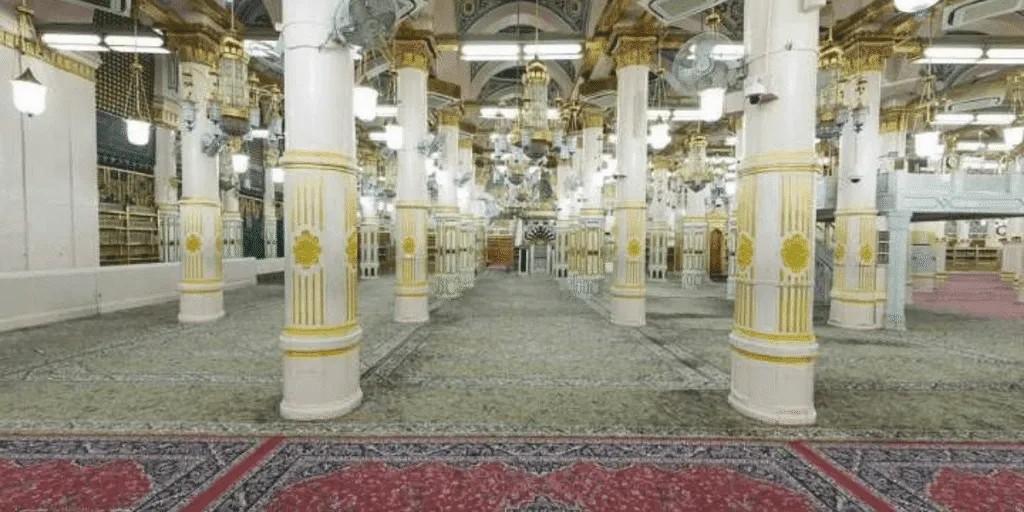
Riyad ul Jannah: The Complete History, Story and Visitor Guide to the Garden of Paradise in Masjid an-Nabawi
Walk through the Prophet’s Mosque in Madinah past the golden grille of the Sacred Chamber, past the pillars wrapped in gold-lettered green medallions, and you will feel the floor change before you consciously register why. The red carpet that covers the rest of Masjid an-Nabawi gives way to a green one, patterned with flowers, softer underfoot in memory if not in fact. You have entered a rectangle of stone and prayer rugs some twenty-two metres long and fifteen metres wide, hemmed in on one side by the house that became a grave and on the other by a pulpit that is not the pulpit it once was. This is Riyad al-Jannah — the Garden of Paradise — and the Prophet Muhammad ﷺ himself is the source of its name. He did not call it beautiful, or blessed, or holy in the vague way such words are used about a thousand shrines. He said, in words preserved with a chain of transmission as strong as anything in the entire hadith corpus, that this particular strip of ground is one of the gardens of Paradise.
This guide is about the Rawdah as it exists to be prayed in, queued for, and stood upon: its exact boundaries and disputed dimensions, the story of its green carpet, the six named pillars that still carry the memory of the first mosque’s palm-trunk columns, the minbar and the long, surprising history of its many replacements, the hadith of its virtue and the honest scholarly disagreement over what that virtue means, and the modern Nusuk permit system that now governs, minute by minute, who may stand there and when. It also corrects two things that are widely repeated about this place and are not quite true — the claim that the famous Qaytbay minbar of 888 AH still stands in the mosque today, and the claim that seventy thousand angels descend upon the Rawdah every day as a matter of prophetic teaching. Both claims are addressed in full below, in their proper places, with the sourcing that corrects them. The building history of Masjid an-Nabawi as a whole, and the full account of the Sacred Chamber and the Prophet’s burial, are treated in companion articles on this site; this guide keeps its focus tightly on the Rawdah itself, as a place of prayer and as a visitor destination in 2026.
Historical Background: The Garden Before It Had a Name
What “Riyad al-Jannah” Actually Names
Riyad al-Jannah — literally “gardens” or “meadows” of Paradise, the plural of rawdah — is the name that has attached itself, through the Prophet’s own words, to the area inside Masjid an-Nabawi lying between his house and his pulpit. In everyday usage today the term is used almost interchangeably with al-Rawdah, “the Garden,” the singular form, and both names point to the same physical space: a rectangle of the mosque’s original floor, now marked out with a distinctive green carpet, running along part of the qibla wall closest to the place where the Prophet ﷺ is buried (Madain Project — Rawdah Riyad ul-Jannah; Hajj and Umrah Planner — Rawdah).
It is worth being precise about what this place is not before describing what it is. It is not a separate building, not a shrine erected after the fact, not a space that was consecrated by ritual or architecture. It is a stretch of floor inside the first mosque of Islam that the Prophet ﷺ himself, in his own lifetime, described in a particular way — and it is that description alone that has made it, for fourteen centuries, one of the most fought-over few square metres of ground on earth, in the entirely peaceful sense that pilgrims contest for the chance to stand and pray on it.
The Geography of the Space: Where It Sits Inside the Mosque
Masjid an-Nabawi as it exists today is an structure of vast scale, its prayer hall stretching under domes and chandeliers across an area almost unrecognisable from the modest enclosure the Prophet ﷺ built in 622 CE. The Rawdah sits within it not as a separate room but as a zone — bounded conceptually by the qibla wall on its southern side, by the golden grille around the Sacred Chamber (the former houses of Aisha and, later, the burial place of the Prophet ﷺ, Abu Bakr and Umar) on part of its eastern boundary, and by the minbar, the pulpit from which the Friday sermon is still delivered, marking its far end. To stand in the Rawdah today is to stand inside what was once the open courtyard of the Prophet’s own house-mosque, in the exact strip of ground where he led prayers, delivered sermons, received delegations, and slept during his retreats.
Because the mosque has been rebuilt, expanded and re-floored so many times across fourteen centuries — a history covered in full in the companion article on the mosque’s architecture — the Rawdah’s edges are not marked by any ancient wall or threshold you can point to and say “this is original.” What marks it today is carpet, memory, and the hadith itself. This is a place defined more by words than by masonry, which is part of what makes its physical boundaries a genuine subject of scholarly disagreement, addressed in detail below.
Pre-Islamic Madinah and the Ground Before the Mosque
Before the Hijra, the plot of land on which the Prophet’s Mosque and the Rawdah now stand was unremarkable — a patch of ground in the oasis settlement of Yathrib, used, according to the earliest accounts of the mosque’s founding, partly as a place for drying dates and partly as a burial ground for polytheists, owned by two orphaned brothers, Sahl and Suhayl, of the Banu Najjar. There was no shrine here, no sanctuary, no memory attached to this particular patch of earth that distinguished it from any other corner of the oasis. Its sanctity, like that of so many sites covered elsewhere in this series, is entirely a creation of what happened after the Prophet ﷺ arrived — not an inheritance from before Islam. The fuller story of the land’s acquisition, the building of the first mosque, and its expansions through the Rashidun, Umayyad, Abbasid, Mamluk, Ottoman and Saudi periods belongs to the companion article on the history of Masjid an-Nabawi; what concerns this guide is only the strip of that mosque that came, through the Prophet’s own words, to be called a garden of Paradise.
Why This Place Became Central to Ziyarah in Madinah
Every one of the great historical and spiritual sites this series covers — Uhud, Quba, the Qiblatayn mosque, the Sacred Chamber itself — draws its importance from an event: a battle, a migration, a revelation, a burial. The Rawdah’s importance is different in kind. No single dramatic event happened here that made it sacred. Its status rests entirely on a spoken description, repeated by the Prophet ﷺ and preserved by multiple independent chains of transmission, that this specific ground is “one of the gardens of Paradise.” That description alone has been enough, across fourteen centuries, to draw pilgrims from every part of the Muslim world to a rectangle of floor roughly the size of a modest house, and it is why, in the modern era, the Saudi authorities have found it necessary to build an entire digital booking system just to manage the volume of people who wish to pray on it. Few places in Islamic history illustrate so clearly how much weight a single sentence from the Prophet ﷺ can carry across time.
The Story Behind the Place: How a Corner of a House Became a Garden of Paradise
The First Mosque and the Ground It Stood On
When the Prophet ﷺ arrived in Yathrib in 622 CE, one of his first acts was to build a mosque — not a grand structure, but a modest enclosure of sun-dried mud brick, its roof supported by trunks of date palms driven into the earth, its floor bare ground or, at best, a covering of pebbles and sand. Attached to this mosque, along its eastern side, were built the simple rooms that would house the Prophet’s ﷺ family — rooms of the same mud brick and palm-frond construction, each with a door opening directly onto the mosque courtyard. It was an arrangement of total intimacy: the Prophet ﷺ lived, in the most literal sense, inside the mosque compound, and his household’s daily life and the community’s daily prayers shared the same walls.
The palm trunks that held up the roof were not decorative. They were structural, driven into the ground at intervals, and it is against one of these plain, working trunks — not a monument, not a carved pillar, simply a piece of the roof’s support system — that the Prophet ﷺ would stand or lean while delivering his sermons to the small early community of Muslims. There was no raised platform. There was no pulpit. There was a man standing on the bare earth beside a tree trunk, speaking to people sitting on the ground around him. It is difficult, standing today in the marbled, chandeliered vastness of the modern Prophet’s Mosque, to reconstruct in the mind how plain this original space actually was — and that plainness matters, because everything that eventually made this ground famous grew out of the ordinary, working geometry of that first small building.
The House Beside the Mosque and the Pulpit That Would Define a Boundary
As the community grew, the Prophet ﷺ needed somewhere to address people that a standing crowd could see and hear. According to the widely transmitted account from the Companion Sahl ibn Sa’d al-Sa’idi, preserved in Sahih al-Bukhari, people noticed that the Prophet ﷺ was tiring from standing for long periods while he spoke, and someone — variously described in different reports as a carpenter, a Roman craftsman, or the slave of an Ansari woman skilled in woodwork — built him a simple pulpit of tamarisk wood, roughly half a metre by just over a metre in size, with steps to raise him above the crowd (Madain Project — Minbar of the Prophet). This new minbar was set up a short distance from the old palm trunk, inside the same modest courtyard, near the same house where Aisha bint Abi Bakr lived.
It is this configuration — a house on one side, a pulpit a short distance away, and a strip of ordinary courtyard floor between them — that the Prophet ﷺ would go on to describe, more than once, in words that have echoed through fourteen centuries of Islamic devotion. He did not build a monument here. He did not consecrate the ground with any ritual beyond the prayers offered on it. He simply told his Companions what that particular stretch of floor, between his house and his pulpit, actually was.
The Weeping of the Abandoned Trunk
Before the story of the Rawdah’s naming can be told in full, one more scene belongs here, because it captures something essential about how deeply this small patch of ground was bound up with the Prophet’s ﷺ own life, and because it is one of the most tender and startling episodes recorded of him. When the new minbar was built, the Prophet ﷺ stopped leaning against the old palm trunk and began delivering his sermons from the pulpit instead. The trunk — the ordinary, load-bearing piece of a working building — is reported to have wept.
The Companion Ibn Umar narrated: “The Prophet ﷺ used to deliver his sermons while standing beside a trunk of a date-palm. When he had the pulpit made, he used it instead. The trunk started crying and the Prophet ﷺ went to it, rubbing his hand over it to stop its crying.” This is recorded in Sahih al-Bukhari 3583, graded Authentic (sahih) (sunnah.com/bukhari:3583). A second, equally authentic version comes from Jabir ibn Abdullah: “…The date-palm cried like a child! The Prophet ﷺ descended and embraced it while it continued moaning like a child being quietened. The Prophet ﷺ said, ‘It was crying for what it used to hear of religious knowledge given near to it.'” This is recorded in Sahih al-Bukhari 3584, also graded Authentic (sahih) (sunnah.com/bukhari:3584). A closely related version at Sahih al-Bukhari 918, again from Jabir, describes the sound as being “like a pregnant she-camel,” repeated once more at Bukhari 3585 via Anas — both also graded Authentic (sunnah.com/bukhari:918; hamariweb.com — Bukhari 3585).
A more elaborate version of this story circulates widely, in which the Prophet ﷺ is said to have offered the grieving trunk a choice — to be replanted and grow again as an ordinary tree, or to be planted in Paradise so that the friends of Allah might eat its fruit — and the trunk is said to have chosen Paradise. This version, with its spoken dialogue and the trunk’s expressed preference, comes from the genre of literature known as Dala’il al-Nubuwwah (“Proofs of Prophethood”), such as the work of that name by al-Bayhaqi (dalailalkhayrat.com, citing Bayhaqi’s Dala’il al-Nubuwwah). A note on authenticity: the core miracle — that the trunk audibly moaned or wept when the Prophet ﷺ stopped using it, and that he embraced it to quiet it — is authentic and mass-transmitted, reported through multiple Companions and recorded in Sahih al-Bukhari with several independent wordings. The additional detail of a spoken dialogue in which the trunk is offered, and chooses, a place in Paradise is a later, more elaborate literary layer belonging to the Dala’il al-Nubuwwah tradition. It should be told, because it has been lovingly transmitted for centuries and captures something true about how the earliest Muslims understood this event, but it should not be presented as though it carries the same authenticity as the Bukhari text itself. The trunk was later buried, by most accounts near or under the minbar; during a subsequent expansion of the mosque, most likely under the caliphate of Uthman ibn Affan, the Companion Ubayy ibn Ka’b al-Ansari is reported to have taken the remaining piece of the trunk into his own house, where it eventually decayed and was consumed by termites (Madain Project; dalailalkhayrat.com).
The Words That Named the Garden
It is against this backdrop — a house, a pulpit, a weeping trunk, and years of prayers offered on the bare floor between them — that the Prophet ﷺ spoke the words that gave this place its name. Multiple Companions transmitted variations of the same core statement, and the wordings differ in ways that matter, because they became, centuries later, the basis for genuine scholarly disagreement over exactly how large the blessed area actually is. The most widely transmitted and most authoritative version, reported by Abu Hurairah and recorded in Sahih al-Bukhari 1888 (also found at Bukhari 1196, 6588 and 7335), reads: “Ma bayna baiti wa minbari rawdatun min riyad al-jannah, wa minbari ‘ala hawdi” — “There is a garden from the gardens of Paradise between my house and my pulpit, and my pulpit is on my Lake Fount (al-Kawthar)” (sunnah.com/bukhari:1888; islamicurdubooks.com). A closely parallel version, reported by Abdullah ibn Zayd al-Mazini and recorded in Sahih Muslim 1390a, gives the same essential statement: “That which is between my house and my pulpit is a garden from the gardens of Paradise” (sunnah.com/muslim/15). The same wording, again from Abdullah ibn Zayd al-Mazini, is preserved in the Muwatta of Imam Malik, in the Book of the Qiblah (Madain Project).
These are not isolated, single-chain reports. This is, by the technical standard hadith scholars apply, a mutawatir hadith — one transmitted through so many independent chains that collusion or error across all of them becomes practically inconceivable (IslamQA #115693). Few statements attributed to the Prophet ﷺ about any physical location in the Islamic world carry this weight of transmission. When the earliest generation of Muslims heard this sentence, they were not hearing a poetic flourish. They were hearing what they understood to be a description of fact, delivered by a man whose words on matters of the unseen they had learned, through years of experience, to take entirely at their word.
The Variant Wordings and Why They Matter
Alongside the “my house” wording, other versions of this same hadith exist with different phrasing, and the differences are not trivial — they eventually determined how large the marked Rawdah is today. One version, narrated by Ahmad, Bayhaqi and Ibn Abi Shaybah, reads “between my grave and my pulpit is one of the gardens of paradise,” substituting “grave” for “house.” Scholars, including those consulted by IslamQA, have graded this specific wording as Weak (da’if) relative to the majority “house” wording, for two reasons: it departs from the phrasing used by the overwhelming majority of narrators, and if the Prophet ﷺ had actually said “my grave,” the Companions would have had no reason to disagree, as some historical reports suggest they did, over exactly where to bury him (IslamQA #115693). The authentic wording is understood to mean specifically Aisha’s house — the house in which the Prophet ﷺ was, in the event, buried — rather than “grave” as an independent, separately intended word.
Other versions widen the picture further. One report, transmitted by Ahmad and cited in visitor literature, has the Prophet ﷺ saying: “Between these houses (i.e. the houses belonging to the Prophet ﷺ) and my pulpit is one of the gardens of Paradise, and the pulpit is one of the gates of Paradise” — replacing the singular “my house” with the plural “these houses,” referring to all the dwellings of the Prophet’s ﷺ wives that once ran along the mosque’s eastern and northern walls (Hajj and Umrah Planner). A still wider version, narrated by Tabarani, al-Haytami and Ibn Shabbah, extends the described garden as far as the Prophet’s musallah — his open-air Eid prayer ground, near the site of today’s Masjid al-Ghamamah: “Between my house and my musallah is one of the gardens of Paradise.” Tradition records that the Companion Sa’d ibn Abi Waqqas built his own house specifically within the zone described by this widest version, in order to gain the blessing of living inside the Rawdah — a decision reportedly approved of by Aisha and other Companions (Hajj and Umrah Planner). This detail on Sa’d’s house is discussed further in the section on the boundaries below, and belongs to the same body of tradition that gives us three genuinely distinct scholarly opinions on how large the Rawdah actually is — opinions this guide sets out fully in the section on the Rawdah’s physical extent.
A Garden Without a Single Dramatic Event — and Why That Is the Point
Every other site in this series of guides has a story built from action: a march, a battle, a migration, a moment of danger survived. The Rawdah’s story is built from something quieter and, in its way, more remarkable — the accumulated weight of ordinary daily life lived in one small space by the Prophet ﷺ over the last decade of his life. He prayed here, five times a day, for years. He delivered the Friday sermon here, week after week. He received delegations here. He slept here during his retreats in Ramadan. He was consulted here on matters of war and peace, marriage and inheritance, worship and law. Companions guarded him here at night. A trunk wept here when he stopped leaning on it. And into this space, saturated with the accumulated texture of ordinary prophetic life, he spoke a sentence that told his community exactly what it was standing on. That is the story of the Rawdah: not a single dramatic morning, but years of quiet, repeated sanctity, named all at once by the man who had lived every day of it.
The Prophet ﷺ and This Place: Every Authentic Event Tied to the Rawdah
Daily Prayer and the Establishment of the Mihrab
For the greater part of his years in Madinah, the Prophet ﷺ led the five daily prayers from this space, standing at what would become known as Mihrab al-Nabi — the Prophet’s prayer niche — a position that later tradition and, according to some reports, Imam Malik himself, held to have shifted slightly over the mosque’s history but which remained anchored within the Rawdah’s boundaries. Before there was a decorative mihrab of the kind seen in later mosques, there was simply the spot where the Prophet ﷺ stood to lead the congregation, day after day, year after year. It is this sheer repetition — thousands of prayers, led in the same small space, over roughly a decade — that gives the ground its density of association, in a way no single event, however dramatic, could replicate.
The Friday Sermon From the Minbar
Once the first minbar was built, the Prophet ﷺ delivered his Friday khutbahs from it, week after week, for the remainder of his life. The minbar’s exact history — its several rebuildings, its steps, its eventual replacement by later dynasties — is treated in full in the dedicated section on the minbar below. What belongs here is the simple fact that this is where the Muslim community, gathered in its full number each Friday, heard the Prophet ﷺ speak directly, on matters ranging from the mundane organisation of communal life to the gravest questions of faith and the Hereafter. The minbar and the space in front of it, where the congregation sat and stood, form the second anchor point — alongside the house — of the entire Rawdah.
Receiving the Delegations of the Tribes
In the years following the conquest of Makkah and the return from the expedition to Tabuk, tribal delegations from across Arabia began arriving in Madinah to declare their acceptance of Islam and pledge their allegiance to the Prophet ﷺ. Ibn Kathir, in al-Bidaya wa al-Nihaya, records that 9 AH became known specifically as “the Year of Delegations” because of how many tribal groups arrived in this single year (Hajj and Umrah Planner). Many of these delegations were received by the Prophet ﷺ inside the mosque, in the area of the Rawdah near a door he sometimes used to enter — a spot later named Ustuwanat al-Wufud, the Pillar of the Delegations, discussed in detail in the section on the named pillars below. This was not simply administrative business. Each delegation’s arrival represented another tribe formally entering the Muslim community, and the Prophet ﷺ conducted this pivotal diplomatic and religious work in the same physical space where he led the five daily prayers.
Voluntary Night Prayer and the Fear of Making It Obligatory
According to tradition preserved in visitor literature and echoing a well-attested theme found independently in Sahih al-Bukhari and Sahih Muslim, the Prophet ﷺ performed voluntary night prayers, tahajjud, on a reed mat in a particular spot within this space — behind what would later be the house of Ali and Fatimah, inside what is now the enclosed Sacred Chamber area. Worshippers are reported to have begun joining him there, night after night, until a crowd had formed; the Prophet ﷺ then stopped praying in that visible spot, fearing that if the community came to see communal night prayer as something he did every night with others watching and joining, it might come to be regarded as an obligatory practice rather than the voluntary one it was meant to be (Hajj and Umrah Planner). A note on authenticity: the specific attribution of this event to this exact pillar comes from visitor-facing historical literature that does not cite a discrete hadith collection and number. The broader theme — the Prophet ﷺ leading a version of what became tarawih prayer in the mosque and then deliberately stopping when a crowd gathered, precisely out of concern that it might be made obligatory — is well established in Sahih al-Bukhari and Sahih Muslim. The location-specific claim tying this precisely to one named pillar should be treated as historical-topographical tradition rather than as part of the wording of an authenticated hadith.
I’tikaf and the Last Ten Nights of Ramadan
The Prophet ﷺ observed i’tikaf — spiritual retreat — in the mosque during the last ten nights of Ramadan in nearly every year of his life in Madinah, by most accounts missing only one year. During these retreats he slept in the mosque itself, on a simple bed made of palm fronds with a cushion stuffed with palm fibre, in a spot later marked as Ustuwanat al-Sarir, the Pillar of the Bed. A report from Ibn Umar describes this modest sleeping arrangement placed near the mosque’s lamps (Hajj and Umrah Planner; Madain Project). This detail is a useful corrective to any romanticised image of the Prophet’s ﷺ life: even during his most intensive periods of devotion, in the very heart of what would become the Garden of Paradise, his physical circumstances were those of a man living with total simplicity.
Being Guarded at Night
Aisha narrated that on one occasion the Prophet ﷺ said, “I wish that a pious man from my companions would guard me tonight,” and that the sound of clattering arms outside revealed it was Sa’d ibn Abi Waqqas who had come, unbidden, to stand watch — a report preserved in Sahih al-Bukhari (Hajj and Umrah Planner). This night-guarding by the Companions, out of concern for the Prophet’s ﷺ safety, is reported to have continued as a regular practice until the revelation of Surah al-Ma’idah 5:67 — “O Messenger, announce that which has been revealed to you from your Lord… and Allah will protect you from the people” — after which the Prophet ﷺ understood that formal human guarding was no longer necessary, since Allah Himself had promised him protection. The spot associated with this guarding, near the door by which the Prophet ﷺ would enter from Aisha’s chambers, became known as Ustuwanat al-Haras, the Pillar of the Guard, examined fully below.
The Sermon on Innovation and the Warning Against Excess at His Grave
Though the fuller treatment of the Prophet’s ﷺ burial belongs to the companion article on the Sacred Chamber, one point is directly relevant here, because it bears on how this very space should be approached by visitors today. The Prophet ﷺ is widely reported, across multiple authentic hadiths addressed more fully in the Hadith References section below, to have warned against turning graves — and by extension the veneration of any physical spot associated with a prophet or righteous person — into a site of excessive ritual, celebration, or practices resembling worship. This warning sits in a certain tension with the extraordinary virtue attached to the Rawdah itself, and reconciling the two — celebrating a place the Prophet ﷺ himself called part of Paradise, while avoiding the very excesses he warned against near his grave — is a live and important theme addressed throughout this guide, particularly in the sections on etiquette and common misconceptions.
What This Place Was Not: Guarding Against Overstatement
It is worth being as careful about what cannot be verified as about what can. No authentic hadith describes a specific miracle occurring inside the Rawdah beyond the weeping-trunk episode already discussed, which occurred at the boundary of this space. No authentic report describes the ground itself possessing any physical property — no claim, for instance, that the soil here differs materially from soil elsewhere, or that objects placed here acquire lasting properties of blessing. The sanctity of the Rawdah, on the evidence available, is a matter of the Prophet’s ﷺ description and the accumulated weight of what happened here during his lifetime — not of any additional, separately attested miracle beyond those already covered. This distinction matters for the section on common misconceptions later in this guide, where several popular but unverified claims about the Rawdah are addressed directly.
Qur’anic Connections: The Verses Woven Into the Rawdah’s Story
Surah al-Hujurat and the Pillar of the Delegations
﴿يَا أَيُّهَا الَّذِينَ آمَنُوا لَا تُقَدِّمُوا بَيْنَ يَدَيِ اللَّهِ وَرَسُولِهِ ۖ وَاتَّقُوا اللَّهَ ۚ إِنَّ اللَّهَ سَمِيعٌ عَلِيمٌ﴾
“O you who have believed, do not put yourselves before Allah and His Messenger but fear Allah. Indeed, Allah is Hearing and Knowing.” — Surah al-Hujurat 49:1
﴿يَا أَيُّهَا الَّذِينَ آمَنُوا لَا تَرْفَعُوا أَصْوَاتَكُمْ فَوْقَ صَوْتِ النَّبِيِّ وَلَا تَجْهَرُوا لَهُ بِالْقَوْلِ كَجَهْرِ بَعْضِكُمْ لِبَعْضٍ أَن تَحْبَطَ أَعْمَالُكُمْ وَأَنتُمْ لَا تَشْعُرُونَ﴾
“O you who have believed, do not raise your voices above the voice of the Prophet or be loud to him in speech like the loudness of some of you to others, lest your deeds become worthless while you perceive not.” — Surah al-Hujurat 49:2
Asbab al-nuzul (occasion of revelation): Tradition, transmitted via the Companion Zayd ibn Arqam, connects part of this surah to an episode involving members of the Banu Tamim delegation calling out loudly for the Prophet ﷺ from outside his wives’ private chambers, rather than waiting patiently or approaching with the proper decorum expected when addressing him (Hajj and Umrah Planner). The location of this incident is tied by tradition to the area later marked as Ustuwanat al-Wufud, the Pillar of the Delegations, examined in full in the section on the named pillars below — the same spot where the Prophet ﷺ received tribal groups throughout the Year of Delegations in 9 AH.
Classical tafsir: Commentators including Ibn Kathir read this surah as establishing a comprehensive etiquette of approaching the Prophet ﷺ — physically, verbally, and in matters of legal and religious judgement — as an expression of the reverence owed to him as the final Messenger. The opening verse, “do not put yourselves before Allah and His Messenger,” is understood not merely as a rule of courtroom procedure but as a broader principle: no believer should presume to judge, decide, or act ahead of the guidance given by Allah and His Messenger ﷺ.
Modern lesson: The proximity of this revelation’s traditional setting to the very spot where delegations were received — inside what is now part of the Rawdah — is a reminder that the etiquette taught in this surah was not an abstract principle but a live, practical correction delivered to real people who had, in their eagerness or their unfamiliarity with the Prophet’s ﷺ household, overstepped a boundary of respect. Visitors today, queuing and moving through the same physical space under very different circumstances, might reflect that lowering one’s voice, moving with patience, and not pushing past others are not merely modern crowd-control rules but echoes of an etiquette taught by revelation on this same ground.
Surah al-Ma’idah and the End of the Night Watch
﴿يَا أَيُّهَا الرَّسُولُ بَلِّغْ مَا أُنزِلَ إِلَيْكَ مِن رَّبِّكَ ۖ وَإِن لَّمْ تَفْعَلْ فَمَا بَلَّغْتَ رِسَالَتَهُ ۚ وَاللَّهُ يَعْصِمُكَ مِنَ النَّاسِ ۗ إِنَّ اللَّهَ لَا يَهْدِي الْقَوْمَ الْكَافِرِينَ﴾
“O Messenger, announce that which has been revealed to you from your Lord, and if you do not, then you have not conveyed His message. And Allah will protect you from the people. Indeed, Allah does not guide the disbelieving people.” — Surah al-Ma’idah 5:67
Asbab al-nuzul: Tradition holds that this verse was revealed at a point when Companions, out of concern for the Prophet’s ﷺ safety, had taken to guarding him personally at night — including, as recorded in Sahih al-Bukhari, Sa’d ibn Abi Waqqas, who stood watch at the spot later known as Ustuwanat al-Haras, the Pillar of the Guard. Upon this verse’s revelation, the Prophet ﷺ reportedly understood that Allah’s own promise of protection made the continued human night-watch unnecessary, and the practice of Companions guarding him at night in this manner is said to have ceased.
Classical tafsir: Commentators note that this verse carries a double message: an instruction to the Prophet ﷺ to convey the message fully and without fear, and a reassurance that his personal safety was under direct divine protection, not dependent on human vigilance. Some classical commentators connect this reassurance specifically to the period before this revelation, when the Prophet ﷺ and his Companions had reason to fear assassination attempts from hostile parties among the Makkans, the hypocrites of Madinah, or the Jewish tribes with whom relations had deteriorated.
Modern lesson: The pillar associated with this episode stands today within the Rawdah, a quiet physical reminder that even the Prophet ﷺ — protected, as this verse states, directly by Allah — was loved and guarded by ordinary men willing to spend their nights standing watch with a sword in hand. The lesson drawn by generations of visitors is one of sincere, active love expressed through practical sacrifice rather than sentiment alone.
Surah al-Anfal, Surah al-Tawbah, and the Pillar of Repentance
﴿يَا أَيُّهَا الَّذِينَ آمَنُوا لَا تَخُونُوا اللَّهَ وَالرَّسُولَ وَتَخُونُوا أَمَانَاتِكُمْ وَأَنتُمْ تَعْلَمُونَ﴾
“O you who have believed, do not betray Allah and the Messenger or betray your trusts while you know [the consequence].” — Surah al-Anfal 8:27
﴿وَآخَرُونَ اعْتَرَفُوا بِذُنُوبِهِمْ خَلَطُوا عَمَلًا صَالِحًا وَآخَرَ سَيِّئًا عَسَى اللَّهُ أَن يَتُوبَ عَلَيْهِمْ ۚ إِنَّ اللَّهَ غَفُورٌ رَّحِيمٌ﴾
“And [there are] others who have acknowledged their sins. They had mixed a righteous deed with another that was bad. Perhaps Allah will turn to them in forgiveness. Indeed, Allah is Forgiving and Merciful.” — Surah al-Tawbah 9:102
Asbab al-nuzul: These two verses, revealed years apart in the Qur’anic timeline but bound together by the seerah tradition into a single continuous story, are connected to the episode of Abu Lubabah ibn Abd al-Mundhir during the siege of Banu Qurayzah in 5 AH, told in full in the section on the named pillars below and again in the section on the Companions. Surah al-Anfal 8:27 is cited by tradition in connection with the act of betraying a confidence — Abu Lubabah’s gesture revealing to the besieged tribe that surrender would mean execution, after he had been sent by the Prophet ﷺ specifically as a trusted advisor. Surah al-Tawbah 9:102 is cited as the verse announcing Allah’s forgiveness for Abu Lubabah after his prolonged act of penitence, tying himself to a pillar in this mosque until the news of his pardon arrived.
Classical tafsir: Ibn Kathir, commenting on both verses, situates them within the broader Qur’anic theme of trust, betrayal, and the mercy available to a believer who sincerely acknowledges wrongdoing rather than either denying it or despairing of forgiveness. The phrase “mixed a righteous deed with another that was bad” is read as describing precisely a man like Abu Lubabah — a Companion of genuine faith and service to the Muslim community who nonetheless erred gravely in a single moment of weakness, and whose sincere and painful repentance became the very means of his forgiveness.
Modern lesson: The pillar tied to this story, Ustuwanat al-Tawbah, is recommended in visitor literature as a place to stand and personally seek Allah’s forgiveness, echoing Abu Lubabah’s example (Hajj and Umrah Planner). The theological point carried by these verses — that grave error, sincerely repented, does not place a person beyond the reach of Allah’s mercy — is inseparable from the physical space in which visitors stand today, making this one of the few pillars in the Rawdah where the Qur’anic connection is not merely thematic but directly, historically located.
On the Nature of Paradise Itself: Reading Ta-Ha 20:118–119 Alongside the Rawdah Hadith
﴿إِنَّ لَكَ أَلَّا تَجُوعَ فِيهَا وَلَا تَعْرَىٰ * وَأَنَّكَ لَا تَظْمَأُ فِيهَا وَلَا تَضْحَىٰ﴾
“Indeed, it is [promised] for you not to be hungry therein or be unclothed, and indeed, you will not be thirsty therein or be hot from the sun.” — Surah Ta-Ha 20:118–119
Asbab al-nuzul: This passage was revealed describing the conditions of Paradise promised to Adam before his descent to earth, part of the broader Qur’anic narrative of creation rather than any event connected to Madinah.
Classical tafsir and its bearing on the Rawdah debate: This passage becomes directly relevant to the Rawdah not through any historical connection but through a genuine scholarly argument over how literally to read the hadith “between my house and my pulpit is a garden from the gardens of Paradise,” examined fully in the Hadith References section below. The scholar Ibn Hazm, in his work al-Muhalla, explicitly cited this passage from Ta-Ha to argue against reading the Rawdah hadith as describing a literal transplantation of Paradise’s soil to earth — reasoning that the actual, described qualities of Paradise (no hunger, no thirst, no exposure, no heat) are manifestly absent from the ordinary, worldly ground of the Rawdah, which experiences heat, dust and the wear of millions of footsteps like any other floor (almosleh.com).
Modern lesson: This is one of the more intellectually serious debates connected to the Rawdah, and it is treated in full, with all its named positions, in the Hadith References section that follows. The lesson for the ordinary visitor lies less in resolving the debate — which remains open among serious scholars — than in recognising that even the most beloved and frequently repeated statements about sacred geography in Islam have historically been subjected to careful, honest scrutiny by the tradition’s own greatest minds, rather than accepted uncritically simply because they are beautiful.
Hadith References: The Rawdah in the Authentic Collections
The Rawdah is unusual among the sites in this series in that its entire claim to sanctity rests on a single, extraordinarily well-attested hadith and its close variants, rather than on a wide scatter of narrations describing different events. What follows is a working reference of the principal hadiths connected to the Rawdah, the minbar, and the named pillars, consolidated and graded. Where a well-loved claim rests on weaker ground, or on no hadith at all, this is stated plainly.
The Core Hadith of the Rawdah’s Virtue
- “There is a garden from the gardens of Paradise between my house and my pulpit, and my pulpit is on my Lake Fount.” Narrated by Abu Hurairah. — Sahih al-Bukhari 1888 (also found at Bukhari 1196, 6588, 7335). Authentic (sahih). (sunnah.com/bukhari:1888; islamicurdubooks.com)
- “That which is between my house and my pulpit is a garden from the gardens of Paradise.” Narrated by Abdullah ibn Zayd al-Mazini. — Sahih Muslim 1390a, Book of Pilgrimage. Authentic (sahih). (sunnah.com/muslim/15)
- “What is between my house and my mimbar is one of the meadows of the Garden.” Narrated by Abdullah ibn Zayd al-Mazini. — Muwatta Imam Malik, Kitab al-Qiblah. Authentic, consistent with the Bukhari and Muslim wordings. (Madain Project)
- Overall grading of the core hadith: Mutawatir — transmitted through so many independent chains that the collection of narrations as a whole is regarded as beyond reasonable doubt, even though individual chains are graded separately. (IslamQA #115693)
The Contested Variant Wordings
- “Between my grave and my pulpit is one of the gardens of paradise.” Narrated by Ahmad, Bayhaqi and Ibn Abi Shaybah. Weak (da’if) relative to the majority “house” wording — scholars note this wording departs from the phrasing used by the great majority of narrators, and that if it were the Prophet’s ﷺ actual words, the Companions would not have shown any uncertainty over his burial site, which some historical reports suggest they did. (IslamQA #115693)
- “Between these houses and my pulpit is one of the gardens of Paradise, and the pulpit is one of the gates of Paradise.” Narrated by Ahmad. Authentic in general transmission, understood as referring to the wider set of the Prophet’s ﷺ wives’ houses rather than the single house of Aisha; this forms the basis of the “wider” scholarly opinion on the Rawdah’s boundaries. (Hajj and Umrah Planner)
- “My pulpit is on one of the gates of paradise. Between the pulpit and Aisha’s house is one of the gardens of paradise.” Narrated by al-Haytami. Consistent with, and explanatory of, the majority “house” wording. (Hajj and Umrah Planner)
- “Between my house and my musallah is one of the gardens of Paradise.” Narrated by Tabarani, al-Haytami and Ibn Shabbah. Basis of the widest scholarly opinion on the Rawdah’s boundary, extending the described area as far as the Prophet’s ﷺ Eid prayer ground. (Hajj and Umrah Planner)
- “Between the minbar and the house of Aisha [is one of the gardens of Paradise].” Narrated by al-Tabarani in al-Mu’jam al-Awsat. Consistent with the majority wording. (IslamQA #115693)
- “The pillars of this pulpit of mine are firmly embedded in Paradise.” Narrated by Ahmad, al-Nasa’i and al-Hakim. Authentic, cited as supporting evidence for the minbar’s own connection to Paradise, separate from the Rawdah boundary question. (Hajj and Umrah Planner)
The Weeping Palm Trunk
- “The trunk started crying and the Prophet ﷺ went to it, rubbing his hand over it.” Narrated by Ibn Umar. — Sahih al-Bukhari 3583. Authentic (sahih). (sunnah.com/bukhari:3583)
- “The date-palm cried like a child… It was crying for what it used to hear of religious knowledge given near to it.” Narrated by Jabir ibn Abdullah. — Sahih al-Bukhari 3584. Authentic (sahih). (sunnah.com/bukhari:3584)
- Parallel wording, “like a pregnant she-camel.” — Sahih al-Bukhari 918, 3585. Authentic (sahih). (sunnah.com/bukhari:918; hamariweb.com)
- The elaborated “choice of Paradise” dialogue. Circulated via Dala’il al-Nubuwwah-genre literature (al-Bayhaqi). A more heavily embellished narrative layer on top of the authentic core; should not be presented as verbatim Bukhari wording. (dalailalkhayrat.com)
The Pillar of the Guard
- “I wish that a pious man from my companions would guard me tonight” — and the arrival of Sa’d ibn Abi Waqqas. Narrated by Aisha. — Sahih al-Bukhari. Authentic (sahih). (Hajj and Umrah Planner)
The Pillar of Perfume and the Spot of Prayer
- Removal and perfuming of spittle found on the qibla wall near this spot with khaluq. Narrated by Ahmad, Ibn Abi Shaybah, and Abd al-Razzaq. Historical report, not independently graded as a hadith of legal ruling in the sourcing available; treated as an authentic-tradition report on the Prophet’s ﷺ conduct rather than a hadith requiring the sahih/da’if apparatus applied to legal or doctrinal narrations. (Hajj and Umrah Planner)
- Al-Khayzuran bint Atta’s perfuming of the pillars during her pilgrimage in 170 AH. Reported by al-Samhudi in Wafa’ al-Wafa. Historical report (akhbar), not a Prophetic hadith. (Al Jumuah Magazine; Hajj and Umrah Planner)
The Pillar of Aisha and the Casting of Lots
- “If people knew about it, they would cast lots to pray here.” Attributed to Aisha, related via Abdullah ibn Zubayr. Athar (a report/statement of a Companion), not a hadith of the Prophet ﷺ himself; treated as a Companion-level report on the virtue of the spot. (Madain Project)
The Ka’b al-Ahbar Report on the Angels — and Why It Is Not a Hadith
One further report deserves careful, separate treatment here, precisely because it is repeated so often as though it were Prophetic teaching. The claim that seventy thousand angels descend upon the Rawdah every day is widely circulated in popular literature and casual conversation among pilgrims. It is not a hadith of the Prophet ﷺ. It is an athar — a report attributed to Ka’b al-Ahbar, an early Jewish convert to Islam and a transmitter of Judeo-Christian and Israelite traditions (Isra’iliyyat) into the early Muslim community, recorded with a chain reaching Ka’b in sources including al-Darimi, al-Bayhaqi’s Shu’ab al-Iman, Ibn al-Mubarak’s Kitab al-Zuhd, Abu Nu’aym’s Hilyah, and Qadi Isma’il’s Fadl al-Salat (marhabayamustafa.wordpress.com). Grading: Athar attributed to Ka’b al-Ahbar, not a Prophetic hadith. This claim is addressed again, in fuller context, in the Common Misconceptions section below; it is flagged here, at the point in this reference list where a reader might expect to find it, precisely so that it is not mistaken for one of the genuinely authentic narrations listed above it. Even granting that the chain of transmission reaching Ka’b himself may be sound, the ultimate origin of the report — whether it reflects Ka’b’s own knowledge, a genuine Islamic teaching he had received, or residual material from his earlier background — remains a separate question from hadith authenticity, and it must never be presented to visitors as something the Prophet ﷺ said.
A Related Practice Among the Companions and Early Scholars
- Salamah ibn al-Akwa’ was reported to be particular about praying specifically in the Rawdah. Scholarly opinion / historical report on Companion practice. (IslamQA.org (Hanafi))
- Ibn Taymiyyah related that Imam Ahmad ibn Hanbal preferred to pray in the Rawdah specifically. Scholarly opinion / historical report. (IslamQA #115693)
A Note on Two Citations Flagged for Independent Re-Verification
Two hadith citations that circulate in popular etiquette literature about behaviour in the Rawdah and the wider mosque deserve a caution here. A prohibition on raising one’s voice in the mosque is commonly cited to Sunan al-Nasa’i 709, and a warning against treating the Prophet’s ﷺ grave as a place of celebration is commonly cited to Musnad Ahmad 7356 (Prayer Times KSA). Both citations, as sourced for this guide, come from a single secondary aggregator rather than a primary hadith-database cross-check, and readers and future editors should treat the specific numbering as provisional pending independent confirmation against sunnah.com or an equivalent primary index, even though the underlying principles — lowering one’s voice in the mosque, and not treating a grave as an occasion for celebration or excessive ritual — are well established in the wider hadith corpus through other, independently verified routes discussed elsewhere in this guide.
Historical Development: The Rawdah Through Fourteen Centuries
The fuller architectural and political history of Masjid an-Nabawi as a whole is the subject of a companion article on this site. What follows here traces only the developments that directly affected the Rawdah, its pillars, its minbar and its carpet, from the Rashidun period to the present day.
The Rashidun Period (11–40 AH / 632–661 CE)
In the years immediately following the Prophet’s ﷺ death, the mosque he had built remained, in essential outline, the same modest structure he had known, though the community’s needs were already beginning to press against its walls. Abu Bakr and, more substantially, Umar ibn al-Khattab expanded the building’s footprint to accommodate a rapidly growing congregation, but the core relationship of house, pulpit and the garden of ground between them remained the defining geography at the heart of the mosque. It is reported that Abu Bakr and Umar, as caliphs, declined to stand on the minbar’s topmost step when delivering sermons, out of deference to the Prophet ﷺ, who alone had stood there — a small but telling gesture of the reverence the earliest generation held for even the physical furniture of prophetic memory.
The Umayyad Period (41–132 AH / 661–750 CE)
Uthman ibn Affan, in the last of the Rashidun caliphates, undertook a significant expansion and rebuilding of the mosque, and it is generally during this period, according to the sources, that the remaining piece of the original weeping palm trunk was removed and taken into the house of the Companion Ubayy ibn Ka’b al-Ansari, where it eventually decayed. Uthman is also credited with adding decorative elements to the minbar, including a fabric dome of Coptic linen placed over it and ebony covering for its steps (Madain Project — Minbar of the Prophet). Under the Umayyads proper, Mu’awiyah ibn Abi Sufyan is reported, around 50 AH (670 CE), to have considered relocating the minbar itself to Damascus, the new seat of Umayyad power — a plan abandoned, according to the sources, after public protest in Madinah. Further steps were added to the minbar during his reign or that of his governor Marwan, according to reports from al-Waqidi and Ibn al-Najjar (Madain Project).
The Abbasid Period (132–656 AH / 750–1258 CE)
By the time of the Abbasid caliph al-Mahdi, reigning in the latter decades of the eighth century CE, the minbar had grown to nine steps through a series of successive additions. Al-Mahdi is reported to have considered removing the six added steps to restore the minbar closer to its original three-step form, but was dissuaded by none other than Imam Malik ibn Anas, who feared that dismantling the aged wooden structure risked damaging or destroying it altogether — a direct intervention by one of the four great imams of Sunni jurisprudence in the physical preservation of this specific object (Madain Project). Earlier in this period, in 170 AH (786 CE), al-Khayzuran bint Atta, mother of the Abbasid caliph Harun al-Rashid, performed pilgrimage and, according to al-Samhudi’s account in Wafa’ al-Wafa, personally anointed the pillars of the Rawdah with perfume — an act of devotion by one of the most powerful women in the Abbasid court, directed at this specific patch of the mosque’s floor (Al Jumuah Magazine). Later in the Abbasid period, the traveller Ibn Jubayr, visiting in 578 AH (c. 1182 CE), described a minbar as tall as a standing man, with eight steps and a door that was usually kept locked except on Fridays — a description preserved via al-Samhudi (Madain Project).
The Mamluk Period (656–923 AH / 1258–1517 CE)
The Mamluk period brought both catastrophe and renewal to the minbar’s history. The minbar described by Ibn Jubayr, repaired repeatedly over the centuries, was ultimately destroyed by fire in 654 AH (1256 CE). A replacement was sent by the king of Yemen, al-Malik al-Muzaffar Shams al-Din, arriving in 656 AH (1258 CE). This in turn was replaced under the Mamluk sultan Baybars al-Bunduqdari, then again by Sultan Barquq around 707 AH (1395 CE), and then by the Mamluk sultan al-Mahmudi, whose minbar was sent in 1417 CE and was itself destroyed in a second great fire in 886 AH (1481 CE), after which the Medinans of the time built a crude, temporary replacement of brick and plaster while a permanent solution was arranged (Madain Project). It was to replace this crude interim structure that the Mamluk Sultan of Egypt, al-Ashraf Qaytbay, commissioned an elaborate new minbar, which arrived and was installed in 888 AH (1483 CE) (al-Riyadh newspaper; Madain Project). This Qaytbay minbar is discussed in full, including an important correction to a popular misconception about its fate, in the dedicated section on the minbar below.
The Ottoman Period (923–1337 AH / 1517–1918 CE)
The single most significant Ottoman-era development affecting the object at the very heart of the Rawdah’s ritual life was the replacement of the Qaytbay minbar. Roughly a century after its installation, in 998 AH (1590 CE), the Ottoman Sultan Murad III sent a new minbar, carved from marble by master craftsmen from Istanbul, to replace Qaytbay’s structure. The Qaytbay minbar was not destroyed; it was relocated to Masjid Quba, where elements of it are preserved to this day (al-Riyadh newspaper; Madain Project). The marble minbar installed under Murad III is, by the sourcing available for this guide, the minbar that still stands in Masjid an-Nabawi today — a point of correction addressed at length in the dedicated section on the minbar. Ottoman-era reconstruction is also responsible for the decorative form in which the Rawdah’s named pillars appear today: each marked with a gold Arabic inscription set within a large green circle, itself encircled by a golden wreath, standing on or near the spots of the original date-palm-trunk columns of the first mosque (Madain Project — Notable Pillars in Rawdah).
The Saudi Period (1344 AH / 1925 CE – Present)
The Saudi era has brought the most extensive physical transformation of the mosque as a whole, covered fully in the companion article on the mosque’s architecture, but two developments belong specifically to the Rawdah’s own story. The first is the changeover of the mosque’s carpet from red to the now-iconic green. According to Saudi Arabic-language reporting from the newspaper al-Jazirah, sourcing officials of the General Presidency for the Affairs of the Two Holy Mosques, carpets for the Two Holy Mosques were imported from three countries between 1402 AH and 1420 AH, after which domestic Saudi manufacturing took over. In 1420 AH, the domestically produced carpets were red. In 1434 AH (approximately 2013 CE), domestic production shifted to the green colour that prevails today, with the Rawdah and the old mosque area among the first to receive it, followed by a phased rollout across the rest of the mosque through 1439, 1440, 1441 and 1443 AH (al-Jazirah newspaper; corroborated by Haramain Archives). The exact calendar date on which the very first green carpet was laid inside the Rawdah specifically, as opposed to the wider old-mosque hall, could not be confirmed in the sourcing available for this guide; Arabic-language sources describe the changeover as a phased, multi-year rollout rather than a single dated event, and this guide states that honestly rather than inventing a precise date.
The second major Saudi-era development is the introduction, in the 2020s, of the mandatory Nusuk digital permit system for Rawdah access — a change so significant to how pilgrims actually experience this space today that it occupies its own extensive treatment in the Practical Visitor Guide section later in this article.
Architecture: The Rawdah as It Stands Today
The Rawdah’s architecture is, in one sense, the least monumental in this entire series of guides. There is no dome built specifically over it, no gate, no threshold marking its edge in stone. Its architecture is instead a layered accumulation: the ghost-plan of the first mosque’s palm-trunk columns, preserved in the position of pillars that are themselves centuries younger than the columns they mark; a carpet whose colour has changed within living memory; a minbar that is, in the strictest sense, not the same physical object the Prophet ﷺ used, but the latest in an unbroken chain of replacements standing in the same consecrated spot. Understanding the Rawdah architecturally means understanding this layering, rather than expecting a single, continuous structure.
Boundaries and Dimensions: Three Scholarly Opinions
Exactly how large is the Rawdah? The honest answer is that it depends which hadith wording a scholar takes as definitive, and three distinct opinions have circulated through the centuries.
Opinion 1, the narrowest, and the one used today: the Rawdah lies strictly between the Prophet’s ﷺ house — Aisha’s house, which came to contain his grave — and his minbar. This reading rests on the majority “my house” wording of Sahih al-Bukhari 1888 and its parallels, on the hadith describing the minbar’s pillars as “firmly embedded in Paradise” (narrated by Ahmad, al-Nasa’i and al-Hakim), and on the variant “between my grave and my pulpit,” which, though graded weak in its exact wording relative to “my house,” is understood to describe the same physical area once “grave” is read as pointing to the house in which the Prophet ﷺ was later buried. These converging narrations describe an area measuring about 26.5 metres from west to east along the mosque’s original southern, qibla-facing wall, extending no further (Hajj and Umrah Planner).
Opinion 2, wider: the Rawdah extends between all of the Prophet’s ﷺ wives’ houses — which historically ran along the mosque’s eastern and northern walls, up to the old Bab al-Rahmah — and his minbar. This reading rests on the hadith narrated by Ahmad: “Between these houses and my pulpit is one of the gardens of Paradise, and the pulpit is one of the gates of Paradise” (Hajj and Umrah Planner).
Opinion 3, widest: the Rawdah extends as far as the Prophet’s ﷺ musallah, his open-air Eid prayer ground, near the site of today’s Masjid al-Ghamamah, based on the hadith narrated by Tabarani, al-Haytami and Ibn Shabbah: “Between my house and my musallah is one of the gardens of Paradise.” Tradition records that the Companion Sa’d ibn Abi Waqqas built his own house specifically within this widest described zone, in order to live inside the blessing of the Rawdah — a decision reportedly approved of by Aisha and other Companions (Hajj and Umrah Planner).
Today’s physical marking follows Opinion 1 — the narrowest and most conservative of the three readings — and it is this area, and no more, that is marked with the distinctive green carpet visitors see and queue to stand on (Hajj and Umrah Planner). This is worth pausing on: the Rawdah that pilgrims visit today represents the most cautious of three legitimate scholarly readings of the hadith, not the most expansive. A pilgrim praying anywhere within the wider zones described by Opinions 2 or 3 — which is to say, in large parts of the historic core of the mosque — is, on those readings, also praying within a garden of Paradise, even without the green carpet beneath their feet.
Measured Dimensions
The overall historical footprint of the Rawdah, following the narrowest and most commonly cited reading, measures approximately 26.5 metres east to west along the original qibla wall. Because part of this strip lies inside the Sacred Chamber itself, behind the golden grille and inaccessible to the general public, the publicly accessible length is about 22 metres. Its width, running north to south, is approximately 15 metres, giving a total accessible area of roughly 397.5 square metres (Hajj and Umrah Planner — Rawdah; consistent figures at IslamicLandmarks.com, Al Maqam Transport, and Madain Project).
The space is broadly rectangular, though as the mosque has been rebuilt and re-floored across the centuries, the “clear physical boundaries” of the original space have, in the words of one visitor-facing source, “blurred” somewhat; the roughly 22-by-15-metre figure remains the commonly cited modern working measurement used by pilgrimage planners and mosque authorities alike (Prayer Times KSA). To put this in terms a visitor can hold in mind while queuing: it is an area smaller than many suburban house plots, into which, on any given day during peak Umrah season, thousands of individually scheduled pilgrims are guided in carefully managed waves, each given only a few minutes to pray before making way for those queued behind them — a scale mismatch between the space’s tiny physical footprint and its immense spiritual gravity that shapes almost everything about the modern visitor experience described later in this guide.
The Green Carpet: Appearance, Symbolism and Dating
The single most visually distinctive feature separating the Rawdah from the rest of Masjid an-Nabawi is its carpet — a green carpet with floral patterns, standing in deliberate contrast to the red carpet historically used throughout the remainder of the mosque (The Might of Pen; Al Maqam Transport). The choice of green is not arbitrary. Green echoes the imagery of “gardens” — riyad — invoked directly in the hadith that names this space, and it carries a long-standing association with Paradise in Islamic visual and textile culture generally; the floral pattern woven into the carpet reinforces this garden theme visually, so that the metaphor of the hadith is, in effect, made walkable (Haramain Antiques).
The carpet’s colour has not always been green, and its change is more recent than many visitors assume. According to Saudi Arabic-language reporting from the newspaper al-Jazirah, sourcing officials of the General Presidency for the Affairs of the Two Holy Mosques, carpets for the Two Holy Mosques were imported from three countries between 1402 AH and 1420 AH, at which point domestic Saudi manufacturing took over. The carpets produced domestically in Saudi Arabia in 1420 AH were red. The shift to green came in 1434 AH, roughly 2013 CE, when domestic production changed to the green colour that prevails today — and this shift covered the Rawdah and the old mosque area first, ahead of the rest of the building (al-Jazirah newspaper). This account is corroborated in English by the Haramain Archives, which states plainly: “In 1420 AH, the carpets were manufactured in Saudi Arabia in a distinguished red colour. In 1434 AH, the colour was changed to green, and this shade is used to this day” (Haramain Archives).
The rollout was phased rather than instantaneous, reaching different parts of the mosque in different years: the Bab al-Salam corridor in 1439 AH; the old Haram carpet and the Rawdah unified to green, replacing red, in 1440 AH; expansion areas and the roof in 1441 AH; and the courtyard carpets in 1443 AH (al-Jazirah newspaper). A vendor listing for a fragment of an original Rawdah carpet describes the piece as dating to the “King Abdullah Era,” labelled “Green: 2004–2014,” a window consistent with the 1434 AH transition (Haramain Antiques). The precise calendar date on which the very first green carpet was laid specifically inside the Rawdah, as distinct from the wider old-mosque hall with which Arabic sourcing tends to group it, could not be confirmed; this guide states that limitation honestly rather than inventing a specific day.
The carpet itself is a considerable feat of textile engineering. According to al-Jazirah‘s reporting, the acrylic pile weighs approximately 4,000 grams per square metre, with a pile height of 14 millimetres and a total carpet height of 16 millimetres, woven at a density of 575,000 knots per square metre. It is manufactured locally to standard sizes of 6 metres and 4 metres in length, and 155 centimetres or 133 centimetres in width, depending on whether it is destined for a prayer hall or a courtyard (al-Jazirah newspaper). For a pilgrim kneeling on it, none of this technical detail is visible or, in the moment, relevant — but it reflects a level of deliberate, state-level care applied to the physical experience of prayer in this exact spot that few textiles anywhere in the world receive.
The Named Pillars: Introduction and Overview
Scattered through the Rawdah are a small number of marble pillars distinguished from their neighbours by a striking decorative feature: a large green circle bearing a gold Arabic inscription, itself ringed by a golden wreath. These pillars are Ottoman in their present decorative form, products of the extensive Ottoman-era reconstruction of the mosque, but they mark something far older — the positions of the original date-palm-trunk columns that supported the roof of the very first mosque built in 622 CE (Madain Project — Notable Pillars in Rawdah). In other words: the pillars you see today are not the pillars the Prophet ﷺ touched, but they stand, by continuous tradition, exactly where those original supports once stood, making them one of the very few places in the mosque where a visitor can point to a specific spot and say, with real historical confidence, “the Prophet ﷺ stood here.”
Sources broadly agree on six pillars accessible to the general public within the open Rawdah, plus two further pillars enclosed within the Sacred Chamber and inaccessible to ordinary visitors, giving a commonly cited total of eight historic pillars — though some sources describe a ninth, Ustuwanat al-Tahajjud, and disagree on whether it belongs among the accessible six or the enclosed two. This guide follows the six most consistently and independently corroborated pillars as its core list — Ustuwanat al-Mukhallaqah (also called al-Hannana), al-Wufud, al-Sarir, al-Haras, al-Tawbah, and Aisha — while noting Tahajjud’s disputed status explicitly where relevant, rather than presenting a false certainty about a point on which the sources themselves disagree (Madain Project).
Ustuwanat al-Mukhallaqah — the Pillar of Perfume, Also Called al-Hannana, the Weeping Pillar
This pillar stands directly behind, or at the site of, the current minbar and the Mihrab al-Nabi. It marks the spot of the original palm trunk against which the Prophet ﷺ used to lean while delivering the Friday khutbah, before the first minbar was built — the very trunk whose weeping, on being abandoned for the new pulpit, is recorded in Sahih al-Bukhari 3583 and 3584 and told in full earlier in this guide.
Its name, “al-Mukhallaqah” — “the perfumed one” — derives from khaluq, a musk-and-saffron perfume. According to a report narrated by Ahmad, Ibn Abi Shaybah and Abd al-Razzaq, the Prophet ﷺ once had spittle removed from the qibla wall near this spot and had the area perfumed with khaluq (Hajj and Umrah Planner — Pillars). Centuries later, al-Khayzuran bint Atta, mother of the Abbasid caliph Harun al-Rashid, is reported by al-Samhudi in Wafa’ al-Wafa to have anointed all the pillars of the Rawdah with perfume during her own pilgrimage in 170 AH — an act that likely reinforced, if it did not originate, the pillar’s enduring association with fragrance (Al Jumuah Magazine; Hajj and Umrah Planner).
Imam Malik is reported to have held that this is the best spot to pray in Masjid an-Nabawi, on the reasoning that the Prophet ﷺ stood here to lead prayers before the mihrab’s current position was established (Hajj and Umrah Planner). A note on authenticity: the underlying weeping-trunk hadith is authentic, recorded in Sahih al-Bukhari. The khaluq-perfuming episode and al-Khayzuran’s later visit are historical reports (akhbar) transmitted through later sources such as al-Samhudi, rather than Prophetic hadiths, and should be understood and presented as such — valuable historical tradition, not gradable hadith narrations.
Ustuwanat al-Wufud — the Pillar of the Delegations
The northernmost of the three pillars incorporated into the golden railing around the Sacred Chamber, historically standing near a door the Prophet ﷺ sometimes used to enter the mosque, this pillar marks the spot where he received the tribal delegations who came to accept Islam and pledge their allegiance — an activity especially concentrated in 9 AH, “the Year of Delegations,” following the conquest of Makkah and the return from the expedition to Tabuk, when groups including the Thaqif embraced Islam, as recorded by Ibn Kathir in al-Bidaya wa al-Nihaya (Hajj and Umrah Planner). The pillar is also historically known by the alternate name majlis ul-qalawah, “the seat of the nobles,” reflecting its use as a gathering place for tribal chieftains and senior Companions (Madain Project — Notable Pillars). Its Qur’anic connection, via the incident involving the Banu Tamim delegation and the revelation of Surah al-Hujurat 49:4–5, is discussed in the Qur’anic Connections section above.
Ustuwanat al-Tahajjud — the Pillar of the Night Prayer
Located behind the house of Ali and Fatimah, inside the Sacred Chamber and next to Mihrab al-Tahajjud, this pillar is not accessible to the general public. It marks the spot where the Prophet ﷺ performed voluntary night prayers on a reed mat, a practice that drew a growing crowd of worshippers night after night until the Prophet ﷺ deliberately stopped, fearing that night prayer might come to be regarded as obligatory if the community saw it performed communally on a regular basis (Hajj and Umrah Planner). As already noted in the section on the Prophet ﷺ and this place, the specific attribution of this story to this exact pillar is not accompanied, in the sourcing available, by a discrete hadith citation with collection and number; the broader theme is well attested in Sahih al-Bukhari and Sahih Muslim, but the topographical detail should be treated as historical tradition rather than as verified hadith wording. Different sources also disagree on whether this pillar belongs among the enclosed pillars of the Sacred Chamber or should be counted among the six normally discussed with visitors — a genuine, acknowledged discrepancy in the available literature.
Ustuwanat al-Sarir — the Pillar of the Bed
The southernmost of the three pillars incorporated into the railing around the Sacred Chamber, closest to the qibla, this pillar marks the spot where the Prophet ﷺ would sleep during his retreat, or i’tikaf, in the last ten nights of Ramadan — on a simple bed made of palm fronds, with a leather cushion stuffed with palm fibre. A report from Ibn Umar describes a cot of dried palm leaves placed here with a pillow, positioned near the mosque’s lamps (Hajj and Umrah Planner; Madain Project). The Prophet ﷺ is reported to have performed i’tikaf during the last ten nights of Ramadan in nearly every year following the Hijra, missing, by most accounts, only a single year (Hajj and Umrah Planner).
Ustuwanat al-Haras — the Pillar of the Guard, Also Known as Ustuwanat Ali ibn Abi Talib
The middle of the three pillars set within the railing around the Sacred Chamber, marking the door by which the Prophet ﷺ would enter from Aisha’s chambers, this pillar takes its principal name from the Companions who stood guard here at night, out of concern for the Prophet’s ﷺ safety — a practice recorded in Sahih al-Bukhari through Aisha’s narration of the night Sa’d ibn Abi Waqqas came, unbidden, to watch over him, and one that is understood to have ended with the revelation of Surah al-Ma’idah 5:67, both discussed above (Hajj and Umrah Planner). Its alternate name, the Pillar of Ali, reflects the fact that Ali ibn Abi Talib frequently stood guard and prayed at this spot, his and Fatimah’s house adjoining Aisha’s own. A tradition transmitted by Tabarani in al-Mu’jam al-Awsat states that the Prophet ﷺ visited Ali and Fatimah’s house daily for forty days following their marriage, reciting a greeting linked to the Qur’anic verse on purification (Hajj and Umrah Planner).
Ustuwanat al-Tawbah — the Pillar of Repentance, Also Known as Ustuwanat Abu Lubabah
Standing next to the Pillar of the Bed, in the first row of pillars closest to Mihrab al-Nabi — the fourth pillar from the minbar as one approaches the Sacred Chamber — this pillar is distinguished even in its stonework: the marble colouring on this particular row differs visibly from the rest of the Rawdah’s pillars (Hajj and Umrah Planner). It carries the single most emotionally powerful story attached to any pillar in the Rawdah, and it deserves to be told in full.
During the siege of Banu Qurayzah in 5 AH, in the immediate aftermath of the Battle of the Trench, the Prophet ﷺ sent the Companion Abu Lubabah ibn Abd al-Mundhir — a man of Banu Aws with long-standing ties of alliance to the besieged Jewish tribe of Banu Qurayzah — into their fortress to advise them on the terms of surrender. Banu Qurayzah, weighing whether to submit to the Prophet’s ﷺ judgement, asked Abu Lubabah directly whether they should. He answered “yes” — but as he spoke, he drew his finger across his own throat, a silent gesture signalling that submission would mean execution. It was an act of profound and immediate betrayal: Abu Lubabah, trusted by the Prophet ﷺ with a sensitive diplomatic mission, had revealed confidential intent to the very party he had been sent to negotiate with.
The moment he realised what he had done, Abu Lubabah was overcome with remorse. He did not wait to be confronted. He left the fortress, walked to the mosque, and tied himself to this pillar, swearing that he would not be released until either the Prophet ﷺ personally untied him or Allah forgave him. He remained bound for six days, his wife or daughter untying him only for the ritual washing before prayer and for the prayer itself, before retying him immediately afterward. He remained in this state of self-imposed penance until Surah al-Tawbah 9:102 was revealed, announcing his forgiveness. Umm Salamah, from whose house door the news was overheard as it was revealed, was the one who announced it; the Prophet ﷺ himself came at the time of Fajr and personally untied him (Hajj and Umrah Planner — Pillars; Madain Project — Notable Pillars).
A note on authenticity: the core outline of this story is a well-known feature of the seerah literature, generally traced to Ibn Hisham’s recension of Ibn Ishaq’s Sirah, with al-Bayhaqi cited for the detail of the Prophet’s ﷺ personal untying, and al-Samhudi, in Wafa’ al-Wafa, as the source for the additional detail that the Prophet ﷺ would spend time near this pillar with poorer Companions after Fajr. Seerah narrations transmitted through Ibn Ishaq and Ibn Hisham are frequently not subjected to the same isnad-critical rigour applied to hadiths in Bukhari and Muslim. That said, the essential episode — Abu Lubabah’s role at Qurayzah and the subsequent Qur’anic revelation announcing his forgiveness — is corroborated by the Qur’an itself, in Surah al-Anfal 8:27–28 and Surah al-Tawbah 9:102, and by early tafsir, including Ibn Kathir’s commentary on both verses. This gives the story strong historical standing as a seerah report with mixed but broadly acceptable chains. It should not, however, be labelled “sahih” in the strict technical sense a Bukhari isnad would carry. Visitors are commonly encouraged, in visitor literature drawing on this tradition, to stand near this pillar and seek Allah’s forgiveness, echoing Abu Lubabah’s example of sincere, total repentance.
Ustuwanat Aisha — the Pillar of Casting Lots, Also Called al-Muhajireen
Standing directly northeast of Mihrab al-Nabi, west of the Abu Lubabah pillar, this pillar carries a tradition in which the Companion Abdullah ibn Zubayr was told by his aunt Aisha that this spot was so blessed that “if people knew about it, they would cast lots to pray here” (Madain Project — Notable Pillars). This explains its alternative name, al-Qur’ah, “the pillar of casting lots” — a reference to drawing straws to settle who would have the privilege of praying there. Its further name, “the Pillar of the Emigrants,” reflects its historical association with the Muhajireen, the emigrants from Makkah, who are reported to have prayed here. A note on authenticity: this is an athar — a report or statement attributed to Aisha, preserved in later sources — rather than a hadith of the Prophet ﷺ himself, and should be treated as a Companion-level report on the virtue of the spot, not a Prophetic statement.
Two Further Pillars Inside the Sacred Chamber
Sources note two additional pillars inside the Maqsurah, the enclosed tomb area, inaccessible to the general public and not among the six normally discussed in visitor literature. One is described as the “Square Pillar of the Tomb” (Ustuwanah Murabba’ al-Qabr), also called the “Pillar of Jibril” (Hajj and Umrah Planner — Masjid Nabawi Pillars). These lie within the scope of the companion article on the Sacred Chamber, and only the fact of their existence is noted here for completeness. As already flagged, sources differ on the total count of named pillars — variously given as six, seven, eight or nine — and this discrepancy appears to stem largely from whether al-Tahajjud is counted among the enclosed pillars or the accessible ones. No single authoritative, universally agreed count could be confirmed in the research for this guide, and readers should treat the six pillars detailed above as the safest, most consistently corroborated core set.
The Minbar: From Palm Trunk to Ottoman Marble
The minbar’s own history is, in miniature, a history of the entire Islamic world’s changing custodianship of the Prophet’s ﷺ legacy — Rashidun caution, Umayyad ambition, Abbasid scholarship, Mamluk patronage, and Ottoman renewal, each leaving its mark on a single piece of mosque furniture that has, remarkably, never gone more than a few centuries without being rebuilt, repaired, or replaced entirely.
The story begins, as already told, with the bare palm trunk against which the Prophet ﷺ leaned to deliver his sermons in the earliest mosque. The first true minbar, built to spare him the fatigue of prolonged standing, was constructed of tamarisk wood, roughly half a metre by just over a metre in size, with three steps, around 629 CE (Madain Project — Minbar of the Prophet). Abu Bakr and Umar, as caliphs, are reported to have declined to use its topmost step out of deference to the Prophet ﷺ. Uthman ibn Affan added decorative elements, including a fabric dome of Coptic linen and ebony-covered steps. Mu’awiyah reportedly considered relocating the entire minbar to Damascus around 50 AH (670 CE) but abandoned the plan after protest, and further steps were added during his reign or that of his governor Marwan.
By the time of the Abbasid caliph al-Mahdi, in the late eighth century CE, the minbar had grown to nine steps; Imam Malik personally intervened to prevent al-Mahdi from removing the added steps, fearing damage to the ageing structure. Ibn Jubayr, visiting in 578 AH (c. 1182 CE), described an eight-step minbar as tall as a standing man, with a door kept locked except on Fridays — a minbar that was ultimately destroyed by fire in 654 AH (1256 CE). A Yemeni-sultan-donated replacement arrived in 656 AH (1258 CE), itself later replaced under Sultan Baybars al-Bunduqdari, then Sultan Barquq around 707 AH (1395 CE), then the Mamluk sultan al-Mahmudi, whose minbar (sent 1417 CE) was destroyed in a second fire in 886 AH (1481 CE), prompting a crude local replacement of brick and plaster (Madain Project).
The Qaytbay Minbar of 888 AH — and an Important Correction
It was to replace this crude interim structure that the Mamluk Sultan of Egypt, al-Ashraf Qaytbay, commissioned an elaborate new minbar, sent to the Prophet’s Mosque and installed in 888 AH (1483 CE) (Madain Project; corroborated in Arabic-language press by al-Riyadh newspaper, which confirms the Qaytbay minbar dates to 888 AH/1483 CE and was a gift following the fire of 886 AH). This minbar was a significant work of Mamluk craftsmanship, combining marble and wood in a style typical of the finest religious furnishings of Cairo in that period.
A claim is sometimes repeated — in casual conversation, in some tour narration, and occasionally in print — that this Qaytbay minbar of 888 AH is still in use today inside Masjid an-Nabawi. This is incorrect, and it is worth stating the correction plainly, with its sourcing. Multiple sources, including the Arabic-language newspaper al-Riyadh in an article specifically devoted to this minbar’s history, state that the Qaytbay minbar remained in place only until 998 AH, when the Ottoman Sultan Murad III sent a new minbar, carved from marble by master craftsmen from Istanbul, to replace it. The Qaytbay minbar was not destroyed. It was relocated to Masjid Quba, where relics and elements of it are preserved to this day (al-Riyadh — “Qaytbay Minbar… one of the historic minbars of Masjid al-Nabawi”; Madain Project).
The minbar that has stood in Masjid an-Nabawi since that replacement — the one from which the Friday khutbah is delivered today, and the one visitors see standing beside the Rawdah — is therefore the Ottoman marble minbar commissioned by Sultan Murad III, installed circa 998 AH (1590 CE) (Madain Project). If any source, guide, or piece of tour narration asserts that the Qaytbay minbar of 888 AH remains in use in the Prophet’s Mosque, that assertion should be corrected: the current minbar is later, Ottoman, and roughly a century younger than Qaytbay’s, which was honourably retired to Masjid Quba rather than destroyed or discarded.
Archaeological Findings
Unlike some of the battlefield and geographical sites covered elsewhere in this series, the Rawdah does not lend itself to conventional archaeological excavation. It sits inside the working, continuously used prayer hall of one of the two holiest mosques in Islam, under a marble and carpeted floor that has been rebuilt and re-laid repeatedly across fourteen centuries, and it is not a site where ground-disturbing archaeological survey has been conducted or published, for reasons that are as much reverential and practical as scientific — the space is in continuous, intensive use for prayer and cannot be closed for excavation in the way an abandoned battlefield or ruin might be.
What exists instead is a body of careful historical-topographical research, most notably the work of the fifteenth-century Madinan historian al-Samhudi, whose Wafa’ al-Wafa bi-Akhbar Dar al-Mustafa remains the single most important study of the mosque’s physical history, based on eyewitness observation, comparison of successive eras’ accounts, and the author’s own careful measurement and record-keeping rather than on excavation. Later travellers, including Ibn Jubayr in the twelfth century CE and Ibrahim Rif’at Pasha in the early twentieth, add further eyewitness description of the minbar, the pillars, and the general layout of the Rawdah in their respective periods, but these too are documentary rather than archaeological sources.
No published, peer-reviewed archaeological excavation report specific to the Rawdah’s floor, foundations, or sub-surface structure was identified in the research for this guide, and this should be stated plainly rather than glossed over: there are, at present, no published archaeological findings specific to the Rawdah as distinct from the documentary and topographical history already described above. What we know about the Rawdah’s physical development across the centuries comes overwhelmingly from written historical sources — hadith, seerah literature, and the topographical scholarship of writers like al-Samhudi — rather than from excavated material evidence. This is an honest limitation of the current historical record, not a gap this guide will paper over with speculation.
Stories of the Companions Connected to the Rawdah
The full seerah treatment of the Prophet’s ﷺ household and his burial belongs to the companion article on the Sacred Chamber. What follows here are the Companions whose connection to this site is specifically tied to the Rawdah as a place of prayer — its pillars, its boundary hadiths, and the events that unfolded within it.
Sa’d ibn Abi Waqqas
One of the ten Companions promised Paradise in his lifetime, Sa’d ibn Abi Waqqas appears twice in the Rawdah’s story. He is the Companion whose night-time vigil, arriving unbidden and armed to guard the Prophet ﷺ, gave the Pillar of the Guard its name, in the episode narrated by Aisha and recorded in Sahih al-Bukhari. Separately, tradition connects him to the widest of the three scholarly opinions on the Rawdah’s boundaries, recording that he built his own house within the zone described by the hadith “between my house and my musallah is one of the gardens of Paradise,” specifically in order to live within its blessing — a decision reportedly approved of by Aisha and other Companions (Hajj and Umrah Planner).
Ali ibn Abi Talib
Ali’s connection to the Rawdah is preserved in the alternate name of the Pillar of the Guard, Ustuwanat Ali ibn Abi Talib, reflecting the frequency with which he stood guard and prayed at this spot, adjoining as it did the house he shared with Fatimah bint Muhammad ﷺ, next door to Aisha’s own house. A tradition transmitted by Tabarani records that the Prophet ﷺ visited Ali and Fatimah’s home daily for forty days following their marriage.
Abu Lubabah ibn Abd al-Mundhir
The central figure of the Pillar of Repentance’s story, Abu Lubabah was a Companion of Banu Aws who had fought at the Battle of the Trench and was present at the subsequent siege of Banu Qurayzah in 5 AH. His moment of betrayal, his overwhelming remorse, and his six days bound to a pillar of this mosque until his forgiveness was revealed in Surah al-Tawbah 9:102, are told in full above. His story stands as one of the most human and instructive episodes connected to any site in this series — a portrait not of a man without fault, but of a man whose repentance was total, physical, and sustained until Allah Himself announced its acceptance.
Zayd ibn Arqam
The narrator of the Banu Tamim delegation incident, tied by tradition to the Pillar of the Delegations and to the revelation of Surah al-Hujurat 49:4–5, discussed in the Qur’anic Connections section above. Zayd’s testimony preserves not only the fact of the incident but the setting in which the Qur’an’s etiquette of approaching the Prophet ﷺ was first taught to the wider community.
Aisha bint Abi Bakr
Aisha’s connection to the Rawdah is more extensive than that of almost any other figure in this story. Her house is the reference point named in the majority wording of the core Rawdah hadith itself — “between my house and my pulpit” — and it was in this house that the Prophet ﷺ was, in time, buried. She is the narrator of the Pillar of the Guard hadith, describing the night Sa’d ibn Abi Waqqas came to watch over the Prophet ﷺ. And she is the source, related through her nephew Abdullah ibn Zubayr, of the athar describing the pillar that bears her name as a spot so blessed that people would cast lots to pray there, were its virtue more widely known.
Ubayy ibn Ka’b al-Ansari
A Companion renowned for his knowledge of the Qur’an, Ubayy ibn Ka’b is reported to have taken the remaining piece of the original weeping palm trunk into his own house following a mosque expansion traditionally dated to the caliphate of Uthman ibn Affan, where the wood eventually decayed and was consumed by termites — a quietly poignant end for an object that had, according to authentic hadith, once wept at being set aside.
Salamah ibn al-Akwa’
Reported in a secondary source drawing on Bukhari to have been particular about praying specifically in the Rawdah, Salamah ibn al-Akwa’ represents the wider pattern, echoed later by Imam Ahmad ibn Hanbal, of Muslims across the generations deliberately seeking out this specific spot for prayer because of its described virtue (IslamQA.org (Hanafi)).
A Caution on Unverified Companion Associations
Several popular pillar-history summaries circulating online and in casual tour narration list additional Companion associations with specific pillars or spots within the Rawdah without citing any primary source. These should be treated as unverified unless they can be traced to Bukhari, Muslim, or classical seerah texts in the manner demonstrated throughout this section. The Companions named above are those whose connection to the Rawdah rests on sourcing that could be traced and checked; readers should be cautious of any guide, in print or in person, who names additional figures without offering a comparable basis.
Stories of Great Islamic Scholars Tied to the Rawdah
Imam Malik ibn Anas
Few scholars in Islamic history are as closely tied to the Rawdah’s own legal and devotional life as Imam Malik, the founder of the Maliki school and a lifelong resident of Madinah. He is reported to have held that the spot marked by Ustuwanat al-Mukhallaqah — the Pillar of Perfume, at the site of the original palm trunk — is the single best place to pray in the entire mosque, on the reasoning that it was here the Prophet ﷺ stood to lead prayers before the mihrab’s later position was fixed (Hajj and Umrah Planner). He is also credited with a direct, physical intervention in the minbar’s preservation: when the Abbasid caliph al-Mahdi considered removing steps that had been added to the minbar over successive reigns, restoring it closer to its original three-step form, it was Imam Malik who dissuaded him, fearing that dismantling the aged wooden structure would damage or destroy it (Madain Project). On the interpretive question of how literally to read the Rawdah hadith, Imam Malik is reported to have held the literal position — that this exact tract of ground will be physically relocated to Paradise on the Day of Resurrection, comparable to the Black Stone, believed to be a stone descended from Paradise (Travel in Makkah).
Ibn Hajar al-Asqalani
The great commentator on Sahih al-Bukhari devoted careful attention, in his monumental Fath al-Bari, to the interpretive question of what it means for a place to be “a garden of Paradise.” Surveying the range of scholarly opinion — the view that the phrase is a simile for tranquillity and blessing, the view that it describes a path leading to Paradise, and the literal view held by Imam Malik and others — Ibn Hajar concluded, on balance, that the first opinion, reading the hadith as comparison rather than literal description, is the strongest, followed by the others in descending order of strength, while explicitly allowing the literal reading as a valid possibility rather than dismissing it (almosleh.com, citing Fath al-Bari 4/100 and 11/475). This measured, non-dogmatic weighing of interpretive options is characteristic of Ibn Hajar’s method throughout his commentary, and it is discussed further in the Hadith References section above.
Ibn Hazm
By contrast, the Andalusian scholar Ibn Hazm, in his work al-Muhalla, explicitly rejected any literal reading of the Rawdah hadith that imagines an actual piece of Paradise’s soil physically present on earth. His argument rested on analogy with other metaphorical hadith usages — such as “Paradise is under the shade of swords,” describing the reward of jihad rather than a literal location — and on the Qur’anic description of Paradise in Surah Ta-Ha 20:118–119, whose promised freedom from hunger, thirst, nakedness and heat is manifestly inconsistent with the ordinary, worldly nature of the Rawdah’s ground, subject as it is to heat, dust and wear like any other floor (almosleh.com). Ibn Hazm applied this same principle of caution against literal readings to other hadiths describing earthly rivers — the Sayhan, the Jayhan, the Euphrates and the Nile — as being “from the rivers of Paradise,” treating all such statements as figurative rather than literal transplantation.
Al-Qadi Iyad and al-Dawoodi
A third interpretive position, associated with al-Qadi Iyad — sometimes attributed in the sources to “al-Dawoodi’s view” — reads the hadith as a metaphor for a path that leads to Paradise: worship performed in this spot is a means that leads a believer toward Paradise, in the same sense that the hadith “Paradise lies in the shade of swords” describes jihad as leading to Paradise rather than literally being Paradise. This reading is discussed by Ibn Abd al-Barr in his work al-Tamhid (almosleh.com; IslamQA #115693).
Ibn Najjar
The historian Ibn Najjar is cited, alongside Imam Malik, as favouring the literal transfer reading of the Rawdah hadith. Some later scholars found this the strongest of the three positions specifically because the other two readings — simile for blessing, or metaphor for a path to reward — could, in principle, apply equally to any virtuous place of worship, and would fail to explain why this particular spot, rather than any other blessed place of prayer, receives such singular and specific description from the Prophet ﷺ (Travel in Makkah).
Al-Samhudi
Writing at the very end of the Mamluk period, al-Samhudi’s Wafa’ al-Wafa bi-Akhbar Dar al-Mustafa is the indispensable historical-topographical source for nearly every physical claim this guide makes about the Rawdah’s pillars, its perfuming, and its minbar’s succession of rebuildings. Al-Samhudi walked the ground of the mosque himself, weighed conflicting historical reports against one another, and recorded plainly which popular claims about the mosque’s history he considered unfounded — a scholarly discipline this guide has tried, in its own more modest way, to follow.
Ibn Kathir
The historian and exegete Ibn Kathir provides the primary classical account, in al-Bidaya wa al-Nihaya, of the Year of Delegations in 9 AH, connecting this period directly to the events associated with the Pillar of the Delegations. His tafsir on Surah al-Anfal 8:27 and Surah al-Tawbah 9:102 is likewise central to understanding the Qur’anic dimension of the Abu Lubabah story at the Pillar of Repentance.
Ibn Taymiyyah
Though his fullest relevance belongs to the companion article on the Sacred Chamber, Ibn Taymiyyah’s positions on grave etiquette and the correct limits of ziyarah bear directly on how the Rawdah should be approached today, given its immediate proximity to the Prophet’s ﷺ grave. He held that visiting a grave should involve only a simple greeting or salutation, not wiping or kissing any surrounding structure, and that seeking one’s needs directly from the deceased — even a prophet — rather than from Allah, constitutes an impermissible innovation in his view. This position is treated in fuller context in the Practical Visitor Guide and Common Misconceptions sections below (Ohio State University dissertation on ziyarah practices, citing Ibn Taymiyyah).
Al-Nawawi
Among the Shafi’i school’s greatest authorities, al-Nawawi’s commentary on Sahih Muslim addresses the Rawdah hadith directly, and his broader body of work on the etiquette of visiting graves — agreeing with scholars of the other schools that it is not sunnah to kiss the grave of any prophet or righteous person — is directly relevant to how visitors should conduct themselves at the boundary between the Rawdah and the Sacred Chamber.
Spiritual Reflection: Standing in the Garden
You have waited, perhaps for months, for a slot that lasts a few minutes. You have queued in a crowd that presses gently but insistently from every side, holding a phone with a QR code you have checked and rechecked. And then, quite suddenly, you are inside a rectangle of green carpet, and a guard’s hand is already, not unkindly, indicating where you should stand, and you understand that you have perhaps ninety seconds, perhaps two minutes, to do everything you came to do. What do you do with that time?
Consider first what you are actually standing on. Not a monument built by human hands to commemorate an event. Not a shrine erected by pious rulers centuries after the fact. A patch of ordinary ground, inside an ordinary house-mosque, about which a man who never spoke carelessly said: this, specifically this, is one of the gardens of Paradise. He did not say it about the whole of Madinah, though Madinah itself is sacred. He did not say it about the whole of the mosque, vast as it has since become. He said it about this exact space, no larger than a modest room, and he said it because he had lived every day of a decade inside it — praying in it, teaching in it, receiving strangers in it, sleeping in it during his most private devotions, being guarded in it at night by men who loved him enough to lose sleep over his safety. Ask yourself: what does it mean that Paradise, the reward promised to the righteous for eternity, has been described as touching this earth in one specific, named location — and that you are permitted, for these few minutes, to kneel inside it?
Think of Abu Lubabah, tied to a pillar a few steps from where you stand, for six days, refusing food he did not need to refuse and comfort he had no right, in his own eyes, to accept, until Allah Himself sent down the words that released him. He was not a stranger to faith. He had fought at the Trench. He had risked everything to follow the Prophet ﷺ from Makkah. And still, in a single unguarded moment, he betrayed a trust — and still, when he understood what he had done, his repentance was not a quiet regret carried privately in the heart. It was total, physical, and public, sustained for six days in the very space where you now stand for a few brief minutes. What does your own repentance look like, by comparison? Is it as total as his? Is it sustained, or does it evaporate the moment the guilt has passed?
Think of Sa’d ibn Abi Waqqas, standing guard through the night near the pillar that bears his memory, armed and alert, simply because the Prophet ﷺ had expressed a wish, not a command, that someone might do so. No one ordered him. He came because he loved the Prophet ﷺ, and love, when it is real, organises itself around the needs of the beloved without being asked. What have you given, lately, that no one asked of you?
Think, too, of the trunk of a tree — not a person, not a Companion, simply a piece of wood that had done its structural work faithfully for years — weeping, audibly, because it had been set aside for something better. If a tree could grieve the loss of proximity to the Prophet ﷺ and the knowledge that used to be spoken near it, what should a heart capable of intention and choice feel, standing this close, for these few minutes, before being moved along by the gentle pressure of the crowd behind it?
You will likely not have time for a long prayer here. The system that brought you here — the permit, the queue, the guard’s directing hand — exists precisely because there is not enough space or time for everyone who wishes to linger. This is not a flaw to resent. It is, in its way, an honest reflection of the space’s own history: even in the Prophet’s ﷺ lifetime, this was never a place of leisurely occupation. It was a place of purposeful prayer, purposeful teaching, purposeful diplomacy, purposeful guard duty, purposeful repentance. Every recorded use of this ground has a verb attached to it. No one is recorded simply sitting here to enjoy the atmosphere. Perhaps, then, the brevity forced upon you today is not a diminishment of the experience but an accidental restoration of something like its original character: come with purpose, do the thing you came to do — pray, ask forgiveness, make du’a for those you love and those who have wronged you and those you have wronged — and then make way, as the Companions themselves made way for one another’s needs in this same crowded, purposeful space fourteen centuries ago.
And when you are moved along, and the moment closes, and you find yourself back in the wider hall among the crowd, ask yourself honestly: did I use it. Not did I feel something — feeling is easy to manufacture and easy to mistake for substance. Did you use the minutes for what they were built for: sincere prayer, honest self-accounting, a request made to Allah with the same directness Abu Lubabah showed when he refused to be released until his Lord forgave him. The Rawdah does not require you to weep, or to feel overwhelmed, or to produce any particular emotional performance for those watching. It requires only that you meant what you prayed. That is available to you whether you have two minutes or twenty, whether you are pressed against strangers or briefly, improbably, alone.
Practical Visitor Guide: Praying in Riyad al-Jannah in 2026
This section is written for the pilgrim standing in Madinah, or planning to be there, who needs to know exactly how to get into the Rawdah, when, and what to expect once inside. The rules described here reflect the system as reported in 2025 and 2026 sourcing; because the Nusuk system is actively managed and adjusted by the Saudi authorities in response to demand, readers should always verify current details inside the app itself before travelling, and treat the specifics below as a reliable general guide rather than a fixed and permanent schedule.
The Nusuk Permit: Why It Exists and How It Works
As of 2025 and continuing into 2026, no worshipper may enter the Rawdah without a valid digital permit obtained through the official Nusuk app, the Saudi government’s official platform for Hajj and Umrah services (The Hajj Guide, 21 July 2026; Nusuk official site). This permit system exists for one simple reason: demand to pray in a rectangle of carpet measuring roughly 22 by 15 metres vastly exceeds the physical capacity of that space, especially during peak Umrah periods and the month of Ramadan (The Hajj Guide). Before the permit system, the Rawdah’s entrances during busy periods were, by all accounts, chaotic and at times genuinely dangerous, with dense crowds pressing toward a passage narrow enough that a small number of people at any moment could actually stand or kneel inside it. The Nusuk system replaced that chaos with a scheduled, ticketed flow.
The permit is free of charge and issued exclusively through the app. The process, in outline: download the Nusuk app, create an account, and verify your identity. From there, select the service listed as “Praying in the Noble Rawdah” — offered as two separate services, one for men and one for women — choose an available date and time slot, and receive a QR code that you must show or have scanned at the entrance to the Rawdah on the day (The Hajj Guide; Hajj and Umrah Planner).
Without a permit, entry is refused outright. Staff check the QR code before the door leading into the Rawdah, and no source consulted for this guide describes any informal, alternative, or discretionary entry route available to the general public without one (The Hajj Guide; Hajj and Umrah Planner). Each visitor needs an individual permit tied to their own identity; permits are not freely transferable within a family or group, so every member of a travelling party who wishes to enter — spouse, parent, adult child — needs their own separate booking (The Hajj Guide).
When Booking Opens: The Realities of the Release Window
This is the detail that causes the most frustration among pilgrims, and it is worth explaining honestly, including where the sourcing itself is inconsistent, because inconsistency is the actual, lived reality of this system. Reports on exactly how far in advance slots open vary by source and appear to have genuinely fluctuated over time as the Saudi authorities have adjusted the system in response to demand.
According to reporting from July 2026, slots “typically open seven to ten days in advance, often on Friday afternoons at 12:00 PM Saudi time,” and fill quickly once released (The Hajj Guide). Aggregated pilgrim experience reports from 2024, however, describe a tighter and more unpredictable window: slots opening “on the dot at the hour or half hour” and remaining visibly available for as little as a minute before filling, with the app typically showing availability for a rolling window of at most six days ahead, and at least the following day. One pilgrim reported checking specifically around Friday morning, 6:15 to 6:30 AM, and finding the entire following week’s slate of slots newly available and marked “green”; another suggested 11:00 AM Saudi time on Friday as the best time to check, though this was disputed by a different user in the same discussion (Hajj and Umrah Planner). As slots fill, the app is reported to mark them progressively orange, then red, then grey — fully booked — though cancellations do occasionally reopen a slot unexpectedly.
The honest, practical synthesis of this conflicting reporting is this: the exact release day and time have changed over the past two years and evidently continue to vary by season and demand. Do not plan your Madinah trip around a single, fixed release time you have read in any one article, including this one. Instead, install and familiarise yourself with the Nusuk app well before you travel, practise navigating to the Rawdah booking screen so you are not fumbling with an unfamiliar interface under time pressure, and in the days immediately before your intended visit, check the app repeatedly and persistently (Hajj and Umrah Planner).
On the question of how often a single person may book: historical guidance held that visitors were limited to one Rawdah permit within a 365-day period. More recent reporting, from December 2025, states that this one-year restriction has been relaxed or removed entirely, allowing multiple bookings without the prior waiting period. This specific claim, however, comes from a secondary source — a YouTube summary video rather than an official Saudi government statement — and should be treated with some caution pending confirmation through the app itself or an official announcement (YouTube — “Latest announcement for Riyaz ul Jannah timings,” 14 December 2025). If you are travelling with a specific need to visit more than once within a year, check your own account’s booking history and any in-app messaging directly rather than relying on any external report, including this one.
Men’s and Women’s Timings
Access to the Rawdah is organised separately by sex, with distinct time windows for men and women, and this has long been the case — one source describing the historical arrangement notes plainly that “the area allocated for women is open for limited hours only while that of men for the whole day” (The Might of Pen). A widely circulated announcement from December 2025, attributed to the General Presidency for the Affairs of the Two Holy Mosques, gives the following published timings:
- Men, regular days: 2:00 AM until Fajr; and 11:20 AM until Isha.
- Men, Fridays: 2:00 AM until Fajr; 9:20 AM until 11:20 AM; and after Jumu’ah until Isha.
- Women, regular days: after Fajr until 11:00 AM; and after Isha until 2:00 AM.
- Women, Fridays: after Fajr until 9:00 AM; and after Isha until 2:00 AM.
(YouTube — “Latest announcement for Riyaz ul Jannah timings,” 14 December 2025)
A separate, independent source from July 2026 gives a broadly consistent but not identical picture, describing men’s slots as typically falling in the early morning, roughly 7:00 to 10:00 AM, and again after Isha until around midnight, while women’s slots typically fall in a late-morning window, roughly 9:00 to 11:00 AM, and again after Isha (The Hajj Guide).
These two sources do not match exactly on clock times, and that mismatch is itself informative rather than a simple error in one or the other: timings are adjusted seasonally and according to crowd levels, and both sources explicitly warn readers to verify current timings inside the Nusuk app rather than rely on any fixed, permanently published schedule (The Hajj Guide). Treat the tables and ranges above as a reliable general shape of the day — men generally have broader access across more of the daily cycle, women a narrower, more concentrated set of windows — and confirm the live figures in the app before you plan your day around them.
Ramadan and Hajj-Season Restrictions
The permit system exists specifically because demand outstrips capacity, and this pressure is described consistently across sourcing as being at its most extreme during the month of Ramadan and the weeks surrounding Hajj (The Hajj Guide). What this guide cannot responsibly do is invent specific, granular rule changes for these periods. No source consulted in preparing this guide provided a distinct, official timing table specific to Ramadan or to the Hajj season — no confirmed statement of additional slot batches, altered timing windows, or the suspension of any particular access route unique to these periods. Given how easily a wrong specific claim here could mislead a pilgrim planning a once-in-a-lifetime trip, the honest and responsible guidance is general rather than specific: if you are travelling during Ramadan or around the Hajj season, expect substantially higher competition for every Rawdah slot, book as early as the app allows, have a backup plan for prayer without a permit (described below), and do not assume the regular-season timings and booking windows described above will apply unchanged. Check the app’s live information for the specific dates of your trip rather than relying on any general seasonal assumption.
Realistic Waiting Times
No source consulted for this guide gives a single, strongly sourced, official average waiting time in minutes, and this guide will not manufacture false precision where none exists in the underlying research. One secondary aggregator source suggests visitors typically spend “around 10 to 15 minutes” inside the Rawdah itself once admitted, reflecting the pace of crowd control and flow through the space rather than the total time from arrival to entry (Prayer Times KSA). This figure describes time inside the Rawdah, not the wait to get there.
Independent pilgrim-report sourcing describes a genuinely multi-stage queueing process: arriving at the mosque in advance of your booked slot time, queuing in the courtyard or a designated waiting area, potentially standing in that queue for a considerable period, then having your QR code checked at a controlled entry point, and in some cases waiting again in another part of the mosque before final admission into the Rawdah itself (Hajj and Umrah Planner). No single authoritative figure for total wait time, from the moment you arrive to the moment you actually stand in the Rawdah, could be confirmed; this varies considerably by day, season, and the volume of pilgrims in Madinah at the time. The practical advice that follows from this honest uncertainty is straightforward: build significant slack into your schedule around a Rawdah slot. Do not book transport, a meal, or another appointment tightly against either end of your permitted time window. Arrive earlier than you think you need to, and expect the whole process, door to door, to take considerably longer than the few minutes you will actually spend praying.
Eligibility for Umrah Visa Holders
No source consulted for this guide identifies a specific, distinct eligibility rule that separates Umrah-visa holders from Hajj-visa holders, tourist-visa holders, or Saudi residents when it comes to booking a Rawdah slot. Every source describes the Rawdah permit as a separate, mosque-specific booking layered on top of whatever visa or entry permission already grants a person legal presence in Madinah — meaning that, in principle, anyone legally present in Madinah and holding a Nusuk account can attempt to book a slot (Hajj and Umrah Planner). One source explicitly frames pilgrims “combining Umrah with a visit to Madinah” as a core group who should plan their booking process in advance, implying that Umrah-visa pilgrims are a central intended user group of the system rather than an excluded one (The Hajj Guide). No source stated that Umrah-visa holders are barred, or that they require any separate approval beyond the standard booking process. This guide states the conclusion as an inference from the absence of any stated restriction, combined with the explicit framing noted above, rather than as a positively confirmed official policy — and recommends that Umrah pilgrims simply proceed through the standard Nusuk booking process described above, verifying eligibility within the app if any doubt arises for their specific visa category.
What to Do Without a Permit
If you are unable to secure a Rawdah permit — whether because the booking window closed before you could act, because slots for your travel dates were fully booked, or because you are travelling with very short notice — you have not lost access to the spiritual reality this guide has described throughout. Several genuine options remain.
Pray as close to the Rawdah’s boundary as circumstances and crowd management allow. The scholarly opinions on the Rawdah’s extent discussed in the Architecture section above are directly relevant here: on the wider readings held by serious scholars — extending the blessed area to all the Prophet’s ﷺ wives’ houses, or as far as his musallah — significant parts of the historic core of the mosque beyond the green-carpeted rectangle may themselves fall within a garden of Paradise, even without a Rawdah-specific permit. Praying anywhere within the old mosque area, with sincerity, is not a consolation prize; it is prayer inside Masjid an-Nabawi itself, a virtue of enormous standing regardless of the Rawdah question.
Attend one of the five daily congregational prayers in the wider mosque. The reward of praying in Masjid an-Nabawi at all is described in authentic hadith as vastly exceeding prayer elsewhere, a virtue entirely separate from, and not dependent on, entry into the Rawdah specifically.
Make du’a from wherever you are able to stand or sit within the mosque. Supplication is not confined to any single rectangle of carpet, however blessed; the Prophet ﷺ taught that Allah is near to every servant who calls upon Him, in every part of His house.
Try again on a later day of your trip. Given the fluctuating and sometimes unpredictable release pattern of Nusuk slots described above, checking the app repeatedly across several days of a longer stay in Madinah materially improves your odds of finding an opening, including last-minute cancellations that occasionally free up a slot.
Keep your intention correct regardless of the outcome. The scholars whose views are surveyed throughout this guide agree on one point without exception: the Rawdah’s virtue lies in what the Prophet ﷺ said about it, not in any independent power of the ground itself to grant or withhold blessing based on whether a visitor’s feet happen to touch it. A pilgrim who could not obtain a permit, and who prayed sincerely elsewhere in the mosque with patience and good character, has not been shut out of the mosque’s blessing.
What You Will Actually See
Once inside, on a permitted visit, here is what you will encounter, in the order most visitors experience it: the transition from red to green carpet beneath your feet, often the first physical sign that you have crossed into the Rawdah; the golden grille of the Sacred Chamber to one side, marking the boundary beyond which the general public may not pass, and behind which lie the graves of the Prophet ﷺ, Abu Bakr and Umar, covered fully in the companion article on the Sacred Chamber; the Ottoman marble minbar, standing at the Rawdah’s far end, from which the Friday khutbah is still delivered today; and, scattered through the space, the pillars described at length in the Architecture section above, each marked by its gold-lettered green medallion. Security and mosque staff — referred to in casual pilgrim literature as “Askari,” or guards — actively manage the flow of people through this space, checking Nusuk QR codes at entry and directing movement once inside, given the extremely high ratio of visitors to available floor space (Hajj and Umrah Planner; The Hajj Guide).
Where to Stand
Within the time you are given, three points are worth deliberately seeking out if the flow of the crowd and the instructions of staff permit it. First, a position facing the mihrab area near Ustuwanat al-Mukhallaqah, understood by Imam Malik to be the single best spot to pray in the entire mosque. Second, a moment near Ustuwanat al-Tawbah, the Pillar of Repentance, where visitor tradition encourages standing to seek Allah’s forgiveness in deliberate echo of Abu Lubabah’s example. Third, whatever position the flow of the crowd brings you nearest to the golden grille of the Sacred Chamber, where the appropriate conduct — a simple, quiet greeting rather than any prolonged address or petition directed at the grave itself — is discussed fully in the companion article on the Sacred Chamber and touched on again in the misconceptions section below. In practice, staff direction and crowd volume will determine far more of where you actually stand than any preference of your own, and this should be accepted with patience rather than resisted.
Best Time to Attempt a Visit
Beyond the men’s and women’s timing windows already described, the general rhythm of crowding in Madinah follows familiar patterns: the periods immediately before and after the five daily prayers are busiest, as is virtually any time during Ramadan or the weeks around Hajj. Late night and pre-dawn windows — reflected in the men’s 2:00 AM to Fajr slot noted above — tend, by the nature of the hour, to draw a smaller and calmer crowd, though this comes at the cost of disrupting a normal sleep schedule during your trip. There is no single universally best hour; the honest guidance is to book whatever slot the app makes available to you, adjust your schedule around it, and treat any quieter period as a bonus rather than something to be relied upon in advance.
Etiquette: What to Do and What to Avoid
Do:
- Perform wudu before your visit, and try to arrive already in a state of ritual purity so you are not searching for facilities under time pressure.
- Dress modestly and respectfully, as you would for prayer in the wider Haram.
- Arrive 15 to 30 minutes before your booked slot, and keep your QR code readily accessible — open and ready on your phone, not something you need to search for while staff and other pilgrims wait (Prayer Times KSA).
- Pray your two rak’ahs of Tahiyyat al-Masjid, or whatever brief voluntary prayer you intend, make your du’a with sincerity, and then move along promptly. Others are waiting behind you for the same few minutes you have just been given (Prayer Times KSA — Rawdah Etiquette).
- Keep your voice low, in keeping with the general instruction not to raise one’s voice inside the mosque.
- Follow the instructions of security and mosque staff promptly and without argument, understanding that they are managing an extraordinarily high volume of people in a small space (YouTube — Riyaz ul Jannah timings announcement).
Do not:
- Push or shove to get closer to the Rawdah or the Sacred Chamber grille. This is widely and repeatedly flagged as a serious, common problem, one that directly defeats the purpose of calm, sincere worship that the space exists for (Prayer Times KSA — Rawdah Etiquette; Hajj and Umrah Planner).
- Linger far beyond a reasonable time for a brief prayer and du’a. Others are waiting, often having queued for a considerable time themselves.
- Take selfies, photographs, or video inside the Rawdah. This is consistently and explicitly discouraged as disrespectful and a distraction from sincere worship (Prayer Times KSA).
- Raise your voice in conversation or in du’a.
- Sit in groups to socialise, turning a devotional space into a social one.
- Touch, kiss, or seek blessing from the pillars, the carpet, or the grille around the Sacred Chamber.
- Face the grave, rather than the qiblah, when performing formal prayer. The qiblah for prayer is always the Ka’bah, under the unanimous position of the four Sunni schools; the Rawdah’s proximity to the Sacred Chamber does not alter this in any way.
Photography
As with the broader etiquette guidance above, photography inside the Rawdah specifically is discouraged, distinct from photography elsewhere in the mosque’s public areas, which is generally tolerated with ordinary courtesy. The reasoning given consistently across sources is that the Rawdah is an intensely time-limited, crowded devotional space, and that stopping to compose a photograph both disrespects the purpose of the visit and delays the many pilgrims waiting behind you. If you wish to photograph the wider mosque, its architecture, the minbar’s exterior view, or the general atmosphere of Masjid an-Nabawi, do so outside your Rawdah slot, in the surrounding halls where such photography is far more widely accepted.
Accessibility
The wider mosque, including the approaches to the Rawdah, has been substantially modernised and is generally level, paved, and equipped with accessible facilities appropriate to a site receiving millions of visitors each year. The Rawdah itself, however, is reached through a managed, moving queue and a narrow, tightly controlled entry point, and visitors with limited mobility should expect this process to take longer and require more assistance than a level, uncrowded space would. Anyone travelling with a wheelchair, a walking aid, or any condition affecting stamina or balance should inform mosque staff in advance if possible, and should build in extra time and, where possible, a companion to assist through the queueing and entry process. There is no substitute for checking current accessibility arrangements directly with mosque authorities or the Nusuk app close to your visit date, since the physical management of the queue is adjusted frequently in response to crowd volume.
Visiting With Children
The Rawdah is a demanding environment for children: a tightly scheduled, crowded, fast-moving space in which the adults around a child are themselves often anxious about time and about not losing their place. Some practical suggestions follow from this reality. Tell the story of the Rawdah — the weeping trunk, Abu Lubabah’s pillar, the delegations, the night-time guard — to your children before you arrive, ideally days in advance, so that the meaning of the place is already present in their minds when the physical experience itself will likely be too brief and too crowded for extended explanation on the spot. Give an older child one specific thing to look for — the green carpet’s edge, or the pillar with the different-coloured marble marking Abu Lubabah’s story — so that the visit has a concrete anchor rather than being an undifferentiated blur of crowd and carpet. Keep your own expectations realistic: a very young child may find the crowding overwhelming, and there is no shame in deciding that a Rawdah visit is better attempted when children are a little older and better able to manage the wait and the brief, intense nature of the moment inside.
Common Mistakes Visitors Make
- Assuming a Rawdah permit can be arranged on arrival in Madinah, without having installed or used the Nusuk app in advance, only to discover the booking process is unfamiliar and slots have already filled.
- Booking a tight connecting appointment — a taxi, a flight, a group departure — immediately after a Rawdah slot, without allowing for the genuinely variable queueing and waiting time described above.
- Treating the visit as primarily a photo opportunity rather than the brief, purposeful act of worship it is designed to be — and then feeling disappointed that staff moved them along quickly.
- Believing, and repeating, the claim that seventy thousand angels descend on the Rawdah daily as though it were a hadith of the Prophet ﷺ — addressed fully, and corrected, in the Common Misconceptions section below.
- Assuming the Qaytbay minbar of 888 AH is what stands in the mosque today — also corrected in this guide, in the Architecture section above.
- Pushing toward the front of the queue or the golden grille, mistaking urgency for devotion, when patience and gentleness with fellow pilgrims are themselves part of what is asked of a visitor to this space.
- Giving up entirely after failing to secure a permit on a first attempt, rather than trying again on a different day or checking for last-minute cancellations, and rather than recognising the genuine alternatives described above for prayer without a permit.
Common Misconceptions About Riyad al-Jannah
“Seventy thousand angels descend on the Rawdah every day”
This is, by a wide margin, the most frequently repeated claim about the Rawdah that this guide must correct, because it is so often stated as though it were a saying of the Prophet ﷺ himself. It is not. The report is attributed not to the Prophet ﷺ but to Ka’b al-Ahbar, an early Jewish convert to Islam known for transmitting Judeo-Christian and Israelite traditions — material the hadith sciences classify as Isra’iliyyat — into the early Muslim community. The report is recorded with a chain reaching Ka’b in several classical works, including al-Darimi, al-Bayhaqi’s Shu’ab al-Iman, Ibn al-Mubarak’s Kitab al-Zuhd, Abu Nu’aym’s Hilyah, and Qadi Isma’il’s Fadl al-Salat (marhabayamustafa.wordpress.com).
The correct grading for this report is: an athar — a saying attributed to a Companion-era or early transmitter — not a hadith of the Prophet ﷺ, and it must never be presented as though he said it. This distinction is not a pedantic technicality. A hadith of the Prophet ﷺ carries the authority of revelation-adjacent prophetic teaching, subject to the rigorous isnad-critical standards this guide has applied throughout. An athar attributed to Ka’b al-Ahbar is, at best, the considered statement or received tradition of one early, learned convert — a man whose own background included pre-Islamic religious material that later Muslim scholars treated with caution precisely because its ultimate origin was not always traceable to a purely Islamic source. Even setting aside questions about Ka’b’s material specifically, the chain reaching him being sound tells us only that Ka’b likely said this; it tells us nothing about whether the underlying claim is true, since Ka’b’s own authority is not that of a prophet receiving revelation.
A note on authenticity: this claim should be corrected firmly wherever it is encountered, but without mockery of those who repeat it — it has been circulating for so long, and is so widely believed, that most people repeating it have simply never had the distinction between an athar and a hadith explained to them. The correction is: this is a report attributed to Ka’b al-Ahbar, not a teaching of the Prophet Muhammad ﷺ, and it should be described that way — “it is reported that Ka’b al-Ahbar said…” — rather than “the Prophet ﷺ said…” Readers and guides alike should adopt this precise language going forward.
“The Qaytbay minbar of 888 AH still stands in the Prophet’s Mosque today”
This claim appears in enough casual retellings, and even some published guides, that it deserves the same direct correction given in full in the Architecture section above. The Mamluk Sultan al-Ashraf Qaytbay’s marble-and-wood minbar, installed in 888 AH (1483 CE), was a genuine and significant historical object — but it did not remain in continuous use. It was replaced in 998 AH (1590 CE) by a new marble minbar sent by the Ottoman Sultan Murad III, and the Qaytbay minbar was relocated, not destroyed, to Masjid Quba, where elements of it survive today (al-Riyadh newspaper; Madain Project). The minbar in use in Masjid an-Nabawi today, and the one from which the Friday khutbah is currently delivered, is the later Ottoman minbar of Murad III, not Qaytbay’s. Anyone repeating the “Qaytbay minbar still in use” claim is working from outdated or imprecise information, and should be gently corrected with reference to the sourcing above.
“The Rawdah’s boundaries are exactly and universally agreed”
As the Architecture section of this guide has set out at length, this is not accurate. Serious scholars have held at least three distinct opinions on how far the “garden of Paradise” described by the Prophet ﷺ actually extends — from the narrow area between his house and his minbar, currently marked with green carpet, to the much wider area encompassing all his wives’ houses, to the widest reading extending as far as his musallah. What is marked with carpet today reflects the most conservative of these three legitimate readings, not an uncontested consensus. A visitor should feel free to understand that praying with sincerity in other parts of the historic mosque core may, on some scholarly readings, carry the same blessing — this is not a matter of one interpretation being simply “correct” and the others being errors, but of genuine, respectable scholarly difference.
“Praying in the Rawdah guarantees entry to Paradise”
No authentic hadith makes this claim, and it should not be implied or suggested to visitors. The hadith at the centre of this entire guide describes the ground itself as being “one of the gardens of Paradise” — a statement about the nature or status of the physical space, debated in its precise meaning by the scholars surveyed in the Stories of Great Islamic Scholars section above. It is not a statement that any individual who prays there, in any state of heart, is thereby guaranteed Paradise in the Hereafter. Salvation, in mainstream Islamic theology, remains a matter of sincere faith, righteous deeds, and Allah’s mercy — not of physical proximity to a particular patch of carpet, however blessed that carpet’s description. Overstating the automatic personal benefit of a Rawdah visit, however well-intentioned, risks distorting a beautiful and well-attested teaching into something closer to superstition.
“The literal reading of the hadith — that this exact soil will be transported to Paradise — is the only correct one”
As shown at length in the Hadith References and Stories of Great Islamic Scholars sections above, this is a matter of genuine, respectable disagreement among classical authorities, not a settled point with a single orthodox answer. Imam Malik and the historian Ibn Najjar favoured the literal reading. Ibn Hajar al-Asqalani, surveying the options in Fath al-Bari, considered the simile reading — the ground is “like” Paradise because of the blessing and tranquillity that descended there — to be the strongest position on balance, while explicitly allowing the literal reading as valid. Ibn Hazm rejected the literal reading altogether, arguing from the Qur’an’s own description of Paradise’s qualities in Surah Ta-Ha. Presenting any one of these positions as the single, uncontested truth misrepresents a debate that serious scholars have conducted, in good faith, for centuries.
“You can identify exactly which pillar corresponds to which historical event with total certainty”
This guide has tried, throughout its treatment of the named pillars, to be honest about where the sourcing is strong and where it is not. The core identification of the six commonly discussed pillars — al-Mukhallaqah, al-Wufud, al-Sarir, al-Haras, al-Tawbah and Aisha — rests on consistent, independently corroborated tradition. But the total count of named pillars varies across sources between six, seven, eight and nine, and the accessibility status of Ustuwanat al-Tahajjud specifically is disputed between sources, with some placing it among the enclosed pillars of the Sacred Chamber and others among the six normally shown to visitors. A confident tour narration that resolves every one of these ambiguities without qualification is presenting more certainty than the underlying historical record actually supports.
“Touching or kissing the pillars, the grille, or the carpet transfers blessing to you”
This practice, and the belief underlying it, is not supported by the hadiths this guide has surveyed, and it runs directly against the broader teaching, discussed by scholars including Ibn Taymiyyah and reflected in mainstream Sunni etiquette literature on grave visitation, that physical objects associated with the Prophet ﷺ or with sacred history should not be treated as sources of blessing that can be transferred by touch. The blessing described in the authentic hadith of the Rawdah attaches to the space and its history as described by the Prophet ﷺ himself, not to any specific physical surface understood as conferring benefit through contact. Visitors are consistently and appropriately discouraged, in the etiquette guidance covered in the Practical Visitor Guide section above, from touching, kissing or rubbing the pillars, the grille, or any other surface in the hope of gaining blessing this way.
Lesser-Known Facts About Riyad al-Jannah
- The publicly accessible portion of the Rawdah, at roughly 22 metres in length, is actually shorter than its full historical footprint of about 26.5 metres, because part of the original space now lies inside the Sacred Chamber, behind the golden grille, and is inaccessible to the general public (Hajj and Umrah Planner).
- The green carpet now considered inseparable from the Rawdah’s visual identity is younger than many pilgrims assume — Saudi domestic production was still making red carpets as recently as 1420 AH, and the shift to green only began in 1434 AH, roughly 2013 CE, with full rollout across the wider mosque continuing until 1443 AH (al-Jazirah newspaper).
- The Rawdah’s carpet is woven to a density of 575,000 knots per square metre, with an acrylic pile weighing around 4,000 grams per square metre — a level of manufacturing precision most pilgrims kneeling on it never learn about (al-Jazirah newspaper).
- The pillars visitors see today, with their gold-lettered green medallions, are Ottoman-era decorative markers, not the original supports the Prophet ﷺ touched — but by continuous tradition, they mark the exact positions of the original date-palm-trunk columns of the very first mosque of 622 CE (Madain Project).
- The minbar’s history includes at least eight distinct rebuildings or replacements across fourteen centuries, driven by fire, decay, and deliberate acts of royal patronage from Yemen, Cairo and Istanbul — making it one of the most frequently replaced pieces of religious furniture in continuous use anywhere in the Islamic world.
- The retired Qaytbay minbar of 888 AH was not destroyed but relocated, and elements of it remain today at Masjid Quba, the first mosque built in Islam — meaning a fragment of Rawdah history can still be seen, in person, at a completely different site a short distance away (al-Riyadh newspaper).
- Imam Malik, the founder of one of the four great Sunni schools of law, personally intervened to stop the Abbasid caliph al-Mahdi from removing steps that had been added to the minbar over successive reigns, fearing the aged structure would be damaged — a direct act of physical heritage preservation by one of early Islam’s greatest legal minds (Madain Project).
- Al-Khayzuran bint Atta, the mother of the Abbasid caliph Harun al-Rashid — one of the most powerful women of her era — personally anointed the Rawdah’s pillars with perfume during her own pilgrimage in 170 AH, an act of devotion by a figure more commonly remembered for court politics than personal piety (Al Jumuah Magazine).
- There is no published archaeological excavation record specific to the Rawdah’s floor or foundations — everything known about its physical development rests on documentary and topographical history rather than excavated material evidence, a limitation this guide states plainly rather than glossing over.
- The widely repeated claim of seventy thousand angels descending daily on the Rawdah traces to Ka’b al-Ahbar, an early convert to Islam known for transmitting material from Jewish and Christian tradition, not to the Prophet ﷺ himself (marhabayamustafa.wordpress.com).
- The Rawdah’s boundary, as marked today, reflects the most conservative of three distinct scholarly readings of the founding hadith — the widest reading would extend the described blessing as far as the Prophet’s ﷺ old Eid prayer ground, an area now well outside the mosque’s carpeted Rawdah zone entirely.
- A Companion, Sa’d ibn Abi Waqqas, is reported to have deliberately built his own house within the widest of the three described boundary zones, specifically in order to live inside the blessing of the Rawdah as he understood it (Hajj and Umrah Planner).
- The single most emotionally resonant pillar in the Rawdah, Ustuwanat al-Tawbah, is physically distinguishable even without reading its inscription: the marble colouring of this row of pillars differs from the rest of the Rawdah’s stonework (Hajj and Umrah Planner).
Timeline of Riyad al-Jannah
The Prophetic Era
- 622 CE (1 AH) — The Prophet ﷺ arrives in Yathrib following the Hijra and builds the first mosque; palm-trunk columns are erected on the spots later marked by the Rawdah’s pillars.
- c. 629 CE (8 AH) — The first minbar, of tamarisk wood with three steps, is built to spare the Prophet ﷺ the fatigue of standing; the abandoned palm trunk weeps, recorded in Sahih al-Bukhari 3583 and 3584.
- 5 AH (627 CE) — Abu Lubabah ibn Abd al-Mundhir ties himself to the pillar later named for him, during the siege of Banu Qurayzah, remaining bound for six days until Surah al-Tawbah 9:102 announces his forgiveness.
- 9 AH (630–631 CE) — “The Year of Delegations”: tribal groups from across Arabia arrive to accept Islam, many received at the spot later marked Ustuwanat al-Wufud.
- Throughout the Madinan period — The Prophet ﷺ speaks the words naming this space “a garden of Paradise,” in the multiple attested wordings recorded in Sahih al-Bukhari, Sahih Muslim and the Muwatta.
The Rashidun Period (11–40 AH / 632–661 CE)
- Pre-644 CE — Abu Bakr and Umar, as caliphs, decline to use the minbar’s topmost step, out of deference to the Prophet ﷺ.
- 644–656 CE — Uthman ibn Affan expands the mosque; the remaining piece of the original weeping palm trunk is reportedly removed and taken by Ubayy ibn Ka’b al-Ansari into his own house, where it later decays.
The Umayyad Period (41–132 AH / 661–750 CE)
- c. 50 AH (670 CE) — Mu’awiyah ibn Abi Sufyan reportedly considers, then abandons, a plan to relocate the minbar to Damascus.
The Abbasid Period (132–656 AH / 750–1258 CE)
- 170 AH (786 CE) — Al-Khayzuran bint Atta, mother of Harun al-Rashid, perfumes the Rawdah’s pillars during her pilgrimage.
- c. 775–785 CE — The minbar reaches nine steps under the caliph al-Mahdi; Imam Malik intervenes to prevent removal of the added steps, fearing damage to the structure.
- 578 AH (c. 1182 CE) — The traveller Ibn Jubayr describes an eight-step minbar, tall as a standing man, with a door kept locked except on Fridays.
The Mamluk Period (656–923 AH / 1258–1517 CE)
- 654 AH (1256 CE) — Fire destroys the standing minbar.
- 656 AH (1258 CE) — A replacement minbar, donated by the king of Yemen, al-Malik al-Muzaffar Shams al-Din, is installed.
- 707 AH (1395 CE) — Sultan Barquq’s replacement minbar is installed.
- 886 AH (1481 CE) — A second fire destroys the mosque’s minbar; a crude local replacement of brick and plaster is built.
- 888 AH (1483 CE) — Sultan al-Ashraf Qaytbay’s marble-and-wood minbar is installed, replacing the crude interim structure.
The Ottoman Period (923–1337 AH / 1517–1918 CE)
- 998 AH (1590 CE) — Sultan Murad III’s marble minbar replaces Qaytbay’s, which is relocated, not destroyed, to Masjid Quba; the Murad III minbar remains in use in Masjid an-Nabawi today.
- Ottoman era, undated precisely — The Rawdah’s named pillars receive their present decorative form: gold Arabic inscriptions on green circles ringed with golden wreaths, marking the positions of the original palm-trunk columns.
The Saudi Era (1344 AH / 1925 CE – Present)
- 1402–1420 AH — Carpets for the Two Holy Mosques are imported from three countries before domestic Saudi manufacturing takes over.
- 1420 AH — Domestically produced carpets, including those used in the Rawdah area, are red.
- 1434 AH (~2013 CE) — Domestic Saudi carpet production shifts to the green colour that prevails today, with the Rawdah and old mosque area among the first to receive it.
- 1439–1443 AH — Phased rollout of the green carpet continues across the rest of the mosque, including expansion areas, the roof, and the courtyards.
- 2025–2026 — The Nusuk app permit system becomes fully mandatory for Rawdah entry, with separate men’s and women’s timing windows, a rolling booking window of roughly six to ten days, and QR-code verification at the point of entry.
Key Lessons from Riyad al-Jannah
Historical Lessons
The Rawdah’s history demonstrates how a space can acquire enduring sacred significance not through any singular dramatic event, architectural grandeur, or ancient inheritance, but through the accumulated weight of ordinary, repeated use by a figure of unique religious authority, combined with his own explicit description of that space’s nature. It also demonstrates the remarkable continuity of Islamic material culture across radically different political eras — Rashidun caution, Umayyad ambition, Abbasid scholarship, Mamluk patronage and Ottoman renewal each left a physical trace on the same small space, from Imam Malik’s intervention to save the minbar’s steps to the Ottoman replacement of the Qaytbay minbar with the marble structure still in use today. And it demonstrates that even sacred history is not immune to simple factual drift over time — the Qaytbay minbar’s popular but mistaken survival, and the misattribution of an athar to the Prophet ﷺ himself, show how easily an inaccurate detail can take hold and spread through generations of well-meaning retelling.
Spiritual Lessons
The story of Abu Lubabah at the Pillar of Repentance offers one of the clearest lessons in this entire guide: that sincere repentance, however grave the sin that preceded it, is never beyond the reach of Allah’s mercy, provided it is total and sustained rather than a passing regret. The weeping of the abandoned palm trunk teaches that even inanimate matter, in the authentic hadith tradition, can register the loss of proximity to prophetic guidance — a standard against which a believer’s own attachment to worship and knowledge might reasonably be measured. And the very existence of scholarly disagreement over how literally to read the Rawdah’s central hadith — Imam Malik’s literal reading against Ibn Hazm’s firm rejection of it, with Ibn Hajar weighing carefully between them — teaches that reverence for a sacred teaching and rigorous, honest scrutiny of its precise meaning are not in tension with one another; the greatest scholars in Islamic history practised both at once.
Personal Lessons
Sa’d ibn Abi Waqqas’s unbidden night watch is a lesson in love expressed through unasked-for service rather than sentiment alone. Abu Lubabah’s six days bound to a pillar is a lesson in the difference between feeling sorry and actually repenting — the latter demands sustained, costly, visible commitment, not merely private regret. And the sheer brevity of the modern Rawdah visit, a matter of minutes after what may be months of anticipation and hours of queueing, is its own quiet lesson in detachment from outcome: what matters is the sincerity brought to those minutes, not their length, and not whether the visit met some imagined ideal of unhurried devotion.
Practical Lessons
The Nusuk permit system’s genuinely fluctuating booking windows teach a simple practical lesson that applies to pilgrimage planning generally: build flexibility into your itinerary, install and learn any required app well before you need it under pressure, and treat published schedules — including the timing tables in this very guide — as a reliable general shape rather than an unchangeable fixed rule. The honest gaps in the historical and hadith record acknowledged throughout this guide — the uncertain exact date of the first green carpet, the unresolved count of the named pillars, the unverified 365-day booking limit — teach a further practical lesson: a serious pilgrim benefits more from an honest account of what is and is not known than from a confident-sounding account that quietly invents certainty where none exists.
Authentic Sources
Primary Islamic Sources
- The Noble Qur’an — Surah al-Hujurat 49:1–5; Surah al-Ma’idah 5:67; Surah al-Anfal 8:27–28; Surah al-Tawbah 9:102; Surah Ta-Ha 20:118–119.
- Sahih al-Bukhari — 918, 1196, 1888, 3583, 3584, 3585, 6588, 7335 (the Rawdah hadith and the weeping palm trunk), plus narrations on the Pillar of the Guard. Accessed via sunnah.com/bukhari:1888, sunnah.com/bukhari:3583, sunnah.com/bukhari:3584, sunnah.com/bukhari:918, and islamicurdubooks.com.
- Sahih Muslim 1390a, Book of Pilgrimage — the parallel Rawdah hadith narrated by Abdullah ibn Zayd al-Mazini. sunnah.com/muslim/15.
- Muwatta Imam Malik, Kitab al-Qiblah — the Rawdah hadith as preserved by Imam Malik, cited via Madain Project.
- Musnad Ahmad ibn Hanbal — narrations on the Rawdah boundary variants; a citation to Musnad Ahmad 7356 on grave etiquette is noted in this guide but flagged for independent re-verification, as it was sourced only from a secondary aggregator.
- Sunan al-Nasa’i — cited for the hadith “the pillars of this pulpit of mine are firmly embedded in Paradise” (narrated by Ahmad, al-Nasa’i and al-Hakim); a further citation to Sunan al-Nasa’i 709 on raising one’s voice in the mosque is likewise flagged for independent re-verification.
- Al-Tabarani, al-Mu’jam al-Awsat — variant Rawdah hadith wordings and the tradition of the Prophet’s ﷺ daily visits to Ali and Fatimah’s house, cited via IslamQA #115693 and Hajj and Umrah Planner.
- Al-Bayhaqi, Dala’il al-Nubuwwah — the elaborated version of the weeping palm trunk story, cited via dalailalkhayrat.com.
- Ibn Hisham, al-Sirah al-Nabawiyyah (recension of Ibn Ishaq’s Sirat Rasul Allah) — the foundational seerah account of the Abu Lubabah episode at Banu Qurayzah. Caution: Ibn Ishaq’s chains are frequently mursal or incomplete; hadith scholars accept his material as valuable seerah history, not as proof for legal or doctrinal rulings.
- Al-Waqidi, Kitab al-Maghazi — cited for minbar history and Mu’awiyah’s considered relocation of the minbar. Caution: al-Waqidi was criticised as a hadith transmitter by Ahmad ibn Hanbal, al-Bukhari and al-Nasa’i; his material should be treated as circumstantial and topographical detail rather than a basis for religious rulings.
- Al-Tabari, Tarikh al-Rusul wa’l-Muluk — general annalistic material relevant to the Rashidun and Umayyad periods discussed in this guide. Caution: al-Tabari transmits conflicting reports together with their chains and deliberately does not adjudicate between them; readers should not assume every report he records is thereby endorsed as reliable.
Classical Scholars and Commentators
- Ibn Hajar al-Asqalani, Fath al-Bari bi-Sharh Sahih al-Bukhari (4/100 and 11/475) — the essential commentary weighing the literal, simile, and “path to Paradise” readings of the Rawdah hadith, cited via almosleh.com and islamqa.org.
- Ibn Hazm, al-Muhalla (7/283–284) — the emphatic rejection of a literal reading of the Rawdah hadith, cited via almosleh.com.
- Al-Nawawi, commentary on Sahih Muslim (9/161) — cited via almosleh.com, on the Rawdah hadith and the etiquette of grave visitation.
- Ibn Abd al-Barr, al-Tamhid (2/287) — the “path to Paradise” interpretive reading associated with al-Qadi Iyad, cited via almosleh.com and IslamQA #115693.
- Al-Samhudi, Wafa’ al-Wafa bi-Akhbar Dar al-Mustafa — the definitive historical-topographical source for the pillars, the minbar’s succession, and al-Khayzuran’s perfuming of the Rawdah, cited via Hajj and Umrah Planner and Al Jumuah Magazine.
- Ibn Kathir, al-Bidaya wa al-Nihaya and Tafsir al-Qur’an al-Azim — the Year of Delegations and the tafsir of Surah al-Anfal 8:27 and Surah al-Tawbah 9:102, cited via Hajj and Umrah Planner.
- Ibn Taymiyyah, positions on grave etiquette and the limits of ziyarah — cited via the Ohio State University dissertation on ziyarah practices.
- Ibn Jubayr, Rihlah (579 AH / 1184 CE, via al-Samhudi) — eyewitness description of the minbar of his era, cited via Madain Project.
- Ibn al-Najjar and al-Waqidi on minbar history — cited via Madain Project.
Modern Academic and Reference Sources
- Madain Project, “Riyad ul-Jannah (Masjid al-Nabawi)” — madainproject.com
- Madain Project, “Notable Pillars in Rawdah Riyad ul-Jannah” — madainproject.com
- Madain Project, “Minbar of the Prophet (Masjid al-Nabawi)” — madainproject.com
- Hajj and Umrah Planner, “Rawdah (Riyazul Jannah) in Masjid Nabawi, Madinah” — hajjumrahplanner.com
- Hajj and Umrah Planner, “Masjid Nabawi Pillars (Riaz ul Jannah)” — hajjumrahplanner.com
- The Hajj Guide, “Rawdah permit rules 2026: how to book Riyadul Jannah on Nusuk” — thehajj.guide
- Nusuk official platform — nusuk.sa
- Al-Jazirah newspaper, “The Story of the Smart Carpet in the Two Holy Mosques” — al-jazirah.com
- Haramain Archives, “Masjid al-Haram Carpets” — theharamainarchives.wordpress.com
- Al-Riyadh newspaper, “Qaytbay Minbar… one of the historic minbars of Masjid al-Nabawi” — alriyadh.com
- Islamic Landmarks, “Riadhul Jannah and Mehrab” — islamiclandmarks.com
- Al Maqam Transport, “Riaz ul Jannah: Rawdah Permit, Virtues & Visiting Tips” — almaqamtransport.com
- Prayer Times KSA, “Rawdah Pillars 2025” — prayertimesksa.com
- Prayer Times KSA, “Riyadh ul Jannah 2026” — prayertimesksa.com
- Prayer Times KSA, “Rawdah Etiquette 2025” — prayertimesksa.com
- Al Jumuah Magazine, “Inside Masjid an-Nabawi: The Silent Sentinels That Have Stories to Tell” — aljumuah.com
- The Might of Pen, “The Green Carpet: A Story of Faith from Prophet’s Mosque” — themightofpen.wordpress.com
- Haramain Antiques, “Carpet Used in the Rawda” — haramainantiques.com
- Travel in Makkah, “Rawdah Riyazul Jannah” — travelinmakkah.com
- Marhaba Ya Mustafa blog, on the Ka’b al-Ahbar report of seventy thousand angels — marhabayamustafa.wordpress.com
- IslamQA, Answer #115693, “The area between my house and my minbar is one of the gardens of Paradise” — islamqa.info
- IslamQA.org (Hanafi), “What is the Significance of the Rawdah in the Prophet’s Mosque?” — islamqa.org
- Islamweb.net, Fatwa #2035, “The Hadeeth: Between my house and my pulpit is a garden” — islamweb.net
- Ohio State University PhD dissertation on ziyarah practices at the Prophet’s grave, citing Ibn Taymiyyah — etd.ohiolink.edu
- YouTube, “Latest announcement for Riyaz ul Jannah timings for ladies and gents,” 14 December 2025 (secondary source, used cautiously and flagged where relied upon) — youtube.com
A Note on Method
This guide distinguishes throughout between what is authentic — established in Sahih al-Bukhari, Sahih Muslim, or graded sahih or hasan by recognised hadith critics — what is a historical report or athar — the material of al-Samhudi, Ibn Kathir’s historical narration, and reports attributed to Companions or early figures such as Ka’b al-Ahbar, valuable for understanding tradition but distinct in authority from a Prophetic hadith — what is disputed among serious scholars — the literal-versus-metaphorical reading of the core Rawdah hadith, and the exact boundary and pillar count questions — and what should be actively corrected when encountered, such as the claim that the Qaytbay minbar remains in use, or that seventy thousand angels descending on the Rawdah is a teaching of the Prophet ﷺ. Two specific hadith citations relied upon by secondary sources in the wider etiquette literature — Sunan al-Nasa’i 709 and Musnad Ahmad 7356 — are flagged in this guide as requiring independent re-verification against a primary hadith database, since they could not be independently re-confirmed within the scope of the research conducted. Where the sources did not permit certainty — the precise date the first green carpet was laid inside the Rawdah specifically, the exact total count of named pillars, the current status of the 365-day booking limit, and any granular Ramadan- or Hajj-specific timing rules — this guide has said so plainly, rather than filling the gap with invented specificity. That approach is not a weakness in an account of a place this beloved. It is the only way to write about it honestly.