The Domes of Masjid an-Nabawi: The Complete History of the Green Dome and the Modern Sliding and Fixed Domes of the Prophet’s Mosque
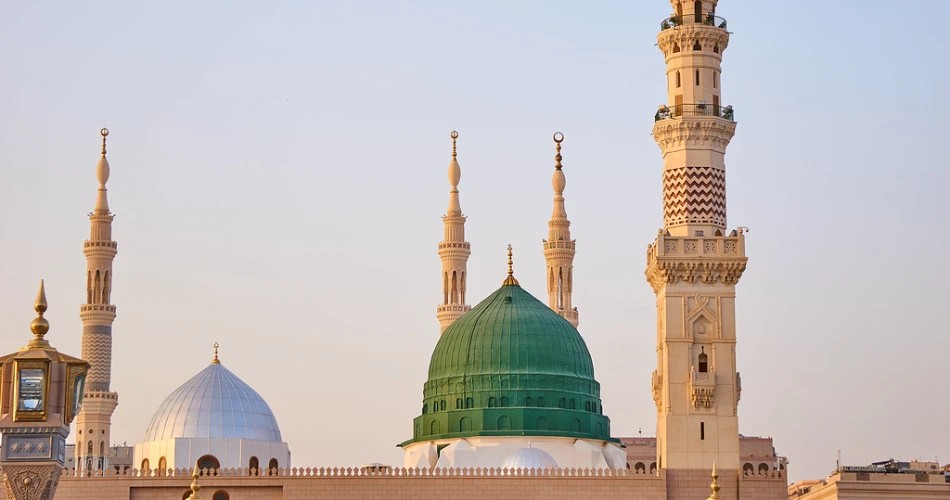
For six hundred years there was no dome. That single fact surprises almost every visitor who stands today in the courtyard of Masjid an-Nabawi and lifts their eyes to the great green cupola rising above the mosque’s south-eastern corner. The dome feels ancient, permanent, almost inseparable from the idea of the Prophet’s Mosque itself — it appears on prayer mats, on money, on the covers of a thousand books about Madinah. But the men who prayed beside the grave of the Prophet Muhammad ﷺ in the first, second, third, fourth, fifth and most of the sixth centuries of Islam never saw it. Abu Bakr, Umar, the great jurists of Madinah, the compilers of the earliest hadith collections — all of them knew the chamber only as a modest, low enclosure of unbaked brick. The dome is a medieval addition, built for reasons that had nothing to do with the Prophet’s own instructions, and its long architectural history — six or seven successive rebuildings in wood, then brick, then stone, painted white, then blue or purple, then finally green from the middle of the thirteenth century after the Hijrah — sits at the centre of one of the most serious and most respectfully contested debates in Islamic scholarship: whether any structure should stand over a grave at all, let alone one crowned in colour and gold and photographed by millions of pilgrims a year.
This guide is about the domes of the Prophet’s Mosque as physical structures: the Green Dome itself, from its absence in the earliest period through every rebuilding to the present day; the scholarly argument over what that dome means and whether it should exist; and the entirely different, entirely modern engineering of the twenty-seven sliding domes and the courtyard skylights that the Saudi expansions of the twentieth and twenty-first centuries added to the mosque’s roof. It does not cover the mosque’s general history, the Rawdah, the internal features of the Sacred Chamber, the pillars, the mihrabs, or the ornamental window set into the Green Dome’s drum — each of those has its own dedicated guide. What follows is the story of what sits, and once did not sit, above the most visited grave on earth: how it was built, who built it, what colour it has been, why serious scholars disagree about whether it should be there, how modern engineers built twenty-seven eighty-tonne domes that slide open and shut in seventy-two seconds, and what you will actually see if you stand in the mosque’s courtyard today.
Historical Background: The Chamber Before There Was a Dome
The Room That Became a Grave
To understand the domes, you first have to understand what they were built over — and what that space was before anyone thought to build over it at all. When the Prophet Muhammad ﷺ died in Madinah in the eleventh year after the Hijrah (11 AH / 632 CE), he was buried not in a mausoleum, not in a shrine, and not even inside the mosque itself, but in the room in which he died: the small dwelling of his wife Aisha رضي الله عنها, one of a row of simple houses built of unbaked mud brick and palm trunks that stood along the eastern and southern sides of the mosque courtyard. Abu Bakr رضي الله عنه was buried beside him a little over two years later, and Umar ibn al-Khattab رضي الله عنه beside Abu Bakr some ten years after that. For the whole of that first generation and for centuries afterward, the space above these three graves was not a mausoleum crowned by a dome. It was, by the most credible historical account available, a private room enclosed by a modest wall roughly waist-high, built of the same unbaked brick as the house around it.
The modern Saudi historian Professor Ali Hafiz, in his history Usul Tarikh al-Madinah al-Munawwarah, describes this original state plainly: the chamber was marked only by a low brick enclosure, with no covering dome of any kind (Ali Hafiz, Usul Tarikh al-Madinah al-Munawwarah, pp. 127–128, as summarised in a widely circulated digest of the book’s chronology, [Scribd, “The Green Dome in Madeenah”](https://www.scribd.com/document/99494955/The-Green-Dome-in-Madeenah); corroborated at [Reddit r/islam](https://www.reddit.com/r/islam/comments/kwg9ke/)). This is the essential starting point for everything that follows in this guide: there is no dome in the earliest history of this space, no dome under the Rashidun caliphs, no dome under the Umayyads who first physically absorbed the room into the body of the enlarged mosque, and no dome for most of the Abbasid period either. The great architectural symbol that visitors travel across the world to see today did not exist for roughly the first six hundred years of Islam.
How the Room Entered the Mosque
Aisha’s house stood outside the original mosque built by the Prophet ﷺ in 1 AH. It became physically part of the mosque only decades later, when the Umayyad caliph al-Walid ibn Abd al-Malik ordered a major expansion of Masjid an-Nabawi and had the row of houses along the qiblah-facing wall, including Aisha’s room, absorbed into the enlarged structure. This is an important and frequently misunderstood point, and it will return later in this guide when the scholarly debate over the dome is discussed in full: the incorporation of the grave into the mosque building was a decision of later state policy, made by an Umayyad ruler, and not a decision made by the Prophet ﷺ, by Abu Bakr, by Umar, or by any of the earliest companions who buried him. Some later observers, seeing the grave now enclosed within the walls of the mosque, assumed that the Prophet ﷺ had been buried inside the mosque proper. He had not. He was buried in his house, and his house was later built around.
This sequence of events — a private room, absorbed into an expanding mosque, later crowned by a succession of domes built by rulers many generations removed from the Prophet ﷺ and his companions — is the architectural skeleton on which the entire history in this guide hangs. Every later development, from the first dome of the Mamluk era to the green paint of the nineteenth century to the scholarly rulings of the twentieth, follows from this initial fact: nobody planned a domed shrine. A room became a grave, a grave became enclosed by a growing mosque, and only centuries later did anyone build a roof of ceremonial shape over the whole arrangement.
Madinah and the Mosque Before the Age of Domes
It is worth pausing on the wider setting. Madinah in the first centuries after the Hijrah was not yet the vast, marble-paved plaza that pilgrims walk today. The mosque itself grew in careful stages — the modest structure of the Prophet’s own lifetime; the enlargements of Umar and of Uthman رضي الله عنهما; the major Umayyad rebuilding under al-Walid ibn Abd al-Malik that brought the grave-chamber inside the mosque’s four walls; further Abbasid-era enlargements. Throughout all of this construction activity — and there was a great deal of it, in wood, brick, and eventually stone — the grave chamber itself remained architecturally unremarkable: walled, respected, visited, but not domed, not painted, not marked by any structure taller than a modest partition. The dome, when it finally came, came from Cairo, not from Madinah, and it came for reasons connected to Mamluk royal patronage and the general architectural fashions of the thirteenth-century Islamic world — not from any instruction traceable to the Prophet ﷺ or the first generations of Muslims.
Geography and the Setting of the Dome
The Green Dome sits, as it has for centuries, above the mosque’s south-eastern quadrant, close to the qiblah wall and immediately recognisable from almost every approach to the mosque precinct. Madinah’s climate — intensely hot and dry through the summer months, cool and pleasant from late autumn through early spring — has shaped every material decision made about the dome across its history, from the choice of lead sheeting to shed the occasional torrential winter rain, to the layers of waterproof tarpaulin and bitumen applied and reapplied across the centuries, to the reasons the King Fahd-era engineers gave for building an entirely different kind of dome — one that opens and closes — elsewhere on the same roofline seven centuries later. The dome you see today is a nineteenth-century Ottoman structure standing on a thirteenth-century Mamluk footprint, in a city whose climate has never stopped testing the materials engineers choose to protect what lies beneath it.
The Story Behind the Green Dome: A Structure Built by Empires, Not by the Prophet ﷺ
Six Centuries of Nothing
It is worth sitting with the silence of those first six centuries before moving on to the noise of construction that follows, because the silence is itself the story. Generation after generation of Muslims prayed in Masjid an-Nabawi, visited the grave, taught hadith within sight of the chamber, and built nothing over it beyond the low brick wall already described. The great jurists of Madinah in the age of the Successors — men who had known companions of the Prophet ﷺ personally — saw no dome. Malik ibn Anas, compiling the Muwatta in Madinah itself in the second century of Islam, worked and taught within metres of an undomed grave. This is not a small or incidental detail. It means that for roughly the first two-thirds of Islamic history to date, the architectural feature that most defines the mosque in the modern imagination simply was not there, and nobody in that long stretch of the earliest and most authoritative generations felt its absence as any kind of religious deficiency.
Cairo Sends a Dome to Madinah: Sultan Qalawun, 678 AH
The story of the dome as a built object begins in Egypt, not in Arabia, with a Mamluk sultan who never set foot in it. In 678 AH (1279–80 CE), the Mamluk sultan al-Malik al-Mansur Sayf al-Din Qalawun al-Salihi ordered the construction of the first covering dome over the burial chamber. Multiple independent tertiary sources converge on this date and name: [Madain Project’s structured entry on the Green Dome](https://madainproject.com/green_dome), the [Zamzam.com history of the Green Dome](https://zamzam.com/blog/green-dome/), and [Crescent International’s history of Masjid al-Nabawi and the Green Dome](https://crescent.icit-digital.org/articles/history-of-masjid-al-nabawi-and-the-green-dome) all agree on Qalawun and on this date. Qalawun’s dome was a modest structure by later standards: built of wood, rising from a square base to an octagonal drum, standing on pillars erected around the chamber, covered with lead plates over wood planking and a waterproofing layer of tarpaulin, and reaching only about 2.2 metres (7.2 feet) in height — a shallow cap sized to the pentagonal footprint of the inner chamber, according to Madain Project’s detailed reconstruction of the structure. Researchers treat this as the true origin point of what would eventually be called the Green Dome, because before Qalawun’s builders raised their wooden octagon, there was no covering dome to speak of at all — only the low brick wall of the earliest centuries.
Qalawun himself was one of the great Mamluk builder-sultans, a former slave-soldier who rose to found a dynasty and who is remembered across the Islamic world for an extensive programme of religious patronage in Cairo, Jerusalem, and the Hijaz. His decision to crown the Prophet’s grave with a dome should be read against that wider pattern: this was an age in which Mamluk sultans expressed piety and legitimacy through monumental building, and a dome over the grave of the Prophet ﷺ in Madinah was, from the sultan’s perspective in Cairo, both an act of devotion and a statement of the dynasty’s custodianship of Islam’s holiest sites. It was not a request from Madinah, and it was not a continuation of any practice from the Prophet’s ﷺ own time or from the generations immediately following him. It was a royal decision made nearly six hundred and fifty years after his death.
A note on an unverified claim: some circulating accounts, including material drawn from a popular online documentary, describe a mosque-wide fire in 654 AH (1256 CE) — a generation before Qalawun’s dome — connected to the turbulent final years of the Abbasid caliphate under al-Musta’sim, with the Prophet’s grave itself said to have survived the blaze. This event, if it occurred, would predate any dome at all. No written chronicle source for this specific 654 AH fire was located in the research behind this guide, and it should be treated as unverified rather than repeated as established history.
The Fourteenth Century: Repairs, Lead, and the First Crescent
Qalawun’s wooden dome did not last unattended. Like any wooden structure exposed to Madinah’s sun, wind, and occasional violent winter rain, it required repeated maintenance across the following century, and the record of that maintenance tells its own quiet story of empires taking turns as custodians of the same modest wooden roof.
Around 761 AH (1360 CE), the dome was renovated under Sultan al-Nasir Hasan bin Muhammad bin Qalawun — Qalawun’s own descendant continuing the family’s patronage. The tarpaulin waterproofing was replaced, and, in a detail that would echo through every description of the dome for the next six centuries, a gold-plated brass crescent finial was installed atop it for the first time, according to Madain Project’s chronology. This is the origin of the crescent that still crowns the dome today, though the specific finial visible now is a later replacement rather than this fourteenth-century original.
Further maintenance followed in short order. In 765 AH, the lead plates covering the dome were fixed and renewed under Sultan al-Ashraf Sha’ban ibn Husayn ibn Muhammad. Roughly five years later, around 771 AH (1370 CE), a heavier restoration under the same Sultan al-Ashraf Sha’ban replaced the ageing tarpaulin waterproofing with tar and bitumen, a more durable if less elegant solution to Madinah’s occasional but destructive rains (all dates per [Madain Project](https://madainproject.com/green_dome)). None of this repair work changed the dome’s basic wooden, octagonal-drum character. It remained, in essence, Qalawun’s structure, patched and re-patched by a sequence of Mamluk sultans who each, in turn, took on the responsibility of keeping a roof over the Prophet’s grave.
Fire and Rebuilding: The Qaytbay Era
The dome’s first century of quiet maintenance ended in disaster. In 881 AH (1477 CE), under the celebrated Mamluk sultan Qaytbay — one of the great architectural patrons of the entire Mamluk period, whose building projects still stand across Cairo and Jerusalem — the dome was renovated once more and painted white, using gypsum specially imported from Egypt. This was, briefly, a white dome: the first attested colour in its long chromatic history, discussed in full later in this guide.
The white paint did not last. In 886 AH (1481 CE), a major fire — reportedly caused by a lightning strike, according to several secondary accounts — swept through the mosque and destroyed Qalawun’s two-century-old wooden dome entirely. This fire is the specific event referenced in Ali Hafiz’s chronology and echoed consistently across multiple independent sources, including [Zamzam](https://zamzam.com/blog/green-dome/), [Al Maqam Transport](https://almaqamtransport.com/the-green-dome/), and the [Arabic Wikipedia article on al-Qubbah al-Khadra](https://ar.wikipedia.org/wiki/القبة_الخضراء). It is a moment worth pausing on: the very first dome built over the Prophet’s grave, having stood for roughly two centuries through patient Mamluk repair and re-repair, was consumed by fire in a single episode, apparently through nothing more dramatic than a strike of lightning on a wooden structure in an open desert climate.
Qaytbay’s response, the following year in 887 AH, was not merely to replace what had been lost but to rebuild on a substantially larger and more durable scale. The wooden substructure was abandoned in favour of brick and stone. The surrounding walls of the chamber were raised by roughly a metre and a half. Curved lead sheets replaced the older tarpaulin and bitumen waterproofing methods. The combined height of chamber and dome together reached approximately 8.88 metres (18 cubits) — four times the height of Qalawun’s original shallow cap. And in the single most architecturally significant decision in the dome’s entire history, Qaytbay’s builders did not simply replace the destroyed dome with a single new one. They built a second, larger dome over the first, creating the dome-within-a-dome — the double-dome arrangement — that remains the fundamental structural logic of the Green Dome to this day. The intricate internal window and double-shell arrangement that resulted from this decision is treated in full in the companion guide dedicated specifically to the window of the Green Dome; it is noted here only because the decision to build in two nested layers, rather than one, originates precisely in this 887 AH Qaytbay reconstruction.
The double-dome was not immediately stable. In 892 AH, cracks appeared in the upper of the two domes. Qaytbay ordered it demolished and rebuilt “in the most solid manner” using white plaster — a rebuild completed later that same year, according to both [Madain Project](https://madainproject.com/green_dome) and [Arabic Wikipedia](https://ar.wikipedia.org/wiki/القبة_الخضراء). This detail is a useful corrective to any assumption that a single royal decree produced a finished, permanent monument. The dome, even in its Mamluk infancy, was already something that cracked, that needed watching, that had to be pulled down and rebuilt within a single sultan’s own lifetime.
The Ottoman Centuries: Rebuilding, Colour, and a Screen for the Labourers
Sovereignty over the Hijaz passed from the Mamluks to the Ottomans in the early sixteenth century, and with it passed responsibility for maintaining the dome. The Ottoman record of rebuilding is real but, in the sources available for this guide, less precisely dated than the Mamluk record — a pattern worth being honest about rather than papering over with false certainty.
At some point in the Ottoman era, conventionally placed in the sources at roughly the mid-eighteenth century, an Ottoman sultan associated with renewed cracking in the structure ordered a rebuilding. During these works, according to Madain Project’s narrative account, a wooden screen was specifically erected between the outer and inner domes “so labourers would not see the grave” — a small human detail that speaks to how seriously the workers and their patrons regarded the sanctity of what they were repairing, even as they clambered through the dome’s own internal structure with tools and timber. This episode carries less date precision in the available sources than the Mamluk-era entries and should be read as approximate rather than exact.
A further, total rebuilding is recorded under the reign of Sultan Abdulhamid II, described in Madain Project’s account as occurring roughly eighty years after the prior rebuild: the dome had deteriorated again and was entirely rebuilt, and on completion it was painted either blue or purple — the sources disagree on the precise shade, a disagreement discussed further below alongside the dome’s fuller colour history. Readers should note that this attribution to Abdulhamid II sits inside a wider chronological tangle that recurs throughout the Ottoman-era record of the dome, one this guide addresses directly and honestly in the section on colour history rather than smoothing over.
The rebuilding that produced essentially the structure still standing today came under Ottoman Sultan Mahmud II, in 1817–1818 CE (corresponding to roughly 1233 AH), as part of a reconstruction of what Ottoman sources term the “Rawda Mutahhara,” the Purified Residence, according to the [Wikipedia article on the Prophet’s Mosque](https://en.wikipedia.org/wiki/Prophet’s_Mosque). Sources vary slightly on the exact year — 1817, 1818, and 1820 all appear in different accounts — and this should be treated as a minor, unresolved discrepancy in dating rather than a substantive disagreement about what happened. Mahmud II’s reconstruction is the direct architectural ancestor of the dome pilgrims see today: subsequent history has added paint, not fundamentally new structure.
The First Saudi State and a Dome That Narrowly Escaped
The dome’s history intersects directly with one of the most consequential religious and political movements in Arabian history in 1805 CE, when forces of the First Saudi State, allied with the reform movement associated with Muhammad ibn Abd al-Wahhab, took control of Madinah. Nearly every dome and shrine structure in the city was demolished at this time on religious grounds connected to the prohibition on building over graves — a prohibition and a controversy explored in full later in this guide. The Green Dome itself, according to [Madain Project](https://madainproject.com/green_dome), “narrowly escaped” destruction in this episode. Exactly why it was spared where so many other domed structures in the city were not is not fully spelled out in the sources reviewed for this guide, and that gap is worth stating plainly rather than filling with speculation. What is clear is that the dome survived 1805 CE while numerous other domed shrines, particularly in the Baqi’ cemetery, did not.
Under King Abdulaziz in the early twentieth-century Saudi era, the record shows only minor internal repairs — cracked plaster inside the chamber, reportedly carried out at night, according to [Arabic Wikipedia](https://ar.wikipedia.org/wiki/القبة_الخضراء). No further major rebuilding of the dome’s structure is recorded under Saudi rule; the structure raised by Mahmud II in 1817–18 remains, in its essentials, the dome visitors see today, maintained rather than rebuilt.
The Colour That Was Not Always Green
Perhaps no single fact about the dome surprises modern visitors more than this: it was not always green. The full colour sequence, reconstructed from multiple independent sources, runs as follows — unpainted wood in the earliest Mamluk period, then white under Qaytbay’s gypsum in the late fifteenth century, then blue or purple for roughly two centuries under a later Ottoman rebuilding, and only finally green from 1253 AH (1837 CE) onward, with one further disputed and unverified interruption discussed below.
The single most-quoted source for the change to green is Professor Ali Hafiz’s Usul Tarikh al-Madinah al-Munawwarah (pp. 127–128), rendered in a widely circulated English digest as follows:
“In 1253 AH, an order was issued by the Ottoman Sultan Abd al-Hameed to paint the dome green. He was the first one to colour it green… It was previously known as the white dome or the fragrant dome or the blue dome.”
(via the [Scribd-hosted excerpt](https://www.scribd.com/document/99494955/The-Green-Dome-in-Madeenah) and the corroborating [Reddit summary](https://www.reddit.com/r/islam/comments/kwg9ke/))
Here this guide must be transparent about a genuine and, as far as the available research shows, unresolved disagreement in the historical record — a disagreement this guide will report rather than resolve, exactly as its source material insists it must. The majority of sources consulted — including [Zamzam](https://zamzam.com/blog/green-dome/), [Al Maqam Transport](https://almaqamtransport.com/the-green-dome/), [Crescent International](https://crescent.icit-digital.org/articles/history-of-masjid-al-nabawi-and-the-green-dome), [People of Madina](https://peopleofmadina.com/a-brief-history-of-the-green-dome/), and several language editions of Wikipedia — attribute the 1253 AH/1837 CE green repainting to a sultan referred to simply as “Sultan Abdulhamid,” and at least one further source, a [Substack history essay](https://sikkawala.substack.com/p/the-green-veil-raja-ravi-varma-medina), goes further and explicitly specifies “Ottoman Sultan Abd al-Hamid II.”
There is a real problem with this attribution, and it deserves to be named rather than smoothed over: Sultan Abdulhamid II’s actual reign ran from 1876 to 1909 CE — decades after 1837. A green-painting order dated 1837 CE simply cannot have been issued by a sultan who did not yet occupy the throne. It appears likely that many popular sources are using the name “Abdulhamid” loosely or anachronistically — possibly conflating him with an earlier Ottoman ruler of a similar name, or simply repeating one another’s error without checking regnal dates against the year given. This should be treated as a live sourcing problem in the popular literature, not as a settled historical fact simply because it is the most frequently repeated one.
Several other sources instead attribute the green repainting directly to Sultan Mahmud II, without always clearly distinguishing the earlier structural rebuild of 1817–18 from the later colour change of 1837 — for instance [Medinahotels.co](https://www.medinahotels.co/blog/exploring-the-secrets-and-history-of-masjid-nabawis-green-dome/) and [World History Edu](https://worldhistoryedu.com/the-green-dome-history-and-major-facts/). Since Mahmud II reigned until 1839, a green-painting order in 1837 is entirely plausible on chronological grounds, and cross-checking regnal dates makes this arguably the best-supported single attribution available — though “best-supported” here means “least chronologically awkward,” not “proven beyond dispute.”
A third attribution comes from a single source, TakeMeToUmrah ([takemetoumrah.com/masjid-al-nabawi](https://takemetoumrah.com/masjid-al-nabawi/)), which names Sultan Abdulmejid I — Mahmud II’s own son and successor, who reigned from 1839 to 1861 — as the ruler under whom the green paint was specifically applied, while crediting Mahmud II only with the earlier brick-and-lead structural reconstruction rather than the colour change itself.
This guide’s conclusion, consistent with the honesty its underlying research demands, is this: the year 1253 AH/1837 CE for the first application of green paint is well corroborated across many independent sources and can be stated with reasonable confidence. The specific sultan responsible is genuinely contested — between “Sultan Abdulhamid” (the phrase most frequently used in circulating popular sources, despite its chronological difficulty), Mahmud II (chronologically the most plausible, and the ruler credited by other sources with the immediately preceding structural rebuild), and Abdulmejid I (named by a single source). This guide reports all three attributions side by side and does not choose between them. Any confident single-sentence claim you encounter elsewhere — “Sultan So-and-so painted the dome green” — is asserting more certainty than the historical record currently supports.
One further claim about the dome’s colour history deserves to be flagged separately, because it illustrates how easily an unverified detail can spread. [Crescent International](https://crescent.icit-digital.org/articles/history-of-masjid-al-nabawi-and-the-green-dome) and a [Medium essay](https://medium.com/@Naresh2017/secret-truths-about-al-masjid-an-nabawi-8c87f57c5655) both report that in 2007 Saudi authorities reportedly attempted to repaint the dome silver, in order to visually match the mosque’s other domes, and that residents of Madinah protested, forcing a reversion to the familiar green. This claim appears in only two lower-authority sources, could not be corroborated against any contemporary news report or official statement, and should be treated as unverified. It is mentioned here only as a flagged, unconfirmed claim circulating in some accounts of the dome’s history — not as established fact.
What the Dome Is Made of Today
Establishing the dome’s exact present-day engineering specification proved harder than establishing its history, and this guide would rather say so plainly than invent precision that is not available. The crescent finial visible atop the dome today is understood to be a later replacement consistent with the Mahmud II-era rebuild, following on from the original fourteenth-century gold-plated brass finial first installed under Sultan al-Nasir Hasan around 761 AH — but a dedicated modern engineering specification giving the current finial’s exact material and height was not located in the research behind this guide, and that gap should simply be acknowledged.
One Indonesian-language source, a Kompasiana blog post, describes the present-day dome as built of reinforced concrete and wood, clad in green ceramic tiles bearing gold calligraphy, with a total height of roughly 27 metres. This is the only source located that offers these specific modern figures, it is not an authoritative primary or technical source, and it should be treated as unverified and low-confidence pending corroboration from an official Saudi or peer-reviewed architectural publication. This guide repeats the figure only with that caveat attached, not as an established specification.
What can be said with confidence is architectural rather than statistical: the chamber and dome interior are not accessible to the public. The space is fully enclosed, with no doors or windows permitting entry, according to both [Madain Project](https://madainproject.com/green_dome) and [Al Maqam Transport](https://almaqamtransport.com/the-green-dome/). How and when maintenance access occurs, if it occurs at all in the modern era, is not documented in any source reviewed for this guide — another honest gap in an otherwise richly documented history, and one worth naming rather than guessing at.
The Prophet ﷺ and This Place: What Can Actually Be Said
This section requires a different kind of honesty than most sections in a guide of this kind, because its subject — a dome — did not exist during the Prophet’s ﷺ lifetime, and there is no authentic report of him ever having seen it, blessed it, requested it, or spoken about it, for the simple reason that it was built roughly six hundred and fifty years after his death. What can honestly be discussed here is not the Prophet’s ﷺ relationship to a dome that never touched his life, but his own words and instructions about graves in general — instructions that later became, and remain today, the central textual evidence in the scholarly debate over whether the dome that now stands above his own grave should exist at all.
During his final illness, in the days immediately before his death, the Prophet ﷺ is reported to have said words that Aisha رضي الله عنها, his wife and the very woman in whose house he would be buried, later transmitted and that now sit at the heart of Islamic scholarship on graves and structures. In Sahih Muslim 529, Aisha narrates that the Prophet ﷺ said: “Allah cursed the Jews and the Christians, for they took the graves of their prophets as places of worship.” Aisha adds, in the same narration, that had it not been for this specific concern, his own grave would have been left exposed and prominent — but the companions feared it would be taken as a place of prostration and worship, and so it was not. A closely related narration, Sahih Muslim 531, transmitted via both Aisha and Abdullah ibn Abbas رضي الله عنهما, preserves the same curse-formula, again reported as spoken while the Prophet ﷺ lay dying.
These words were spoken by a man who knew, in the last days of his own life, that he would soon be buried, and who used those days to warn his community against exactly the kind of veneration that elevates a grave into an object of worship. That his own grave would one day sit beneath a painted, gilded, internationally photographed dome is not something he instructed, requested, or — on the reading many scholars give these very words — would necessarily have welcomed. This guide does not resolve that question; it simply records, as precisely as the sources allow, what he is authentically reported to have said, and leaves the interpretation of it to the fuller treatment of the scholarly controversy later in this guide.
Elsewhere, according to a report transmitted by Ali ibn Abi Talib رضي الله عنه and preserved in Sahih Muslim 969, the Prophet ﷺ gave Abu al-Hayyaj al-Asadi a specific instruction to carry out on his behalf: “Shall I not send you on the same mission as Allah’s Messenger (ﷺ) sent me? Do not leave an image without obliterating it, or a high grave without levelling it.” And in Sahih Muslim 970, narrated by Jabir ibn Abdullah رضي الله عنه, the Prophet ﷺ is reported to have forbidden plastering graves, sitting on them, and building over them. Both of these hadiths are discussed in full, with their gradings and their place in the wider scholarly argument, in the dedicated hadith and controversy sections below. They are introduced here because they represent the only authentic body of the Prophet’s ﷺ own recorded words that bears directly on the subject of this guide — not because he ever spoke about a dome that would not exist for six and a half centuries after he spoke.
It is also worth recording, plainly, what the Prophet ﷺ did not do and did not have the opportunity to do. He did not select a site for a mausoleum. He did not request a dome, a marker, a painted structure, or any architectural monument over his grave. He was buried, according to the accounts of his companions, in the ordinary floor of the room in which he died, and the room continued to be used as an ordinary room — Aisha herself continued to live in the rest of the house and prayed in its other quarters rather than in the room containing the graves, a point of real significance that the scholarly-controversy section of this guide will return to directly. Everything that came afterward — the wall, the first dome, the fire, the rebuilding, the colour, the twentieth-century debates — belongs to the history of later generations acting on their own understanding of piety, architecture, and protection. It does not belong to an instruction, a wish, or an action of the Prophet ﷺ himself.
Qur’anic Connections: What the Qur’an Says About Graves and Veneration
The Qur’an does not mention the Green Dome, could not mention it, and this guide will not force a connection where none exists in the text. What the Qur’an does address, in verses that scholars on every side of the dome controversy draw upon, is the broader question of veneration, of associating partners with Allah, and of the dangers that can attach themselves to sacred sites and sacred figures when devotion tips into something the Qur’an itself warns against.
The Warning Against Taking the Righteous as Objects of Worship
﴿وَاتَّخَذُوا مِن دُونِ اللَّهِ آلِهَةً لِّيَكُونُوا لَهُمْ عِزًّا﴾
“And they have taken besides Allah [false] deities that they might be a source of honour and power for them.” — Surah Maryam 19:81
Classical tafsir on this verse and others like it in the same surah addresses the general human tendency to elevate righteous figures, symbols, and sacred objects into something approaching independent sources of power or blessing, rather than treating them as signs pointing back to Allah alone. This general Qur’anic concern — not a verse about domes specifically, but about the psychology of veneration that domes, shrines and monuments can sometimes encourage — is precisely the concern that later scholars, discussed at length below, apply to the specific case of structures built over graves, including, in the view of some, the Green Dome itself.
The Prophet ﷺ as a Man Who Will Die
﴿وَمَا مُحَمَّدٌ إِلَّا رَسُولٌ قَدْ خَلَتْ مِن قَبْلِهِ الرُّسُلُ ۚ أَفَإِن مَّاتَ أَوْ قُتِلَ انقَلَبْتُمْ عَلَىٰ أَعْقَابِكُمْ﴾
“Muhammad is not but a messenger; messengers have passed on before him. So if he was to die or be killed, would you turn back on your heels?” — Surah Aal Imran 3:144
This verse was revealed in the context of the Battle of Uhud, when a rumour spread across the battlefield that the Prophet ﷺ had been killed. Its relevance to the subject of this guide is indirect but real: the Qur’an here insists, in the plainest terms, on the Prophet’s ﷺ mortality and on his status as a messenger among messengers rather than a figure whose physical continuation — or, by extension, whose physical resting place — should become the central object of the believers’ attention. Classical commentators read this verse as establishing a permanent principle: the Muslim community’s faith is anchored in Allah and in the message the Prophet ﷺ delivered, not in his person, his body, or, later readers have argued by extension, in any structure built over his grave. Modern scholars who caution against excessive veneration of the Green Dome frequently invoke the spirit of this verse, even though it long predates the dome itself by many centuries.
Guarding Against Extremism in Religion
﴿يَا أَهْلَ الْكِتَابِ لَا تَغْلُوا فِي دِينِكُمْ﴾
“O People of the Scripture, do not commit excess in your religion.” — Surah an-Nisa 4:171
Although this verse is addressed in its immediate context to the People of the Book on the specific question of the nature of Jesus عليه السلام, Muhammad ibn Abd al-Wahhab and the later scholarly tradition that built on his work — discussed in detail in the scholarly controversy section below — treat the underlying principle, ghuluww (excess or extremism in matters of religion), as a general warning applicable to any community, including Muslims themselves, when veneration of a righteous figure begins to exceed the bounds that figure’s own teaching would have sanctioned. This is one of the Qur’anic threads that Ibn Abd al-Wahhab draws on in Kitab al-Tawhid when he warns against the veneration of graves and the structures sometimes built over them — a doctrine explored fully, and fairly, later in this guide.
A note on method: this guide has deliberately avoided reaching for verses that do not genuinely bear on the subject, and has avoided presenting a general Qur’anic principle as though it constituted a specific ruling on the Green Dome by name. The Qur’an addresses veneration, excess, and the mortality of the Prophet ﷺ as general principles. It does not adjudicate the specific case of a thirteenth-century Mamluk sultan’s decision to roof a grave chamber in Madinah. The application of these general principles to that specific case is the work of the scholars discussed later in this guide, and it is their reasoning — not a direct Qur’anic verdict — that this guide reports.
Hadith References: The Complete Textual Foundation, Consolidated and Graded
This section gathers, in one place, every hadith relevant to the subject of this guide, each with its exact collection, number, and grading stated plainly, so that a reader need not search through the narrative sections above to find the primary textual evidence. Every hadith below was checked against sunnah.com’s indexing; Sahih Muslim 969 in particular was corroborated through a secondary citation after a direct-fetch access error, a detail recorded here in the interest of full transparency about the research process.
On Graves, Images, and Building Over the Dead
- Sahih Muslim 969 ([sunnah.com/muslim:969](https://sunnah.com/muslim:969)) — Abu al-Hayyaj al-Asadi reported that Ali ibn Abi Talib رضي الله عنه said to him: “Shall I not send you on the same mission as Allah’s Messenger (ﷺ) sent me? Do not leave an image without obliterating it, or a high grave without levelling it.” Grade: Authentic (Sahih Muslim).
- Sahih Muslim 970 ([sunnah.com/muslim:970](https://sunnah.com/muslim:970)) — narrated by Jabir ibn Abdullah رضي الله عنه: the Prophet ﷺ forbade plastering graves, sitting on them, and building over them. Grade: Authentic (Sahih Muslim).
- Sahih Muslim 529 ([sunnah.com/muslim:529](https://sunnah.com/muslim:529)) — narrated by Aisha رضي الله عنها: the Prophet ﷺ said during his fatal illness, “Allah cursed the Jews and the Christians, for they took the graves of their prophets as places of worship.” Aisha adds that, had it not been for that concern, his grave would have been left exposed and prominent — but it was feared it would be taken as a place of prostration. Grade: Authentic (Sahih Muslim).
- Sahih Muslim 531 ([sunnah.com/muslim:531](https://sunnah.com/muslim:531)) — a closely related narration transmitted via Aisha and Abdullah ibn Abbas رضي الله عنهم, with the same curse-formula, again reported as spoken while the Prophet ﷺ was dying. Grade: Authentic (Sahih Muslim).
- Sahih al-Bukhari 435 ([sunnah.com/bukhari:435](https://sunnah.com/bukhari:435)) — narrated by Aisha and Ibn Abbas: “May Allah’s curse be on the Jews and the Christians, for they built the places of worship at the graves of their Prophets.” Grade: Authentic (Sahih al-Bukhari).
- Sahih al-Bukhari 436 ([sunnah.com/bukhari:436](https://sunnah.com/bukhari:436)) — a further recorded chain of the same narration and text. Grade: Authentic (Sahih al-Bukhari).
- Sahih al-Bukhari 1330 ([sunnah.com/bukhari:1330](https://sunnah.com/bukhari:1330)) — narrated via Urwah from Aisha: the same curse-hadith, with Aisha’s added remark that the Prophet’s ﷺ grave was deliberately not left prominent, for fear it might be taken as a place of prayer. Grade: Authentic (Sahih al-Bukhari).
These seven narrations form the complete textual foundation cited by the scholars, discussed at length below, who regard domes and built structures over graves — including, in principle, the Green Dome itself — as contrary to the Prophet’s ﷺ own instruction. It is worth noting what these hadiths do and do not say. None of them mentions the Green Dome, Madinah, or the Prophet’s own grave as a physical structure built centuries later; they establish a general prohibition on building over, plastering, or elevating graves, and a specific warning about the danger of graves becoming places of worship. The application of these general texts to the specific historical case of the dome that now stands in Madinah is a matter of scholarly reasoning, not a matter of direct textual command about that dome by name — a distinction this guide will keep in view throughout the controversy section that follows.
A Note on Authenticity and Method for This Section
A note on authenticity: all seven hadiths listed above are graded Sahih (authentic) by scholarly consensus, being found in the two most rigorously authenticated hadith collections in Sunni Islam, Sahih al-Bukhari and Sahih Muslim. No weak, fabricated, or disputed hadith is presented in this guide as though it were authentic, and no fabricated hadith making direct reference to the Green Dome by name was located in the research behind this guide — which is itself an expected and important finding, since the dome postdates the entire period of hadith compilation by five to six centuries. Any hadith you encounter elsewhere that claims to praise, sanctify, or specifically describe the Green Dome by name should be treated as presumptively spurious unless it comes with a specific, checkable citation to a classical collection, because no such citation was found in this research and none is known to exist.
Historical Development: The Domes Through the Rashidun, Umayyad, Abbasid, Mamluk, Ottoman and Saudi Periods
The Rashidun Period: No Dome, No Ambiguity
Under the four Rightly Guided Caliphs — Abu Bakr, Umar, Uthman and Ali رضي الله عنهم — the grave chamber remained exactly as it had been at the Prophet’s ﷺ death: a room within Aisha’s house, marked by a low brick enclosure, with no dome and no distinguishing architectural feature beyond that modest wall. Abu Bakr رضي الله عنه was buried there in 13 AH, and Umar رضي الله عنه in 23 AH, both alongside the Prophet ﷺ in the same small room. Uthman’s caliphate saw a significant expansion of the mosque itself, and Ali’s caliphate was consumed by civil conflict that drew him away from Madinah altogether — but at no point in this earliest period does any source describe a covering dome being added over the graves. The room simply continued as a room, respected, visited, and architecturally unremarkable.
The Umayyad Period: The Room Enters the Mosque
The single most consequential Umayyad-era development, so far as the domes are concerned, was not the construction of any dome at all but the physical absorption of Aisha’s house into the body of the enlarged mosque under the caliph al-Walid ibn Abd al-Malik. This expansion, part of a much wider Umayyad building programme that transformed Masjid an-Nabawi from a modest structure into a substantial congregational mosque, brought the row of houses along the qiblah-facing side — including the room containing the three graves — inside the mosque’s outer walls for the first time. This is the point at which some later observers began to describe the Prophet ﷺ as having been “buried in the mosque,” a description that, as later scholars would insist, is imprecise: he was buried in his house, and his house was later built around by a caliph making an architectural decision more than eighty years after his death. No dome accompanied this Umayyad-era absorption of the room into the mosque; the chamber remained walled but uncovered by any ceremonial roof for a further five and a half centuries after al-Walid’s expansion.
The Abbasid Period: Continued Silence, Then Local Rebuilding
The long Abbasid period, spanning several centuries of Islamic history, produced further enlargements and embellishments of Masjid an-Nabawi as a whole, reflecting the wealth and patronage networks of successive Abbasid courts. So far as the specific grave chamber is concerned, the record available for this guide describes local rebuilding of the surrounding structure — including, in the period of roughly 575–622 AH (1180–1225 CE), a rebuilding of the mosque and dome-area structure sponsored by the mother of the Abbasid caliph al-Nasir li-Din Allah — but the era of a true, purpose-built covering dome over the chamber itself still lay ahead. It would take the arrival of Mamluk patronage, discussed above and revisited below, to produce Qalawun’s dome in 678 AH.
The Mamluk Period: Qalawun to Qaytbay
The Mamluk period is the true founding era of the dome as a physical structure, and its outline has already been traced above in detail: Qalawun’s original wooden octagonal dome of 678 AH/1279–80 CE; the fourteenth-century maintenance under al-Nasir Hasan and al-Ashraf Sha’ban, including the first crescent finial around 761 AH; the destructive fire of 886 AH/1481 CE; and Qaytbay’s substantial rebuilding in brick and stone the following year, which introduced both the double-dome arrangement and a combined chamber-and-dome height of roughly 8.88 metres. The Mamluk sultans, as a dynasty, treated the maintenance of this dome as a recurring mark of royal religious patronage, each ruler in turn associating his name with its upkeep — a pattern of dynastic prestige-building through architecture that continued, in modified form, into the Ottoman period that followed.
The Ottoman Period: Rebuilding, Colour, and the Structure That Endures
Ottoman rule over the Hijaz, beginning in the early sixteenth century, brought a further sequence of rebuildings whose precise dating is, as noted earlier in this guide, less exact in the available sources than the Mamluk record. The mid-eighteenth-century rebuilding that included the installation of an internal screen “so labourers would not see the grave,” the total rebuilding attributed to the reign of Sultan Abdulhamid II with its associated blue-or-purple repainting, and finally the reconstruction under Sultan Mahmud II in 1817–18 CE that produced the structure essentially still standing today — all belong to this Ottoman phase. The change of colour to green in 1253 AH/1837 CE, with its disputed attribution among Mahmud II, “Abdulhamid,” and Abdulmejid I, also belongs to this period and has been discussed in full above.
The First Saudi State and the Early Twentieth Century
The dome’s history intersects with early Saudi religious and political history at two key points. First, in 1805 CE, when forces of the First Saudi State took Madinah and demolished nearly every domed shrine structure in the city except, narrowly, the Green Dome itself. Second, in the early twentieth century under the Third Saudi State’s founder, King Abdulaziz, when a further wave of demolitions removed domed structures over graves elsewhere in Madinah — most notably in the Baqi’ cemetery — while the Green Dome itself was again left standing, receiving only minor internal plaster repairs rather than demolition. Both episodes are directly relevant to the scholarly controversy discussed at length below, because both raise the same question in a historical rather than purely textual form: if the doctrine that opposes domes over graves motivated the demolition of so many other structures in the same city, why was this particular dome spared on both occasions? The sources available for this guide describe the fact of its survival clearly; they do not offer a single, fully spelled-out official explanation for why it alone survived both waves of demolition, and that gap is acknowledged rather than filled with speculation.
The Modern Saudi State: A New Kind of Dome Altogether
The most recent chapter in the mosque’s domed architecture belongs to an entirely different category of structure and an entirely different set of builders. Beginning in the 1980s, under King Fahd, the Saudi state undertook the Second Saudi Expansion of Masjid an-Nabawi, and as part of that expansion commissioned twenty-seven mechanised sliding domes — a work of modern engineering with no precedent in the mosque’s architectural history and no connection, structurally or symbolically, to the Green Dome’s long masonry lineage. A further, ongoing phase, the Third Saudi Expansion under King Abdullah and King Salman, has added further fixed and movable domes and skylights elsewhere in the complex. Both of these modern developments are treated in full in the architecture and controversy sections that follow; they are noted here to complete the historical-development sequence: Rashidun silence, Umayyad absorption, Abbasid continuity, Mamluk origin, Ottoman rebuilding and colour, Saudi-era survival of the old dome, and Saudi-era invention of an entirely new kind of dome altogether.
Architecture: Design, Materials, Structure, and What Modern Engineering Added
The Green Dome: A Summary of Its Architecture
The Green Dome, as it stands today, is the product of Mahmud II’s 1817–18 reconstruction, built on the structural logic established by Qaytbay’s double-dome rebuilding of 887–892 AH and ultimately resting on the footprint first established by Qalawun’s original 678 AH wooden octagon. Its defining structural feature, inherited from the Qaytbay era, is the dome-within-a-dome arrangement: an inner shell and an outer shell, nested one inside the other, with an internal space between them — the specific window and lighting arrangement created by this nested structure is the subject of a dedicated companion guide and is mentioned here only for structural completeness. The dome’s exterior is painted the green that gives it its popular name, a colour applied from 1253 AH/1837 CE onward following the earlier documented sequence of unpainted wood, white gypsum, and blue or purple. It is crowned by a crescent finial, a feature of the dome’s silhouette since the first such finial was installed in gold-plated brass around 761 AH, though the present finial is a later replacement whose precise specifications were not located in the research behind this guide.
As discussed above, claims about the dome’s current construction materials should be treated with real caution. A single Indonesian-language source describes the present dome as reinforced concrete and wood, clad in green ceramic tiles bearing gold calligraphy, with a total height of roughly 27 metres — a specific-sounding claim that nonetheless comes from only one non-technical, non-official source and should not be repeated as a verified engineering specification. What can be stated with confidence, because it is corroborated by more than one independent source, is that the chamber and dome interior remain entirely inaccessible to the public, with no doors or windows permitting entry, and that the dome’s silhouette — its double-shell structure, its green colour, and its crescent — is the most recognisable single architectural feature of the entire mosque complex, visible from a great distance across the city and instantly identifiable in photographs of Madinah taken from any angle.
The Twenty-Seven Sliding Domes: A Wholly Different Kind of Engineering
Where the Green Dome is a masonry structure built up in stages over seven centuries, the twenty-seven sliding domes of the King Fahd-era expansion are a single, coordinated piece of late-twentieth-century mechanical engineering, designed and built within a single decade and unlike anything else in the mosque’s architectural history. As part of the Second Saudi Expansion, whose foundation stone was laid in 1984/1405 AH and whose main works ran from 1985 to 1994 — adding roughly 280,000 square metres of prayer capacity to the mosque — the flat roof of the new extension was fitted with twenty-seven sliding, retractable domes, each covering one of twenty-seven square inner courtyards measuring eighteen metres by eighteen metres. This scale and configuration is documented in the peer-reviewed conference paper “Robotics and automation in the construction of the sliding domes of King Fahd’s extension,” published by the International Association for Automation and Robotics in Construction ([IAARC](http://www.iaarc.org/publications/fulltext/Robotics_and_automation_in_the_construction_of_the_sliding_domes_of_king_fahd’s_extension_of_the_.PDF)), and corroborated independently by [SL Rasch’s own project page](https://www.sl-rasch.com/en/projects/sliding-domes/) and by [Saudi Gazette](https://www.saudigazette.com.sa/article/631674).
The design credit for this project belongs, on the basis of every source consulted for this guide, to the German-Muslim architect and engineer Dr. Mahmoud Bodo Rasch and his firm SL Rasch GmbH — Special and Lightweight Structures — working in partnership with the British engineering firm Buro Happold. This is confirmed both by the [Wikipedia article on the Prophet’s Mosque](https://en.wikipedia.org/wiki/Prophet’s_Mosque) and by [SL Rasch’s own company history](https://a.osmarks.net/content/wikipedia_en_all_maxi_2020-08/A/SL_Rasch_GmbH_Special_and_Lightweight_Structures), which dates the twenty-seven sliding domes to 1991 and a related set of twelve large convertible courtyard umbrellas to 1992. Composite-fabrication and construction expertise was contributed by teams later associated with firms including DK Composites and Premier Composite Technologies, both of which credit their founding personnel with work on “the Sliding Domes of the Prophet’s Holy Mosque” beginning in 1990 ([dkcomposites.com](http://www.dkcomposites.com/prophet-mosque/); [PCT](https://www.pct.ae/prophets-mosque)). The main civil contractor for the Second Saudi Expansion as a whole was the Saudi Bin Laden Group, according to a historical-account social media post referencing archival photography of the period, which also credits an on-site collaborator named Muhammad Kamal Ismail.
This guide must be explicit about a specific correction to a commonly repeated error. A name sometimes associated with this project — “Ibrahim Muhammad Al-Bawardi” — could not be found or verified in any source consulted in the research behind this guide, including SL Rasch’s own extensive project materials, the peer-reviewed IAARC paper, the Wikipedia article, Saudi Gazette’s engineering features, and multiple composite-manufacturer company histories. This attribution should be treated as unverified and should not be repeated as established fact. The verified engineering credit, based on every source reviewed for this guide, rests with Bodo Rasch and SL Rasch GmbH, in partnership with Buro Happold.
The project moved from prototype to full production on a documented timeline. A single prototype dome was installed and tested between October and December 1990. King Fahd personally reviewed the completed prototype and gave his approval on 27 December 1990, authorising construction of the remaining twenty-six domes, according to the historical account referenced above and corroborated by SL Rasch’s own chronology of the project.
How a Sliding Dome Is Built
The engineering of each dome, as described in the peer-reviewed IAARC paper, is worth setting out in some detail, because it explains both why the domes are so heavy and why they move as smoothly as they do. Each dome sits on a support frame that rides on four steel wheels running along steel rails; each of the four wheels is independently powered by its own direct-drive electric motor, with a manual override available in case of mechanical failure. The spherical dome shell itself is built up from several distinct layers.
The structural skeleton is a steel frame of twenty-four meridian ribs and three ring beams, which carries the cladding and the internal insulation and waterproofing layers. Inside this skeleton, the inner cladding — the surface worshippers would see if they could look up into the dome’s underside — is built from wood-laminate, formed by bonding layers of wood veneer with epoxy resin, and decorated with hand-carved ornaments, some of them gilded and inlaid with amazonite, a green mineral stone. Bodo Rasch is reported to have purchased one of the last operating amazonite mines specifically to secure a long-term supply of the stone for this decorative work, according to [SL Rasch’s own project page](https://www.sl-rasch.com/en/projects/sliding-domes/). The decorative cedar-wood elements incorporated into this inner cladding were hand-carved in Morocco before being shipped to the site.
The outer cladding — the surface visible from the courtyard below and from the wider mosque precinct — is a sandwich structure: a carbon-fibre and glass-fibre epoxy laminate, reinforced with carbon-fibre flanges, onto which fifty-millimetre hexagonal ceramic tiles are bonded with epoxy resin. [Saudi Gazette](https://saudigazette.com.sa/article/641433) describes the resulting surface as forming a turquoise-and-light-beige mosaic pattern, with each tile precisely positioned using computer-numerically-controlled (CNC) cut templates prior to installation, as detailed in the IAARC paper. This guide must state plainly, because the task brief specifically raises the point, that no source consulted in this research mentions basalt or basalt cladding on the sliding domes. The confirmed and verified cladding is ceramic tile bonded over a carbon-fibre and glass-fibre composite laminate on the exterior, and wood-laminate with cedar ornamentation on the interior. Any description of the sliding domes as basalt-clad does not match the engineering documentation reviewed for this guide and should not be repeated as fact.
Weight, Rails, and Timing
Each of the twenty-seven domes weighs approximately 80 tonnes — a figure repeated consistently across multiple independent sources, including [Saudi Gazette (2023)](https://www.saudigazette.com.sa/article/631674), [Saudi Gazette (2024)](https://saudigazette.com.sa/article/641433), and the [Haramain Archives](https://theharamainarchives.wordpress.com/2021/09/03/domes-of-masjid-al-nabawi/). The rail network connecting the sliding domes across the mosque roof totals more than 1,573 metres of iron track, according to [Saudi Gazette](https://www.saudigazette.com.sa/article/631674). The final, refined opening and closing time for each dome — arrived at after prototype testing that initially achieved sixty seconds — was 72 seconds, according to the historical account of the SL Rasch prototype trials; most popular secondary sources round this figure to “around a minute” or describe a range of “sixty to ninety seconds,” which is broadly consistent with the more precise 72-second figure given in the primary project account.
The domes’ function is climate control on a scale unlike anything in the mosque’s pre-modern architectural history. They open at night and during cooler periods to vent hot air upward and admit natural light and ventilation into the courtyards beneath them, and they close during the heat of the day — particularly around the intense midday period and the Dhuhr prayer — to shield worshippers below from direct sun. This system works in tandem with the mosque’s separate retractable courtyard umbrellas as part of an overall, integrated climate-control strategy, as described in [Premier Composite Technologies’ project description](https://www.pct.ae/prophets-mosque) and the [Bonner Design project page](http://www.bonner-design.com/projects/sliding_domes.htm), the latter of which describes the domes as converting “an enclosed courtyard into a domed chamber” when closed. The sliding-dome project is reported, in one secondary source, to have won the Best Innovation prize from the International Association for Automation and Robotics in Construction in 1993 — a plausible claim, given that the IAARC is the same organisation that later published the peer-reviewed technical paper on this project, but one that was not independently corroborated against a formal awards record in the research behind this guide and should therefore be treated with light caution rather than stated as an unqualified fact.
The Domes and the Umbrellas: A Related but Distinct System
The twenty-seven sliding domes should be clearly distinguished from the mosque’s large courtyard umbrellas — of which roughly 250 now stand in the mosque’s open courtyards, according to Saudipedia. The umbrellas are separate, freestanding structures in open courtyards, rather than roof-mounted domes over enclosed spaces, though both systems were designed by the same firm, SL Rasch and Bodo Rasch, as parts of a single integrated climate-control strategy for the mosque: the domes manage roof-level ventilation and light over enclosed courtyards, while the umbrellas provide shade over open courtyards and can themselves open and close on a broadly similar automated logic. SL Rasch’s own company history dates twelve large convertible umbrellas, each measuring seventeen by eighteen metres, to 1992 — one year after the twenty-seven sliding domes were completed. This guide mentions the umbrellas only for their functional relationship to the sliding domes; a fuller treatment of the umbrellas themselves falls outside its scope.
The King Salman Expansion: Fixed Domes and Skylights, Flagged as Incomplete
The most recent phase of construction at Masjid an-Nabawi is officially termed the Third Saudi Expansion. Its foundation stone was laid by King Abdullah on 24 September 2012, with the bulk of construction carried out and completed in phases under King Salman, according to [Saudipedia’s official entry on the Third Saudi Expansion](https://saudipedia.com/en/the-third-saudi-expansion-of-the-prophet’s-mosque).
A construction-industry trade report from World Construction Network describes a substantial programme of new dome-related works as part of this expansion, though this guide must flag a specific and important caveat before repeating any of its figures: the report in question appears in places to conflate details from both the Grand Mosque in Mecca and Masjid an-Nabawi in Madinah, and its figures should accordingly be read with caution rather than treated as confirmed Madinah-specific specifications. With that caveat clearly stated, the reported works include twelve movable or portable glass domes above the rear and middle courtyards, each weighing roughly 300 tonnes with plan dimensions of about 28.5 by 17 metres and an external height of 8.75 metres; six fixed glass domes installed on the second floor; and four additional fixed domes atop the current middle halls on the second floor, each with an external diameter of about 16.6 metres, an internal height of 9.6 metres, an external height of 13.6 metres, and a weight of approximately 25 tonnes. A further, much larger flexible or retractable dome is reported over what the source calls an “honorary corridor,” with an internal height of 25 metres, an external diameter of 36 metres, and a weight of about 800 tonnes — but this specific figure is flagged as possibly belonging to the Grand Mosque project in Mecca rather than to Madinah, given the source’s dual coverage of both sites, and it is reported here only with that explicit caveat rather than as a confirmed Madinah specification.
[Saudipedia](https://saudipedia.com/en/the-third-saudi-expansion-of-the-prophet’s-mosque) independently confirms, in more general and less numerically specific terms, that the Third Expansion includes automated retractable glass ceilings and movable and fixed glass domes, intended to serve as air and light outlets using modern architectural techniques, alongside electric stairways, elevators for elderly and disabled worshippers, and roughly 250 courtyard umbrellas.
On the specific question of current project status, this guide must be transparent about a genuine gap in the available sources. [Arab News (2015)](https://www.arabnews.com/saudi-arabia/news/777311) reported that King Salman approved a revised phasing plan, prioritising construction on the eastern side of the mosque before the west. [Middle East Construction News (2024)](https://meconstructionnews.com/topics/prophets-mosque) references renewed permission for the “resumption of expansion works,” indicating that the project has experienced phases of pause and restart over the years. The [Saudi Ministry of Finance’s project page](https://www.mof.gov.sa/en/Projects/Pages/Prophet’s_Mosque.aspx) cites Royal Decree No. 3497 of 24 April 2017, authorising the paving of the mosque’s western squares — approximately 95,000 square metres, with an intended additional capacity of 80,000 to 100,000 worshippers — as part of Phase 1 of the Third Saudi Expansion, though this particular decree concerns courtyard paving rather than dome construction specifically.
No dedicated, dated 2025–2026 status update specifically addressing the completion, or non-completion, of the new fixed and movable dome elements of the Third Saudi Expansion was located in the research behind this guide. This is a genuine and acknowledged sourcing gap: the Third Expansion is confirmed to be an active, multi-phase, multi-decade undertaking, but the specific current construction status of its dome and skylight elements, as of mid-2026, could not be confirmed from any dated, authoritative source available. A visitor arriving in Madinah in 2025 or 2026 should expect to see an active, evolving construction landscape around parts of the mosque’s expansion zones, rather than a single, finished, fully documented set of new domes matching the figures given above with certainty.
What Was Lost: A Note on Architectural Continuity
It is worth closing this architecture section with a reflection on what has and has not survived. The Green Dome, in its present form, is substantially the work of Mahmud II’s 1817–18 reconstruction, itself built on Qaytbay’s 887 AH double-dome logic, itself built on Qalawun’s 678 AH original footprint. Despite fire, cracking, repeated rebuilding, and two separate waves of Saudi-era demolition that swept away numerous other domed structures in the same city, this particular architectural lineage has never been entirely erased; each rebuilding preserved something of the arrangement established by its predecessor, even as materials changed from wood to brick and stone, and even as the colour changed from bare wood to white to blue or purple to green. The twenty-seven sliding domes and the Third Expansion’s fixed domes and skylights, by contrast, represent something genuinely new: not a continuation of the Green Dome’s masonry lineage at all, but an entirely separate, modern engineering tradition, addressing an entirely different problem — the climate control of a mosque now large enough to hold hundreds of thousands of worshippers at once — using materials and methods that Qalawun, Qaytbay, and Mahmud II could not have imagined.
Archaeological Findings: What Has and Has Not Been Studied
A guide committed to honesty about its sources must say plainly, in this section, that no dedicated archaeological excavation study of the Green Dome structure itself — as distinct from historical and architectural description drawn from chronicles, travellers’ accounts, and photographs — was located in the research behind this guide. This is a genuine sourcing gap and should be recorded as such rather than papered over with confident-sounding claims borrowed from architectural description. Everything this guide has been able to establish about the dome’s construction history in the sections above comes from historical chronicles, from later compilations such as Ali Hafiz’s Usul Tarikh al-Madinah al-Munawwarah, from structured architectural-history entries such as those on Madain Project, and from nineteenth- and twentieth-century photographic and travel accounts. None of this constitutes archaeology in the technical sense of a stratigraphic or excavation-based study, and no such study appears to exist in the public record consulted for this guide.
What does exist, and what this guide treats as the closest available substitute for an archaeological record, is a body of early photography, discussed in detail in the heritage-debate section below. The photographs taken by Muhammad Sadiq Bey in 1880–1881 are the earliest reliable visual documentation of the dome’s exterior appearance, and they function, in the absence of any excavation-based study, as the nearest thing to a physical, dated record of the structure’s nineteenth-century state. Later photographs, including a period-captioned 1910-era image reproduced by Sacred Footsteps describing “the green dome over the tomb of the Prophet built 1840,” add further, if imprecise, visual corroboration of the dome’s appearance and its contemporaries’ understanding of its date. But photographic documentation of a standing structure’s exterior is not archaeology, and this guide will not describe it as such.
Readers interested in the archaeological record of Madinah more broadly should also be aware that heritage advocates such as Sami Angawi and Irfan al-Alawi, discussed at length below, have specifically criticised the Saudi state for conducting large-scale demolition and redevelopment around the two holy mosques without, in their view, adequate archaeological documentation or preservation — a criticism that applies to the wider heritage landscape of Mecca and Madinah rather than to the Green Dome specifically, since the dome itself has not been demolished. This guide records that criticism in full in the heritage-debate section, while maintaining, in this section, the narrower and more precise point: no dedicated archaeological study of the dome structure itself has been located, and this remains an honest gap in an otherwise well-documented architectural history.
Stories of the Companions: Who Built, and Who Did Not Build, Around This Grave
This section requires particular care, because the domes discussed in this guide were built centuries after every companion of the Prophet ﷺ had died, and it would be a distortion to attach any companion’s name to the dome’s construction. What can honestly be told here is the story of the companions’ own relationship to the ungoverned, undomed grave they knew — and the story of how their example was later invoked, on more than one side of the scholarly debate, in arguments about what should be built, or not built, over it.
Abu Bakr and Umar: Buried Beside Him, Without a Dome
Abu Bakr al-Siddiq رضي الله عنه, the closest companion of the Prophet ﷺ and the first caliph, was buried in 13 AH in the same chamber, beside the Prophet ﷺ, according to the near-universal account preserved across the classical historical tradition. Umar ibn al-Khattab رضي الله عنه, the second caliph, was buried beside Abu Bakr a decade later, in 23 AH, following his assassination. Neither burial was accompanied by any structural addition to the chamber beyond its existing low brick enclosure. Both men, whose names are inseparable from the earliest and most authoritative practice of Islam, rest today beneath the same Green Dome that covers the Prophet ﷺ — a dome that came into existence roughly six and a half centuries after either of them died, and that reflects no decision, wish, or practice of either man.
Aisha رضي الله عنها: The Woman Whose House Became the Grave
No companion’s story is more directly tied to the physical space this guide describes than that of Aisha رضي الله عنها, in whose room the Prophet ﷺ died and was buried, and who continued to live in the rest of the same house for the remainder of her own life. Her own reported practice is one of the most significant pieces of evidence in the entire scholarly debate discussed below: rather than praying in the room containing the graves, she prayed in the other quarters of her house — a choice later scholars read as directly consistent with, and indeed motivated by, the very hadiths she herself transmitted condemning the taking of graves as places of prayer. Aisha did not build a dome, did not request one, and by her own reported practice appears to have actively avoided treating the room containing the graves as a place of devotional focus in its own right, separate from prayer directed to Allah alone. Her house was absorbed into the growing mosque only decades after her own lifetime, under the Umayyad expansion described earlier in this guide — a decision of state architecture, not a choice she made.
Ali ibn Abi Talib رضي الله عنه and the Instruction on High Graves
Ali ibn Abi Talib رضي الله عنه, the fourth caliph, is the transmitter of one of the two central hadiths in the entire controversy discussed in this guide: the instruction, preserved in Sahih Muslim 969, that Abu al-Hayyaj al-Asadi should “not leave a high grave without levelling it,” given to Ali by the Prophet ﷺ himself as a specific mission comparable to one the Prophet ﷺ had been given. This is a companion’s own transmitted report of a direct Prophetic instruction concerning graves, and it sits, discussed fully below, at the very centre of the scholarly argument over whether any structure — dome or otherwise — should be permitted to stand over a grave, including, in the view of some scholars, the grave of the Prophet ﷺ himself.
Companions Not Present, and a Story That Belongs to Later Centuries
In the interest of the same honesty this guide has applied throughout, it must be said plainly that no companion of the Prophet ﷺ was present for, consulted about, or in any way connected to the construction of the first dome in 678 AH, the Qaytbay rebuilding of 887–892 AH, the Ottoman-era rebuildings, or the twentieth-century engineering of the sliding domes. The nearly six and a half centuries separating the death of the last companions from Qalawun’s decision to build a dome are a gulf this guide will not pretend to bridge. Where later writers invoke “the way of the companions” in arguments either for or against the dome, they are invoking a historical example of absence — the companions’ own practice of leaving the grave undomed — rather than any recorded statement, positive or negative, by a companion about a dome that did not yet exist in their lifetimes.
Stories of Great Islamic Scholars: The Domes and the Ruling Tradition
Malik ibn Anas and the Silence of the Earliest Madinan Jurisprudence
Malik ibn Anas, the founder of the Maliki school of jurisprudence, taught and compiled his great work the Muwatta in Madinah itself, in the second century of Islam — a period, as established earlier in this guide, in which the grave chamber remained undomed. Malik’s school, along with the Shafi’i and Hanbali schools, is recorded in the authoritative Al-Mawsu’ah al-Fiqhiyyah (the Kuwait-published Encyclopedia of Islamic Jurisprudence, 32/250) as holding the view that it is disliked (makruh) to build structures over graves in general — a ruling stated to apply “whether the structure is a dome or a room or anything else,” according to [IslamQA’s compiled answer on the care of graves in Islam](https://islamqa.info/en/answers/126400), which cites this encyclopedia directly. This general Maliki position on grave-structures, formed in a school whose own founder taught within sight of an undomed grave, is one strand of the wider cross-madhhab picture discussed fully below.
Abu Hanifah and the Hanafi Position: The Strictest of the Four Schools
The Hanafi school, tracing its jurisprudential method back to Abu Hanifah, is recorded in the same authoritative encyclopedia as taking the strictest position of the four Sunni schools on this specific question: the Hanafi view, per Al-Mawsu’ah al-Fiqhiyyah (32/250) as reported by [IslamQA](https://islamqa.info/en/answers/126400), prohibits the construction of structures over graves even where the stated intention is mere adornment or beautification, rather than merely disliking it as the Maliki, Shafi’i, and Hanbali schools do. This is a significant point for any reader tempted to imagine that opposition to grave-domes is a narrowly modern or narrowly Salafi phenomenon: on this specific question, the classical Hanafi position — one of the four great schools of Sunni law, with no direct connection to the eighteenth-century reform movements discussed below — is, if anything, more restrictive than the general Maliki, Shafi’i, and Hanbali position of mere dislike.
Al-Shafi’i and the Shafi’i School’s Position
The Shafi’i school is recorded, alongside the Maliki and Hanbali schools, as holding that building over graves in general is disliked (makruh) rather than strictly prohibited, according to the same Al-Mawsu’ah al-Fiqhiyyah citation. This dossier’s research located no evidence of a specific ruling by al-Shafi’i himself naming the Prophet’s grave chamber or its later dome by name — an unsurprising gap, since al-Shafi’i died in 204 AH, more than four and a half centuries before Qalawun’s first dome existed to be ruled upon. What can be said is that the general Shafi’i legal principle disfavouring structures over graves predates the dome by centuries and was not formulated with this specific dome in mind, even though later Shafi’i jurists would go on to apply the school’s general principle to the dome once it existed.
Ahmad ibn Hanbal and the Hanbali Tradition
The Hanbali school, tracing its method to Ahmad ibn Hanbal, likewise holds the general position — shared with the Maliki and Shafi’i schools — that building structures over graves is disliked. It is worth noting, and this guide will note it plainly, that the later Najdi reform movement associated with Muhammad ibn Abd al-Wahhab, discussed in detail below, itself worked within the Hanbali legal tradition, drawing especially on the earlier writings of Ibn Taymiyyah, himself a Hanbali jurist. The strong opposition to grave-domes associated in the popular mind with “Wahhabism” is, in this sense, not a rejection of classical Hanbali fiqh but an intensification and doctrinal sharpening of a position already present, in more moderate form, within the classical Hanbali school’s general disapproval of building over graves.
Ibn Taymiyyah: The Doctrinal Bridge Between the Classical Schools and Ibn Abd al-Wahhab
Ibn Taymiyyah, the towering fourteenth-century Hanbali jurist and theologian, is the crucial doctrinal bridge between the general classical fiqh discussed above and the specific, sharpened Najdi position discussed in the section that follows. Writing in the same century in which Qalawun’s original dome still stood, and in which Qaytbay’s larger rebuilding had not yet occurred, Ibn Taymiyyah developed an extensive body of theological writing on the dangers of grave-veneration, on the correct etiquette of visiting graves, and on the theological line between permissible respect for the dead and impermissible veneration that risks shirk. This body of writing became, centuries later, one of the central textual foundations on which Muhammad ibn Abd al-Wahhab built his own, more concentrated argument specifically against domes and structures over graves — a debt this guide records because it is essential to understanding that the doctrine discussed below did not emerge from nothing in the eighteenth century, but drew on a much older current within Hanbali theology.
Ibn Kathir, al-Nawawi, Ibn Hajar, and al-Samhudi: The Commentarial Tradition
None of the great commentators most closely associated with the Prophet’s ﷺ life and with Madinah’s history — Ibn Kathir, al-Nawawi, Ibn Hajar al-Asqalani, or al-Samhudi — left, in the sources reviewed for this guide, a dedicated ruling specifically on the Green Dome as a structure. This is worth stating honestly rather than inventing a connection that does not exist in the record available. What each of these scholars did contribute, more generally, was the commentarial and historical infrastructure within which later scholars situated their arguments about grave-structures: al-Nawawi’s commentary on Sahih Muslim addresses the hadiths on graves discussed in this guide’s hadith section directly, in the course of his broader commentary on the collection; Ibn Hajar’s Fath al-Bari similarly addresses the Bukhari narrations on graves within his comprehensive commentary; and al-Samhudi’s Wafa’ al-Wafa bi-Akhbar Dar al-Mustafa, the definitive historical topography of Madinah, is one of the essential sources any modern historian of the dome’s construction must consult for the physical and historical development of the mosque and its surrounding structures, including the chamber itself, even where the specific later dome falls slightly outside the period al-Samhudi’s own writing most fully covers. This guide has drawn on the broader historical tradition these scholars represent throughout, while being careful not to attribute to any one of them a specific verdict on the dome that the available sources do not support.
Muhammad ibn Abd al-Wahhab: The Doctrine of Kitab al-Tawhid
The single most consequential figure in the modern scholarly controversy over the dome is the eighteenth-century Najdi reformer Muhammad ibn Abd al-Wahhab, whose foundational treatise, Kitab al-Tawhid (“The Book of Monotheism”), contains a chapter devoted explicitly to this theme. In most English and German editions, this chapter is titled along the lines of “Exaggeration or extremism concerning the graves of the righteous turns them into idols (awthan) that are worshipped besides Allah.” In this chapter, Ibn Abd al-Wahhab marshals the same body of hadith discussed in this guide’s hadith section — narrations cursing those who take the graves of earlier prophets as places of worship, and warning of the danger that veneration around graves can lead to shirk, the association of partners with Allah — as the doctrinal foundation for his movement’s strong opposition to building over graves, raising them above ground level, or erecting structures and domes upon them (per a German-language digitised edition of Kitab at-Tawhid, chapter 21, [available via archive.org](https://dn760107.eu.archive.org/0/items/DeutscheEbooks/kitab-at-tawhid_ibn-abdalwahab.pdf)).
It is important, in the interest of scholarly fairness, to state precisely what Ibn Abd al-Wahhab’s argument does and does not claim. His argument in this chapter is general — it concerns graves and shrines of “the righteous” as a broad category, drawing on the same authentic hadith texts set out earlier in this guide — rather than a specific fatwa naming the Green Dome in Madinah by name. This chapter of Kitab al-Tawhid is, nonetheless, the doctrinal wellspring from which the later, more specific Najdi and Salafi objections to the Green Dome, discussed in the sections that follow, directly draw their textual and theological foundation. A direct, specifically dated statement by Ibn Abd al-Wahhab himself naming the Prophet’s own dome was not located in the research behind this guide, and this should be recorded honestly as a sourcing gap: his position is textually well-established at the level of general principle, but a specific historical statement about Madinah’s dome by his own name and pen was not found, and this guide will not invent one.
The doctrine set out in this chapter of Kitab al-Tawhid had direct and concrete historical consequences, discussed already above in the historical-development section: when forces of the First Saudi State, whose religious alliance with Ibn Abd al-Wahhab’s movement is well documented, occupied Madinah in 1805 CE, and again when forces associated with the founder of the modern Saudi state occupied the city in the early 1920s, domes and shrine structures throughout Madinah — including over the graves of several of the Prophet’s own family members and companions in the Baqi’ cemetery — were demolished as a matter of policy, on the grounds that such structures risked becoming objects of impermissible veneration. The Green Dome itself, notably and specifically, was not demolished on either occasion — a fact of real significance that the next part of this section addresses directly.
The Permanent Committee and Ibn Baz: Why the Dome Was Not Removed
The single most authoritative and most precisely quotable modern statement on this entire question comes from the Permanent Committee for Islamic Research and Ifta (al-Lajnah al-Da’imah), the Saudi state’s own standing council of senior scholars. In a ruling cited as Fatawa al-Lajnah al-Da’imah, 2/264–265, and signed by Shaykh Abd al-Aziz ibn Baz, Shaykh Abd al-Razzaq Afifi, and Shaykh Abdullah ibn Qa’ud, the Committee addresses directly the argument, sometimes made informally by ordinary Muslims, that the existence of a dome over the Prophet’s ﷺ own grave justifies building similar domes over the graves of saints (awliya’) or other righteous people elsewhere. The Committee’s answer is that it does not, and its reasoning is worth quoting in full:
“…the building of a dome over his grave was not done on his instructions and was not done by any of his companions, or by the Tabi’in, or by any of the imams of guidance in the early generations… Rather it was done by people of bid’ah (innovation).”
This is, in effect, the same historical argument this guide has set out at length in its Historical Background and Historical Development sections, now stated as a formal juristic ruling by the Kingdom’s own highest religious authority: the dome is not evidence of Prophetic or early-generation approval, because it did not exist in the Prophet’s ﷺ lifetime, in his companions’ lifetimes, or in the lifetimes of the generation that directly followed them (the Tabi’in), or indeed in the lifetimes of “any of the imams of guidance in the early generations” — a category that would include Malik, Abu Hanifah, al-Shafi’i, and Ahmad ibn Hanbal, all of whom died centuries before Qalawun’s first dome was built. Ibn Baz is separately quoted, in the same secondary compilation, as stating that “no Muslim should feel any attachment to the action of innovators who built a dome over the grave of the Prophet.” This body of reasoning is drawn from a widely circulated Q&A and fatwa digest, [learnaboutislam.net’s PDF on “Taking graves as places of worship”](http://www.learnaboutislam.net/wp-content/uploads/2020/04/Taking-graves-as-places-of-worship.pdf), which is itself restating and summarising IslamQA- and Permanent-Committee-sourced material. In fairness to the primary sourcing, it should be noted that the exact primary Arabic fatwa volume was not independently re-verified by page image in the research behind this guide, and readers requiring primary-document verification should consult the official Fatawa al-Lajnah al-Da’imah collection directly; this is a sourcing caveat about documentation, not a doubt about the fatwa’s existence, which is corroborated across multiple independent sources aligned with this scholarly current.
If the Permanent Committee regards the dome’s construction as an unwarranted innovation, why does it remain standing, under the authority of the very state whose official religious scholars issue such rulings? The answer given within this same scholarly tradition follows directly from the “Aisha’s house” argument discussed next, together with a distinct and separately reasoned argument about avoiding fitnah — discord and public unrest — which this guide sets out fully below, in fairness to the reasoning actually offered rather than a simplified or partisan restatement of it.
The “Aisha’s House, Not a Constructed Shrine” Argument
A separate, complementary argument — used within this same scholarly current to explain both why the dome is theologically criticised and why it has nevertheless not been physically removed — rests on the specific historical fact, established earlier in this guide, that the Prophet ﷺ was buried inside Aisha’s own room and house, not in a purpose-built mausoleum and not in the mosque proper as originally constructed. The same [learnaboutislam.net fatwa digest](http://www.learnaboutislam.net/wp-content/uploads/2020/04/Taking-graves-as-places-of-worship.pdf) sets out this reasoning in explicit terms:
“It is clear now that the Prophet (ﷺ) was not buried in the Masjid, but was buried in his house. When Al-Waleed ibn Abdul-Maalik widened Al-Masjid Al-Nabawee (the Prophet’s Mosque), he included the room where the Prophet (ﷺ) was buried in the Masjid. Therefore, some people thought that the Prophet (ﷺ) was buried in the Masjid. But it was not so. The Sahaabah were the most knowledgeable people about Sunnah… Thus, they did not bury the Prophet (ﷺ) in the Masjid, but they buried him in his house so that it would not be used as a Masjid.”
On this reasoning, Aisha’s own subsequent practice of praying in the rest of her house, rather than in the room containing the graves, is read as directly connected to her own transmission of the hadiths condemning the taking of graves as places of prayer, discussed above in the Stories of the Companions section: “she did not perform Salaah in the room where the graves were located because doing so contradicts the Hadeeths she reported from the Prophet (ﷺ)… So she performed Salaah in the rest of her house.” The room’s later, physical incorporation into the mosque, decades after both the Prophet’s ﷺ death and Aisha’s own lifetime, is understood on this argument as a decision of later Umayyad state policy under al-Walid ibn Abd al-Malik — not a decision made, or endorsed, by the Prophet ﷺ or by any of his companions.
The Fitnah-Avoidance Argument: Why Demolition Was Judged the Greater Harm
Following directly from the historical argument set out above, the reasoning found within the same fatwa tradition for not physically demolishing the standing dome — despite regarding its original construction as a blameworthy innovation — runs, as synthesised from the Permanent Committee-aligned material reviewed for this guide, along the following lines. The grave itself is now physically enclosed within the body of the mosque, a situation that is not of the Prophet’s ﷺ making and not of his companions’ choosing, but the result of the much later Umayyad-era expansion already described. Centuries after that expansion, out of fear of grave desecration or robbery, protective walls of lead and stone were erected around the chamber, and eventually a covering dome was added over the whole arrangement — again, by later rulers, not by any of the earliest generations of Muslims. Because removing or altering the dome now risks physically disturbing the grave itself, and because the wider Muslim public has, over many centuries, developed a strong emotional attachment and reverence toward the dome as a recognisable marker of the Prophet’s ﷺ resting place, scholars within this tradition judge that forcibly demolishing it would likely provoke fitnah — discord and public unrest — disproportionate to whatever doctrinal benefit might be gained.
The practical conclusion drawn from this reasoning is a two-track position, and it deserves to be stated with the same precision the underlying sources use: the ruling on the dome’s original construction remains, within this scholarly current, that it was an unwarranted innovation, and this should be explained honestly to the public as such; but the decision on physical removal is left to the discretion of the ruling authorities, who have to date judged against removal, specifically in order to avoid a greater harm and division than any doctrinal gain would justify. This is, on its own terms, a position of practical restraint — what the classical tradition calls maslahah, weighing public benefit and harm — rather than a doctrinal endorsement of the dome’s existence. A reader should understand clearly that this is not a contradiction within the tradition that holds it: the same scholars who regard the dome as an innovation can, consistently, also regard its forcible removal as inadvisable, for entirely separate reasons concerned with public order rather than theological approval.
The Counter-Arguments and the Wider Fiqh Picture
In fairness to the fullest possible statement of this debate, it must also be recorded that the position set out above is not universally shared, and that other scholars and other communities within the broader Muslim world hold, and have long held, a warmer view of visiting and even architecturally marking the graves of the righteous, including prophets, saints, and scholars — a position associated with much of the historical practice across large parts of the Muslim world for many centuries, and one that draws on a different reading of the balance between the hadiths on graves discussed above and the long, widespread historical practice of building tombs, shrines, and domes over the graves of the righteous across the Islamic world, from Cairo to Delhi to Central Asia. This guide’s sources do not provide a specific, named modern counter-fatwa defending the Green Dome’s construction as positively meritorious — no such position was located in the research behind this guide, and none is invented here — but the broader historical fact that domed shrines have been built, maintained, and visited with devotion across many centuries and many regions of the Muslim world is itself the practical counter-argument that the Permanent Committee’s position exists to answer. The debate, in other words, is not evenly matched in terms of documented, quotable modern fatwas defending the dome’s construction as a positive good; it is better understood as a debate between an explicit, quotable current of criticism-with-restraint on one side, and a much larger, less formally articulated current of longstanding devotional practice and attachment on the other, which the critical current itself acknowledges when it invokes the risk of fitnah as its reason for not demolishing the dome.
Independent of this specific Najdi-Salafi debate, the broader cross-madhhab fiqh picture, drawn from Al-Mawsu’ah al-Fiqhiyyah (32/250) and set out earlier in this section, shows that scepticism toward domed grave-structures is not confined to a single theological current: the Maliki, Shafi’i, and Hanbali schools regard such construction as disliked in general, and the Hanafi school prohibits it even where the stated intent is mere adornment. The schools differ on the precise legal weight involved — disliked as opposed to prohibited — and on how such general rulings interact with the specific historical situation of the Prophet’s ﷺ own chamber, but none of the four classical Sunni schools offers an enthusiastic, permission-granting position on building domes over graves as a starting principle. What separates the classical cross-madhhab position from the specific modern Najdi-Salafi argument discussed above is less the underlying legal disapproval, which is broadly shared, and more the practical conclusion drawn from it regarding this one, uniquely significant, already-standing dome.
A reader finishing this section should understand why sincere, learned scholars land in different places on this question. Those who emphasise the authenticity and plain meaning of the hadiths cursing those who take graves as places of worship, and who emphasise the historical fact that no dome existed for six centuries, tend toward regarding the dome as an innovation whose construction cannot be justified by appeal to the Prophet ﷺ or his companions. Those who emphasise the practical realities of a grave now permanently enclosed within a mosque used by millions, the risk of fitnah in any attempt at physical alteration, and the weight of many centuries of devotional attachment, tend toward the position that removal, whatever the theoretical merits of the original objection, would now cause more harm than it resolves. Both positions draw on the same authentic hadith texts. Both positions take seriously the historical fact that the dome postdates the Prophet ﷺ by six centuries. They differ in how they weigh the competing considerations of textual principle, historical circumstance, and present-day communal welfare — and this guide, consistent with the standard it has held throughout, does not tell you which weighing is correct.
Al-Samhudi and the Historical-Topographical Tradition on the Chamber
It is worth returning briefly to al-Samhudi, whose Wafa’ al-Wafa bi-Akhbar Dar al-Mustafa remains the single most important classical source for the physical and historical topography of Madinah, including the mosque and its surrounding structures. Al-Samhudi’s work, compiled in the early tenth century after the Hijrah (he completed the work in 911 AH/1506 CE), sits chronologically after Qalawun’s dome and after Qaytbay’s rebuilding, and its detailed historical-topographical method — carefully sourcing claims to earlier authorities, distinguishing reliable from unreliable reports, and explicitly rejecting traditions he judged unsupported — is part of the same broader tradition of careful historical scrutiny that this guide has tried to apply throughout its own account of the dome’s construction history. His work does not, on the evidence available for this guide, offer a specific ruling on the propriety of the dome’s construction, but it exemplifies the kind of source-critical rigour that any serious modern account of the dome’s history, including this one, must draw upon and imitate.
The Heritage Debate: Photography, Criticism, and the Saudi State’s Response
Muhammad Sadiq Bey and the First Photographs
The Ottoman-Egyptian army engineer and surveyor Muhammad Sadiq Bey (born around 1822 or 1832, died 1902) is credited as the first person to photograph Madinah and the Prophet’s Mosque, including the Green Dome, according to the [Wikipedia article on Muhammad Sadiq (photographer)](https://en.wikipedia.org/wiki/Muhammad_Sadiq_(photographer)). His first attempt came on 11 February 1861 — the earliest known attempt by anyone to photograph the holy sanctuaries of Islam — but none of these earliest images survive; they were reportedly of poor quality and were never published, according to the [Review of Religions account, “The First Photographer of Makkah and Madinah”](https://www.reviewofreligions.org/48023/the-first-photographer-of-makkah-madinah/).
Sadiq Bey’s second expedition, undertaken in 1880–1881, was more successful, producing roughly ten to twelve published photographs of Madinah, including its Green Dome — the first published photographs of the city ever to reach a wider audience. These images were shared internationally through geographic societies, in notable contrast to a rival, Ottoman-sponsored set of Mecca photographs from roughly the same era that were instead kept secret within the Ottoman Sultan’s palace and were not rediscovered and published until 2006, over a century later. Sadiq Bey’s willingness to share his Madinah photographs, where the parallel Mecca set was suppressed for generations, makes his body of work the single most important early visual record of the dome’s nineteenth-century appearance — the closest thing available, in the absence of any archaeological study, to a dated physical record of the structure discussed throughout this guide.
A separately dated image, reproduced by [Sacred Footsteps in “Madina the Radiant, pictured 1890–1916”](https://sacredfootsteps.com/2015/04/07/madina-the-radiant-pictured-1890-1916/), carries a period caption describing a photograph from around 1910 as showing the “green dome over the tomb of the Prophet built 1840” — a rounded, approximate date that is broadly, though not precisely, consistent with the 1837 green-repainting date discussed earlier in this guide. This caption is useful chiefly as evidence of how contemporaries in the early twentieth century were already describing and dating the dome, rather than as a precise historical source in its own right.
Sami Angawi: A Lifetime of Documented Criticism
The most extensively quoted heritage critic of Saudi redevelopment policy in the international press over the past several decades is Dr. Sami Angawi, a Saudi and Hejazi architect and the founder, in 1975, of the Hajj Research Centre. Angawi’s criticism, while directed principally at the wider pattern of demolition across Mecca and Madinah rather than at the Green Dome specifically — since the Green Dome, as this guide has established, has itself survived rather than been demolished — bears directly on the broader heritage-preservation debate that surrounds the dome’s own long survival and the fate of the many other domed structures that did not survive alongside it.
Speaking to Reuters and quoted via [Islamic Pluralism](https://www.islamicpluralism.org/467/dr-sami-angawi-on-wahhabi-desecration-of-makkah) in 2005, Angawi said: “We are witnessing now the last few moments of the history of Mecca… Its layers of history are being bulldozed for a parking lot.” He went on, in the same interview, to give his own explanation for why religiously motivated demolition has targeted structures connected to the Prophet ﷺ specifically: “[Wahhabis] have not allowed preservation of old buildings, especially those related to the prophet. They fear other Muslims will come to see these buildings as blessed and this could lead to polytheism and idolatry.” This is, in essence, Angawi’s own summary of the very doctrine set out at length and with full fairness in this guide’s scholarly-controversy section — he does not dispute that this is the sincere reasoning behind the policy; he disputes whether the resulting destruction of heritage is justified or proportionate.
To the [Independent in 2005](https://www.independent.co.uk/news/world/middle-east/the-destruction-of-mecca-saudi-hardliners-are-wiping-out-their-own-heritage-304029.html), Angawi said: “What we are witnessing are the last days of Mecca and Medina,” and, describing the demolition of an excavated house believed linked to the Prophet’s family: “The bulldozer is there, and they take only two hours to destroy everything. It has no sensitivity to history. It digs down to the bedrock and then the concrete is poured in.” To the [Los Angeles Times in 2007](https://www.latimes.com/archives/la-xpm-2007-sep-16-adfg-mecca16-story.html), he said: “To me, Mecca is not a city. It is a sanctuary. It is a place of diversity and tolerance… Unfortunately it isn’t anymore,” adding, reflecting on decades of largely unheeded advocacy: “I have been saying this for 35 years but nobody listens. It is becoming a hopeless case.”
Perhaps Angawi’s most striking personal act of preservation is recorded in the [New York Times in 2002](https://www.nytimes.com/2002/02/15/world/jidda-journal-where-the-prophet-trod-he-begs-tread-lightly.html): he described excavating, and then deliberately reburying, a site he had identified as the house of the Prophet’s grandson, specifically in order to protect it from demolition — a striking act of quiet, unofficial preservation rather than public confrontation, and one that came with its own careful statement of loyalty: “I am loyal to my government… My conflict is with religious extremism.” In a 2012 profile republished via [LobeLog](https://lobelog.com/mecca-money-and-monotheism/), drawing on an earlier New Yorker interview, Angawi is quoted arguing that the pattern of reconstruction ran contrary to the Prophet’s own known wishes to preserve “everything that was old, sacred and beautiful,” and elsewhere he is quoted describing the Mecca Royal Clock Tower — a modern architectural landmark built near the Grand Mosque — as “the stupid Clock Tower.”
Angawi’s own specific estimate of the scale of loss, repeated consistently across [Islamic Pluralism](https://www.islamicpluralism.org/467/dr-sami-angawi-on-wahhabi-desecration-of-makkah), the [Independent](https://www.independent.co.uk/news/world/middle-east/the-destruction-of-mecca-saudi-hardliners-are-wiping-out-their-own-heritage-304029.html), and the [Middle East Forum’s “Dissident Watch” profile](https://www.meforum.org/middle-east-quarterly/dissident-watch-sami-angawi), is that over 300 historically significant buildings in Mecca and Medina had been destroyed over the preceding fifty years as of his mid-2000s statements, with the Washington-based Gulf Institute separately estimating that some 95 per cent of Mecca’s millennium-old buildings had been demolished in the preceding two decades, as reported in the same period. These figures concern the two holy cities’ built heritage broadly, not the Green Dome specifically, and this guide reports them, consistent with its stated scope, only as necessary context for the wider debate in which the dome’s own survival is one significant and much-discussed data point.
Irfan al-Alawi: A Sharper, More Direct Accusation
Dr. Irfan al-Alawi, executive director of the Islamic Heritage Research Foundation, has offered some of the most direct public criticism of Saudi redevelopment policy of any heritage advocate writing in English. Quoted in an academic-adjacent publication from Heidelberg University ([PDF](https://ahnp.ub.uni-heidelberg.de/journals/heritage/article/download/20043/13836)), al-Alawi said: “No one denies that Medina is in need of expansion, but it’s the way the authorities are going about it which is so worrying… There are ways they could expand which would either avoid or preserve the ancient Islamic sites but instead they want to knock it all down.”
Al-Alawi went further, offering an explanation not merely of the doctrinal reasoning behind demolition but of what he characterises as an additional, non-doctrinal motive: “Their excuse is they want to make more room and create 20 spaces in a mosque that will eventually hold 1.6 million. It makes no sense. What they really want is to move the focus away from where the Prophet is buried.” This is a sharper and more contested claim than the doctrinal explanation Angawi offers — it attributes to the authorities a specific intent to diminish devotional focus on the Prophet’s ﷺ grave, rather than simply a doctrinal concern about veneration risking shirk — and this guide reports it as al-Alawi’s own stated view, in fairness to the fullest and most direct expression of the heritage-preservation criticism, without adopting or endorsing the claim itself. Al-Alawi has also framed his criticism as a criticism of the broader Muslim public’s response as much as of Saudi policy itself: “Muslim silence over the destruction of Mecca and Medina is both disastrous and hypocritical… the destruction of the Prophet’s birthplace, where he prayed and founded Islam has been allowed to continue without any criticism.”
The Saudi State’s Position and the 1994 Fatwa
A specific, on-the-record Saudi government response is documented in connection with a related, though distinct, 2002 demolition controversy: the removal of the Ottoman-era Ajyad Fortress in Mecca, which had overlooked the Grand Mosque. According to the [New York Times](https://www.nytimes.com/2002/02/15/world/jidda-journal-where-the-prophet-trod-he-begs-tread-lightly.html), Turkey’s Culture Minister at the time, Istemihan Talay, condemned the demolition as a “cultural massacre,” to which Saudi Arabia’s Minister of Islamic Affairs, Saleh Abdul-Aziz bin al-Sheikh, responded that the fortress was merely being taken down for reconstruction at another site — a response addressing the specific fortress rather than engaging with the wider doctrinal or heritage debate directly.
More significant for the purposes of this guide is a specific, dated religious ruling described in the same New York Times report: a 1994 fatwa, formally numbered Fatwa No. 16626, issued by the Kingdom’s senior religious scholars, obtained by the Times, and confirmed as authentic by Angawi himself despite his own strong disagreement with its conclusions. The fatwa states, in terms that directly echo the doctrinal reasoning this guide has already set out at length in its scholarly-controversy section:
“It is not acceptable to glorify buildings and historical sites… Such actions could lead to polytheism, as individuals might attribute spiritual significance to these places. The Prophet (peace be upon him) forbade building on or praying at graves, as it constitutes a form of polytheism. Therefore, we must reject such practices and caution others against them.”
This 1994 fatwa is the clearest documented statement of the Saudi religious establishment’s own justification for the broader pattern of demolition that Angawi and al-Alawi criticise — and it is, in substance, the same reasoning already examined in careful and fair detail in this guide’s scholarly-controversy section, now applied specifically to the question of historical sites and buildings rather than solely to grave-domes.
More broadly, according to the [Wikipedia article “Destruction of early Islamic heritage sites in Saudi Arabia”](https://en.wikipedia.org/wiki/Destruction_of_early_Islamic_heritage_sites_in_Saudi_Arabia), Saudi officials are reported to justify large-scale redevelopment around the two holy mosques primarily on capacity and pilgrim-safety grounds — the practical need to accommodate exponentially growing hajj and umrah crowds — rather than on explicitly doctrinal grounds in their public statements, while critics, per the same source, argue that this economic and capacity-based rationale works in tandem with, rather than instead of, state-backed doctrinal policy discouraging veneration of historical sites associated with the Prophet ﷺ and his companions. No further specific, named official Saudi rebuttal directly addressing Angawi or al-Alawi by name was located in the research behind this guide, and this should be recorded as a further honest sourcing gap: the state’s position is documented mainly through general policy statements, the 1994 fatwa, and the specific Ajyad Fortress response, rather than through any direct, on-the-record reply to either of these two individual critics.
This guide records both sides of this debate because both sides are real, are held by identifiable named individuals and institutions, and speak in their own quoted words to a genuine and continuing tension in how the Muslim world’s most sacred urban landscape is managed. It does not resolve that tension, and it will not pretend the Green Dome’s own survival — spared in 1805, spared again in the twentieth century, still standing today — settles the argument in either direction. It is, instead, the single most visible and most debated data point within an argument that remains genuinely open.
Spiritual Reflection: What the Absence and Presence of a Dome Might Teach You
Stand for a moment, before you read any further, with the plainest fact this guide has set out: for six hundred years, nobody who prayed beside that grave saw a dome. Abu Bakr did not see one. Umar did not see one. The great scholars of the earliest Madinan generations, teaching within earshot of that room, taught without one. What, then, is a dome — any dome, this dome, the twenty-seven mechanised domes above the roof you may be standing under right now — actually for?
You might ask yourself, standing in the courtyard and looking up at the green cupola in the distance: is my attention, right now, resting on Allah, or has it drifted to the building? The dome did not make the Prophet ﷺ who he was, and it did not make his grave more or less sacred than it was on the night his companions first lowered him into it, in a room with no dome and no distinguishing mark beyond a low brick wall. Whatever reverence you feel, standing near this place, is owed to the man buried there and to the message he delivered — not to lead sheeting, gypsum plaster, green paint, or a crescent finial cast in brass seven centuries ago. The scholars who regard the dome as an innovation and the scholars who accept its continued existence for reasons of communal welfare agree, at least, on this much: the dome itself is not the object of anyone’s devotion, and any pilgrim who finds their heart drawn to the building rather than through it, toward Allah and toward gratitude for the Prophet’s ﷺ life and message, has lost the thread of what the visit is actually for.
There is a particular humility available to you in learning that even sincere, learned scholars disagree about a structure this consequential. It would be easy to want a simple answer — the dome is good, or the dome is bad — and easier still to adopt whichever answer you heard first and repeat it with more confidence than the sources actually support. But you have read, in the section above, seven authentic hadiths, the reasoning of a Hanbali reformer, a formal ruling of the Kingdom’s most senior religious council, the counter-consideration of a woman’s own recorded prayer habits inside her own house, and the practical wisdom of avoiding fitnah. Holding all of that together without needing to resolve it into a slogan is itself a kind of religious maturity — a willingness to sit with complexity rather than reach for the easiest verdict.
You might also reflect on absence itself as a form of instruction. Six centuries of an undomed grave were not six centuries of deficient devotion. The earliest Muslims did not feel that something was missing. If you find yourself, centuries later, moved more by architecture than by remembrance, it may be worth asking what those earliest generations understood that a green dome, however beautiful, cannot by itself teach you. Make du’a, when you visit, for the man buried beneath that structure — not to the structure itself, and not even, in the fullest sense, to the man, but to Allah, on his behalf and for his sake, exactly as the earliest generations did in a room with no dome at all.
Practical Visitor Guide: Seeing the Domes of Masjid an-Nabawi in 2025–2026
Whether You Can See the Dome From Inside the Mosque
A question worth answering plainly, because it surprises many first-time visitors: the Green Dome is an exterior architectural feature. It is not visible from inside the prayer hall or from the area around the Rawdah and the grave-grille, where the ceiling is the mosque’s own internal roof structure rather than the dome itself. To see the Green Dome, you need to be outside, in one of the mosque’s courtyards or in the streets and open spaces surrounding the complex, looking up and outward at the exterior roofline rather than inward toward the grave itself. This is consistent with the dome’s whole architectural history as set out in this guide: it is a roof, built over an enclosed and inaccessible inner chamber, and like any roof it is seen from outside the building it covers, not from within the room it shelters.
Best Viewing Locations
Several vantage points are consistently recommended across visitor guides for seeing the Green Dome clearly. The western courtyard near Bab as-Salam offers a clear sightline to the dome between the minarets. The southern walkways give a view of the dome rising above the mosque’s roofline as you approach from that direction. The northern umbrella-courtyard area provides a further, southward-facing view toward the dome (per [Al Maqam Transport](https://almaqamtransport.com/the-green-dome/) and [Hisar Travel Singapore’s visitor guide](https://hisartravel.sg/green-dome-madinah-history-and-viewing-tips-for-sg/)). Some nearby hotel rooftops offer partial views of the dome as well, though access to these rooftops and the equipment permitted there vary by hotel and are not guaranteed for any particular visit.
Best Time of Day for Viewing and Photography
Three windows are repeatedly recommended. Before Fajr prayer, the courtyards are at their quietest, and the atmosphere around the dome is calm and uncrowded. Shortly after Fajr, before the day’s crowds build, offers a similar calm with better light. And in the period before Maghrib, low sunset light is widely described as the most flattering light on both the mosque’s white marble and the dome’s green surface — [Trip.com’s visitor notes](https://my.trip.com/moments/poi-the-green-dome-141517849/) specifically recommend sunset lighting for anyone hoping to photograph the dome at its best. Midday in the hotter months brings both intense heat and harsher, flatter overhead light, and is generally the least rewarding time for either comfortable viewing or good photography.
Photography Norms and Etiquette
Casual smartphone photography of the dome and the mosque’s exterior in the outer courtyards is generally tolerated and widely practised by visitors. Photography is discouraged or prohibited during active prayer times, inside the prayer halls themselves, and near the Rawdah and grave-grille area specifically. Drones and tripods or other professional camera rigs are typically restricted around the mosque complex, and visitors should comply immediately if asked to stop by mosque security, without argument (synthesised from [Al Maqam Transport](https://almaqamtransport.com/the-green-dome/) and [Hisar Travel Singapore](https://hisartravel.sg/green-dome-madinah-history-and-viewing-tips-for-sg/)). As with any sacred site, ordinary courtesy matters as much as formal rules: photographing the dome itself is normal and expected, but treating the surrounding courtyards primarily as a backdrop for elaborate photography, at the expense of the worship and reflection those spaces exist for, reads poorly to those around you.
A Caution About Overconfident Travel-Blog Claims
Several lower-quality travel-blog sources contain unusually specific, unverifiable operational claims — precise contact numbers for supposed “express” queue services, highly specific gate numbers presented with unusual confidence, and similar details that could not be corroborated in the research behind this guide and that read as potentially unreliable or promotional in nature. This guide deliberately does not repeat such claims. Even among more mainstream guides, such as [House of Saud’s mosque guide](https://houseofsaud.com/travel/prophets-mosque-guide/), sources are themselves inconsistent on exact gate numbers for entry logistics, and this inconsistency should be treated as genuinely unresolved rather than papered over with a false appearance of precision. Detailed Rawdah entry logistics, in any case, fall outside this guide’s specific scope on the domes as structures, and are mentioned here only to explain which categories of claim this guide has deliberately excluded, and why.
What You Cannot Do
The chamber and dome interior cannot be entered by anyone. There are no doors or windows permitting public access to the space beneath the Green Dome, and no visitor, however senior or however determined, should expect or request entry. Maintenance access, if and when it occurs, is not a matter of public visitation and is not documented in any source available for this guide. Set your expectations accordingly: your visit to the Green Dome is, by design and by the dome’s entire architectural history, a visit to something seen from outside and from a respectful distance, not a space you will ever walk beneath.
Common Misconceptions About the Domes
“The Prophet ﷺ built or approved the dome over his grave”
This is false on the timeline alone. No dome existed for roughly six hundred years after the Prophet’s ﷺ death, and the first dome was added only by Sultan Qalawun in 678 AH/1279 CE, according to Madain Project’s chronology and the Ali Hafiz history this guide has drawn on throughout. Indeed, the Prophet’s ﷺ own reported words in Sahih Muslim 529 and 531 — cursing those who took the graves of earlier prophets as places of worship — are read by many scholars as evidence against, rather than for, any claim of his approval of such a structure; his own grave, according to Aisha’s own testimony in Sahih al-Bukhari 1330, was deliberately kept unprominent for exactly this reason.
“The dome precisely marks the exact spot of the grave, visible from directly beneath it”
The dome’s structure, as this guide has traced in detail, has been rebuilt, enlarged, and reconstructed multiple times across roughly seven and a half centuries — under Qalawun, under Qaytbay, across several Ottoman-era rebuildings, and finally under Mahmud II — with the enclosing walls raised and the structure altered on more than one occasion. It is a symbolic and protective architectural marker built up in stages over the historic room across many centuries, not a single precision monument engineered from the outset to a fixed grave-point. Nor, as this guide has also established, is the space beneath it visible or accessible to anyone standing inside the mosque; the dome covers a fully enclosed chamber that no visitor can see into.
“Green was chosen because green is Islam’s sacred or symbolic colour”
The colour history set out earlier in this guide directly contradicts this popular explanation. The dome was not originally green. It went through a documented sequence — unpainted wood, then white under Qaytbay’s Egyptian gypsum, then blue or purple for roughly two centuries under a later Ottoman rebuilding, and only finally green from 1253 AH/1837 CE — more than five centuries after the first dome was built. This point is made explicitly by a dedicated myth-busting article, [“6 Misconceptions About the Green Dome of Masjid al-Nabawi” (Life in Saudi Arabia)](https://lifeinsaudiarabia.net/6-misconceptions-about-the-green-dome-of-masjid-al-nabawi/), which states plainly that the “green equals the colour of Islam” explanation is a later folk rationalisation rather than a historical reason: the dome was not always green, and no contemporary Ottoman source is cited by that piece as giving any doctrinal reason for the specific colour choice made in 1837. This guide’s own research corroborates that conclusion: no source consulted offers a documented religious or symbolic justification given at the time for choosing green specifically, as opposed to the dome simply having arrived at green through this particular, contingent sequence of nineteenth-century Ottoman repainting decisions.
“There is a specific hadith praising or sanctifying the Green Dome”
No fabricated or otherwise circulating hadith directly praising or sanctifying the Green Dome by name was identified anywhere in the research behind this guide — a finding that is itself significant and expected, since the dome postdates the entire period of hadith compilation by five to six centuries. Any hadith about the Green Dome specifically that you encounter should be treated as presumptively spurious unless it comes with a specific, checkable citation to a classical collection such as Bukhari or Muslim, because no such citation was found in this research and none is known to exist. The genuine and serious controversy that does exist, and that this guide has set out at length and with real fairness to both sides, concerns the interpretation and application of authentic hadith about graves in general — Bukhari 435, 436, and 1330; Muslim 529, 531, 970, and 969 — to the specific historical case of the dome’s construction. It does not concern any invented text about the dome itself.
“Sami Angawi and Irfan al-Alawi are calling for the dome itself to be demolished”
This guide’s research located no statement, from either Angawi or al-Alawi, calling for the demolition of the Green Dome. Their documented criticism, quoted at length above, concerns the wider pattern of demolition of other historical structures and sites across Mecca and Madinah — houses, mosques, cemeteries, forts — and the preservation policy surrounding that broader heritage landscape. The Green Dome itself has, as this guide has established repeatedly, survived every wave of religiously motivated demolition in the city’s modern history, and neither of these two heritage advocates is on record calling for that to change. Conflating their advocacy for broader heritage preservation with a call to remove the one dome that has consistently been spared would misrepresent their actual, quoted position.
Lesser-Known Facts About the Domes
- For six hundred years, the most photographed religious structure in the Islamic world today simply did not exist. The chamber was marked only by a low brick wall from the Prophet’s ﷺ death in 11 AH until Sultan Qalawun’s first wooden dome in 678 AH — a gap of roughly six and a half centuries (Ali Hafiz, Usul Tarikh al-Madinah al-Munawwarah, via [Scribd](https://www.scribd.com/document/99494955/The-Green-Dome-in-Madeenah)).
- The first dome was destroyed by fire, apparently from a single lightning strike. Qalawun’s roughly two-century-old wooden dome burned down in 886 AH/1481 CE, prompting Qaytbay’s much larger rebuild the following year ([Zamzam](https://zamzam.com/blog/green-dome/); [Arabic Wikipedia](https://ar.wikipedia.org/wiki/القبة_الخضراء)).
- The dome you see today is technically two domes, one inside the other. The double-dome, dome-within-a-dome arrangement originates specifically in Qaytbay’s 887 AH rebuilding, and it remains the structural logic of the dome standing today, more than five centuries later ([Madain Project](https://madainproject.com/green_dome)).
- During at least one Ottoman-era rebuilding, a wooden screen was deliberately erected inside the double-dome structure “so labourers would not see the grave” while repair work was underway — a small, human detail of reverence shown by builders clambering through scaffolding and timber directly above a space they were careful not to look into (per Madain Project’s narrative account).
- The crescent finial atop the dome has been there, in one form or another, since roughly 761 AH — installed originally in gold-plated brass under Sultan al-Nasir Hasan bin Muhammad bin Qalawun, making it one of the longest-continuous single decorative features associated with the structure, even though the specific finial visible today is a later replacement.
- The dome was not always green — it spent roughly two centuries painted blue or purple, and before that it was painted white with gypsum specially imported from Egypt under Qaytbay. Green only arrived in 1253 AH/1837 CE (multiple sources, §1.6 of this guide’s underlying research).
- Nobody can say with certainty which sultan ordered the dome painted green. Sources genuinely disagree between “Sultan Abdulhamid” (widely repeated, but chronologically difficult if read as Abdulhamid II), Mahmud II (the ruler credited by other sources with the immediately preceding structural rebuild, and chronologically the most plausible), and Abdulmejid I (named by a single source only). This guide has deliberately reported all three without choosing between them.
- The Green Dome “narrowly escaped” the wave of demolitions that removed nearly every other domed shrine in Madinah in 1805 CE, when forces of the First Saudi State took the city — and it was spared again in a further twentieth-century wave of demolitions that removed domed structures elsewhere in the city, including in the Baqi’ cemetery ([Madain Project](https://madainproject.com/green_dome)). No source consulted for this guide fully explains why this one dome was spared on both occasions while so many others were not.
- The Hanafi school’s classical position on grave-structures is stricter than the position usually associated with modern reform movements. While the Maliki, Shafi’i, and Hanbali schools regard building over graves as merely disliked (makruh), the Hanafi school prohibits it even where the stated purpose is mere adornment, according to Al-Mawsu’ah al-Fiqhiyyah (32/250), as cited by [IslamQA](https://islamqa.info/en/answers/126400).
- Aisha رضي الله عنها, in whose house the Prophet ﷺ was buried, is reported to have avoided praying in the room containing the graves for the rest of her life, praying instead in the other quarters of the same house — a detail read by later scholars as directly connected to the very hadiths on graves that she herself transmitted.
- The modern sliding domes contain a rare green mineral called amazonite, and the project’s own designer reportedly bought one of the last working amazonite mines to guarantee a lasting supply of it. Bodo Rasch’s decision to secure his own source of this decorative stone is recorded on [SL Rasch’s own project page](https://www.sl-rasch.com/en/projects/sliding-domes/).
- The decorative cedar-wood carving inside each sliding dome was made in Morocco, thousands of kilometres from the mosque roof the finished pieces would eventually be installed on ([SL Rasch](https://www.sl-rasch.com/en/projects/sliding-domes/)).
- Each of the twenty-seven sliding domes weighs about as much as fifty-five London double-decker buses — roughly 80 tonnes apiece — and rides on rails that together stretch for more than 1,573 metres across the mosque’s roof, longer than fifteen football pitches laid end to end ([Saudi Gazette](https://www.saudigazette.com.sa/article/631674)).
- The prototype sliding dome was tested for two full months, in front of the king himself, before the remaining twenty-six domes were approved for construction. King Fahd personally reviewed the completed prototype and gave his authorisation on 27 December 1990.
- A widely repeated engineering credit attached to the sliding domes — a name sometimes given as “Ibrahim Muhammad Al-Bawardi” — could not be verified in any source consulted for this guide, including the designing firm’s own extensive project materials and the peer-reviewed engineering literature on the project. Equally, no source located for this guide describes the sliding domes as basalt-clad; the verified cladding is ceramic tile over a carbon-fibre and glass-fibre composite. Both claims appear to be commonly repeated errors, and this guide has deliberately corrected rather than repeated them.
Timeline of the Domes of Masjid an-Nabawi
Before Any Dome
- 11 AH / 632 CE — the Prophet Muhammad ﷺ dies and is buried in Aisha’s room, marked only by a low brick enclosure. No dome exists.
- 13 AH / 634 CE — Abu Bakr al-Siddiq رضي الله عنه is buried beside the Prophet ﷺ. Still no dome.
- 23 AH / 644 CE — Umar ibn al-Khattab رضي الله عنه is buried beside Abu Bakr. Still no dome.
- Early Umayyad period, reign of al-Walid ibn Abd al-Malik — the mosque is substantially expanded, and Aisha’s house, containing the three graves, is physically absorbed into the enlarged mosque building for the first time. The chamber remains uncovered by any dome.
- Second century AH — Malik ibn Anas teaches and compiles the Muwatta in Madinah, within sight of the still-undomed grave chamber.
The Mamluk Era: The First Dome
- 678 AH / 1279–80 CE — Sultan al-Malik al-Mansur Sayf al-Din Qalawun al-Salihi builds the first covering dome: a wooden, octagonal-drum structure roughly 2.2 metres high, covered in lead plate and tarpaulin.
- c. 761 AH / 1360 CE — renovation under Sultan al-Nasir Hasan bin Muhammad bin Qalawun; a gold-plated brass crescent finial is installed for the first time.
- 765 AH — lead plates fixed and renewed under Sultan al-Ashraf Sha’ban ibn Husayn ibn Muhammad.
- c. 771 AH / 1370 CE — heavier restoration under the same Sultan al-Ashraf Sha’ban; tarpaulin waterproofing replaced with tar and bitumen.
- 881 AH / 1477 CE — renovation under Sultan Qaytbay; the dome is painted white with gypsum imported from Egypt.
- 886 AH / 1481 CE — a major fire, reportedly caused by a lightning strike, destroys the wooden dome.
- 887 AH — Qaytbay orders a full rebuild: brick and stone replace wood, the surrounding walls are raised by roughly 1.5 metres, curved lead sheeting is used for waterproofing, the combined chamber-and-dome height reaches about 8.88 metres, and a second, larger dome is built over the first, establishing the double-dome arrangement.
- 892 AH — cracks appear in the upper dome; Qaytbay orders it demolished and rebuilt in white plaster, completed the same year.
The Ottoman Era: Rebuilding and Colour
- Roughly mid-18th century (approximate) — an Ottoman-era rebuilding, during which a wooden screen is erected between the outer and inner domes so that labourers would not see the grave.
- Reign of Sultan Abdulhamid II (as described in the source chronology, though this attribution carries an internal chronological tension discussed in this guide) — the dome, having deteriorated again, is totally rebuilt and painted either blue or purple.
- 1805 CE — forces of the First Saudi State take control of Madinah and demolish nearly every domed shrine structure in the city on religious grounds; the Green Dome itself narrowly escapes destruction.
- 1817–1818 CE / c. 1233 AH — Ottoman Sultan Mahmud II undertakes a reconstruction of the “Rawda Mutahhara” that produces essentially the dome structure standing today (sources vary slightly, giving 1817, 1818, or 1820).
- 1253 AH / 1837 CE — the dome is painted green for the first time. The specific sultan responsible is disputed among the sources: “Sultan Abdulhamid” (most frequently repeated, though chronologically awkward), Mahmud II (chronologically most plausible), and Abdulmejid I (named by a single source). This guide reports all three without adjudicating.
- 1861 and 1880–1881 — Muhammad Sadiq Bey attempts, and then successfully completes, the first photography of Madinah and the Green Dome.
The Early Twentieth Century and the First Saudi-Era Photographs
- Early Saudi era, reign of King Abdulaziz — only minor internal repairs to cracked plaster inside the chamber are recorded, reportedly carried out at night; no major rebuilding of the dome’s structure occurs.
- Early 1920s — a further wave of religiously motivated demolitions removes domed shrine structures elsewhere in Madinah, including in the Baqi’ cemetery; the Green Dome itself is again spared.
- c. 1910 — a period photograph, later reproduced by Sacred Footsteps, captions the Green Dome as built in 1840 — an approximate figure broadly consistent with the 1837 colour-change date.
The Modern Engineering Era: 1985–1994
- 1405 AH / 1984 CE — the foundation stone of the Second Saudi Expansion, under King Fahd, is laid.
- 1985–1994 — the main works of the Second Saudi Expansion are carried out, adding roughly 280,000 square metres of prayer capacity.
- 1990, October–December — a single prototype sliding dome is installed and tested by SL Rasch/Bodo Rasch, in partnership with Buro Happold.
- 27 December 1990 — King Fahd personally reviews the completed prototype and authorises construction of the remaining twenty-six domes.
- 1991 — the twenty-seven sliding domes, each covering an 18-by-18-metre courtyard, are completed.
- 1992 — twelve large convertible courtyard umbrellas, each 17 by 18 metres, are completed as a related but distinct climate-control system.
- 1993 (reported, not independently confirmed) — the sliding-dome project reportedly wins the Best Innovation prize from the International Association for Automation and Robotics in Construction.
The Third Saudi Expansion: 2012–Present
- 24 September 2012 — King Abdullah lays the foundation stone of the Third Saudi Expansion.
- 2015 — King Salman approves a revised phasing plan prioritising construction on the mosque’s eastern side.
- 24 April 2017 — Royal Decree No. 3497 authorises the paving of the mosque’s western squares, approximately 95,000 square metres, as part of Phase 1 of the Third Expansion.
- 2024 — trade press references renewed permission for the resumption of expansion works, indicating a project that has experienced phases of pause and restart.
- 2025–2026 — the Third Expansion’s dome and skylight elements remain, per the sources available for this guide, without a dedicated, dated status update confirming completion; this remains an open and acknowledged sourcing gap rather than a settled fact in either direction.
Key Lessons From the Domes of Masjid an-Nabawi
Historical Lessons
Absence can last centuries without anyone treating it as deficiency. Six hundred years passed between the Prophet’s ﷺ death and the first dome. None of the earliest and most authoritative generations of Muslims — the companions, the Tabi’in, the founders of the four schools of law — regarded this absence as a religious problem to be solved. A structure’s eventual arrival does not retroactively make its earlier absence a gap that needed filling.
Architecture follows politics as often as it follows piety. The dome’s construction history — Mamluk sultans in Cairo, Ottoman sultans rebuilding after fires and cracking, a Saudi state that spared this one dome while demolishing many others — is inseparable from the political history of whichever empire held custodianship of the Hijaz at a given moment. Reading the dome’s history is, in large part, reading a history of who governed Madinah and how each government chose to express its own religious patronage or its own religious reform.
The same textual and doctrinal tradition can produce both destruction and restraint. The doctrine that led to the demolition of the Baqi’ shrines in the 1920s is the same doctrine that the Permanent Committee applies, decades later, to explain why the Green Dome itself should not be demolished. Consistency of principle does not always produce consistency of practical outcome, once considerations of fitnah and public welfare are weighed alongside doctrine.
Spiritual Lessons
Reverence is owed to what a structure protects, not to the structure itself. Whatever your own view of the scholarly debate this guide has set out, every position within it agrees on this much: nobody should direct devotion toward paint, lead sheeting, or brasswork. The dome exists to shelter a grave; it is not itself an object of worship, and no scholar on any side of this debate has argued that it should be.
Sincere scholarship can disagree without either side being insincere. The controversy over the dome is not a case of one side reasoning carefully and the other side reasoning carelessly. Both sides draw on the same authentic hadiths, the same historical facts, and a genuine concern for protecting the integrity of worship. Learning to recognise this kind of disagreement — principled, textually grounded, and irresolvable by simply reading harder — is itself a spiritual discipline.
What is hidden can matter more than what is displayed. The chamber beneath the dome has been fully enclosed and inaccessible for centuries. Its sanctity does not depend on visibility, decoration, or public display. There is a lesson here about the difference between outward magnificence and the substance it may or may not actually protect.
Personal Lessons
Hold your opinions with the same honesty this guide has tried to hold its sources. If you find yourself certain about which sultan painted the dome green, or certain about which side of the demolition debate is simply correct, ask whether that certainty is earned by the evidence you have actually seen, or borrowed from whichever source you happened to encounter first, stated with more confidence than it deserves.
Correcting a repeated error is a form of respect, not pedantry. This guide has twice corrected commonly repeated claims — an unverified engineer’s name, and an unverified cladding material — not to score a point, but because repeating unverified claims about a place this sacred is itself a small failure of care toward the truth the place deserves.
Practical Lessons
Plan your viewing of the dome around light and crowds, not convenience alone. The pre-Fajr and pre-Maghrib windows repeatedly recommended in visitor guides are recommended for good reason: calmer courtyards and better light produce a better visit and better photographs than an opportunistic midday glance between other errands.
Do not expect access you will not be given. The chamber beneath the dome is not open, has not been open for centuries, and will not be opened for you. Set this expectation before you travel, and you will not waste any part of your visit hoping for an exception that does not exist.
Authentic Sources
Primary Islamic Sources
- The Noble Qur’an — Surah Maryam 19:81; Surah Aal Imran 3:144; Surah an-Nisa 4:171.
- Sahih al-Bukhari — 435, 436, 1330.
- Sahih Muslim — 529, 531, 969, 970.
- Muhammad ibn Abd al-Wahhab, Kitab al-Tawhid, chapter on exaggeration concerning the graves of the righteous — general doctrinal foundation for the modern controversy discussed in this guide; a German-language digitised edition is available via [archive.org](https://dn760107.eu.archive.org/0/items/DeutscheEbooks/kitab-at-tawhid_ibn-abdalwahab.pdf). Caution: this treatise addresses grave-veneration as a general category and does not, on the evidence located for this guide, name the Green Dome specifically by date or by name.
- Fatawa al-Lajnah al-Da’imah, 2/264–265 (Ibn Baz, Afifi, Ibn Qa’ud) — the Permanent Committee’s ruling on the dome, cited here via a secondary compilation, [learnaboutislam.net](http://www.learnaboutislam.net/wp-content/uploads/2020/04/Taking-graves-as-places-of-worship.pdf). Caution: the primary Arabic fatwa volume was not independently re-verified by page image in this guide’s research; readers requiring primary-document verification should consult the official collection directly.
- Al-Mawsu’ah al-Fiqhiyyah (Kuwait), 32/250 — the cross-madhhab fiqh position on structures over graves, cited via [IslamQA](https://islamqa.info/en/answers/126400).
A caution on primary seerah and history sources: classical narrative historians such as Ibn Ishaq, al-Waqidi, and al-Tabari are the foundational sources for early Islamic history generally, but this guide’s subject — a dome built roughly six and a half centuries after the events these historians describe — falls largely outside their direct coverage. Where this guide has drawn on early historical material about the burial chamber itself, it has relied on the historical-topographical tradition represented by al-Samhudi rather than on these earlier narrative historians, whose material on other subjects is accepted by hadith scholars as historical record rather than as a basis for religious rulings.
Classical Scholars and Commentators
- Al-Samhudi, Wafa’ al-Wafa bi-Akhbar Dar al-Mustafa — the definitive historical topography of Madinah, including the mosque’s structures; completed 911 AH/1506 CE.
- Ibn Taymiyyah — the doctrinal bridge between classical Hanbali fiqh on grave-structures and the later Najdi reform movement; his extensive writing on grave-veneration underlies the eighteenth-century doctrine discussed in this guide’s controversy section.
- Ibn Hajar al-Asqalani, Fath al-Bari bi-Sharh Sahih al-Bukhari — commentary addressing the Bukhari narrations on graves cited in this guide.
- Al-Nawawi, commentary on Sahih Muslim — addressing the Muslim narrations on graves cited in this guide.
- Muhammad ibn Abd al-Wahhab — see Primary Sources above.
Modern Academic and Reference Sources
- Ali Hafiz, Usul Tarikh al-Madinah al-Munawwarah, pp. 127–128 — via [Scribd, “The Green Dome in Madeenah”](https://www.scribd.com/document/99494955/The-Green-Dome-in-Madeenah) and corroborating [Reddit r/islam summary](https://www.reddit.com/r/islam/comments/kwg9ke/).
- Madain Project, “Green Dome” — madainproject.com
- Zamzam.com, “History of the Green Dome” — zamzam.com
- Crescent International, “History of Masjid al-Nabawi and the Green Dome” — crescent.icit-digital.org
- Al Maqam Transport, “The Green Dome” — almaqamtransport.com
- Arabic Wikipedia, “al-Qubbah al-Khadra” — ar.wikipedia.org
- People of Madina, “A Brief History of the Green Dome” — peopleofmadina.com
- Wikipedia, “Prophet’s Mosque” — en.wikipedia.org
- Medinahotels.co, “Exploring the Secrets and History of Masjid Nabawi’s Green Dome” — medinahotels.co
- World History Edu, “The Green Dome: History and Major Facts” — worldhistoryedu.com
- TakeMeToUmrah, “Masjid al-Nabawi” — takemetoumrah.com
- A Substack history essay, “The Green Veil” — sikkawala.substack.com
- IAARC, “Robotics and automation in the construction of the sliding domes of King Fahd’s extension” (peer-reviewed conference paper) — iaarc.org
- SL Rasch, “Sliding Domes” project page — sl-rasch.com
- Saudi Gazette, on the sliding domes (2023) — saudigazette.com.sa
- Saudi Gazette, on the sliding domes (2024) — saudigazette.com.sa
- Haramain Archives, “Domes of Masjid al-Nabawi” — theharamainarchives.wordpress.com
- DK Composites, “Prophet’s Mosque” — dkcomposites.com
- Premier Composite Technologies, “Prophet’s Mosque” — pct.ae
- Bonner Design, “Sliding Domes” project page — bonner-design.com
- Green Prophet, on sunshades at the Hajj and Madinah — greenprophet.com
- Saudipedia, “The Third Saudi Expansion of the Prophet’s Mosque” — saudipedia.com
- World Construction Network, on Haramain expansion works — worldconstructionnetwork.com
- Arab News (2015), on King Salman’s approval of revised phasing — arabnews.com
- Middle East Construction News (2024), on resumption of expansion works — meconstructionnews.com
- Saudi Ministry of Finance, project page on the Prophet’s Mosque — mof.gov.sa
- Wikipedia, “Muhammad Sadiq (photographer)” — en.wikipedia.org
- Review of Religions, “The First Photographer of Makkah and Madinah” — reviewofreligions.org
- Sacred Footsteps, “Madina the Radiant, pictured 1890–1916” — sacredfootsteps.com
- Heidelberg University journal, on heritage in Mecca and Medina (Irfan al-Alawi interview) — PDF
- Islamic Pluralism, “Dr. Sami Angawi on Wahhabi Desecration of Makkah” — islamicpluralism.org
- The Independent (2005), “The destruction of Mecca” — independent.co.uk
- Los Angeles Times (2007), on Mecca’s redevelopment — latimes.com
- New York Times (2002), “Jidda Journal: Where the Prophet Trod, He Begs, Tread Lightly” — nytimes.com
- LobeLog (2012), “Mecca, Money and Monotheism” — lobelog.com
- Middle East Forum, “Dissident Watch: Sami Angawi” — meforum.org
- Wikipedia, “Destruction of early Islamic heritage sites in Saudi Arabia” — en.wikipedia.org
- IslamQA, “How to Look after Graves in Islam” (Fatwa/answer 126400) — islamqa.info
- learnaboutislam.net, “Taking graves as places of worship” — PDF
- Life in Saudi Arabia, “6 Misconceptions About the Green Dome of Masjid al-Nabawi” — lifeinsaudiarabia.net
- Al Maqam Transport and Hisar Travel Singapore, visitor guides to the Green Dome — almaqamtransport.com; hisartravel.sg
- Trip.com, visitor notes on the Green Dome — my.trip.com
- House of Saud, “Prophet’s Mosque Guide” — houseofsaud.com
A Note on Method
This guide distinguishes throughout between what is authentic — established in Sahih al-Bukhari or Sahih Muslim, and graded accordingly — and what is historically reported through architectural chronicles, tertiary compilations, and modern journalism, which is the substance of the dome’s construction and colour history but is not itself a basis for religious ruling. It distinguishes further between what is disputed among reputable sources — the exact sultan behind the 1837 green repainting, the precise Ottoman-era dating of certain rebuildings, the exact status of the Third Saudi Expansion’s dome elements as of 2025–2026 — and what is simply unverified or could not be corroborated, including the 654 AH fire, the 2007 silver-repainting episode, the specific engineering credit sometimes given as “Ibrahim Muhammad Al-Bawardi,” and any claim of basalt cladding on the sliding domes. Fifteen distinct points of this kind were identified in the research behind this guide and have been flagged individually, in context, rather than smoothed into false certainty. On the single most serious question this guide addresses — whether the Green Dome should exist at all — it has presented the authentic hadith, the reasoning of named scholars on more than one side, and the historical record of both destruction and restraint, without declaring a verdict of its own. That is not a failure of judgement. It is the only honest way to write about a disagreement this sincere, held by scholars this serious, about a structure this significant.