The Eight Historic Pillars of Masjid an-Nabawi: Al-Asatin, Their Names, Stories and Ziyarah Guide
Stand inside the Rawdah, between the pulpit and the chamber where the Prophet Muhammad ﷺ is buried, and you are standing in a forest of marble. Thousands of columns rise around you in the modern prayer hall, white stone and brass, indistinguishable from one another, repeating in every direction until the eye gives up counting them. But eight of them are not like the rest. Eight of them are older than the idea of counting columns at all — older than marble at this site, older than carved stone, older even than the mosque’s first timber. They began as the trunks of date palms, cut and planted upright in the sand by the Prophet’s ﷺ own companions, and they carry names that every student of the seerah learns before they learn the geography of Madinah itself: al-Hannana, the pillar that wept. Aisha’s pillar, the one she never named aloud. The Pillar of Repentance, where a man tied himself in ropes for the sin of a gesture. The Pillar of the Bed, the Pillar of the Guard, the Pillar of the Delegations, the Pillar of Night Prayer, and the Pillar of Gabriel, sealed forever behind the wall of the Sacred Chamber.
This is their article. Masjid an-Nabawi’s broader history, the Rawdah as an area of the mosque, and the Sacred Chamber that holds the Prophet’s ﷺ grave are told in companion pieces on this site and are not repeated here at length. What belongs here is narrower and, in its way, more intimate: eight specific columns, eight specific events, and the question every pilgrim eventually asks while standing in that crowd with a permit slip on their phone and two minutes to pray — which pillar am I actually looking at, and can I even reach it. The honest answer, worked out fully below, is that three of the eight can still be approached, three more can only be seen through a golden screen, and two have not been visible to a human being outside the Sacred Chamber for over a thousand years. Understanding why requires walking back through fourteen centuries of rebuilding, one hadith at a time, one grading at a time, refusing at every step to claim more certainty than the sources actually offer.
That refusal is the method of this guide. Where a report is sahih and multiply attested — as the story of the weeping palm trunk is — it is presented as settled fact. Where a report comes from Ibn Ishaq’s sira rather than a hadith collection, as the story of Abu Lubaba does, it is named plainly as sira material, valuable and widely accepted as history, but not subjected to isnad grading the way Bukhari and Muslim are. Where a citation traces only to al-Tabarani’s Mu’jam al-Awsat or to Majma al-Zawa’id without a confirmed individual grading, it is flagged as an ungraded report from a named collection, not silently upgraded to “hadith” the way so much popular pilgrim literature does. And where a claim could not be verified against any primary text at all — a wording, a duration, a specific number of days — it is said outright that it could not be verified, rather than smoothed over. This is what makes this a piece of Islamic heritage writing and not merely a piece of Umrah historical sites marketing copy. The pillars deserve the truth about themselves, including the truth about what is not fully known.
A word, too, on why this article exists as its own piece rather than as a subsection of the broader history of Masjid an-Nabawi. The mosque as a whole, the Rawdah as a defined space, and the Sacred Chamber housing the Prophet’s ﷺ grave are each large enough subjects to warrant their own full treatment, and this site carries that treatment elsewhere. The eight pillars deserve the same depth of attention precisely because they are so often treated as a footnote inside larger articles — a paragraph here, a photograph caption there — when in fact each one carries enough documented history, enough scholarly disagreement, and enough genuine ambiguity in its sourcing to reward sustained, careful attention in its own right. This article gives them that attention, pillar by pillar, source by source, without assuming the reader has already absorbed everything there is to know about the wider mosque. Where a detail of the mosque’s general history is necessary to understand a pillar — the location of the mihrab, the position of the Sacred Chamber, the layout of the Rawdah — it is given here only to the extent required, with the fuller account left to the companion articles where it belongs.
Historical Background: The Ground Before the Pillars Stood
A Mosque Without Columns
When the Prophet Muhammad ﷺ arrived in Yathrib after the Hijra in 622 CE and began building the mosque that would carry his name, there was no marble, no brass, no carved stone anywhere in it. The site itself had been a place for drying dates, owned by two orphaned brothers of the Banu’l-Najjar, Sahl and Suhayl. The Prophet ﷺ purchased or was given the land, and the community built walls of unbaked mud brick and a roof of palm leaves and branches laid across a modest structure of palm-tree trunks used as columns. This is not a matter of local tradition or later embellishment. It is recorded directly in the hadith literature: Sahih al-Bukhari 446 describes the successive building phases of the mosque in exactly these terms, moving from the Prophet’s ﷺ own construction in palm trunks, mud brick and palm-leaf roofing, through Caliph Umar’s expansion using the same materials but taller walls, to Caliph Uthman’s later rebuilding in carved stone and lime mortar with a teak roof. Every column discussed in this article descends, materially and in memory, from those first palm trunks driven into the ground of Yathrib.
The mosque as first built was small by any modern measure — roughly square, its roof barely two and a half metres high, low enough that a standing man could reach it. Columns were spaced according to the length and structural limit of a palm trunk, not according to any aesthetic plan, because there was no aesthetic plan. Function alone governed the layout: enough trunks to hold up enough roof to shade enough worshippers, arranged so that rows could form for prayer behind the Prophet ﷺ. Even the mihrab as a concave feature did not yet exist. The Prophet ﷺ prayed at the front of the congregation, and for the first many months of the mosque’s life, prayer faced not Makkah but Jerusalem, until the descent of the qibla-change verses recorded in Surah al-Baqarah 2:144. One of the eight columns discussed in this article, Ustuwanat Aisha, sits at the approximate spot associated with that early direction of prayer — a detail explored fully in its own section below.
Geography and the House Beside the Mosque
The mosque did not stand alone. It was built adjoining the Prophet’s ﷺ own residential quarters, simple rooms of mud brick housing his wives, opening directly onto the prayer area through low doorways. This proximity is the single most important geographic fact behind the naming of several pillars in this dossier. The Pillar of the Guard marks a doorway the Prophet ﷺ used to pass from Aisha’s chamber into the mosque. The Pillar of Night Prayer sits behind the former house of Fatimah and Ali. The Pillar of Gabriel sits inside the very walls that today enclose the Prophet’s ﷺ grave, because that grave is, in fact, the floor of Aisha’s own room, the room in which the Prophet ﷺ died and was buried where he lay, following the well-established practice of burying a prophet at the place of his death. None of the eight pillars, in other words, were placed with tourism or commemoration in mind. They mark the ordinary architecture of a house and a mosque that happened to grow into the second most sacred site on earth, and their significance was assigned after the fact, by memory, by the companions who had watched specific things happen at specific spots and who told their children where those spots were.
The wider mosque compound would later be described in geographic and expansion surveys covering the full site — its size before and after each caliphal enlargement, its position relative to the qibla, its relationship to the Rawdah as a defined area between the pulpit and the house-turned-grave. Those broader questions belong to the companion article on Masjid an-Nabawi as a whole. What matters here is narrower: within that footprint, in the specific zone that the Prophet ﷺ, his family, and his earliest companions actually occupied day to day, eight columns came to be remembered by name, and those eight names have survived, with only minor variation, for well over a thousand years.
Pre-Islamic Yathrib and Why the Pillars Owe It Nothing
Unlike Makkah’s sanctuary, whose sanctity Islam inherited and then purified of idolatry, the ground on which these pillars stand carried no pre-Islamic religious significance at all. Yathrib before the Hijra was an oasis economy of date cultivation and rival fortified neighbourhoods, home to Jewish clans and to the Arab tribes of Aws and Khazraj, but the specific plot used for drying dates that became the mosque was not a shrine, not a place of pilgrimage, not associated with any deity or ritual. Its sanctity, like the sanctity of the mountain of Uhud a few kilometres to the north, is entirely a product of what happened there after the Prophet ﷺ arrived — a point worth holding onto firmly, because it is precisely the kind of ground on which later misconceptions tend to grow. A place with no inherited sanctity is a place where visitors are especially prone to inventing new practices to fill the felt gap, and the pillars, as this article’s misconceptions section will show at length, have not been immune to that tendency.
Naming Conventions and the Problem of Consistency
Anyone who spends time cross-referencing sources on these eight pillars quickly discovers that consistency is not this subject’s strong suit. Saudipedia, the Saudi government’s own encyclopedic reference, offers the naming convention this dossier follows throughout: Ustuwanat al-Hannana or al-Mukhallaqa, Ustuwanat Aisha or al-Qur’ah, Ustuwanat al-Tawba or Abu Lubaba, Ustuwanat al-Sarir, Ustuwanat al-Muhras or al-Haras, Ustuwanat al-Wufud, Ustuwanat al-Tahajjud, and Ustuwanat Jibril or Murabba’at al-Qabr. Independent sources cross-checked against this list generally confirm the same eight names and the same rough groupings, but ordinal position counts — which pillar is third from the minbar, which is fourth from the grave — vary from guide to guide in ways that are not always reconcilable. This dossier treats that variance honestly throughout, in the Common Misconceptions section in particular, rather than picking one guidebook’s numbering and presenting it as though it were beyond dispute. A reader arriving at this subject for the first time should understand from the outset that the names of the eight pillars are on far firmer ground than their exact ordinal positions, and that this is a genuine, documented feature of the source material rather than a gap in this dossier’s research.
From Palm Trunks to Names: How Eight Columns Became Distinct
In a mosque built entirely of identical palm-tree trunks, how did eight specific ones ever become individually memorable, worth naming, worth locating precisely enough that a plaque could later be fixed to them in gold Thuluth script on green marble? The answer is that each of the eight pillars treated in this dossier is attached to a specific, repeatable event witnessed by multiple people over an extended period — not a single fleeting moment but a habit, a station, a place someone returned to again and again. Al-Hannana marks the spot where the Prophet ﷺ stood to deliver every sermon before the minbar existed; repetition over years fixed it in communal memory. Ustuwanat Aisha marks a spot the Prophet ﷺ praised as exceptionally blessed, which drove companions to try to identify it precisely enough to seek it out themselves. The Pillar of Repentance marks where a specific companion, Abu Lubaba, spent days bound in full public view — impossible to forget, because so many people walked past him during it. The Pillar of the Bed marks an annual practice, the Prophet’s ﷺ i’tikaf retreat, repeated nearly every year of his life in Madinah. The Pillar of the Guard marks a sustained period of communal anxiety and vigilance. The Pillar of the Delegations marks a diplomatic function performed repeatedly through the “Year of Delegations.” The Pillar of Night Prayer marks a nightly devotional practice, cut short deliberately once it began to draw a crowd. And the Pillar of Gabriel marks not an event exactly but a location — the former door of Fatimah’s house, associated by local tradition with visits from the angel of revelation. Naming grew from repetition and memory, not from decree. No caliph sat down and assigned these eight names; the community assigned them by continuing to talk about what had happened at each spot until the names simply stuck.
The Story Behind the Place: A Grove of Ordinary Trunks That Became a Map of a Life
To understand why these eight columns matter, it helps to walk the Rawdah as it existed in roughly the seventh year after the Hijra, before Uthman’s stone rebuilding, when the whole structure was still recognisably what it had always been: a shaded courtyard of palm trunks, a community centre as much as a place of prayer, a space where the Prophet ﷺ ate, slept, judged disputes, received foreign envoys, comforted the grieving, and led five daily prayers, often within feet of where he had done all the rest.
Picture the trunk beside where the mihrab now stands. For years, before any minbar was built, the Prophet ﷺ stood against this trunk to address the congregation — no pulpit, no raised platform, simply a man leaning against a length of date palm while he spoke to a room full of people who had left everything to follow him. When the community grew large enough that not everyone could see or hear him from the back, companions built him a minbar, a small structure with steps, so that he could be seen when he stood to speak. He began using it. And the abandoned trunk, according to multiple sahih narrations examined in full in the Hadith References section below, cried. Not metaphorically. Audibly, according to Ibn Umar, Jabir ibn Abdullah, and others who were present and later narrated what they themselves heard: a moaning sound compared in one narration to a she-camel separated from her young, in another to a child, in a third to a pregnant she-camel in distress. The Prophet ﷺ came down from the minbar, walked to the trunk, and placed his hand on it, or in the fuller version embraced it, until it fell silent. He is reported to have explained that the trunk was crying because it missed the remembrance of Allah it used to hear from that position — a detail that turns an already striking report into something closer to a statement about creation itself: that the natural world can register loss, and that even inanimate things can be moved by proximity to remembrance.
Walk a short distance from that spot and you reach the area where a young Abdullah ibn al-Zubayr, watching Aisha’s private prayers with the close attention of someone raised in her household, worked out something she had deliberately kept to herself. The Prophet ﷺ had told her, according to reports carried in Arabic sources through al-Tabarani’s Mu’jam al-Awsat, that there was a specific spot in the mosque so blessed that people would draw lots for the right to pray there if they knew exactly where it was. Aisha kept the location private for the rest of her life rather than see the spot mobbed. It was her nephew who eventually noticed which direction she consistently prayed toward within her own chamber and inferred the column outside it that corresponded to the spot the Prophet ﷺ meant. Whether or not every detail of that transmission can be traced to a fully graded hadith — and, as the relevant section below explains at length, it cannot, since the underlying report rests on Tabarani and parallel citations in Haythami’s Majma al-Zawa’id rather than on Bukhari or Muslim — the story itself has been told and retold in Madinah for well over a millennium, and the pillar has carried Aisha’s name across all of that time.
Nearby, closer to the qibla wall, stands the column that carries perhaps the most emotionally exposed story of the entire set. During the siege of Banu Qurayza near the end of the Battle of the Trench, a companion named Abu Lubaba ibn Abd al-Mundhir was sent by the Prophet ﷺ to advise the besieged tribe on whether to accept judgment. Asked by the Qurayza whether they should submit, Abu Lubaba — without a word — drew his hand across his throat. A gesture. A single, silent signal of what he believed their fate would be if they surrendered. And the instant he made it, according to the account preserved in Ibn Ishaq’s sira as transmitted through Ibn Hisham’s recension, he understood what he had done: he had betrayed a trust placed in him, revealing or at least implying military intelligence he had no right to disclose. He did not wait to be confronted. He walked to the mosque, tied himself to this pillar with rope, and swore he would not release himself until Allah accepted his repentance and the Prophet ﷺ personally untied him. He remained bound for what different secondary sources report as anywhere between six and twenty days and nights — the sources genuinely disagree on the exact figure, and this dossier will not pretend otherwise — refusing food beyond the minimum, refusing to be freed by anyone but the Prophet ﷺ himself. When his repentance was finally accepted, tradition holds that the Prophet ﷺ came personally to untie him, though even here the sira reports some variation in exactly who performed the physical untying. Some later commentators have connected the episode to Surah al-Anfal 8:27, on believers who betray the trusts placed in them, and Abu Lubaba’s eventual forgiveness to Surah al-Tawba 9:102, on those who mixed a righteous deed with a bad one and were nonetheless pardoned — an interpretive, tafsir-level connection rather than an explicit statement that the verse was revealed about this specific man at this specific pillar, and it is presented that way throughout this article.
Further toward the qibla, inside what is now the golden enclosure around the Sacred Chamber, three more columns hold quieter, more domestic stories: the spot where the Prophet ﷺ laid his sleeping mat and cushion during his annual retreat in the last ten nights of Ramadan; the spot marking the door through which he passed between Aisha’s room and the mosque, watched over by companions during a period of communal anxiety about his safety; and the spot where delegations from across Arabia were received in the year historians call the Year of Delegations, the ninth year after the Hijra, when tribe after tribe arrived to declare their acceptance of Islam. And behind the Sacred Chamber, two further columns — one marking a niche where the Prophet ﷺ prayed voluntary night prayers until he deliberately stopped rather than see the practice become communally obligatory, and one marking the former door of Fatimah’s house, associated in local tradition with the angel Gabriel’s appearances — have not been visible to any visitor, of any era, for well over a thousand years. They exist. Saudi government sources confirm their location. But no pilgrim living today has seen them, and none will.
This is the shape of the story this article tells: eight ordinary architectural supports, each one carrying a specific, repeatable human event, some resting on the strongest hadith material in the entire Islamic tradition, others resting honestly on sira, local tradition, or ungraded citation, and all of them now sealed inside a mosque so large and so crowded that reaching even the three that remain physically accessible has become, in the era of digital permits and timed entry slots, its own small pilgrimage within the pilgrimage.
The Prophet ﷺ and This Place: Every Verified Event Attached to the Eight Pillars
Al-Hannana: Where He Preached Before He Had a Pulpit
For years after the mosque’s construction, the Prophet ﷺ delivered his sermons standing directly against a date-palm trunk planted upright in the ground near where the mihrab stands today. There was no minbar, no raised seat, no steps. He simply stood, leaned, and spoke, and the congregation gathered around him on the ground. This was not a temporary arrangement born of necessity in the earliest, poorest days of the community. It continued long enough, and with enough regularity, that the trunk itself became bound up with the act of remembrance in a way that the hadith literature treats as more than incidental.
When the mosque grew and a minbar with steps was eventually built for him — so that those at the back of a larger congregation could see him — the Prophet ﷺ moved to it and began preaching from there instead. The abandoned trunk, left standing where it always had, was heard to moan. This is the single best-attested pillar event in this entire dossier, carried in Sahih al-Bukhari through at least three separate chains and in Jami’ at-Tirmidhi through a fourth, a level of multiple attestation that very few individual events in the seerah receive. The core narrations are examined hadith by hadith in the Hadith References section below; the essential fact, established beyond reasonable dispute in Islam’s two most rigorously verified hadith collections, is that the trunk cried audibly enough for a room full of people to hear it, that the Prophet ﷺ heard it too, came down from the minbar he had just begun using, walked to the trunk, and placed his hand on it — in the fuller narrations, embraced it — until it fell silent. He is reported to have explained its distress as a longing for the dhikr of Allah that had taken place beside it.
It is worth pausing on what this event is not. It is not framed anywhere in the sahih narrations as a magical object come to life, nor as evidence that ordinary trees possess awareness in the way animals or humans do. The hadith commentators who have handled this report over the centuries treat it as one of the recognised physical miracles (mu’jizat) of the Prophet ﷺ — evidence of his prophethood witnessed directly by a room of companions, comparable in category, though not in form, to other physical signs recorded in the sahih collections. The trunk did not ask for anything, make any request, or communicate any content beyond its evident distress. What it registered, according to the Prophet’s ﷺ own explanation, was proximity to remembrance and the loss of that proximity — a detail that gives the event a spiritual weight well beyond its strangeness as a physical occurrence.
Aisha’s Pillar: A Blessing the Prophet ﷺ Named but Would Not Locate for Everyone
According to a report most commonly traced in Arabic sources to al-Tabarani’s Mu’jam al-Awsat, on the authority of Aisha herself, the Prophet ﷺ told her that there was a particular spot within the mosque of such blessing that people would draw lots for the right to pray there if its exact location were generally known. As explained fully in the Hadith References section, this report’s grading could not be independently confirmed to the standard of Bukhari or Muslim within the scope of this dossier’s research; al-Tabarani’s Mu’jam al-Awsat mixes narrations of varying strength without collection-wide grading, and a parallel citation in al-Haythami’s Majma al-Zawa’id — a work specifically designed to cross-check Tabarani-type material against the six major hadith collections — could not be matched to a confirmed individual grading either. It is presented here, honestly, as a historical report from named but individually ungraded sources, not as a canonical sahih hadith.
What can be said with more confidence is what happened next, as local Madinan tradition tells it: Aisha kept the location to herself rather than see the spot she had been told about turned into a source of competition or crowding among the companions. It was her nephew, Abdullah ibn al-Zubayr, who is reported to have deduced the location by observing which pillar she consistently prayed toward from within her own private chamber, and it is his identification that fixed the pillar’s name and position for later generations. Separately, and on firmer ground, local historical tradition holds that the Prophet ﷺ prayed toward Jerusalem at approximately this location for the sixteen to eighteen months following the Hijra during which that remained the qibla, and for a further ten days or so after the direction of prayer changed to Makkah, before the mihrab area in its later form was established. This duration-at-this-specific-spot claim does not rest on a specific graded hadith naming the pillar and should be read as local topographical tradition; the Qur’anic verses governing the qibla change itself, addressed fully in the Qur’anic Connections section below, are separately and firmly established regardless of the precise spot involved.
The Pillar of Repentance: A Companion’s Ropes and a Prophet’s ﷺ Own Hands
The event tied to this pillar belongs to the aftermath of the Battle of the Trench and the siege of Banu Qurayza, and its principal actor is the companion Abu Lubaba ibn Abd al-Mundhir, sent by the Prophet ﷺ to the besieged tribe to advise them on whether to accept the Prophet’s ﷺ judgment. When Abu Lubaba made the throat-slitting gesture signalling what he believed their fate would be, he immediately understood the gravity of what he had revealed, and rather than wait for any confrontation he bound himself to this pillar and refused release until Allah, and the Prophet ﷺ personally, forgave him. As this dossier states plainly and repeats wherever the story appears, this narrative’s earliest identifiable textual home is Ibn Ishaq’s sira, preserved through Ibn Hisham’s recension — a foundational and widely respected source for the outline of seerah events, but a work whose transmission chains are frequently mursal or otherwise loosely constructed by the standards hadith scholars apply to Bukhari- or Muslim-type material. This is a historical report, well-established and broadly accepted within the Islamic historical tradition, but it is explicitly not a matter settled by a canonically graded sahih or even weak hadith text in the way the weeping-trunk narrative is. Secondary sources additionally name al-Bayhaqi and al-Samhudi’s Wafa al-Wafa as transmitting or elaborating on the story, though this dossier’s research was not able to verify those citations against primary texts directly.
The Prophet ﷺ, according to the sira accounts, eventually came to release Abu Lubaba himself, or in some tellings sent someone to do so on his behalf — the sources show some variation here as well. What is consistent across the tradition is the moral shape of the event: a companion who felt he had betrayed a trust chose public, physical, self-imposed accountability rather than private guilt, and the Prophet ﷺ received that accountability with forgiveness rather than rebuke. Additional detail found in secondary sources citing al-Samhudi holds that after the dawn prayer the Prophet ﷺ would sit with poor and homeless companions near this pillar, reciting recently revealed verses and speaking with them until sunrise — a detail this dossier reports as sourced secondhand and not independently confirmed against al-Samhudi’s primary text.
The Pillar of the Bed: Ten Nights a Year, Almost Every Year
This pillar, now enclosed within the golden railing surrounding the Sacred Chamber, marks the place where the Prophet ﷺ laid a sleeping mat of woven palm fronds and a leather cushion stuffed with palm fibre during his i’tikaf, the spiritual retreat he observed in the last ten nights of Ramadan every year after the migration to Madinah, with the single exception of one year. The Prophet’s ﷺ general practice of i’tikaf in the final third of Ramadan is independently and firmly established across Sahih al-Bukhari and Sahih Muslim as a matter of settled hadith fact. What this dossier’s research did not find is a primary hadith text naming this specific pillar as the location of his sleeping mat during that retreat. The pillar-to-event linkage, in other words, should be treated as a historical and topographical tradition preserved by the early Madinan community — almost certainly accurate as a matter of physical memory, since the house it borders was the Prophet’s ﷺ own — but not a claim resting on a hadith that names the pillar itself.
The Pillar of the Guard: Vigilance, and Then a Promise of Protection
During a period in which the Prophet ﷺ and his household were considered to be at risk of attack, companions stood guard at the spot marked by this pillar, which corresponds to the former location of the doorway through which the Prophet ﷺ passed between Aisha’s chamber and the mosque. Ali ibn Abi Talib is named prominently among those who stood watch. Tradition holds that the practice ceased once the Prophet ﷺ informed the companions that Allah had guaranteed his protection from that point onward, an assurance secondary sources connect to Surah al-Ma’idah 5:67, addressed further in the Qur’anic Connections section below. This dossier must flag, as it does wherever the sourcing is thin, that one secondary source attributes the guarding narrative itself to Sahih al-Bukhari on Aisha’s authority without providing a specific hadith number, and this research was unable to independently locate and confirm an exact Bukhari citation for this particular claim. It should not be repeated as a confirmed Bukhari hadith without further verification. A related purification statement often paired with this narrative, echoing the language of Surah al-Ahzab 33:33, is cited by the same secondary source to al-Tabarani’s Mu’jam al-Awsat — again an ungraded report, not independently checked here against a primary manuscript.
The Pillar of the Delegations: The Year Arabia Came to Him
This pillar marks the spot where the Prophet ﷺ received tribal delegations, a practice especially associated with the ninth year after the Hijra, remembered in the historical tradition as Am al-Wufud, the Year of Delegations, when tribe after tribe across the Arabian Peninsula sent representatives to Madinah to declare acceptance of Islam or to negotiate terms with the new order the Prophet ﷺ had established. This periodization is drawn in secondary literature from Ibn Kathir’s al-Bidaya wa’l-Nihaya, though this dossier’s research accessed that attribution only secondhand and did not verify it against Ibn Kathir’s primary text directly. Some secondary sources further connect this pillar to the incident behind Surah al-Hujurat 49:4–5, in which members of a delegation from Banu Tamim called out to the Prophet ﷺ from outside his wives’ private chambers rather than waiting to be received with due respect, an episode reportedly narrated by Zayd ibn Arqam. The Banu Tamim incident and the associated Qur’anic revelation are independently well attested in the tafsir literature; what could not be verified in this research is a specific hadith text tying that incident to this exact pillar’s physical location, and that narrower pillar-specific link is flagged as unverified accordingly.
The Pillar of Night Prayer: A Congregation He Deliberately Turned Away
Behind the former house of Fatimah and Ali, next to a niche known as Mihrab al-Tahajjud, stands the pillar associated with one of the most quietly instructive episodes of the Prophet’s ﷺ private devotional life. Tradition holds that he prayed voluntary night prayer, tahajjud, on a reed mat at this spot, and that as companions began to notice his nightly presence there and join him in growing numbers over successive nights, he deliberately stopped coming. His stated reason, preserved in the broader hadith tradition, was his fear that if congregational night prayer continued to grow in this way, it might come to be regarded as obligatory upon the entire community — a burden he did not wish to place on them. The general version of this account, describing the Prophet ﷺ curtailing a congregational night prayer specifically to prevent it becoming obligatory, is a well-known and independently sahih hadith theme found across Sahih al-Bukhari and Sahih Muslim, and it forms part of the historical background to the later development of tarawih prayer in Ramadan. What this dossier’s research did not find is a primary hadith text naming this specific pillar as the exact location of that event. The location claim should therefore be understood as local topographical tradition layered onto a hadith theme that is, in its general form, fully authentic — a useful example of how a sound hadith and an unverified place-claim can sit right next to each other in the same story.
An inscription at the site today reads, in Arabic, “this is the place of the Prophet’s ﷺ tahajjud” — a plaque confirmed by Saudi government sources, though the pillar itself, along with its inscription, is now covered by a bookcase in the modern mosque and is not visible to visitors under any circumstance.
The Pillar of Gabriel: A Door, a Room, and a Tradition That Cannot Be Checked
The final pillar in this set stands inside the wall enclosing the Prophet’s ﷺ grave, in line with the Pillar of the Delegations, and it cannot be seen or approached by the public under any permit or arrangement, because it lies entirely within the Sacred Chamber. It marks the former location of the door to Fatimah’s house. Local tradition, distinct from any graded hadith text, holds that this is where the angel Gabriel would appear to the Prophet ﷺ, at times taking the physical form of the companion Dihya al-Kalbi, a mode of angelic appearance that is itself separately and authentically attested in the wider hadith corpus in other contexts. What this dossier did not find, and states plainly that it did not find, is any primary hadith citation tying Gabriel’s appearances specifically to this exact pillar’s location. It is presented here as precisely what it is: a local historical tradition, unverifiable against a hadith text, attached to a location whose broader historical identity — the door of Fatimah’s house — is not in serious dispute.
Qur’anic Connections: The Verses Woven Into the Pillars’ Stories
Surah al-Baqarah 2:144 — The Qibla Change and Aisha’s Pillar
﴿قَدْ نَرَىٰ تَقَلُّبَ وَجْهِكَ فِي السَّمَاءِ ۖ فَلَنُوَلِّيَنَّكَ قِبْلَةً تَرْضَاهَا ۚ فَوَلِّ وَجْهَكَ شَطْرَ الْمَسْجِدِ الْحَرَامِ ۚ وَحَيْثُ مَا كُنتُمْ فَوَلُّوا وُجُوهَكُمْ شَطْرَهُ﴾
“We have certainly seen the turning of your face, O Muhammad, toward the heaven, and We will surely turn you to a qibla with which you will be pleased. So turn your face toward al-Masjid al-Haram. And wherever you are, turn your faces toward it.” — Surah al-Baqarah 2:144
The revelation of this verse marks the change of the direction of prayer from Jerusalem to Makkah, an event the classical tafsir tradition places roughly sixteen to eighteen months after the Hijra. Local historical tradition, distinct from the verse’s own well-established asbab al-nuzul, associates the approximate location of Ustuwanat Aisha with the spot where the Prophet ﷺ prayed toward Jerusalem before the change and continued praying for a short additional period afterward before the mihrab area took its later, settled form. Classical tafsir treats the qibla change itself as a test of loyalty and obedience for the early Muslim community, distinguishing sincere believers from those who used the change as a pretext for doubt, a reading the verse’s own continuation makes explicit in the verses that follow it. The modern lesson many contemporary commentators draw from this passage is about the nature of religious obedience itself: the qibla’s sanctity lies not in the direction as such but in submission to what Allah commands, a lesson that travels well beyond the specific historical circumstance of the change.
Surah al-Anfal 8:27 — Betrayal of Trust and the Pillar of Repentance
﴿يَا أَيُّهَا الَّذِينَ آمَنُوا لَا تَخُونُوا اللَّهَ وَالرَّسُولَ وَتَخُونُوا أَمَانَاتِكُمْ وَأَنتُمْ تَعْلَمُونَ﴾
“O you who have believed, do not betray Allah and the Messenger or betray your trusts while you know [the consequence].” — Surah al-Anfal 8:27
Several secondary sources connect this verse to the episode of Abu Lubaba’s gesture to Banu Qurayza, reading it as an admonition against precisely the kind of disclosure his gesture represented — a signal of confidential intent, betraying a trust reposed in him as an emissary. This connection is best understood as an interpretive, tafsir-level reading rather than a hadith stating explicitly that the verse was revealed about this specific incident; classical tafsir works generally locate the verse’s asbab al-nuzul in the broader context of trust and treaty obligations during this period of the Prophet’s ﷺ Madinan life, of which the Qurayza episode is one prominent example among several considered by different commentators. The modern lesson drawn from the verse, independent of which specific incident occasioned it, concerns the seriousness of any breach of confidence entrusted to a believer, whether military, personal, or communal — a lesson Abu Lubaba’s own remorse and self-imposed accountability dramatise vividly, whatever the precise chain connecting verse to event.
Surah al-Tawba 9:102 — Mixed Deeds and the Acceptance of Repentance
﴿وَآخَرُونَ اعْتَرَفُوا بِذُنُوبِهِمْ خَلَطُوا عَمَلًا صَالِحًا وَآخَرَ سَيِّئًا عَسَى اللَّهُ أَن يَتُوبَ عَلَيْهِمْ ۚ إِنَّ اللَّهَ غَفُورٌ رَّحِيمٌ﴾
“And [there are] others who have acknowledged their sins. They had mixed a righteous deed with another that was bad. Perhaps Allah will turn to them in forgiveness. Indeed, Allah is Forgiving and Merciful.” — Surah al-Tawba 9:102
Some later commentators associate this verse with Abu Lubaba’s own case, reading his acknowledged error and subsequent repentance as an instance of the pattern the verse describes: a believer who erred, recognised the error without excuse, and was met with divine mercy rather than condemnation. This dossier presents this connection as it is generally presented in the secondary literature — an interpretive link drawn by later commentators rather than an explicit statement within a hadith that the verse was revealed specifically about Abu Lubaba. Classical tafsir more commonly reads the verse in the wider context of the Tabuk expedition and the believers who stayed behind out of weakness rather than hypocrisy, later confessing their fault; the association with Abu Lubaba, where it appears, sits alongside that broader reading rather than displacing it. The lesson drawn from the verse regardless of the specific occasion is one of the Qur’an’s most consoling: that a life is not defined by its worst moment if that moment is met with honest acknowldgment and repentance.
Surah al-Ma’idah 5:67 — A Promise of Protection and the Pillar of the Guard
﴿يَا أَيُّهَا الرَّسُولُ بَلِّغْ مَا أُنزِلَ إِلَيْكَ مِن رَّبِّكَ ۖ وَإِن لَّمْ تَفْعَلْ فَمَا بَلَّغْتَ رِسَالَتَهُ ۚ وَاللَّهُ يَعْصِمُكَ مِنَ النَّاسِ﴾
“O Messenger, announce that which has been revealed to you from your Lord, and if you do not, then you have not conveyed His message. And Allah will protect you from the people.” — Surah al-Ma’idah 5:67
Secondary sources connect the cessation of companion-led guarding at the Pillar of the Guard to this verse’s assurance of divine protection. The verse’s classical asbab al-nuzul, as recorded across the major tafsir works, concerns the general command to convey revelation fully and without fear of the surrounding community’s hostility, delivered at a point in the Madinan period when such fear was a real and reasonable concern. The specific claim that the Prophet ﷺ cited this verse to stand down companions guarding him at this exact pillar was not independently verified against a primary hadith text in the course of this dossier’s research and should be read as a plausible, commonly repeated historical association rather than a settled textual fact. The modern lesson many draw from the verse, independent of the guarding tradition, is a statement about reliance on Allah that runs through the entire Madinan period: precaution is not incompatible with trust, but ultimate safety rests with Allah rather than with any human arrangement, however sincere.
Surah al-Hujurat 49:4–5 — Etiquette Toward the Prophet ﷺ and the Pillar of the Delegations
﴿إِنَّ الَّذِينَ يُنَادُونَكَ مِن وَرَاءِ الْحُجُرَاتِ أَكْثَرُهُمْ لَا يَعْقِلُونَ﴾
“Indeed, those who call you, [O Muhammad], from behind the chambers – most of them do not use reason.” — Surah al-Hujurat 49:4
This verse and the one following it rebuke members of a delegation, commonly identified in tafsir literature as representatives of Banu Tamim, who called out to the Prophet ﷺ from outside his wives’ private chambers instead of waiting for him to come out to them, a breach of the etiquette due to him. Some secondary sources link this incident to the Pillar of the Delegations as the physical location where such receptions generally took place, though as already noted in the section above, no primary hadith text tying this specific incident to this specific pillar’s location could be verified in this research; the incident and the revelation themselves are independently well attested in tafsir literature regardless of the precise spot. Classical commentary treats the passage as establishing a broader principle of etiquette toward the Prophet ﷺ that extends, by scholarly extension, to due respect in how believers approach sacred knowledge and sacred people more generally — a lesson with obvious resonance for how a pilgrim today ought to comport themselves anywhere within the mosque’s more sacred precincts, including at the pillars themselves.
Hadith References: Every Citation Behind the Eight Pillars, Consolidated and Graded
The Weeping Trunk (al-Hannana): Multiply Attested and Fully Sahih
- Sahih al-Bukhari 3583 — narrated by Ibn Umar: the Prophet ﷺ used to stand by a trunk in the mosque; when he began using the minbar instead, the trunk moaned like a camel until the Prophet ﷺ came down and placed his hand over it. Graded Authentic (sahih).
- Sahih al-Bukhari 3584 — narrated by Jabir ibn Abdullah, a fuller version: the trunk cried “like a child,” and the Prophet ﷺ came down and embraced it until it calmed, explaining that it was crying for the remembrance of Allah it used to hear nearby. Graded Authentic (sahih).
- Sahih al-Bukhari 918 — narrated by Jabir ibn Abdullah, in the Book of Friday Prayer: the trunk cried “like a pregnant she-camel” until the Prophet ﷺ descended and placed his hand on it, after which it settled. Graded Authentic (sahih).
- Jami’ at-Tirmidhi 505 — narrated by Ibn Umar, the same core narration, graded Authentic (sahih), with al-Tirmidhi’s own appended comment describing it as hasan gharib sahih. The chapter heading notes that similar reports were also narrated by Anas, Jabir, Sahl ibn Sa’d, Ubayy ibn Ka’b, Ibn Abbas, and Umm Salamah, making this one of the most widely narrated single events in the entire seerah.
These four citations, taken together, make the weeping-trunk narrative the best-attested pillar story in this entire dossier — not a single isolated report but a multiply narrated event recorded independently across companions and preserved in two of the most rigorously verified hadith collections in Islam. A popular addition found in pilgrim literature — that the Prophet ﷺ was offered a choice between replanting the trunk in the mosque courtyard or in Paradise, and chose Paradise, sometimes attributed to Sunan al-Darimi — could not be located and confirmed against a primary hadith text in this research and is treated as unverified; it does not affect the fully sahih status of the core weeping-trunk narration itself.
Aisha’s Pillar: An Ungraded Report From a Named Collection
The report describing the Prophet’s ﷺ statement to Aisha about a spot of exceptional blessing is most commonly sourced in Arabic literature to al-Tabarani’s Mu’jam al-Awsat, with a parallel citation appearing in al-Haythami’s Majma al-Zawa’id. Neither this dossier’s research nor the underlying source material was able to independently confirm a specific isnad-level grading for this narration against a primary manuscript or grading database. Grade: historical report from a named but individually ungraded collection — not a canonical sahih hadith. A separate citation to Ibn Majah for a related report could not be matched to a specific, checkable hadith number and is likewise flagged as unverified.
Abu Lubaba and the Pillar of Repentance: Sira, Not Hadith
The narrative of Abu Lubaba’s self-binding rests on Ibn Ishaq’s sira as preserved through Ibn Hisham’s recension. This is explicitly sira and historical-report material, not a hadith transmitted in Sahih al-Bukhari or Sahih Muslim, and it should never be cited as if it were a graded hadith. Sira material compiled by Ibn Ishaq is widely accepted by Muslim historians as broadly reliable for the outline of seerah events, but it is not subjected to the isnad-critical grading — sahih, hasan, da’if — that hadith scholars apply to material in the six major hadith books, because Ibn Ishaq’s chains are frequently mursal or otherwise loosely transmitted by the standards of hadith science. Additional secondary citations to al-Bayhaqi and to al-Samhudi’s Wafa al-Wafa were not independently verified against primary texts in this research.
The Pillar of the Bed: A Sound General Practice, an Unconfirmed Specific Location
The Prophet’s ﷺ general practice of i’tikaf during the last ten nights of Ramadan is independently and firmly established as Authentic (sahih) across Sahih al-Bukhari and Sahih Muslim as a general matter. No primary hadith text naming this specific pillar as the location of his sleeping mat during that retreat was located in this research. Grade for the pillar-specific claim: historical and topographical tradition, not a matter settled by a hadith naming the pillar.
The Pillar of the Guard: An Unconfirmed Bukhari Attribution
A secondary source attributes the guarding narrative behind this pillar to Sahih al-Bukhari on Aisha’s authority, without providing a specific hadith number, and this research could not independently locate or confirm an exact citation on this claim. Grade: unverified — do not repeat as a confirmed Bukhari hadith without further checking. A related purification statement, echoing the language of Surah al-Ahzab 33:33, is cited by the same source to al-Tabarani’s Mu’jam al-Awsat. Grade: ungraded Tabarani report, not independently checked against a primary manuscript.
The Pillar of the Delegations: Historical Periodization, Unverified Pillar-Link
The periodization of the Year of Delegations to 9 AH is drawn from Ibn Kathir’s al-Bidaya wa’l-Nihaya, cited secondhand and not independently verified against the primary text in this research. The proposed connection to Surah al-Hujurat 49:4–5 and the Banu Tamim incident, reportedly narrated by Zayd ibn Arqam, is independently well attested in tafsir literature as to the incident and revelation themselves, but no specific hadith text tying that incident to this exact pillar’s location was confirmed. Grade: unverified pillar-location linkage, layered onto separately well-attested tafsir material.
The Pillar of Night Prayer: A Sahih Theme, an Unconfirmed Location
The general account of the Prophet ﷺ curtailing congregational night prayer to prevent it becoming obligatory upon the community is a well-known hadith theme, Authentic (sahih), found across Sahih al-Bukhari and Sahih Muslim, and forms part of the historical background to the later development of tarawih. No primary hadith text naming this specific pillar as the exact location of that event was found. Grade for the location claim: local topographical tradition layered onto an otherwise sahih hadith theme, not itself a hadith-graded claim.
The Pillar of Gabriel: Local Tradition Only
The claim that the angel Gabriel appeared to the Prophet ﷺ at this specific location, at times in the form of the companion Dihya al-Kalbi, rests entirely on local historical tradition. Gabriel’s appearance in the physical form of Dihya al-Kalbi is separately and authentically attested in the wider hadith corpus in other contexts, but no primary hadith citation tying such appearances specifically to this exact pillar was located in this research. Grade: local/historical tradition, not established by a graded hadith text.
The Mosque’s Physical Development: Sahih Foundation
- Sahih al-Bukhari 446 — describes the successive building phases of the mosque: the Prophet’s ﷺ original construction using palm trunks, mud brick walls, and a roof of palm leaves and branches; Caliph Umar’s expansion, still using palm-trunk columns but taller walls of the same materials; and Caliph Uthman’s later rebuilding using carved and engraved stone, lime mortar, and a teak-wood roof. Graded Authentic (sahih). This is the single most important hadith underpinning the Historical Development and Architecture sections of this article, since it establishes directly, in a primary text, the material transition from palm trunk to timber to carved stone that every later column in the mosque descends from.
Reward for Prayer in the Mosque: Sahih, Weak, and Disputed Multipliers
- Sahih al-Bukhari 1190 — narrated by Abu Hurayra: “One prayer in my Mosque is better than one thousand prayers in any other mosque, except al-Masjid al-Haram.” Graded Authentic (sahih).
- A separate narration in Sunan Ibn Majah (1413) claims a multiplier of fifty thousand times rather than one thousand. This narration is explicitly noted by hadith specialists as carrying a Weak (da’if) chain, and should not be read as displacing or contradicting the authentic thousand-times figure above.
- A third narration, sourced to Musnad Ahmad and al-Tabarani’s Mu’jam, on the authority of Anas, claims that forty consecutive congregational prayers at the mosque grant freedom from the Hellfire and from hypocrisy. Scholars have graded this narration in contradictory ways: al-Haythami and al-Mundhiri both described its narrators as sound or trustworthy, but al-Albani explicitly graded it Weak (da’if), identifying an unknown narrator, Nabit ibn Umar, within its chain. This is a genuinely Disputed grading among recognised hadith critics, and it is presented as such rather than resolved artificially in one direction.
None of these three reward-related narrations — sahih, weak, or disputed — attaches its stated reward to any one of the eight named pillars specifically. Any claim encountered by a visitor asserting a specific numeric reward tied to a particular pillar should be treated as folk elaboration without a traceable hadith source, since no primary textual basis for pillar-specific quantified reward claims was found in this research.
Historical Development: How the Columns Changed Hands Across Fourteen Centuries
The Prophet’s ﷺ Original Mosque, 1 AH / 622 CE
The first columns at this site were nothing more than the trunks of date palms, cut, stripped, and set upright in the ground to support a roof of palm leaves and branches over walls of unbaked mud brick. This is established directly in Sahih al-Bukhari 446, which records the successive phases of the mosque’s construction in sequence. There was no ornamentation, no uniformity of height or thickness beyond what nature had already provided in the trunks chosen, and no concept yet of a column as a decorative or symbolic element. A column at this stage was purely structural: it held up a roof low enough that a standing adult could touch it, over a floor of packed earth and pebbles.
The Prophet’s ﷺ Own Expansion, Circa 7 AH / 628–629 CE
As the Muslim community in Madinah grew, the Prophet ﷺ personally oversaw an expansion of the mosque, still built with palm-tree trunks as columns, but with the roof height raised from roughly two and a half metres to around three and a half metres, allowing more room and better air circulation for a larger congregation. The construction materials remained unchanged — the columns were still palm trunks, the roof still palm leaves and branches — but the scale of the building had grown to match the scale of the community it now needed to hold.
Caliph Umar’s Expansion, 17 AH / 638–639 CE
Under Umar ibn al-Khattab, the mosque was enlarged again, and for the first time the columns themselves changed in material: wooden pillars replaced the palm-tree trunks that had stood since the Prophet’s ﷺ own construction, even as the rest of the building continued to use adobe walls and a palm-leaf roof. This is a modest-sounding change with real significance. It marks the moment at which the community, now expanding rapidly under the caliphate, began to treat the mosque’s physical fabric as something to be actively upgraded rather than simply maintained in its original form — a pattern of expansion and improvement that would repeat under every subsequent ruling dynasty for the next fourteen centuries.
Caliph Uthman’s Expansion, 29 AH / 649–653 CE
Uthman ibn Affan’s rebuilding, recorded in the same Sahih al-Bukhari 446 narration cited above, represents the single most dramatic material transformation the mosque had yet undergone. The walls were rebuilt in carved and engraved stone set with lime mortar, and the columns themselves were remade in carved, engraved stone, with a roof of teak wood replacing the palm-leaf covering used until then. This is the point at which the mosque, materially speaking, stopped being a structure built from whatever was locally and immediately available and became a structure built with deliberate craftsmanship, imported materials, and permanence in mind. The transition from palm trunk, to timber, to carved stone — all three stages confirmed in a single sahih hadith — is the clearest primary-source evidence available anywhere in the tradition for how radically the mosque’s fabric changed in barely three decades.
The Umayyad Expansion Under al-Walid I, 88–91 AH / 707–709 CE
The Umayyad caliph al-Walid I, working through his governor in Madinah, Umar ibn Abd al-Aziz, undertook an expansion that brought the mosque into an entirely new architectural register. Columns were reinforced with iron dowels set in molten lead for structural strength, and marble wall cladding was introduced for the first time, alongside multicoloured stone and gold-leaf polish on decorative surfaces. This period also saw the mosque’s first concave mihrab niche, glass mosaic work executed by Coptic and Byzantine craftsmen brought in for the purpose, and the addition of four minarets — the first minarets the mosque had ever had. Where Uthman’s rebuilding had made the mosque permanent, the Umayyad expansion made it monumental, borrowing craftsmanship and decorative vocabulary directly from the Byzantine architectural tradition the young Islamic empire had inherited territory from.
The Abbasid Expansion Under al-Mahdi, 161–165 AH / 775–785 CE
The Abbasid caliph al-Mahdi extended the mosque further northward and added twenty new doors to accommodate the growing volume of worshippers and visitors. No explicit change to column material specific to this period is documented in the sources reviewed for this dossier, which is itself a useful reminder that not every expansion touched every element of the building equally; some phases of the mosque’s growth expanded its footprint and its access points without necessarily replacing its existing structural fabric.
The Mamluk Period, From 678 AH / 1279 CE
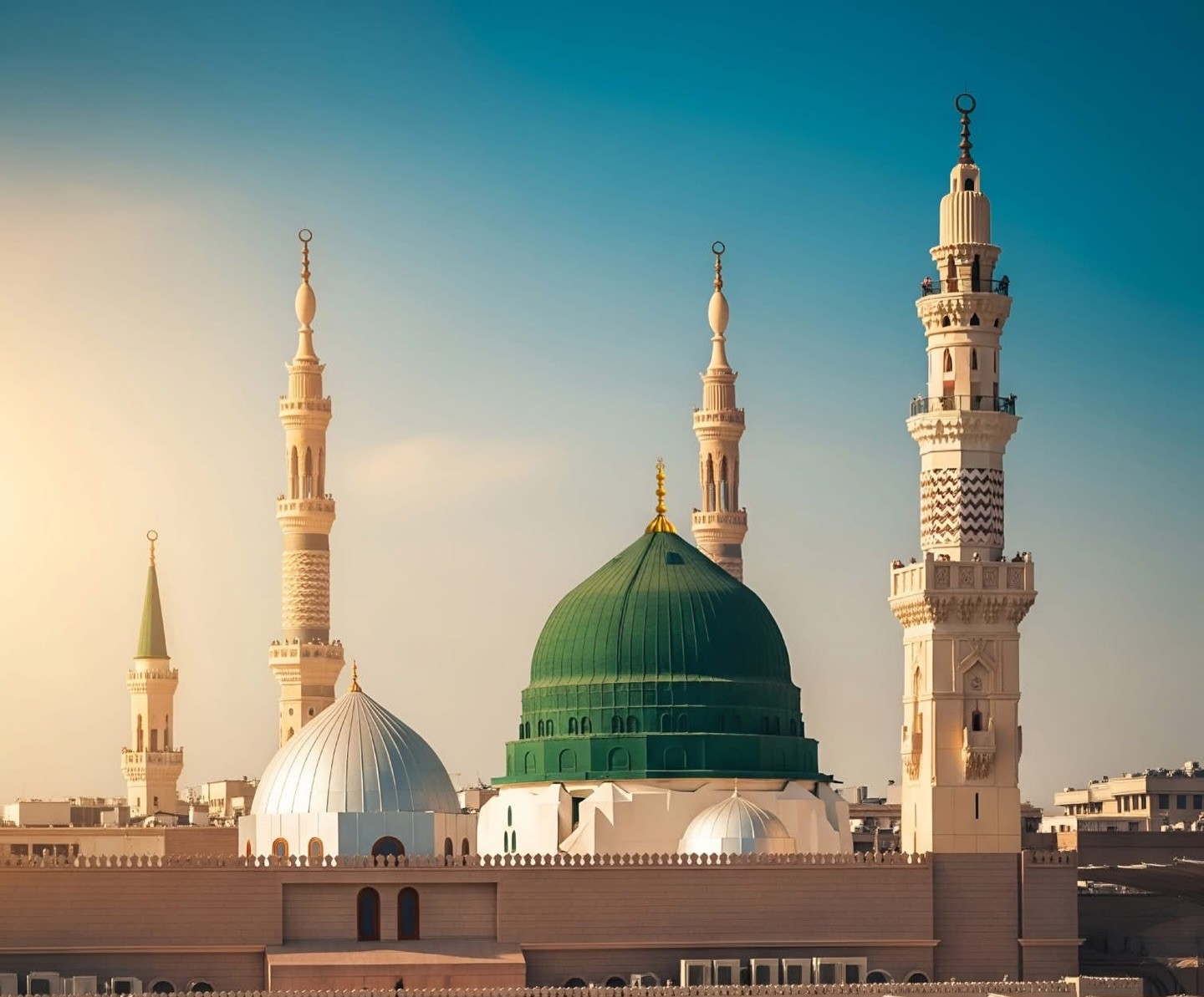
The Mamluk sultan al-Mansur Qalawun oversaw the construction of the first dome over the Prophet’s ﷺ tomb in 1279 CE, later painted white and blue. No explicit named-pillar material change specific to the Mamluk period is documented in general architectural histories reviewed for this dossier, and no primary pillar-specific source was located describing Mamluk-era work on the eight columns discussed here directly. The dome itself, however, would go on to have a long architectural life of its own, rebuilt and repainted repeatedly under later dynasties before arriving at the green colour and form recognisable today.
The Ottoman Period, 1233–1277 AH / 1817–1861 CE
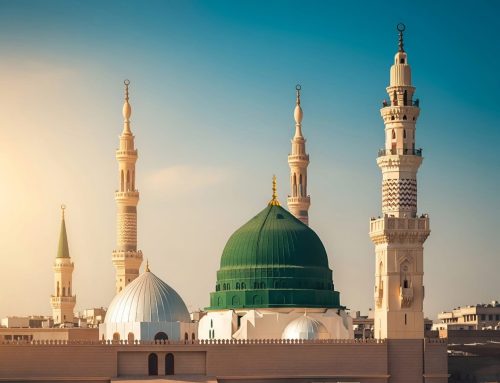
Ottoman-era work on the mosque proceeded in two major phases. Sultan Mahmud II rebuilt the dome into essentially its current shape, and it was painted green from 1837 onward, giving rise to the name by which it is universally known today, the Green Dome. A far more extensive renovation followed under Sultan Abd al-Majid I, a thirteen-year project running from 1849 to 1861 that rebuilt nearly the entire mosque with the exception of the tomb itself, three mihrabs, the minbar, and the Sulaymaniyya minaret. It was during this renovation that the columns were painted red, in an intentional echo of the reddish stone found in Wadi al-Aqiq near Madinah, and the pillars specifically within the Rawdah area were clad in red-and-white marble, their capitals finished in gold leaf. By the end of this renovation, the total column count across the mosque’s porches had reached 327 — a mosque now built almost entirely in stone, marble, and gilded decoration, a world away from the palm trunks of the seventh century, though standing on precisely the same ground and, in the case of the eight named pillars, marking precisely the same locations.
The Saudi Era: First Expansion, 1367–1375 AH / 1948–1955 CE
Following the establishment of the Kingdom of Saudi Arabia, the first Saudi-era expansion doubled the area of the Ottoman-era mosque and introduced standardised carpeting across the prayer hall. This expansion was primarily about capacity and comfort for a rapidly growing number of pilgrims arriving by increasingly modern means of transport, rather than a wholesale redesign of the mosque’s decorative language.
The Saudi Era: Second Expansion Under King Fahd, 1405–1414 AH / 1985–1994 CE
The second Saudi expansion, undertaken under King Fahd, was transformative in scale. It raised the mosque’s total capacity past one million worshippers, added twenty-seven courtyard plazas fitted with retractable, sliding concrete domes — each with a radius of 7.35 metres and a weight of eighty tonnes — increased the number of minarets to ten, added twenty-four escalators for pilgrim movement, and constructed an entire basement level to house the air conditioning, ventilation, fire-safety, and dome-control systems that a mosque of this size now required. It is this expansion, more than any before it, that gave the mosque its modern character as a building whose scale requires industrial-level mechanical infrastructure hidden beneath its floors — infrastructure directly relevant, as the Architecture section below explains, to how the modern columns themselves function.
The Saudi Era: Third Expansion Under King Abdullah, From 1433 AH / 2012 CE
The most recent major phase of expansion, begun under King Abdullah and continuing as an ongoing programme, targets an eventual capacity of two million worshippers and has added further marble-clad columns in entirely new wings of the mosque. This expansion is the one responsible for much of the mosque’s current outward scale as seen from the surrounding plazas, and it is within this same era that the giant retractable courtyard umbrellas, discussed fully in the Architecture section below, were engineered and installed.
What This Timeline Means for the Eight Named Pillars Specifically
It is essential to be precise about what this long sequence of rebuilding does and does not mean for the eight pillars this article is about. The general column stock of the mosque has been entirely replaced, multiple times over, across fourteen centuries — from palm trunk, to timber, to carved stone, to iron-reinforced and marble-clad stone, to painted and gilded Ottoman marble, to the modern white marble and brass columns of the Saudi era. The eight named pillars have not been physically continuous objects surviving from the Prophet’s ﷺ own lifetime; no source claims that the trunk the Prophet ﷺ embraced in the seventh century is the same piece of wood standing at that location today, after fourteen centuries of demolition and rebuilding in ever more permanent materials. What has been continuous, instead, is the location — a fact preserved by community memory, reinforced across generations, and eventually formalised with inscribed markers. Every time the mosque was rebuilt, the builders and the scholars overseeing the work took care to reconstruct a column at the remembered position of each named pillar, so that the name and the story could continue to attach to a physical column on that spot, even as the column’s material, shape, and decoration changed completely across the centuries. This distinction between continuity of location and continuity of material matters enormously for how a pilgrim should understand what they are looking at today: not a seventh-century artefact, but a modern column standing precisely where a seventh-century artefact once stood, carrying forward a memory that has survived every rebuilding the mosque has undergone.
Architecture: What the Pillars Are Made of Today, and How They Work
The Modern Column, General Description
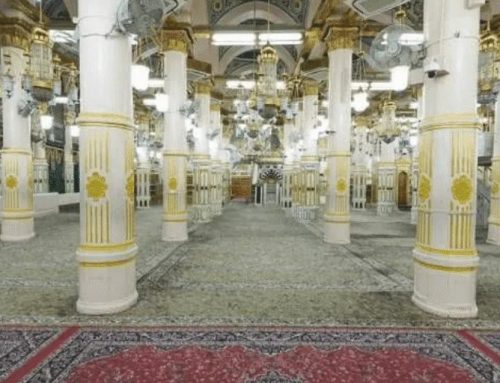
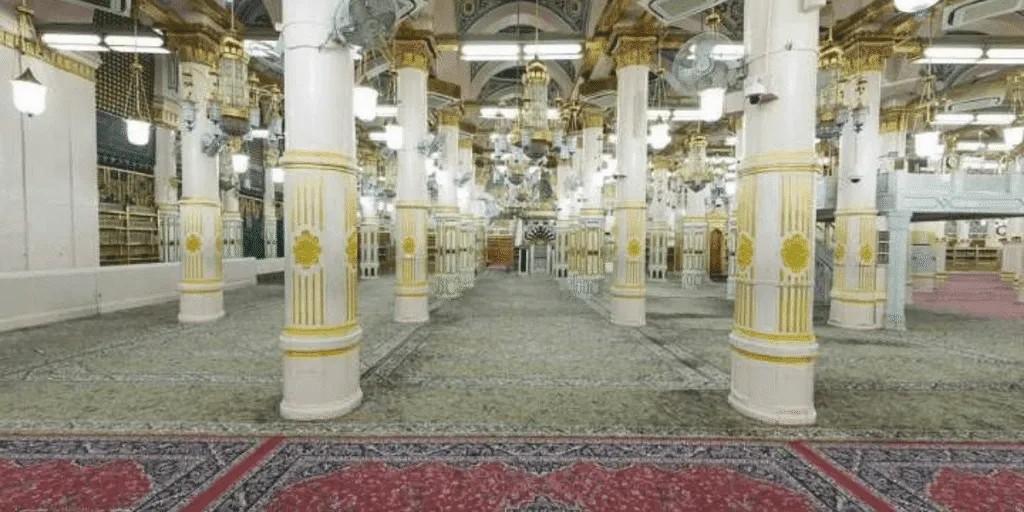
The modern mosque’s general column stock — roughly 2,345 columns across the two twentieth-century Saudi-era expansions — is described in architectural surveys as white marble with brass capitals supporting slightly pointed arches. Roughly this same number of columns are clad in Italian Carrara marble, with decorative inlays of Italian Bardiglio, Spanish Alicante, Indian Green, and Turkish Travertine and Rosa marbles used at entrances and in the spaces between columns. This is a level of imported material sourcing that would have been unimaginable to the community that first drove palm trunks into the sand of Yathrib, and it reflects the scale of the modern kingdom’s investment in the site as one of the two holiest places in Islam.
Ventilation Built Into the Column Bases
One of the more striking features of the modern columns, directly relevant to how the mosque manages the extreme heat of the Hijaz, is that the column bases are fitted with ventilation grilles that regulate the temperature inside the prayer hall. This is not a decorative feature. It is the visible end-point of an enormous mechanical cooling system that begins far beneath the mosque floor. The cooling plant serving Masjid an-Nabawi covers an area of roughly 70,000 square metres and includes what is reported as the world’s largest water-cooling condenser system: six chillers, each with a capacity of 3,400 tons, cooling water down to five degrees Celsius. This chilled air is distributed to the prayer hall through ducts that terminate in the grilles and vents built directly into the mosque’s columns — cold air, quite literally, is released from netting attached to the pillars themselves, drawn from a network reported to include 151 separate air treatment, distribution, and cooling units feeding the system as a whole. A pilgrim standing near any column in the modern prayer hall during the punishing heat of a Madinah summer is standing beside a piece of climate engineering as much as a piece of architecture, and the contrast with the shade-and-breeze cooling strategy of the original palm-frond roof could hardly be more complete.
The Retractable Umbrella-Columns of the Courtyards
In the mosque’s open plazas, 250 giant convertible umbrellas were installed between August and November 2010, under a project ordered by King Abdullah, engineered by the German firm SL-Rasch under architect Mahmoud Bodo Rasch, with fabric supplied by the Swiss company Sefar and manufacturing carried out by Liebherr of Germany and Taiyo Kogyo of Japan, at a total reported cost of roughly 4.7 billion Saudi riyals, or approximately 1.25 billion US dollars. Each umbrella spans 25.5 by 25.5 metres when fully open and stands roughly 15 to 22 metres tall depending on the source consulted. The engineering detail most relevant to this article’s subject is what happens when the umbrella is closed: the entire mechanism, including its working parts, retracts into a narrow, elegant column, faced in marble with brass capitals designed to match the surrounding arcade columns, so that a closed umbrella mast reads visually as another slender column or minaret rather than as a piece of modern machinery. SL-Rasch’s own technical description of the project notes that in summer, the umbrellas also emit cooled air from the base of the masts and from the capitals, directly linking these umbrella-columns to the same climate-control infrastructure described above for the interior columns. The entire opening-and-closing cycle is automated by software tied to the position of the sun and to an anemometer that halts movement above roughly 50 kilometres per hour of wind speed, with the structures engineered to withstand wind loads of up to 155 kilometres per hour.
It is worth being explicit about what these umbrella-columns are and are not. They are not among the eight historic named pillars discussed throughout this article, and no historical event from the Prophet’s ﷺ life is attached to them. They are included here because they represent the most technologically advanced expression of the same basic architectural idea that has run through this mosque’s history since its first palm trunks: a column as both a structural support and an environmental device, shaped to make an unbearable climate bearable for people who have come to pray. The SL-Rasch umbrella-column system is simply the twenty-first century’s version of a problem the mosque’s builders have been solving, in one material after another, since the seventh century.
The Golden Maqsura and the Three Enclosed Pillars
Three of the eight named pillars — the Pillar of the Bed, the Pillar of the Guard, and the Pillar of the Delegations — are physically incorporated into the ornate brass and gold lattice screen, the maqsura, that surrounds the Sacred Chamber holding the Prophet’s ﷺ grave. This screen is itself a significant piece of Islamic architectural craftsmanship in its own right, a filigree structure fine enough to allow a clear view through to the chamber beyond while still functioning as a physical barrier preventing entry. The three pillars inside it can be seen by any visitor standing near the railing, but they cannot be touched, approached closely, or examined at leisure; they are visible only from a respectful distance, through the gaps in the brasswork, for as long as the crowd moving past allows.
What Was Lost
No original palm-trunk column, no Umayyad marble cladding, and no Ottoman red-painted pillar survives today in its original seventh, eighth, or nineteenth-century form at any of the eight named locations; each rebuilding replaced what came before. What has been preserved, instead, across every one of these material transformations, is the community’s memory of exactly where each pillar stood and what had happened there — a form of continuity that depends entirely on transmission, generation to generation, rather than on the survival of any single physical object. This is architecturally unusual. Most historic sites derive their significance substantially from the survival of an original fabric; here, the significance survives the near-total loss of that fabric, carried instead by names, plaques, and the persistence of collective memory across fourteen centuries of demolition and reconstruction.
Why the Modern Columns Look the Way They Do
It is worth dwelling for a moment on why the mosque’s builders, across every era from the Umayyads onward, kept returning to marble, brass, and increasingly elaborate decoration for the columns specifically, rather than treating them as purely structural elements to be finished as cheaply and simply as possible. A column in this mosque has never been merely a support. From the moment the Umayyads introduced marble cladding and gold-leaf polish in the early eighth century, the column became a canvas for expressing the dignity owed to the space, a load-bearing member that was also, unavoidably, one of the most visually repeated elements a worshipper’s eye would encounter throughout an entire prayer. Multiply a single decorative choice by two thousand repetitions across a vast hall, and even a modest ornamental flourish on one capital becomes a defining visual rhythm for the whole building. This is part of why the Ottoman decision to paint the columns red and to clad the Rawdah pillars specifically in red-and-white marble reads, in hindsight, as more than a stylistic preference: it was a way of marking the most historically significant zone of the mosque as visually distinct from the surrounding hall, using exactly the same architectural vocabulary — colour and material applied to a column — that every previous dynasty had already established as the mosque’s primary means of expressing hierarchy and significance within an otherwise repetitive structural grid.
Archaeological Findings: A Site With Almost No Published Excavation
It must be said plainly, in keeping with this dossier’s commitment to reporting negative results honestly rather than inventing findings to fill a gap: no published archaeological excavation report specific to the eight named pillars of Masjid an-Nabawi was located in the course of this research. This is not unusual for the site as a whole. Masjid an-Nabawi remains an active, continuously used place of worship of the very highest religious sensitivity, and it has never been subject to the kind of systematic below-ground archaeological excavation that has been carried out at many other historically significant sites around the world. What exists instead, and what this dossier has relied on throughout, is a combination of textual history — hadith literature, classical historical works such as al-Samhudi’s Wafa al-Wafa, and modern architectural surveys conducted during successive Saudi-era expansions — rather than excavated physical evidence in the conventional archaeological sense.
The architectural surveys conducted during the twentieth-century Saudi expansions, cited throughout the Historical Development and Architecture sections above, come closest to functioning as a form of documented physical investigation, since work of that scale necessarily involved detailed examination of the existing structure before demolition and rebuilding. But these surveys are engineering and construction records, not archaeological excavation reports in the academic sense, and this dossier’s research did not locate any peer-reviewed archaeological publication specifically addressing the eight named pillars, their foundations, or any physical evidence of their historical positions beyond what is preserved in textual and architectural-survey sources already cited. Readers should treat the absence of archaeological literature here as a genuine gap in the published record, not as evidence against the pillars’ traditional locations, which rest instead on the textual and architectural-survey evidence set out at length above.
Stories of the Companions: The People Whose Lives Are Written Into These Columns
Abu Lubaba ibn Abd al-Mundhir: The Man Who Bound Himself
Of the companions attached to these eight pillars, none is more fully present in the story than Abu Lubaba ibn Abd al-Mundhir, a leading figure of the Aws whose given name is itself disputed in the sources — variously reported as Bashir or Rifa’a — a small but telling reminder of how much detail about even prominent early Muslims has not survived with perfect clarity. Abu Lubaba had been present at the pledge of Aqabah and at Badr, and he held enough standing among the Ansar and enough personal history with Banu Qurayza, with whom his own family had ties, that the Prophet ﷺ chose him specifically to advise the besieged tribe during the aftermath of the Battle of the Trench. That trust is exactly what makes his subsequent gesture, and his response to it, so significant. He was not a marginal figure making a careless mistake. He was a man the Prophet ﷺ had judged capable of handling a sensitive diplomatic moment, and it was precisely because of that closeness and that insight into the situation that his single gesture carried so much weight, and precisely because of that weight that his subsequent guilt was so severe.
What Abu Lubaba did next is, on any honest reading, one of the most striking acts of self-accountability recorded anywhere in the early Islamic community. He did not wait for anyone to notice what he had signalled to Banu Qurayza. He did not offer a private explanation to the Prophet ﷺ and hope the matter would pass. He walked to the mosque, bound himself with rope to this pillar, and made his repentance a matter of public, physical, sustained record — visible to everyone who passed through the mosque for however many days his self-binding lasted, a period the sources report with genuine disagreement as anywhere from six to twenty days and nights. He refused to eat beyond the minimum necessary to survive, and he refused release by anyone other than the Prophet ﷺ himself, a condition that meant his ordeal could only end when the Prophet ﷺ chose to end it, not when Abu Lubaba himself judged enough time had passed.
There is a lesson here about the difference between guilt and repentance that the seerah rarely states so physically. Guilt is often private, diffuse, and endlessly rationalised. Abu Lubaba made his repentance the opposite of all three: public, specific, and bounded by a condition he could not control. When forgiveness came, tradition holds that the Prophet ﷺ came to release him personally, though the sira accounts show some variation on exactly who performed the physical untying. Abu Lubaba lived on afterward as a respected member of the community, his name permanently associated not with the moment of his error but with the pillar where he answered for it — a association the Muslim tradition has generally been comfortable with, on the reasoning that a sin openly repented is not a shameful secret to be hidden but, in its way, an instructive example.
Aisha bint Abi Bakr: The Blessing She Chose Not to Announce
Aisha, the Prophet’s ﷺ wife and one of the most significant transmitters of hadith in Islamic history, appears in this dossier in an unusually quiet register: not as a narrator relaying what she witnessed, but as the guardian of a piece of information she deliberately withheld. According to the tradition associated with her pillar, the Prophet ﷺ told her privately about a spot of exceptional blessing within the mosque, and rather than make that location public, she kept it to herself. The reasoning attributed to her by later tradition is straightforward and consistent with what is known of her broader character from far better attested reports: a location known to be especially blessed would draw crowds competing for it, and Aisha appears to have judged that outcome undesirable, whether for the sake of preserving the sanctity of ordinary worship or simply to avoid unseemly competition among believers for spiritual advantage.
It fell to her nephew, Abdullah ibn al-Zubayr, raised close to her household and evidently attentive enough to her private habits of prayer to work out what she would not say directly, to identify the pillar by observing the direction of her own devotions. This detail, whatever its exact grading, fits a pattern visible throughout Aisha’s life as it is documented in far better attested sources: a woman entrusted with significant private knowledge — about the Prophet’s ﷺ household, about specific rulings, about matters of Islamic law that she alone had witnessed or been told — who exercised real discretion about what to share, when, and with whom, without ever appearing to hoard that knowledge out of vanity or self-interest.
Ali ibn Abi Talib: Standing Guard at the Household Door
Ali ibn Abi Talib appears in the tradition associated with the Pillar of the Guard as one of the companions who stood watch at the doorway between Aisha’s chamber and the mosque during a period when the Prophet’s ﷺ safety was considered to be at risk. This is consistent with the broader pattern of Ali’s role throughout the Madinan period as a companion repeatedly entrusted with matters of close personal protection and sensitive responsibility — the same companion who, in accounts well documented elsewhere in the seerah literature, slept in the Prophet’s ﷺ bed on the night of the Hijra to draw off pursuers while the Prophet ﷺ made his escape from Makkah. The guarding tradition at this pillar, though its specific hadith attribution could not be independently confirmed in this dossier’s research, sits comfortably within that established pattern of trust, even where the specific textual sourcing for this particular episode remains less certain than the sourcing for Ali’s other, better-attested acts of protection.
Abdullah ibn al-Zubayr: A Childhood Spent Watching Closely
Abdullah ibn al-Zubayr, son of al-Zubayr ibn al-Awwam and Asma bint Abi Bakr, and therefore Aisha’s nephew through her sister, is remembered in Islamic history for a great deal more than his role in identifying this pillar — he would go on to become a companion of real independent stature, and later a claimant to the caliphate during the second Islamic civil war, a period well outside the scope of this article. But the detail preserved in the tradition of Aisha’s pillar, of a young man attentive enough to his aunt’s private devotional habits to deduce what she would not tell him directly, is a small but human window into what it meant to be raised inside the household of one of the Prophet’s ﷺ wives: a childhood spent in unusually close proximity to prophetic knowledge, absorbed as much by observation as by direct instruction.
Zayd ibn Arqam and the Delegation of Banu Tamim
Zayd ibn Arqam is named in secondary sources as the narrator connecting the Pillar of the Delegations to the incident behind Surah al-Hujurat 49:4–5, in which representatives of Banu Tamim called out to the Prophet ﷺ from outside his wives’ private chambers rather than waiting to be received properly. Zayd ibn Arqam is a well-established narrator elsewhere in the hadith corpus, a young companion at the time of the events he transmitted and a long-lived source of testimony about the Prophet’s ﷺ Madinan period well into the later part of the seventh century. This dossier’s inability to verify the specific pillar-location link tied to his narration, discussed fully in the Hadith References section above, should not be read as any doubt about Zayd ibn Arqam’s general reliability as a transmitter; it reflects only the specific difficulty of tracing this one detail — the exact physical spot of the Banu Tamim incident — back to a confirmed primary hadith text.
Who Was Not There: A Note on Honesty About Absence
It is worth being explicit, in keeping with the spirit of honest historical writing this dossier has followed throughout, about a companion frequently associated in popular imagination with events at Masjid an-Nabawi who has no documented connection to any of these eight pillars specifically. Abu Bakr, despite his centrality to the Prophet’s ﷺ life and his eventual burial immediately beside him within the Sacred Chamber, does not appear in any of the primary or secondary sourcing behind the eight pillar narratives examined in this dossier. His story belongs overwhelmingly to the Sacred Chamber itself and to the broader history of the mosque, both covered in this site’s companion articles, rather than to any of the specific pillar events treated here. This is simply a matter of scope, not of any diminishment of his standing; not every major companion’s life intersects with every specific feature of the mosque, and this dossier has been careful throughout not to manufacture connections that the sources do not support.
Stories of Great Islamic Scholars: Rulings and Reflections Tied to the Pillars
Imam Malik ibn Anas and the Best Place to Pray
Imam Malik ibn Anas, the founder of the Maliki school of law and a lifelong resident of Madinah whose entire juristic method was shaped by direct proximity to the mosque and its living community, is reported in secondary sources to have held that the area at al-Hannana pillar, beside the Prophet’s ﷺ mihrab, was the single best spot in the entire mosque at which to offer voluntary prayer. This dossier was not able to trace this attribution to a primary fiqh text directly, and it is presented here, as it is in the sourcing it derives from, as a reported scholarly opinion rather than a confirmed textual ruling. It is nonetheless a plausible and fitting attribution: Imam Malik’s entire legal method rested on giving special evidentiary weight to the practice of the people of Madinah, on the reasoning that a community living continuously atop the ground the Prophet ﷺ himself had walked was uniquely positioned to have preserved his authentic practice by simple, unbroken transmission. A scholar who reasoned that way about law in general would naturally also have reasoned that way about sacred geography — that the spot where the Prophet ﷺ himself chose to stand and pray for years, marked by the very trunk his hand once touched, carries a virtue that later, more elaborately built spaces in the same mosque do not automatically inherit.
Al-Nawawi on the Etiquette of the Grave
Imam al-Nawawi, whose Sharh Sahih Muslim remains one of the indispensable commentaries on the hadith literature and whose al-Majmu’ Sharh al-Muhadhdhab is a foundational work of Shafi’i jurisprudence, records in that latter work a position he attributes to “the scholars” generally: that touching or kissing the Prophet’s ﷺ grave is disliked, makruh, and that the proper etiquette for a visitor is to maintain the same respectful distance one would have kept when visiting the Prophet ﷺ during his lifetime. This position, examined at greater length in the Common Misconceptions section below, bears directly on how a pilgrim should approach not only the grave itself but, by clear extension, the pillars nearest to it — several of which sit immediately adjacent to the Sacred Chamber and have historically attracted the same impulse toward physical contact that al-Nawawi’s ruling addresses.
Ibn Taymiyyah on Touching Sacred Structures
Ibn Taymiyyah, in his Majmu al-Fatawa, states the same underlying principle even more sweepingly, holding that it is not sunnah, by the agreement of the imams, to kiss or physically touch even the two corners of the Ka’bah adjacent to the Hijr, nor the walls of the Ka’bah itself, nor the Maqam Ibrahim, nor the rock at Bayt al-Maqdis, nor the grave of any prophet or righteous person. This is a scholar working from general principle rather than from a ruling specific to Masjid an-Nabawi’s pillars, but the principle he states — that physical contact with a structure, however sacred the structure or the person associated with it, is not itself a means of drawing closer to Allah, and was not practised even by the earliest generations toward the most sacred structure in Islam, the Ka’bah itself — applies with obvious and direct force to the question of touching the mosque’s historic pillars for blessing, addressed fully below.
Imam Ahmad ibn Hanbal: A Reported Minority Position
Set against al-Nawawi’s and Ibn Taymiyyah’s clearly stated positions is a report, carried by later intermediary sources discussing the question of tabarruk at the Prophet’s ﷺ grave, that Imam Ahmad ibn Hanbal held a more permissive view specifically regarding physical contact with the Prophet’s ﷺ own grave, on account of the singular and unrepeatable status of his person. This dossier presents this as exactly what the sources present it as: a minority position reported within the Hanbali school, standing in contrast to the stricter majority view articulated by al-Nawawi and Ibn Taymiyyah, and not as an settled alternative ruling that overturns the mainstream position. Genuine disagreement of this kind exists within the Islamic scholarly tradition, and this dossier’s approach throughout has been to present both sides fairly, name who holds which position, and decline to adjudicate between them — a principle that applies here with particular importance, since the question of touching sacred structures for blessing is one where sincere and learned scholars have reached different conclusions, and where a pilgrim is best served by understanding the disagreement rather than being handed a false consensus in either direction.
Ibn Kathir and the Periodization of the Year of Delegations
Ibn Kathir’s al-Bidaya wa’l-Nihaya, one of the great works of classical Islamic historiography, is the source secondary literature credits for framing the ninth year after the Hijra as Am al-Wufud, the Year of Delegations — the period during which the Pillar of the Delegations is traditionally understood to have seen its heaviest use as a site for receiving tribal representatives from across Arabia. Though this dossier’s research accessed this attribution only through modern intermediary sources rather than Ibn Kathir’s primary text directly, the broader historical fact of the Year of Delegations as a distinct and significant phase of the Prophet’s ﷺ Madinan life is well established across the classical historical tradition, of which Ibn Kathir’s work is one of the most thorough and widely used syntheses.
Al-Samhudi: The Historian Whose Work This Dossier Could Not Fully Access
No scholar’s name recurs more often in the secondary sourcing behind this dossier than al-Samhudi, the fifteenth-century historian of Madinah whose Wafa al-Wafa bi-Akhbar Dar al-Mustafa remains the definitive classical topography of the city and its mosque. Al-Samhudi is credited, through intermediary modern sources, with preserving details about the perfuming of the pillars in the second century after the Hijra, additional context on the Prophet’s ﷺ practice near the Pillar of Repentance, and much of the fine-grained topographical detail this dossier has drawn on throughout. It must be stated plainly, in keeping with this article’s commitment to honest sourcing, that al-Samhudi’s original Arabic text was not directly accessed in the course of this research; every citation to him here has come through modern websites that quote or paraphrase him, generally without precise volume or page references. This is flagged as a genuine sourcing gap in the Authentic Sources section below, and any future revision of this material should prioritise obtaining direct access to a critical edition of Wafa al-Wafa to convert these secondhand citations into properly page-referenced primary ones.
Sa’id ibn al-Musayyib and the Generation That Kept the Names Alive
The names and locations of these eight pillars did not survive fourteen centuries by accident. They survived because early Madinan scholars of the generation after the companions, men later Islamic scholarship would call the Tabi’un, took the trouble to record and transmit precisely this kind of local, place-based knowledge, treating it as worth preserving even though it did not carry the same legal weight as a ruling on prayer or inheritance. Sa’id ibn al-Musayyib, one of the most respected jurists of the generation following the companions and a lifelong resident of Madinah married into Abu Hurayra’s family, is representative of this wider pattern of scholars who lived their entire lives within a few hundred metres of these pillars and who form the unbroken chain of local memory behind everything this dossier has reported about their positions. It is this kind of scholar, more than any single caliph or architect, who is ultimately responsible for the fact that a pilgrim standing in the Rawdah today can be told with reasonable confidence which column marks which event, even after the physical material of every column has been replaced many times over.
Spiritual Reflection: What Eight Ordinary Columns Ask of You
Stand for a moment, if you are ever fortunate enough to be inside the Rawdah during a permitted window, beside the pillar known as al-Hannana, and consider what it actually asks of you to believe that a piece of wood once cried from loneliness. Not loneliness for an object, not loneliness for a room, but loneliness for remembrance — for the specific sound of Allah’s name being spoken nearby, a sound so woven into that spot that its absence produced something the room full of companions could hear and the Prophet ﷺ himself came down to comfort. If a trunk could register that loss so plainly that history preserved the sound of it in three separate chains of transmission, what does it say about you, walking distracted through your own days, that the absence of remembrance in your own life so rarely produces anything you notice at all?
You may never reach Aisha’s pillar and know for certain you are standing where the Prophet ﷺ said a particular blessing waited. That uncertainty is not a flaw in your visit. It is, in a way, the entire point of what Aisha did with the knowledge she was given: she did not turn a spiritual gift into a public competition, and the mosque today, in its crowding and its permit slots and its two allotted minutes of standing room, has inherited a version of the same lesson without perhaps intending to. You cannot claim this specific pillar for yourself. You can only offer sincere prayer somewhere near it, trusting that Allah, who knew exactly which column Aisha prayed toward without ever being told, knows exactly where you are standing too.
Consider Abu Lubaba, bound to his pillar for days that felt, one imagines, considerably longer than six or even twenty nights to the man living through them. What debt do you owe that you have not yet tied yourself to anything to repay? Most of us are permitted the mercy of private repentance, unwatched, unbound, easy to abandon halfway through when the discomfort becomes inconvenient. Abu Lubaba removed that mercy from himself deliberately, because he judged his fault serious enough to deserve a repentance that could not be quietly walked back. You are not asked to tie yourself to anything literal. You are asked to consider whether your own repentances have ever cost you anything at all, or whether they have simply been words, said once, and left exactly where they were said.
Think, too, about the two pillars you will never see. Somewhere behind a wall you cannot pass, behind a bookcase installed centuries after the fact, stands the place where the Prophet ﷺ prayed alone at night until the crowd that gathered around him became a burden he chose to lift from the whole community rather than let it grow. He denied himself witnesses to protect the rest of us from an obligation we could not have carried. There is a particular kind of leadership in that act — a willingness to be less visible, less imitated, less followed, for the sake of those who would otherwise have been crushed by following too closely — that has nothing to do with whether you can physically stand where he stood. You cannot see that pillar. You are still permitted to learn from what happened there.
And when you finally stand, permit in hand, in the crush of the Rawdah, unable to say with certainty which exact flagstone marks which exact pillar, ask yourself honestly what you actually came for. Was it the geography — the precise coordinate, the photograph, the claim you were here — or was it what the geography exists to point toward: a man who wept over a trunk of wood, a woman who guarded a secret out of love rather than pride, a companion who bound himself in rope rather than live with an unexamined conscience, and a community that has carried the memory of all three, faithfully, imperfectly, arguing over exact positions and exact wordings, for fourteen hundred years. The pillars do not need you to find them exactly. They need you to understand what they are still, after all this time, trying to tell you.
Practical Visitor Guide: Finding the Pillars in 2025 and 2026
Getting There: The Nusuk Permit Reality
Close proximity to the three publicly reachable named pillars is, in practice, inseparable from access to the Rawdah itself, and since the post-pandemic reorganisation of Rawdah entry, that access runs exclusively through the Saudi government’s official Nusuk app. You will need to download the app, register using your passport number, visa number, and date of birth, and then navigate to the Prophet’s Mosque Services section — sometimes labelled Holy Mosque Services — to select the Booking of Permit for Noble Rawdah, offered separately for men and for women. There is no informal walk-in access to the Rawdah under the current system. A confirmed booking generates a QR code that must be shown to guards at the entrance gate, and attempting entry without a valid permit will simply result in being turned away, however far you have travelled to get there.
Permits are free of charge and are released roughly seven to ten days in advance, with some sources reporting a window of up to fourteen days; one current guide specifies a fixed weekly release time of Friday afternoons at 12:00 pm Saudi time, though you should treat any specific release schedule as subject to change and always confirm the live timing inside the app itself before you travel. Slots are widely reported to fill within seconds to minutes of release, so the practical advice is straightforward: have the app installed, your details entered, and your alerts set well before you plan to visit, and be ready to book the instant a window opens rather than assuming you can return to it later in the day.
Timing Windows and Gates
Men’s and women’s visiting windows are kept separate. As currently structured, one guide gives men’s normal-day slots as running from roughly 2:00 am until the Fajr call to prayer, and again from about 11:20 am until Isha; women’s normal-day slots run from just after Fajr until around 11:00 am, and again from after Isha until 2:00 am. Friday timings shift around the Jumu’ah prayer and should be checked separately. These clock times illustrate the current shape of the system rather than representing a permanent, unchangeable schedule — Saudi authorities have adjusted Rawdah timings more than once in recent years, and the only reliable source for what applies on the day of your visit is the live schedule inside the Nusuk app itself.
Entry commonly runs through Bab al-Salam, numbered Gate 1, and Bab Jibril, numbered Gate 2, for general access, with a separate women’s gate — numbered 32 in several recent guides — used for the female visiting slots. Arrive at the correct gate for your permit type and your booked window with time to spare; queues form well before the window officially opens, and Haramain security staff are not able to make exceptions for pilgrims who arrive at the wrong gate or outside their allotted time.
Honest Guidance: No Permit Guarantees a Specific Pillar
This needs to be said plainly, because pilgrim expectations are often shaped by photographs and guidebook descriptions that imply a calm, orderly visit to each named pillar in turn. That is not the reality of a modern Rawdah visit. Time inside the Rawdah is now tightly slotted, and the space is extremely crowded even within a booked window. A realistic visit typically allows enough time to pray two rak’ahs somewhere within the Rawdah carpet and to offer du’a near the railing surrounding the Sacred Chamber. Precisely identifying and pausing at each of the three publicly reachable named pillars in turn — al-Hannana, Aisha’s pillar, and the Pillar of Repentance — is not guaranteed, and depends heavily on where the crowd happens to place you and how much time genuinely remains once you are inside. Do not build an itinerary around visiting all three pillars individually and in sequence; build it instead around the more modest and more attainable goal of praying sincerely somewhere inside this sacred space, wherever you find yourself standing.
The three pillars enclosed within the golden maqsura around the Sacred Chamber — the Pillar of the Bed, the Pillar of the Guard, and the Pillar of the Delegations — can only ever be viewed from a distance, in passing, through the brass lattice screen. No permit, no arrangement, and no level of advance planning changes this; they are structurally inaccessible to any visitor by design. The remaining two pillars — the Pillar of Night Prayer and the Pillar of Gabriel — are not visible on any public visit under any circumstance whatsoever, permit or no permit, because they sit entirely inside the sealed precinct of the Sacred Chamber itself. If your goal is to see all eight pillars with your own eyes, that goal is simply not achievable by anyone; five of the eight are either enclosed behind a screen or fully hidden, and no degree of planning, patience, or personal connection changes that structural fact.
What You Will See
Where the pillars are marked, they carry inscriptions or plaques executed in gold Thuluth calligraphy set against a facing of green marble, giving the pillar’s name. The clearest confirmed example is the Pillar of Night Prayer’s inscription, which reads, in Arabic, “this is the place of the Prophet’s ﷺ tahajjud” — though as already noted, this particular pillar and its plaque are today covered by a bookcase and are not visible even though the wording has been confirmed by Saudi government sources. The exact wording on the other seven plaques was not independently verified against a photographed primary source in the research behind this dossier, and should be treated as a description of the general marking practice rather than a guaranteed verbatim transcription of every individual inscription. What you can rely on is the general visual language: green marble, gold Thuluth script, a small, dignified marker rather than an elaborate monument, consistent with the mosque’s broader restraint in how it marks even its most historically significant interior features.
Where to Stand and Best Times to Try
If your permit places you anywhere near the front portion of the Rawdah, closer to the mihrab than to the general prayer hall, you are likely in the vicinity of al-Hannana and Aisha’s pillar, since both stand relatively close to the mihrab and to each other near the centre of the Rawdah. The Pillar of Repentance stands nearby as well, adjacent to the Pillar of the Bed, which marks the beginning of the enclosed maqsura zone — so if you find open railings and a golden screen ahead of you, you have likely reached the boundary between the walkable Rawdah and the enclosed pillars. Later, quieter windows — where your permit and local conditions allow you any choice at all — are generally reported to be less crowded than the periods immediately around the five daily prayers, though this varies considerably by season, by the volume of pilgrims present for Hajj or Ramadan, and by factors entirely outside any visitor’s control.
Etiquette: What to Do and What Not to Do
- Do treat your time in the Rawdah as time for sincere worship first, and pillar-identification second. The reward of a sincere two rak’ahs prayed anywhere within the space far exceeds any value in correctly naming the column nearest to you.
- Do move with the flow of the crowd rather than against it. Standing still to take a photograph or search for a plaque blocks pilgrims behind you who may have travelled as far as you have for the same limited window.
- Do lower your voice. This remains an active place of prayer and reflection for everyone present, whatever your own reason for being there.
- Do not touch, rub, kiss, or press yourself against any pillar, wall, or railing in the hope of gaining blessing. This practice is addressed at length in the Common Misconceptions section below and is the subject of a clear, mainstream scholarly ruling against it.
- Do not attempt to reach into or past the golden maqsura railing to touch the enclosed pillars. The barrier exists for structural and religious reasons alike, and staff are present specifically to prevent this.
- Do not assume you will have time to locate all three publicly accessible pillars individually. Plan for the possibility that you will only clearly identify one, or none, and treat that outcome as entirely normal rather than as a failed visit.
- Do not argue with security staff about gate assignments, timing windows, or permit rules. The system is standardised across enormous numbers of pilgrims, and individual exceptions are not something gate staff have the authority to grant.
Photography
Photography rules inside the Rawdah have varied over time and continue to be enforced with some inconsistency depending on the specific staff present at any given moment; the safest working assumption is that photography, particularly of other worshippers, should be minimised or avoided, and that your attention is better spent on the prayer and reflection the space exists for than on capturing an image of a plaque you may not have time to compose carefully in any case. If you wish to record your visit, doing so briefly, respectfully, and without obstructing the movement of other pilgrims is the most defensible approach, but you should be prepared for staff to ask you to stop, and you should comply without argument if they do.
Best Practices for a First-Time Rawdah Visitor Seeking the Pillars
If this is your first visit and the eight pillars are a genuine priority for you rather than a secondary curiosity, the single most useful thing you can do in advance is read the descriptions in this article’s earlier sections closely enough that you can recognise each pillar’s approximate location the moment you glimpse a plaque, rather than trying to read and translate an inscription for the first time while being carried forward by a moving crowd. Know before you arrive that al-Hannana sits beside the mihrab on its northern side, that Aisha’s pillar sits nearby toward the centre of the Rawdah, and that the Pillar of Repentance stands adjacent to the boundary where the golden maqsura begins. Knowing this in advance turns a few fleeting seconds of eye contact with a green marble plaque into actual recognition, rather than a blur of gold script you will not have time to read properly.
It is also worth mentally separating your two goals for the visit — prayer and pillar recognition — and ranking them honestly before you go. If you treat the prayer as primary and the pillar recognition as a bonus that may or may not happen depending on the crowd, you will leave satisfied regardless of the outcome. If you treat pillar recognition as the primary goal, you risk spending your brief and precious time inside the Rawdah anxious and distracted, scanning for markers instead of present in prayer — precisely the outcome the scholarly guidance on sincerity in worship would caution against.
Accessibility
The Rawdah’s crowding and its narrow permitted windows present genuine practical challenges for visitors with mobility difficulties, older pilgrims, or anyone who cannot move quickly through a dense crowd within a limited time. There is no separate slower-paced accessibility track documented for the Rawdah specifically in the sources behind this dossier; pilgrims with such needs should plan for extra time, consider requesting assistance from mosque staff where available, and set realistic expectations that a full circuit of the accessible pillars may not be possible within the time and physical conditions of a single visit. Bringing a companion who can assist with movement through the crowd is strongly advisable.
Visiting With Children
The combination of a strict timed permit, a dense crowd, and a solemn devotional atmosphere makes the Rawdah a genuinely difficult environment for young children, and this should be weighed honestly before bringing them. If you do bring children, prepare them beforehand for the crowding and the need for quiet, keep physical contact with them constant throughout the visit given the density of the crowd, and consider whether an older child capable of understanding the significance of the space will get more from the experience than a younger one who may find it primarily overwhelming or frightening. There is no shame in deciding that a first Rawdah visit is better undertaken without young children, with a return visit planned for when they are older.
Common Mistakes Pilgrims Make
- Assuming there will be time to identify and pray at each of the eight pillars in turn — an expectation the modern permit system simply cannot support, as explained above.
- Confusing the enclosed pillars behind the golden maqsura with the three that remain in the open, walkable Rawdah, and searching in the wrong area for a pillar that is, in fact, permanently inaccessible.
- Treating position descriptions such as “the third pillar from the minbar” as fixed, universally agreed coordinates, when in fact different guidebook sources genuinely disagree on exact ordinal counts, a documented point of confusion addressed fully in the Common Misconceptions section below.
- Touching or attempting to touch the pillars for blessing, a practice addressed by clear scholarly rulings discussed below.
- Failing to book a Nusuk permit far enough in advance, or misunderstanding the separate booking flows for men and women, and arriving in Madinah without any confirmed access to the Rawdah at all.
- Repeating specific numeric reward claims — such as a particular multiplier of reward tied to one specific pillar — that have no traceable basis in any hadith text, sahih or weak, as explained fully below.
Common Misconceptions: What Real Scholarship Says About the Pillars
Touching and Kissing the Pillars for Tabarruk
A recurring practice among some visitors to Masjid an-Nabawi is touching, rubbing, or kissing the historic pillars, walls, or the mihrab in the hope of gaining blessing, tabarruk. The mainstream scholarly position, set out in an IslamQA fatwa titled “Islamic Guidelines for Visitors to the Prophet’s Mosque,” holds that it is not permissible to seek blessing from any part of the Prophet’s Mosque — explicitly including its pillars, walls, doors, mihrab, and minbar — by touching or kissing them, and likewise not permissible to seek blessing from the Prophet’s ﷺ chamber by touching it, kissing it, wiping clothing against it, or circumambulating it (IslamQA, answer 36863). The fatwa frames these acts as an unwarranted innovation that violates the sanctity of the mosque, and states that anyone who has done so should repent and not repeat it. This ruling grounds the general sanctity of Madinah in an authentic hadith concerning the city as a sanctuary narrated from Abu Hurayra, though the specific prohibition on touching or kissing structural elements is presented as a direct scholarly ruling rather than tied to one single prohibitive hadith text.
A closely related IslamQA fatwa on seeking blessing from scholars and relics states plainly that it is not permissible to seek blessing from anyone or anything other than the Prophet ﷺ himself during his own lifetime — his ablution water, his hair, his sweat, and comparable relics — because, as the fatwa notes, the companions did not seek blessing from any one of their own number, not even the rightly guided caliphs, either during or after the Prophet’s ﷺ lifetime (IslamQA, answer 10083).
A note on authenticity: the mainstream fatwa position against touching or kissing the pillars is clear and widely disseminated, and this dossier presents it as the ruling a visitor is most likely to encounter from official and mainstream scholarly channels. It should not be read as the only view any scholar has ever held on the narrower question of touching the Prophet’s ﷺ grave specifically, as the next section explains.
A Genuine Point of Scholarly Disagreement: Al-Nawawi and Ibn Taymiyyah Against a Reported Position of Imam Ahmad
A separate source, citing Imam al-Nawawi’s al-Majmu’ Sharh al-Muhadhdhab (8/275), records that touching or kissing the Prophet’s ﷺ grave is disliked, makruh, according to the position al-Nawawi attributes to “the scholars,” who held that the proper etiquette is to keep the same respectful distance one would have kept visiting the Prophet ﷺ during his life. The same source quotes Ibn Taymiyyah’s Majmu’ al-Fatawa (27/79) stating that it is not sunnah, by the agreement of the imams, to kiss or touch even the two corners of the Ka’bah adjacent to the Hijr, nor the walls of the House, nor the Maqam Ibrahim, nor the rock at Bayt al-Maqdis, nor the grave of any prophet or righteous person (Umm-ul-Qura.org).
The same source separately notes a report attributed to Imam Ahmad ibn Hanbal taking a more permissive position specifically regarding touching the Prophet’s ﷺ grave, on account of the unique status of his person — presented explicitly as a minority position within the Hanbali school, standing in contrast to the stricter majority view described above. This is a matter of genuine, named scholarly disagreement, and this dossier declines to adjudicate between the two positions. Readers should understand that real disagreement exists on the narrower question of touching the grave itself, while the mainstream and most commonly issued fatwa position — the one reflected in official guidance a visitor is likely to encounter in practice — is a clear prohibition on touching or kissing any part of the mosque structure, including its pillars.
Quantified Reward Claims Tied to Specific Pillars
No sahih or even weak hadith exists that assigns a specific, quantified reward to praying at any one of the eight named pillars individually. This point deserves emphasis precisely because it is so commonly contradicted by informal guides and word-of-mouth claims heard on the ground. The quantified-reward hadiths that do exist in the corpus concern the mosque as a whole, not any specific pillar within it, and even these carry gradings that are frequently conflated by visitors:
- Sahih al-Bukhari 1190, narrated by Abu Hurayra, states that one prayer in the Prophet’s ﷺ mosque is better than one thousand prayers in any other mosque except al-Masjid al-Haram. This is Authentic (sahih).
- A separate narration found in Sunan Ibn Majah claims the multiplier is fifty thousand times rather than one thousand. This narration carries a Weak (da’if) chain according to hadith specialists, and should not be understood as contradicting the authentic thousand-times figure; specific numbers in virtue-narrations of this kind are not always intended to be read as mutually exclusive precise counts.
- A third narration, claiming that forty consecutive congregational prayers at the mosque grant freedom from the Hellfire and from hypocrisy, is sourced to Musnad Ahmad and al-Tabarani’s Mu’jam on the authority of Anas. Scholars disagree sharply on its grading: al-Haythami and al-Mundhiri both judged its narrators sound, but al-Albani explicitly graded the narration Weak (da’if), identifying an unknown narrator, Nabit ibn Umar, in its chain. IslamWeb’s fatwa department, addressing this disagreement directly, concludes that because the narration concerns a meritorious deed rather than a ruling of obligation or prohibition, acting upon it remains unproblematic even granting the weak grading, in keeping with the classical principle that narrations concerning the virtues of good deeds may be acted upon even when weak, so long as they are not fabricated and do not establish a new obligation (IslamWeb, fatwa 84025).
None of these three narrations — sahih, weak, or disputed — attaches its stated reward to any one of the eight named pillars specifically. Any claim you encounter online or from a local guide asserting a specific numeric reward at one particular pillar should be treated as folk elaboration without a traceable hadith source, since no primary textual basis for pillar-specific quantified reward claims was found in the research behind this dossier.
A Negative Result: No Fabrication Compilation Names These Pillars
In preparing this dossier, a targeted search was made of the Luton Islamic Centre’s compiled work on inauthentic narrations in the seerah, and a related compilation on Mawlid-related fabrications, specifically looking for entries concerning the eight named pillars of Masjid an-Nabawi. No entry specifically naming any of the eight pillars — al-Hannana, Aisha or al-Qur’ah, al-Tawba or Abu Lubaba, al-Sarir, al-Muhras or al-Haras, al-Wufud, al-Tahajjud, or Jibril — as the subject of a fabricated or weak narration was found in the portions of these compilations reviewed. This is reported honestly as a negative result of a bounded search, not as proof that no such fabrication exists anywhere in the wider literature; it means these particular, well-regarded compilations did not happen to catalogue a pillar-specific fabrication, not that none has ever circulated in less rigorous popular literature. This dossier will not invent a fabricated narration to debunk simply to fill a section; where the honest answer is “no evidence of this was found,” that is the answer given.
One related but separate finding is worth noting for completeness. A different pillar tradition entirely — Ustuwanat al-Mus’haf, said to mark where a copy of the Qur’an was once kept near where the Prophet ﷺ prayed voluntary prayers — has been the subject of source-critical scholarly scrutiny in an academic article examining its claims about Qur’an codex history. This pillar sits outside the scope of the eight pillars treated in this article and is mentioned here only to flag it as a ninth, separately named pillar tradition appearing in some sources, which contributes to the wider guidebook-naming confusion discussed next.
Confusion Between Pillar Names and Positions Across Guidebooks
This dossier’s research directly encountered several documented inconsistencies while cross-referencing sources on the pillars, and rather than silently resolving them in one direction, they are flagged here as genuine points of visitor confusion:
- Position-counting disagreements: the Pillar of Repentance is described by some sources as the fourth pillar from the minbar, second from the grave, and third from the qibla, while other guides give slightly different ordinal counts without reconciling the discrepancy against a single agreed numbering convention.
- Duration disagreement in the Abu Lubaba story: secondary sources report his self-binding lasted anywhere from six to twenty days and nights, with no single figure clearly dominant across the literature.
- Naming overlap: al-Hannana is also called al-Mukhallaqa in some sources, and multiple pillars — al-Hannana, Aisha’s, and the one west of the mihrab — were reportedly all once informally called “the perfumed pillar” before the Mukhallaqa title narrowed over time to refer to just one of them, a plausible explanation for why modern guidebooks sometimes disagree on which pillar the name Mukhallaqa properly refers to.
- A ninth pillar tradition, Ustuwanat al-Mus’haf, appears in some academic literature but not in the mainstream pilgrim-guide lists of “the eight pillars,” adding to the inconsistent counts a visitor might encounter across different websites and printed guidebooks.
Given this, you should treat exact ordinal positions such as “third pillar from the minbar” as approximate orientation aids rather than precise, universally agreed coordinates, and should rely on the mosque’s own posted plaques, where present and visible, as the most authoritative on-site identification available to you.
Lesser-Known Facts About the Eight Pillars
- The Hannana pillar’s second name, al-Mukhallaqa, comes from khaluq, a musk-and-saffron-based perfume historically applied directly to the pillar — a detail few visitors realise when they see the name written on a plaque, assuming it to be a purely descriptive title rather than a record of a specific historical practice.
- Multiple secondary sources report that al-Khayzuran bint Ata, mother of the Abbasid caliph Harun al-Rashid, had all of the mosque’s pillars perfumed with khaluq in 170 AH, giving particular attention to al-Hannana, to Aisha’s pillar, and to the pillar west of the mihrab — a citation traced to al-Samhudi’s Wafa al-Wafa through intermediary sources, though this dossier was not able to confirm the exact page and volume citation against al-Samhudi’s original text directly.
- Aisha’s pillar is also known as Ustuwanat al-Muhajirin, the Pillar of the Emigrants, a name far less commonly used today than either “Aisha’s pillar” or al-Qur’ah, but preserved in some classical Arabic sources.
- The exact given name of the companion behind the Pillar of Repentance, Abu Lubaba, is itself disputed — variously reported in the sources as Bashir or as Rifa’a — a small reminder that even a companion at the centre of one of the mosque’s best-known stories has details of his own biography that did not survive with full certainty.
- The Pillar of Night Prayer, though completely hidden from public view today behind a bookcase, carries a confirmed Arabic inscription reading “this is the place of the Prophet’s ﷺ tahajjud” — meaning a plaque exists and has been documented, describing a location no living visitor can actually see.
- The total column count in the mosque’s porches reached 327 by the end of the nineteenth-century Ottoman renovation under Sultan Abd al-Majid I, a striking figure to compare against the roughly 2,345 columns present across the modern mosque’s two twentieth-century Saudi-era expansions alone — illustrating just how much the mosque’s scale has grown in barely a century and a half.
- The modern mosque’s cooling infrastructure, whose vents are built directly into the column bases, includes six chillers of 3,400 tons capacity each, cooling water down to five degrees Celsius, fed through a network reported to include 151 separate air treatment and distribution units — an entire hidden mechanical mosque operating beneath the visible one.
- The 250 retractable courtyard umbrellas, when closed, are engineered so that their masts resemble slender columns clad in marble with brass capitals matching the surrounding arcade — meaning that several of the mosque’s most futuristic pieces of engineering are deliberately disguised to look like the very columns whose seventh-century ancestors were simple palm trunks.
- A separate, ninth pillar tradition, Ustuwanat al-Mus’haf, exists in some academic and popular literature but falls outside the standard list of eight pillars this dossier and most pilgrim guides describe — a genuine point of confusion in the wider literature rather than a settled ninth member of the set.
- No archaeological excavation report specific to any of the eight pillars has been published, meaning that everything known about their exact original construction rests on textual history and architectural survey records rather than excavated physical evidence.
Timeline: The Pillars Across Fourteen Centuries
- 1 AH / 622 CE — the Prophet ﷺ builds the original mosque; columns are palm-tree trunks; the trunk later known as al-Hannana stands near the future mihrab site.
- Circa 1–2 AH / 622–624 CE — the Prophet ﷺ prays toward Jerusalem in the approximate area later associated with Aisha’s pillar.
- 2 AH / 623–624 CE, per Surah al-Baqarah 2:144 — the qibla changes from Jerusalem to Makkah; local tradition holds the Prophet ﷺ continued praying near the same area for roughly ten further days before the mihrab took its later form.
- Circa 7 AH / 628–629 CE — the Prophet ﷺ expands the mosque; columns remain palm trunks; roof height raised from roughly 2.5 to 3.5 metres.
- Undated, within the Prophet’s ﷺ lifetime — a minbar with steps is built; the Prophet ﷺ moves from preaching against the trunk to preaching from the minbar; the trunk is heard to weep, recorded in Sahih al-Bukhari 3583, 3584, 918 and Jami’ at-Tirmidhi 505.
- 5 AH / 627 CE — the Battle of the Trench and the subsequent siege of Banu Qurayza; Abu Lubaba is sent to advise the tribe, makes the throat-slitting gesture, and binds himself to the pillar later known as al-Tawba for a disputed period of six to twenty days and nights.
- Undated, within the Prophet’s ﷺ Madinan years — the Prophet ﷺ observes annual i’tikaf in the last ten nights of Ramadan at the spot later marked as the Pillar of the Bed, a practice maintained nearly every year after the Hijra.
- Undated, within the Prophet’s ﷺ Madinan years — companions, including Ali ibn Abi Talib, stand guard at the doorway later marked as the Pillar of the Guard during a period of concern for the Prophet’s ﷺ safety, reportedly ended following the revelation associated with Surah al-Ma’idah 5:67.
- 9 AH / 630–631 CE — the Year of Delegations; tribal representatives from across Arabia are received at the spot later known as the Pillar of the Delegations, including the delegation of Banu Tamim associated with Surah al-Hujurat 49:4–5.
- Undated, within the Prophet’s ﷺ Madinan years — the Prophet ﷺ prays voluntary night prayer at the spot later marked as the Pillar of Night Prayer, later deliberately curtailing the practice as companions began to join him in growing numbers.
- 11 AH / 632 CE — the Prophet ﷺ dies and is buried in Aisha’s chamber, adjoining the mosque; the area later enclosing the Pillar of Gabriel becomes part of the Sacred Chamber precinct.
- 17 AH / 638–639 CE — Caliph Umar’s expansion; columns change from palm trunks to wooden pillars.
- 29 AH / 649–653 CE — Caliph Uthman’s expansion; columns and walls rebuilt in carved, engraved stone with lime mortar and a teak roof, recorded in Sahih al-Bukhari 446.
- 88–91 AH / 707–709 CE — the Umayyad expansion under al-Walid I; columns reinforced with iron dowels and molten lead; marble cladding, gold-leaf polish, the first concave mihrab, glass mosaics, and four minarets introduced.
- 161–165 AH / 775–785 CE — the Abbasid expansion under al-Mahdi; the mosque extended northward with twenty new doors added.
- 170 AH / 786–787 CE — al-Khayzuran bint Ata, mother of Harun al-Rashid, reportedly has the mosque’s pillars perfumed with khaluq, with particular attention to al-Hannana, Aisha’s pillar, and the pillar west of the mihrab, per secondary citations of al-Samhudi.
- 678 AH / 1279 CE — the Mamluk sultan al-Mansur Qalawun builds the first dome over the Prophet’s ﷺ tomb.
- 1233 AH / 1817–1818 CE onward — Sultan Mahmud II rebuilds the dome into its current shape.
- 1253 AH / 1837 CE — the dome is painted green, giving rise to the name Green Dome.
- 1265–1277 AH / 1849–1861 CE — Sultan Abd al-Majid I’s thirteen-year renovation rebuilds nearly the entire mosque except the tomb, three mihrabs, the minbar, and the Sulaymaniyya minaret; columns are painted red in an echo of the stone of Wadi al-Aqiq; the Rawdah pillars are clad in red-and-white marble with gilded capitals; total porch columns reach 327.
- 911 AH / 1506 CE — al-Samhudi completes Wafa al-Wafa, the definitive classical topography of Madinah and its mosque, the source behind much of the pillar-specific detail preserved in later literature.
- 1367–1375 AH / 1948–1955 CE — the first Saudi-era expansion doubles the Ottoman-era mosque area and introduces standardised carpeting.
- 1405–1414 AH / 1985–1994 CE — the second Saudi-era expansion under King Fahd raises capacity past one million, adds twenty-seven retractable-domed courtyard plazas, increases minarets to ten, and builds the basement infrastructure for air conditioning and dome control.
- August–November 2010 CE — 250 giant retractable umbrella-columns, engineered by SL-Rasch, are installed in the mosque’s courtyards.
- From 1433 AH / 2012 CE — the third Saudi-era expansion under King Abdullah targets a capacity of two million, adding further marble-clad columns in new wings.
- 2025–2026 CE — Rawdah access, and by extension proximity to the three publicly reachable named pillars, is managed exclusively through the Nusuk app’s permit system, with separate timed windows for men and women.
Key Lessons from the Pillars of Masjid an-Nabawi
Historical Lessons
Names outlast materials. Every one of the eight pillars has been physically rebuilt multiple times, from palm trunk to timber to carved stone to marble and brass, yet each rebuilding preserved the same name and the same location. What survived fourteen centuries of demolition was not an object but a memory, faithfully transmitted by a community that cared enough to keep rebuilding at exactly the same spots.
A single sahih hadith can carry an entire architectural history. Sahih al-Bukhari 446 alone establishes the mosque’s transition from palm trunk, to timber, to carved stone across three caliphal periods — a reminder that hadith literature is not only a source of law and theology but also, at times, of documented architectural fact.
Expansion has been the constant, not the exception. From the Prophet’s ﷺ own enlargement of his first mosque through ten centuries of Umayyad, Abbasid, Mamluk, Ottoman, and Saudi rebuilding, this site has never stopped growing. The pillars are a fixed point of memory inside a structure that has otherwise never stayed the same size or shape for more than a few generations at a time.
Spiritual Lessons
Grief can be heard even where you do not expect it. The weeping of the abandoned trunk, established across four separate sahih and hasan-graded chains, is a reminder that proximity to remembrance leaves a mark, and that its absence can register as loss even in places we assume to be indifferent to us.
Private knowledge can be an act of care rather than secrecy. Aisha’s decision not to publicise the location of a spot of exceptional blessing was not withholding for its own sake. It protected the sanctity of ordinary worship from becoming a site of competition, a lesson worth holding onto in an age when sacred experiences are so often turned into content to be captured and compared.
Repentance can be costly without being theatrical. Abu Lubaba’s self-binding was public, but it was not performed for an audience; it was performed because he judged his fault serious enough to deserve real cost. The difference between visible repentance and performative repentance is intention, not visibility.
Personal Lessons
You do not need certainty about the exact spot to receive the benefit of standing near it. Guidebooks disagree on ordinal counts; crowds obscure plaques; permits do not guarantee proximity to any one pillar. None of that diminishes the value of sincere prayer offered anywhere within the Rawdah.
Sincerity is not measured by how much you can prove. Several of the events behind these pillars rest on sira material or ungraded citations rather than sahih hadith. Their devotional value to generations of believers has never depended on achieving a grading they were never going to receive; it has depended on what the stories ask of the person hearing them.
Discretion is itself a form of devotion. Abdullah ibn al-Zubayr’s quiet observation of his aunt’s prayer habits, and Aisha’s original silence about the blessing itself, both model a kind of attentiveness that seeks understanding without demanding disclosure.
Practical Lessons
Plan around the system that exists, not the one you wish existed. The Nusuk permit system, with its narrow windows and rapid slot depletion, is the only route into the Rawdah in 2025 and 2026. Pilgrims who plan around an imagined, calmer, walk-in visit will be disappointed; pilgrims who plan around the permit system as it actually operates will not be.
Know before you go which pillars you can actually reach. Three pillars are open, three sit behind a golden screen, and two are entirely hidden. Understanding this in advance prevents wasted time searching for something that cannot be found, and redirects that time toward what is actually attainable: sincere prayer wherever you are able to stand.
Verify a claim before you repeat it. This dossier has flagged, again and again, citations that could not be confirmed against primary texts — an unconfirmed Bukhari attribution here, an ungraded Tabarani report there, a duration that varies from source to source. The discipline of checking a claim before repeating it, rather than repeating whatever sounds most impressive, is itself one of the practical lessons this entire subject teaches.
Authentic Sources
Primary Islamic Sources
- The Noble Qur’an — Surah al-Baqarah 2:144; Surah al-Anfal 8:27; Surah al-Tawba 9:102; Surah al-Ma’idah 5:67; Surah al-Hujurat 49:4–5; Surah al-Ahzab 33:33.
- Sahih al-Bukhari 3583 — the weeping trunk, narrated by Ibn Umar.
- Sahih al-Bukhari 3584 — the weeping trunk, fuller version, narrated by Jabir ibn Abdullah.
- Sahih al-Bukhari 918 — the weeping trunk, Book of Friday Prayer, narrated by Jabir ibn Abdullah.
- Sahih al-Bukhari 446 — the successive building phases of the mosque, from palm trunk to timber to carved stone.
- Sahih al-Bukhari 1190 — the reward of prayer in the Prophet’s ﷺ mosque, narrated by Abu Hurayra.
- Jami’ at-Tirmidhi 505 — the weeping trunk, narrated by Ibn Umar, with the chapter heading noting parallel narrations from Anas, Jabir, Sahl ibn Sa’d, Ubayy ibn Ka’b, Ibn Abbas, and Umm Salamah.
- Sunan Ibn Majah 1413 — the weak fifty-thousand-times reward narration.
- Musnad Ahmad and al-Tabarani, al-Mu’jam — the disputed forty-prayers narration, on the authority of Anas.
Caution on Ibn Ishaq, al-Waqidi, and al-Tabari: the narrative of Abu Lubaba and the Pillar of Repentance rests on Ibn Ishaq’s sira, preserved through Ibn Hisham’s recension, rather than on a hadith transmitted in Bukhari or Muslim. Ibn Ishaq’s material is widely accepted by Muslim historians as broadly reliable for the outline of seerah events, but his chains are frequently mursal or otherwise loosely transmitted by the standards hadith science applies to material in the six major hadith books, and his reports should not be cited as if they carried the same authentication as a graded hadith. Al-Waqidi and al-Tabari are not primary sources for any of the eight pillar narratives specifically discussed in this article, but where either is encountered in wider reading on this subject, the same caution applies: al-Waqidi was criticised as a hadith transmitter by Ahmad ibn Hanbal, al-Bukhari, and al-Nasa’i, and al-Tabari’s historical compilation transmits conflicting reports together with their chains without adjudicating between them, leaving that task to the reader or to later scholarship.
Classical Scholars and Commentators
- Al-Samhudi, Wafa al-Wafa bi-Akhbar Dar al-Mustafa — the definitive classical topography of Madinah and its mosque, cited throughout this dossier via modern intermediary sources rather than accessed directly in primary form; a priority for future verification.
- Ibn Zabala and al-Harbi, early Madinan local historians, cited via secondary Arabic compilations.
- Ibn Kathir, al-Bidaya wa’l-Nihaya — the source credited with framing the ninth year after the Hijra as the Year of Delegations.
- Al-Tabarani, al-Mu’jam al-Awsat — the named but individually ungraded source behind the report of Aisha’s pillar and the guarding narrative behind the Pillar of the Guard.
- Al-Haythami, Majma al-Zawa’id — cited as a parallel source for the Aisha’s-pillar narration, without a confirmed individual grading located in this research.
- Al-Nawawi, al-Majmu’ Sharh al-Muhadhdhab (8/275) — the ruling that touching or kissing the Prophet’s ﷺ grave is disliked, makruh.
- Ibn Taymiyyah, Majmu’ al-Fatawa (27/79) — the ruling against touching or kissing sacred structures generally, by the agreement of the imams.
- Imam Malik ibn Anas — reported, via secondary sources, to have regarded al-Hannana as the best spot in the mosque for voluntary prayer.
- Imam Ahmad ibn Hanbal — a reported minority position within the Hanbali school permitting touching the Prophet’s ﷺ grave specifically.
Modern Academic and Reference Sources
- Saudipedia, “Asatin al-Masjid al-Nabawi” — saudipedia.com (the governing naming convention for the eight pillars used throughout this article)
- Madain Project, “Expansion Chronology of Masjid al-Nabawi” — madainproject.com
- Madain Project, “Architecture of the Masjid an-Nabawi” — madainproject.com
- Archnet, site record — archnet.org
- Illustrarch, “Al-Masjid an-Nabawi: Architectural Styles” — illustrarch.com
- TakeMeToUmrah, “Masjid al-Nabawi” — takemetoumrah.com
- LastProphet.info, “The Prophet’s Mosque | Masjid al-Nabawi” — lastprophet.info
- Luxuryland.sa, “Marble in the Prophet’s Mosque” — luxuryland.sa
- MM News, “How does the world’s largest cooling station in Masjid-e-Nabawi work?” — mmnews.tv
- Haramain Archives, “Masjid Al Nabawi Umbrellas” — theharamainarchives.wordpress.com
- Senatus, “The Giant Umbrellas That Protect Pilgrims at the Medina Mosque” — senatus.net
- SL-Rasch, “Courtyard” project page — sl-rasch.com
- Yahoo Tech, fact-check on high-tech umbrellas (2025) — tech.yahoo.com
- Hajj & Umrah Planner, “Masjid Nabawi Pillars (Riaz ul Jannah)” — hajjumrahplanner.com
- Hajj & Umrah Planner, “Masjid Nabawi — The Prophet’s Mosque in Madinah” — hajjumrahplanner.com
- Islamic Landmarks, “Major pillars of Masjid-e-Nabwi” — islamiclandmarks.com
- Dar al-Zahra, “The Pillars of Masjid al-Nabawi” — daralzahra.org
- Aljumuah, “Inside Masjid an-Nabawi: The Silent Sentinels That Have Stories to Tell (Part 1)” — aljumuah.com
- Yaqeen Institute, “Abu Lubabah (ra): A Rope Only the Prophet ﷺ Could Untie” — yaqeeninstitute.org
- Understanding-Islam.com, “Contradictory information regarding the events with Banu Qurayzah” — understanding-islam.com
- IslamQA, “Islamic Guidelines for Visitors to the Prophet’s Mosque” — islamqa.info
- IslamQA, “Seeking blessing from scholars and righteous people” — islamqa.info
- IslamWeb, “Rewards for Prayers in the Prophet’s Mosque” (fatwa 84025) — islamweb.net
- Hadith Answers, “Reward for Salah in Masjid Nabawi” — hadithanswers.com
- Umm-ul-Qura.org, “Did Imam Ahmad allow Tabarruk with the Prophetic grave?” — umm-ul-qura.org
- Luton Islamic Centre, “Inauthentic narrations in the seerah” (PDF) — lutonislamiccentre.com
- Luton Islamic Centre, “Mawlidun Nabawi: Fact or Fiction?” (PDF) — lutonislamiccentre.com
- Ghamidi.tv, “Critical Evaluation of Ustuwanah al-Mushaf Narratives” — ghamidi.tv
- UmrahTransit, “How to Book Rawdah Permit on Nusuk App (2026 Guide)” — umrahtransit.com
- GuideToHajj, “How to Book Rawdah — Complete Nusuk Booking Guide (2026)” — guidetohajj.com
- UmrahCompanions, “Latest Rawdah Visiting Rules and How to Book Your Slot” — umrahcompanions.com
- The Hajj Guide, “Rawdah permit rules 2026: how to book Riyadul Jannah on Nusuk” — thehajj.guide
- Divine Dua, “Masjid an-Nabawi: The Beating Heart of Madinah (2025 Pilgrim Guide)” — divinedua.blogspot.com
A Note on Method
This article distinguishes throughout between what is authentic — established in Sahih al-Bukhari or Jami’ at-Tirmidhi and graded sahih, such as the weeping-trunk narrations and the mosque’s material building history — what is sira material — the substance of the Abu Lubaba narrative, historically valuable and widely accepted but not isnad-graded the way canonical hadith are — what is a named but ungraded report from collections such as al-Tabarani’s Mu’jam al-Awsat, what is local or historical tradition layered onto an otherwise sound hadith theme, as with the pillars of the Bed and of Night Prayer, and what is genuinely disputed among scholars, as with the question of touching the Prophet’s ﷺ grave for blessing. Every hadith cited carries its collection and number; every weaker report is named as such rather than silently elevated; every scholarly disagreement is presented with both sides named rather than resolved by editorial fiat; and where a claim could not be verified at all — an exact plaque wording, a precise number of days, a specific hadith number attributed by only one secondary source — this article says so plainly rather than filling the silence with invention. That approach will occasionally frustrate a reader hoping for a tidier story. It is nonetheless the only approach faithful to what these eight pillars actually are: places whose importance rests on a foundation of genuinely mixed evidentiary strength, exactly as fourteen centuries of honest Islamic scholarship have always found them to be.