Historic Jeddah, Al-Balad: The Complete History and Visitor Guide to the Gate to Makkah
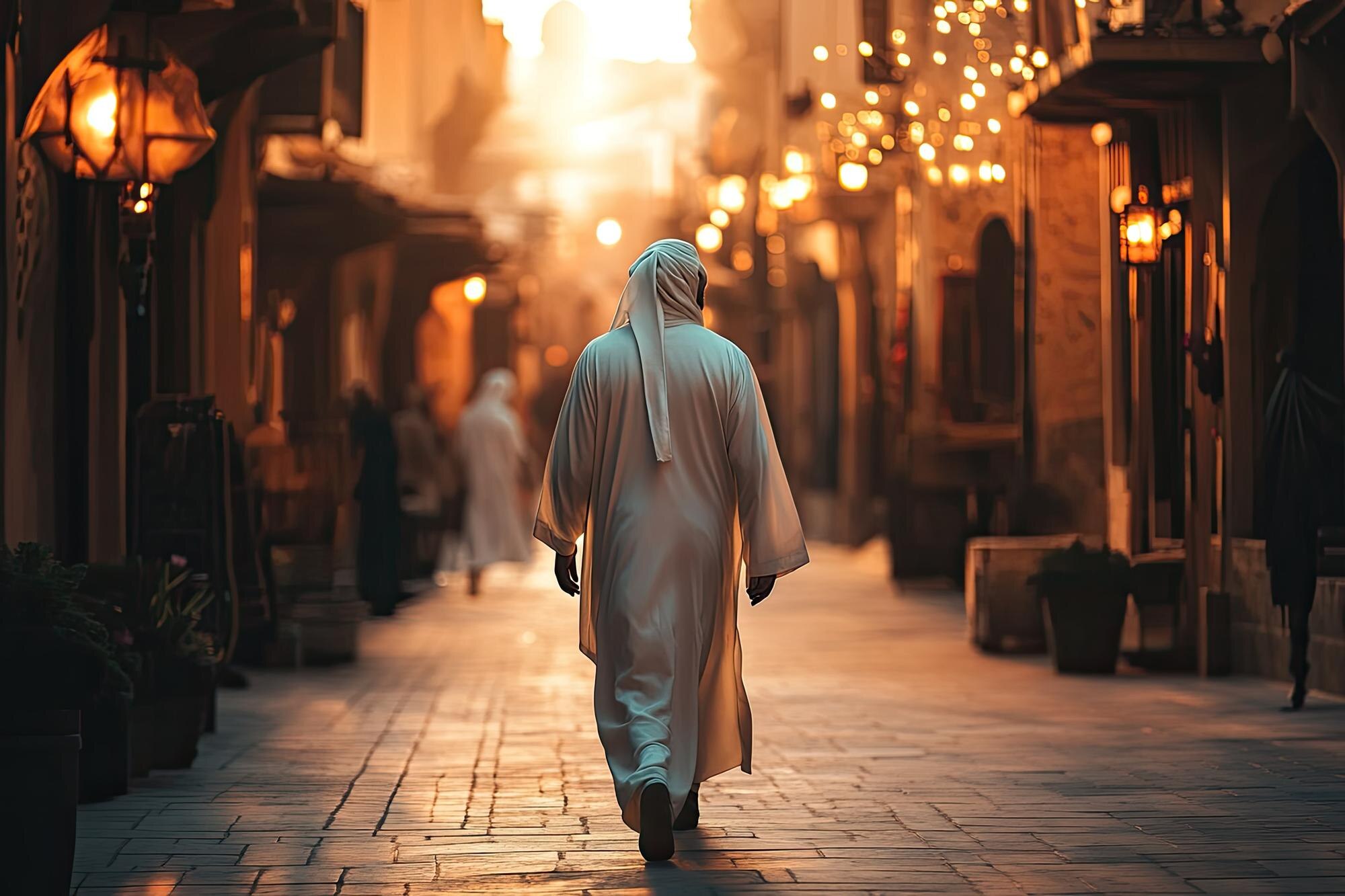
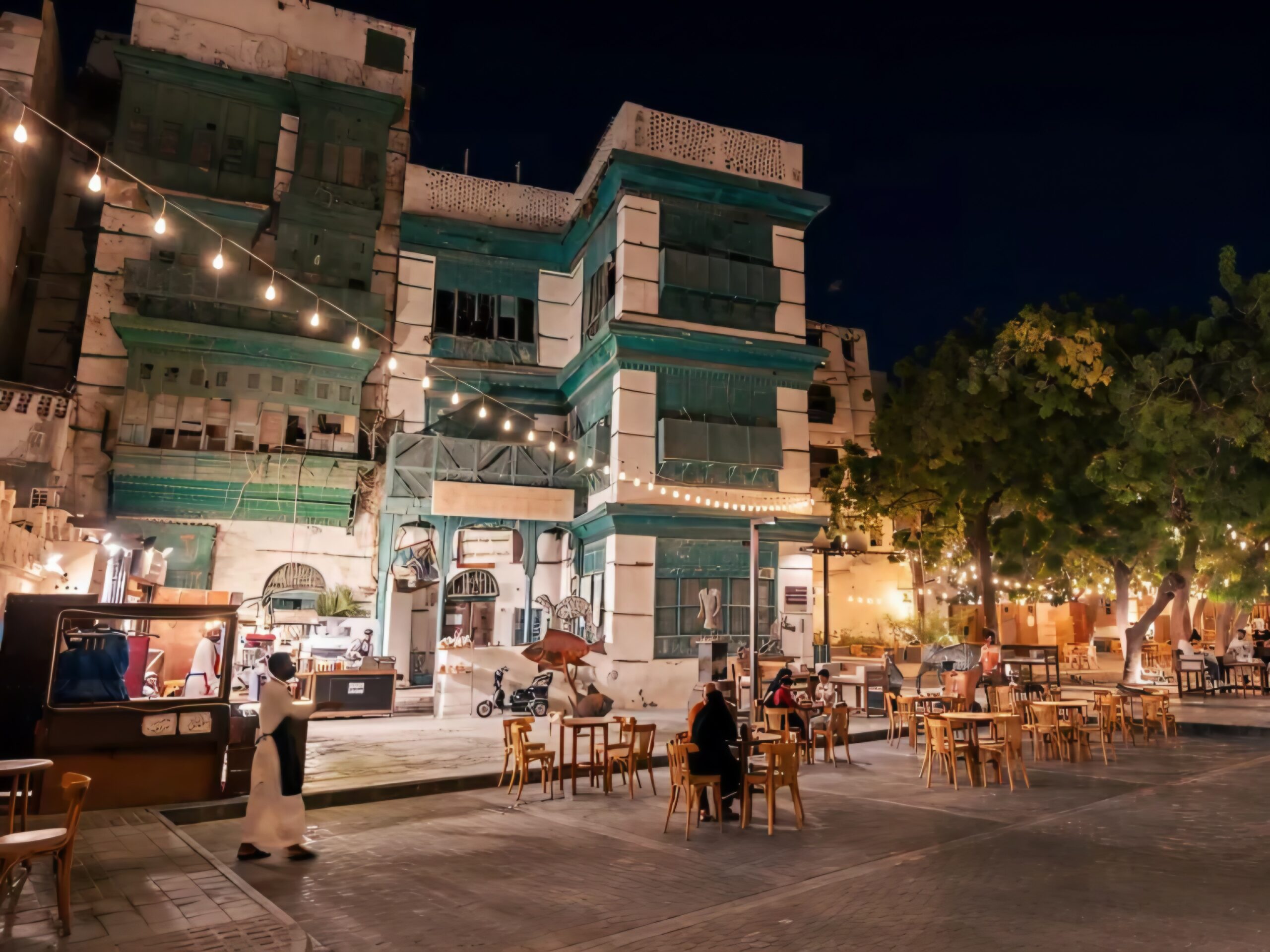
The lanes of Al-Balad are narrow enough that a tall man can touch both walls at once, and they run in no straight line for more than a few dozen metres. Above them, screened wooden balconies called rawasheen lean out over the street, close enough that neighbours on opposite sides once passed dishes of food across the gap without leaving their houses. The stone underfoot is coral, cut from the reefs of the Red Sea and hauled up through the centuries by hands that left no other record of themselves. This is the old heart of Jeddah, the port city that has stood at the edge of the Arabian Peninsula for more than a thousand years as the sea gate to Makkah, and in 2014 UNESCO inscribed it on the World Heritage List under the name Historic Jeddah, the Gate to Makkah, recognising it as an exceptional testimony to the meeting of Red Sea trade routes and the pilgrimage to the holiest city in Islam.
This guide sets out the history of Jeddah’s old town in full: its disputed pre-Islamic origins, the caliphal decree that made it the port of Makkah in the seventh century, the more than one thousand years of Hajj pilgrims who stepped off ships onto its quaysides, the merchant families and Ottoman governors who shaped it, the coral-stone tower houses and carved wooden screens that make its architecture unlike anywhere else in Arabia, and the walls that once encircled it before their demolition in 1947. It also gives an honest account of the district’s modern crisis — the collapse and fire damage that UNESCO itself has documented — alongside the restoration programme now under way through Saudi Arabia’s Vision 2030, and the separate, heavily criticised demolitions that have displaced residents elsewhere in Jeddah since 2021. Read together with practical advice on visiting in 2025 and 2026, this is intended as the fullest available account of the Islamic history of Jeddah and a serious answer to the question of what actually happened at this place, and what a visitor to Al-Balad today will and will not find.
Historical Background
Geography: Why a Port Grew Here
Jeddah sits on the eastern shore of the Red Sea, roughly seventy kilometres west of Makkah across a coastal plain broken by low hills and dry watercourses. The site that became the old city occupies a shallow, naturally sheltered indentation in the coastline, protected offshore by a screen of coral reefs that made it treacherous for large ships to approach carelessly but workable for smaller vessels with local knowledge of the channels. This combination — a sheltered anchorage, a break in the reef system navigable by pilots who knew it, and a position roughly equidistant between the Bab el-Mandeb strait to the south and the Gulf of Suez to the north — made the location valuable for as long as people have sailed the Red Sea. The town’s role, from its earliest attested history onward, was never primarily industrial or agricultural. Jeddah had no river, no extensive farmland, and only brackish well water until modern desalination; what it had was a harbour, and the overland road east to Makkah. Everything else in its history follows from that basic geographic fact, a point made directly in UNESCO’s own description of the site, which frames Historic Jeddah as “an outstanding example of a historic trading and pilgrim gateway city.”
Before Islam: Fishing Settlement and Disputed Antiquity
Popular accounts of Jeddah’s history often assert specific pre-Islamic dates — that the site was inhabited by fishermen for three thousand years, or that it flourished as a settlement as early as 2,500 years before the present, sometimes citing a foundation around 250 BC. Some of this material appears in serious secondary sources: Saudipedia’s entry on Historic Jeddah states that the site “is about three thousand years old, when it first appeared as a locale for fishermen after their fishing trips across the Red Sea,” and an academic conference paper on the old city’s planning history likewise states that “the historical values of old Jeddah date back to 250 BC” (Alyafi, Alansari and colleagues, “The Old City of Jeddah: from a walled city to a heritage site,” WIT Transactions on The Built Environment).
These claims should be read as scholarly estimate and local tradition rather than as established archaeological fact, and a careful reader should treat them as disputed rather than confirmed. A detailed academic history of the city produced by the Pfander Center for Apologetics notes plainly that “Jedda does not appear to be mentioned in any pre-Islamic source,” meaning that no surviving text from before Islam names the settlement at all (Pfander Center, “History of Jeddah”). What can be said with confidence is more modest: the coastline where Jeddah now stands was almost certainly used by fishing communities for a long period before Islam, because the reef systems along this stretch of the Red Sea have always supported fishing, and Arabian coastal populations of the pre-Islamic centuries left few durable structures that would have survived to be excavated. No systematic archaeological excavation has yet produced published stratified evidence proving continuous settlement back to 250 BC at the specific site of Al-Balad. Readers should hold the “thousands of years old” framing as tradition and popular history, not as a claim resting on peer-reviewed excavation data, and this guide will say so plainly wherever the underlying evidence is thin rather than repeat the number as fact.
The Meaning of the Name: Grandmother, Shore, or Something Else
The name “Jeddah” carries two competing explanations in the Arabic sources, and scholars have never fully resolved which is correct. The first ties the name to jaddah, meaning “grandmother,” and connects it to a local tradition holding that Eve, the grandmother of humanity, was buried near the town after her reunion with Adam following their descent from Paradise — a folk tradition tied to a site historically known as the Tomb of Eve (Qabr Hawwa), a long, low grave enclosure that existed in a cemetery in Jeddah until the early twentieth century. This tradition sits outside anything that can be verified through the Qur’an or hadith and belongs to popular legend rather than confirmed Islamic history; it is addressed in more depth, including its connection to the wider Eve tradition in Islamic folklore, elsewhere in this guide’s companion coverage of that subject. The Tomb of Eve itself was reportedly destroyed or sealed by Saudi religious authorities in the late 1920s as part of a broader campaign against grave shrines that were judged to encourage practices inconsistent with Islamic teaching on tawhid, and travellers’ accounts from the nineteenth century, including that of the explorer Richard Burton, describe visiting a long grave attributed to Eve before its later closure.
The second explanation derives the name from jadd or a related root connected to “shore” or “coastline,” reading Jeddah simply as a description of the town’s position on the edge of the sea — a plain, functional toponym rather than a legendary one. Modern academic treatments of the city’s history, including the Pfander Center’s survey cited above, tend to treat the coastal/shore etymology as the more linguistically defensible reading, while acknowledging that the grandmother/Eve tradition is deeply embedded in local memory and continues to circulate in popular and even some official descriptions of the city. This guide presents both explanations as disputed, because neither can be proven definitively from the available philological and historical evidence, and no classical Islamic scholar has issued an authoritative ruling settling the question one way or the other.
Importance Before and After Islam
Before the rise of Islam, the Arabian Red Sea coast was dotted with small anchorages used by regional trade, most of it modest compared to the great incense and spice routes running through the interior of the peninsula toward the Mediterranean. Jeddah’s transformation from a minor coastal point into a place of major and lasting significance is inseparable from a single event: its designation as the official port of Makkah in the early Islamic period, replacing an older port to the south. That designation multiplied the town’s importance by tying it permanently to the two things that would define the rest of its history — the trade routes of the Indian Ocean world, and the annual tide of pilgrims travelling to perform Hajj and Umrah. Where Jeddah before this decree was one coastal settlement among several, Jeddah after it became, in effect, irreplaceable: every ship carrying pilgrims or goods bound for the Hijaz from Egypt, the Levant, East Africa, Yemen, India, or Southeast Asia had strong incentive to call there, and the town’s fortunes rose and fell for the next thirteen centuries according to the volume of that traffic.
Changes Through History: An Overview
The centuries that followed saw Jeddah pass through the hands of the Rashidun and Umayyad caliphates, the Abbasids, a succession of regional dynasties contesting control of the Hijaz, the Mamluk sultanate of Egypt, the Ottoman Empire, and finally the modern Kingdom of Saudi Arabia founded by Abdulaziz ibn Abdul Rahman Al Saud. Each period left a mark: the Mamluks built the city wall in the early sixteenth century in response to the arrival of Portuguese warships in the Indian Ocean; the Ottomans held Jeddah, with interruptions, from the sixteenth century into the twentieth and left administrative and architectural traces still visible in the old town; the twentieth century brought the discovery of oil, the collapse of the old pilgrim-tax economy that had sustained the port for a millennium, and a construction boom that moved Jeddah’s centre of gravity away from the historic core and toward new districts to the north and east. This full arc, treated period by period with dates in both the Hijri and Gregorian calendars, is set out later in this guide’s Historical Development section. What matters at the outset is the basic shape of the story: a fishing anchorage of uncertain and disputed antiquity, converted by a decision of the third caliph into the maritime gate of the holiest city in Islam, sustained for well over a thousand years by pilgrimage and trade, and left today as a UNESCO World Heritage Site whose surviving fabric is simultaneously a record of extraordinary continuity and a casualty of twentieth-century neglect.
The Story Behind the Place
A City Built by Necessity, Not by Empire
Unlike the great administrative and military cities of early Islam — Kufa, Basra, Fustat — Jeddah was never founded as a garrison town or an act of imperial planning. It grew instead out of a logistical problem: how to move pilgrims and goods safely and efficiently from the Red Sea coast to Makkah, a task that fell for a period to a port called al-Shu’aybah, roughly forty kilometres south of the site of modern Jeddah. Al-Shu’aybah appears to have functioned adequately for a time, but it lacked Jeddah’s natural advantages of a more sheltered anchorage and shorter overland route, and by the early decades of Islam the pressure to find a better solution had become acute as the numbers of Muslims travelling for Hajj grew year on year following the conquests. The story of how that problem was solved belongs, in the reliable historical record, to the third of the rightly-guided caliphs, Uthman ibn Affan, and it is treated in full in the following section of this guide because it is the single most consequential event in Jeddah’s entire history — the decision that turned a coastal settlement into a city that would never again be ordinary.
A City of Strangers
What makes Jeddah’s story unusual among Islamic historic cities is that, almost from the moment of its designation as Makkah’s port, it became a city defined by people who were not originally from it. Sailors, merchants, pilots, brokers, customs officials, and pilgrims from every shore of the Indian Ocean world passed through or settled in Jeddah, and many stayed. Hadrami merchant families from what is now Yemen, Indian traders from Gujarat and the Malabar coast, East African communities from the Swahili coast, Egyptian and Levantine merchants, and Ottoman Turkish administrators all left their mark on the town’s population, its architecture, and its trade networks. The tower houses of Al-Balad, discussed in detail in the architecture section below, were largely built and owned by these merchant families, whose wealth came from the twin engines of the Red Sea spice and textile trade and the logistics of the Hajj — provisioning, housing, and transporting pilgrims who arrived by the tens of thousands every year. Jeddah’s historic character as a cosmopolitan port, closer in social texture to Aden, Malacca, or Zanzibar than to the more homogeneous inland towns of the Najd, is one of the qualities that UNESCO’s own Statement of Outstanding Universal Value singles out, describing the property as bearing witness to “a multicultural and multi-ethnic community” shaped by “the annual gathering of pilgrims from the entire Muslim world” (UNESCO World Heritage Centre, Historic Jeddah, the Gate to Makkah).
The Rhythm of a Pilgrimage Economy
For most of its history, Jeddah’s calendar was not the Gregorian year but the Hijri one, and its economic life pulsed to the rhythm of the Hajj season. In the weeks before the pilgrimage, the harbour would fill with sailing ships — first Red Sea dhows and later steamships — bringing pilgrims from Egypt, the Levant, the Hejaz’s own coastal towns, and, after longer and more arduous voyages, from Yemen, East Africa, India, and the Malay world. The town’s population could swell dramatically in these weeks, its inns, caravanserais, and private houses pressed into service as lodging, its markets stretched to feed and equip tens of thousands of additional people preparing for the overland journey to Makkah. Then, as the pilgrims departed for the interior and later returned to sail home, the town would empty again, its economy contracting until the cycle began once more the following year. This seasonal surge-and-contraction pattern, repeated for over a millennium, is what gave Jeddah’s built environment its particular character: dense, vertical, designed to house transient crowds efficiently, and oriented functionally toward the port and the routes leading east and inland toward the holy city.
Loss and Endurance
The story of Jeddah’s old town is not only one of prosperity. It endured Portuguese naval raids in the sixteenth century, several serious epidemics tied directly to the concentration of pilgrims passing through its gates, a documented episode of mob violence in 1858 that killed foreign consuls (recounted in the Historical Development section below), and, most consequentially for the physical fabric that survives today, a long twentieth-century decline as the oil economy reoriented Saudi Arabia’s centres of wealth and modern Jeddah expanded around and past the old walled town rather than through it. The district survived not because it was carefully preserved through this period but largely because it was economically bypassed — merchants and officials moved to newer, more modern quarters, and the old coral-stone tower houses of Al-Balad were left standing, increasingly neglected, while the city grew up around them. That accident of urban history is precisely why Al-Balad exists today as a coherent historic quarter rather than as scattered individual monuments, and it is also precisely why the quarter now faces the crisis of structural decay documented later in this guide. Endurance and neglect, in Jeddah’s case, are two sides of the same coin.
Uthman ibn Affan and the Founding Decree
Al-Shu’aybah: The Port Jeddah Replaced
Before Jeddah became the port of Makkah, that role belonged to a place called al-Shu’aybah, an anchorage roughly forty kilometres to the south. Al-Shu’aybah had served as Makkah’s maritime outlet since before Islam and continued to do so into the early Islamic period; an Egyptian academic study of the port’s history describes it as “the old name of the main port of Makkah in the Jahiliyyah and early Islamic era, before Jeddah was taken as the main port in the time of Uthman ibn Affan” (“Shuaiba Port at the Beginning of Islam,” Egyptian Knowledge Bank). Al-Shu’aybah’s disadvantages relative to Jeddah were practical rather than dramatic: a less favourable anchorage, and a longer or less convenient route inland. As the number of Muslims travelling by sea for Hajj grew in the years following the conquests of the 630s and 640s, the case for a better harbour became pressing enough to reach the caliph himself.
The Decree of 26 AH
The historically dominant account, found across multiple classical and modern sources, holds that in the year 26 AH (647 CE), during the caliphate of Uthman ibn Affan رضي الله عنه, the notables of Makkah petitioned him to move the port from al-Shu’aybah to Jeddah, arguing that Jeddah was closer to the city and better suited to the purpose. A summary of the classical narration, drawn from early Islamic economic histories, records the episode in vivid detail: “In 26 AH, the people of Makkah spoke to Uthman about moving the port from Shu’aybah, which was the old port of Makkah during the Jahiliyyah, to where it is now in Jeddah, because it was closer. Uthman went out to Jeddah to see its location, and he ordered that the port be moved there. Then he went into the sea and washed himself with seawater, and said: It is blessed. And he said to those who were with him: Go into the sea and wash yourselves with seawater, but keep your izars (waist-wrappers) on. Then he set out from Jeddah via Asfan to Madinah, and the people abandoned the port of al-Shu’aybah at that time, and Jeddah has remained the port of Makkah until now” (“Public Finance in Islam: Contributions of the 3rd Caliph, Uthman bin Affan”, summarising the classical economic-history tradition on the caliph’s public expenditure decisions).
This account should be graded with care. It is not a hadith in the technical sense — it is not a report of the Prophet’s ﷺ words or deeds transmitted through a chain of named narrators subject to the formal criticism of hadith science — but a historical report (khabar) about an administrative decision of the caliph, of the kind recorded in early Islamic administrative and economic histories. As history, it should be classified as a widely attested historical tradition rather than either “authentic” or “fabricated” in the hadith sense; the core fact — that Uthman ibn Affan designated Jeddah as the port of Makkah in place of al-Shu’aybah, in or around 26 AH — is corroborated across independent modern academic treatments, including Saudipedia’s institutional history of the city, which states plainly that “Caliph Uthman Bin Affan (may Allah be pleased with him) had made Jeddah a major port for receiving pilgrims headed to the Holy Sites in Makkah al-Mukarramah” and dates this to the year 647 CE (Saudipedia, “Historic Jeddah”), and by Arab News reporting on research from the King Abdul Aziz Foundation for Research and Archives, which likewise credits “the use of the city as a port for Makkah by Caliph Uthman ibn Affan in 647” (Arab News, “Different phases of Jeddah’s rich history under spotlight”). The specific narrative details of Uthman’s visit — that he personally travelled to inspect the site, entered the sea, and blessed it — are transmitted in the classical historical tradition as a coherent episode, but they rest on chains of historical transmission rather than hadith-grade chains of legal transmission, and should be presented, in the terminology this guide uses throughout, as historically well-attested but not hadith-graded: a serious and widely accepted historical account, not a religious text carrying the authority of Prophetic speech.
Why This Decision Mattered
Uthman’s decree did more than relocate a harbour. It fused Jeddah’s identity permanently to Makkah’s, making the port not simply a trading town but the maritime threshold of the Hajj itself — the point through which the overwhelming majority of pilgrims arriving by sea would pass for the next thirteen centuries. Every later chapter of Jeddah’s history, from its Mamluk fortification to its Ottoman administration to its role in the Saudi state’s modern management of the pilgrimage, flows from this single administrative act. It is difficult to think of another Arabian city whose entire subsequent history was set in motion so directly by one decision of one man. For this reason, this guide treats Uthman ibn Affan’s decree as the pivotal event of Jeddah’s Islamic history in the way that a Prophetic visit or sermon functions in the history of a mosque or battlefield: it is the moment the place acquired its lasting identity.
Uthman ibn Affan: The Man Behind the Decision
Uthman ibn Affan رضي الله عنه, the third of the rightly-guided caliphs, ruled from 23 AH to 35 AH (644–656 CE) and is remembered in Islamic history above all for two administrative legacies: the compilation and standardisation of the Qur’anic text into the single authoritative recension still used today, and a programme of infrastructure and provincial development that included roads, canals, and ports across the expanding Islamic world. His decision on Jeddah fits a broader pattern of his caliphate: a preference for practical, functional improvements to the machinery of the state and the pilgrimage, informed by direct petitions from the people affected rather than imposed from Madinah without consultation. Classical historians describe him as a wealthy Makkan merchant before Islam, among the earliest converts, married to two of the Prophet’s ﷺ daughters in succession — Ruqayyah and then Umm Kulthum — and known for his modesty and his extensive charitable expenditure, including the purchase of the well of Ruma for the free use of the Muslims of Madinah. His decision to personally travel to inspect the site at Jeddah before ordering the port’s relocation is consistent with this administrative style: a caliph who preferred direct verification to delegation on matters of lasting consequence.
The Port of the Pilgrims: Jeddah and the History of Hajj by Sea
A Millennium of Maritime Pilgrimage
From the seventh century until the arrival of mass air travel in the mid-twentieth century, Jeddah was the point of arrival for the majority of pilgrims travelling to Makkah from outside the Arabian Peninsula. For well over a thousand years, Muslims from East Africa’s Swahili coast, from Egypt and the wider Ottoman Mediterranean, from the Hadramawt and the Yemeni highlands, from the Malabar and Coromandel coasts of India, from Bengal, and — from at least the sixteenth century onward in growing numbers — from the Malay Archipelago, the region now comprising Indonesia, Malaysia, and southern Thailand, sailed to Jeddah as the last stage of their journey before the final overland leg to the holy city. This is the aspect of Jeddah’s history most directly tied to the lived, embodied experience of ordinary Muslims across the Islamic world, and it deserves to be told with the same care given to any other layer of the city’s past.
The Voyage Itself
The sea crossing to Jeddah was, for most of this history, a serious undertaking rather than a routine one. Pilgrims travelling from Southeast Asia faced a journey of many weeks, first across the Indian Ocean to a transit port — often Aden, Bombay, or later Singapore — and then up the Red Sea itself, a body of water notorious among sailors for its coral reefs, shifting sandbanks, and seasonal winds that could becalm a sailing ship for days or drive it dangerously off course. Nineteenth-century steamship travel shortened the journey but did not remove its dangers or its discomforts: pilgrim ships were frequently overcrowded, sanitation was poor, and the concentration of large numbers of travellers from different regions in confined quarters made the route a recurring corridor for the spread of infectious disease, a problem serious enough that it shaped the administrative history of the port for more than a century, as described below.
Arrival: The First Sight of Arabia
For pilgrims who had travelled for weeks or months, the first sight of the Arabian coast — a low line of pale buildings rising out of the heat haze, the town’s coral-stone towers catching the light — marked the psychological as well as physical threshold of the pilgrimage. Historical and travel accounts from the nineteenth and early twentieth centuries consistently describe the crowded, chaotic character of arrival: ships anchoring offshore because the reef prevented them from approaching the quay directly, pilgrims and their belongings transferred to smaller boats for the final approach, and a shore thronging with porters, guides, customs officials, and touts competing for the pilgrims’ custom the moment they set foot on land. Jeddah’s role as gatekeeper to the Hajj made it, for these few weeks each year, one of the most cosmopolitan and most commercially intense cities anywhere on the Indian Ocean rim.
Quarantine and Disease Control
The concentration of pilgrims from across the Islamic world made Jeddah a recurring flashpoint for epidemic disease, and the port’s administrative history includes a long struggle to manage this risk. A serious cholera outbreak associated with the Hajj in 1865 killed a substantial number of pilgrims and alarmed European colonial administrations whose subjects — from British India, French North Africa, and Dutch Southeast Asia — travelled through Jeddah in large numbers every year. The international response led to the establishment of formal quarantine infrastructure: a quarantine station was established on Kamaran Island, in the southern Red Sea, from 1882 onward, through which many pilgrim ships were required to pass for inspection and, where necessary, isolation before continuing to Jeddah. A further major outbreak in 1893 renewed pressure for stricter sanitary controls and closer international oversight of pilgrim shipping, reflecting the uncomfortable reality that the concentration of a global religious obligation through a single narrow maritime corridor also concentrated public health risk on a global scale. These quarantine measures were not simply bureaucratic inconvenience; for individual pilgrims they often meant additional weeks of delay, confinement in unfamiliar and sometimes harsh conditions, and — for those who fell ill — a real risk of dying within sight of their destination without ever completing the pilgrimage they had sailed so far to perform.
The Mutawwifin: Pilgrim Guides and Brokers
Once ashore, pilgrims depended heavily on a distinct professional class that grew up specifically to serve them: the mutawwifin (sometimes rendered muzawwirs or dalils in different regional usages), local guides and brokers who met arriving pilgrims, arranged their lodging, negotiated transport to Makkah, provided ritual instruction, and in many cases handled the pilgrims’ money and documents for the duration of their stay. This system was indispensable to the practical functioning of the Hajj for centuries — pilgrims arriving in a foreign port, often speaking no Arabic, needed local expertise to navigate customs, transport, lodging, and ritual practice — but it was also a well-documented source of exploitation. Historical accounts describe guides who overcharged vulnerable pilgrims, withheld documents or funds to extract further payment, or abandoned pilgrims who could not pay additional fees demanded after the journey had begun. The system endured because it solved a real problem, and it produced hardship because that same dependency created opportunities for abuse; both facts belong in an honest account of the pilgrim experience at Jeddah, and modern Saudi administration of the Hajj has progressively formalised and regulated guide services precisely because of this long history of documented exploitation.
Hardship as a Recurring Theme
Reading across the historical and travel literature on the Jeddah pilgrimage route, a consistent picture emerges of a journey that tested pilgrims severely even after they reached land: the heat of the Red Sea coast, often exceeding what travellers from temperate regions had ever experienced; the crowding and poor sanitation of both the ships and the town’s overstretched lodging during the Hajj season; the financial predation of some brokers and guides; the ever-present risk of disease; and the sheer scale of logistics required to move tens of thousands of people from a coastal town with limited infrastructure onto the overland route to Makkah within the fixed and unmovable days of the Hajj calendar. None of this diminished the spiritual significance pilgrims attached to the journey — if anything, historical and devotional accounts often frame the hardship of the route as part of the trial through which the pilgrimage was earned — but an honest history of Jeddah’s role in Islamic history must record that “the Gate to Makkah” was, for most of the people who passed through it, a genuinely difficult passage, not merely a scenic waypoint.
Historical Development: Rashidun to Saudi Era
Rashidun and Umayyad Period (26 AH / 647 CE – 132 AH / 750 CE)
The Rashidun period begins Jeddah’s Islamic history with Uthman ibn Affan’s decree of 26 AH, discussed above. Under the Umayyad caliphate that followed, Jeddah continued to function as Makkah’s port, though detailed administrative records from this period are sparse compared to later centuries. The town’s importance during this period derived almost entirely from its role in servicing the annual Hajj traffic and the associated trade in provisions, textiles, and goods moving between the Hijaz and the wider Islamic world via the Red Sea.
Abbasid Period (132 AH / 750 CE – 923 AH / 1517 CE, with Regional Rule)
Through the Abbasid centuries, control over the Hijaz — and by extension Jeddah — passed through various arrangements involving Abbasid governors, local Hijazi sharifs, and, from the tenth century onward, an increasingly autonomous line of sharifian rulers of Makkah who exercised practical authority over the holy city and its port even as nominal suzerainty shifted between larger regional powers, including the Fatimids of Egypt and later the Ayyubids. Jeddah in this period functioned as a working Red Sea entrepôt, its prosperity tied closely to the broader health of Indian Ocean trade and to the political stability, or instability, of the routes connecting Egypt, Yemen, and the wider Islamic world.
Mamluk Period (923 AH and Earlier – 923 AH / 1517 CE)
Mamluk Egypt extended its authority over the Hijaz, including Jeddah, from the thirteenth century onward, folding the port into a broader Mamluk strategy of controlling the Red Sea trade routes that were central to Egypt’s own prosperity. The most consequential Mamluk intervention in Jeddah’s physical history came in the early sixteenth century, when the arrival of Portuguese warships in the Indian Ocean — part of Portugal’s push to seize control of the spice trade by rounding the Cape of Good Hope — posed a direct military threat to Red Sea ports for the first time in centuries. In response, the Mamluk Sultan Qansuh al-Ghuri ordered the construction of a fortified wall around Jeddah in 915 AH / 1509 CE, a project overseen by the Mamluk prince Hussein al-Kurdi, who — according to research by Saudi Arabia’s King Abdul Aziz Foundation for Research and Archives (Darah) — “equipped the wall with fortresses, towers and cannons to stop invading ships and dug a trench around the wall,” a project built “with the help of Jeddah’s residents” (Arab News, “Different phases of Jeddah’s rich history under spotlight”). This wall, described in more detail in the Architecture and City Walls sections below, is described by an academic conference paper on the city’s planning history as “the first documented attempt to protect the city since its establishment,” and the same paper credits the wall with having preserved the historic core of Al-Balad as a coherent quarter across the following four centuries (Alyafi et al., “The Old City of Jeddah”).
Ottoman Period (923 AH / 1517 CE – 1344 AH / 1925 CE, with Interruptions)
The Ottoman Empire absorbed the Hijaz, including Jeddah, following its conquest of Mamluk Egypt in 1517, and Ottoman authority over the port — administered in practice through a combination of an appointed governor and the sharifs of Makkah — persisted, with periods of local autonomy and occasional interruption, into the early twentieth century. The Ottomans rebuilt and strengthened Jeddah’s fortifications in 1525 following the initial Mamluk construction, reflecting the continuing seriousness with which Red Sea powers treated the Portuguese and, later, other European naval threat. Ottoman Jeddah developed as an administrative node connecting Istanbul’s authority to the holy cities, and the period saw the town’s merchant class — increasingly dominated by Hadrami families from southern Arabia alongside Indian, Egyptian, and Ottoman-Turkish traders — consolidate the commercial wealth that would later be expressed architecturally in the tower houses of the old town.
The single most violent recorded episode of the Ottoman period in Jeddah occurred on 15 June 1858 (3–4 Dhu al-Qi’dah 1274 AH), when a riot in the town, arising from a dispute over the flag status of a vessel and simmering tension between local Hadrami merchants and the European-protected trading community, escalated into a mass killing. According to Wikipedia’s summary of the episode, corroborated by contemporary British parliamentary testimony, “21 Christian residents of Jeddah… were massacred, including the French consul Élise Éveillard and his wife, and the British vice-consul Stephen Page, by some hundreds of Hadramites, inhabitants of Southern Arabia” (Wikipedia, “Jeddah massacre of 1858”). A detailed account given to the British House of Lords shortly afterward describes the immediate trigger as a dispute between Ottoman authorities and the British ship HMS Cyclops over the nationality of a vessel, and describes the vice-consul Page being thrown from a window and killed, the French consul and his wife killed at their consulate, and around twenty-five survivors rescued by Cyclops’s boats and carried to safety in Suez (Hansard, “The Massacre at Jeddah,” House of Lords, 19 July 1858). A recent academic study places the episode in its fuller context of “rivalry between European merchants and Hadrami Muslim traders, disputes over [a] vessel’s flag status, and rising hostility toward the Christian population,” noting that at least twenty-four Europeans and local Christians were killed and that survivors sought refuge aboard the Cyclops (Turkish Journal of Middle Eastern Studies). The British Navy retaliated by bombarding the town from HMS Cyclops on 25 July 1858, killing several residents, and Ottoman authorities, under heavy Anglo-French diplomatic pressure, ultimately executed a number of local notables held responsible, including — according to the Arabic Wikipedia account of the episode — the town’s muhtasib (market inspector) among those put to death, while other suspects were imprisoned or exiled (Arabic Wikipedia, “Jeddah Massacre 1858”). A French-language academic study of Jeddah’s Hadrami merchant community frames the episode as tied to the broader “emergence of Hadrami merchants in Jeddah” as a rising and increasingly assertive commercial and political force in the town during this period (“1858, l’émergence des marchands hadramis à Djedda”). The episode is recorded here as history, not as a reflection on any religious community as a whole; it belongs to the same category as other documented episodes of nineteenth-century colonial-era violence at ports where European commercial privilege, local economic grievance, and diplomatic pressure collided.
The Hashemite and Early Saudi Period (1344 AH / 1925 CE Onward)
Ottoman rule over the Hijaz ended during the First World War, when Sharif Hussein bin Ali led the Arab Revolt against Ottoman authority beginning in 1916, briefly establishing an independent Hashemite Kingdom of the Hijaz with Jeddah as one of its principal cities. This arrangement proved short-lived. Abdulaziz ibn Abdul Rahman Al Saud, having already unified much of central and eastern Arabia under his rule, moved against the Hijaz, and Jeddah surrendered to his forces in December 1925, formally becoming part of what would in 1932 be proclaimed the Kingdom of Saudi Arabia. Abdulaziz himself resided in Jeddah’s old town for a period of roughly ten years during this consolidation, and his residence — Bait Nassif, the House of Nassif, discussed in the Architecture section below — remains one of the most historically significant buildings in Al-Balad precisely because of this royal association, as recorded by Saudipedia’s institutional history of the district (Saudipedia, “Historic Jeddah”).
The Oil Era and Twentieth-Century Transformation (1938 CE Onward)
The discovery of commercial quantities of oil in Saudi Arabia’s Eastern Province in 1938, and the vast growth in state revenue that followed in the following decades, fundamentally altered Jeddah’s economic basis. For over a millennium the town’s wealth had rested substantially on pilgrim traffic, customs duties, and Red Sea trade; the oil era introduced a wholly new source of national wealth that had nothing to do with the old port economy, and much of that wealth was directed toward building modern infrastructure, government buildings, and residential districts outside the historic core. Jeddah’s population grew explosively across the twentieth century — from an estimated 25,000 to 30,000 residents in the early twentieth century to roughly 50,000 by mid-century, according to demographic estimates cited in an academic history of the city’s modern development (“A Brief History of Jeddah in the Nineteenth and Twentieth Centuries,” Project MUSE), and to several million by the twenty-first century. This growth occurred overwhelmingly outside the old walled town, whose narrow lanes and dense tower-house construction were ill-suited to modern vehicle traffic and modern infrastructure. The same academic source notes that the old city wall, encircling a town area of only about one square kilometre, was demolished in 1947 in substantial part because “only one out of a total of five city gates was wide enough to allow for the passage of cars” — a small, almost mundane detail that captures, better than any grand narrative could, exactly how the automobile age made the old fortified town obsolete on its own terms.
The SS Jeddah: A Documented Disaster on the Pilgrim Route
No single episode illustrates the hardship of the maritime Hajj route to Jeddah more starkly, or more reliably, than the case of the steamship Jeddah itself — a vessel named for the port it served, whose near-loss in 1880 became one of the most thoroughly documented pilgrim-ship disasters of the nineteenth century and later inspired Joseph Conrad’s novel Lord Jim. The ship left Singapore on 17 July 1880, called at Penang two days later, and departed Penang the following day carrying a general cargo and 953 passengers bound for Jeddah, the overwhelming majority of them pilgrims travelling to perform Hajj (Joseph Conrad Society, “Newspaper Accounts of the Jeddah Affair,” compiling contemporary 1880 press reports and Vice Admiralty court records). Contemporary press accounts, drawing on testimony from ship’s officers and passing captains involved in the same trade, describe conditions aboard such vessels in terms that leave little room for romantic imagination: one captain in the same pilgrim trade, writing in a letter reproduced by these newspaper accounts, described “1,000 or 1,200 fanatics cooped up on the deck of a small vessel for eighteen or twenty days, with no room to move, and little or no fresh air to breathe,” adding that there was “no medical man to attend to their wants when sick, and but a limited stock of medicine on board.” He recorded losing seven pilgrims to illness in roughly ten days, and stated plainly that he believed prompt medical treatment would have saved them all.
Aboard the Jeddah’s own final voyage, roughly seven hundred pilgrims travelled below deck and some five hundred more lived on the open deck itself, exposed to weather regardless of conditions, according to the same compiled press accounts. Smallpox was present on board; the same source records that forty-six pilgrims died during the passage, some from disease and some from what the account bluntly calls starvation, and that a baby born during the voyage died before morning “for want of attendance,” the ship carrying no medical officer at all. Official regulation held that no more than three pilgrims should be carried for every two tons of a ship’s measurement, but contemporary reporting notes plainly that this rule “was by no means generally observed.” Pilgrims typically travelled as deck passengers, paying between two and four pounds for the voyage, and were expected to bring their own provisions, mostly of a vegetable kind, since shipping companies made no reliable provision for feeding the people they carried.
The crisis itself began on 7 August 1880, when the Jeddah encountered severe weather; water rose above the ship’s fire grates, her boilers came loose from their mountings, and by midnight the exhausted passengers refused to continue manning the pumps that were keeping the vessel afloat. At two in the morning on 8 August, the ship’s captain, Joseph Clark, together with his wife and several officers, abandoned the vessel in one of its lifeboats, leaving behind more than nine hundred pilgrims aboard a ship they believed was sinking. Clark and his officers were picked up by a passing steamer and initially reported the Jeddah lost with all pilgrims aboard. In fact the ship had not sunk. Another vessel, the Antenor, found the Jeddah still afloat later that same day, her decks awash with seven or eight feet of water, her boilers adrift and her steam power gone, drifting helplessly toward the African coast near Cape Guardafui, and towed her safely into the port of Aden with the pilgrims still aboard. A subsequent Court of Inquiry at Aden suspended Captain Clark’s certificate for three years over his abandonment of the ship and its passengers, and a later admiralty salvage judgment awarded the rescuing crew several thousand pounds in salvage payment — a small, telling detail, since it meant that the pilgrims’ survival was adjudicated, in the end, primarily as a matter of maritime salvage law and commercial reward rather than as an event centred on the welfare of the hundreds of Muslims who had nearly died at sea attempting to fulfil their pilgrimage. This episode was not an isolated horror story; it was, by the standards of contemporary press coverage at the time, a representative one, illustrating in unusually well-documented detail the everyday risks that defined the sea route to Jeddah for ordinary pilgrims across the age of steam navigation.
Danger Beyond the Storm: Disease, Fraud, and Violence at Sea
Beyond the specific crisis of the Jeddah’s near-sinking, the same body of contemporary reporting describes a wider pattern of danger and disorder aboard the pilgrim ships of this era. One officer’s account describes armed passengers among his own pilgrim cargo — Turkoman, Arabo-Persian, and Bedouin travellers who came aboard “armed to the teeth,” forcing the crew to confiscate and lock away their weapons, only for the officer to later discover some hundred and fifty men still armed and prepared to resist the ship’s authority. The same account describes a near-catastrophic shipboard fire, started on the open deck when pilgrims lit a fire to prepare tea, which caught on the ship’s dry pine decking; had the same accident occurred belowdecks among the densely packed passengers, the officer noted, the results would very likely have been fatal on a large scale, since the confined decks would have filled with smoke and the ship’s pumps would have become unworkable in the chaos. Wider newspaper commentary on the pilgrim trade in this period describes routine exposure to “frauds, overcrowding, and epidemics, like cholera or smallpox,” and records other documented disasters in the same trade, including hundreds of pilgrims washed overboard from an Austrian Lloyd steamer in the eastern Mediterranean during the same general period. Taken together, this evidence supports the picture given earlier in this guide of the Hajj sea route to Jeddah as a genuinely hazardous undertaking for ordinary Muslims for well over a century of steam navigation, not merely as an inconvenience remembered romantically after the fact.
Southeast Asia’s Jawi Pilgrims and the Making of a Global Port
The Jeddah’s own route — Singapore to Penang to Jeddah — reflects a specific and historically important current within the broader story of Jeddah’s pilgrim traffic: the Southeast Asian Hajj corridor, carrying Muslims from what is now Indonesia, Malaysia, and southern Thailand across the Indian Ocean to the Red Sea. Ships built and operated specifically for this trade, of which the Jeddah was one of the most famous examples, ran on a regular seasonal schedule tied to the Hajj calendar, carrying thousands of Southeast Asian Muslims — often called Jawi pilgrims in the historical literature, after the regional term for the Malay-Arabic script and the wider Malay Muslim world — on journeys that could take several weeks each way and that exposed travellers to exactly the risks documented above: overcrowding, disease, inadequate medical care, and occasional outright disaster. Southeast Asian pilgrims arriving at Jeddah joined the same crowded, chaotic disembarkation process described earlier in this guide — transfer from ship to smaller boats due to the reef, competition among porters, guides, and brokers on the quay, and the immediate practical challenge of arranging onward transport and lodging in an unfamiliar port thousands of miles from home, in a language most of them did not speak fluently. That so many completed the journey nonetheless, across generation after generation, despite the well-documented risks, is itself part of the story this guide is trying to tell honestly: Jeddah’s role as the Gate to Makkah was earned through the accumulated sacrifice and risk tolerance of ordinary believers, not simply granted by geography.
Trade Beyond Pilgrimage: Jeddah’s Commercial Life
The Red Sea Spice and Textile Trade
While the Hajj gave Jeddah its unique religious significance, the city’s day-to-day economic life for most of its history rested equally on ordinary Indian Ocean commerce unconnected to the pilgrimage calendar. Coffee from Yemen, spices from India and the East Indies, textiles from Gujarat and Bengal, and goods moving in both directions between the Mediterranean world and the wider Indian Ocean passed through Jeddah’s harbour, generating customs revenue that, alongside pilgrim-related fees, formed the backbone of the port’s prosperity across the Ottoman centuries. This trade is what made Jeddah wealthy enough to build the tower houses described in the Architecture section of this guide, and it is what drew merchant families from India, East Africa, and southern Arabia to settle permanently in the city rather than simply passing through it as pilgrims did.
The Customs House and the Economics of the Port
Jeddah’s customs administration — collecting duties on both trade goods and, in various periods, on pilgrims themselves — was one of the most lucrative and most contested administrative posts in the Ottoman Hijaz, and disputes over customs revenue and administrative authority recur throughout the port’s Ottoman-era history, including, as discussed in the Historical Development section of this guide, as a contributing factor in the tensions that preceded the 1858 massacre. Control of Jeddah’s customs house meant control of a revenue stream that touched nearly every ship and nearly every pilgrim passing through the Red Sea’s principal port, which is precisely why the office attracted sustained competition among local notables, appointed Ottoman officials, and the sharifs of Makkah across the centuries.
The Human Geography of a Port City
A Population Defined by Movement
Unlike most historic Arabian towns, whose population growth over the centuries came primarily from natural increase within a stable resident community, Jeddah’s population was continuously reshaped by arrival and departure. Pilgrims who intended only to pass through sometimes stayed — settling permanently after Hajj, taking up trades connected to the pilgrimage economy, marrying into local families, and gradually becoming Jeddawis themselves rather than visitors. This pattern, repeated across many centuries and many countries of origin, is a significant part of why Historic Jeddah’s population historically included substantial communities of Hadrami, Indian, East African, and, in smaller numbers, Southeast Asian descent, layered over the town’s original core population, producing the multi-ethnic character that UNESCO’s Statement of Outstanding Universal Value specifically identifies as part of the property’s significance.
Language and Daily Life
The practical consequence of this layered settlement was a town in which multiple languages were audible in the markets and streets of Al-Balad at any given time — Arabic in its Hijazi dialect, but also Hadrami Arabic, Gujarati and other South Asian languages, Swahili, and, during the Hajj season, an even wider range of languages carried by that year’s pilgrim cohort. Guides and brokers of the kind discussed earlier in this guide often built their businesses specifically around language ability, serving as intermediaries not only between pilgrims and the physical logistics of the journey but between different linguistic communities converging, for a few weeks each year, on a single crowded quarter of coral-stone houses.
Jeddah’s Place Among the Great Ports of the Islamic World
Comparison With Other Historic Islamic Trading Cities
Jeddah’s combination of religious and commercial function invites comparison with other historic port cities of the wider Islamic and Indian Ocean world — Aden, at the mouth of the Red Sea; Malacca, on the Malay peninsula; Zanzibar, on the Swahili coast; and Basra, at the head of the Persian Gulf. Each of these cities built its historic wealth and cosmopolitan character on a combination of maritime trade and, in Jeddah’s case uniquely, a religious obligation that guaranteed an annual influx of travellers regardless of the state of regional commerce in any given year. Where Aden’s or Malacca’s fortunes rose and fell primarily with trade conditions and regional political stability, Jeddah’s core function as the Gate to Makkah gave it a demand floor that no recession or war could fully eliminate, since the Hajj continued, in some form, through every century of Islamic history regardless of the wider state of Indian Ocean commerce. This is part of what is meant by the summary of UNESCO’s own inscription language describing Historic Jeddah as “the only surviving urban ensemble of the Red Sea cultural world” (Aramco Expats, “The Seven Wonders of Arabia: Historic Jeddah,” quoting UNESCO’s inscription language): other Red Sea ports of comparable historical importance have been substantially rebuilt, abandoned, or transformed beyond recognition, while Al-Balad, despite the genuine crisis documented in this guide, still preserves a coherent physical record of what a working Red Sea pilgrimage-and-trade city actually looked like.
The UNESCO Boundary and Buffer Zone in Detail
UNESCO’s inscribed property covers 17 hectares, set within a considerably larger buffer zone of some 113 hectares intended to protect the setting and approaches to the historic core from incompatible development, according to the executive summary of Saudi Arabia’s own nomination document submitted to UNESCO in January 2013 (UNESCO World Heritage Centre, Nomination Document, “Historic Jeddah, the Gate to Makkah”). This inscribed area, extending over roughly 179,000 square metres with a maximum length of about 1,000 metres and a maximum width of some 600 metres, represents only about one third of the area originally enclosed by the city walls described earlier in this guide, concentrated across the historic Sham, Mazloum, and Yemen quarters east of Dahab Street, and organised along three main axes: the two historic west-east souks and a north-south commercial spine linking Madinah Gate to the southern limit of the old city. Understanding this boundary matters practically as well as academically: much of what a visitor today might loosely call “Al-Balad” extends beyond this strict UNESCO-protected core, and the level of structural risk, restoration investment, and heritage protection can vary meaningfully between the inscribed core and its surrounding buffer and transitional areas.
Criteria for Inscription, in Full
UNESCO’s decision to inscribe Historic Jeddah rested on three specific criteria, each targeting a distinct dimension of the site’s significance, according to a detailed summary of the inscription language. Criterion (ii) recognises the property because “the cityscape of Historic Jeddah is the result of an important exchange of human values,” reflecting the interchange of building techniques, materials, and cultural influences discussed at length in this guide’s Architecture section. Criterion (iv) recognises Historic Jeddah as “an outstanding reflection of its final flourishing as a trading and pilgrimage city and the only surviving urban ensemble of the Red Sea cultural world,” a striking claim given how many comparable historic Red Sea ports have since been demolished, rebuilt, or lost. Criterion (vi), arguably the criterion most central to this guide’s purpose, recognises Historic Jeddah as “directly associated, both at the symbolic intangible level and at the architectural and urban level, with the Hajj, the yearly Muslim pilgrimage to the Holy City of Makkah” (Aramco Expats, “The Seven Wonders of Arabia: Historic Jeddah,” quoting UNESCO’s inscription language). This formal recognition was agreed by consensus of the full World Heritage Committee at its 38th session in Doha in June 2014, recorded as Decision 38 COM 8B.21, which inscribes the property on the World Heritage List under criteria (ii), (iv), and (vi) (UNESCO World Heritage Centre, Decision 38 COM 8B.21). This decision is the international legal and institutional foundation for everything else this guide describes about the site’s protection, monitoring, and restoration.
Quarantine, Cholera, and the Politics of Disease at the Gate to Makkah
The quarantine measures mentioned earlier in this guide’s account of the pilgrim arrival experience were not a minor bureaucratic footnote; they were part of a much larger and more troubling international story in which Jeddah’s status as the principal sea gate to Makkah placed it, and the pilgrims who passed through it, at the centre of nineteenth-century global public health politics. In 1865, cholera travelled from Africa along the Hajj pilgrimage route into the Eastern Mediterranean, and the outbreak that followed helped entrench a durable European association between Muslim pilgrimage and epidemic disease (Gavi, the Vaccine Alliance, “Cholera and the inequitable origins of public health diplomacy”). European medical and colonial authorities of the period, drawing on what the historical literature terms a “miasma” framework, cast the Hindu and Muslim pilgrims moving through Jeddah and the wider Red Sea corridor as inherently suspect carriers of disease; an 1892 article in the Times of India, quoted in modern historical analysis of this period, claimed that “the actual danger for Europe lies in the international Mahomedan places of pilgrimage” and attributed this danger to what it called “Oriental squalor” among pilgrims “weakened by all kinds of deprivations” — language that reveals more about the prejudices of the colonial medical establishment than about any genuine epidemiological finding.
This suspicion had concrete institutional consequences for every pilgrim travelling to Jeddah by sea. A series of International Sanitary Conferences, beginning in Paris in 1851 and continuing through fourteen sessions over the following decades, worked to harmonise European quarantine requirements, and pilgrim vessels bound for or returning from Jeddah were treated as suspect in essentially all cases by the 1890s. The 1894 conference explicitly ruled that “the Mecca pilgrims must be subjected to quarantine in the lazaretto of Camaran,” referring to the quarantine station established on Kamaran Island in the Red Sea, through which pilgrims returning from Hajj were routed for enforced isolation before being permitted to continue their journeys home. A wider network of lazarettos — isolation stations — was established along the Red Sea specifically to monitor and contain pilgrim traffic, administered in part by an Alexandria-based health council staffed by European officers rather than by any Ottoman, Egyptian, or Hijazi medical authority. Egyptian delegates to these conferences were not blind to the double standard this system embodied: at the 1892 conference in Venice, the Egyptian delegate Boutros Pacha protested that the arrangement made of Egypt “a sentry to safeguard Europe” while expecting Egypt itself to bear the financial cost, memorably summarised in his objection: “You make of Egypt a sentry to safeguard Europe, and then you tell her, ‘Pay for it.'” Historians of this period have concluded plainly that the international quarantine regime imposed on the Hajj route was, in the words of one modern account, an effort to “externalise quarantine measures to the East,” treating Asian, African, and Middle Eastern pilgrims “as vectors of disease, not a global public worthy of equal protection.” For the ordinary pilgrim passing through Jeddah, this history meant that the final stage of a journey undertaken for the sake of worship was routinely subject to added delay, confinement, and suspicion imposed not for demonstrated medical necessity in every case, but as an instrument of a distinctly unequal system of international public health governance — a genuinely difficult chapter in the history of the Hajj sea route that this guide records honestly rather than smoothing over.
The Quarters of Old Jeddah
Harat: The Historic Neighbourhood Structure
Historic Jeddah’s urban fabric, like that of many walled Islamic cities, was organised into named quarters, or harat, each functioning as a semi-autonomous neighbourhood with its own internal social character, dominant families, and, in some cases, distinct dialect features and communal identity. The three quarters that fall within the UNESCO-inscribed boundary today — Harat al-Sham, Harat al-Mazloum, and Harat al-Yemen — take their names respectively from the northern direction toward Greater Syria, from an Arabic root associated with grievance or wrongdoing whose precise historical origin as a place name is not definitively established in the sources available, and from the southern direction toward Yemen, reflecting the general orientation of trade and travel associated with each quarter’s historic population and commercial focus. A fourth quarter, Harat al-Bahar, closer to the sea, and the harat al-Karantina discussed elsewhere in this guide for its connection to the quarantine history described above, lay historically outside or at the edges of what UNESCO’s boundary now protects, illustrating again the gap between the historic city’s full footprint and the smaller area formally inscribed in 2014.
Social Structure Within the Quarters
Each hara historically functioned as a partially self-governing social unit, with its own night watchmen, its own local reputation, and often its own dominant merchant families whose tower houses anchored the quarter both physically and socially. Marriage patterns, business partnerships, and religious study circles often operated within as much as across these quarter boundaries, particularly among the town’s older established families, while the transient population of pilgrims, sailors, and seasonal labourers moved more fluidly across the whole urban fabric, converging especially on the main commercial spine connecting the town’s principal gates. This layered social geography — settled quarter-based families overlaid by constant transient pilgrim and merchant traffic — is part of what UNESCO’s own documentation gestures toward when it describes Historic Jeddah’s urban form as a direct product of the exchange of human values under criterion (ii) of its inscription.
Ottoman Governance and the Sharifate of Makkah
A Dual System of Authority
For most of the Ottoman period, Jeddah operated under a layered and sometimes contested system of authority that visitors and later historians alike have found genuinely complex to summarise briefly. Formal Ottoman sovereignty was exercised through an appointed governor and garrison, reflecting Istanbul’s strategic interest in controlling the Red Sea approach to the Hijaz and, by extension, to Islam’s two holiest cities. Alongside this Ottoman administrative presence, the Sharif of Makkah — traditionally a descendant of the Prophet’s ﷺ family through his grandson Hasan ibn Ali, holding a position of immense religious and social prestige across the wider Islamic world — exercised substantial local authority over the Hijaz, including significant influence over Jeddah’s affairs, particularly regarding matters connected to the Hajj and to the local Bedouin tribes whose cooperation was essential to safe overland travel between Jeddah and Makkah. This dual system produced recurring friction over precisely defined spheres of authority, taxation rights, and customs revenue, tensions that surface repeatedly in the historical record and that, as this guide has already discussed, formed part of the combustible background to the violence of 1858.
Why This Mattered for Ordinary Pilgrims
For the pilgrim arriving at Jeddah’s quay after weeks at sea, this dual system of authority was rarely visible directly, but its effects were felt everywhere: in which officials collected which fees, in whose soldiers guarded which gate, in whose permission was required to organise the onward caravan to Makkah, and in whose patronage a local broker or guide needed to secure to operate profitably in the pilgrim trade. The mutawwifin discussed earlier in this guide as pilgrim brokers and guides typically operated within networks of patronage and licensing that connected, however loosely, to this same dual structure of Ottoman and Sharifian authority, meaning that a pilgrim’s practical experience of Jeddah’s bureaucracy — fair or exploitative, swift or delayed — often depended significantly on which official or broker network they happened to encounter upon arrival.
Jeddah in Travel Literature and Foreign Accounts
European and Orientalist Travellers
Beyond the specifically Islamic travel literature already discussed in this guide, Jeddah also features in the accounts of a number of European travellers, some of whom entered the Hijaz in disguise, since non-Muslims were and remain forbidden from entering Makkah and Madinah, though the port town of Jeddah itself, being outside the strictly defined sacred precincts, was more frequently visited and described by European travellers, diplomats, and colonial officials across the nineteenth century than the holy cities it served. These outsider accounts, whatever their limitations and biases, form part of the wider documentary record from which historians have reconstructed the physical appearance, commercial life, and public health conditions of nineteenth-century Jeddah described throughout this guide, including much of the material on quarantine policy, ship conditions, and the 1858 violence already presented in detail.
A Caution About Colonial-Era Sources
This guide has drawn on some nineteenth-century European and colonial-era sources, particularly British parliamentary and press material concerning the 1858 massacre and the later cholera quarantine regime, because they provide detailed, dated, and in many cases officially recorded information not always preserved elsewhere. Readers should understand, however, that such sources often carry the explicit biases of their era, including the orientalist framing of Muslim pilgrims as inherently suspect discussed above; this guide has used these sources for their factual, dateable content while explicitly naming and setting aside their prejudicial interpretive framing, consistent with the standard of honest, source-critical treatment applied throughout.
Architecture: Coral Stone, Rawasheen, and the Tower Houses of Al-Balad
Building From the Sea: The Coral-Stone Tradition
Al-Balad’s architecture begins with a simple geographic constraint: the Hejazi coastline offers almost no conventional quarry stone, but the Red Sea offers an inexhaustible supply of fossilised coral limestone. Builders harvested large blocks of coral reef from shallow waters and the shoreline, then shaped and dried them before laying them as load-bearing wall material — a technique found nowhere else in the Arab world at this scale and density (House of Saud, “Jeddah Coral Architecture: Al Balad Heritage Buildings Guide”). The material proved unexpectedly well suited to the climate: porous and comparatively lightweight, it provides natural thermal insulation that keeps interiors measurably cooler than the outside air, and it absorbs and releases humidity, helping to moderate conditions in buildings that stand barely a kilometre from the sea. Builders used a dark-brown clay dredged from the shallow lagoon known as al-Manqabah, mixing it with lime to produce the mortar that bound the coral blocks together — the origin of the term manqabi sometimes used locally for this coral-and-clay building tradition, named for the lagoon that supplied its principal ingredient.
The Engineering of a Tower House
The tower houses of Al-Balad rise five, six, and in a handful of cases seven storeys above streets sometimes barely wide enough for two people to pass — a building type UNESCO itself singled out on inscription as “an outstanding building typology unique within the Arab and Muslim world” (House of Saud, “Jeddah Coral Architecture”). Achieving that height in coral stone required real structural ingenuity. Foundations were excavated to a depth of roughly one metre and built up from compacted coral stone and clay bound tightly together; the load-bearing coral walls at the base of a typical house run fifty to sixty centimetres thick, tapering progressively on the upper storeys to reduce the weight the lower walls had to carry. To prevent the coral masonry from cracking under its own weight and under the stresses of the building’s height, builders inserted horizontal courses of imported hardwood timber through the coral walls at intervals of roughly 1.2 metres — a reinforcing technique known locally as takaleel, using timber brought from India to bind the masonry into a coherent structural frame rather than a simple stacked wall. Structural beams supporting the wooden floor platforms were cut from hardwood imported from East Africa and from Indonesia and the wider Southeast Asian timber trade, a detail that quietly records, in the fabric of the buildings themselves, the same Indian Ocean trade networks that built Jeddah’s economy in the first place: a house in Arabia held together by wood grown in the forests of Sumatra or Java and carried across the ocean on the same routes that brought pilgrims to the port. A lime plaster coating was applied over the finished coral walls to protect them from weathering and the corrosive effect of salt-laden air, a maintenance layer that, as discussed later in this guide’s account of the district’s modern crisis, is precisely the kind of routine upkeep that lapsed across much of Al-Balad during the twentieth century, with serious structural consequences.
Rawasheen: The Wooden Screens That Define Al-Balad’s Skyline
No feature of Al-Balad’s streetscape is more immediately recognisable than the rawasheen (singular roshan, a term traced to the Persian rosen, meaning balcony) — projecting carved wooden window screens that extend outward from the upper floors of the tower houses over the street below. Architectural surveys of the district distinguish at least three grades of this feature: al-masmat, a minimal projection with a simple wooden covering, typically found on smaller residential buildings in the Sham and Yaman quarters; al-bariz, featuring ornate geometric lattice patterns and a decorative crown known as the taj, with moderate projection, seen along the old commercial street of Suq al-Alawi; and the full roshan proper, a complete balcony-style projecting unit with elaborate carved lattice work, the most visually dramatic form, found at grand merchant houses such as Nasseef House and Sharbatly House (House of Saud, “Jeddah Coral Architecture”).
These screens were never purely decorative. Before mechanical air conditioning arrived in the mid-twentieth century, the roshan functioned as the building’s primary cooling and ventilation system, catching Red Sea breezes and channelling them into the room while its lattice work blocked the direct force of the sun; the same carved geometric openings filtered harsh daylight into a soft, diffused interior light, and allowed residents to observe the street below without being seen from it — a privacy function of particular importance in a densely built, socially conservative merchant town. The screens also extended a house’s usable floor area on the upper storeys without requiring a larger footprint at street level, letting rooms grow outward over the lane rather than the family having to buy more land. Many carry attached stone or brick benches, known as dekka, built into the screen for seating. The finest examples were carved from imported hardwood into complex geometric and arabesque patterns drawn from the wider vocabulary of Islamic decorative art, and while their natural finish ranged through browns and untreated wood tones, the vivid green paint seen on many surviving and restored rawasheen today has become the single most photographed detail of the district’s streetscape.
Nasseef House: Merchant Mansion and Royal Residence
The single most historically significant building in Al-Balad is Bayt Nasseef (Nasseef House), a four-storey coral-limestone mansion built between 1872 and 1881 for the wealthy merchant and Ottoman-era governor Omar Nasseef Effendi, standing directly above Suq al-Alawi, the main commercial artery of the old town. The house contains roughly forty rooms across some nine hundred square metres, with elaborate rawasheen on its upper floors and windcatcher ventilation openings on its fourth storey. Its significance to Saudi national history, rather than architectural history alone, comes from a specific event: when King Abdulaziz Ibn Saud entered Jeddah in December 1925 during his unification of the territories that would become the Kingdom of Saudi Arabia, he took up residence in Nasseef House, and it served as his home for approximately ten years — a period recorded by Saudipedia’s institutional history of the district, which notes that the house is where “the founding King Abdulaziz Bin Abdulrahman Al Saud resided for about ten years” (Saudipedia, “Historic Jeddah”). The building was later converted first into a public library and then, in 2009, into a museum and cultural centre, with exhibits covering Jeddah’s merchant history, the building’s own architectural features, and its role in the founding of the modern Saudi state (House of Saud, “Jeddah Coral Architecture”).
Sharbatly House and the Diplomatic Life of Al-Balad
On Al-Bayaa Square stands Sharbatly House, a four-storey mansion originally built in the late nineteenth century by Sharif Abdulilah Mihanna Al-Abdaly and later sold to the merchant Abdullah Sharbatly. It carries some of the finest surviving Hejazi mashrabiyya woodwork in the district, its wooden lattice balconies notably detailed and well preserved, and it later served as the headquarters of the Egyptian diplomatic mission in Saudi Arabia before its conversion into a cultural centre now used for literary and artistic events (House of Saud, “Jeddah Coral Architecture”). Its history as a diplomatic seat is a reminder that Al-Balad functioned, well into the twentieth century, as something close to the diplomatic and commercial capital of the Hijaz, a role only gradually surrendered as modern Jeddah expanded around it.
Matbouli House: The Oldest Surviving House
Local tradition holds that Bayt al-Matbouli (Matbouli House), tucked into Qumusani Alley off Suq al-Alawi in the Yemen quarter, is the oldest surviving house in Historic Jeddah, said to have been built by Sheikh Mahmoud al-Matbouli around 1022 AH, which corresponds to roughly the early seventeenth century CE — making it, on this account, close to four hundred years old (Rehlat, “Matbouli House Museum, Jeddah”). This claim of specific extreme age should be treated with the same caution this guide applies elsewhere to inflated antiquity claims: it rests on family tradition and popular heritage tourism material rather than on published archaeological dating of the structure’s fabric, and readers should hold it as a claimed rather than an independently verified date. What is not in dispute is that the Matbouli family restored the house specifically to preserve their own family’s heritage and that of the district’s original residents, and converted it into a heritage museum of historic Jeddah’s domestic life, now open to visitors in the heart of the old town.
Al-Shafi’i Mosque: The Oldest Place of Worship
Jeddah’s oldest and largest mosque, Al-Shafi’i Mosque, stands near the historic waterfront. Popular sources describing the mosque state that the current structure dates to around 1250 CE, built during the Ayyubid period, and that some historians believe the site has served as a place of worship since the era of Caliph Uthman ibn Affan in the seventh century — a claim that would make the site, though not necessarily the standing building, potentially well over 1,300 years old (House of Saud, “Jeddah Coral Architecture”). As with Matbouli House, this guide flags the seventh-century foundation claim as tradition rather than confirmed archaeological fact; what can be stated more confidently is that the mosque, built from coral limestone and wood in a hypostyle plan around a courtyard paved in white marble, underwent a significant renovation in 1533 CE funded by the Indian merchant Khawaja Muhammad Ali, and was most recently restored in 2009 with care taken to preserve its original architectural details. Its minaret, estimated by some sources at close to a thousand years old, is among the oldest standing structures anywhere in Jeddah. Saudipedia’s own listing of Al-Balad’s historic mosques separately names the Mosque of Uthman ibn Affan, al-Shafi’i Mosque, al-Basha Mosque, Ukash Mosque, al-Mimar Mosque, and al-Hanafi Mosque among the district’s significant places of worship, underscoring that Al-Balad’s 36 historic mosques form as important a layer of the built heritage as its merchant houses (Saudipedia, “How Old is al-Balad District in Jeddah?”).
Why UNESCO Recognised This Architecture
UNESCO’s Statement of Outstanding Universal Value for Historic Jeddah rests architecture at the centre of two of its three inscription criteria. Under Criterion (ii), the property is recognised for bearing witness to “an important exchange of building techniques, materials and cultural values” across the Red Sea and the wider Indian Ocean trade world from roughly the sixteenth to the early twentieth centuries — precisely the exchange visible in coral walls reinforced with Indian timber and roofed with Indonesian hardwood. Under Criterion (iv), the rawasheen tower houses are recognised as “an outstanding building typology” without parallel elsewhere in the Arab and Islamic world (UNESCO World Heritage Centre, Historic Jeddah, the Gate to Makkah). This is architecture that exists because of trade and pilgrimage, built by hands and materials drawn from three continents, and it is this combination — not merely age, and not merely beauty — that gives Al-Balad its World Heritage status.
Archaeological Findings
Compared with many ancient sites in the wider Islamic world, published archaeological excavation specifically within the boundaries of Historic Jeddah remains limited, and this guide states that plainly rather than inflating what is a genuinely thin published record. UNESCO’s own nomination documentation for the site does not claim extensive stratified excavation revealing pre-Islamic occupation layers; rather, the property’s Outstanding Universal Value rests on the surviving standing architecture of the Ottoman and later periods and on documentary and architectural evidence rather than on excavated archaeological strata. Vision 2030’s Jeddah Historic District Program does include an “Archaeology and Excavation Project” among its listed subprojects, indicating that structured excavation work within Al-Balad is a live, ongoing initiative rather than a completed body of published research (Vision 2030, “Jeddah Historic District”). Readers should therefore understand claims about Jeddah’s antiquity extending back two or three thousand years, discussed earlier in this guide’s Historical Background section, as resting primarily on textual and toponymic tradition rather than on a substantial excavated archaeological record; where future excavation under the current restoration programme produces peer-reviewed published findings, they will refine or revise the currently thin picture. Until then, the honest position is that Historic Jeddah’s archaeology is a work in progress, not a settled body of findings.
City Walls and Gates
Origins of the Fortification
Jeddah possessed some form of protective wall well before the sixteenth century — the medieval traveller Nasir-i Khusraw is cited in some secondary accounts as describing a coral-limestone fortification as early as around 1000 CE, with two gates, one facing east toward Makkah and one facing the sea — but the wall that defined the historic city and survived, in modified form, into the twentieth century was a sixteenth-century project undertaken in direct response to a specific military threat: the arrival of Portuguese naval power in the Indian Ocean and Red Sea following Vasco da Gama’s voyages around the Cape of Good Hope. Portuguese fleets under commanders including Afonso de Albuquerque and, in 1517, Lopo Soares de Albergaria mounted attacks and a siege against Jeddah as part of a broader Portuguese effort to seize control of the spice and pilgrimage trade routes of the Red Sea (Wikipedia, “Jeddah”).
Construction Under the Mamluks and the Ottomans
In response to this threat, the Mamluk Sultan Qansuh al-Ghuri commissioned the construction of a new fortified wall around Jeddah in 915 AH / 1509 CE, with the project overseen by the Mamluk prince Hussein al-Kurdi, who equipped it with towers and cannon emplacements and had a defensive trench dug outside the wall, all built with the participation of Jeddah’s own residents (Arab News, “Different phases of Jeddah’s rich history”). This wall proved insufficient to prevent the 1517 Portuguese siege, and following the Ottoman conquest of the Mamluk sultanate the same year, the Ottomans undertook a more substantial rebuilding of the fortifications in 1525, following what Wikipedia’s account of the city describes as “the defense of the city against the Lopo Soares de Albergaria’s Armada at the Siege of Jeddah (1517)” (Wikipedia, “Jeddah”). The rebuilt Ottoman wall included six watchtowers and, in most accounts, six main gates, enclosing a town area of roughly one square kilometre, with walls reported in some sources as some three metres thick and five metres high.
The Gates: Bab Makkah, Bab Sharif, and the Rest
Sources describing the wall’s gates broadly agree on a core set of six named gates, though the total number cited varies between six and eight depending on the period described and whether later additions are included. The most consistently named are: Bab Makkah, the eastern gate facing toward the holy city and, for centuries, the principal departure point for pilgrim caravans making the final overland leg of the Hajj, standing near the Bedouin market and the Haraj markets outside the wall; Bab al-Madinah (also called Bab al-Sham or Bab al-Sharaf in some sources), facing north; Bab Sharif, facing south and used principally by traders and merchants; Bab al-Maghariba, the western gate facing the port and the sea, its origins tied to a tower reportedly built around 947 AH / 1540 CE and later expanded into full gate form; Bab Jadid (“the new gate”); and Bab al-Bunt. A later addition, Bab al-Sabbah (or Bab al-Saba), was added at the beginning of the twentieth century, and some accounts describe a further new gate added by King Abdulaziz Al Saud after the Saudi takeover of the city (Saudipedia, “Historic Jeddah”; JeddahPoint, “Jeddah’s Old Wall and Popular Gates”). By the nineteenth century, an account cited by Wikipedia describes these gates as having been consolidated into four larger gates with four towers — the Gate of Sham to the north, the Gate of Makkah to the east, the Gate of Sharif to the south, and the Gate of al-Maghariba on the seaside — reflecting the ordinary process by which fortifications are rebuilt, merged, and simplified across centuries of use (Wikipedia, “Jeddah”). Each gate was fitted with heavy wooden flaps, assembled from thick beams bonded with iron strips and secured with large nails, and guarded by towers at each gate, according to descriptions drawn from historians and travellers including Ibn Battuta, cited in an academic conference paper on the old city’s development (Alyafi et al., “The Old City of Jeddah”).
Life Inside the Walls: The Quarters of Al-Balad
Within the wall, the city was organised into a small number of named quarters (harat), whose names survive in local usage and in academic literature to this day: Harat al-Sham (the Levant quarter), Harat al-Yaman (the Yemen quarter), Harat al-Mazloum, and Harat al-Bahr (the sea quarter), with some accounts adding a fifth, Harat al-Karantina (the quarantine quarter) — its name a direct legacy of the port’s long struggle with pilgrim-borne epidemic disease discussed earlier in this guide (Arab News, “Different phases of Jeddah’s rich history”). It is these four or five quarters, packed inside barely a square kilometre of fortification, that UNESCO’s inscribed property boundary largely follows today, and it is within them that the surviving tower houses, mosques, and markets of Al-Balad are concentrated.
The 1947 Demolition
The wall that had defined Jeddah’s shape for more than four centuries was demolished in 1947. Multiple independent sources converge on this date and on a broadly consistent explanation: the wall had come to constrain rather than protect the city, and the practical demands of a modernising, motorised urban environment made its removal all but inevitable. An academic history of the city’s nineteenth- and twentieth-century development, drawing on demographic and infrastructural records, notes that “only one out of a total of five city gates was wide enough to allow for the passage of cars,” making the wall a direct obstacle to the ordinary movement of motor vehicles into and through the town (“A Brief History of Jeddah in the Nineteenth and Twentieth Centuries,” Project MUSE). A separate academic conference paper on the old city’s planning history describes the same outcome in more general urban terms, noting that “the city wall was demolished in 1947 due to the” — pressures of the city’s expanding built-up area overtaking the fortification’s original perimeter (Alyafi et al., “The Old City of Jeddah”). A research project on Jeddah’s urban history hosted by the Leibniz-Zentrum Moderner Orient frames the demolition in social as much as physical terms, observing that the city’s population “was defined by residence within the walls” before 1947, and that “the demolition of the wall in 1947 symbolises the end of this clear demarcation and an opening and growth which to many seem uncontrollable from a contemporary perspective” (ZMO, “An Urban History of Jeddah, ca. 1850–1947”).
What Remains
Almost none of the sixteenth-century Mamluk-Ottoman wall survives as standing fortification today. What remains are echoes rather than structure: the names of the old gates persist as place names and neighbourhood markers within Al-Balad, and a modern reconstructed gate structure resembling Bab Makkah has been built in the district in recent years as a heritage marker and orientation point for visitors, though it should not be mistaken for surviving original Ottoman or Mamluk fabric. The absence of the wall is, in a strict physical sense, one of the most significant losses in Jeddah’s architectural history — a near-total erasure of the single structure that had defined the city’s shape, boundaries, and defensive logic for over four hundred years — and it stands as the starkest illustration in this guide’s account of a broader pattern: Al-Balad survives today not because everything was preserved, but because enough was left standing, almost by accident, after enough was already gone.
Intellectual Life: The Nasseef Library and the Making of a Reading Culture
Sheikh Muhammad Nasseef and Jeddah’s First Great Private Library
Beyond its role as a merchant residence and, briefly, a royal one, Nasseef House holds a distinctive place in the intellectual history of early twentieth-century Jeddah as the home of one of the city’s most significant private libraries. In the mid-1970s, a member of the Nasseef family transformed the house into a private library that grew to hold some sixteen thousand books, made available to scholars, students, and visiting religious teachers who could read there freely (Wikipedia, “Nasseef House”). Arabic biographical sources on Sheikh Muhammad Nasseef describe a man who, from his youth, devoted himself to collecting and pursuing rare books, whose relationships with the scholars of his era — both resident in Jeddah and passing through it — fed a growing love of study, and who hosted and supported students of religious knowledge, distributing scholarly texts printed at his own expense at a time when few could otherwise afford to acquire them (Arabic Wikipedia, “Maktabat al-Shaykh Muhammad Nasif”). The collection eventually passed to King Abdulaziz University’s central library, but the house itself, preserved today as a museum, still stands as physical testimony to the fact that Jeddah’s merchant elite invested not only in trade and architecture but in scholarship and the circulation of books — a dimension of the city’s history easily overshadowed by its more famous commercial and religious functions, but genuinely documented in its own right.
A House With Many Lives
Nasseef House itself, discussed in detail in the Architecture section of this guide, was built between 1872 and 1881 for Omar Nasseef Effendi, a governor of Jeddah and member of one of the city’s most prominent merchant families (Wikipedia, “Nasseef House”). Locally, the house was long known as “the house with the tree,” since a neem tree growing in the small square before its entrance was, until the 1920s, said to be the only tree in the entire city, water being far too scarce to support ordinary vegetation elsewhere in Jeddah’s coral-stone streets. When Abdulaziz Ibn Saud entered Jeddah in December 1925 following the siege that ended Hashemite rule, he took up residence in Nasseef House while his own palace was under construction, and the house served for a period as a site of royal audiences and early state business, before eventually being purchased by the Saudi government in 1975 and designated a protected historic landmark, then repurposed successively as a private library, a museum, and today a cultural centre hosting lectures and exhibitions.
The Railway That Never Reached Jeddah
The Hijaz Railway’s Ambition and Its Limit
No account of Hajj transport history in this period would be honest without addressing the Hijaz Railway, the celebrated Ottoman engineering project connecting Damascus to Madinah, completed in 1908 under the personal initiative of Sultan Abdul Hamid II specifically to ease the pilgrimage for Muslims arriving overland from Syria, Anatolia, and beyond (Encyclopedia Britannica, “Hejaz Railway”). The railway shortened a punishing forty-day camel caravan journey from Damascus to a rail journey of a few days, and by 1914 was reportedly carrying as many as 300,000 pilgrims annually along its route (Nabataea.net, “History of the Hejaz Railway”). What this guide must state plainly, however, is that the railway never reached Jeddah, and never reached Makkah either: opposition from Bedouin tribes whose livelihoods depended on guiding and transporting pilgrims across the final stretch of desert prevented the planned extension of the line beyond Madinah, and construction of the line was permanently interrupted by the outbreak of the First World War before those plans could be revisited (AramcoWorld, “Ottoman-Era Hijaz Railway’s Legacy Endures, Chugging Toward Revival”). Jeddah’s own Hajj traffic in this period therefore remained overwhelmingly maritime, exactly as it had been for the preceding twelve centuries since Uthman ibn Affan’s decree, and pilgrims arriving at Jeddah’s quay after the railway’s completion in 1908 still faced the same overland caravan journey to Makkah described earlier in this guide, unaffected by the railway’s achievements further north.
Rivalry Between Routes
Interestingly, French academic research on this period notes that the opening of the Suez Canal in 1869 had already produced a substantial increase in the number of pilgrims arriving at Jeddah by sea from Mediterranean regions, since the canal allowed a continuous sea voyage from the Mediterranean into the Red Sea without the earlier need to cross Egypt overland, meaning that Jeddah’s maritime Hajj traffic was expanding for its own separate reasons even as Ottoman planners were investing in a competing overland rail route through Madinah (OpenEdition Books, “Le pèlerinage à La Mecque au temps du chemin de fer du Hedjaz, 1908–1914”). The same research notes that even after the railway’s completion, the total number of pilgrims still travelling by traditional overland camel caravan was generally estimated to exceed the number arriving by the new railway, illustrating how gradually new transport technology actually displaced older pilgrimage routes in this period, and how central Jeddah’s sea route therefore remained to the overall Hajj infrastructure of the late Ottoman era, notwithstanding the railway’s fame in later Western historical memory, driven substantially by its association with T. E. Lawrence and the Arab Revolt rather than by its actual share of pilgrim traffic.
Jeddah’s Museums Today: Where the City’s History Is Kept
A Working Collection of Small Institutions
Beyond Nasseef House itself, Jeddah today maintains a modest but genuine network of museums and heritage collections documenting different dimensions of the city’s past, including the Jeddah Regional Museum of Archaeology and Ethnography, operated by the relevant government antiquities authority; the Jeddah Municipal Museum; the privately run Abdul Rauf Hasan Khalil Museum; and the Arts Heritage Museum, among roughly a dozen such institutions of varying scale and professional standard scattered across the city (Wikipedia, “Jeddah”). Within Al-Balad specifically, Nasseef House remains the most visited and best-resourced of these institutions, though it operates alongside smaller house-museums in some of the other restored merchant residences discussed earlier in this guide’s Architecture section. Visitors seeking a fuller understanding of Jeddah’s history beyond what can be gathered from walking the streets of Al-Balad alone will find these museums a useful, if modest, complement to the built heritage itself — though prospective visitors should confirm current opening hours and access arrangements directly before planning a visit, since, as this guide’s Practical Visitor Guide section has already noted regarding Al-Balad’s historic buildings generally, opening schedules for smaller museums in Jeddah can change without extensive advance notice.
Condition and Crisis: An Honest Account
A District in Genuine Danger
It would be dishonest to describe Historic Jeddah as a polished, fully restored heritage showcase, and this guide will not pretend otherwise. UNESCO’s own state of conservation reporting on the property documents, in blunt administrative language, a district in serious physical trouble. A 2016 state of conservation report prepared for the World Heritage Committee states that despite the momentum generated by the 2014 inscription, “the situation on the field is still worrying with many historic buildings in unstable conditions” (UNESCO World Heritage Centre, State of Conservation Report, Historic Jeddah). The same report cites a complete survey of the historic city carried out by the Al-Turath Foundation, finding 608 historic buildings still standing in Jeddah, of which 400 lie within the boundaries of the World Heritage property itself. Of these, the survey identified 52 buildings in severely bad condition and a further 38 that were partially collapsing at the time of the survey. Separately, the report records that 77 buildings originally catalogued in an earlier 1980s inventory by the architect Robert Matthews had already collapsed and were subsequently rebuilt, while 38 more had been demolished outright and left as empty plots since the 1980s. This is not the language of a heritage site in gentle decline; it is the language of a heritage authority racing to stabilise a district that is actively losing buildings.
Fires and Structural Failure
Compounding the risk of slow structural collapse from weathering and neglected maintenance, Al-Balad has suffered a documented pattern of fires in its densely packed timber-and-coral tower houses, whose upper floors and internal structures rely heavily on wood framing exactly of the kind described in the Architecture section of this guide. The 2016 UNESCO report notes that the Saudi Commission for Tourism and National Heritage (SCTH) maintains “an updated and detailed record of the fires and collapses that took place in the past years,” treating fire risk and structural collapse as a single, linked category of ongoing threat to the property rather than as separate, occasional incidents (UNESCO, State of Conservation Report). A subsequent state of conservation report from 2023 confirms that this concern had not been resolved in the intervening years, continuing to describe “a high rate of decay” affecting the property’s historic fabric (UNESCO World Heritage Centre, State of Conservation, Historic Jeddah, 2023). Individual fires in the district in 2010 and 2017 have been documented in press and heritage-monitoring coverage, destroying or badly damaging historic structures whose loss, unlike a modern building, cannot simply be replaced with new construction without permanently erasing part of the district’s authentic fabric.
Why the Damage Happened
The causes are not mysterious, and they follow directly from the economic and social history traced earlier in this guide. As Jeddah’s wealth and administrative centre of gravity shifted toward newer districts across the twentieth century, following the discovery of oil and the growth of a modern, car-oriented city outside the old walls, the merchant families who had built and maintained Al-Balad’s tower houses increasingly moved out, leaving many properties rented to lower-income tenants, subdivided, or simply left vacant and unmaintained. The lime plaster coatings that protect coral-stone walls from weathering and salt-air corrosion, described in the Architecture section, require regular renewal; where that maintenance lapsed for decades, the underlying coral masonry began to fail. Absentee or fragmented ownership, in many cases divided among numerous heirs following inheritance law, made coordinated restoration difficult even where individual owners wanted to act. The result, by the early twenty-first century, was a UNESCO World Heritage Site in which a meaningful share of the historic building stock was structurally compromised, and in which fire and collapse were treated by the responsible heritage authority as recurring, trackable categories of loss rather than isolated accidents.
Restoration and Revitalisation: Vision 2030 and the Jeddah Historic District Programme
Early Restoration Efforts
Concern about Al-Balad’s condition predates both the UNESCO inscription and Vision 2030. Restoration and preservation initiatives reach back decades: a Jeddah Urban Development Company was established specifically to work on restoring Al-Balad, and in 2002 approximately four million US dollars was earmarked for a dedicated preservation society working in the district, according to Wikipedia’s history of the district (Wikipedia, “Al-Balad, Jeddah”). The 2014 UNESCO inscription, achieved after nomination by the Saudi Commission for Tourism and Antiquities in 2009, gave this longer-running preservation effort an international profile and a formal set of monitoring obligations under the World Heritage Convention, obliging Saudi authorities to report periodically to the World Heritage Committee on the property’s condition — which is precisely the mechanism that has produced the blunt state of conservation reports cited above.
The 2019 Restoration Pledge and the Ministry of Culture Programme
In May 2019, Crown Prince Mohammed bin Salman announced a dedicated, multi-million-dollar restoration commitment covering 56 historical buildings in Al-Balad, with the first stage of the work valued at approximately 13.3 million US dollars and implementation assigned to the Ministry of Culture (Wikipedia, “Al-Balad, Jeddah”). This announcement sits within the broader institutional framework of the Jeddah Historic District Program, established within the Ministry of Culture specifically to manage the district and to preserve both its tangible heritage — the buildings, markets, and mosques — and its intangible heritage, meaning the customs, crafts, and living traditions associated with the old town. The official Vision 2030 project page for the Jeddah Historic District describes the programme’s stated objectives as creating “an attractive center for business and cultural projects,” achieving “sustainable development through eco-friendly urban development projects,” and using the district’s heritage assets “to build a vibrant and creativity enabling ecosystem” (Saudi Vision 2030, “Jeddah Historic District”). The same page sets out ambitious published targets: fifteen million visits to Al-Balad annually by 2030, a cumulative regional GDP contribution exceeding 43 billion Saudi riyals by 2035, more than 40,000 jobs by 2024, over 770,000 square metres of gross leasable office and retail space, more than 3,000 hotel rooms, and the restoration of 650 historical buildings across five historic markets, 36 historic mosques, and 16 ribats (traditional pilgrim hostels), within a designated project area of 2.5 square kilometres.
Al Balad Development Company and the 2023 Acceleration
In October 2023, Saudi Arabia’s Public Investment Fund (PIF) established the Al Balad Development Company (BDC) specifically to serve as the principal developer for the historic district’s regeneration, with a mandate covering infrastructure improvement, oversight of historic building restoration, and the development of residential, commercial, hotel, and office space across an overall development area of roughly 2.5 million square metres (The National, “Saudi Arabia’s PIF launches new company to develop Jeddah’s historic district”). Wikipedia’s account of Al Balad Development Company records that in May 2024, the Jeddah Historic District Program announced the restoration of three specific historical houses — the Jokhdar House, the Al-Rayyis House, and the Kedwan House — for conversion into luxury hotels, with the restoration work supervised by the Ministry of Culture and hotel management assigned to BDC (Wikipedia, “Al Balad Development Company”). This model — heritage restoration paired directly with commercial hospitality investment — represents the current dominant approach to funding the district’s physical rescue: rather than restoration funded solely through state heritage budgets, individual historic tower houses are being restored to functioning standard specifically because they will generate hotel or hospitality revenue once complete, a strategy that has the advantage of attracting large-scale capital but that also means the buildings selected first for restoration tend to be those with the clearest commercial hospitality potential rather than necessarily those in the most urgent structural danger.
What Has Actually Been Achieved
It is fair to record genuine, tangible progress alongside the continuing concerns documented by UNESCO. An urgent structural consolidation campaign, funded jointly by the Saudi government and local authorities and described in UNESCO’s 2016 state of conservation report, was designed specifically to counter “the progressive collapse of the Historic City surviving structures” through emergency interventions on roofs, walls, and foundations, with new standardised methods established for consolidating surviving wall fragments and reinforcing partially collapsed windows, roofs, and internal partitions (UNESCO, State of Conservation Report). Nasseef House, Sharbatly House, and Matbouli House — described in the Architecture section above — have each been successfully converted into functioning museums and cultural centres open to visitors, demonstrating that full, high-quality restoration of individual landmark buildings is achievable within the district. The Historic Jeddah Revitalisation and Jeddah Historic District programmes have coordinated a comprehensive building survey through the Al-Turath Foundation, established clear condition categories for the district’s remaining stock, and set up institutional mechanisms specifically to manage collapsed and at-risk structures going forward. None of this should be minimised. At the same time, the scale of the ambition announced under Vision 2030 — 650 buildings restored, 15 million annual visitors, thousands of new hotel rooms — remains, as of the most recent UNESCO reporting available, a target rather than a completed achievement, and the 2023 state of conservation report’s continued reference to “a high rate of decay” indicates that the underlying structural crisis documented in 2016 had not been fully resolved by the early 2020s (UNESCO, State of Conservation, 2023).
The Jeddah Central Project: Demolitions and Displacement Since 2021
A Separate but Related Story
A distinct and considerably more controversial chapter of Jeddah’s Vision 2030 story unfolded not within the UNESCO-inscribed boundaries of Al-Balad itself, but in surrounding neighbourhoods of southern and central Jeddah, under a separate initiative known as the Jeddah Central Project (previously called New Jeddah Downtown). On 17 December 2021, Crown Prince Mohammed bin Salman unveiled a master development plan for this project, officially budgeted at around 20 billion US dollars, envisioning the demolition of existing working-class and middle-class neighbourhoods in southern Jeddah and their replacement with what official plans describe as luxury housing, high-end retail, an opera house, a museum, a stadium, and an aquarium (DAWN, “The Jeddah Demolitions: Forced Evictions and Neighborhood Destructions Put More Than a Million Residents at Risk”; BBC, “Jeddah demolitions provoke rare display of dissent in Saudi Arabia”). This guide treats this project as distinct from, but historically connected to, the restoration of the UNESCO-listed Al-Balad core described above: both fall under the umbrella of Vision 2030’s transformation of Jeddah, and both involve neighbourhoods with genuine historical roots in the wider old city, but the Jeddah Central Project targets areas outside the inscribed World Heritage boundary and pursues wholesale demolition and rebuilding rather than restoration of existing historic fabric.
The Scale of the Demolitions
Demolitions under the project began slowly in October 2021 and accelerated sharply by December of that year. Research by the human rights organisation DAWN found that “between October 2021 and May 2022, Saudi authorities demolished between 16 and 20 neighbourhoods across 4,000 square kilometres,” with a published project map indicating that the demolitions were expected to ultimately affect 1.5 million Saudis across 63 neighbourhoods (DAWN, “The Jeddah Demolitions”). Wikipedia’s dedicated entry on the demolitions states that “as of January 2022, approximately one million people had been affected,” and cites analysis by Amnesty International noting that the affected area, calculated from satellite imagery, was equivalent to roughly 13,000 football fields (Wikipedia, “Demolitions in Jeddah”). A report by the Italian news agency AsiaNews, summarising Amnesty International’s findings, states that the demolitions have “affected at least 558,000 inhabitants,” and specifically highlights that foreign migrant workers, who make up 47 percent of the city’s population, were excluded from the compensation scheme extended to Saudi nationals (AsiaNews, “Jeddah: development plan leaves over 500,000 people homeless”).
How the Evictions Were Carried Out
Independent human rights documentation converges on a consistent picture of how these evictions unfolded. Amnesty International’s Diana Semaan, the organisation’s then acting deputy director for the Middle East and North Africa, stated that “behind the progressive and glitzy image that Saudi Arabia is trying to present to the world, there are horrific stories of abuse and violations,” and criticised authorities for excluding hundreds of thousands of foreign nationals from compensation (AsiaNews, citing Amnesty International). A dedicated survey conducted by the Saudi human rights monitoring organisation ALQST found that more than 91 percent of surveyed respondents had residential or commercial property demolished; that while 60 percent said they received some advance notification, 37.1 percent said they received none at all; that 54.3 percent said they were forced out under threat of imprisonment if they did not vacate; and that 71.4 percent said they were never told financial compensation was available to them (ALQST, “ALQST survey documents the devastating impact of Jeddah evictions and home demolitions”). NPR’s reporting from the affected neighbourhoods describes buildings marked with red spray-painted Arabic text meaning “evacuate,” and residents typically given a week’s notice or, in some neighbourhoods, as little as 24 hours to leave (NPR, “Demolition of Jeddah neighborhoods sparks rare widespread criticism in Saudi Arabia”). The BBC’s coverage similarly records residents “resembling the aftermath of war” in describing the scale of the bulldozing, and quotes a Saudi activist describing the project as “erasing the city’s history” (BBC, “Jeddah demolitions provoke rare display of dissent in Saudi Arabia”).
The Government’s Position
Saudi authorities have defended the project on the grounds of public safety, infrastructure quality, and crime reduction, characterising many of the demolished areas as informal or illegally constructed settlements with poor infrastructure that had become associated with crime, and framing the redevelopment as a long-overdue upgrade for residents rather than a punitive displacement. The BBC notes that officials “defined the areas that cover a substantial slice of the older parts of Jeddah as slums,” a characterisation that residents themselves have disputed, telling reporters that these were long-established districts providing affordable housing to lower-income Saudis and expatriates alike, not the crime-ridden slums officials described (BBC, “Jeddah demolitions provoke rare display of dissent”). Middle East Monitor’s coverage traces the redevelopment rationale back to 2007, when Prince Khaled Al-Faisal, appointed governor of the Makkah region that year, first announced plans to redevelop what officials described at the time as more than fifty informal settlements around Jeddah with poor infrastructure (Middle East Monitor, “Saudis express outrage over residents displaced from Jeddah slums”). Some Saudi commentators cited in this same coverage supported the demolitions on exactly these grounds, citing legitimate concerns about crime and infrastructure quality in the affected areas, even as other Saudis — including the human rights defender Yahia Al-Hadid, chairman of the Gulf Institute for Democracy and Human Rights — publicly criticised the government for what he described as destroying residents’ homes “without any consideration of their humanitarian situation.”
Presenting Both Sides Fairly
An honest account of this episode must hold both realities in view at once, without collapsing one into the other. On one hand, Vision 2030’s redevelopment ambitions for Jeddah — including the restoration work inside Al-Balad described earlier in this section — have produced real, internationally documented achievements: successfully restored landmark buildings, a coordinated heritage survey, new museums, and substantial announced investment in infrastructure and tourism. On the other hand, the Jeddah Central Project’s demolitions, distinct from but conducted under the same broad Vision 2030 banner, have been documented by multiple independent human rights organisations — Amnesty International, ALQST, and DAWN among them — and by major international news organisations including the BBC and NPR, as having displaced hundreds of thousands of people, in many cases with minimal notice, inconsistent compensation, and specific documented discrimination against foreign migrant residents. The rare public dissent this provoked inside Saudi Arabia itself — including the trending Arabic hashtag translating as “Jeddah demolition,” and street graffiti rejecting the official narrative, both reported by the BBC — is itself notable precisely because open criticism of state megaprojects is otherwise unusual in the kingdom’s public sphere. This guide records both facts because both are true, and because a visitor arriving in Al-Balad today, walking past restored museums a short distance from neighbourhoods that have been levelled entirely, is walking through the physical evidence of both stories at once.
Spiritual Reflection
Stand for a moment at the edge of Souq al-Alawi, where the coral-stone towers close in overhead and a roshan screen throws its lattice shadow across the stones, and consider what you are actually looking at. You are standing in the doorway through which more than a thousand years of pilgrims passed on their way to stand before the Ka’bah. Every one of them arrived carrying the same intention you carry, whether you are here for Umrah, for Hajj, or simply to see the place with your own eyes: to draw nearer to Allah. The merchant from Malabar unloading pepper on the quay, the mother from the Swahili coast disembarking after weeks at sea with young children beside her, the scholar from Java stepping onto Arabian soil for the first time in his life — none of them knew you would ever stand where they stood, and yet you do, and the stones under your feet do not know the difference between their footsteps and yours.
What does it mean that a caliph’s practical decision about a harbour, made for reasons of convenience and distance, became the means by which countless souls reached the House of Allah? There is a lesson here about how Allah works through ordinary human decisions — administrative, unglamorous, entirely reasonable on their own terms — to serve purposes far larger than the people making them could have intended. Uthman ibn Affan رضي الله عنه was solving a logistics problem. He could not have known that his decision would still be shaping the movement of millions of Muslims fourteen centuries later. Ask yourself what ordinary decisions in your own life might be doing something similar, quietly serving a purpose beyond what you can currently see.
Consider, too, the hardship documented earlier in this guide — the quarantine stations, the exploitative brokers, the diseases that killed pilgrims within sight of their goal. It is tempting to read pilgrimage history as triumphant and skip past its suffering, but the sources will not let you. Every pilgrim who reached Makkah through Jeddah’s gate paid something for the privilege: money, health, weeks or months of their life, sometimes their life itself. What does that suggest about the nature of drawing near to what matters most? Ease is not owed to you, and difficulty on the path is not evidence that you have taken a wrong turn. It may be evidence that you are exactly on the path the earlier pilgrims walked.
And consider what Al-Balad is today: not a museum, not fully restored, not a monument frozen in a moment of glory, but a working quarter that has genuinely suffered — buildings collapsed, families displaced from neighbourhoods nearby, structures lost to fire and neglect before anyone thought to stop the loss. There is something honest in that imperfection that a fully polished heritage park would lack. You are not visiting a fantasy of the past. You are visiting a place still working out what to do with its own history, still deciding, room by room and house by house, what will be saved and what has already been lost. Ask yourself, walking through it, what you are doing with your own history — what in your own life still stands, weathered but intact, waiting for someone to notice it is worth saving before it is too late. Ask Allah, as you walk these lanes that carried so many pilgrims before you, to accept your own journey, to forgive what needs forgiving, and to let the sincerity of those who walked here before you be reflected somehow in your own.
Practical Visitor Guide
Getting There: From the Airport
Al-Balad lies within the modern city of Jeddah, and visitors typically reach it either directly from King Abdulaziz International Airport or as a stop during a wider Jeddah or Umrah itinerary. From the airport, the most straightforward option is a taxi or ride-hailing service such as Uber or Careem, generally taking between twenty and forty minutes depending on traffic and costing roughly 120 to 200 Saudi riyals or more depending on the terminal and time of day (GetFromTo, “How to get from Jeddah King Abdulaziz Airport to Al-Balad”). Travellers wanting to avoid road traffic can take the Haramain High-Speed Railway from the airport’s dedicated station to Jeddah Station (also called Al-Sulimaniyah), a journey of roughly ten to twenty minutes, followed by a short taxi ride of a similar duration to reach Al-Balad itself; this option requires checking the official Haramain timetable in advance, since services do not run continuously throughout the day. A public bus option also exists via Jeddah’s city bus network, generally taking forty-five to ninety minutes in total including waiting time and a last-mile taxi or walk, and suits budget-conscious travellers arriving during daylight hours with light luggage.
Getting There: From Makkah and Madinah
For pilgrims combining a visit to Al-Balad with Umrah or Hajj, Jeddah’s position roughly seventy kilometres from Makkah makes a stopover genuinely feasible, and many Umrah itineraries now build in a half-day or full-day visit to Historic Jeddah either before entering the state of ihram or after completing Umrah rites, once ihram has been formally exited. Because Al-Balad sits outside the boundary of the Haram, there is no restriction on ordinary clothing, photography, or activity once a pilgrim has completed their rites and removed ihram; travellers planning to visit Al-Balad while still in ihram should note that the normal restrictions of ihram continue to apply until rites are completed, and should plan their itinerary accordingly, visiting either before entering ihram or after formally exiting it.
Moving Within Al-Balad
Vehicles are not permitted within most of Al-Balad’s historic lanes, which were built for pedestrian and animal traffic centuries before the automobile existed; visitors should expect to be dropped at the edge of the district and to explore on foot from there, with a short ride-hailing trip from elsewhere in Jeddah typically costing around 15 to 30 Saudi riyals (Explore Saudi, “Photographer’s Walking Route: Al-Balad”). A well-established walking route runs from one of the historic gate sites — either the reconstructed Bab Makkah or Bab Jadid — inward through Souq al-Alawi, the district’s main historic commercial street, to Nasseef House and onward to Al-Shafi’i Mosque; this core loop covers roughly two kilometres and takes most visitors between two and three hours at an unhurried pace, longer if stopping at museums along the way. The stone lanes are uneven underfoot, and proper closed shoes are strongly advisable rather than sandals.
Best Time of Day and Season
Jeddah’s climate is hot and humid year-round, and the comfortable visiting season runs roughly from October to April, when daytime temperatures are more manageable for extended walking. Visitors travelling between June and September should expect both temperature and humidity to climb sharply, and should plan to explore early in the morning, retreating before midday, since summer skies over the district are often hazy, flattening the light and adding to the heat. Within any season, the half hour around sunrise offers the coolest temperatures, the quietest lanes, and the most striking light on the coral-stone facades, while the hour either side of sunset brings warmer light, a livelier atmosphere as the souq fills with evening shoppers, and — for those willing to stay another twenty to thirty minutes after sunset — a “blue hour” during which many restored buildings are illuminated (Explore Saudi, “Photographer’s Walking Route: Al-Balad”). Midday visits in any season should be treated cautiously: heat, sun exposure on the more open stretches, and reduced shade combine to make the middle of the day the least comfortable window for walking.
Which Buildings Are Open
Not every historic house in Al-Balad is open to visitors, and this is one of the district’s most important practical realities: the majority of its roughly 650 catalogued historic buildings remain private property, vacant, under restoration, or structurally unsafe to enter, and only a relatively small number function as open museums or cultural centres. Nasseef House, converted into a museum and cultural centre in 2009, is reliably among the most accessible and best-documented sites, generally open daily except Fridays during prayer times, with a visit taking roughly forty-five minutes to an hour. Matbouli House and Sharbatly House likewise function as heritage museums and cultural venues open to the public, though hours and access can vary and should be confirmed locally or through a guide on the day of the visit, since opening arrangements for individually restored houses in Al-Balad are less standardised than at a purpose-built national museum. Al-Shafi’i Mosque remains an active place of worship rather than a museum; non-Muslim visitors are generally able to view its exterior and, outside prayer times, in some cases its courtyard, but should not enter during prayer and should always dress and behave with the respect due to a functioning mosque.
Guided Tours
An official guided historical tour of Al-Balad, led by licensed local guides, is bookable through Saudi Arabia’s national tourism platform and covers the district’s architecture, hidden courtyards, and artisan shops, priced from around 300 Saudi riyals per person (VisitSaudi, “AlBalad: Jeddah Historical Tour With Official Guide”). Independent local guides can also be arranged informally for a half-day at rates in the region of 200 to 400 Saudi riyals, and a good guide’s principal value is less about narration than about access: guides with established local relationships can sometimes open doors into houses, workshops, or courtyards that an independent visitor would otherwise simply walk past (Explore Saudi, “Photographer’s Walking Route: Al-Balad”). For visitors with limited time or a strong interest in the architectural and historical detail covered in this guide, a guided tour is genuinely worth the modest cost.
The Historic Jeddah Festival
Saudi Arabia’s Ministry of Culture and the Jeddah Historic District Program have periodically staged a dedicated Historic Jeddah Festival, timed to showcase the district’s restored buildings, markets, and cultural programming to both domestic and international visitors, typically featuring evening cultural performances, craft demonstrations, and extended opening hours for participating heritage sites. Because exact festival dates shift from year to year and are announced closer to the event, travellers planning a 2025 or 2026 visit specifically to coincide with the festival should check the Jeddah Historic District Program’s own channels and Saudi Arabia’s official tourism platform in the months before travel rather than relying on a fixed annual date, since this guide cannot responsibly assert a specific future date that has not yet been confirmed at the time of writing.
Dress Code
Saudi Arabia relaxed its formal abaya requirement for women in 2019, and it is not compulsory for female visitors to Al-Balad today, but modest dress remains both a legal expectation in public and a matter of basic respect in a historic religious and residential quarter: loose clothing covering the shoulders and knees is the practical standard for women, and carrying a light scarf is useful for the small number of moments — such as passing near a mosque — where covering the head is appropriate (Explore Saudi, “Photographer’s Walking Route: Al-Balad”). Men should avoid shorts. Dressing modestly also has a practical social benefit beyond compliance: it helps a visitor blend into the rhythm of a working quarter rather than standing out as an obvious tourist, which in turn tends to make ordinary interactions with shopkeepers and residents easier.
Photography Etiquette
Casual photography of streets, building exteriors, and the district’s public spaces is freely permitted, and Al-Balad’s coral facades and rawasheen are, unsurprisingly, among the most photographed subjects in Saudi Arabia. The etiquette that matters is around people: always ask before photographing an individual, especially women or children, using a simple phrase such as “mumkin soura?” (“may I take a photo?”), and respect a refusal without argument. Photography inside mosques during prayer is not appropriate, and visitors should not photograph military or police personnel or government buildings. Commercial photography or filming, and any use of drones over the heritage zone, requires advance permission from the relevant historic-district authorities rather than being assumed as a default right (Explore Saudi, “Photographer’s Walking Route: Al-Balad”).
Food and Refreshment
Small shops and cafes selling drinks and snacks are scattered throughout Al-Balad, and in recent years several restored houses around the main souq have opened rooftop cafes, offering views over the packed rooftops, roshan balconies, and distant minarets of the old town — a popular and pleasant way to end a walking visit, with coffee typically priced around 25 to 40 Saudi riyals (Explore Saudi, “Photographer’s Walking Route: Al-Balad”). Visitors interested in food beyond drinks and light snacks will find a broader range of traditional Hijazi cuisine, from grilled meats to regional specialities, in and around the district’s markets and in nearby parts of central Jeddah.
Practical Essentials
Bring water; shade within the lanes is patchy and cannot be relied upon for a full walking visit, particularly outside the cooler months. Keep some cash in small denominations for souq purchases, since not every small vendor accepts cards. Wear proper closed shoes rather than sandals, given the uneven stone paving throughout the district. The walk is, by most visitors’ own account, longer than it appears on a map, since the density of the lanes and the frequent stops worth making — a doorway, a roshan, a market stall — slow progress considerably compared to a straight-line walking estimate.
Accessibility and Visiting With Children
Al-Balad’s narrow, uneven, occasionally stepped lanes present genuine accessibility challenges for wheelchair users and visitors with limited mobility, and prospective visitors with mobility needs should contact the Jeddah Historic District Program or a local tour operator in advance to establish which routes and buildings are realistically navigable, since accessibility infrastructure across the district remains uneven, consistent with its status as a still-developing heritage site rather than a purpose-built modern attraction. Families visiting with children should plan for shorter walking segments, frequent water and shade breaks, and should be attentive to genuinely uneven and occasionally unstable ground near buildings that have not yet been structurally restored, since not every part of the district carries the same level of pedestrian safety as the fully restored core around Nasseef House and Souq al-Alawi.
Safety
Al-Balad is generally considered safe for visitors by day and in the well-trafficked evening hours around the souq and restored landmarks. As with any dense historic quarter containing structurally compromised buildings, visitors should exercise sensible caution around visibly derelict or partially collapsed structures rather than entering or climbing on them, and should follow any barriers or signage restricting access to unsafe areas — a real and practical safety consideration given the structural conditions documented earlier in this guide, not merely a formality.
Common Misconceptions
Misconception: Al-Balad Is a Fully Restored Heritage Park
Perhaps the single most important misconception to correct before visiting is the assumption, encouraged by glossy tourism photography, that Al-Balad is a completed, polished heritage destination comparable to a restored old town in Europe. It is not, at least not yet. As documented in this guide’s Condition and Crisis section, UNESCO’s own reporting describes dozens of buildings in severely bad condition or partially collapsed, and the district’s 2023 state of conservation report continued to describe “a high rate of decay” affecting the property (UNESCO, State of Conservation, Historic Jeddah, 2023). Visitors should expect a working, lived-in, and in places genuinely derelict quarter, with pockets of beautifully restored buildings — Nasseef House chief among them — standing near structures that are fenced off, crumbling, or simply empty shells. This is not a flaw in the visitor’s itinerary; it is the honest current state of a heritage site still mid-restoration, and appreciating it requires holding both the beauty and the disrepair in view at once.
Misconception: Every Building’s Claimed Age Is Independently Verified
Popular guides and heritage tourism sources frequently state specific, precise ages for individual buildings — a house said to be “almost 400 years old,” a mosque site said to date to the seventh century — with a confidence that the underlying evidence does not always support. As discussed in the Architecture and Archaeological Findings sections of this guide, claims such as Matbouli House’s roughly four-century age, or Al-Shafi’i Mosque‘s foundation in the era of Uthman ibn Affan, rest substantially on family tradition and local heritage narrative rather than on published archaeological dating of the standing fabric. Visitors should treat impressively specific ages quoted by guides and plaques as historically plausible tradition rather than as scientifically confirmed fact, particularly where, as with much of Al-Balad’s archaeology, the published excavation record remains thin.
Misconception: Jeddah’s Pre-Islamic History Is Well Documented
Claims that Jeddah was a fishing settlement for three thousand years, or that its historical roots reach back to 250 BC, circulate widely and appear even in respectable secondary sources. As discussed in the Historical Background section, a careful academic history of the city notes plainly that “Jedda does not appear to be mentioned in any pre-Islamic source” (Pfander Center, “History of Jeddah”), meaning these specific figures should be understood as scholarly estimate and popular tradition rather than as settled historical fact backed by contemporary written sources or extensive published excavation.
Misconception: The Jeddah Central Project Demolitions Happened Inside Al-Balad
Because both fall under the broad banner of Vision 2030’s transformation of Jeddah, visitors sometimes conflate the large-scale, heavily criticised demolitions of the Jeddah Central Project, discussed earlier in this guide, with the UNESCO-inscribed core of Al-Balad itself. These are geographically and administratively distinct: the Jeddah Central Project’s demolitions targeted neighbourhoods in southern and central Jeddah outside the World Heritage boundary, while Historic Jeddah’s inscribed core has been subject to restoration efforts, not demolition, since well before 2021. Visitors should understand these as two related but separate stories rather than a single undifferentiated narrative of destruction.
Lesser-Known Facts
Jeddah’s old quarter contains an estimated 16 ribats — historic hostels originally built to shelter poorer pilgrims arriving without means to pay for lodging — a detail that speaks directly to the port’s centuries-long function as a charitable as well as commercial gateway to the Hajj (Arab Urban Development Institute, “Jeddah Historic District”).
The district’s quarantine quarter, Harat al-Karantina, preserves in its very name the memory of the port’s long struggle against pilgrim-borne epidemic disease, discussed in this guide’s account of the Hajj pilgrimage route — a rare case of a neighbourhood name functioning as a direct historical record of a public health crisis rather than a person, event, or geographic feature.
Several of Al-Balad’s grandest surviving merchant houses, including Sharbatly House, later found second lives as informal or formal diplomatic premises, reflecting the district’s role well into the twentieth century as something close to a de facto foreign quarter for the wider Hijaz, a function most people associate with Jeddah’s modern diplomatic district rather than its historic core.
The reconstructed gate structures visitors see in Al-Balad today, including versions of Bab Makkah, are modern heritage markers built after the 1947 demolition of the original wall rather than surviving Ottoman or Mamluk fabric; almost none of the sixteenth-century fortification survives as standing original structure anywhere in the district.
The Jeddah Historic District Program’s restoration ambitions extend to reviving entire categories of intangible heritage alongside buildings — traditional crafts, culinary practices, and market customs specific to Al-Balad’s historic souqs — a dimension of the revitalisation effort that receives far less international press attention than the restoration of individual landmark houses, but that Vision 2030’s own project documentation lists as a core objective alongside physical restoration (Saudi Vision 2030, “Jeddah Historic District”).
Uthman ibn Affan and This Place: The Closest Analogue to a Prophetic Connection
Why This Section Is Framed Differently
Historic Jeddah is not a seerah site in the way Masjid Quba or Mount Uhud are seerah sites. The Prophet Muhammad ﷺ is not recorded in any authentic source as having visited Jeddah, prayed there, or referred to it by name in a hadith, and this guide will not manufacture a connection that the sources do not support. What Jeddah has instead is a comparably weighty connection to a companion of the Prophet ﷺ acting in his capacity as caliph: the decree of Uthman ibn Affan رضي الله عنه that made Jeddah the port of Makkah, examined in detail earlier in this guide. This section brings together what is known about that decision and about Uthman’s character as a companion, since — for a site whose defining event is administrative and post-Prophetic rather than a direct episode from the seerah — this is the honest and closest equivalent this guide can offer to a section on “the Prophet ﷺ and this place.”
Uthman’s Standing Among the Companions
Uthman ibn Affan رضي الله عنه holds a distinctive place among the companions of the Prophet ﷺ. He was among the earliest converts to Islam in Makkah, one of the ten companions promised Paradise according to a hadith recorded in the Sunan of al-Tirmidhi, and he is remembered by the overwhelming consensus of Sunni scholarship as the third of the rightly-guided caliphs (al-khulafa al-rashidun), ruling for twelve years from 23 AH to 35 AH. The Prophet ﷺ gave him two of his own daughters in marriage in succession, first Ruqayyah رضي الله عنها and, after her death, Umm Kulthum رضي الله عنها, a mark of the closeness between the two men. Uthman is remembered above all in the classical sources for two enduring legacies: the compilation of the Qur’an into the single standardised written text that Muslims use to this day, undertaken to preserve the unity of the revealed text as the Islamic world expanded rapidly beyond Arabia; and a programme of practical infrastructure and provincial administration, including roads, canals, and — as this guide has documented at length — the relocation of Makkah’s port from al-Shu’aybah to Jeddah in 26 AH.
A Caliph Who Went to See for Himself
One detail of the classical account of the Jeddah decree deserves particular attention as a window into Uthman’s character as caliph: rather than simply issuing an order from Madinah on the basis of the Makkan petition alone, the sources describe him travelling to Jeddah personally to inspect the site before ordering the port’s relocation, then entering the sea and pronouncing it blessed, and inviting those travelling with him to do the same (“Public Finance in Islam: Contributions of the 3rd Caliph, Uthman bin Affan”). This should be read, as noted earlier in this guide, as a historically well-attested administrative tradition rather than a hadith bearing the authority of Prophetic speech; it is not attributed to the Prophet ﷺ and is not transmitted through a hadith chain subject to the formal criticism of hadith science. As a historical account of a caliph’s governing style, however, it is a small but telling detail: a leader who preferred direct verification over delegation when a decision would affect the pilgrimage of every future generation of Muslims travelling by sea.
Qur’anic Connections
An Honest Accounting
Unlike sites directly named or clearly alluded to in the Qur’an — Makkah, Madinah, Badr, the Ka’bah — Jeddah itself is not named or described in any verse of the Qur’an, and this guide will not force an artificial connection where none exists in the text. Readers seeking specific Qur’anic verses tied to Historic Jeddah by name will not find them, because there are none, and any claim to the contrary should be treated as unsupported.
The General Qur’anic Framework of Hajj That Gives Jeddah Its Meaning
What gives Jeddah its religious significance is not a specific verse about the city but its historical function as the gateway to the pilgrimage that the Qur’an does command directly. Surah Al Imran instructs:
﴿وَلِلَّهِ عَلَى النَّاسِ حِجُّ الْبَيْتِ مَنِ اسْتَطَاعَ إِلَيْهِ سَبِيلًا﴾
“Pilgrimage to this House is an obligation by Allah upon whoever is able among the people.” — Surah Al Imran 3:97 (Quran.com, Surah Al Imran 3:97)
For over a thousand years, “able to make their way there” for pilgrims from Africa, the Indian subcontinent, and the Malay world meant, in practice, making their way through Jeddah — the single most consequential sea gate through which this Qur’anic obligation was fulfilled by the majority of the Muslim world’s population living beyond Arabia’s immediate reach. In this indirect but historically real sense, Jeddah’s entire significance in Islamic history is downstream of this verse and the Qur’anic institution of Hajj that it establishes: a place made meaningful not by direct Qur’anic naming, but by its historical role in enabling countless believers to fulfil a Qur’anic command.
Hadith References
An Honest Accounting
As with the Qur’anic Connections section above, this guide will state plainly what the evidence supports: there is no authentic hadith in which the Prophet Muhammad ﷺ names Jeddah, describes it, or refers to any event that occurred there. Jeddah’s later prominence as the port of Makkah postdates the Prophet’s ﷺ death by roughly fifteen years, since the port relocation under Uthman ibn Affan occurred in 26 AH, some years into the caliphate that followed the Prophet’s ﷺ passing in 11 AH. No genuine hadith collection — not Sahih al-Bukhari, not Sahih Muslim, not the Sunan collections — contains a report in which the Prophet ﷺ speaks of Jeddah by name.
General Hadith on the Merit of Hajj, Relevant to Jeddah’s Historical Role
Because Jeddah’s significance is downstream of the Hajj rather than a direct subject of Prophetic speech, the hadith literature most relevant to this guide’s subject concerns the merit of the pilgrimage itself, which every pilgrim who passed through Jeddah’s gate was travelling to fulfil. The Prophet ﷺ is reported to have said, in a hadith recorded in Sahih al-Bukhari:
“Whoever performs Hajj for Allah’s pleasure and does not have sexual relations with his wife, and does not do evil or sins, then he will return (after Hajj free from all sins) as if he were born anew.”
This hadith is recorded in Sahih al-Bukhari 1521, graded Authentic (sahih), and is confirmed as resolving to this text via direct verification of the hadith reference (Sunnah.com, Sahih al-Bukhari 1521). Every pilgrim who ever stepped off a ship at Jeddah’s quay across more than a thousand years of maritime Hajj travel was, in principle, walking toward the fulfilment of exactly this promise, which is why this guide includes it here rather than in a section about a specific place named in the hadith itself: the hadith describes the goal, and Jeddah was, for a millennium, the necessary threshold most sea pilgrims had to cross to reach it.
Stories of the Companions
Uthman ibn Affan: Founder, Administrator, Caliph
The fullest treatment of Uthman ibn Affan’s رضي الله عنه connection to Jeddah appears earlier in this guide, in the dedicated section on his founding decree of 26 AH. What belongs here, in a section specifically devoted to the companions, is a broader picture of the man behind that decision. Uthman was a wealthy Makkan cloth merchant before his conversion, among the earliest to accept Islam, and one of the most financially generous companions throughout his life; classical biographical sources record his purchase of the well of Ruma to provide free water to the Muslims of Madinah, and his funding of the well-known expedition supply column during a period of drought and hardship, actions for which the Prophet ﷺ is reported to have praised him. His caliphate, from 23 to 35 AH, saw the greatest territorial expansion of the early Islamic state to that point, the standardisation of the Qur’anic text, and a substantial programme of public works — of which the Jeddah port decree was one instance among several, but arguably the one whose practical consequences have lasted longest and touched the largest number of people across the centuries since.
An Honest Note on Absent Companions
No other companion of the Prophet ﷺ is recorded in reliable historical sources as having a direct, personal connection to the founding or early development of Jeddah as a place. The companions most associated with the early Islamic conquests and administration — Umar ibn al-Khattab, Ali ibn Abi Talib, Abu Bakr — are not tied to Jeddah’s history in the way Uthman is, and this guide will not stretch the evidence to manufacture additional companion connections where none exist. Jeddah’s story, among the companions, belongs distinctly and specifically to Uthman ibn Affan.
Stories of Great Islamic Scholars, Merchants, and the Making of a Cosmopolitan Port
An Adapted Section for a Trading City
Because Jeddah’s history is not built around the rulings and visits of the classical jurists — Malik, Abu Hanifah, al-Shafi’i, Ahmad ibn Hanbal, Ibn Taymiyyah — in the way a mosque or a seerah battlefield might be, this section adapts this guide’s intent to the material Jeddah’s own history actually offers: the merchant scholars, travelling jurists, and learned families whose lives are genuinely documented in connection with the port, alongside an honest note on which of the classical giants of Islamic law have no substantiated personal connection to the city at all.
Ibn Battuta’s Passage Through Jeddah
The great fourteenth-century Moroccan traveller and jurist Ibn Battuta, who studied Islamic law in the Maliki tradition before setting out on the journey that would make him the most travelled individual of the medieval world, passed through Jeddah during his extensive pilgrimage and travels. Britannica’s biographical account of his journeys notes that “embarking on a boat in Jiddah, he sailed with a retinue of followers down both shores of the Red Sea to Yemen,” using the port as his point of departure for onward travel after completing Hajj (Encyclopedia Britannica, “Ibn Battuta”). His famous travelogue, the Rihlah, does not linger on Jeddah in the extended descriptive detail he gives some other cities, but his practical use of the port as an embarkation point for his onward journeys through Yemen, East Africa, and beyond is itself a small but genuine data point in the port’s long function as a hub for scholarly as well as commercial travel across the Indian Ocean world (Wikipedia, “List of places visited by Ibn Battuta”).
The Hadrami Merchant-Scholar Families
Jeddah’s merchant elite, discussed earlier in this guide’s account of its cosmopolitan character, included families whose wealth and standing rested on a blend of trade, religious learning, and social patronage characteristic of the wider Hadrami diaspora from what is now Yemen. Academic research into these families, drawing on Ottoman, European, and private family archives, describes how families such as Ba Naja, Bugshan, and others became central to Jeddah’s Ottoman-era notability from the 1850s onward, combining “success in adapting family agency to an extensive network of trade” with “their role in the local Hadhrami community” and “their integration into the business group of the city” (French Consulate in Saudi Arabia, “The Big Hadhrami Merchant Families of Jeddah, 1850–1950,” summarising Pétriat’s doctoral research). A study of Hadrami diaspora networks describes how the Bugshan family in particular “sponsored hundreds” of fellow Hadramis arriving to build new lives around the pilgrimage economy, illustrating how merchant wealth in Jeddah routinely functioned as a form of communal patronage rather than purely private accumulation (COMPAS, University of Oxford, “Recipe for a Diaspora: Take One Millionaire”). The Ba Naja family in particular is described in French academic scholarship as, by 1900, among the most influential families within Jeddah’s local merchant elite, alongside the Ali Rida family (OpenEdition Books, “Chapitre V: Des familles marchandes”).
An Honest Note on the Classical Jurists
None of the four great Sunni legal scholars whose rulings shape so much of Islamic jurisprudence — Imam Malik ibn Anas, Imam Abu Hanifah, Imam al-Shafi’i, or Imam Ahmad ibn Hanbal — is recorded in reliable biographical sources as having a specific, documented personal connection to Jeddah as a place, in the way that, for instance, al-Shafi’i’s connection to Egypt or Malik’s lifelong residence in Madinah is well established. Imam al-Shafi’i’s name is famously attached to Jeddah’s oldest and largest mosque, discussed in the Architecture section of this guide, but this reflects the mosque’s association with the Shafi’i school of law that came to dominate religious life in the Hijaz, rather than a documented personal visit or ruling by al-Shafi’i himself concerning the city. This guide states this distinction plainly rather than implying a personal connection that the historical record does not support.
Timeline: Historic Jeddah, the Gate to Makkah
Pre-Islamic and Early Islamic Period
Unknown date, disputed (traditionally estimated 250 BC or earlier): Fishing settlement possibly established at the site of modern Jeddah; no confirmed pre-Islamic textual or extensive archaeological record survives.
26 AH / 647 CE: Caliph Uthman ibn Affan رضي الله عنه designates Jeddah as the official port of Makkah, replacing al-Shu’aybah, following a petition from Makkan notables.
Rashidun, Umayyad, and Abbasid Periods
26 AH / 647 CE onward: Jeddah develops as the maritime gateway for Hajj pilgrims and Red Sea trade under successive caliphates.
Circa 3rd–4th century AH / 9th–10th century CE: Sharifian rule over Makkah and its port begins to consolidate, with Abbasid suzerainty increasingly nominal.
Mamluk Period
Circa 388 AH / circa 1000 CE: Traveller Nasir-i Khusraw reportedly describes an early coral-stone fortification with two gates.
923 AH / 1517 CE: Portuguese forces under Lopo Soares de Albergaria besiege Jeddah, testing the Mamluk-era defences.
915 AH / 1509 CE: Mamluk Sultan Qansuh al-Ghuri orders construction of a fortified wall around Jeddah, overseen by Hussein al-Kurdi, in response to the Portuguese naval threat in the Indian Ocean.
Ottoman Period
923 AH / 1517 CE: Ottoman Empire absorbs Egypt and the Hijaz, including Jeddah, following its defeat of the Mamluk sultanate.
931 AH / 1525 CE: Ottomans rebuild and strengthen Jeddah’s fortifications following the 1517 siege.
947 AH / 1540 CE: A defensive tower later expanded into the Bab al-Maghariba gate structure is reportedly built.
3–4 Dhu al-Qi’dah 1274 AH / 15 June 1858 CE: The Jeddah Massacre — rioting linked to a dispute over a vessel’s flag status escalates into the killing of the French and British consuls and other Christian residents; the British Navy bombards the town in retaliation on 25 July 1858, and Ottoman authorities subsequently execute or exile a number of local notables held responsible.
Hashemite and Early Saudi Period
1334 AH / 1916 CE: Sharif Hussein bin Ali launches the Arab Revolt against Ottoman rule, briefly establishing an independent Hashemite Kingdom of the Hijaz that includes Jeddah.
1344 AH / December 1925 CE: Jeddah surrenders to the forces of Abdulaziz ibn Abdul Rahman Al Saud, ending Hashemite rule and beginning the city’s incorporation into the emerging Saudi state; King Abdulaziz takes up residence in Nasseef House for approximately the next ten years.
1350 AH / 1932 CE: The Kingdom of Saudi Arabia is formally proclaimed.
The Oil Era and Modern Transformation
1357 AH / 1938 CE: Commercial quantities of oil are discovered in Saudi Arabia’s Eastern Province, beginning the transformation of the national economy away from a pilgrim-and-trade basis.
1366 AH / 1947 CE: Jeddah’s historic city wall is demolished, its perimeter overtaken by urban expansion and its narrow gates unable to accommodate motor vehicle traffic.
UNESCO Recognition and Vision 2030
1430 AH / 2009 CE: The Saudi Commission for Tourism and Antiquities nominates Historic Jeddah for UNESCO World Heritage status.
1435 AH / 2014 CE: UNESCO inscribes “Historic Jeddah, the Gate to Makkah” on the World Heritage List at its 38th session in Doha, Qatar, under criteria (ii), (iv), and (vi).
1437 AH / 2016 CE: A state of conservation report documents dozens of buildings in severely bad or partially collapsed condition across the historic district.
1440 AH / May 2019 CE: Crown Prince Mohammed bin Salman announces restoration funding for 56 historical buildings in Al-Balad.
1443 AH / 17 December 2021 CE: The Jeddah Central Project master development plan is unveiled, initiating large-scale demolitions in neighbourhoods of southern and central Jeddah outside the UNESCO boundary.
1445 AH / October 2023 CE: The Public Investment Fund establishes Al Balad Development Company to lead the historic district’s hospitality-driven regeneration.
1445 AH / 2024 CE: Restoration of the Jokhdar House, Al-Rayyis House, and Kedwan House for conversion into luxury hotels is announced.
1445 AH / 2023 CE: A further state of conservation report continues to describe “a high rate of decay” affecting the property, indicating the underlying structural crisis remains only partially resolved.
Key Lessons
Historical
Jeddah’s entire subsequent history flows from a single, practical administrative decision — Uthman ibn Affan’s relocation of Makkah’s port in 26 AH — a reminder that historical significance is not always born of dramatic events, but sometimes of ordinary governance decisions whose consequences compound across centuries. The city’s identity as a cosmopolitan, multi-ethnic trading port, built by merchants and pilgrims from Africa, India, and Southeast Asia as much as by Arabia itself, illustrates how deeply Islamic civilisation’s classical-era prosperity depended on maritime and commercial networks spanning the wider Indian Ocean world, not on any single region acting alone.
Spiritual
The hardship of the historical Hajj sea route through Jeddah — quarantine, disease, exploitative brokers, the sheer difficulty of the journey — reflects a recurring pattern in Islamic devotional life: that drawing near to what is most sacred is rarely without cost, and that the value of worship is not diminished, and may be enhanced, by the difficulty of the path taken to reach it. Uthman ibn Affan’s decree, made through ordinary administrative reasoning rather than revelation, is a reminder that Allah works through the mundane decisions of sincere people as readily as through dramatic intervention.
Personal
Al-Balad’s own history — prosperity, neglect, partial collapse, and now a contested and uneven restoration — offers a personal lesson about maintenance and attention: things of real value do not survive on the strength of their original construction alone, but require the unglamorous, continuous work of upkeep, exactly the kind of lime-plaster renewal and structural care whose absence, over decades, produced the crisis this guide has documented honestly. What is left unattended, however well built, eventually fails.
Practical
Visiting Historic Jeddah rewards preparation: knowing which buildings are genuinely open, which claims about the district’s age and condition are well evidenced and which are popular tradition, and how to move safely and respectfully through a quarter that is simultaneously a UNESCO World Heritage Site, a functioning residential and commercial neighbourhood, and a documented restoration project still very much in progress.
Authentic Sources
Primary Islamic Sources
A caution is necessary here, consistent with the standards applied throughout this guide: classical historical chronicles such as those associated with al-Waqidi, Ibn Ishaq, and al-Tabari are indispensable to the study of early Islamic history, but they are historical compilations rather than hadith collections subject to the same formal chain-of-transmission criticism, and later scholars have identified weaknesses in some of their individual narrations. Where this guide has drawn on the classical historical tradition regarding Uthman ibn Affan’s port decree, it has done so through modern academic summaries of that tradition rather than by treating any single classical narrator’s account as beyond question, and it has explicitly distinguished historical tradition from hadith-grade transmission throughout.
The hadith on the merit of Hajj cited in this guide is drawn from Sahih al-Bukhari 1521, accessed via Sunnah.com, one of the two most rigorously authenticated hadith collections in Sunni Islam.
The Qur’anic verse cited in this guide is drawn from Surah Al Imran 3:97, accessed via Quran.com.
Classical Scholars
Uthman ibn Affan رضي الله عنه, third of the rightly-guided caliphs, whose administrative decree of 26 AH founded Jeddah’s role as the port of Makkah, and whose broader legacy includes the standardisation of the Qur’anic text.
Ibn Battuta, the fourteenth-century Moroccan jurist and traveller, who embarked from Jeddah on his onward journeys through Yemen and East Africa after completing Hajj, documented in his own travelogue, the Rihlah.
Imam al-Shafi’i, whose school of Islamic law gives its name to Jeddah’s oldest and largest mosque, reflecting the Shafi’i school’s historical dominance in the religious life of the Hijaz, though without a documented personal visit to the city itself.
Modern Academic and Reference Sources
UNESCO World Heritage Centre, “Historic Jeddah, the Gate to Makkah” — the official inscription record and Statement of Outstanding Universal Value.
UNESCO World Heritage Centre, State of Conservation Report (2016) — detailed survey data on building condition, collapse, and fire risk.
UNESCO World Heritage Centre, State of Conservation (2023) — updated conservation status.
Saudipedia, “Historic Jeddah” — official Saudi encyclopaedic reference on the district’s history and heritage.
Pfander Center for Apologetics, “History of Jeddah” — academic historical analysis, including caution on pre-Islamic sourcing.
Arab News, “Different phases of Jeddah’s rich history under spotlight” — reporting on King Abdul Aziz Foundation for Research and Archives (Darah) findings.
“A Brief History of Jeddah in the Nineteenth and Twentieth Centuries,” Project MUSE.
Wikipedia, “Jeddah massacre of 1858”, cross-referenced against Hansard’s contemporary parliamentary record and academic analysis in the Turkish Journal of Middle Eastern Studies.
Saudi Vision 2030, “Jeddah Historic District” — official programme objectives and figures.
Wikipedia, “Al Balad Development Company”.
ALQST, “ALQST survey documents the devastating impact of Jeddah evictions and home demolitions”.
BBC, “Jeddah demolitions provoke rare display of dissent in Saudi Arabia”.
NPR, “Demolition of Jeddah neighborhoods sparks rare widespread criticism in Saudi Arabia”.
House of Saud, “Jeddah Coral Architecture: Al Balad Heritage Buildings Guide”.
French Consulate in Saudi Arabia, “The Big Hadhrami Merchant Families of Jeddah, 1850–1950”.
A Note on Method
This guide has drawn on UNESCO’s own primary inscription and monitoring documentation wherever possible, cross-referenced classical historical traditions against modern academic summaries rather than repeating unverified popular claims, and flagged as disputed or unverified any claim — particularly around pre-Islamic antiquity and the precise age of individual buildings — that rests on tradition rather than confirmed documentary or archaeological evidence. Where a historical account, such as Uthman ibn Affan’s founding decree, is well attested across independent sources but does not meet the formal standard of hadith transmission, this guide has said so explicitly rather than blurring the distinction. Where scholars or sources disagree — on the meaning of Jeddah’s name, on the precise age of specific buildings, on the interpretation of the Jeddah Central Project’s demolitions — this guide has presented the competing positions and named who holds them, rather than adjudicating a verdict the evidence does not support.