Al-Rahmah Mosque, Jeddah: The Floating Mosque on the Red Sea Corniche
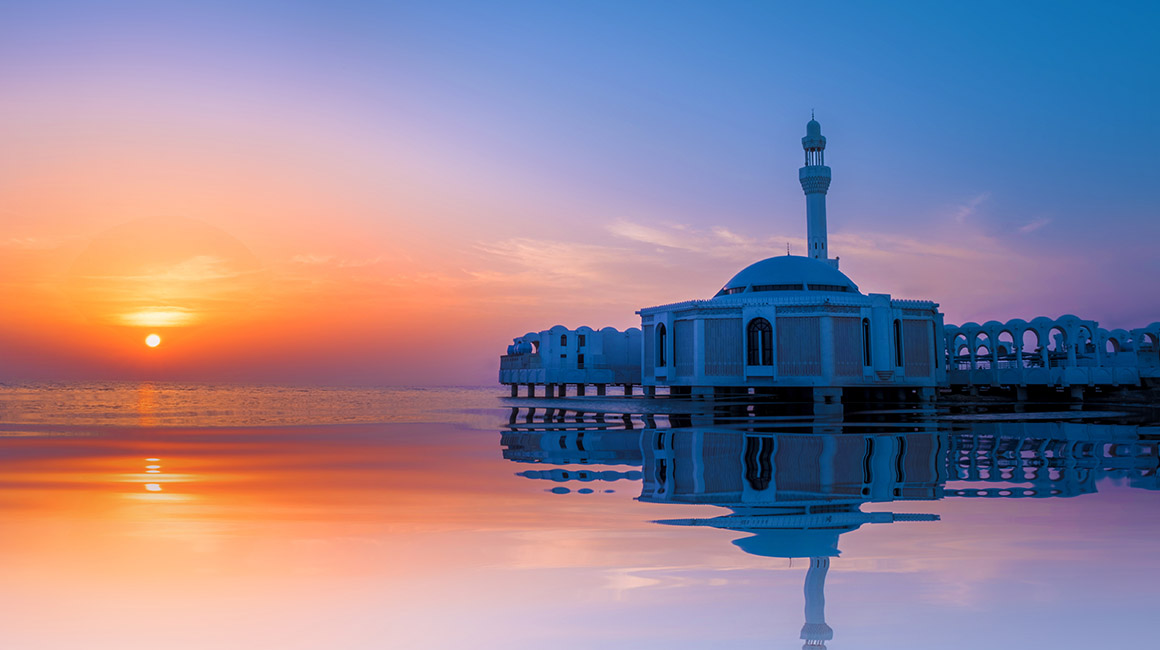
The white minaret catches the light first, long before the dome comes into view. Then, as the Corniche road curves north past Jeddah’s yacht clubs and fountains, the whole building appears to detach itself from the land. A field of pale pillars stands in shallow water. Above them, a turquoise dome and a crown of smaller domes seem to rest directly on the sea. At high tide, when the pillars disappear beneath the waves, the illusion is complete: a mosque, floating.
It is not floating. It has never floated. Al-Rahmah Mosque, known across Jeddah and far beyond it as the Floating Mosque, stands on concrete piles driven into the seabed of the Red Sea, a few metres from the shoreline of the al-Shati’ district. The appearance of weightlessness is a design achievement, not a structural fact, and it is worth saying plainly at the outset because so much of what circulates about this building online inflates that illusion into something it was never meant to be. What the mosque actually is turns out to be more interesting than the myth: a piece of late-twentieth-century Saudi engineering and religious architecture, built in a single, concentrated decade of Jeddah’s development as a modern coastal city, using materials and techniques chosen specifically to survive being surrounded by saltwater every single day for four decades and counting.
Historical Background
Jeddah’s transformation into a modern city accelerated through the 1970s and 1980s, driven by oil wealth, the responsibilities of being the gateway port for pilgrims arriving by sea and air to Makkah and Madinah, and a civic ambition to build a Corniche — a coastal promenade — that would rival other Gulf and Red Sea cities. The Jeddah Corniche project, developed in phases from the 1970s onward, eventually stretched for many kilometres along the waterfront and drew a reported budget in the hundreds of millions of dollars for its various stages of parks, walkways, public art, and civic monuments (Jeddah Corniche, Wikipedia). Within this larger project, several coastal mosques were built directly into or beside the sea, continuing a long regional habit of building mosques at the water’s edge in Red Sea port towns, but none captured public imagination the way Al-Rahmah Mosque did.
The broader pattern of mosque siting along working waterfronts, of which Al-Rahmah Mosque is an unusually dramatic example, also reflects a practical civic logic common to port cities well beyond the Islamic world: a religious or civic building placed at the edge of a harbour or promenade functions simultaneously as a landmark for wayfinding, a symbol of the city’s identity to arriving visitors by sea or air, and a visually anchoring feature for an otherwise open and undifferentiated stretch of coastline. Jeddah’s Corniche, stretching for a considerable distance along the city’s Red Sea frontage, needed exactly this kind of anchoring feature at intervals along its length, and the placement of Al-Rahmah Mosque at a prominent point along the al-Shati’ stretch of that coastline, within sight of King Fahd’s Fountain and a short distance from the city’s yacht club facilities, situates it as one of several such anchor points in a coordinated, if not always explicitly documented, civic design strategy for the Corniche as a whole.
The mosque was completed in 1985 (1406 AH in the Islamic calendar), a date confirmed consistently across encyclopedic and travel-industry sources describing the building (Saudipedia; The National; Atlas Obscura). One tourism source states that construction began in the late 1970s and that the mosque was “fully completed” only by 1988, which would place the structure’s finishing work — interior fittings, mechanical systems, landscaping — a few years after the 1985 opening date commonly cited (Memphistours). That claim comes from a lower-authority travel-industry source and has not been corroborated elsewhere, so it should be treated as a secondary detail rather than an established fact; 1985 is the date that appears across the strongest sources and is used as the mosque’s accepted completion year throughout this article.
It is worth dwelling for a moment on what an “open-air museum” city means in Jeddah’s specific case, since this framing recurs across descriptions of the Corniche era in which Al-Rahmah Mosque was built and helps explain why a mosque, of all civic buildings, became one of the era’s most celebrated pieces of public design. Jeddah’s municipal leadership during the 1970s and 1980s pursued a deliberate policy of commissioning international and Saudi artists to install monumental public sculpture throughout the city’s public spaces, especially along the newly developed Corniche, turning roundabouts, waterfront plazas, and promenades into an outdoor gallery encountered by residents and visitors simply moving through ordinary civic life rather than by visiting a dedicated museum building. This period produced Jeddah’s now-famous collection of large-scale public sculpture — abstract geometric forms, calligraphic works, and figurative pieces by artists from across the world — installed alongside more conventional civic infrastructure such as roads, parks, and fountains (Saudi Arabia ABC). A mosque built to double as a landmark, visible from a distance and photographed from every angle, fits naturally within this civic ambition: it is a building whose primary function is unambiguously religious and practical — a place to pray five times a day — but whose secondary function, as a piece of public spectacle woven into the fabric of a promenade designed explicitly for spectacle, situates it alongside the sculptures and fountains of the same Corniche building programme rather than apart from them. This is one useful way of understanding why Al-Rahmah Mosque, of the many working mosques built in Jeddah during the same decades, became the one whose image circulates internationally: it was built, whether by explicit intention or by the coincidental alignment of its engineering with the civic mood of its moment, exactly for the kind of visual attention the Corniche programme as a whole was designed to attract.
The mosque’s original name was Masjid al-Sayyidah Fatimah — the Mosque of the Lady Fatimah, a reference to Fatimah al-Zahra, the daughter of the Prophet Muhammad ﷺ — before it was renamed Al-Rahmah Mosque, meaning the Mosque of Mercy (Saudipedia). Some sources still refer to it by both names, “Al-Rahmah” and “Fatimah al-Zahra,” reflecting this history (Mosqpedia). No source found in the course of researching this article documents precisely when or why the name changed, so that detail cannot be established beyond the fact that it happened.
Saudipedia, an official Saudi encyclopedic reference, states that the mosque was executed by the Dallah Al-Baraka Group, a large Saudi construction and finance conglomerate founded by Saleh Abdullah Kamel that was active in major infrastructure and building projects across the Kingdom during this period (Prayer Now). This detail is corroborated by more than one source describing the mosque’s construction history, though detailed primary documentation — a construction contract, a government gazette notice, an inauguration record naming officials present — was not located in the course of this research and should be understood as a gap rather than a settled record.
The identity of the mosque’s architect is genuinely contested, and it is worth being honest about that contest rather than picking the most convenient name and presenting it as fact. One widely used database of Islamic architectural heritage lists a “Corniche Mosque – Al Rahmah Mosque” in Jeddah, dated 1986, attributed to the Egyptian-Saudi architect Abdel-Wahed El-Wakil, a major figure in twentieth-century mosque design known for his revival of traditional load-bearing masonry construction. On its face, this looks like a clean answer. But closer examination across multiple sources describing El-Wakil’s actual built work in Jeddah — including material connected to the Aga Khan Development Network’s documentation of El-Wakil’s mosques, and academic descriptions of his Corniche Mosque commission — describes a building that is small (between roughly 174 and 1,200 square metres in different accounts), built from solid brick using traditional load-bearing construction with a single modest dome, and built on land, not on piles driven into the sea. That description does not match Al-Rahmah Mosque, which is a roughly 2,400-square-metre reinforced-concrete structure built on stilts over tidal water with fifty-two subsidiary domes. The most plausible explanation is that two different mosques on Jeddah’s Corniche — El-Wakil’s much smaller brick mosque and the far larger floating mosque known as Al-Rahmah — have been conflated in at least one architectural database, a mix-up made easier by the fact that both sit somewhere along the same stretch of coastline and both are sometimes loosely called “the Corniche mosque.” Because this cannot be resolved with confidence from the sources available, this article does not assert a named architect for Al-Rahmah Mosque. Readers researching further should be aware that El-Wakil’s name is sometimes attached to it, and should treat that attribution with caution until it can be verified against primary architectural records. A separate, lower-authority tourism source vaguely credits “the vision” behind the mosque’s design to the Hejazi architect and cultural historian Sami Angawi in the late 1970s; this claim likewise could not be corroborated against an independent second source, so it is mentioned here only as an unverified lead, not a fact.
What can be established with more confidence is the mosque’s basic footprint and scale. Sources converge on a built area of approximately 2,400 square metres (The National; Memphistours), with a more granular figure from Arabic-language reference material giving overall building dimensions of approximately 60 metres by 40 metres and a height of around 9 metres, figures that are consistent with, though more specific than, the general area figure and which have not been independently corroborated by a second detailed source. The cost of construction — a figure any serious building history would normally want to establish — could not be verified in any source consulted for this article. No government record, contractor statement, or contemporary press report giving a riyal figure for the mosque’s construction was found. That gap is stated here plainly rather than papered over with a guessed number, in keeping with the basic obligation not to present unverified figures as fact.
The Story Behind the Place
Al-Rahmah Mosque was not built to mark a battlefield, a revelation, or the site of a companion’s grave. It was built because a fast-growing port city with a new, ambitious waterfront needed a mosque, and someone decided to put it where the sea meets the shore rather than a few streets inland. That is the entire origin story, and it is worth resisting the temptation to dress it up as anything grander. What makes the story interesting is not a legend but a decision: the decision to solve an ordinary civic need — a place for the neighbourhood and for Corniche visitors to pray — with an extraordinary structural gesture, extending the building out over the tideline itself.
Jeddah in the late 1970s and early 1980s was in the middle of a construction boom fed by oil revenue, and the Corniche was one of the flagship projects of that boom, a long public promenade meant to give the city a civic face on the Red Sea to match its role as the maritime gateway to the Two Holy Mosques. Public art, fountains, and monumental sculpture — much of it commissioned during this same period under the guidance of the city’s mayor at the time — became part of Jeddah’s identity as an “open-air museum” city, a reputation it holds to this day (Saudi Arabia ABC). A mosque built out over the water fit naturally into that ambition: it gave the Corniche a religious and civic anchor with the same appetite for visual drama as the fountains and sculptures nearby, most famously King Fahd’s Fountain, the enormous seawater jet that would be switched on a few kilometres down the coast around the same period.
Locating a mosque directly over tidal water was not without precedent in the wider region, but it was unusual enough, and executed distinctively enough, that Al-Rahmah Mosque has repeatedly been described as the first mosque in the world built on the surface of the sea (Saudipedia). That is a claim of historical priority, not merely of local uniqueness, and it should be treated with the same caution due to any superlative of this kind: it is widely repeated, including by an official Saudi encyclopedic source, but a claim of being the literal first anywhere in the world is difficult to verify exhaustively, since it depends on a complete inventory of every coastal and stilt-built mosque constructed before 1985 anywhere on earth, which no source consulted here actually provides. What is safe to say is that Al-Rahmah Mosque was a genuinely novel undertaking for Saudi Arabia and the wider Gulf and Red Sea region at the time it was built, and that it predates most of the other “floating mosque” structures built in South East Asia and elsewhere that are sometimes compared to it, several of which were not built until the 2000s.
The mosque’s placement also solved a practical problem inherent to any building intended to serve both worshippers and the general public along a busy public promenade. By projecting the building out from the shoreline on a raised platform connected to land by a walkway, its designers created a mosque that is visible from a distance in every direction along the Corniche, functions as a landmark for boats and pedestrians, and yet remains physically separated from the noise and traffic of the road itself, buffered by open water on three sides. The elevated, semi-detached siting also gave the prayer halls unobstructed sea breeze and natural light from windows on every exposed face, a real functional advantage in Jeddah’s humid coastal climate, quite apart from the visual spectacle it created. This is the story behind the place: not a legend, but a piece of pragmatic civic design that happened to also become one of the most photographed buildings in the city.
The story is also, in part, one of adaptive naming and identity. Known variously across sources as Al-Rahmah Mosque, the Fatimah al-Zahra Mosque, and, almost universally in casual and tourist usage, simply “the Floating Mosque,” the building carries three layers of identity: a devotional name tied to the Prophet’s ﷺ household, a formal name meaning mercy, and a popular nickname describing its most famous visual trick. All three are still in active use, sometimes on the same page of the same source, which is itself a small piece of evidence for how thoroughly the “floating” nickname has taken over the building’s public identity, even though, as this article establishes at the outset and returns to throughout, the building does not float at all.
The Prophet ﷺ and This Place
There is no historical connection between the Prophet Muhammad ﷺ and this specific location. Al-Rahmah Mosque is a twentieth-century building, completed in 1985 on a stretch of Red Sea coastline that did not exist as a developed urban site during the Seerah, the biography of the Prophet’s ﷺ life. Jeddah itself has a documented pre-Islamic and early Islamic history as a port serving the pilgrimage route to Makkah, and the city holds genuine Islamic historical weight in that sense, but no source consulted for this article claims, and this article will not manufacture, any tradition placing the Prophet ﷺ at this precise spot on the coastline, any companion visit to this location, or any historical event of the Seerah tied to the ground beneath the mosque’s pillars. Readers looking for a Seerah-era connection to this building will not find an honest one, because none exists.
What this section can honestly offer instead is the broader prophetic teaching about mosques as an institution — teaching that applies to Al-Rahmah Mosque exactly as it applies to any other mosque built anywhere in the Muslim world, precisely because it is general in scope rather than tied to any particular site. The Prophet ﷺ built the first mosque of Madinah, Masjid an-Nabawi, from unbaked mud bricks, with a roof of palm-leaf thatch and columns made from palm trunks — a building of striking material simplicity by the standards of monumental religious architecture in the late antique world around it, in Byzantine Syria or Sassanid Persia. That simplicity was not an accident of poverty alone; it set a pattern that later generations of Muslims would argue about explicitly, a debate this article addresses in full in the Hadith References and Historical Development sections below. The Prophet ﷺ also taught, in hadith verified on Sunnah.com and discussed in detail in the next section, that building a mosque for the sake of Allah — regardless of its size — earns the builder a house in Paradise, and that mosques are the places on earth most beloved to Allah. Those two teachings, simplicity in construction and generosity in reward for the act of building, sit in productive tension with each other, and that tension is exactly what later Islamic architecture, including a building like Al-Rahmah Mosque nearly fourteen centuries later, has had to navigate in its own way.
It is also worth being honest about what this section is not: it is not an attempt to borrow the emotional and historical weight of Seerah-era sites — the Prophet’s ﷺ mosque in Madinah, the cave of Hira, the battlefield of Uhud — and transplant it onto a modern civic building on the strength of shared function alone. A mosque built in 1985 is fully and legitimately a mosque, a house of Allah in every sense that matters devotionally and legally in Islamic law, but it is not a Seerah location, and this article treats it as what it is.
Qur’anic Connections
Surah At-Tawbah 9:18 — Those Who Maintain the Mosques of Allah
﴿إِنَّمَا يَعْمُرُ مَسَاجِدَ اللَّهِ مَنْ آمَنَ بِاللَّهِ وَالْيَوْمِ الْآخِرِ وَأَقَامَ الصَّلَاةَ وَآتَى الزَّكَاةَ وَلَمْ يَخْشَ إِلَّا اللَّهَ فَعَسَىٰ أُولَٰئِكَ أَن يَكُونُوا مِنَ الْمُهْتَدِينَ﴾
“The mosques of Allah should only be maintained by those who believe in Allah and the Last Day, establish prayer, pay alms-tax, and fear none but Allah. It is right to hope that they will be among the truly guided.” — Surah At-Tawbah 9:18 (Quran.com)
The verse belongs to a passage in Surah At-Tawbah that addresses who has the moral and spiritual standing to build, maintain, and take custodianship of mosques. Classical commentary situates the verse in contrast with the immediately preceding ayat, which state that it is not for polytheists to maintain the mosques of Allah while bearing witness to disbelief against themselves — a reference understood by most commentators to concern the Makkan polytheists’ historical custodianship of the Kaaba and its precincts before the conquest of Makkah, and their exclusion from that role once the message of Islam had been rejected by them. Asbab al-nuzul material connects the passage to disputes in the early Muslim community over who was fit to hold guardianship of the sacred mosque, with some reports naming al-Abbas ibn Abd al-Muttalib, the Prophet’s ﷺ uncle, as a figure discussed in this context because of his role providing water to pilgrims, a role some companions wished to elevate above emigration and jihad; the Qur’an’s response redirects the criterion for honour away from lineage or ceremonial office and toward the specific qualities named in the verse itself: belief in Allah and the Last Day, establishing prayer, paying zakat, and fearing none but Allah.
The word used for maintaining or tending the mosques, ya’muru, comes from the root associated with building up, populating, and keeping something inhabited and functioning — it does not mean merely constructing a building, but keeping it alive with worship, use, and upkeep. This is the modern lesson most commonly drawn from the verse, and it applies without strain to Al-Rahmah Mosque: a mosque earns its place not by the ambition of its architecture but by whether the people who use it meet the conditions the verse describes. A building on stilts over the Red Sea, however striking to look at, is only “maintained” in the Qur’anic sense described here if it is filled with people establishing prayer and giving charity, not merely admired from a promenade for its silhouette. Given the number of daily worshippers and the mosque’s function as a genuine neighbourhood and family prayer space, described later in this article’s Practical Visitor Guide and Spiritual Reflection sections, that condition of use appears to be met, though this article makes no claim about the internal faith or sincerity of any individual worshipper, since the verse’s criteria are matters of the heart that no outside observer can adjudicate.
Surah An-Nur 24:36–37 — Houses Which Allah Has Permitted to Be Raised
﴿فِي بُيُوتٍ أَذِنَ اللَّهُ أَنْ تُرْفَعَ وَيُذْكَرَ فِيهَا اسْمُهُ يُسَبِّحُ لَهُ فِيهَا بِالْغُدُوِّ وَالْآصَالِ﴾
“That light shines through houses of worship which Allah has ordered to be raised, and where His Name is mentioned. He is glorified there morning and evening.” — Surah An-Nur 24:36 (Quran.com)
﴿رِجَالٌ لَا تُلْهِيهِمْ تِجَارَةٌ وَلَا بَيْعٌ عَنْ ذِكْرِ اللَّهِ وَإِقَامِ الصَّلَاةِ وَإِيتَاءِ الزَّكَاةِ يَخَافُونَ يَوْمًا تَتَقَلَّبُ فِيهِ الْقُلُوبُ وَالْأَبْصَارُ﴾
“By men who are not distracted—either by buying or selling—from Allah’s remembrance, or performing prayer, or paying alms-tax. They fear a Day when hearts and eyes will tremble.” — Surah An-Nur 24:37 (Quran.com)
These two verses come immediately after the celebrated “Light Verse” (Ayat an-Nur, 24:35), one of the most metaphysically dense passages in the Qur’an, comparing Allah’s light to a niche containing a lamp, the lamp inside glass, the glass like a radiant star. Verse 36 answers an implicit question the Light Verse raises: where is this light manifested in the world? The answer given is “in houses” — understood by the overwhelming majority of commentators to mean mosques — that Allah has permitted, or in some translations “commanded” or “ordered,” to be raised. Tafsir explains “raised” (turfa’) in at least two overlapping senses: raised physically, in the sense of being built and constructed, and raised in honour and status, in the sense of being exalted and treated with reverence and protected from what would degrade their sanctity. Ibn Kathir’s commentary on this passage frames these houses as the places most beloved to Allah on earth, echoing — and, in classical tafsir literature, sometimes cross-referenced with — the hadith identifying mosques as the dearest of places to Allah, which is discussed with its full authentic reference in the next section of this article.
It is worth adding a further layer of tafsir detail to Surah An-Nur 24:36, since the verse’s placement immediately after the Light Verse has generated a specific and long-running exegetical discussion relevant to how this article frames Al-Rahmah Mosque’s own relationship between physical beauty and spiritual function. A number of commentators, including material drawing on Ibn Kathir’s tafsir already introduced in this article’s Qur’anic Connections section above, describe the “houses” of verse 36 as functioning almost as the physical vessel or setting for the metaphysical light described in the preceding verse — the lamp of verse 35 needs a niche to be placed in, and the commentary tradition reads the mosques of verse 36 as, in effect, that niche at a communal, architectural scale, the physical structure within which the remembrance, glorification, and prayer described in verse 37 actually take place. This reading gives a mosque’s physical existence a kind of instrumental honour distinct from, but not unrelated to, the ornamentation debate this article has traced through the hadith literature: the building itself is honoured because of what it enables and contains, not admired for its own sake independent of that function. Read this way, the tafsir tradition on this verse offers a kind of implicit answer to the ornamentation debate, one that neither fully endorses lavish decoration nor condemns architectural ambition outright, but instead asks whether a given mosque’s physical form serves or distracts from the remembrance, prayer, and charity the verse describes as its true content. Applied to Al-Rahmah Mosque specifically, this article does not claim to resolve that question on the building’s behalf; it simply notes that the question the tafsir tradition raises is the same question a visitor standing beneath the mosque’s turquoise dome, distracted for a moment by the play of light through its stained glass, might reasonably ask themselves.
Verse 37 then describes the character of the people who inhabit these houses: men whose devotion to remembrance of Allah, prayer, and charity is not crowded out by commercial life, even though verse 37 explicitly names buying and selling as the very activities they might reasonably be expected to be absorbed in. Classical commentators have taken this as a description of merchants and townspeople — the same social class as much of Jeddah’s own historic mercantile population, given the city’s identity for centuries as a trading port — who nonetheless keep worship as their controlling priority. Asbab al-nuzul traditions around this passage are less specific than for many other Qur’anic verses; most classical exegetes read verses 36–37 as a general description of righteous character rather than as revelation tied to a single identifiable incident or individual, and this article does not manufacture a more specific occasion of revelation than the sources support.
The modern lesson drawn from these two verses together is a coherent one: a mosque’s sanctity comes from the permission and honour Allah has attached to houses of worship as a category, and the conduct of the people who fill them, not from the scale or artistry of the structure itself. A modern mosque built in 1985 with reinforced concrete and glass, rather than mud brick or carved stone, is included in this permission exactly as fully as the oldest mosques in the Muslim world, provided it functions as a house in which Allah’s name is remembered, prayer is established, and charity is given. Nothing in either verse ties the permission or honour specifically to age, material, or architectural style — a point directly relevant to a building like Al-Rahmah Mosque, whose modernity is sometimes treated, in casual conversation, as though it diminished its religious seriousness compared to older or more historically storied mosques. The Qur’anic text gives no support for that assumption.
Hadith References
The authentic hadith literature on mosques falls into two broad currents that matter directly to understanding a building like Al-Rahmah Mosque: hadith praising the act of building a mosque and describing mosques as the most beloved places to Allah, and hadith cautioning against excessive height, ornamentation, and extravagance in mosque construction. Both currents are genuinely part of the Sunnah, both are widely cited by scholars across the centuries, and both deserve to be presented together rather than selectively, because a modern, visually striking mosque like this one sits squarely inside the tension between them.
On building mosques and their status with Allah
Authentic (sahih). It is narrated on the authority of Uthman ibn Affan رضي الله عنه that he said: “I heard the Messenger of Allah ﷺ say: ‘Whoever builds a mosque, desiring thereby the pleasure of Allah, Allah builds for him a similar house in Paradise.'” This hadith is recorded in Sahih al-Bukhari 450 and Sahih Muslim 533, and its text and grading have been verified directly against Sunnah.com (Sahih al-Bukhari 450). Uthman narrated this hadith at a moment when he was being criticised by some companions for rebuilding the Prophet’s ﷺ mosque in Madinah on a larger and more elaborate scale than before — a detail discussed further in the Historical Development section below — and is reported to have cited the Prophet’s ﷺ words in his own defence.
Authentic (sahih). Abu Hurairah رضي الله عنه reported that the Messenger of Allah ﷺ said: “The most beloved places to Allah are the mosques, and the most hated places to Allah are the markets.” This hadith is recorded in Sahih Muslim 671, and its Arabic and English text have been verified directly against Sunnah.com (Sahih Muslim 671). Commentators have read this hadith as describing the mosque’s function as a place stripped of the competitive, self-interested transactional character of a marketplace, an idea consistent with the description of righteous men in Surah An-Nur 24:37, discussed above, who are not distracted by trade from the remembrance of Allah even while living and working among traders.
Authentic (sahih), narrated on the authority of Jabir ibn Abdullah. A close variant of the Uthman narration states that the Messenger of Allah ﷺ said: “Whoever builds a mosque for the sake of Allah, like a sparrow’s nest or even smaller, Allah will build for him a house in Paradise.” This hadith is recorded in Sunan Ibn Majah 738 and has been classed as sahih by the hadith scholar al-Albani according to secondary scholarly sourcing consulted for this article (Islam Q&A, citing Ibn Majah 738); this article was not able to independently load and verify the Ibn Majah 738 page directly on Sunnah.com at the time of writing, so the reference is presented here with that caveat rather than the same first-hand verification applied to the Bukhari and Muslim narrations above. The image of a mosque “like a sparrow’s nest” is notable for directly undercutting any assumption that scale or grandeur is a condition of the reward described: the smallest possible mosque earns the same promise as the largest.
On restraint, height, and ornamentation in mosque construction
Weak (da’if). It is reported, in a hadith found in Sunan Ibn Majah 741, along the lines that no people ever adorned their mosques without having, in some sense, gone astray or abandoned other priorities — a warning against decoration crowding out devotion. This hadith has been graded da’if (weak) by the hadith scholar and publisher Darussalam in their edition of Ibn Majah’s Sunan, as directly verified on Sunnah.com. Its weakness should be understood in the ordinary technical sense used throughout hadith science — a problem in its chain of narration that prevents scholars from relying on it as a source of religious law on its own — not as a statement that its content is necessarily false. As the editorial standard’s own methodology requires, a weak report is still recorded here, with its grading stated plainly, rather than either suppressed or presented as equal in authority to the sahih material above.
Authentic (sahih). Ibn Abbas رضي الله عنهما reported that the Messenger of Allah ﷺ said: “I have not been commanded to build lofty mosques.” Ibn Abbas then added, in his own words rather than as part of the Prophet’s ﷺ statement: “You will certainly adorn them as the Jews and Christians did.” This hadith is recorded in Sunan Abi Dawud 448, graded sahih by al-Albani, and has been directly verified on Sunnah.com in the course of researching this article, alongside a closely related version recorded in Sunan Ibn Majah, chapter on mosques, describing the Prophet ﷺ foretelling that people would build their mosques high “just as the Jews built their synagogues high and the Christians built their churches high” (Sunan Ibn Majah, The Book on the Mosques and the Congregations). The word used for “lofty” in the Arabic, tashyid, is explained by classical commentators including al-Baghawi as referring specifically to excessive height and elaborate ornamentation beyond structural need, not to the ordinary act of building a sound, weatherproof, adequately sized mosque. A number of scholarly sources are careful to note that this hadith is not understood by the majority of jurists as forbidding the strengthening, expansion, or professional construction of a mosque as such — only its adornment and excessive elevation for the sake of display (Encyclopedia of Translated Prophetic Hadiths; Islam Q&A).
Mu’allaq (a narration Bukhari relates without a connected chain, recorded as part of a chapter heading), attributed to Umar ibn al-Khattab رضي الله عنه. Imam al-Bukhari, in the chapter heading preceding Sahih al-Bukhari 446 on the construction of mosques, records that Umar, upon ordering the rebuilding of the Prophet’s ﷺ mosque in Madinah during his caliphate, instructed the builders: “Shelter the people from the rain, and beware of using red or yellow, for they cause fitnah (temptation or distraction) for the people.” This report is recorded by Bukhari in mu’allaq form (without a full connected chain of narration in that location) before hadith 446, a form of transmission distinct from the fully connected sahih hadith discussed above, and its precise chain and grading are treated with more caution by hadith specialists than a fully connected sahih report would be; it is nonetheless widely cited by classical and contemporary scholars alike as reflecting Umar’s authentic policy on mosque construction, and it is referenced in the same breath as the sahih Ibn Abbas narration above in multiple scholarly treatments of this subject (Fiqh-us-Sunnah, Volume 2; Islam Q&A). In the same chapter-heading material, Bukhari records a companion, Anas ibn Malik, observing that people “build mosques to boast about that, but they do not use them for worship except rarely,” and records Ibn Abbas’s warning, already cited above, that mosques would come to be adorned as the Jews and Christians adorned their places of worship. The full text of Sahih al-Bukhari 446 itself, which follows this chapter heading, describes the material progression of the Prophet’s ﷺ mosque through the Rashidun period and is quoted and discussed in full in the Historical Development section below (Sahih al-Bukhari 446).
Scholarly opinion, drawing on the hadith above. The majority of jurists across the schools of Islamic law have held that decorating mosques with gold, silver, elaborate carving, or writing intended to draw the eye is disliked (makruh), particularly where such decoration risks distracting a worshipper’s concentration during prayer, though opinions differ on exactly how far this dislike extends and whether it rises to outright prohibition in any specific case. A minority of jurists have argued that decoration intended to honour and beautify a house of Allah, provided it does not involve extravagance, ostentation for its own sake, or material that would properly be classed as wasteful spending, is not what the restrictive hadith are actually condemning; the hadith on lofty mosques and the report from Umar, on this reading, target boastfulness and the imitation of the ornamental habits of other religious traditions, not the general principle of building well and durably. This article does not adjudicate between these positions — both are represented in the Islamic scholarly tradition, and both are presented here so that a reader can weigh them independently, in line with the honest, non-editorializing treatment this dispute deserves (IslamWeb fatwa on the decoration of mosques).
This body of hadith is directly relevant to Al-Rahmah Mosque precisely because the building is, by any honest description, visually striking rather than austere: a turquoise dome, fifty-two subsidiary domes, fifty-six arched stained-glass windows, and a tall white minaret, discussed in full in the Architecture section below. Nothing in the authentic hadith literature specifically addresses this mosque, and this article makes no claim that it does. But the general debate about how far beauty and elaboration in mosque-building should extend, a debate that runs from the Prophet’s ﷺ own simple mosque of palm trunks through Uthman’s monumental rebuilding to the present day, is unmistakably the debate that any visually ambitious modern mosque, including this one, exists inside.
Historical Development
The history of mosque architecture as an evolving built form, from the Prophet’s ﷺ time to the present, provides the necessary context for understanding where a building like Al-Rahmah Mosque sits within a much longer story — a story that is itself a history of an ongoing argument about simplicity, permanence, and beauty in the house of Allah.
The first mosque: simplicity by design (1 AH / 622 CE)
The Prophet’s ﷺ mosque in Madinah, built shortly after the Hijrah in 622 CE (1 AH), was constructed from the most basic materials available in the Hijaz: sun-dried mud bricks for the walls, palm-tree trunks as roof supports, and palm-leaf thatch for the roof itself. Sahih al-Bukhari 446 records this directly, narrated by Abdullah ibn Umar: “In the lifetime of Allah’s Messenger ﷺ the mosque was built of adobes, its roof of the leaves of date-palms and its pillars of the stems of date-palms,” a description independently verified against Sunnah.com in the course of researching this article (Sahih al-Bukhari 446). The building had no minaret, no dome, no decorative program of any kind. Its floor, in the driest months, was simply packed earth; when it rained, worshippers reportedly prayed in mud. This was not a matter of the Muslim community lacking resources or skill — construction techniques capable of far more elaborate building existed elsewhere in the seventh-century Middle East, in Byzantine and Sassanid territory bordering Arabia — but rather appears, on the balance of the hadith evidence already discussed above, to reflect a deliberate ethic of restraint attached to the earliest phase of mosque-building.
Abu Bakr’s caliphate: continuity without change (11–13 AH / 632–634 CE)
According to the same hadith, Sahih al-Bukhari 446, the first caliph, Abu Bakr al-Siddiq رضي الله عنه, “did not alter” the mosque during his brief caliphate. Given the demands of the Ridda wars and the consolidation of the new state following the Prophet’s ﷺ death, this is unsurprising on purely practical grounds, but it also set an early precedent of restraint that later tradition would remember and, at times, invoke as a model.
Umar’s expansion: growth within the same idiom (17 AH / 638 CE)
Sahih al-Bukhari 446 continues: “Umar expanded it on the same pattern as it was in the lifetime of Allah’s Messenger ﷺ by using adobes, leaves of date-palms and changing the pillars into wooden ones.” Umar ibn al-Khattab, as the growing Muslim community in Madinah required more space, enlarged the mosque’s footprint but kept its materials and character essentially unchanged — mud brick, palm thatch, and now timber pillars rather than palm trunks, a modest material upgrade rather than a stylistic transformation. This is the same Umar whose instruction on avoiding red and yellow decoration is recorded, as discussed above, in the mu’allaq material preceding this hadith in Bukhari’s chapter arrangement — a caliph who, by the converging witness of both reports, pursued growth in capacity without a corresponding growth in ornament.
Uthman’s rebuilding: the turn toward monumental construction (29 AH / 649–650 CE)
The same hadith records a sharper break under the third caliph: “Uthman changed it by expanding it to a great extent and built its walls with engraved stones and lime and made its pillars of engraved stones and its roof of teak wood.” This is the first explicit textual evidence, within the sahih hadith corpus itself, of a genuine material and stylistic escalation in mosque construction — carved stone in place of mud brick, teak in place of palm thatch. Uthman’s rebuilding drew criticism from some companions at the time, which is precisely the context in which, as noted above, Uthman is reported to have cited the Prophet’s ﷺ words on the reward for building a mosque in his own defence (Sahih al-Bukhari 450). The tension embedded in the hadith literature discussed in the previous section — reward for building a mosque set against caution about excessive height and ornament — is therefore not a later theoretical dispute invented by jurists; it appears to have been a live disagreement among the companions themselves within a single generation of the Prophet’s ﷺ death.
Umayyad and Abbasid monumentalism (1st–3rd century AH / 7th–9th century CE)
Over the following two centuries, mosque architecture across the expanding Islamic world moved decisively toward the monumental: the Umayyad Mosque of Damascus, the Dome of the Rock in Jerusalem (technically a shrine rather than a congregational mosque, but built in the same architectural moment and idiom), and the Great Mosque of Kairouan all introduced marble columns, gold mosaic, monumental gateways, and increasingly elaborate minarets. This period established, as a matter of historical record rather than legend, the precedent for treating mosque architecture as a legitimate vehicle for the visual expression of religious and political power and prestige, a precedent every later tradition of mosque-building, including Ottoman, Mughal, Safavid, and eventually Saudi state-sponsored architecture, has inherited in some form.
Ottoman and later monumental traditions (9th–14th century AH / 15th–20th century CE)
The Ottoman mosque tradition, epitomised by the work of the architect Mimar Sinan in Istanbul and Edirne, developed a distinctive vocabulary of vast central domes, cascading semi-domes, slender pencil minarets, and richly tiled interiors — an idiom that would later inform, at a considerable remove, the modern Saudi state’s own approach to mosque architecture in the twentieth century, including elements that recur, on a modest scale, at Al-Rahmah Mosque itself: the central dome flanked by smaller subsidiary domes, and a single slender minaret marking the building from a distance.
Saudi state mosque architecture and the Corniche period (14th century AH / 20th century CE)
The mosque architecture built across Saudi Arabia during the oil-boom decades of the 1970s and 1980s, the period in which Al-Rahmah Mosque was constructed, drew on this deep historical inheritance while also embracing new construction materials unavailable to any earlier generation of builders: reinforced concrete, structural steel, large-format glass, and, in Al-Rahmah Mosque’s specific case, deep-driven marine piling capable of supporting a substantial masonry-clad building directly over tidal seawater. This represents the most recent chapter in the same long story that began with palm trunks and mud brick fourteen centuries earlier: each generation of mosque builders has worked at the edge of the construction technology available to it, and each has had to answer, implicitly or explicitly, the same question the earliest hadith on mosque-building already raised — how much of that technological and material capability should be spent on grandeur, and how much restrained.
Architecture
Al-Rahmah Mosque rewards a slower look than most visitors give it. From the Corniche, at a distance, it reads as a single, unified white-and-turquoise silhouette. Close up, and especially from the water side, it resolves into a carefully layered composition of structural, functional, and decorative elements, each addressing a distinct problem: how to build permanently in salt water, how to light a large interior without excessive heat gain, how to separate men’s and women’s prayer space without walling either off from the sea view, and how to signal, from a distance, that this is unmistakably a mosque rather than any other kind of coastal pavilion.
Site and foundations: building over tidal seawater
The mosque sits a short distance offshore in the al-Shati’ district of Jeddah’s northern Corniche, connected to the mainland by a raised walkway enclosed by a low wall, so that a worshipper or visitor walks out over open water to reach the entrance rather than approaching across dry land (The National). The building itself is supported on a field of concrete pillars, sometimes described as piles or stilts, driven down to the seabed beneath it; this basic structural fact — that the mosque rests on point supports rising from the sea floor, not on a solid platform or reclaimed fill — is the single most consistently and independently corroborated engineering detail about the building, confirmed by encyclopedic sources, travel journalism, and, most convincingly, by visitor accounts describing seeing the bare pillars directly at low tide, when the water recedes far enough to expose their full height above the waterline (Tripadvisor visitor review; Jeddah Uncovered).
This siting decision means the building’s foundations experience a daily tidal cycle of full submersion and exposure at their base, and permanent exposure to airborne salt spray above the waterline — conditions that are genuinely hostile to ordinary reinforced concrete and untreated steel over a forty-year service life. Reinforced concrete exposed to seawater is vulnerable to a well-understood, well-documented failure mode in coastal and marine engineering: chloride ions from seawater penetrate the concrete cover over time and reach the embedded steel reinforcing bars, breaking down the thin protective oxide layer that normally keeps the steel from rusting; once that layer is compromised, the steel corrodes, and the resulting rust occupies more volume than the original steel, which cracks and eventually spalls the surrounding concrete from the inside out. This is a generic description of the engineering problem faced by any reinforced-concrete marine structure — piers, offshore platforms, coastal piling — not a claim specific to any documented failure at Al-Rahmah Mosque itself, and it is presented here as background context rather than as reporting on this particular building’s structural history, which has not been the subject of any published engineering case study located in the course of this research.
What can be said about the mosque’s own construction, with appropriate caution about source quality, is that at least one travel-industry account describes the builders as having used “isolated iron and resistant cement” in the foundations, along with unspecified additional materials intended to resist marine algae growth on the structure’s submerged and tidal surfaces (Memphistours). This description is imprecise in its engineering terminology — “isolated iron” is not a standard term in reinforced-concrete construction, and the source does not specify whether this refers to coated or galvanised reinforcing bar, cathodic protection, epoxy coating, or a sulfate-resisting or low-permeability concrete mix, all of which are legitimate, real-world techniques used in marine reinforced-concrete construction to slow chloride penetration and reinforcement corrosion. No higher-authority engineering source, technical paper, or restoration report describing the specific corrosion-protection strategy used at Al-Rahmah Mosque was located during this research. Readers should treat the claim of specialised anti-corrosion and anti-algae materials as plausible in principle — such techniques were available and in use in marine construction well before 1985 — but as unverified in the specific case of this building, pending a more authoritative primary source such as a structural engineering report or contractor record.
To understand why any account of Al-Rahmah Mosque’s durability has to speak in terms of general marine-engineering principles rather than a specific published case study, it helps to understand the scale of the underlying technical problem that any structure of this kind faces, independent of the specific solutions this particular building’s builders chose. Reinforced concrete relies on a close chemical and physical bond between the concrete itself and the steel reinforcing bars embedded within it; the concrete’s naturally alkaline chemistry forms a thin, stable passive oxide layer on the surface of the steel that, under normal conditions, prevents rust from forming for the practical lifetime of the structure. Seawater disrupts this protection through the ingress of chloride ions, which diffuse slowly through the concrete’s pore structure over months and years until they reach the depth of the embedded steel in sufficient concentration to break down that passive layer chemically, even though the concrete surrounding the steel may show no external sign of damage for a long period beforehand. Once that threshold, referred to in engineering literature as the chloride threshold, is crossed, corrosion of the reinforcing steel begins, and because rust occupies significantly more volume than the metal it replaces, the expanding corrosion products exert an outward pressure on the surrounding concrete that eventually cracks and spalls it, a failure mode that becomes visibly worse, not better, the longer it goes unaddressed. This is why marine and coastal engineering has, since long before 1985, employed a range of countermeasures aimed at slowing or interrupting this process: increasing the concrete cover — the depth of concrete between the outer surface and the embedded steel — using low-permeability concrete mixes with supplementary materials such as fly ash, silica fume, or slag to slow chloride penetration through the pore structure, applying epoxy or galvanised coatings directly to the reinforcing steel before it is cast into the concrete, using corrosion-inhibiting admixtures mixed directly into the concrete itself, and, for the most demanding and long-lived marine structures, installing cathodic protection systems that use a controlled electrical current or sacrificial metal anodes to prevent the steel from corroding electrochemically in the first place. All of these techniques were established practice in marine and coastal engineering well before Al-Rahmah Mosque’s 1985 completion date, and it is entirely plausible, on general engineering grounds, that one or more of them was used in the mosque’s construction. But plausibility is not the same as documentation, and this article, as it has stated already, was unable to locate a specific technical account of which of these methods, if any, the mosque’s builders actually employed. What can be stated with confidence, independent of that gap, is that any reinforced-concrete structure built directly into a tidal zone, whatever protective measures were used at the time of construction, requires ongoing inspection and periodic remedial work over a multi-decade service life, since even the most effective corrosion-protection techniques slow rather than permanently eliminate the underlying chemical process — a general engineering reality that fits naturally with the periods of renovation and closure this article’s Practical Visitor Guide section documents at Al-Rahmah Mosque itself.
What is not in doubt, because it is directly observable and repeatedly documented in visitor photography and video, is that the mosque has required visible maintenance and, at least once in the period covered by this research, extended closure. A social media post from 2025 recorded a visitor’s report that the mosque was closed for renovations during a November visit, and other tourist accounts describe periods when the building was undergoing repair work while remaining partly accessible (Instagram post, 2025). This pattern of periodic renovation is exactly what would be expected of any reinforced-concrete structure standing permanently in tidal seawater, regardless of the specific protective measures used in its original construction, since even the best marine concrete technology available in 1985 requires ongoing inspection and remedial work over a multi-decade service life. This article treats the mosque’s need for periodic maintenance and renovation as a normal and expected feature of its engineering situation, not as a sign that its original construction was flawed.
Scale and layout
The mosque covers a built area of approximately 2,400 square metres (The National), with overall building dimensions given in Arabic-language reference material as approximately 60 metres in length, 40 metres in width, and 9 metres in height — figures drawn from a single detailed source and not independently corroborated elsewhere, and presented here with that caveat. The mosque is generally reported to accommodate around 2,300 worshippers in total (The National), a figure that several sources break down further into a men’s prayer hall accommodating approximately 1,800 worshippers and a separate women’s prayer area accommodating approximately 500, a breakdown treated in more detail in this article’s dedicated section on women’s prayer facilities below (Saudipedia).
The central dome
The mosque’s defining visual feature is its central dome, finished in a distinctive turquoise or teal-green colour that stands out sharply against the white masonry of the rest of the building and the blue of the sea and sky around it — a colour choice widely credited, in descriptive tourism and travel writing, with reinforcing the building’s “floating” illusion, since the pale, water-adjacent palette of white walls and blue-green dome echoes the colours of the sea itself rather than contrasting against them (Jeddah Uncovered). Detailed Arabic-language reference material gives the central dome’s diameter as approximately 20 metres and its height as approximately 6 metres, figures that, again, come from a single source and have not been independently corroborated by a second detailed technical description, and should be read with that limitation in mind. Multiple independent sources agree that the central dome is supported internally by eight pillars, and that a chandelier hangs from the dome’s interior, beneath a roof inlaid with stained glass through which natural light filters into the prayer hall below (Memphistours; video documentation of the interior corroborates the eight-pillar arrangement and hanging chandelier independently).
The fifty-two outer domes
Surrounding the central dome, the mosque’s roofline carries a substantial number of smaller subsidiary domes, a feature repeatedly and specifically quantified across independent sources as fifty-two in total, in addition to the main dome. This figure is corroborated by Atlas Obscura’s editorially reviewed description of the building — “Fifty-two outer domes encircle the central one, which stands below a towering minaret” (Atlas Obscura) — and independently by video documentation of the building describing “52 outer domes in addition to its main dome.” Because this specific figure recurs consistently, in the same precise number, across sources with different origins and purposes (a curated travel-and-culture publication on one hand, descriptive video content on the other), it can be treated with a reasonable degree of confidence, in contrast to some of the more granular dimensional figures elsewhere in this article that rest on a single source. The fifty-two subsidiary domes are arranged around the perimeter of the roofline, giving the building, from a distance, the visual rhythm and repetition characteristic of much Ottoman-influenced and later Ottoman-revival mosque architecture, in which a large central dome is stepped down through a cascade of smaller domes toward the building’s edges — though this mosque’s flatter, more evenly distributed arrangement of subsidiary domes, rather than the graduated semi-dome cascades of classical Ottoman architecture, gives it a distinct visual signature of its own.
The minaret
A single slender white minaret rises from the mosque, described in Arabic-language reference material as approximately 21 metres in height. This figure has not been independently corroborated by a second detailed source in the course of this research and should be treated as indicative rather than definitively established; no source consulted gives a materially different figure, but nor does any second source confirm this one independently. The minaret’s plain white finish contrasts with the turquoise of the central dome in the same way the mosque’s white walls do, reinforcing the sea-and-sky palette that runs through the building’s exterior as a whole, and it functions, as minarets have throughout Islamic architectural history and as discussed in the Historical Development section above, as a distance marker calling attention to the mosque’s presence from elsewhere along the Corniche and from the water itself, in addition to its traditional role as the vantage point from which the call to prayer would historically have been given.
Windows, mashrabiya, and the glass walls facing the sea
The mosque is consistently described as containing fifty-six windows built in an arched, Islamic architectural style, corroborated across a descriptive video account and a travel-industry description that specifically notes “56 arched windows in classical Islamic style” (Memphistours). At least some of these are stained glass, contributing coloured light to the prayer hall’s interior; The National’s description of the building’s “advanced sound and lighting systems” alongside its architectural description of the structure situates the windows within a broader account of a building designed, from the outset, with attention to how natural and artificial light would work together inside the space (The National).
Large glazed openings and window walls facing the sea are a repeatedly noted feature of the building in visitor and travel descriptions, consistent with a design intention of keeping worshippers visually connected to the surrounding water rather than screening it off, an intention that makes structural sense given the building’s entire siting logic depends on that visual relationship with the Red Sea. Descriptions of mashrabiya-style perforated screening at this specific mosque were not corroborated by a technical or architectural source strong enough to state with confidence exactly where such screens are used or in what pattern; mashrabiya, the traditional wooden or masonry latticework screen long used across the wider Islamic architectural tradition of the Red Sea coast and the Hijaz specifically to filter direct sunlight, encourage passive airflow, and preserve privacy for those inside a building while allowing them to see out, is exactly the kind of feature one would expect a Hijazi coastal building of this type and period to incorporate, given how central mashrabiya screening is to historic Jeddah’s own domestic architecture in the old city of al-Balad, a short distance from the Corniche. But this article was not able to locate a source describing mashrabiya screening at Al-Rahmah Mosque with enough specificity — material, pattern, precise location on the building — to state its presence as an established fact rather than a plausible inference from regional building tradition. That gap is stated here rather than filled with invented detail.
Marble, interior finishes, and the mihrab
Descriptions of the mosque’s interior consistently mention marble finishes and an overall impression of bright, light-coloured stone surfaces throughout the prayer halls, consistent with the white-dominant exterior palette and with wider Saudi and Gulf mosque-building practice of the same period, in which imported and locally quarried marble was a standard and prestigious finishing material for major religious buildings. As with the mashrabiya question above, this article was not able to locate a source giving the marble’s specific origin, type, or the extent of its use within the building with the level of technical detail found, for comparison, in documentation of marble usage at Makkah’s Grand Mosque, where the specific type and origin of the flooring stone (Thassos marble from Greece) is a matter of published record. No comparable level of documentation exists for Al-Rahmah Mosque’s interior finishes in the sources located for this article. The mosque’s mihrab, the niche indicating the direction of prayer toward Makkah, is present as it is in any functioning mosque, but no source consulted describes its specific decorative treatment, material, or calligraphic program in enough detail to add further description here without inventing detail the sources do not support.
Lighting and sound systems
The National’s description of the mosque as “equipped with advanced sound and lighting systems” is the clearest available sourcing on this point, though it does not specify equipment, manufacturer, or installation date (The National). Given the building’s function as a large congregational mosque serving Friday prayers and daily five-times prayer for a capacity in the low thousands, a sound reinforcement system for the imam’s voice and Qur’an recitation, and a lighting system combining the natural light admitted through the stained-glass roof and window walls with artificial lighting for evening prayers, would be a standard and expected feature of a mosque of this scale and period, consistent with the general description available even though granular technical specification could not be independently verified.
Air conditioning and climate control
No source located in the course of this research gives a specific, documented description of Al-Rahmah Mosque’s air-conditioning or climate-control system — its capacity, manufacturer, or cooling technology. This is a genuine gap in the available public record rather than an oversight in this article’s research, and it stands in useful contrast to the extensively documented cooling systems of Makkah’s Grand Mosque and the Prophet’s Mosque in Madinah, where published sources give exact cooling capacities in refrigeration tons, chiller plant locations, and marble specifications chosen partly for their heat-reflective properties. Given Jeddah’s hot, humid coastal climate, some form of mechanical cooling is a practical near-certainty for a fully enclosed prayer hall of this scale used for congregational prayer throughout the year, and the building’s extensive glazing, discussed above, would make passive cooling alone an unlikely sole strategy; but this article states plainly that it cannot describe the mosque’s specific air-conditioning system, because no source consulted provides that information, rather than filling the gap with an invented technical description.
The external umbrellas and Qur’anic inscriptions
Video documentation of the mosque describes twenty-three external umbrellas or canopy structures around the building, inscribed with verses of the Qur’an. This detail was not independently corroborated by a second source in the course of this research, so it is presented with the same caution applied to other single-sourced figures in this article, but it is consistent with the building’s broader character as a structure that combines functional shading elements — genuinely useful in Jeddah’s climate for worshippers and visitors moving between the building and the Corniche — with devotional and decorative inscription, a combination with deep roots in the wider Islamic architectural tradition of using Qur’anic calligraphy as both ornament and reminder.
Archaeological Findings
No archaeological findings have been published in connection with Al-Rahmah Mosque, and none should be expected. The mosque is a twentieth-century building, completed in 1985 on a site that was open sea or newly reclaimed coastal land at the time of construction, not a site with any pre-existing occupation layer, ruin, or older structure beneath it that would be a candidate for archaeological investigation. This article states that fact plainly rather than searching for a connection that does not exist. Readers interested in the archaeology of Jeddah’s much older urban core, particularly the historic district of al-Balad a short distance to the south, which has genuine documented archaeological and conservation history connected to its status as a UNESCO World Heritage Site, should look to sources specific to that separate part of the city; nothing in the archaeological record of al-Balad connects to or informs the history of Al-Rahmah Mosque itself, and this article does not conflate the two.
Al-Rahmah Mosque in Saudi modern mosque architecture
Al-Rahmah Mosque belongs to a specific and identifiable moment in Saudi architectural history: the oil-boom decades of the 1970s and 1980s, when the Kingdom’s newly available capital funded a wave of ambitious public building, and when Jeddah in particular pursued a distinct civic identity built around monumental public art, fountains, and a landscaped Corniche that would give the city an internationally recognisable waterfront. This period produced two broadly distinct currents in Saudi mosque architecture that ran alongside each other. One current, associated most closely with the architect Abdel-Wahed El-Wakil, pursued a deliberate revival of traditional load-bearing masonry construction, hand-finished domes, and forms drawn directly from historic Mamluk, Ottoman, and vernacular Hijazi precedent, built without the reinforced concrete and steel that had become standard in most contemporary construction — a conscious, scholarly act of architectural conservation and revival rather than an embrace of contemporary building technology. The other current, into which Al-Rahmah Mosque falls, embraced modern construction methods and materials — reinforced concrete, structural engineering capable of unusual siting such as construction on marine piles, large-format glazing — while still drawing its decorative and formal vocabulary from the same deep well of historic Islamic architectural forms: the dome, the minaret, the arched window, the mihrab. Both currents were understood, in the Saudi Arabia of that period, as legitimate and complementary ways of building mosques appropriate to a modern nation continuing an old religious and architectural inheritance, rather than as opposed or competing schools.
Set against this backdrop, Al-Rahmah Mosque’s most distinctive architectural decision — building over the water itself on piles, rather than adjacent to it on reclaimed or natural land — represents an engineering-led departure from both of the currents just described. Neither the El-Wakil revival tradition nor the standard modern concrete mosque of the period typically extended a building’s footprint out over open tidal water; doing so required marine engineering expertise that had more in common with harbour and pier construction than with conventional mosque-building practice of either school. This is likely the central reason the building achieved the level of local and international recognition it has, well beyond its size or decorative program relative to other Saudi mosques of the same era: it solved an old design problem — how to make a mosque a landmark, visible and legible from a distance — using a genuinely new structural means.
The wider tradition of Islamic architecture on the Red Sea coast
Building close to, and in this case directly over, the water has deep roots in the Islamic architectural tradition of the Red Sea and Hijaz coastline, a tradition shaped by the region’s long history as a maritime pilgrimage and trade corridor connecting Africa, Arabia, and the wider Indian Ocean world. Historic Jeddah, whose old town of al-Balad lies a short distance south of Al-Rahmah Mosque along the same coastline, developed a distinctive Hijazi vernacular architecture over several centuries — tall coral-stone merchant houses fronted with elaborately carved wooden mashrabiya screens designed specifically to manage the region’s intense sun and high humidity while preserving the privacy of households inside, a building tradition recognised in al-Balad’s inscription as a UNESCO World Heritage Site. That vernacular tradition, built from coral aggregate stone quarried from the Red Sea itself and timber imported along historic maritime trade routes, is the deep local architectural inheritance against which any modern Jeddah mosque, including Al-Rahmah, should be read, even where — as this article has been honest about above — the specific presence of mashrabiya screening at Al-Rahmah Mosque itself could not be independently confirmed from the sources available. The impulse behind Al-Rahmah Mosque’s siting, projecting a religious building out toward the sea to claim a position of maximum visibility and civic prominence along a working waterfront, echoes a much older regional habit of orienting significant buildings, historically including mosques, toward the harbour and the sea lanes that were the source of the city’s wealth and its religious significance as the gateway to the Hajj.
The specific vocabulary of that Hijazi vernacular tradition is worth setting out in more detail, because it clarifies exactly what kind of building tradition Al-Rahmah Mosque sits beside, even where, as this article has been careful to note, it cannot always confirm that specific vernacular techniques were used in the mosque’s own construction. Historic Jeddah’s merchant houses, many of them still standing in the al-Balad district and recognised in the UNESCO World Heritage inscription of 2014, were built from coral limestone, known locally as mengabi stone, quarried directly from Red Sea coral reefs, in some cases from what is now the Al-Ruwais neighbourhood, and bound using sea mud drawn from a coastal lake and used as a substitute for cement in an environment where imported cement was, for centuries, scarce and costly (Arab News). Timber was, if anything, even scarcer than binding material in a city with little natural woodland and no reliable fresh water for agriculture; the finest wood used in Jeddah’s historic houses was imported from as far away as India and East Asia, prized for its ability to withstand the coastal climate for centuries, while more basic timber came from Wadi Fatimah, the nearest valley capable of supplying it (Arab News). That imported wood was carved into the roshan, the projecting, pierced wooden window screens that are the single most recognisable feature of historic Jeddawi domestic architecture and the direct regional ancestor of the mashrabiya tradition invoked earlier in this article’s discussion of the mosque’s windows. The roshan’s lattice pattern was not merely decorative: its meandering, perforated geometry was engineered specifically to admit ventilation and filtered light while blocking direct outside sightlines into the house, and to physically slow wind-borne dust and sand before it could enter through the window opening, a genuinely functional piece of passive climate design refined over centuries of building in exactly the hot, humid, occasionally dusty coastal conditions Al-Rahmah Mosque itself was later built into (Arab News). Whether or not Al-Rahmah Mosque’s own window walls directly borrow this specific roshan technique in a way this article’s sources can confirm, the building shares the same fundamental design problem its historic Hijazi predecessors solved for centuries: how to admit light, air, and a view of the sea into an occupied interior in a climate where unmediated sun and heat make an unscreened window a liability rather than a simple asset. This continuity of problem, even where the continuity of specific technique cannot be fully documented, is itself a meaningful way in which Al-Rahmah Mosque belongs to the deeper architectural history of its own coastline.
Historic Jeddah’s own status as a UNESCO World Heritage Site, inscribed in 2014 under the title “Historic Jeddah, the Gate to Makkah,” situates the whole city, and by extension the modern Corniche that Al-Rahmah Mosque anchors, within a much older story of maritime pilgrimage infrastructure. UNESCO’s own listing describes Jeddah as established as a major port from the seventh century CE, serving Indian Ocean trade routes that channelled goods toward Makkah, and functioning as the principal landing harbour for pilgrims arriving in Arabia by sea (UNESCO World Heritage Centre, Historic Jeddah). Notably, the same listing records a tradition that it was the third caliph, Uthman ibn Affan رضي الله عنه — the same companion whose rebuilding of the Prophet’s ﷺ mosque in Madinah and whose citation of the hadith on mosque-building reward this article has already discussed at length — who formally designated Jeddah as the official port serving Makkah, a designation UNESCO’s documentation dates to the early Islamic period of his caliphate (UNESCO World Heritage Centre, Historic Jeddah). This is a genuine, documented point of connection between a companion already central to this article’s discussion of mosque-building history and the city in which Al-Rahmah Mosque now stands, even though, as this article has stressed throughout, that connection is to the city of Jeddah as a whole and its historic function as a pilgrim gateway, not to this specific mosque or this specific stretch of coastline, which did not exist as a built site in Uthman’s own lifetime.
UNESCO’s listing describes the historic city’s built fabric as combining Red Sea coastal coral-building traditions with architectural and craft influences absorbed through centuries of trade contact with Asia, Africa, and the wider Indian Ocean world, given the multicultural, cosmopolitan population the dual function of trade port and pilgrimage gateway attracted to the city over many centuries (UNESCO World Heritage Centre, Historic Jeddah). The listing specifically credits the city’s tower houses, decorated with the large wooden roshan screens already discussed in this article, as “an outstanding example of a typology unique within the Arab and Moslem world,” and it explicitly includes mosques among the characteristic urban elements of the historic city’s fabric, alongside lower coral-stone houses, ribat hostels for pilgrims, suqs, and small public squares, noting that many of the city’s historic mosques have preserved both their original function and much of their original physical fabric to the present day (UNESCO World Heritage Centre, Historic Jeddah). Al-Rahmah Mosque stands entirely outside this UNESCO-inscribed historic core, both geographically, on the modern Corniche rather than within the boundaries of al-Balad, and architecturally, as a twentieth-century reinforced-concrete structure rather than a coral-stone and roshan building of the kind the World Heritage listing specifically protects. But the same UNESCO documentation is useful precisely because it establishes, with real authority, that mosque-building integrated into a working port city’s civic and commercial fabric is not a new idea introduced by the Corniche developers of the 1970s and 1980s; it is a pattern with a documented history in this exact city stretching back over a thousand years, of which Al-Rahmah Mosque is the most recent, most technologically distinct, and most internationally photographed chapter.
Comparison with other notable modern and “floating” mosques
Al-Rahmah Mosque is often discussed in the same breath as several other modern mosques around the world that have earned the popular nickname “floating mosque,” almost all of which were built considerably later. In Malaysia, the Tanjung Bungah floating mosque in Penang, along with the Kota Kinabalu City Mosque and the Straits Mosque (Masjid Selat Melaka) in Malacca, are built directly over or immediately beside water — a lake, a strait, or the sea — using the same basic visual strategy of appearing to rest on the water’s surface, particularly at high tide or high water level, that has made Al-Rahmah Mosque famous. These Malaysian mosques were constructed considerably later than Al-Rahmah, mostly in the first decade of the twenty-first century, and their designers have, in various public accounts, cited earlier “floating mosque” precedents, including examples from the Gulf and Red Sea region, as part of the general international currency of the concept by the time they were built — though this article has not located a source that specifically credits Al-Rahmah Mosque by name as a direct design precedent for any individual Malaysian project, so that specific line of influence should not be overstated. What can be said is that Al-Rahmah Mosque’s 1985 completion date places it chronologically ahead of the best-known Malaysian examples, consistent with, though not conclusive proof of, the claim, discussed earlier in this article, that it was among the earliest mosques in the world built directly on the sea’s surface rather than merely beside it.
Beyond the specific “floating mosque” category, Al-Rahmah Mosque also invites comparison with other internationally celebrated modern mosques built in the same broad late-twentieth-century period that similarly combined contemporary construction technology with historic Islamic formal vocabulary, such as the Hassan II Mosque in Casablanca, completed in 1993, which likewise sits partly over the Atlantic Ocean on land reclaimed and built out from the Moroccan coastline, uses a similarly monumental single minaret as its dominant vertical feature, and was, in its own case, explicitly conceived from the outset as a coastal, sea-facing statement of modern Islamic architecture on a grand scale. The comparison is instructive largely for its contrast: the Hassan II Mosque’s minaret, at over 200 metres, and its overall scale dwarf Al-Rahmah Mosque by an order of magnitude, and it was the product of a single, heavily documented royal commission with named architects (Michel Pinseau led its design) and a fully published budget, in contrast to the considerably less well-documented authorship and cost history of Al-Rahmah Mosque discussed earlier in this article. One visitor review of Al-Rahmah Mosque explicitly invoked this kind of comparison, judging the Jeddah building unfavourably against “Hasan II in Casablanca, Sultan Qaboos Mosque, or other mosques in Saudi” in terms of grandeur and finish (Tripadvisor visitor review) — a useful reminder that Al-Rahmah Mosque’s fame rests overwhelmingly on the visual trick of its siting rather than on the scale or opulence of its construction, and that reasonable visitors have differed sharply in how impressed they are by the building once that trick is accounted for.
A further useful comparison, beyond the Hassan II Mosque already discussed, is the Sultan Qaboos Grand Mosque in Muscat, Oman, completed in 2001, a generation after Al-Rahmah Mosque. Documentation of that mosque’s construction is considerably more detailed and technically specific than anything available for Al-Rahmah Mosque: its complex covers 416,000 square metres, its main minaret rises 91.5 metres with four subsidiary minarets of 45 metres each at the corners of the site, its main prayer hall measures 61 by 71 metres and holds 6,600 worshippers beneath a central dome 34 metres high, and its prayer hall carpet, a single continuous piece of Persian weaving covering 4,263 square metres, is itself a documented work of applied art in its own right, illuminated by a chandelier fitted with 1,122 crystal lamps (Sultan Qaboos Grand Mosque, Ministry of Endowments and Religious Affairs, Oman). Set beside this level of published architectural detail, the comparative thinness of the public record on Al-Rahmah Mosque’s own specific materials, systems, and interior finishes, repeatedly flagged throughout this article’s Architecture section, becomes especially clear. Both buildings pursue a broadly similar strategy of combining historically rooted Islamic architectural vocabulary — dome, minaret, courtyard, richly finished prayer hall — with the structural and material capabilities of modern construction, and both were built as explicit statements of national religious and civic identity by Gulf states in the second half of the twentieth century. But where the Omani mosque’s patron state commissioned and has maintained an extensive public record of its design and construction, no comparably detailed public record of Al-Rahmah Mosque’s design and construction process has survived into the accounts available today, or if such a record exists in Saudi government or municipal archives, it has not been published in a form accessible to the research conducted for this article. This absence is itself a meaningful data point about how differently individual mosque projects of the same general era and region have been documented and remembered, even when, as in this case, the less-documented building achieved considerably wider international popular recognition through its visual novelty alone.
Stories of the Companions
Al-Rahmah Mosque has no documented connection to any companion of the Prophet ﷺ, and this article will not invent one. The companions, the men and women who knew the Prophet ﷺ directly and transmitted the Islamic tradition to the generations after them, lived and died many centuries before this stretch of the Jeddah coastline held any mosque at all. No historical chronicle, biographical dictionary, or local Jeddah tradition consulted for this article claims that any companion visited, prayed at, or is connected in any way to this specific site, and it would be dishonest to manufacture such a connection simply because this section exists in the required structure of this article.
What this section can honestly and usefully offer instead is the same material already introduced in the Hadith References and Historical Development sections above, read specifically through the lens of the companions who are its narrators and, in some cases, its subjects. Uthman ibn Affan رضي الله عنه, the third caliph, is not a companion associated with this mosque, but he is the companion at the centre of the earliest and most significant historical episode of debate over lavish mosque construction in Islamic history: his rebuilding of the Prophet’s ﷺ mosque in Madinah in carved stone and teak, discussed in full above, and the criticism he faced from some of his contemporaries for that choice, met with his citation of the Prophet’s ﷺ own promise that whoever builds a mosque for Allah’s sake will have a similar house built for him in Paradise (Sahih al-Bukhari 450). Umar ibn al-Khattab رضي الله عنه, the second caliph, is likewise not connected to this mosque, but his recorded instruction to the builders rebuilding the Prophet’s ﷺ mosque during his own caliphate — to shelter the people from rain while avoiding red and yellow decoration that might cause fitnah — is the founding document, within the Islamic tradition, of the entire scholarly conversation about restraint in mosque ornamentation that this article has treated in depth. Ibn Abbas رضي الله عنهما, a younger companion renowned across the Islamic tradition for his depth in Qur’anic exegesis, is the narrator of the sahih hadith warning that mosques would come to be adorned as the Jews and Christians adorned their places of worship, and his own gloss on that hadith — his personal observation, distinct from the Prophet’s ﷺ own words, that this adornment was already beginning to happen in his own lifetime — makes him arguably the single most important companion-era voice in the debate this article has presented from both sides. None of these companions ever saw the Red Sea coastline where Al-Rahmah Mosque now stands, and this article does not claim they did; but the arguments they are recorded as having made, and the events in which they took part, are the direct ancestors of the debate that any visually striking modern mosque, including this one, still sits inside.
It is worth adding one further layer of honesty to this section, since the temptation to over-claim companion connections is exactly the kind of temptation this article’s brief requires resisting. Jeddah as a city does have a documented early Islamic history connected to a companion, as this article’s Architecture section has already noted in discussing Uthman ibn Affan’s designation of the city as Makkah’s official port. But a city-level historical connection of this kind, real as it is, does not transfer onto a specific twentieth-century building constructed on land, or more precisely on water, that did not exist in any built form during the companions’ lifetimes. It would be a subtle but real distortion to let the genuine, well-documented history of Jeddah as a companion-era pilgrim gateway bleed, in a reader’s mind, into an implied claim that Al-Rahmah Mosque itself carries some of that same historical weight. This article draws the line deliberately at the city’s history on one side and the mosque’s own history, beginning only in the 1970s and 1980s, on the other, and asks readers to hold the same distinction in mind.
A further scholarly dimension worth adding to this section concerns how contemporary Saudi religious authorities have approached the question of mosque access for non-Muslims, a question directly relevant to Al-Rahmah Mosque given its documented status, discussed in this article’s Practical Visitor Guide, as one of a small number of Jeddah mosques officially opened to non-Muslim visitors. The public comment attributed to the imam of Quba Mosque in Madinah, cited in coverage of this policy, that non-Muslim entry into mosques does not conflict with Islamic law or involve any violation of Shariah, reflects one strand of contemporary Saudi religious opinion on a question that has, historically, been treated with some diversity of view across the classical schools of Islamic law, several of which historically permitted non-Muslims to enter mosques other than the sacred precinct of Makkah itself under specified conditions, while others were more restrictive. This article does not attempt a full survey of that broader classical juristic debate over non-Muslim mosque entry, since it falls outside the specific, documented scope of what is known about Al-Rahmah Mosque itself, but it notes the connection here because it is a live example of exactly the kind of scholarly reasoning — weighing textual principle against practical and social considerations — that this article’s treatment of the mosque-ornamentation debate has already modelled in more depth above.
Stories of Great Islamic Scholars
As with the Companions section above, no source consulted for this article documents a ruling, visit, or teaching by any named classical or medieval Islamic scholar specifically concerning Al-Rahmah Mosque, a building that did not exist until 1985. This section does not manufacture such a connection. What it can honestly offer is an account of how later generations of scholars engaged with the same debate over mosque ornamentation and mosque architecture more generally that this article has already traced back to the companions, since that scholarly engagement is directly relevant to how a mosque like this one should be understood within the Islamic tradition, exactly as the task instructions for this article specifically call for.
The jurist and hadith scholar Ibn Hajar al-Asqalani, writing his celebrated commentary on Sahih al-Bukhari known as Fath al-Bari in the ninth century AH (fifteenth century CE), directly discusses the chapter heading material on mosque construction, including Umar’s instruction on avoiding red and yellow decoration, treating it as part of a coherent body of early precedent establishing the norm of restraint in mosque-building, a norm that later scholarly literature would repeatedly cite in discussing the increasingly elaborate mosque architecture of their own eras (summary discussion citing Fath al-Bari references). The majority position among jurists of the classical schools of Islamic law, as this article’s Hadith References section has already discussed, treats elaborate decoration of mosques with gold, silver, or ornamentation likely to distract a worshipper’s concentration during prayer as disliked (makruh) rather than strictly forbidden, a position attributed across multiple later fiqh compilations to scholars including those of the Hanafi school, where the jurist Ibn Abidin specifically singled out decoration of the mihrab wall as especially discouraged, on the reasoning that this is the specific part of the mosque a worshipper’s eyes most naturally rest upon during prayer and where a distraction is therefore most consequential (Questions on Islam, citing Ibn Abidin).
Set against this current of caution, other scholars across Islamic history have argued that strength, durability, and even a measure of dignified beauty in mosque construction are not what the restrictive hadith are actually condemning, provided the underlying motive is sincere devotion rather than ostentation or competitive boasting — a reading that draws directly on the hadith recorded in Sahih al-Bukhari and Sahih Muslim praising the reward for building a mosque without any condition attached regarding its size or plainness, discussed above. Contemporary scholarly rulings consulted for this article, including material published by the fatwa service Islam Q&A, explicitly extend this permissive reading to architectural features that serve a clear practical or devotional purpose: a dome built to admit light and air, or a minaret built tall enough that the call to prayer carries and the mosque can be recognised and located from a distance, are treated in this line of reasoning as legitimate means to a legitimate end, to be judged by whether they remain proportionate to that purpose rather than becoming extravagant for its own sake (Islam Q&A). This is presented here, as the task instructions for this article require, as context rather than as a specific scholarly ruling issued about Al-Rahmah Mosque, which — so far as this research was able to establish — has not itself been the subject of any published fatwa or scholarly architectural critique naming it directly. The debate is nonetheless directly relevant to how the building might be evaluated within the Islamic tradition it belongs to: a mosque with a turquoise central dome, fifty-two subsidiary domes, fifty-six arched windows, and a minaret rising above the Red Sea is, on any honest reading, closer to the ornamented end of this spectrum than to the mud-brick simplicity of the Prophet’s ﷺ own mosque — and reasonable scholars, following the lines of argument set out above, could assess that fact differently.
Spiritual Reflection
You arrive, most likely, along the Corniche road, with the sound of traffic behind you and the sea somewhere ahead through gaps in the parked cars and low walls. You walk out along the connecting causeway, and for a few dozen metres you are neither fully on land nor fully at sea — walking, in a small and literal way, into a threshold space, which is exactly what every mosque is meant to be in a less literal sense: a place set apart from the transactional, noisy world of the marketplace described in the hadith discussed earlier in this article, “the most hated places to Allah,” and dedicated instead to remembrance.
If you arrive near sunset, near high tide, you will likely see what has made this building famous: the pillars beneath it disappear under the rising water, and the white walls and turquoise dome seem, for a stretch of minutes as the light changes, to rest directly on the surface of the Red Sea, with no visible means of support at all. It is worth letting that illusion work on you fully before you remind yourself, as this article has insisted throughout, that it is exactly that — an illusion, a trick of engineering and timing, not a miracle and not a metaphor requiring your belief. The mosque does not need to literally float for what happens inside it to be real. Ordinary people arrive, remove their shoes, perform wudu, and stand in rows to pray, in a building whose entire physical purpose, whatever the sea is doing outside its windows at that moment, is the same purpose served by the Prophet’s ﷺ mosque of palm trunks and mud brick fourteen centuries ago: to be, in the words of the hadith already discussed, one of the places most beloved to Allah on earth.
Visitors to the mosque describe this ordinariness alongside the spectacle. One woman, describing her own visits, spoke of the mosque’s suspended women’s prayer area — discussed in full in the next section of this article — as a place where she felt able to pray comfortably with a clear line of sight to the imam and the sea beyond him at the same time, an experience she found distinctly calming compared to more enclosed women’s prayer spaces she had used elsewhere (The National). Other visitors describe bringing children to play in the open areas around the mosque after prayer, treating the building and its surrounding walkways as a natural extension of a family outing along the Corniche, an ordinary use of sacred space that sits comfortably alongside, rather than in tension with, the building’s role as a functioning house of worship (The National).
There is a particular kind of attentiveness available to you here that a landlocked mosque cannot offer in quite the same way: the adhan, when it is called from the minaret, carries out over open water in a way that has its own acoustic quality, and the light entering through the stained glass and window walls facing the sea changes constantly with the movement of clouds and the angle of the sun reflecting off the water’s surface, so that no two visits to the same prayer hall look quite the same. None of this changes what is actually happening when you pray here. The verses discussed earlier in this article, from Surah An-Nur, describe the light of Allah shining through “houses which Allah has ordered to be raised, and where His Name is mentioned” (Surah An-Nur 24:36) — a description that, as this article has stressed, applies to this mosque with no more and no less force than it applies to the smallest, plainest mosque anywhere else in the world. The sea view is a gift of this particular place. The obligation and the reward described in the Qur’an and hadith this article has cited are not.
Practical Visitor Guide
If you are planning a visit to Al-Rahmah Mosque as part of a trip to Jeddah, whether as a pilgrim beginning or ending an Umrah or Hajj journey through the city, or as a general visitor exploring the Corniche, the following details reflect the most current and reliable information available at the time of writing, cross-referenced across multiple 2024–2026 sources. Given that mosque operating conditions, renovation status, and local rules can change, you should treat this as a strong starting point rather than a substitute for checking current conditions immediately before you travel.
Location and how to reach it
Al-Rahmah Mosque sits on Corniche Road in the al-Shati’ (Ash Shati) district of northern Jeddah, on the Red Sea side of the roadway, roughly midway between King Abdulaziz International Airport and Jeddah’s older city centre, a stretch of coastline several sources describe as easily located on mapping services under the names “Al-Rahma Mosque” or “Floating Mosque” (Jeddah Uncovered). A commonly cited street address places it at 6826 Corniche Rd, Jeddah 23613, Saudi Arabia (Rehlat; Tripadvisor), and a more recent listing gives a Google Plus Code and district reference of “J4X2+C9C, Ash Shati, Corniche Road” (Trip.com). The mosque can be reached by taxi or private car directly along the Corniche, or on foot from other Corniche attractions and the nearby yacht club area, with Atlas Obscura noting specifically that “you can access the mosque via the Jeddah Corniche or the Yacht Club” (Atlas Obscura).
Opening hours and whether it opens between prayers
Multiple sources, including Atlas Obscura and a range of travel and social media accounts, describe the mosque as open twenty-four hours a day, with the five daily prayers observed within that continuous availability (Atlas Obscura; Memphistours). This is corroborated by aggregated listings showing the same 12:00 AM to 11:59 PM hours every day of the week (Tripadvisor). At least one visitor account, however, reports arriving early one morning to find that, contrary to what is generally described online, the mosque was not in fact open around the clock on the day of that particular visit (Tripadvisor, German-language review), and separate reporting from mid-2025 describes at least one period of closure for renovation work (Instagram, 2025). Taken together, the most defensible summary is that the mosque is generally intended to be open continuously and does typically remain accessible outside prayer times, but that visitors should be prepared for the possibility of a closed gate, ongoing renovation work, or restricted access on any given day, and should not treat round-the-clock access as an absolute guarantee. If your visit depends on entering at a specific time, confirming current access locally — through your hotel, a local contact, or a very recent review — before travelling to the site is a sensible precaution given this inconsistency in the record.
Whether non-Muslims may enter, and under what conditions
The general and repeated pattern across independent sources is that non-Muslim visitors are permitted to view and photograph the mosque’s exterior at all times, and are generally permitted inside the building itself outside of the five daily prayer times and the Friday congregational prayer, provided they dress and behave respectfully (Jeddah Uncovered; Travelsetu; Hilton). This pattern is reinforced by a notable piece of policy reporting: coverage citing Saudi Gazette and Okaz sources describes official instructions permitting non-Muslim visitors to enter four specifically designated mosques in Jeddah to become acquainted with Islamic civilisation and practice, with Al-Rahmah named directly among the four, alongside Al-Taqwa Mosque, King Fahd Mosque, and King Saud Mosque, on condition that visitors respect the sanctity of the mosque and do not desecrate the holiness of these houses of Allah. The same coverage records a local imam’s public comment that non-Muslim entry to mosques, including in the holy city of Madinah, does not conflict with Islamic law or involve any violation of Shariah. This gives Al-Rahmah Mosque a documented, semi-official status as a mosque specifically open to non-Muslim visitors, distinct from the informal tolerance that governs non-Muslim mosque visits in many other places. Set against this consistent picture, a small number of individual visitor reviews report being told, on a specific occasion, that entry was not permitted to non-Muslims at all; this article records that minority experience honestly rather than erasing it, since it is a genuine data point even though it runs against the weight of the other evidence, and it is a reminder that on-the-ground enforcement by individual staff or security personnel on any given day may not perfectly reflect stated general policy. If you are a non-Muslim visitor, the safest approach is to plan your visit for a time clearly outside the five daily prayers and Friday prayer, dress modestly as described below, and be prepared to be respectfully guided toward exterior viewing only if a staff member on duty that day asks you to remain outside.
Prayer times
Like every mosque, Al-Rahmah Mosque observes the five daily prayers — Fajr, Dhuhr, Asr, Maghrib, and Isha — at times that shift daily according to the solar calendar, and the Friday Jumu’ah congregational prayer replaces the Dhuhr prayer on Fridays and draws the largest crowds of the week. No source located for this article publishes a mosque-specific prayer timetable independent of Jeddah’s general prayer times, which is expected, since mosque prayer times within a single city are standardised to the citywide schedule rather than varying mosque to mosque; visitors should consult a current Jeddah prayer time source or app for the exact times on the day of their visit, and should be aware that the mosque, and the roads and parking around it, will be busiest in the immediate period before and during each prayer, especially Maghrib, when many visitors combine sunset viewing with the sunset prayer itself, and Friday Dhuhr, when the Jumu’ah crowd is at its largest (Travelsetu).
Dress code
Modest dress is expected of all visitors, Muslim and non-Muslim alike. Multiple sources specify that shoulders and knees should be covered, that women should cover their hair when entering the prayer area, and that footwear must be removed before entering, in line with universal mosque etiquette (Jeddah Uncovered; Wasalt Blog; Trip.com). Loose, non-revealing clothing is advisable generally, and women visiting from outside Saudi Arabia should bring a scarf or shawl that can be used to cover the head if they intend to enter the interior of the mosque, even if they do not wear one elsewhere in the city.
Photography rules
Photography of the mosque’s exterior is uniformly described as welcome and is, in practice, the entire reason most visitors come — the building’s exterior silhouette against the sea, particularly at sunrise, sunset, and high tide, is the subject of an enormous volume of published tourist and professional photography. Photography inside the mosque is treated with more caution across sources: general guidance is that photography of the interior architecture is usually acceptable outside of active prayer, but that visitors should not photograph worshippers who are praying, and should ask mosque staff for permission before photographing the interior if there is any doubt, particularly during busier periods (Jeddah Uncovered; Wasalt Blog).
Women’s prayer facilities
Al-Rahmah Mosque’s provision for women is unusually well developed for a mosque of its type and period, and is one of the more concretely documented aspects of the building’s internal layout. The mosque contains a dedicated suspended wooden prayer platform for women, built above the main men’s prayer hall, with a capacity described by the official Saudi encyclopedic source Saudipedia as approximately five hundred worshippers, set against a men’s prayer hall capacity of approximately 1,800, within the mosque’s overall reported capacity of roughly 2,300 (Saudipedia). This elevated position is not simply a functional partition; multiple visitor accounts describe the women’s section as offering a clear sightline both to the imam leading prayer below and out through the mosque’s windows to the sea beyond, an arrangement one woman visitor specifically praised as unusually comfortable compared to the more enclosed or visually cut-off women’s prayer spaces she had experienced in other mosques (The National). This combination — a physically separate, elevated, wood-built platform that nonetheless keeps women visually and acoustically connected to both the prayer leader and the mosque’s signature sea view — is a genuinely distinctive design choice rather than a routine afterthought, and it is directly connected to the mosque’s broader reputation, discussed further below, as a place popular with families and with women visiting the Corniche specifically because of how well provided for they are here compared to some other public religious spaces in the city.
Ablution facilities and accessibility
As a functioning congregational mosque built to serve the five daily prayers, Al-Rahmah Mosque maintains ablution (wudu) facilities for worshippers, a standard and expected feature of any operating mosque of this scale, though no source consulted for this article gives a specific description of the ablution area’s size, location relative to the causeway and prayer halls, or design. On accessibility for visitors with mobility limitations, no source consulted provides specific documented information about ramps, lifts, or other accessibility accommodations at the mosque; given the building’s construction on a raised platform reached via a walkway from the shore, and the general character of Saudi religious-tourism infrastructure investment in this period along the Jeddah Corniche, some level of accessible access is plausible, but this article does not claim a specific accessibility provision that no source actually documents.
Parking and nearby food
A parking area exists near the mosque directly off the Corniche, though multiple sources note that it can fill quickly, particularly around Friday morning prayers when local worshippers arrive in large numbers for Jumu’ah (Jeddah Uncovered). Visitors combining a mosque visit with a broader Corniche outing will find casual dining and, in particular, fresh fish restaurants concentrated toward the historic al-Balad district a short distance to the south, a pairing several practical visitor guides recommend as a natural extension of a Corniche and mosque visit, allowing a full afternoon or evening itinerary combining sightseeing, prayer, and a meal by the water.
Best time to visit: light and tide
The single most repeated piece of practical advice across every source consulted for this article is to time a visit around either sunrise or, more commonly recommended, the period beginning around forty-five minutes before sunset and continuing until the light fades after Maghrib, when the combination of low, warm light and, ideally, a rising or high tide produces the mosque’s famous “floating” appearance at its most convincing (Jeddah Uncovered; Wasalt Blog). Jeddah Uncovered’s guidance is specific and worth repeating in full: visit near sunset for the most reliable combination of light and tide, and be aware that at midday, especially at low tide, the effect is largely lost and “you can see the concrete pillars clearly,” which several visitors have found makes the mosque’s daytime, low-tide appearance considerably less impressive than photographs suggest (Jeddah Uncovered). Because tide timing shifts daily and is not fixed to a particular clock time the way sunset broadly is, visitors who want to see the mosque at or near high tide specifically should check a Jeddah tide table for the date of their visit rather than assuming any given evening will automatically coincide with high water.
The sunset view and combining the visit with the Corniche and King Fahd’s Fountain
The sunset view from the mosque and its surrounding causeway, looking west and southwest across the Red Sea, is consistently described as the single best-loved experience the site offers, and it is easily combined with a longer walk or drive along the Jeddah Corniche, the long landscaped waterfront promenade that runs for a considerable distance along the city’s coast and is dotted with public sculpture, parks, and other landmarks (Saudi Arabia ABC). A short distance down the coast stands King Fahd’s Fountain, sometimes called the Jeddah Fountain, one of the tallest fountains in the world, reaching a height of roughly 312 metres (1,024 feet), which uses Red Sea saltwater itself as its source, drawn and pumped through the fountain’s jet before falling back into the sea — a fitting companion landmark to a mosque whose own defining feature is its relationship to that same body of water. King Fahd’s Fountain was built between 1980 and 1983 and formally inaugurated in 1985, the same year construction of Al-Rahmah Mosque is generally dated to, making the two landmarks close contemporaries in Jeddah’s Corniche development, and a gift of King Fahd bin Abdulaziz to the city. Many visitors sequence an evening itinerary to take in both landmarks together: arriving at Al-Rahmah Mosque before sunset for the prayer and the light, then continuing along the Corniche to view King Fahd’s Fountain illuminated after dark, when its lit spray becomes visible from a considerable distance along the coastline. Readers seeking a fuller dedicated treatment of King Fahd’s Fountain and of the Jeddah Corniche as standalone subjects should consult dedicated articles on those two subjects, since this guide covers them here specifically in their role as natural companions to a visit to Al-Rahmah Mosque rather than as an exhaustive account of either landmark in its own right.
Combining the visit with the wider Corniche experience
The Jeddah Corniche in the immediate vicinity of Al-Rahmah Mosque offers considerably more than the mosque alone, and most practical visitor guides recommend treating a trip to the mosque as one stop within a longer coastal excursion rather than a single isolated destination. The Corniche in this stretch of the city includes landscaped walking paths directly along the seafront, benches and shaded seating areas favoured by local families particularly in the cooler hours around sunset and after dark, and, as this article’s Historical Background section has discussed, a substantial body of public sculpture installed during the same civic building programme that produced the mosque itself, giving a walking visitor the chance to take in large-scale outdoor artwork on the same outing as the mosque and the fountain. The stretch of coastline near the mosque is also, according to several practical guides, a popular spot for family picnics, particularly in the late afternoon and evening once the day’s heat has eased, with some visitors bringing their own food and mats to sit on the grassed or paved areas near the water rather than relying solely on restaurants (The National). Traffic and pedestrian activity along this part of the Corniche builds noticeably in the hour or two before sunset and remains busy well into the evening, particularly on weekends, which in Saudi Arabia fall on Friday and Saturday, so visitors seeking a quieter experience of the mosque and its surroundings may prefer a weekday visit, while those who want to experience the site as most local families do should expect and plan for weekend crowds.
Seasonal considerations
Jeddah’s climate is hot and humid for most of the year, with the summer months from roughly May through September bringing daytime temperatures that make an early morning or evening visit considerably more comfortable than a midday one, quite apart from the lighting and tide considerations already discussed. Visitors travelling during these months should plan mosque and Corniche visits around sunrise or the hours approaching and following sunset specifically to avoid the most intense heat and humidity, a consideration that reinforces, for an entirely separate practical reason, the same sunset-visit recommendation already given above for the sake of the mosque’s visual appearance. The cooler months from roughly November through March offer more flexibility for a comfortable midday visit as well, though, as this article has noted, midday visits at any time of year lose much of the specific “floating” visual effect that draws most visitors to the site in the first place, since midday in Jeddah frequently coincides with lower tide levels and harsher, more directly overhead light that flattens the building’s silhouette rather than dramatising it.
What to expect on arrival
Visitors arriving for the first time should expect a modest, functional approach rather than a grand formal entrance: a causeway walkway leads from the shore out to the mosque platform, with the building’s exterior, rather than an elaborate forecourt or gatehouse, forming the immediate visual experience on arrival. Security and mosque staff presence varies according to several visitor accounts, with some describing an entirely informal, unstaffed approach and others describing a staffed checkpoint or gate, particularly during periods of renovation or heightened security around major national or religious occasions; this inconsistency is consistent with the broader pattern this article has already noted regarding opening hours and non-Muslim access, and reinforces the same general advice to confirm current conditions close to the date of any planned visit rather than relying solely on older published accounts, including, where relevant, this one.
Common Misconceptions
“The mosque literally floats on the water”
This is the single most widespread misconception about Al-Rahmah Mosque, repeated in countless social media captions, and it is false in the literal sense those captions usually intend. The mosque does not float free on the surface of the sea the way a boat or a pontoon does. It is a fixed structure, permanently anchored to the seabed by concrete pillars driven into the ground beneath the water, connected to the shore by a solid causeway. What creates the floating illusion is the combination of high tide submerging the pillars from view, the building’s pale, sea-and-sky-matched colour palette, and the angle from which most photographs and videos are taken, usually from the Corniche promenade at some distance, where the supporting structure is hardest to see. At low tide, by contrast, visitors repeatedly report that the illusion collapses entirely and the supporting pillars are plainly visible rising out of shallow water or exposed sand, an observation made independently and somewhat bluntly by more than one visitor reviewing the site online: “it’s a Mosque on concrete pylons in a few feet of water,” as one review put it, and another, more charitably, called it “a lovely piece of engineering” precisely because the pillars supporting the base are visible and structurally legible up close, not because the building actually floats (Tripadvisor). Even casual social media comments on viral posts about the mosque now routinely correct this misconception in the replies, with visitors who have been there in person noting plainly, “it doesn’t literally float, it is attached” (Instagram). This article has stated the same fact plainly at its outset and repeats it here for emphasis: the mosque rests on piles. It does not float.
Exaggerated or inconsistent capacity and dome-count figures
Numerical claims about the mosque circulate online with varying and sometimes inflated precision, and it is worth being clear about which figures rest on reasonably solid, cross-referenced sourcing and which do not. The capacity figure of approximately 2,300 worshippers, broken down as roughly 1,800 men and 500 women, is corroborated across more than one independent source of reasonable authority, including an official Saudi encyclopedic reference and international press coverage, and can be treated with a fair degree of confidence (Saudipedia; The National). The figure of fifty-two subsidiary domes surrounding the central dome is likewise corroborated by more than one independently sourced description, including a curated travel-and-culture publication, and can also be treated with reasonable confidence (Atlas Obscura). Other figures repeated across the wider body of tourism and social media content about the mosque — the mosque’s exact area, the minaret’s exact height, the precise number of supporting pillars beneath the building, and the mosque’s construction cost — rest, at best, on a single source each, and in the case of construction cost, on no source located in the entire course of this research. Readers encountering confident-sounding numerical claims about this mosque online, particularly cost figures presented as fact, should treat them with real scepticism unless the claim is accompanied by a citable, checkable source, which is frequently not the case in casual online content about the building.
Claims of special spiritual reward for praying specifically at this mosque
No authentic hadith or established scholarly ruling consulted for this article grants any special, mosque-specific reward for praying at Al-Rahmah Mosque, distinct from the reward attached to prayer in any mosque generally, or distinct from the specific, textually established multiplied rewards attached to the three mosques Islamic law does recognise as carrying unique, named spiritual merit — Masjid al-Haram in Makkah, the Prophet’s ﷺ mosque in Madinah, and Masjid al-Aqsa in Jerusalem. The Sahih Muslim hadith describing mosques generally as “the most beloved places to Allah” (Sahih Muslim 671), discussed at length in the Hadith References section above, is a general statement about mosques as a category, not a statement conferring distinctive merit on this specific mosque, and it should not be read or repeated as though it singles out Al-Rahmah Mosque for special mention. If a claim of unique spiritual reward specifically tied to this mosque is encountered — for instance, a claim that praying here carries a multiplied reward comparable to the three mosques named above, or a claim that visiting it counts toward or substitutes for any part of Hajj or Umrah — that claim has no basis in the sources reviewed for this article and should be treated as an invented or exaggerated tradition rather than an authentic teaching. The mosque’s genuine spiritual value, as this article’s Spiritual Reflection section has already discussed, lies in what it shares with every other functioning mosque in the Muslim world: the general, universal reward described in the authentic hadith on mosque-building and mosque attendance, available in a village mosque in any country exactly as it is available here.
Confusion over the mosque’s name and architect
As this article’s Historical Background section discussed in detail, the question of who designed Al-Rahmah Mosque is genuinely unsettled in the available public record, and at least one architectural database appears to conflate this building with a separate, much smaller mosque of the same general “Corniche Mosque” description designed by the architect Abdel-Wahed El-Wakil. This is worth flagging explicitly as a misconception risk: a reader who encounters El-Wakil’s name attached to “the floating mosque” or “the Corniche mosque” in Jeddah should not assume this necessarily refers to Al-Rahmah Mosque without checking further, since the structural, material, and scale details of El-Wakil’s documented Corniche Mosque commission do not match the building described throughout this article.
One further dimension of the ornamentation debate deserves fuller treatment here, because it bears directly and specifically on how a reader should think about Al-Rahmah Mosque’s most theatrical feature: its relationship with the sea itself. None of the hadith or scholarly material this article has surveyed addresses water, tidal siting, or visual illusion directly — unsurprisingly, since no comparable structure existed anywhere in the Muslim world during the formative centuries in which this body of scholarly opinion took shape. But the underlying principle at stake in the ornamentation debate, whether a given architectural choice serves the purpose of worship or distracts from it for the sake of spectacle, applies with a kind of unexpected precision to a mosque whose defining characteristic is a visual trick. A dome that admits light, in the reasoning of the scholars cited above, serves a legitimate practical end; a minaret that projects the call to prayer serves a legitimate practical end. Does a building sited specifically to appear as though it floats serve a comparable devotional end, or is its primary purpose closer to display for its own sake, the very quality the hadith on lofty and adorned mosques warns against? This article does not know of any scholar who has addressed this precise question in relation to Al-Rahmah Mosque by name, and it does not attempt to answer the question on their behalf. But it is worth setting the question down plainly, because it is the natural extension, applied to this specific building, of the same debate the rest of this article has traced from Umar’s instruction on red and yellow through to contemporary fatwa literature on domes and minarets — and a thoughtful visitor, having read this article, is now equipped to ask it for themselves rather than simply admiring the view.
There is also a case to be made, consistent with the more permissive strand of scholarly opinion already presented, that the mosque’s relationship with the sea serves a purpose beyond pure visual spectacle: it draws people to prayer who might not otherwise have been drawn. Several of the visitor accounts already cited in this article’s Practical Visitor Guide and Spiritual Reflection sections describe tourists and casual visitors, including non-Muslims, stopping to watch and listen as the call to prayer is given from the mosque’s minaret over the water, an experience one travel account specifically described as “genuinely moving regardless of your faith background” (Jeddah Uncovered). If a building’s visual drama draws attention that leads, even occasionally, to a moment of reflection on prayer and the remembrance of Allah among people who would not otherwise have paused for it, that outcome sits comfortably within the same instrumental logic the more permissive scholars apply to domes built for light and minarets built for sound: a means justified by a devotional end, rather than spectacle pursued for its own sake. This article offers this observation as one possible way of thinking through the question it has just posed, not as a settled scholarly answer to it, since, as throughout this article, that adjudication is left to readers and to qualified scholars rather than claimed here.
Finally, it is worth stepping back to state plainly what this article has been able to establish about Al-Rahmah Mosque with confidence, and what remains genuinely uncertain, since a reader who has followed this article through its Historical Background, Architecture, and Hadith References sections has encountered a great many careful qualifications and deserves a clear summary rather than being left to reconstruct one. With confidence: the mosque was completed in 1985 on piles driven into the seabed of the Red Sea in Jeddah’s al-Shati’ district; it covers approximately 2,400 square metres; it holds a men’s prayer hall and a suspended women’s prayer platform with a combined capacity of roughly 2,300 worshippers; it features a turquoise central dome surrounded by fifty-two subsidiary domes and a single minaret; it does not, and has never, literally floated, resting instead on a fixed structural foundation visible at low tide; and it is one of a small number of Jeddah mosques with documented, semi-official openness to non-Muslim visitors. Genuinely uncertain, and stated as such throughout this article rather than resolved by assertion: the identity of the mosque’s architect, which this article has traced through a probable database conflation with a different building by Abdel-Wahed El-Wakil without reaching a confident alternative attribution; the cost of construction, for which no source at all was located; the specific engineering methods used to protect the structure’s foundations from saltwater corrosion, for which only an imprecisely worded, lower-authority source exists; the exact height of the minaret and the precise dimensions of the central dome, each resting on a single unverified source; and the presence or absence of specific mashrabiya screening and the details of the mosque’s marble and air-conditioning systems, none of which this article was able to document with the specificity a curious reader might reasonably want. This division between the well-established and the genuinely unknown is not a weakness in this account; it is the most honest picture the available public record actually supports, and it is offered here in place of the more confident-sounding, unsourced claims that circulate widely about this building online.
Lesser-Known Facts
- The mosque’s original name was Masjid al-Sayyidah Fatimah, honouring Fatimah al-Zahra, the daughter of the Prophet Muhammad ﷺ, before it became more widely known by its current name, Al-Rahmah, meaning mercy (Saudipedia).
- Some sources still record both names in current use side by side, referring to the building as “Al-Rahma Mosque (Fatima Al-Zahra Mosque)” (Mosqpedia).
- Video documentation of the mosque describes the roof of its central dome as inlaid with stained glass from which a chandelier hangs, a detail of the interior not visible or apparent from the exterior photographs that dominate the mosque’s public image.
- The mosque’s central dome is internally supported by eight pillars, a detail corroborated across more than one descriptive source of the building’s interior.
- According to a travel-industry source, the mosque is described as constructed using specialised materials intended to resist saltwater corrosion and marine algae growth — described imprecisely as “isolated iron and resistant cement” — though, as this article’s Architecture section discusses at length, this specific engineering claim has not been corroborated by any higher-authority technical source (Memphistours).
- The mosque’s fame as “the first mosque in the world built on the surface of the sea” is a claim of global priority repeated by an official Saudi encyclopedic source, though, as this article notes, a claim of absolute global priority of this kind is inherently difficult to verify exhaustively (Saudipedia).
- King Fahd’s Fountain, the towering seawater fountain a short distance down the Corniche from the mosque, was inaugurated in the same year, 1985, making the two Jeddah Corniche landmarks close contemporaries in the city’s development history.
- In 2025, Saudi authorities’ policy of allowing non-Muslim visitors into a small number of designated Jeddah mosques specifically named Al-Rahmah as one of only four mosques in the city with this status, alongside Al-Taqwa Mosque, King Fahd Mosque, and King Saud Mosque — a detail that gives the mosque a more formal, documented openness to non-Muslim visitors than many casual online guides suggest.
- The mosque’s women’s prayer platform is suspended above the men’s prayer hall rather than positioned beside or behind it at ground level, an architectural choice that several visitors specifically credit with preserving women’s sightlines to both the imam and the sea view, a detail not widely advertised in general tourism descriptions of the building’s exterior appeal.
Timeline
- 1 AH / 622 CE — The Prophet’s ﷺ mosque in Madinah is built from mud brick, palm-leaf thatch, and palm-trunk pillars, establishing the foundational model of material simplicity in mosque construction (Sahih al-Bukhari 446).
- 11–13 AH / 632–634 CE — Caliph Abu Bakr al-Siddiq رضي الله عنه makes no changes to the mosque’s structure during his caliphate (Sahih al-Bukhari 446).
- 17 AH / 638 CE — Caliph Umar ibn al-Khattab رضي الله عنه expands the mosque while preserving its simple materials, and separately instructs builders working on mosque construction to shelter worshippers from rain while avoiding red and yellow decoration.
- 29 AH / 649–650 CE — Caliph Uthman ibn Affan رضي الله عنه rebuilds the mosque on a much larger scale using carved stone, lime, and teak wood, drawing contemporary criticism and prompting his citation of the Prophet’s ﷺ promise of a house in Paradise for mosque-builders (Sahih al-Bukhari 446; Sahih al-Bukhari 450).
- 1st–3rd century AH / 7th–9th century CE — Umayyad and Abbasid mosque architecture develops monumental forms, including large domes, marble, and elaborate mosaic decoration, across the expanding Islamic world.
- 9th–14th century AH / 15th–20th century CE — The Ottoman mosque tradition, associated above all with the architect Mimar Sinan, develops the large central dome and slender minaret vocabulary later echoed, on a modest scale, in twentieth-century Saudi mosque design.
- Mid-20th century CE — Jeddah’s historic Hijazi coral-stone and mashrabiya architectural tradition, concentrated in the old city of al-Balad, continues as the deep local vernacular backdrop against which the city’s later modern coastal development would take place.
- 1970s CE — Jeddah’s Corniche development begins in earnest, funded by the oil-boom-era Saudi economy, bringing landscaped waterfront parks, public sculpture, and major civic monuments to the city’s coastline.
- 1406 AH / 1985 CE — Al-Rahmah Mosque, originally known as Masjid al-Sayyidah Fatimah, is completed on piles over the Red Sea in the al-Shati’ district of Jeddah’s Corniche, with construction credited to the Dallah Al-Baraka Group (Saudipedia; Prayer Now).
- 1400–1403 AH / 1980–1983 CE — King Fahd’s Fountain is constructed a short distance down the Corniche from the mosque site.
- 1405 AH / 1985 CE — King Fahd’s Fountain is formally inaugurated, the same year generally given for the completion of Al-Rahmah Mosque, making the two landmarks close contemporaries.
- 1408 AH / 1988 CE — According to one lower-authority travel-industry source, final completion and fitting-out of Al-Rahmah Mosque is finished several years after its 1985 opening; this specific claim has not been independently corroborated and is recorded here with that caveat (Memphistours).
- Early 21st century CE — Several “floating mosque” projects are built in Malaysia, including in Penang, Kota Kinabalu, and Malacca, using a similar visual strategy of apparent construction directly over water, decades after Al-Rahmah Mosque’s completion.
- 1446 AH / 2025 CE — Reporting citing Saudi Gazette and Okaz describes Al-Rahmah Mosque as one of four Jeddah mosques officially designated for non-Muslim visitor access, alongside Al-Taqwa Mosque, King Fahd Mosque, and King Saud Mosque; separate reporting the same year records at least one period of renovation-related closure at the mosque.
Key Lessons
Historical
Mosque architecture has always moved between simplicity and monumentality, and that movement began within a single generation of the Prophet ﷺ. The Prophet’s ﷺ own mosque was mud brick and palm trunks; within thirty years, Uthman had rebuilt it in carved stone and teak, and companions disagreed openly about whether that was the right decision. Al-Rahmah Mosque, with its reinforced concrete piles, turquoise dome, and fifty-two subsidiary domes, sits at the most technologically advanced end of a spectrum that has existed, in some form, since the earliest decades of Islamic history — it did not invent the tension between restraint and grandeur in religious building; it simply inherited it and answered it in its own way, using the engineering tools of its own century.
Documentation and verification matter, even for well-known modern buildings. A building completed in living memory, in 1985, ought in principle to be easier to document with certainty than a seventh-century Seerah site — and in some respects it is, since Qur’an quotations and hadith gradings do not depend on this building’s own history. But basic facts about Al-Rahmah Mosque specifically — its architect, its construction cost, the precise engineering of its corrosion protection — turned out to be genuinely difficult to establish with confidence, and at least one architectural database appears to have conflated it with an entirely different building. Recency is not the same thing as reliable documentation.
Spiritual
A mosque’s sanctity does not depend on its architecture. Surah At-Tawbah 9:18 ties the honour of maintaining Allah’s mosques to belief, prayer, charity, and fearing none but Allah — not to a building’s scale, material, or visual drama. Surah An-Nur 24:36 describes the houses Allah has permitted to be raised without specifying what they must be built from. Whatever admiration or scepticism a visitor brings to Al-Rahmah Mosque’s engineering, the spiritual weight of praying there rests on exactly the same foundation as prayer in the plainest mosque anywhere else.
Beauty and restraint in worship are both defensible positions, held by serious people, and the disagreement between them is worth sitting with rather than resolving too quickly. Umar’s warning against red and yellow, Ibn Abbas’s caution about imitating the ornamental habits of other faiths, and the majority juristic view that gold and elaborate decoration in mosques is disliked, sit across the table from the hadith rewarding anyone who builds a mosque “like a sparrow’s nest or even smaller” with no such reward withheld from someone who builds something considerably larger and more elaborate, and from the reasoned scholarly position that a dome for light and a minaret for the call to prayer serve real devotional ends. Neither side of this argument has been shown, in the course of this research, to have decisively defeated the other within the Islamic scholarly tradition, and a visitor standing beneath Al-Rahmah Mosque’s turquoise dome is standing, whether aware of it or not, inside that unresolved conversation.
Personal
The most photographed version of a place is often not the truest version of it. Nearly every image of Al-Rahmah Mosque in wide circulation is taken at or near high tide, near sunset, from a flattering distance along the Corniche. The mosque at midday, at low tide, with its concrete pillars fully exposed, is a different and less dramatic sight, and at least one visitor has judged the building unimpressive once that context is stripped away. Neither version is a lie; they are simply different moments of the same physical object, and a wise visitor holds both in mind rather than being disappointed that the second is not the first.
An illusion can be worth appreciating for what it is, without needing to be mistaken for something it is not. Nothing about accepting that the mosque does not literally float diminishes the genuine skill involved in making it look, for a portion of every tidal cycle, as though it does. The engineering achievement of building durably on piles in tidal seawater is itself worth respecting; it does not need the additional, false claim of literal weightlessness to be interesting.
Practical
Time your visit to the tide as carefully as to the clock. Sunset alone will not guarantee the mosque’s famous appearance; that depends on the water level as much as the light, and the two do not always coincide on any given evening. Checking a Jeddah tide table alongside the sunset time for your travel date will do more for the quality of your visit than arriving at any fixed hour by habit.
Confirm current access before you travel, and default to visiting outside prayer times. This mosque has had documented periods of renovation-related closure, and reports on round-the-clock accessibility are not perfectly consistent across sources. Non-Muslim visitors in particular should plan to arrive outside the five daily prayers and Friday Jumu’ah, dress modestly with shoulders, knees, and, for women, hair covered, and be ready to be guided to exterior viewing only if asked, while remembering that Al-Rahmah Mosque carries a documented, semi-official status as one of a small number of Jeddah mosques specifically opened to non-Muslim visitors.
Authentic Sources
Primary Islamic Sources
Qur’anic citations in this article — Surah At-Tawbah 9:18 and Surah An-Nur 24:36–37 — have been verified directly against Quran.com (Quran.com, 9:18; Quran.com, 24:36; Quran.com, 24:37). Hadith citations have been verified directly against Sunnah.com, the standard modern online reference for the major Sunni hadith collections, including Sahih al-Bukhari 446 and 450 (Sahih al-Bukhari 446; Sahih al-Bukhari 450), Sahih Muslim 671 (Sahih Muslim 671), Sunan Abi Dawud 448 (Sunan Abi Dawud 448), and Sunan Ibn Majah’s Book on the Mosques and the Congregations, including hadith 741 graded da’if by Darussalam (Sunan Ibn Majah, Book 4). A note of caution applies to the earliest layer of Islamic historical writing more broadly, though it is used only sparingly and generally in this article given the mosque’s modern date: the biographical works of Ibn Ishaq, and the later historical compilations of al-Waqidi and al-Tabari, which form the basis of much of what is known about the Seerah and early Islamic history generally, were compiled one to two centuries after the events they describe, contain material of varying and sometimes disputed reliability, and are treated by hadith scholars and historians with a more cautious, source-critical eye than the canonical hadith collections verified directly above. Nothing in this article’s factual claims about Al-Rahmah Mosque itself rests on those early historical compilations, since the mosque postdates them by well over a thousand years; they are relevant here only to the general historical material on the Prophet’s ﷺ mosque and its early development discussed in the Historical Development section, which this article has sourced instead from the hadith collections directly.
Classical Scholars
This article draws on classical scholarly material at two removes rather than through direct primary-text verification, and states that limitation plainly. Ibn Hajar al-Asqalani’s Fath al-Bari, his commentary on Sahih al-Bukhari, is referenced for its treatment of the mosque-construction chapter and Umar’s instruction on decoration, via secondary discussion rather than direct consultation of the primary Arabic text (secondary discussion citing Fath al-Bari). The Hanafi jurist Ibn Abidin’s position on mihrab decoration is likewise referenced via a secondary summary rather than direct consultation of his original legal writings (Questions on Islam, citing Ibn Abidin). Readers seeking to engage with these scholars’ actual arguments in full should consult critical editions of their original works rather than relying on this article’s necessarily brief, secondary-sourced summary of their positions.
Modern Academic and Journalistic Sources
Encyclopedic and journalistic sourcing for the mosque’s history and description includes Saudipedia’s entry on Al-Rahma Mosque (Saudipedia), Mosqpedia’s entry on the same building (Mosqpedia), The National’s feature reporting on the mosque (The National), and Atlas Obscura’s editorially curated entry (Atlas Obscura). Wikipedia’s articles on Jeddah Corniche and on the Al-Rahma Mosque in Liverpool (used here only for comparative capacity context regarding a differently named mosque, and not conflated with the Jeddah building) are cited where relevant (Wikipedia, Jeddah Corniche). Practical visitor information draws on Jeddah Uncovered’s dedicated guide to the mosque (Jeddah Uncovered) and the Wasalt travel blog’s guide (Wasalt Blog), cross-referenced against multiple Tripadvisor visitor reviews for both corroboration and honest disagreement (Tripadvisor; Tripadvisor). Lower-authority travel-industry sources, including Memphistours (Memphistours) and Rehlat (Rehlat), have been used only for specific, clearly flagged details not available elsewhere, with their lower evidentiary weight stated explicitly at each point of use throughout this article. Scholarly and fatwa-service discussion of the mosque ornamentation debate draws on Islam Q&A (Islam Q&A) and IslamWeb’s fatwa service (IslamWeb), and on Fiqh-us-Sunnah’s compiled discussion of mosque-building hadith (Fiqh-us-Sunnah, Volume 2).
A Note on Method
This article was built by separating claims into distinct tiers of confidence and stating those tiers explicitly rather than flattening them into a single, uniformly authoritative-sounding narrative. Qur’anic verses and canonical hadith have been checked directly against Quran.com and Sunnah.com and are quoted with their exact reference; where a hadith’s authenticity grading is disputed or weak, that grading is stated openly rather than omitted, following the same standard applied to sahih material. Facts about the mosque’s physical history — its completion date, capacity, and general architectural features — are treated as reliable where corroborated by two or more independent sources of reasonable authority, and are flagged as single-sourced or unverified where they are not, including the mosque’s construction cost, which could not be established at all and is reported here as an open gap rather than papered over with an invented figure. The question of the mosque’s architect has been treated with particular care, since the most readily available attribution appears, on cross-examination, to describe a different building entirely; rather than repeat that attribution as fact, this article has explained the discrepancy and left the question open. Scholarly debate over mosque ornamentation has been presented with named positions on both sides and no attempt to declare a winner, in line with the honest, non-editorializing treatment such genuine and long-running disagreements within Islamic scholarship deserve. Where this article states that no source could be found for a given claim — an archaeological record, a specific air-conditioning system, a mashrabiya screen at this particular building — that statement is a report of the limits of available public documentation at the time of research, not a claim that the thing in question does not exist.