Masjid Quba: The Complete History, Story and Ziyarah Guide to the First Mosque in Islam
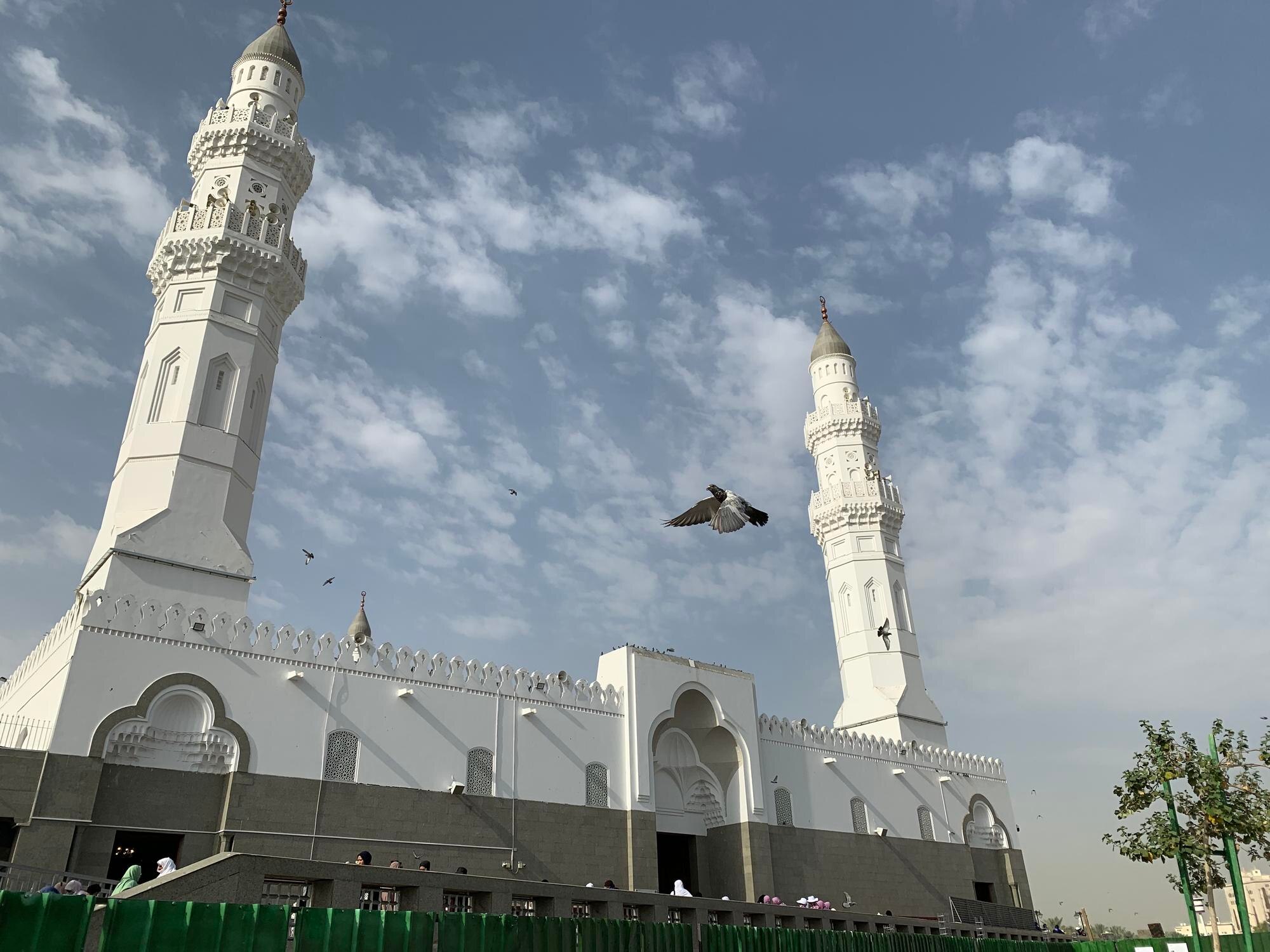
South-west of the Prophet’s Mosque, past the wide corridor of Quba Boulevard, a white stone building with four minarets and a field of small domes stands on ground that has been sacred to Muslims for fourteen centuries. It looks, at first glance, like any of the large modern mosques of Madinah — spacious courtyard, marble floors, retractable canopies against the sun. But this ground carries a distinction no other mosque on earth can claim. Here, in the first days after the Hijrah, the Messenger of Allah ﷺ arrived on foot and by camel, exhausted from an eight-day desert crossing pursued the whole way by men who wanted him dead, and here, before he had even entered the city that would take his name, he did something no Muslim had ever done before: he built a mosque. He is reported to have carried the stones himself. This is Masjid Quba — the first mosque built in the history of Islam, and one of only a handful of places on the earth’s surface about which the Qur’an itself may have spoken directly.
This guide traces Quba from the pre-Islamic village of Banu Amr ibn Awf to the King Salman expansion now moving through Saudi Arabia’s tendering process in 2026. It tells the story of the Prophet’s arrival in Rabi’ al-Awwal of 1 AH, his stay in the home of the elderly Ansari chief Kulthum ibn al-Hidm, the founding of the mosque, and his lifelong habit of returning to it, on foot or on his camel, every single Saturday. It examines, without flinching from the disagreements, the hadith that promises the reward of an Umrah for a prayer offered here, the scholarly dispute over whether Surah al-Tawbah’s “mosque founded on piety from the first day” means Quba or the Prophet’s own mosque, and the four-madhhab consensus that makes Quba the one recognised exception to the rule against travelling specifically to visit a mosque. It is written for the pilgrim who wants to stand in that prayer hall knowing exactly what happened there, what is certain, what is disputed, and what is simply unknown — because a place this important deserves to be understood honestly, not merely admired.
Historical Background: Quba Before and After the Hijrah
The Oasis and Its People
Before it was a mosque, Quba was a village — one of the scattered agricultural settlements that made up the wider oasis of Yathrib, the city that would become Madinah. It sat on the southern edge of that oasis, a pocket of well-watered ground given over to date palms and modest farmsteads, inhabited by the Banu Amr ibn Awf, a clan of the Aws tribe (Madain Project; Wikipedia, Banu Amr). Like the rest of Yathrib in the century before Islam, this was Aws-and-Khazraj country — two related Arab tribes descended, tradition holds, from migrants out of Yemen after the collapse of the Ma’rib dam, who had settled among the older Jewish clans of the oasis and gradually became its dominant force, even as they exhausted themselves and each other in generations of internal blood feud.
Of the specific pre-Islamic history of the Quba site itself — whether it held any distinct religious or commercial significance of its own, separate from the general story of the oasis — the sources available are thin. Beyond the fact of Banu Amr ibn Awf’s settlement there, no confirmed detail survives about the village’s life before the Hijrah. The most relevant academic study of Medina’s sacred geography in this period is Harry Munt’s The Holy City of Medina: Sacred Space in Early Islamic Arabia (Cambridge University Press, 2014), which examines exactly this question of what, if anything, counted as sacred ground in the Hijaz before Islam (Cambridge Core). This is stated plainly rather than papered over: where the specific pre-Islamic history of Quba is concerned, honesty requires acknowledging a gap in the record rather than inventing a past to fill it.
What can be said with confidence is that Quba’s importance in Islamic history begins abruptly, and it begins with a single event: the arrival, on a Monday in the autumn of 622 CE, of a man on a camel named Qaswa, worn down by an eight-day flight from Makkah, entering the territory of people who had been waiting for him for weeks.
Geography: Where Quba Stands
Masjid Quba stands today on the southern to south-western edge of greater Madinah, and one of the gates of Masjid an-Nabawi itself — Bab Quba — is named in its direction, a small but telling sign of how central this site has always been to the city’s sense of itself (Madain Project). The exact distance separating the two mosques is reported with some variation across sources. The official Saudi Ministry of Hajj and Umrah guide describes the Quba Boulevard walkway connecting the two mosques as roughly three kilometres long and three hundred metres wide (Haj.gov.sa Umrah Guide). Other sources put the distance at 3.2 to 3.5 kilometres (Hisar Travel Singapore), a flat three kilometres (distancesfrom.com), 4.4 kilometres by road (IslamicLandmarks.com), or as much as five kilometres depending on the exact route measured (MEED). The safest statement for a visitor is a range: commonly cited figures cluster around three to three-and-a-half kilometres south-west of the Prophet’s Mosque, with some sources giving distances up to five kilometres depending on the road or path used. The mosque’s coordinates are given as 24°26′20.52″N, 39°37′02.00″E in one detailed source (Scribd, “Mosques of Madinah”), close to the figure of 24.43917°N, 39.61722°E given by Simple Wikipedia (Simple Wikipedia).
Before the most recent expansion began moving through Saudi Arabia’s planning and tendering process, the mosque complex covered a total site area of roughly 13,500 square metres, with the prayer hall itself occupying about 5,035 square metres and a capacity of approximately 20,000 worshippers (Saudipedia). A separate figure from Archnet’s architectural database gives a larger total site area of 40,780 square metres and a ground-floor area of 13,730 square metres (Archnet) — a discrepancy most likely explained by different definitions of the site’s boundary, and one worth flagging rather than silently resolving. The mosque as it stands today — before the King Salman expansion changes it again — is a large white stone and marble hypostyle building: a rectangular prayer hall wrapped around a generous central courtyard, four minarets rising from its corners, and a deliberate architectural echo of the older Mamluk and Ottoman styles once found across Madinah (Wikipedia, Quba Mosque; AboutIslam.net).
Why “Historical Landmarks in Saudi Arabia” Begins Here
Any serious account of Islamic history of Madinah, or of the Islamic heritage of the wider Hijaz, has to begin close to where Quba stands, because this is where the physical infrastructure of the new religion first took shape. Before there was a Prophet’s Mosque in the heart of the city, before there was a marketplace, a treaty with the Jewish clans, or a formal constitution binding the tribes of the oasis together, there was a small mosque on the southern edge of town, built with stones the Prophet ﷺ is reported to have carried with his own hands. Every Umrah historical sites itinerary that includes Madinah eventually arrives here, because Quba is where the built environment of Islam begins. What happened before and after Islam in this one corner of the oasis is therefore not a footnote to the larger seerah — it is close to its opening page.
The changes this small village has undergone since then are almost impossible to summarise in a single sentence: from a scatter of mudbrick homes and palm groves belonging to a single Arab clan, to a modest mosque of perhaps a few dozen square metres, to a stone structure rebuilt and repaired across the Umayyad, Abbasid, Mamluk and Ottoman periods, to the vast 1980s reconstruction under King Fahd, and now to a planned expansion that will make it, on completion, the third-largest mosque in Saudi Arabia by worshipper capacity, trailing only the Grand Mosque in Makkah and the Prophet’s Mosque itself (Saudi Gazette). Few buildings anywhere have been rebuilt so many times while never losing the reason people come to them in the first place.
The Story Behind the Place: The Hijrah to Quba
A City Waiting
By the late summer of 622 CE, the community the Prophet ﷺ had spent thirteen years building in Makkah — battered by boycott, mockery and the murder or torture of some of its weakest members — had begun quietly moving north. Group by group, family by family, the Muslims of Makkah slipped away toward Yathrib, a city whose leading men from the Aws and Khazraj tribes had pledged, at Aqabah, to protect the Prophet ﷺ as they protected their own wives and children. By the time the Prophet ﷺ himself was ready to leave, almost the entire Muslim community of Makkah had already gone ahead of him. Only Abu Bakr al-Siddiq, Ali ibn Abi Talib, and a small number of others remained in the city, waiting.
In Yathrib, meanwhile, something remarkable had begun to happen. The Ansar — the people who would become known as “the Helpers” for their reception of the Muhajirun, the Meccan emigrants — had taken to walking out to the edge of the oasis each morning after Fajr, out toward the black volcanic rock fields on the city’s outskirts, to wait. They had heard the Prophet ﷺ was coming, though no one could say exactly when, and so they went out day after day, watching the horizon until the heat of the sun drove them home, only to return the next morning and do it again.
Consider what this daily vigil actually required of the people keeping it. Yathrib in 622 CE was not a single unified city with clear leadership and settled order; it was a fractious oasis of competing clans, still recovering from the exhausting internal wars between the Aws and Khazraj described earlier in this guide, a place where the arrival of a single respected outsider as arbitrator was itself an unusual and hopeful development. And yet, morning after morning, without any announced date of arrival and with real personal risk attached to openly harbouring a man wanted by the most powerful tribe in Arabia, a portion of this fractured community kept walking out to the edge of the settlement to watch for him. This was not a single dramatic welcome staged for one afternoon. It was a sustained, repeated act of hope and commitment, carried out by people who had made a promise at Aqabah and intended to keep it even before they knew exactly when it would be tested.
The Journey South, Then North
The Prophet’s ﷺ own departure took the famously indirect and dangerous route: south from Makkah to the cave of Thawr, where he and Abu Bakr hid for three days while Quraysh search parties combed the hills around them, and only then north along the coastal route toward Yathrib, guided by a hired pagan tracker, Abdullah ibn Uraiqit, who knew paths the Quraysh would never think to search. It was a journey undertaken with a bounty of a hundred camels on the Prophet’s ﷺ head, dead or alive, and it was shadowed for much of its length by the same men — most famously Suraqah ibn Malik — who very nearly caught him.
The sources describing the exact chronology of this final approach to the oasis differ in their detail, but the shape of the story is consistent: an arduous, closely pursued crossing of roughly eight days, ending not in the heart of Yathrib itself but at its southern edge — at Quba, in the territory of Banu Amr ibn Awf.
Monday, in Rabi’ al-Awwal
Ibn Ishaq’s account, transmitted through the earliest biographies of the Prophet ﷺ, places the arrival at Quba on a Monday. The precise date within the month of Rabi’ al-Awwal is itself the subject of a genuine, long-recognised discrepancy in the sources, one that a careful guide should present honestly rather than resolve by simply picking a number and moving on.
One tradition — reflected in modern seerah retellings drawing on Ibn Ishaq’s material — has the Prophet ﷺ completing an eight-day journey and arriving at Quba on Monday, 8 Rabi’ al-Awwal, then departing for Yathrib proper on Friday, 12 Rabi’ al-Awwal: a stay of four nights, Monday through Thursday (Islamweb, “The warm welcoming by the Ansar”; rasoulallah.net, “Reaching Quba”, which states explicitly that he stayed four days: “Monday, Tuesday, Wednesday and Thursday”). A second, longer tradition, resting on Ibn Sa’d’s al-Tabaqat al-Kubra, gives a stay commonly described as fourteen nights, or “more than ten nights,” with 12 Rabi’ al-Awwal marking the arrival rather than the departure (Umrah Travel, citing Ibn Sa’d’s Tabaqat I, 235). A Bukhari-based abridged narration likewise states that “the Prophet ﷺ stayed with Banu Amr ibn Awf for more than ten nights and laid the foundation of the mosque” (Mukhtasar Sahih Bukhari, via Tohed). A minority report extends the stay further still, to as many as twenty-two days.
Neither tradition can simply be declared the winner on the evidence available. The four-night account rests on Ibn Ishaq via multiple modern seerah retellings; the fourteen-night account rests on Ibn Sa’d’s Tabaqat, a major early biographical compilation in its own right. What can be said is that both figures are genuinely reported in the classical literature, that they are not easily reconciled, and that a responsible account presents both rather than asserting either as settled fact. What is not in dispute is the destination, the season, and the essential shape of events: the Prophet ﷺ came first to Quba, not to the heart of Yathrib, and he stayed there — for however many nights — before completing the final short leg of the Hijrah into the city that would take his name.
The House of Kulthum ibn al-Hidm
The Prophet ﷺ spent his nights at Quba in the home of Kulthum ibn al-Hidm (his name is also transliterated al-Hadm or al-Hadam), the elderly chief of Banu Amr ibn Awf. Tradition holds that the ground on which the mosque would soon be built belonged to Kulthum, and that he made it available, freely and without hesitation, for the new structure (Umrah Travel, citing Musnad Ahmad II, 10 and Ibn Shabbah’s Tarikh al-Madinah I, 41). It is worth pausing on what this meant in practical terms. An old man, already established as the head of his clan, opened his own household to a fugitive from Makkah — a man wanted, at that very moment, by an army of pursuers offering a fortune for his capture — and did so without any of the security that hindsight now gives the story. Kulthum did not know, when he opened his door, that he was hosting the man who would reshape the religious history of Arabia. He knew only that this was the man the Aqabah delegation had pledged to protect, and he acted on that pledge.
During the daytime hours, the Prophet ﷺ did not remain solely in Kulthum’s home. He held his public assemblies instead at the house of Sa’d ibn Khaythamah, a young, unmarried man of the same clan known as the keeper of “Bayt al-Uzzab” — the House of the Bachelors — a household without the women and children that filled Kulthum’s home, and therefore a more suitable place for visitors, delegations and the daily business of a growing community to gather (Yaqeen Institute, “Kulthum ibn al-Hadm and Sa’ad ibn Khaythamah: The Hosts of Masjid Quba”). Abu Bakr, who had travelled the entire journey at the Prophet’s ﷺ side, lodged separately, in the home of an Ansari host named in one source as Habeeb ibn Asaf, though this particular identification has not been independently confirmed across multiple sources and should be treated as provisional (Islamweb).
Kulthum ibn al-Hidm did not live to see the community he had sheltered grow into what it would become. He died shortly after the Hijrah — reportedly the very first companion to die in Madinah following the Prophet’s ﷺ arrival (Yasir Qadhi seerah transcript). His house had held, for a matter of days or weeks, the most consequential guest in Islamic history, and then he was gone — a detail easy to lose amid the drama of the Hijrah’s larger events, but one that deserves to be remembered on its own terms. A man’s final act of significance in this world was to give shelter to a Prophet, and shortly afterward he died.
A Village Transformed
What Quba experienced in those few days of 1 AH was not simply a visit. It was the arrival of the first organised expression of the Muslim community as a physical, structured presence on the earth. Before Quba, Islam had been a movement of individual conviction, practised largely in secret or under open persecution in Makkah. At Quba, for the first time, Muslims gathered daily, prayed together in a fixed place, and began the work of building something that would outlast any of them. The transformation of this modest agricultural settlement — a cluster of palm groves and mudbrick homes belonging to one clan of the Aws — into the site of the first mosque in the history of Islam happened within the span of a single week, or perhaps two, depending on which account of the length of the stay one accepts. Few places on earth have absorbed so much historical weight in so short a time.
The Prophet ﷺ and This Place
The Founding of the Mosque
The mosque built at Quba is also known in the classical sources as Masjid Bani Amr ibn Awf, after the clan on whose land it stood (Umrah Travel). Tradition holds that the Prophet ﷺ personally laid or positioned the first foundation stones during his initial stay, and that he returned to the site on a later visit — after the change of the qiblah from Jerusalem to Makkah — to oversee alterations, on that occasion carrying stones himself alongside his companions. This second account is transmitted through Ibn Sa’d’s compilation via a chain running through Muhammad ibn Umar al-Waqidi, a historian whose narrations are widely graded weak by hadith critics. It should therefore be presented, honestly, as a historical report resting on a weak chain — valuable as part of the received narrative tradition of the seerah, but not to be treated as an authenticated hadith of the Prophet ﷺ (Aal-e-Qutub, compiling Ibn Sa’d’s Tabaqat).
A note on authenticity: the image of the Prophet ﷺ carrying stones for the mosque at Quba is one of the most beloved details in the entire story, and it is told here because it belongs to the earliest layer of the seerah tradition. But it should not be repeated as though it carries the same evidentiary weight as a hadith recorded in Bukhari or Muslim. Its chain runs through al-Waqidi, and hadith critics including Ahmad ibn Hanbal, al-Bukhari and al-Nasa’i criticised al-Waqidi’s reliability as a transmitter. The story is worth telling. It should be told with this caveat attached, not silently upgraded into settled fact.
A separate, better-attested companion report in the same compilation, transmitted via Sufyan ibn Uyaynah from Zayd ibn Umar from Ibn Umar, describes the Prophet ﷺ entering “the mosque of Banu Amr ibn Awf, and that was the mosque of Quba,” and being met there by the Ansar with gestures of raised hands in greeting. Because Sufyan ibn Uyaynah is a widely trusted transmitter, this chain appears on its face more reliable than the stone-carrying narration, though a full independent grading of this specific report was not completed in the research behind this guide and should be treated as provisional rather than settled (Aal-e-Qutub).
Whatever the precise chain of any single narration, the underlying fact is not seriously disputed by any source consulted for this guide: within days of arriving at Quba, the Prophet ﷺ organised the construction of a mosque — a simple structure, its exact original dimensions unrecorded in any source available today — on ground given by Kulthum ibn al-Hidm, built by the hands of the Muhajirun and the Ansar working side by side. It was the first such structure raised anywhere in the history of Islam, a building whose sole purpose was communal prayer, oriented at that time toward Jerusalem, since the command to face the Ka’bah in Makkah had not yet been revealed.
The Later Mosque in Madinah: Bricks and a Saying About Khaybar
Once the Prophet ﷺ completed the short final journey from Quba into Madinah proper, construction began on what would become Masjid an-Nabawi, the Prophet’s Mosque. According to the Islamweb seerah account, the Prophet ﷺ again took part in the physical labour, carrying bricks himself and saying: “Carrying this load is better than carrying the load of Khaybar, for its reward will remain with Allah, and there is much purity and goodness in it” (Islamweb). This saying is reported in the source consulted without a specific hadith-collection citation, and it should therefore be treated as a historical narration of unconfirmed grading rather than cited as a numbered hadith. It is included here because it belongs to the same pattern established at Quba days earlier: a Prophet ﷺ who did not merely instruct others to build, but who built alongside them.
The Habit of a Lifetime: The Prophet’s Saturday Visits
What sets Quba apart from almost every other site associated with the Hijrah is that the Prophet’s ﷺ connection to it did not end when he moved into Madinah proper. For the rest of his life, he maintained a standing practice of returning to Quba, and the hadith literature records this with a clarity and consistency rare even among well-attested prophetic habits.
Sahih al-Bukhari 1193 records, on the authority of Abdullah bin Dinar from Ibn Umar: “The Prophet (ﷺ) used to go to the Mosque of Quba every Saturday (sometimes) walking and (sometimes) riding.” Grade: Authentic (sahih), contained in Sahih al-Bukhari (sunnah.com/bukhari:1193). A parallel narration, Sahih al-Bukhari 1194, transmitted via Nafi’ from Ibn Umar, adds the detail that the Prophet ﷺ “would offer two rak’at” once he arrived — Authentic (sunnah.com/bukhari:1194). Sahih Muslim 1399 preserves the same practice under an explicit chapter heading concerning “the virtue of the Masjid of Quba’, and the virtue of praying therein and visiting it”: “Ibn Umar reported that Allah’s Messenger (ﷺ) visited (the mosque) at Quba’ riding and on foot” — Authentic (sunnah.com/muslim:1399). Related narrations in Sahih al-Bukhari 1191 and 1192 note that Ibn Umar himself never prayed the voluntary Duha prayer except in Makkah or during his own weekly visits to Quba, in emulation of the Prophet’s ﷺ practice — again graded Authentic (sunnah.com/bukhari:1191). Riyad as-Salihin 374 combines these narrations under the joint authority of Bukhari and Muslim (sunnah.com/riyadussalihin:374).
This is one of the most secure and widely cited practices connected to any site in Madinah: a specific weekly habit, maintained across years, recorded by multiple chains in the two most rigorously verified collections in Sunni Islam. It is also one of the most emulated. To this day, many residents of Madinah and visiting pilgrims make a point of visiting Quba specifically on a Saturday, in direct imitation of a practice the Prophet ﷺ is reported to have kept for the whole of his life in the city — sometimes walking the distance, sometimes riding, but rarely, it seems, letting the week pass without going.
Picture what this meant in practice. Madinah in the years after the Hijrah was not a city of paved roads and shaded corridors. The distance between the Prophet’s Mosque and Quba — several kilometres of open ground, exposed to the full heat of the Hijaz sun — was not a casual stroll. And yet week after week, whatever the demands of governing a growing state, receiving delegations, organising the defence of the community, or simply living an ordinary life, the Prophet ﷺ made the journey. Sometimes on foot, sometimes mounted, but consistently. It is difficult to think of a clearer, more sustained demonstration of what a place meant to him.
The Reward of an Umrah
Beyond the Saturday visits, the hadith literature preserves a specific, remarkable promise attached to prayer at Quba: that a single prayer offered there carries a reward comparable to that of performing an Umrah. Because this claim shapes real travel decisions for pilgrims today, it is treated with particular care in this guide, and in full in the Hadith References section below. In brief: the tradition is recorded in Sunan Ibn Majah 1412, Jami’ at-Tirmidhi 324, and Sunan an-Nasa’i 699, each with its own chain and its own grading history, and each is examined separately later in this guide rather than compressed into a single unexamined claim here.
The Purification of the People of Quba
One further episode ties the Prophet ﷺ directly to this specific community, beyond the general habit of visiting. Imam Ahmad’s Musnad and Ibn Khuzaymah’s Sahih record that the companion ‘Uwaym ibn Sa’idah al-Ansari reported the Prophet ﷺ coming to Masjid Quba and asking the people gathered there: “Allah has praised you concerning the purification you perform… what is this purification?” They explained that they had Jewish neighbours who, after using the toilet, would wash with water, and that they had adopted the same practice themselves (cited within Ibn Kathir’s tafsir of 9:108). This exchange — a Prophet ﷺ asking his own followers to explain a practice Allah had already praised — is the textual thread connecting the people of Quba to a specific phrase in Surah al-Tawbah, examined fully below.
The scene itself is worth sitting with for a moment. Here is a Prophet ﷺ who, rather than simply commending a good practice from a position of authority, asks the ordinary people who perform it to explain themselves — curious, it seems, about the reasoning behind a habit that had already earned divine praise before he even inquired about it. It is a small moment, easily passed over, but it says something about how information moved in the earliest Muslim community: not always from Prophet ﷺ down to people, but sometimes the other way, with the Prophet ﷺ himself asking to understand what his own companions were already doing well.
Qur’anic Connections: A Mosque Founded on Piety
Surah al-Tawbah 9:108
﴿لَا تَقُمْ فِيهِ أَبَدًا ۚ لَمَسْجِدٌ أُسِّسَ عَلَى التَّقْوَىٰ مِنْ أَوَّلِ يَوْمٍ أَحَقُّ أَنْ تَقُومَ فِيهِ ۚ فِيهِ رِجَالٌ يُحِبُّونَ أَنْ يَتَطَهَّرُوا ۗ وَاللَّهُ يُحِبُّ الْمُطَّهِّرِينَ﴾
“Never stand [to pray] therein. A mosque founded on piety from the first day is more worthy for you to stand in. In it are men who love to purify themselves, and Allah loves those who purify themselves.”
— Surah al-Tawbah 9:108
This verse falls within a wider passage, 9:107–110, concerning Masjid al-Dirar — a mosque a faction of hypocrites (munafiqun) built in Madinah as a deliberately divisive, rival institution, ostensibly for the convenience of the weak and elderly but in reality intended to shelter plotting against the Prophet ﷺ and the unity of the believers. The Qur’an commands the Prophet ﷺ never to pray in that structure, and the classical accounts record that it was later demolished, in some reports burned, on his instruction. Verse 108 draws the contrast directly: set against the mosque built on hypocrisy and division stands “a mosque founded on piety from the first day,” a phrase more worthy of the Prophet’s ﷺ presence and prayer.
Which mosque does this phrase describe? Here the sources genuinely disagree, and a guide that wants to be trusted must present that disagreement honestly rather than resolve it by fiat. There are three identifiable positions among the classical and modern authorities, each with named proponents, and this guide sets out all three.
Position One: The Verse Refers to Masjid Quba
The majority tafsir tradition inclines toward Quba. Ibn Kathir, in his Tafsir al-Qur’an al-‘Azim, states explicitly that the verse is “in reference to the Masjid of Quba’,” citing both the Umrah-reward hadith and the report of ‘Uwaym ibn Sa’idah on the purification practices of the people of Quba as supporting evidence (Ibn Kathir on 9:108, via Quran.com; mirrored at AbdurRahman.org). Mufti Muhammad Shafi, in his widely used modern commentary Maarif al-Qur’an, likewise states: “The context of the verse shows what is being referred to here is Masjid Quba’ where the Holy Prophet ﷺ used to say his prayers at that time,” citing reports transmitted from Ibn Marduwayh (via Ibn Abbas), ‘Amr ibn Shaibah (via Sahl al-Ansari), and Ibn Khuzaymah’s Sahih (via ‘Uwaimir ibn Sa’idah) (Maarif al-Qur’an, via Quran.com).
A historical report with a weaker chain — again running through al-Waqidi in Ibn Sa’d’s compilation — has two prominent early figures, Abu Ayyub al-Ansari and ‘Urwah ibn al-Zubayr, independently identifying the verse with Masjid Quba (Aal-e-Qutub). The prominent modern teacher Yasir Qadhi, in his seerah lectures, states that the majority tafsir opinion favours Quba, reasoning that Masjid al-Dirar — the rival mosque condemned earlier in the same passage — stood near Quba geographically, and citing a report attributed to Abu Dawud (its exact hadith number not independently verified in the research behind this guide) in which the people of Quba are specifically asked, after the revelation of 9:108, why Allah had praised their purification habits (transcript, arqadhi.blogspot.com). A peer-reviewed Turkish academic article, based on hadith analysis, likewise concludes the verse’s intended referent is Masjid Quba (DergiPark).
Position Two: The Verse Refers to Masjid an-Nabawi
Set against this majority tafsir position is a hadith of the highest possible grade, recorded under a chapter heading that leaves no room for ambiguity about how the compiler understood it. Sahih Muslim 1398a, transmitted under the heading “The Masjid whose foundation was founded upon piety is the Masjid of the Prophet in Al-Madinah,” records that the companion Abu Sa’id al-Khudri asked the Prophet ﷺ directly which of the two mosques the verse described. In response, “he took a handful of pebbles and threw them on the ground and then said: This is the very mosque of yours (mosque at Medina).” Grade: Authentic (sahih) (sunnah.com/muslim:1398a; a parallel version, 1398b, carries the same grading).
Jami’ at-Tirmidhi 323 preserves a related episode: a dispute arose between a man of Banu Khudrah, who favoured the Prophet’s own mosque, and a man of Banu Amr ibn Awf, who favoured Quba, and the matter was brought before the Prophet ﷺ himself. He replied: “It is this — meaning his Masjid — and in that one [Quba] there is much good (khayr kathir).” Grade: Authentic (Darussalam); Tirmidhi’s own verdict was “Hasan Sahih” (sunnah.com/tirmidhi:323). This hadith is worth pausing over, because it already contains the seed of a reconciling position: it affirms the Prophet’s Mosque as the primary referent while explicitly crediting Quba with “much good” — not nothing, not a rejected rival claim, but a real share of honour, subordinate to but not erased by the primary answer.
A further chain-analysis source notes a hasan-graded report from Sahl ibn Sa’d, transmitted via Musnad Ahmad 22805 and al-Tabarani’s al-Mu’jam al-Kabir 6025, in which the Prophet ﷺ says “It is my mosque” whenever asked the same question. A weaker variant naming the companion Ubay ibn Ka’b is graded weak (da’if) by al-Haythami in Majma’ al-Zawa’id (4/10); although al-Hakim graded a version naming Ubay ibn Ka’b as sahih in his al-Mustadrak (2/334), this specific attribution has been disputed by later analysts as unsound (surahquran.com). Al-Nawawi’s commentary treats the Sahih Muslim hadith as a decisive confirmation that the Prophet’s Mosque is intended, while acknowledging that some exegetes hold the Quba view (islamstory.com).
Position Three: Ibn Hajar’s Reconciliation — Both Are Intended
Between these two positions stands a reconciling view associated above all with Ibn Hajar al-Asqalani. In his monumental commentary on Sahih al-Bukhari, Fath al-Bari (7/245), he holds that both mosques were, in a real sense, founded upon piety — that the Sahih Muslim hadith identifies the Prophet’s Mosque as the primary and explicit referent of the verse without thereby denying that the same Qur’anic description, in principle, also applies to Quba (cited on surahquran.com). This is not a hedge invented to avoid the discomfort of disagreement; it is a considered scholarly position from one of the most rigorous hadith commentators in the Islamic tradition, built on the observation that the Tirmidhi hadith itself already grants Quba “much good” even while naming the Prophet’s Mosque as the primary answer.
Modern teachers such as Yasir Qadhi present a version of the same reconciling reading in popular lectures, framing the Prophet’s ﷺ reply of “It is my mosque” as a corrective against ranking Quba above his own mosque, rather than as an outright denial that Quba, too, was founded upon piety from its first day (arqadhi.blogspot.com).
Weighing these three positions fairly: the strongest textual evidence available — a sahih hadith in Sahih Muslim, reinforced by Tirmidhi’s hasan-sahih report — favours Masjid an-Nabawi as the hadith’s explicit, named referent. But the majority tafsir tradition, carried by Ibn Kathir and Maarif al-Qur’an among others, keeps Quba meaningfully in the picture, and Ibn Hajar’s reconciling view offers a considered path between the two rather than forcing a stark either-or choice. This guide presents all three, names their proponents, and does not resolve the dispute as settled, because it is not settled, and pilgrims deserve to know that.
“Men Who Love to Purify Themselves”
The final phrase of 9:108 — “in it are men who love to purify themselves, and Allah loves those who purify themselves” — is tafsir-linked directly to the reported practices of Banu Amr ibn Awf, the people of Quba, described earlier in this guide: their custom, learned from Jewish neighbours, of washing with water after using the toilet, a practice the Prophet ﷺ is reported to have specifically asked them about and which Ibn Kathir’s tafsir cites, via Imam Ahmad and Ibn Khuzaymah’s Sahih, as the occasion behind this line of the verse (Ibn Kathir’s tafsir).
The modern lesson many contemporary teachers draw from this phrase, regardless of which position one holds on the wider dispute over 9:108, is one about the dignity of ordinary discipline. The people of Quba were not praised in the Qur’an for a miracle, a military victory, or a feat of endurance. They were praised for a habit of personal cleanliness, quietly maintained, that had nothing spectacular about it at all. It is a reminder that in the moral universe the Qur’an describes, small, consistent, private disciplines can earn a mention that outlives empires.
Hadith References: Quba in the Authentic Collections
Quba is one of the few sites in Islamic history where the central religious claim attached to it — that a single prayer there is rewarded like an Umrah — carries real, practical weight for how pilgrims plan their time in Madinah. Because readers make travel and worship decisions based on this claim, this section grades it with particular care, collection by collection, rather than repeating it as an unqualified fact.
The Saturday Visits
- Sahih al-Bukhari 1193 — “The Prophet (ﷺ) used to go to the Mosque of Quba every Saturday (sometimes) walking and (sometimes) riding,” narrated by Abdullah bin Dinar from Ibn Umar. Authentic (sahih). sunnah.com/bukhari:1193
- Sahih al-Bukhari 1194 — parallel narration via Nafi’ from Ibn Umar, adding that the Prophet ﷺ “would offer two rak’at” upon arrival. Authentic. sunnah.com/bukhari:1194
- Sahih Muslim 1399 — “Ibn Umar reported that Allah’s Messenger (ﷺ) visited (the mosque) at Quba’ riding and on foot,” recorded under the chapter heading “The virtue of the Masjid of Quba’, and the virtue of praying therein and visiting it.” Authentic. sunnah.com/muslim:1399
- Sahih al-Bukhari 1191 and 1192 — Ibn Umar never prayed the Duha prayer except in Makkah or during his weekly Quba visits, in emulation of the Prophet’s ﷺ practice. Authentic. sunnah.com/bukhari:1191
- Riyad as-Salihin 374 — combines the above narrations under the joint authority of Bukhari and Muslim (muttafaqun ‘alayh). sunnah.com/riyadussalihin:374
This group of narrations is about as secure as hadith evidence gets: multiple chains, both of the two most rigorously authenticated collections in Sunni Islam, and a consistent, specific, repeated practice rather than a single isolated report. There is no serious scholarly dispute about the authenticity of the Prophet’s ﷺ weekly visits to Quba.
The Reward of an Umrah
This is the tradition that matters most for how pilgrims plan their visit, and it deserves a careful, collection-by-collection treatment rather than a single blended grading.
- Sunan Ibn Majah 1412 — “Whoever purifies himself in his house, then comes to the Quba’ Mosque and offers one prayer therein, will have a reward like that for ‘Umrah,” narrated by Sahl ibn Hunaif. Darussalam’s printed grading on sunnah.com marks this hadith Hasan. sunnah.com/ibnmajah:1412
- Jami’ at-Tirmidhi 324 — “The prayer in Masjid Quba is like an Umrah,” narrated by the companion Usaid (also transliterated Asaid) ibn Zuhair al-Ansari, via Abu al-Abrad, the freed slave of Banu Khatmah. Al-Tirmidhi’s own verdict on this specific hadith is “Hasan Gharib” — he notes that Usaid ibn Zuhair has no other known hadith besides this one, and that it is transmitted only through the single route of Abu Usama. sunnah.com/tirmidhi:324
- Sunan an-Nasa’i 699 — “Whoever goes out to his Masjid — the Masjid of Quba’ — and prays therein, that will be equivalent to an ‘Umrah,” narrated by Abu Umamah ibn Sahl ibn Hunaif from his father, Sahl ibn Hunaif. Darussalam grading: Hasan. sunnah.com/nasai:699
Here is where precision matters most for a reader deciding how much weight to place on this promise. The printed Darussalam translations available on sunnah.com grade the Ibn Majah and Nasa’i versions as Hasan, and Tirmidhi’s own verdict on his version is the closely related but distinct classification “Hasan Gharib” — hasan in strength, but gharib because it is known through only a single narrator and a single route. None of the three primary texts, in their standard printed gradings, is classified as sahih in isolation.
However, the great hadith scholar Muhammad Nasir al-Din al-Albani reached an independent, and in this case stronger, conclusion. In his Sahih al-Targhib wa al-Tarhib, al-Albani graded the Sahl ibn Hunaif narration — the route underlying both the Ibn Majah and the Nasa’i versions — as Authentic (sahih), at hadith numbers 1180 and 1181 in that work (AbuAminaElias / Daily Hadith Online; corroborated at AbdurRahman.org, which cites the hadith as narrated by Ahmad, 3/437, and al-Nasa’i, 699, “classed as saheeh by al-Albaani in Saheeh al-Targheeb, 1180, 1181”). Al-Albani’s specific grading is attributed to Sahih al-Targhib no. 1181 for the Ibn Majah wording particularly.
Net assessment for the reader planning a visit: the “Umrah reward” tradition is attested across three of the six major Sunni hadith collections — Ibn Majah, Tirmidhi, and Nasa’i — as well as in Imam Ahmad’s Musnad, with multiple companion narrators (Sahl ibn Hunaif and Usaid ibn Zuhair) reporting essentially the same promise through independent routes. The collections’ own standard printed gradings place it at Hasan, with Tirmidhi’s version specifically Hasan Gharib. Al-Albani, working independently in Sahih al-Targhib, upgraded the Sahl ibn Hunaif route to Sahih. The honest summary is therefore: at minimum Hasan across multiple collections, trending toward Sahih on al-Albani’s independent grading — a hadith with real strength behind it, transparently reported here with both gradings named and attributed to their sources, rather than flattened into a single unqualified claim in either direction.
Several additional variants appear in the Musannaf of Ibn Abi Shaybah. No. 7736 repeats Usaid ibn Zuhair’s wording. No. 7737 gives a variant, attributed to Sahl ibn Hunaif, specifying “four rak’ahs” rather than a single prayer; the reliability of the narrators in this specific chain was not independently confirmed in the research behind this guide, and it should be treated cautiously rather than repeated as an established variant. Nos. 7739 (from Ibn Umar) and 7740 (from Aisha bint Sa’d, reporting her father Sa’d ibn Abi Waqqas’s personal preference for praying at Quba over travelling twice to Bayt al-Maqdis) are companion-level reports rather than hadiths attributed to the Prophet ﷺ himself, and should be understood as such (Tohed / Musannaf Ibn Abi Shaybah). Sa’d ibn Abi Waqqas’s preference statement is also recorded in Ibn Hajar’s Fath al-Bari (3/90), citing ‘Umar ibn Shabbah’s Tarikh al-Madinah al-Munawwarah, with a chain described there as sound (Tohed commentary on Bukhari 1191).
The Dispute Over Which Mosque Was “Founded on Piety”
- Sahih Muslim 1398a, 1398b — the Prophet ﷺ identifies his own mosque, in Madinah, as the referent of Surah al-Tawbah 9:108, in response to a direct question from Abu Sa’id al-Khudri. Authentic. sunnah.com/muslim:1398a
- Jami’ at-Tirmidhi 323 — the Prophet ﷺ names his own mosque as the primary referent while affirming that “in that one [Quba] there is much good.” Grade: Authentic (Darussalam); Tirmidhi’s own verdict “Hasan Sahih.” sunnah.com/tirmidhi:323
These two hadiths are discussed at length in the Qur’anic Connections section above, alongside Ibn Kathir’s and Maarif al-Qur’an’s tafsir positions favouring Quba, and Ibn Hajar’s reconciling view. They are repeated here in consolidated form because this section aims to gather every graded hadith connected to Quba in one place for ease of reference.
Narrations Connected to Quba That Are Weak, Unconfirmed, or Require Caution
These reports circulate widely in popular seerah retellings and pilgrim literature. They are listed here so a reader knows precisely where each one stands rather than encountering them presented, elsewhere, as settled fact.
- The Prophet ﷺ personally carrying stones to build the mosque at Quba on his later visit, after the qiblah change. Transmitted via al-Waqidi in Ibn Sa’d’s compilation. Weak chain (da’if) — a beloved and widely told story, but resting on a transmitter whose reliability major hadith critics have questioned.
- “Carrying this load is better than carrying the load of Khaybar” — attributed to the Prophet ﷺ while carrying bricks for the Prophet’s Mosque in Madinah proper. Reported without a specific hadith-collection citation in the source consulted. Scholarly opinion / unconfirmed grading — a historical narration, not a numbered hadith with an established chain of authentication in this research.
- ‘Umar ibn al-Khattab’s statement: “If the Mosque of Quba had been situated in the horizon of the world we would have exhausted our camels [going there].” Transmitted via Umm Bakr bint al-Miswar, as recorded by Ibn Sa’d. The chain was not independently graded in the research behind this guide. Disputed / ungraded — presented here as a widely quoted statement of devotion, not a fully authenticated report.
- The “four rak’ahs” variant of the Umrah-reward hadith (Musannaf Ibn Abi Shaybah 7737). Requires caution — the reliability of its narrators was not independently confirmed.
A note on authenticity: none of the above reports should be dismissed as false. They belong to the same category the great seerah historians — Ibn Kathir among them — worked with constantly: material transmitted early and widely, valuable for narrative and devotional purposes, but falling short of the rigorous chain standards required to build a specific religious ruling. The rule that matters for a pilgrim standing at Quba today is simple: enjoy these stories for what they are, and do not treat any of them as though they carry the same weight as a hadith recorded in Bukhari or Muslim.
Historical Development: Quba Through Fourteen Centuries
The Rashidun Period (1–40 AH / 622–661 CE)
The mosque founded by the Prophet ﷺ and the Ansar of Banu Amr ibn Awf in 1 AH began, by every indication available, as a modest structure — its precise original dimensions are not recorded in any source consulted for this guide, a genuine gap in the historical record rather than a detail simply omitted here for brevity. What is certain is the mosque’s continuous use across the Rashidun period: the Prophet’s ﷺ own weekly visits established a pattern of devotion at the site that outlived him, and the community that had gathered there in 1 AH continued to treat it as a place of special significance long after his death in 11 AH.
Madain Project separately states that Uthman ibn Affan made the first renovations to the mosque, though this claim is not clearly reconciled in the sources available with the later, better-documented Umayyad-era addition of a minaret discussed below; these appear to describe two distinct, loosely dated renovation traditions rather than a single continuous narrative, and this guide flags rather than merges them (Madain Project).
The Umayyad Period (41–132 AH / 661–750 CE)
The most significant documented Umayyad-era addition to Masjid Quba is its first minaret, attributed to Umar ibn Abd al-Aziz, who served as governor of Madinah from roughly 706 to 712 CE before later becoming caliph from 717 to 720 CE (99–101 AH). The available source does not specify whether the minaret was added during his governorship or his later caliphate, and this detail should be treated as unconfirmed rather than assigned confidently to either period (Madain Project). For more than a millennium after this addition, Masjid Quba would have only this single minaret — the three others familiar to visitors today are a twentieth-century addition, discussed in the Architecture section below.
The Abbasid Period (132–656 AH / 750–1258 CE)
Two specific renovations are documented within the wide span of Abbasid rule. In 435 AH (1043 CE), a renovation credited to Abu Yali al-Husaini added a mihrab to the mosque. In 555 AH (1160 CE), further additions were made under the patronage of Kamal al-Din al-Isfahani (Madain Project). Beyond these two dated interventions, the Abbasid centuries at Quba are not richly documented in the sources available for this guide, a pattern consistent with the wider historical record of Madinah in this period, where Abbasid attention and patronage were directed more heavily toward the Prophet’s Mosque itself.
The Mamluk Period (656–923 AH / 1258–1517 CE)
A cluster of renovation dates — 1272, 1332, 1436 and 1476 CE — falls within the period of Mamluk rule over the Hijaz, though it should be noted plainly that the source recording these dates does not explicitly attribute them to named Mamluk sultans, nor does it use the word “Mamluk” itself. The Mamluk label applied to this cluster of renovations in this guide, as in the research dossier behind it, is an inference drawn from the date range rather than a directly sourced attribution, and should be understood as such (Madain Project).
The Ottoman Period (923–1337 AH / 1517–1918 CE)
The last major renovation of the mosque before the modern era is dated to 1245 AH (1829–1830 CE). Here, however, the sources genuinely conflict on a specific and important point: which Ottoman sultan is responsible for this work. This guide flags the discrepancy rather than silently choosing a name.
Madain Project attributes “the latest changes” of 1245 AH to “Sultan Abdulmajid” — understood to mean Abdulmecid I, who reigned from 1839 to 1861. But 1829–1830 CE falls entirely within the reign of Sultan Mahmud II, who ruled from 1808 to 1839, and a full decade before Abdulmecid I’s accession to the throne. On chronological grounds alone, an attribution to Mahmud II is more plausible than one to Abdulmecid I, since the latter had not yet become sultan when this renovation is dated to have occurred. This guide’s own research could not independently confirm the correct attribution against a primary Ottoman archival source, and so both names are presented here: Madain Project’s stated attribution to “Sultan Abdulmajid,” and the chronologically more consistent alternative attribution to Sultan Mahmud II. Readers should treat this as an open discrepancy in the historical record rather than a settled fact in either direction (Madain Project).
The Saudi Period (1370s AH / 1950s CE – Present)
The twentieth century brought Quba’s most dramatic physical transformations. A mid-century renovation, reported around the 1370s AH (1950s CE), reportedly increased the mosque’s area from 1,225 square metres to 6,100 square metres, added three minarets — bringing the total to four — and six domes, at a cost said to exceed SR 90 million (Hajj and Umrah Planner). These figures partially conflict with other Saudi-era figures for the mosque’s scale discussed elsewhere in this guide, and are best understood as describing an intermediate twentieth-century phase, distinct from the far larger reconstruction that followed a few decades later.
That larger reconstruction took place in 1405–1406 AH (1984–1986 CE), under the patronage of King Fahd ibn Abdulaziz. Primary sources date the foundation of this rebuilding to 3 November 1984, with its inauguration on 2 November 1986 (Saudipedia; Mosques of the World; Haramain Archives). This project, designed by the Egyptian architect Abdel-Wahed El-Wakil, expanded the mosque from roughly 1,600 square metres to 13,500 square metres — an area increase of nearly ninefold, per Saudipedia’s own figures — and produced, in essentially its current form, the building most pilgrims recognise as Masjid Quba today. This is the reconstruction examined in detail in the Architecture section below.
In March 2023, administrative oversight of Masjid Quba was transferred from the Ministry of Islamic Affairs, Dawah, and Guidance to the Al-Madinah Region Development Authority (MRDA), a shift reflecting the site’s growing importance within Saudi Arabia’s wider heritage and urban development planning (Wikipedia, Quba Mosque).
Most significantly for pilgrims visiting today, the King Salman Quba Mosque Expansion Project was announced on 8 April 2022, during Ramadan 1443 AH, and as of the July 2026 compilation of the sources behind this guide remains in its tendering and pre-construction phase. This project — the largest expansion in the mosque’s history — is treated in full in the Practical Visitor Guide and Lesser-Known Facts sections below, because it directly affects what a pilgrim visiting Quba in 2025 or 2026 will actually see on the ground.
Reading the Fourteen Centuries as a Whole
Stepping back from the individual dates and named patrons, a pattern emerges across this fourteen-century span that is worth naming explicitly. Almost every generation of Muslim rulers who held authority over the Hijaz — Rashidun, Umayyad, Abbasid, the Mamluk-era sultans, the Ottomans, and finally the Saudi state — found reason to invest in this specific mosque, on this specific patch of ground on the edge of Madinah, even though it is not one of the three mosques named in the Prophet’s ﷺ own hadith restricting deliberate travel. No caliph or sultan needed to be persuaded that Quba mattered. The investment simply continued, dynasty after dynasty, largely without the kind of interruption or neglect that so often befalls sites of secondary religious importance once the political centre of gravity shifts elsewhere. This continuity is itself a form of historical evidence, independent of any single hadith or tafsir position: across every phase of Islamic political history, from the Rashidun caliphs who had personally known the Prophet ﷺ to a modern nation-state managing a mosque through a dedicated regional development authority, someone in power has judged this small mosque worth the expense of maintaining, restoring, and eventually rebuilding entirely. The specific facts of any one renovation may be disputed — the identity of an Ottoman sultan, the exact date of an Abbasid mihrab — but the underlying pattern of sustained investment across fourteen centuries is not in serious question.
Architecture: The Mosque as It Stands Today
The 1984–1986 Reconstruction and Its Architect
The Masjid Quba that pilgrims visit today, in the years leading up to the King Salman expansion, is essentially the building completed in 1986 under the design of Abdel-Wahed El-Wakil, an Egyptian architect and later winner of the Aga Khan Award and the Driehaus Prize, known for a New Classical, traditionalist approach to Islamic architecture. His structural and tensile engineering was provided by the Stuttgart-based engineer Mahmoud Bodo Rasch, a student of the pioneering tensile-structure designer Frei Otto, in collaboration with the Pakistani architect Hassan Khan Sayyid (Madain Project; Wikipedia, Abdel-Wahed El-Wakil).
El-Wakil had originally hoped to incorporate elements of the older, pre-1984 mosque structure into his new design, preserving some physical continuity with the building the Prophet’s ﷺ own community and the generations after them had used and rebuilt. In the end, this proved impossible, and the old mosque was demolished in its entirety and replaced with the far larger structure that stands today (callingummah.blogspot.com). This is a loss worth naming plainly: whatever fabric of the historical mosque had survived fourteen centuries of renovation and rebuilding did not survive this final, most thorough reconstruction. What replaced it is a building of real architectural distinction, deliberately referencing the older Mamluk and Ottoman styles once seen across Madinah, but it is not physically continuous with the structures that came before it.
El-Wakil’s broader career makes this specific commission easier to understand. Rather than pursuing the modernist, internationally standardised style adopted by many large twentieth-century mosque projects across the Muslim world, he built a reputation on a deliberately historicist approach: hand-drawn geometry, load-bearing masonry construction rather than poured concrete frames disguised with decorative cladding, and a close study of the specific regional building traditions of the Hijaz, Cairo and the wider Mamluk and Ottoman architectural world. His work at Quba, and separately at the Kiswa Factory and other Saudi commissions of the same era, is often cited by architectural historians as part of a wider late-twentieth-century movement to root large-scale modern construction in the Hijaz in visibly traditional forms, rather than in the glass-and-steel idiom found elsewhere in the rapidly modernising Gulf of that period (IOP Conference Series; Mosqpedia).
Layout and Courtyard
The mosque is a hypostyle building: a rectangular main prayer hall organised around a large central courtyard, which occupies roughly a quarter of the building’s total footprint, surrounded on all sides by covered arcades in a peristyle arrangement. Two distinct prayer areas — a larger hall to the south, facing the qiblah, and a smaller hall to the north — are connected by roofed colonnades running along the eastern and western sides of the building (AboutIslam.net; Madain Project).
The courtyard itself is paved in a striking combination of black, red and white marble (Madain Project), and shaded by retractable canopies made of fibreglass-reinforced fabric, which can be folded and unfolded depending on the time of day and the intensity of the sun — a modern engineering solution, drawing on Bodo Rasch’s tensile-structure expertise, to the very old problem of praying comfortably in the Hijaz heat (Saudipedia). Visitors standing in this courtyard at midday in summer will feel the practical value of this design immediately: the marble underfoot stays markedly cooler where the canopies are extended, and the whole space can shift from open sunlight to shaded coolness within minutes.
The Domes: A Genuine Discrepancy
How many domes does Masjid Quba have? This is one of the more curious factual disputes surrounding the building, and different reputable sources give meaningfully different answers, which this guide reports rather than silently harmonises.
Wikipedia’s infobox, along with Simple Wikipedia’s, gives a simplified figure of six main domes (Wikipedia; Simple Wikipedia). AboutIslam.net’s detailed architectural account describes six large domes over the main southern prayer hall, flanked by fifty-six smaller domes over the eastern, western and northern sections of the building — with six of those fifty-six small domes positioned directly alongside the six large ones at either end of the main hall (AboutIslam.net). Saudipedia’s official figure closely matches this: six large domes, each twelve metres in diameter, plus fifty-six smaller domes, each six metres in diameter — a combined total of sixty-two domes (Saudipedia). Mosqpedia’s academic-style article on El-Wakil’s design likewise references fifty-six domes, consistent with the Saudipedia and AboutIslam.net figures (Mosqpedia).
Madain Project, however, gives a meaningfully different total: fifty-four domes of three distinct sizes — forty-eight small domes, five mid-sized domes, and one large one (Madain Project). This is a genuinely divergent count from the sixty-two figure given by Saudipedia and AboutIslam.net, and this guide presents both rather than picking one. If a reader wishes to count domes on a visit, the most detailed and mutually consistent sources — Saudipedia and AboutIslam.net — point toward sixty-two; Madain Project’s fifty-four should be understood as a minority, divergent figure rather than dismissed outright.
Minarets
Four minarets rise from the corners of the prayer hall, each approximately forty-seven metres tall according to Saudipedia’s figures, patterned after the Mamluk and Ottoman-style minarets historically found across Madinah — two examples of which are still retained at Masjid an-Nabawi itself. The minarets rest on square bases, transition to octagonal shafts up to the second of two balconies (each balcony decorated with muqarnas, the stalactite-like decorative vaulting characteristic of Islamic architecture), and finally become circular toward their tops (Saudipedia; AboutIslam.net).
It is worth remembering, standing beneath these four towers today, that for well over a thousand years — from the Umayyad-era addition attributed to Umar ibn Abd al-Aziz until El-Wakil’s 1980s reconstruction — this mosque had only a single minaret. The other three are a distinctly modern addition, however seamlessly they have been integrated into a design that otherwise deliberately evokes much older architectural traditions.
Entrances, Windows and Materials
The mosque has seven main entrances — three on the northern side, and two each on the eastern and western sides — supplemented by additional secondary doors, though sources disagree slightly on the exact count: AboutIslam.net gives ten supplementary doors, while Saudipedia gives twelve, a minor discrepancy worth noting rather than resolving arbitrarily. The building has twenty-eight windows in total: eleven on the eastern side, eleven on the western side, and six on the northern side. The qiblah wall itself is windowless (AboutIslam.net).
The exterior is described as retaining the character of traditional Madinah architecture — ribbed white domes, basalt facing, and a deliberately modest exterior that avoids ostentation even at this considerable scale (Wikipedia, Quba Mosque; callingummah.blogspot.com). Architectural critics have described the resulting building as a clever hybrid of Mamluk, Ottoman, Fatimid and Seljuq elements, drawn together into a single coherent design rather than left as a pastiche of borrowed motifs (AboutIslam.net).
Historical Dimensions: What the Mosque Looked Like Before
Reconstructing exactly what earlier phases of the mosque looked like relies on textual descriptions rather than surviving physical fabric. In the Abbasid period, per Ibn Shabbah’s Tarikh al-Madinah as summarised by Wikipedia, the mosque measured approximately 32 by 32 metres, with an interior courtyard of roughly 24 by 12.5 metres, walls around 9 metres high, and a minaret approximately 24 metres tall. By the late nineteenth century, the Egyptian pilgrimage official Ibrahim Rifat Pasha, in his Mir’at al-Haramayn, recorded the mosque at roughly 40 by 40 metres, with a ceiling about 6 metres high (Wikipedia, Quba Mosque).
The dimensions of the very first mosque, built in 1 AH under the Prophet’s ﷺ own direction, are not recorded in any source consulted for this guide. This is stated here as a genuine gap rather than filled with an invented figure: we know the mosque grew from something considerably smaller than 32 by 32 metres to the 13,500-square-metre complex of today, but the earliest dimensions themselves have not survived in the historical record.
What Was Lost
Beyond the general demolition of the pre-1984 structure discussed above, the specific architectural fabric of each earlier renovation — the Abbasid mihrab of 435 AH, the additions of Kamal al-Din al-Isfahani in 555 AH, the Mamluk-era interventions of the thirteenth through fifteenth centuries, and the Ottoman renovation of 1245 AH — has not survived into the present building. What survives instead is the documentary record of these interventions, preserved in sources such as Ibn Shabbah’s history and Ibrahim Rifat Pasha’s nineteenth-century account, and the unbroken continuity of the site itself, if not its stonework.
Facilities
The current complex includes sixty-four men’s toilets, thirty-two women’s toilets, and forty-two ablution units, along with housing for the imam and muezzin, a library, and a small shopping or market area serving visitors (AboutIslam.net; Saudipedia). A dedicated women’s prayer section exists with its own entrances and ablution facilities; architecturally, this section is divided into two parts, connected to the courtyard by a passageway from the northern entrance (callingummah.blogspot.com; Hisar Travel Singapore).
Archaeological Findings: An Honest Account of What Has and Has Not Been Studied
This section must be direct about a genuine gap in the evidentiary record, rather than implying a body of excavation-based research that does not exist. No records of a formal, published archaeological excavation of the Masjid Quba site were located in the research behind this guide. Everything that can be said about the mosque’s earlier physical states rests on textual and historical sources — principally Ibn Shabbah’s Tarikh al-Madinah and Ibrahim Rifat Pasha’s nineteenth-century Mir’at al-Haramayn, both cited secondhand through modern compilations such as Wikipedia and Madain Project — rather than on stratigraphic or artefactual excavation reports of the kind archaeologists would produce from a dig.
The 1984–1986 Saudi reconstruction involved the complete demolition of the pre-existing structure. If any archaeological survey was conducted before or during that demolition, it was not documented in any source located for this guide. This should be stated plainly as an evidentiary gap rather than glossed over: a building this significant to Islamic history was entirely rebuilt in the 1980s, and no published record of an accompanying archaeological study of what lay beneath or within the older structure has been found.
One piece of scholarship exists that is worth naming, though it is architectural-history research rather than field archaeology in the conventional sense: an academic paper published in the IOP Conference Series, analysing El-Wakil’s traditionalist architectural design for the mosque (IOP Conference Series, “El Wakil’s Traditionalist Architecture of Quba Mosque”), and a related article in Mosqpedia covering the same design in more popular form (Mosqpedia). Both examine the building as a case study in modern traditionalist design — how El-Wakil drew on historical Islamic architectural vocabulary to create a new structure — rather than reporting on any excavation of the ground itself.
The honest summary for a visitor curious about archaeology at Quba is this: the mosque’s architectural history is reasonably well documented through textual sources, and its modern design has been studied seriously as a piece of architectural scholarship, but the ground on which fourteen centuries of Muslims have prayed has not, as far as the published record shows, been the subject of a formal archaeological excavation. Absence of evidence here should not be mistaken for evidence of absence — it may simply be that no such excavation has been undertaken or published, a situation not unusual for actively used religious sites of major sensitivity.
This gap is worth sitting with for a moment rather than passing over quickly, because it says something about how the Muslim world has generally related to its own earliest religious sites. Unlike many ancient sites elsewhere in the world, where continuous religious use eventually gave way to periods of abandonment that later permitted systematic excavation, Masjid Quba has never stopped being a working mosque. There has been no century in which the site sat empty long enough, or was considered sufficiently a historical curiosity rather than a living place of worship, for it to become the object of the kind of careful stratigraphic dig that has revealed, for instance, the layered history of ancient cities elsewhere in the region. Every renovation from the Rashidun period onward has been an act of continued use and rebuilding rather than a pause for study. This is not a criticism of the communities that maintained the mosque across fourteen centuries — quite the opposite, it reflects an unbroken continuity of purpose that many archaeological sites elsewhere in the world lack — but it does mean that certain questions a modern historian might wish to ask, about the exact dimensions and construction methods of the original 1 AH structure, about what lay beneath the Abbasid or Mamluk-era floors, or about the precise archaeological relationship between the various reported renovations, may simply never be answerable from physical evidence, only from the textual record that has survived.
It is also worth noting, in the interest of giving a complete picture, that the King Salman expansion project now underway involves extensive new excavation and foundation work across a dramatically larger footprint than the current building occupies. Whether this construction process will incorporate, or has incorporated, any formal archaeological survey of the newly disturbed ground is not addressed in any of the planning or tender documentation reviewed for this guide. Given the scale of the works — moving from a prayer-hall area of roughly 5,035 square metres to a planned 50,000 or more — this is a live question for the historical record of the site, and one worth watching for as the project moves from tendering into active construction over the coming years.
Stories of the Companions Connected to Masjid Quba
Before turning to the individual figures, a note on honesty is necessary, because it is easy for pilgrim literature to imply a crowded scene of famous names at Quba’s founding when the truth is more specific and, in some ways, more moving: this was a small community, of specific people, at a specific and dangerous moment, and not every well-known companion of later Islamic history was present or even yet a Muslim.
What the surviving reports do give us is a set of individual, identifiable people, each occupying a distinct role in a fast-moving sequence of events: a host who gave shelter, a young man who gave his home for public gatherings, companions who carried specific hadiths down through the generations, and at least one companion whose birth, rather than any action of his own, tied him permanently to this stretch of ground. Reading these figures together, rather than treating Quba’s story as belonging to the Prophet ﷺ alone, restores something of the collective, communal character of what actually happened here: an entire small society reorganising itself, in a matter of days, around a shared act of building and prayer.
Kulthum ibn al-Hidm (رضي الله عنه)
As related earlier in this guide, Kulthum ibn al-Hidm was the elderly chief of Banu Amr ibn Awf, and it was in his home that the Prophet ﷺ spent his nights during the stay at Quba. The land on which the mosque was built is linked to him, freely made available for the new structure. He died shortly after the Hijrah — reportedly the very first companion to die in Madinah following the Prophet’s ﷺ arrival, a detail that gives his brief but significant role in Islamic history a quiet, almost elegiac quality: a man’s house sheltered the Prophet ﷺ at the most dangerous moment of his life, and within a short time afterward, that same man was gone (Yaqeen Institute; Umrah Travel).
Sa’d ibn Khaythamah (رضي الله عنه)
A young, unmarried man of Banu Amr ibn Awf, Sa’d ibn Khaythamah hosted the Prophet’s ﷺ daytime assemblies at his home, known as “Bayt al-Uzzab,” the House of the Bachelors. What makes his role notable is not only his hospitality but his earlier significance: he was the sole representative of Banu Amr ibn Awf present at the pivotal First Pledge of al-Aqabah in Makkah, before the Hijrah — a striking fact given that he was a young, unmarried man rather than a tribal elder, and yet his clan trusted him alone to represent them at one of the founding moments of the entire Medinan alliance. He was later martyred in combat with ‘Amr ibn Abd Wudd — the same formidable Quraysh champion who would, years later, be killed by Ali ibn Abi Talib at the Battle of the Trench (Yaqeen Institute).
‘Uwaym ibn Sa’idah al-Ansari (رضي الله عنه)
A lesser-known but significant companion of Banu Amr ibn Awf, ‘Uwaym ibn Sa’idah is the figure who explained to the Prophet ﷺ the purification practices of his people — washing with water after using the toilet, learned from Jewish neighbours — a report that ties directly into the tafsir of Surah al-Tawbah 9:108 discussed earlier in this guide (Medium, summarising Yaqeen Institute material).
Abu Bakr al-Siddiq (رضي الله عنه)
Abu Bakr accompanied the Prophet ﷺ through the entire Hijrah, including the stay at Quba, though he lodged in a separate Ansari household rather than with the Prophet ﷺ at Kulthum’s home. One source names his host as Habeeb ibn Asaf, though this specific identification has not been independently cross-verified against other sources and should be treated as provisional rather than confirmed (Islamweb).
Ibn Umar — Abdullah ibn Umar (رضي الله عنه)
Ibn Umar is the narrator behind almost every hadith describing the Prophet’s ﷺ weekly Saturday visits to Quba — Sahih al-Bukhari 1193 and 1194, and Sahih Muslim 1399 — and he himself later maintained the same practice of visiting Quba weekly, in direct imitation of what he had observed. An important honesty check belongs here: Ibn Umar was a young child at the time of the Hijrah, born in the 610s CE, and was therefore not himself an adult, eyewitness companion present at the founding events of Quba in 1 AH. His hadiths describe the Prophet’s ﷺ habitual practice as later observed and reported over the following years and decades, not a first-hand account of the founding moment itself. This distinction matters for understanding exactly what his narrations do and do not establish.
Usaid ibn Zuhair al-Ansari (رضي الله عنه)
The companion-narrator behind the Tirmidhi version of the Umrah-reward hadith (Tirmidhi 324). Tirmidhi himself notes that no other hadith beyond this one is known to be transmitted from Usaid ibn Zuhair — a detail that shaped his “Hasan Gharib” grading of the report, as discussed in the Hadith References section above.
Sahl ibn Hunaif and Abu Umamah ibn Sahl ibn Hunaif (رضي الله عنهما)
Father and son, and the narrators behind the Ibn Majah and Nasa’i versions of the Umrah-reward hadith respectively. Sahl ibn Hunaif’s route is the one al-Albani independently graded as sahih in Sahih al-Targhib, making this father-son chain of transmission particularly significant to how confidently a pilgrim can rely on the hadith’s promise.
Sa’d ibn Abi Waqqas (رضي الله عنه)
Reported, via his daughter Aisha bint Sa’d, to have personally preferred praying at Quba over travelling twice to Bayt al-Maqdis (Jerusalem) — a companion-level statement of personal preference rather than a hadith of the Prophet ﷺ, but a striking indication of how highly at least one senior companion valued this specific mosque.
‘Umar ibn al-Khattab (رضي الله عنه)
Quoted by his family, via Umm Bakr bint al-Miswar as recorded by Ibn Sa’d, with a memorable statement of devotion: “If the Mosque of Quba had been situated in the horizon of the world we would have exhausted our camels [going there].” The chain behind this report was not independently graded in the research behind this guide, and it is presented here as a widely quoted expression of devotion rather than a fully authenticated statement.
Abu Ayyub al-Ansari (رضي الله عنه)
Abu Ayyub hosted the Prophet ﷺ in Madinah proper, not at Quba, after the final short leg of the Hijrah was completed. He is separately quoted, in a weak-chain report transmitted via al-Waqidi, as identifying Masjid Quba with the “founded on piety” verse of Surah al-Tawbah, a position discussed in the Qur’anic Connections section above.
‘Abdullah ibn al-Zubayr (رضي الله عنهما)
Reportedly born at Quba shortly after his mother Asma bint Abi Bakr completed her own hijrah while pregnant with him, ‘Abdullah ibn al-Zubayr is described in the sources as the first child born to the Muslim community after the Hijrah (Tohed, Mukhtasar Sahih Bukhari). This event relates to the wider context of the Quba and Medina migration rather than to the mosque itself, but it belongs to the same extraordinary handful of weeks and the same small stretch of ground.
A Note on Who Was Not There
Companions who converted to Islam or emigrated to Madinah later in the Prophet’s ﷺ life were not present at Quba in 1 AH, and no reliable basis exists in the sources consulted for this guide to place any senior companion who converted in a later period at the original founding events. This is a small point, but an important one for the integrity of the historical record: the founding of Masjid Quba belongs to a specific, identifiable, and relatively small group of people — the Muhajirun who made the journey with or shortly after the Prophet ﷺ, and the Ansar of Banu Amr ibn Awf who received them — and it does the historical record no favours to blur that specificity for the sake of a more crowded, more famous-sounding cast of characters.
Stories of Great Islamic Scholars and Their Rulings Tied to Quba
The scholarly literature connected to Masjid Quba centres on one specific and practically important fiqh question: given that the Prophet ﷺ said, in an authentic hadith found in both Sahih al-Bukhari and Sahih Muslim, “Do not undertake a journey except to three mosques: al-Masjid al-Haram, this mosque of mine, and al-Masjid al-Aqsa” (لا تشد الرحال إلا إلى ثلاثة مساجد), how should Muslims understand the other authentic hadiths praising prayer specifically at Quba? Since Masjid Quba is not one of the three named mosques, scholars across the centuries had to reconcile a general restriction on travelling to visit mosques with a specific, authentically graded set of hadiths praising this one mosque above others. This section gathers what the great scholars said, both on this specific question and on the wider tafsir dispute discussed earlier in this guide.
The Four Madhhabs and the “Three Mosques” Restriction
The reconciling position reported across the four Sunni madhhabs is this: travelling specifically and solely to visit any mosque other than the three named in the hadith — including undertaking a long journey from another city purely to visit Masjid Quba — is unanimously held impermissible by the four Imams: Malik ibn Anas, Abu Hanifah, al-Shafi’i, and Ahmad ibn Hanbal. Their reasoning follows directly from the wording of the hadith itself: it restricts intentional travel (rihlah) undertaken for the specific purpose of visiting a mosque to those three mosques alone, and no other mosque, however historically significant, qualifies for this specific category of travel. A minority opinion attributed to the jurist Layth ibn Sa’d holds that if someone has already vowed to make such a journey, the vow itself must be fulfilled — but this is explicitly not the position of the four Imams, and should not be confused with their consensus (Tohed, “The ruling on traveling for ziyarat besides the three mosques”).
This is a crucial distinction for any pilgrim to understand, and it deserves to be stated as clearly as possible: the four-madhhab consensus concerns travelling from afar, from another city or country, with the specific intention of visiting Quba as a destination unto itself. It does not concern visiting Quba locally, while one is already present in Madinah for the far broader and unrestricted purpose of visiting the Prophet’s Mosque, performing Umrah, or simply residing in or passing through the city. On this narrower and, for most pilgrims, far more practically relevant question, the scholarly position is considerably more permissive, and Quba occupies a genuinely unique status among the many historical sites clustered around Madinah.
Why Quba Is the Recognised Exception
Malik ibn Anas and other scholars of Madinah, as reported by Ibn Waddah al-Qurtubi in his work al-Bida’ wa’l-Nahiy ‘anha (p. 43), held that visiting the various mosques and historical sites scattered around Madinah associated with the Prophet ﷺ was generally disliked (makrooh) — with two explicit exceptions carved out from that general dislike: Quba and Uhud (IslamQA). This is a striking position from the very school of law rooted in the practice of Madinah itself, the city where these sites are actually located: even scholars living within walking distance of dozens of locations associated with the seerah held that visiting most of them was not a recommended practice — except for these two.
Ibn Taymiyyah, in his Majmu’ al-Fatawa (17/469), states the same principle in his own words: “the scholars of the salaf among the people of Madeenah and elsewhere did not regard it as mustahabb [recommended] to set out to visit any places in and around Madeenah after the Mosque of the Prophet ﷺ, apart from the mosque of Quba’, because the Prophet ﷺ did not specify any [other] mosque to be visited apart from that” (IslamQA, citing Majmu’ al-Fatawa 17/469). Ibn Taymiyyah’s formulation affirms Quba, alongside the martyrs’ graves at Uhud, as the one specific, legitimately recommended local visitation site in greater Madinah beyond the Prophet’s Mosque itself — a position notable given Ibn Taymiyyah’s generally strict approach to matters of grave visitation and the potential for veneration to shade into impermissible practice.
The modern Hanbali-trained scholar Muhammad ibn ‘Uthaymeen summarised what has become, in effect, the settled practical position among mainstream Sunni scholarship today: “There are no places in Madeenah to be visited apart from these: al-Masjid al-Nabawi, the grave of the Prophet ﷺ, al-Baqee’, the martyrs of Uhud, and the Mosque of Quba’. As for other sites, there is no basis for visiting them” (Fiqh al-‘Ibadaat, p. 405, via IslamQA). This list is short, specific, and Quba sits on it — one of only five sites named in the whole of greater Madinah.
On the narrower, specific act of praying the two rak’ahs at Quba once one is already there — as distinct from the question of travelling specifically to get there — fiqh manuals generally treat this as an established, encouraged voluntary (nafl) practice grounded directly in the hadiths discussed earlier in this guide, without recorded dissent among the classical madhhabs over whether the prayer itself, once a person is present, is praiseworthy. The entire scholarly debate is confined to the narrower question of whether one may undertake a journey specifically to get there — not whether the prayer, once performed, carries the reward the hadiths describe.
What This Means in Practice for a Pilgrim in Madinah
It is worth translating this scholarly picture into the terms a pilgrim actually needs while standing in Madinah deciding how to spend a free afternoon. If you have flown or driven to Madinah specifically to visit the Prophet’s Mosque, to perform Umrah, to pray in the Rawdah, or simply to spend time in the city associated with the Hijrah, then a visit to Quba while you are there carries no tension with the scholarly consensus described above — you have not travelled specifically to Quba, you have travelled to Madinah, and Quba is one of the recognised, praiseworthy things to do while present. The four-madhhab restriction bites only on the narrower, and for most pilgrims largely theoretical, scenario of someone deciding to fly from another country with Quba alone as the explicit and sole purpose of the journey, the way one might plan a dedicated trip to Makkah for Umrah or to Jerusalem for al-Aqsa. Almost no realistic pilgrim itinerary actually falls into that narrower, restricted category, which is precisely why Ibn Taymiyyah, Malik, and Ibn ‘Uthaymeen could all affirm Quba as a recommended local visit while still upholding the general travel restriction without contradiction. The two positions are not actually in tension with each other once the specific wording of the hadith — journeying with a mosque itself as the stated destination — is properly understood.
Scholars Whose Specific Rulings on Quba Could Not Be Located
In the interest of transparency, it should be stated plainly that beyond the general four-Imam consensus on the rihlah restriction described above, this guide’s research did not locate specific, individually attributed rulings on Masjid Quba from al-Shafi’i or Ahmad ibn Hanbal beyond their shared position within that consensus. Similarly, al-Nawawi’s engagement with Quba, discussed below, is confined to his commentary on the Sahih Muslim hadith concerning Surah al-Tawbah 9:108, rather than a distinct fiqh ruling on visiting the mosque. Ibn Kathir’s position, likewise, is a tafsir opinion rather than a separate fiqh ruling. Ibn Hajar al-Asqalani’s engagement with Quba, similarly, is his reconciling tafsir position on 9:108 rather than an independent fiqh treatment. Al-Samhudi’s specific fiqh treatment of Quba in his history of Madinah, Wafa’ al-Wafa, was referenced only generally in the sources consulted, and was not accessed directly for a specific ruling in the research behind this guide. These gaps are noted here rather than filled with unsupported attribution.
Ibn Kathir on the Qur’anic Connection
As discussed in the Qur’anic Connections section above, Ibn Kathir (d. 774 AH), in his Tafsir al-Qur’an al-‘Azim, holds that Surah al-Tawbah 9:108 refers to Masjid Quba, citing both the Umrah-reward hadith and the report of ‘Uwaym ibn Sa’idah’s exchange with the Prophet ﷺ about purification practices. This remains one of the most consequential scholarly positions connected to the mosque, because Ibn Kathir’s tafsir is among the most widely read and consulted works of Qur’anic commentary in the Muslim world today, and his position has shaped how generations of readers have understood the verse’s connection to this specific site.
Al-Nawawi on the Mosque of the Prophet ﷺ
Al-Nawawi (d. 676 AH), in his commentary on Sahih Muslim, treats the hadith of Abu Sa’id al-Khudri — in which the Prophet ﷺ identifies his own mosque as the one “founded on piety” — as a decisive confirmation that the Prophet’s Mosque, rather than Quba, is the verse’s primary referent, while acknowledging that other exegetes hold the alternative view favouring Quba (islamstory.com). This puts al-Nawawi, notably, on the opposite side of the tafsir dispute from Ibn Kathir — a genuine and long-standing scholarly disagreement between two of the most respected authorities in the Islamic tradition, presented here without editorialising about which one is correct.
Ibn Hajar al-Asqalani’s Reconciliation
Ibn Hajar al-Asqalani (d. 852 AH), in his monumental Fath al-Bari (7/245), offers the reconciling reading discussed in detail earlier in this guide: that both mosques were, in a genuine sense, founded upon piety, with the Sahih Muslim hadith identifying the primary referent without denying the description’s applicability, in principle, to Quba as well. This careful middle position is characteristic of Ibn Hajar’s method throughout his commentary — a scholar known for weighing seemingly conflicting hadiths against each other and finding a path that honours the textual evidence on both sides rather than simply declaring one report victorious over another.
A Note on Malik, Abu Hanifah, al-Shafi’i and Ahmad ibn Hanbal
Beyond their shared position within the four-Imam consensus on the “three mosques” restriction, and Malik’s specifically documented exception for Quba and Uhud discussed above, this guide’s research did not locate additional named, individually attributed rulings from Abu Hanifah, al-Shafi’i, or Ahmad ibn Hanbal specifically concerning Masjid Quba. This is noted honestly rather than papered over with invented attribution: the four-madhhab consensus on the travel restriction, and Malik’s specific exception, represent the clearest and best-documented scholarly engagement with this site available in the sources consulted.
Spiritual Reflection: Standing at the First Mosque
Stand for a moment in the courtyard, before you go in to pray, and consider what this ground has seen.
You are standing close to where a man arrived, exhausted, having crossed a desert in eight days while pursued by people who wanted him dead, carrying nothing of the life he had built for over fifty years in Makkah — no house, no trade, no guarantee of safety even here. He had left behind the city of his birth, the graves of his family, everything familiar, and arrived instead among strangers who had pledged, on the strength of a promise made at Aqabah, to take him in. And the very first thing he did, before securing his own lodging beyond a borrowed room, before even completing the short remaining journey into the city that would carry his name, was to build a place for people to pray together.
Ask yourself: what does it say about a person’s priorities that the first structure raised in the entire history of a new faith was not a house, not a fortress, not a monument — but a place of prostration? You have almost certainly, at some point, arrived somewhere new — a new city, a new stage of life, a new set of circumstances entirely — and had to decide what to build first, what mattered enough to establish before anything else. The Prophet ﷺ, arriving with nothing, chose worship. Not comfort. Not security, not yet. Worship, first.
Consider, too, the man who opened his home. Kulthum ibn al-Hidm had no way of knowing, when he took in a fugitive from Makkah, that history would remember his hospitality for fourteen centuries and counting. He knew only that a promise had been made, and that a stranger needed shelter. He gave his home, and shortly afterward, he died — his last significant act in this world an act of unconditional welcome to someone whose full importance he could not have fully grasped in the moment. How many of the good things you do will only be understood, if ever, long after you are gone?
Now think about the stones themselves — carried, tradition holds, by the Prophet’s ﷺ own hands, alongside companions who had far less claim to comfort or ease than he did, and yet who worked without complaint because the goal was shared. There is something in this image that resists every modern instinct toward delegation, toward directing others rather than labouring alongside them. A leader who builds. A Prophet ﷺ who carries stones.
And then there is the weekly habit — every Saturday, for the rest of his life in Madinah, walking or riding the distance back to this specific place. Not because he needed to. Not because any obligation compelled it. Simply because this place mattered to him, consistently, across years of governing a growing state, receiving delegations, raising a family, facing war and peace in turn. Ask yourself honestly: what is the equivalent, in your own life, of a weekly journey back to a place that formed you? Do you still make it? Or has the place that shaped you become, over time, simply somewhere you used to go?
You do not need to resolve, standing here, whether the mosque founded on piety in Surah al-Tawbah refers to this ground or to the one a few kilometres north. The scholars themselves have not resolved it in fourteen centuries, and you are not required to succeed where they have differed honestly. What you can do is recognise that both possibilities point toward the same underlying truth: that piety, sincerity, and purification of intention are what the Qur’an is praising in this passage — wherever, precisely, it locates that praise. The question of which building is less important, in the end, than the quality the verse is describing.
Ask yourself what “purification” would mean if the verse were describing you: not merely the outward practice the people of Quba are reported to have kept with such care, but the state of a heart approaching Allah without division, without the hypocrisy that built the rival mosque condemned in the very same passage.
Before you leave, make du’a. For yourself, for your own sincerity to match whatever outward practice of worship you maintain. For the man who opened his home when it was dangerous to do so. For the community that built this place with their own hands, stone by stone, in the first uncertain days of a religion that would eventually reach every continent on earth. And for yourself again — that whatever “first mosque” you have yet to build in your own life, whatever act of worship or sacrifice you have been delaying until circumstances feel more secure, you might find, in this place, the resolve to begin it now rather than waiting for conditions that may never fully arrive.
Think, too, about how modest this beginning actually was. There was no grand ceremony at the founding of Masjid Quba, no crowd of thousands, no announcement broadcast to the wider world. A small number of people, in genuine danger, built a simple structure out of palm trunks and unbaked brick, in a village most of Arabia had never heard of. Nothing about the scene would have suggested, to an outside observer, that this was the beginning of something that would eventually be prayed toward, or travelled to, or written about, by hundreds of millions of people across fourteen centuries and every inhabited continent. If you are waiting for your own circumstances to look sufficiently significant before you consider what you build worth remembering, Quba’s own beginning argues against that instinct. Significance was not visible at the start. It was revealed only by what was built afterward, prayer by prayer, Saturday by Saturday, century by century.
Notice, finally, what this place does not ask of you. It does not require a permit. It does not require a scheduled slot, a booking reference, or a specific hour of arrival. It asks only that you come, that you purify yourself before you do, and that you pray with whatever sincerity you can bring. Of all the demands a modern pilgrimage places on a traveller’s planning and paperwork, this one mosque, among the most historically significant on earth, asks almost nothing of the kind. There is something worth sitting with in that simplicity — a reminder, perhaps, that the weight of a place need not be measured by the difficulty of reaching it.
Practical Visitor Guide: Visiting Masjid Quba Today
Getting There
Masjid Quba lies roughly three to three-and-a-half kilometres south-west of Masjid an-Nabawi, though as discussed earlier in this guide, some sources give distances of up to five kilometres depending on the exact route measured. You have several practical options for making the journey. Walking is entirely feasible for a reasonably fit visitor and takes roughly forty to fifty-five minutes at a gentle pace, depending on the exact route and the heat of the day (Hisar Travel Singapore; IslamicLandmarks.com). A taxi or private car will typically make the trip in ten to fifteen minutes outside of peak traffic hours. Organised coach tours are common for group pilgrims travelling as part of a larger Umrah package.
The Saudi government has invested specifically in the pedestrian connection between the two mosques: the official Ministry of Hajj and Umrah guide describes a dedicated walkway, Quba Boulevard, roughly three kilometres long and three hundred metres wide, linking the Prophet’s Mosque and Masjid Quba as part of a wider heritage-connectivity project (Haj.gov.sa Umrah Guide; Archnet, Quba Boulevard Development). If you have the time and the weather is not excessively hot, walking this route yourself — following, in a modest way, the same ground the Prophet ﷺ crossed on foot every Saturday of his life in Madinah — is a meaningful way to arrive.
No Permit Required — A Common Point of Confusion
This point deserves to be stated as clearly as possible, because it is a genuine and frequent source of confusion among pilgrims planning their Madinah itinerary: no permit of any kind is required to enter or pray at Masjid Quba. The Nusuk app’s permit system governs entry to the Rawdah (Riyad al-Jannah) inside Masjid an-Nabawi, and separately governs Umrah rituals at the Grand Mosque in Makkah — but it has no bearing whatsoever on visiting Quba, which remains a mosque of entirely open access, exactly as it has been for fourteen centuries. General visitor information confirms Quba has no entrance fee and is open to the public without booking or reservation of any kind (Travelsetu FAQ).
If you are travelling as part of an Umrah package that has already familiarised you with booking Rawdah slots or Umrah entry windows through Nusuk, it is worth explicitly telling yourself, before you set out for Quba: no app, no booking, no permit. You simply go. Some visitor sources describe the mosque as open all day but closed to casual, non-praying visitors during active prayer congregation windows, though this specific closure detail was not independently confirmed against an official source in the research behind this guide and should be treated as provisionally reliable rather than fully verified (Travelsetu).
Non-Muslim Visitors
Non-Muslim visitors are generally not permitted to enter the mosque’s interior, though the exterior architecture — the domes, minarets, and overall structure — can be appreciated and photographed from outside. Policies in this area can change, and anyone in this situation should check current guidance before travelling (Travelsetu).
Best Time to Visit
Early morning, shortly after Fajr, or the late afternoon around Asr, are generally recommended as the coolest and least crowded times to visit. Midday, particularly during the hotter months of the Hijaz calendar, should generally be avoided if flexibility allows. Fridays and weekends tend to draw larger numbers of local visitors alongside pilgrims (Hisar Travel Singapore). Most visits, allowing for prayer, a walk around the courtyard, and travel time, take somewhere between forty-five minutes and an hour and a half, depending on crowding and your mode of transport.
Visit on a Saturday, If You Can
Given the strength and consistency of the hadith evidence for the Prophet’s ﷺ own practice — recorded in Sahih al-Bukhari 1193 and 1194 and Sahih Muslim 1399 — many pilgrims and Madinah residents deliberately plan their visit to Quba for a Saturday, specifically in emulation of this habitual practice. This remains one of the most widely observed devotional customs connected to the site today, and if your itinerary allows any flexibility in which day you visit, this is worth considering — not as an obligation, but as a way of walking, quite literally, in a well-documented footstep.
Wudu Before You Leave
The wording of the Umrah-reward hadith specifies purifying oneself “in his house” before setting out for Quba. In line with this, many visitor guides encourage performing your ablution before leaving your hotel or accommodation, rather than waiting to perform it only at the mosque itself — though ablution facilities are, of course, available on site if your wudu breaks en route (Hisar Travel Singapore).
What You Will See
Approaching the mosque, you will first notice its four minarets and the field of small domes covering the eastern, western and northern sections of the building, with the six larger domes rising over the main southern prayer hall. The central courtyard, paved in black, red and white marble, is often shaded by the retractable canopies described in the Architecture section above. Inside, the prayer halls are spacious, well-lit, and carpeted, with the qiblah wall — windowless, as noted earlier — oriented toward Makkah. Women have a dedicated section with separate entrances and facilities.
Where to Stand and What to Pray
There is no single, specific spot within the mosque marked as more significant than another for prayer, unlike, for instance, the Rawdah at Masjid an-Nabawi. The virtue described in the hadiths attaches to praying within the mosque generally — traditionally understood as two rak’ahs, per the addition recorded in Sahih al-Bukhari 1194 — rather than to any particular location within the building. Pray wherever space allows, with the same sincerity and unhurried attentiveness the hadith’s promised reward deserves.
Etiquette
Standard mosque etiquette applies, with the same seriousness it would at any other significant site in Madinah: modest dress for all visitors, women covering according to their own understanding of hijab, quiet and unhurried movement through the courtyard and prayer halls, and consideration for other worshippers, particularly during the busier periods around Saturday visits and the five daily prayers. Avoid loud conversation, especially on phone calls, within the prayer halls themselves.
Photography
Photography of the mosque’s exterior architecture is generally accepted and common among visitors. Exercise discretion and sensitivity when photographing worshippers in prayer, and be mindful that phones and cameras should not become a distraction from the purpose of the visit itself — a discipline worth adopting deliberately, given how easy it is to spend more of a visit composing a photograph than actually praying.
Accessibility
The 1984–1986 reconstruction, being a large modern building with wide courtyards and paved surfaces, is generally accessible to visitors with mobility limitations, though specific accessibility features such as ramps, accessible toilets, and dedicated parking should be confirmed with current on-site facilities given the ongoing construction discussed below, which may affect access routes and parking arrangements during the period of works.
Visiting With Children
Quba is a genuinely suitable site for visiting with children, given its open access, lack of any permit requirement, and relatively relaxed atmosphere compared to the often much busier and more tightly managed environment of the two Haramayn. It can be a good opportunity to tell children the story of the Prophet’s ﷺ arrival here, the mosque he built with his own hands, and his lifelong habit of returning to it — a manageable, concrete story for younger listeners, tied to a place they can see and stand in themselves.
Common Mistakes to Avoid
- Assuming a Nusuk permit is required. As emphasised above, no permit system applies to Quba. Do not waste time searching for a booking option that does not exist for this site.
- Confusing Quba with the Rawdah. These are two entirely different sites with entirely different access arrangements, and conflating the two leads to unnecessary confusion in trip planning.
- Treating a visit to Quba as religiously equivalent to travelling specifically from another city for that purpose. As discussed in the Scholars section above, the four madhhabs hold that travelling specifically and solely to visit Quba from afar is not religiously sanctioned in the way travel to the three named mosques is. Visiting Quba while already in Madinah is a different and well-supported matter.
- Expecting a single, marked spot of special virtue inside the mosque. Unlike the Rawdah, there is no specific location within Masjid Quba singled out in the hadith literature as more virtuous than the rest of the prayer hall.
- Visiting only once and assuming that satisfies the Sunnah practice. The hadith describes a weekly habit, not a single visit; if your stay in Madinah spans more than one Saturday, consider returning.
Ongoing Construction — An Important Caveat for 2025–2026 Visitors
Anyone planning a visit to Quba in this period should know, before arriving, that the site is in the midst of a major, multi-year redevelopment. The King Salman Quba Mosque Expansion Project, announced in April 2022, has moved through site clearance and design phases since then, and as of July 2026 the Madinah Region Development Authority issued a main construction tender with a bid submission deadline of 31 August 2026 (MEED, 17 July 2026). This means visitors in this window should expect an active construction and development zone around the mosque and its surrounding historical sites, with property clearance in the surrounding area already underway since late 2022, when more than two hundred real-estate properties were slated for expropriation ahead of the works (Saudi Gazette, December 2022).
Practically, this means parking arrangements, pedestrian access routes, and the immediate surroundings of the mosque may differ from what older online descriptions or photographs suggest, and some flexibility and patience should be built into any visit planned for this period. The mosque itself remains open and functioning throughout — this is a staged, phased redevelopment project rather than a closure of the site — but the broader area around it is, and will likely remain for some time, a working construction zone rather than the finished plaza and heritage district the completed project envisions.
It is worth setting reasonable expectations about the timeline itself. Large-scale infrastructure and religious-site projects of this kind, in this region, typically move through years of tendering, contractor mobilisation and phased construction before a finished result is unveiled. With the main construction tender only issued in July 2026 and its bid deadline set for the end of August that year, the practical reality is that the fully completed expansion — the version of Masjid Quba with a fifty-thousand-square-metre prayer hall and capacity for sixty-six thousand worshippers — remains, at the time of writing, still years away. Visitors in the near term should plan around the mosque as it exists today, described throughout the Architecture section of this guide, while understanding that the surrounding landscape is actively changing and will continue to change for the foreseeable future. Checking current on-the-ground conditions shortly before travel, through an Umrah operator or recent traveller reports, is a sensible precaution for anyone whose itinerary depends on precise access details around the site.
Common Misconceptions About Masjid Quba
“You Should Travel Specifically to Quba, the Way You Would to the Three Sacred Mosques”
This is perhaps the most consequential misconception connected to the site, because it touches directly on how pilgrims plan and justify their travel. As shown in the Scholars section above, the four madhhabs unanimously hold that intentional, long-distance travel undertaken specifically and solely for the purpose of visiting a mosque is religiously sanctioned only for the three mosques named in the Sahihain hadith: al-Masjid al-Haram, the Prophet’s Mosque, and al-Masjid al-Aqsa. Visiting Quba is a praiseworthy, well-attested practice specifically as a local activity undertaken once a person is already present in Madinah — not as a destination journey in its own right, planned and undertaken the way one would plan a journey to Makkah or Jerusalem (Tohed; IslamQA). This distinction is subtle but important, and it is worth restating plainly: nobody suggests that visiting Quba while in Madinah is discouraged — quite the opposite, as the weight of authentic hadith evidence shows. The restriction concerns only the specific act of undertaking travel from elsewhere with Quba itself as the sole stated destination.
Overstating the Certainty That 9:108 Refers to Quba
A great deal of popular pilgrim literature presents it as an uncontested, settled fact that the “mosque founded on piety from the first day” of Surah al-Tawbah 9:108 refers definitively to Masjid Quba. As shown at length in the Qur’anic Connections section of this guide, this is a genuine simplification of a real and long-standing scholarly dispute. The strongest single piece of hadith evidence — Sahih Muslim 1398a and 1398b, in which the Prophet ﷺ himself explicitly names his own mosque in response to a direct question — favours Masjid an-Nabawi as the verse’s textual referent, even as the majority tafsir tradition, carried by scholars such as Ibn Kathir, leans toward Quba. Presenting Quba as the definite, uncontested answer, as some popular literature does, is a simplification this guide corrects: the honest position is that this is a live, three-sided scholarly disagreement, not a settled question with one obvious answer.
Assuming a Nusuk Permit Is Required to Enter Masjid Quba
As emphasised in the Practical Visitor Guide above, no permit system of any kind applies to Masjid Quba. This misconception arises naturally enough: pilgrims planning a modern Umrah trip become thoroughly familiar with the Nusuk app’s permit requirements for the Rawdah inside Masjid an-Nabawi and for Umrah rituals at the Grand Mosque in Makkah, and it is an easy, understandable mistake to assume the same system extends to every significant mosque in Madinah. It does not. Quba remains, exactly as it has been for fourteen centuries, a mosque of open access.
The Idea That the Umrah-Reward Hadith Is Weak or Fabricated
Some casual online discussion, seeking to correct against over-enthusiastic promotion of the Umrah-reward hadith, has swung too far in the other direction, suggesting the hadith has no real basis at all. This is also a misconception, and the corrective in this case runs the other way. As shown in detail in the Hadith References section above, the tradition is genuinely attested across three of the six major Sunni hadith collections — Ibn Majah, Tirmidhi and Nasa’i — plus Imam Ahmad’s Musnad, with the standard printed gradings placing it at Hasan, and al-Albani independently upgrading the Sahl ibn Hunaif route to Sahih in Sahih al-Targhib. This is not a weak or baseless tradition. It is a well-attested one, graded with genuine rigour and some legitimate variation between sources, but not fabricated, and not without foundation.
“The Stone-Carrying Story Is a Confirmed Hadith”
The beloved image of the Prophet ﷺ personally carrying stones to help build the mosque, particularly on the account of his later visit after the qiblah change, is transmitted through a chain running via al-Waqidi — a historian whose reliability as a hadith transmitter has been questioned by major critics, including Ahmad ibn Hanbal, al-Bukhari and al-Nasa’i. The story should not be presented as an authenticated hadith of the Prophet ﷺ. It belongs, rather, to the wider seerah narrative tradition, valuable as history but resting on a weaker evidentiary foundation than a report found, for instance, in Sahih al-Bukhari or Sahih Muslim.
No Distinctly Famous Fabricated Hadith Specific to Quba
It is worth being honest about what a careful search for “myths about Quba” actually turns up. Despite an active search of al-Albani’s grading work as cited secondhand in modern compilations, general seerah fabrication-catalogues such as the Luton Islamic Centre’s compiled work on inauthentic seerah narrations, and fatwa resources such as IslamQA, no single, distinctly well-known fabricated hadith unique to Quba — comparable, for instance, to some of the more dramatic fabricated stories attached to other seerah locations — was identified in the research behind this guide (Luton Islamic Centre PDF). The Luton compilation’s catalogued fabrications concern general seerah material, not anything specific to Quba. The strongest debunking material connected to this site concerns nuanced grading questions — Hasan versus Sahih, per al-Albani — and the travel-intention misconception discussed first in this section, rather than a single famous “fake hadith about Quba” waiting to be exposed. This should be stated honestly rather than manufacturing a dramatic misconception where the evidence does not support one.
The Well of Aris and the Sweetened Water
A popularly repeated tradition holds that the Prophet’s ﷺ saliva sweetened the naturally salty water of the nearby Well of Aris. This is a widely told story, but its hadith or historical chain was not verified for authenticity in the research behind this guide. It should be understood as an unverified popular tradition rather than cited as an established fact, pending a dedicated chain-critical examination that falls outside the scope of what could be confirmed here.
Confusing the Dome Count or Ottoman Sultan Discrepancies for Errors in This Guide
A final, more procedural misconception is worth addressing directly. A careful reader comparing this guide against other sources may notice that two specific numerical details — the total number of domes on the current building, and the name of the Ottoman sultan behind the 1245 AH renovation — are presented here as open discrepancies rather than as single settled figures. This is not an oversight or an inconsistency within this guide. It reflects a genuine disagreement between reputable sources consulted in its research: Saudipedia and AboutIslam.net give a dome count of sixty-two, while Madain Project gives fifty-four; and Madain Project names “Sultan Abdulmajid” for the 1829–1830 CE renovation, while the reign dates of Abdulmecid I and Mahmud II point toward Mahmud II as the chronologically consistent figure. Rather than silently picking one figure and presenting it as fact, this guide has chosen to name both figures in each case and explain exactly why the disagreement exists, so that a reader encountering a different number elsewhere understands the reason for the discrepancy rather than assuming an error.
Lesser-Known Facts About Masjid Quba
- The Well of Aris was discovered while digging the mosque’s own foundations. Known also as Bi’r al-Khatam (“Well of the Ring”) and Bi’r al-Nabi, this well sits just to the west of Masjid Quba — reportedly some thirty-eight to forty-two metres from the mosque’s western side, according to the historian Ibn Najjar — and its water was used in the mosque’s original construction (Markaz Inayah; Islamic Heritage).
- A caliph’s signet ring was lost in this well and never recovered. The ring belonged to Uthman ibn Affan, inherited by him via Abu Bakr and Umar from the Prophet ﷺ himself, inscribed “Muhammad Rasul Allah.” It fell into the Well of Aris during the sixth year of Uthman’s caliphate. A search lasting, by most accounts, three days — though some sources report as many as six or seven — failed to recover it, and the well was later drained without success. Many Muslim historians regard this loss as an ill omen preceding the civil strife (fitna) that culminated in Uthman’s assassination (Life in Saudi Arabia). A specific hadith number for this account, sometimes attributed to Sahih al-Bukhari, could not be independently confirmed against sunnah.com in the research behind this guide, and this detail should be treated with appropriate caution pending fuller verification.
- The same well was the setting for a remarkable, well-attested scene of foretelling. The Prophet ﷺ is reported to have once sat at the edge of the Well of Aris with his feet in the water, giving glad tidings of Paradise successively to Abu Bakr, then Umar, then Uthman as each arrived in turn — with a specific foretelling of future trial attached to Uthman alone.
- The well itself has physically vanished. It now lies beneath the mosque’s modern western courtyard and plaza, filled in during later expansions of the site — a historically significant location hidden in plain sight beneath the feet of most visitors today, who walk over it without any way of knowing (Markaz Inayah).
- A senior modern scholar opposed building a dome over the well’s traditional site. Sheikh Ibn Baz is reported to have opposed a proposal to construct a dome over the location of the Well of Aris, consistent with the broader position within Salafi scholarship against structures that risk encouraging shrine-like veneration. This specific report rests on a single Arabic-language secondary source, and a primary fatwa text was not located in the research behind this guide, so it should be treated as moderately reliable rather than fully confirmed (Markaz Inayah).
- Sa’d ibn Khaythamah, one of Quba’s two main hosts, was the sole tribal representative of Banu Amr ibn Awf at the pivotal First Pledge of al-Aqabah in Makkah, before the Hijrah — despite being a young, unmarried man rather than a tribal elder, as discussed in the Companions section above.
- ‘Abdullah ibn al-Zubayr, later a major political and military figure of early Islam, was reportedly born at Quba shortly after the Hijrah, described in the sources as the first child born to the Muslim community there (Tohed).
- The mosque’s dome count is genuinely disputed among reputable sources — fifty-four total per Madain Project, versus sixty-two per Saudipedia and AboutIslam.net — a small but real curiosity for any visitor inclined to try counting them during a visit, as discussed in the Architecture section above.
- The mosque had only a single minaret for well over a millennium. From the Umayyad-era addition attributed to Umar ibn Abd al-Aziz until the 1980s reconstruction, Quba’s skyline was marked by just one minaret. The other three, familiar to every visitor today, are a distinctly modern addition.
- The upcoming King Salman expansion will make Quba the third-largest mosque in Saudi Arabia by worshipper capacity, behind only the Grand Mosque in Makkah and the Prophet’s Mosque in Madinah, once the project is complete (Saudi Gazette).
- The planned expansion is described consistently as roughly a tenfold increase in the mosque’s area — from a prayer-hall area of approximately 5,035 square metres to a reported 50,000 to 53,000 square metres depending on the source and date of the report, with worshipper capacity rising from an estimated 12,000 to 20,000 today to a planned 66,000 (Vision2030.gov.sa; MEED, 17 July 2026).
- The expansion project’s scope extends well beyond the mosque building itself, encompassing the restoration and development of fifty-seven historical sites in the surrounding area — including wells, farms and orchards connected to the early Islamic history of Quba — and the creation of three dedicated heritage pathways connecting prophetic and historical landmarks in the district (Vision2030.gov.sa).
- No formal archaeological excavation of the Masjid Quba site has been published, despite the mosque’s complete demolition and reconstruction in the 1980s — a genuine gap in the evidentiary record discussed at length in the Archaeological Findings section above.
- Bab Quba, one of the gates of Masjid an-Nabawi, is named directly after this mosque, oriented toward it and used by generations of Madinah residents heading south toward Quba, a small but telling architectural sign of how central Quba has remained to the city’s own sense of its geography (Madain Project).
- Ibn Umar, whose narrations preserve nearly every hadith about the Prophet’s ﷺ Saturday visits, was himself only a young child during the Hijrah and was not an adult eyewitness to the mosque’s founding — a detail easy to miss, since his hadiths are so central to how the mosque’s ongoing significance in the Prophet’s ﷺ own lifetime is documented, as discussed in the Companions section above.
Timeline of Masjid Quba
Before the Hijrah
- Pre-622 CE — Banu Amr ibn Awf, a clan of the Aws tribe, inhabit the Quba oasis on the southern edge of Yathrib. No further specific pre-Islamic detail about the site itself has been confirmed in the sources consulted (Madain Project).
- c. Five years before the Hijrah — the ruinous Battle of Bu’ath between the Aws and Khazraj exhausts the leadership of both tribes across the wider Yathrib oasis, setting the stage for the political vacuum the Prophet ﷺ would later fill as arbitrator.
The Hijrah and the Founding
- 622 CE / 1 AH, Rabi’ al-Awwal, Monday — the Prophet ﷺ arrives at Quba after an eight-day journey from Makkah, pursued for much of it by parties seeking the bounty on his capture. The exact date within Rabi’ al-Awwal, and the length of his stay — reported variously as four nights or roughly fourteen — are genuinely disputed in the sources, as discussed at length above (Islamweb; Umrah Travel, citing Ibn Sa’d’s Tabaqat I, 235).
- 1 AH, during the stay at Quba — the Prophet ﷺ lodges with Kulthum ibn al-Hidm and holds daytime assemblies at the home of Sa’d ibn Khaythamah. The foundation of Masjid Quba is laid — the first mosque built in the history of Islam.
- Shortly after 1 AH — Kulthum ibn al-Hidm dies, reportedly the first companion to die in Madinah after the Prophet’s ﷺ arrival (Yaqeen Institute).
- Early Islamic period, undated — the Prophet ﷺ establishes the enduring practice of visiting Quba every Saturday, walking or riding, and offering two rak’ahs there — recorded in Sahih al-Bukhari 1193 and 1194 and Sahih Muslim 1399.
- Early Islamic period, undated — Surah al-Tawbah 9:107–110 is revealed concerning Masjid al-Dirar and “a mosque founded on piety from the first day,” inaugurating the scholarly dispute over its referent discussed throughout this guide.
Rashidun and Umayyad Development
- Rashidun period, undated within range — a renovation attributed to Uthman ibn Affan is reported by Madain Project, though its relationship to later, better-documented renovations is not clearly reconciled in the sources available.
- Umayyad period, 706–720 CE (exact year unconfirmed) — Umar ibn Abd al-Aziz, either as governor of Madinah or later as caliph, adds the mosque’s first minaret (Madain Project).
Abbasid and Mamluk Renovations
- 435 AH / 1043 CE — renovation by Abu Yali al-Husaini; a mihrab is added.
- 555 AH / 1160 CE — further additions under the patronage of Kamal al-Din al-Isfahani.
- 1272, 1332, 1436 and 1476 CE — successive renovations, likely falling within the Mamluk era by date range, though the specific patrons are not named in the sources consulted and the “Mamluk” attribution is an inference from the dates rather than a directly sourced fact (Madain Project).
Ottoman Renovation
- 1245 AH / 1829–1830 CE — the last major pre-modern renovation of the mosque. Sources disagree on the responsible sultan: Madain Project attributes the work to “Sultan Abdulmajid” (Abdulmecid I, who did not accede to the throne until 1839), while chronological reasoning points instead toward Sultan Mahmud II, who reigned from 1808 to 1839 and whose reign covers the 1829–1830 renovation date. This discrepancy could not be resolved against a primary Ottoman source in the research behind this guide and is presented here as unresolved rather than settled in either direction.
Saudi-Era Transformation
- 1370s AH / 1950s CE (precise year unconfirmed) — a Saudi-era renovation reportedly expands the mosque from 1,225 to 6,100 square metres, adding three minarets and six domes (Hajj and Umrah Planner).
- 3 November 1984 (foundation) to 2 November 1986 (inauguration) / 1405–1406 AH — complete reconstruction under King Fahd ibn Abdulaziz, designed by the architect Abdel-Wahed El-Wakil with structural engineering by Mahmoud Bodo Rasch; the mosque’s area expands to approximately 13,500 square metres total site area, with a 5,035-square-metre prayer hall (Saudipedia; Mosques of the World).
- March 2023 — administrative oversight of Quba Mosque is transferred from the Ministry of Islamic Affairs, Dawah, and Guidance to the Al-Madinah Region Development Authority (MRDA) (Wikipedia).
The King Salman Expansion Project
- 8 April 2022 / Ramadan 1443 AH — Crown Prince Mohammed bin Salman announces the King Salman Quba Mosque Expansion Project, named after King Salman bin Abdulaziz, described as the largest expansion in the mosque’s history (Asharq Al-Awsat; Vision2030.gov.sa).
- Mid-2022 — initial site redevelopment and preparatory works begin (Arab News).
- December 2022 — the MRDA announces the first implementation phase, requiring the expropriation of more than two hundred real-estate properties around the mosque, with owners given roughly a month’s notice ahead of utility disconnection and demolition (Saudi Gazette, 28 December 2022).
- July 2026 — the MRDA issues the main construction tender, with a bid submission deadline of 31 August 2026; project management consultancy is confirmed as awarded to Jasara, working with London-based HKA on procurement and delivery-model advice, with the design prepared by Dar Al-Omran (MEED, 17 July 2026).
- As of 25 July 2026 — the project remains at the tendering and pre-construction stage. Full-scale main construction has not yet begun on site pending contractor selection, though earlier site clearance and preparatory works had already started in 2022. The rollout should be understood as a phased, multi-year project rather than a single construction event (MEED; Enterprise AM, 19 July 2026).
Key Lessons from Masjid Quba
Historical Lessons
The first structure of a new community reveals its priorities. Arriving in a strange land with almost nothing, the earliest Muslim community’s first collective act was to build a place of worship, before securing housing, before establishing a marketplace, before organising a formal government. What a community builds first tells you what it actually values, regardless of what it later claims to value.
Institutions survive by being rebuilt, not by being preserved unchanged. Masjid Quba has been renovated and rebuilt across the Rashidun, Umayyad, Abbasid, Mamluk, Ottoman and Saudi periods, with almost none of its original physical fabric surviving into the present building. And yet it remains, in every meaningful sense, the same mosque — the same ground, the same continuous purpose, the same unbroken chain of prayer stretching back to 1 AH. Continuity of purpose, not continuity of stone, is what has kept this site significant for fourteen centuries.
Genuine historical uncertainty does not erase genuine historical significance. Scholars disagree on how many nights the Prophet ﷺ stayed at Quba, which Ottoman sultan ordered a specific nineteenth-century renovation, and how many domes the current building actually has. None of this uncertainty diminishes the mosque’s importance. It simply means that honest history sometimes involves living with open questions rather than manufacturing false certainty to close them.
Political power has repeatedly chosen to invest in this specific site, across every era of Islamic history. From the Rashidun caliphs through the Umayyads, Abbasids, the Mamluk-era sultans, the Ottomans, and now the Saudi state under the King Salman expansion, ruling authorities across fourteen centuries have judged this mosque worth maintaining and rebuilding, even though it is not one of the three mosques named in the hadith restricting deliberate travel. Sustained investment across centuries and dynasties is itself a form of historical testimony to a site’s importance.
Spiritual Lessons
Consistency outlasts intensity. The Prophet’s ﷺ connection to Quba was not a single dramatic event but a habit maintained weekly, without fail, across years of an extraordinarily demanding life. The spiritual weight of Quba comes as much from this quiet, repeated faithfulness as from the drama of the original arrival.
Small, private disciplines can carry great weight. The people of Quba were praised in the Qur’an not for a miracle or a victory, but for a habit of personal cleanliness, quietly maintained. Whatever position one takes on the wider dispute over which mosque 9:108 describes, this underlying lesson holds regardless: ordinary discipline, sincerely kept, matters to Allah.
Hospitality offered without knowledge of its full significance is still hospitality of the highest order. Kulthum ibn al-Hidm opened his home to a stranger under real danger, without knowing how history would remember the act. The value of a good deed does not depend on the doer understanding its full future significance at the moment they perform it.
A place does not need to be one of the three mosques to carry real spiritual weight. The four-madhhab restriction on deliberate long-distance travel names only al-Masjid al-Haram, the Prophet’s Mosque, and al-Masjid al-Aqsa, and Quba is not among them. And yet an authentically graded body of hadith, and the considered judgment of scholars from Malik ibn Anas to Ibn Taymiyyah to Ibn ‘Uthaymeen, affirms Quba’s distinct and recognised virtue. Significance need not be exclusive to be real.
Personal Lessons
Build worship into your life before you build comfort. The Prophet ﷺ established a mosque before he had even completed his journey to permanent shelter. Ask what in your own life you have postponed establishing — a habit of prayer, a discipline of study, an act of charity — until circumstances feel sufficiently secure, when the example set at Quba suggests the opposite order.
Return to the places and habits that formed you. A weekly journey, sustained for years, to a place that mattered — this is a pattern worth examining honestly in your own life. What formed you, and do you still go back to it?
Live with unresolved questions rather than manufacturing false certainty. The scholarly disputes surrounding Quba — over which mosque a Qur’anic verse describes, over how many nights the Prophet ﷺ stayed, over which sultan ordered a renovation — model an intellectual honesty worth carrying into your own life: the willingness to say “the evidence points in more than one direction” rather than forcing a confident answer the evidence does not actually support.
Significance is not always visible at the moment it is created. No one present at the founding of a small mosque on the edge of a minor Arabian oasis in 1 AH could have known that fourteen centuries later, a nation would be spending roughly a billion dollars expanding it into a structure serving sixty-six thousand worshippers. What you build quietly today may matter more, to more people, than you can currently imagine.
Practical Lessons
Understand exactly what is and is not required before you travel. The confusion between Quba’s open access and the Rawdah’s permit system is a small but real example of a larger practical lesson: verify specific requirements for specific sites rather than assuming uniform rules across an entire pilgrimage itinerary.
A well-attested tradition deserves neither uncritical promotion nor dismissive skepticism. The Umrah-reward hadith connected to Quba is neither an unquestionable guarantee nor a baseless fabrication. It is a genuinely well-attested tradition with real, if nuanced, grading behind it — precisely the kind of evidence that rewards careful, honest reporting rather than either exaggeration or unwarranted dismissal.
Plan around active construction rather than around outdated expectations. Any pilgrim visiting Quba in the current period should expect a site in active transition, and should build flexibility into their plans accordingly, rather than relying on descriptions or photographs that predate the current expansion works.
Authentic Sources
Primary Islamic Sources
- The Noble Qur’an — Surah al-Tawbah 9:107–110, on Masjid al-Dirar and “a mosque founded on piety from the first day.”
- Sahih al-Bukhari 1191, 1193, 1194 — the Prophet’s ﷺ weekly Saturday visits to Quba. sunnah.com/bukhari:1191, 1193, 1194
- Sahih Muslim 1398a, 1398b, 1399 — the identity of the mosque “founded on piety,” and the Saturday visits. sunnah.com/muslim:1398a, 1399
- Jami’ at-Tirmidhi 323, 324 — the dispute over which mosque the verse describes, and the Umrah-reward hadith. sunnah.com/tirmidhi:323, 324
- Sunan Ibn Majah 1412 — the Umrah-reward hadith, narrated by Sahl ibn Hunaif. sunnah.com/ibnmajah:1412
- Sunan an-Nasa’i 699 — the Umrah-reward hadith, narrated by Abu Umamah ibn Sahl ibn Hunaif. sunnah.com/nasai:699
- Riyad as-Salihin 374 — combined narration of the Saturday visits, attributed jointly to Bukhari and Muslim. sunnah.com/riyadussalihin:374
- Musannaf Ibn Abi Shaybah, hadiths 7736–7740 — variant narrations connected to the Umrah-reward tradition and companion-level statements of preference for Quba. en.tohed.com
- Mukhtasar Sahih Bukhari (abridged compilation) — on the length of the Prophet’s ﷺ stay at Quba. en.tohed.com
- Musnad Ahmad ibn Hanbal — additional material on the Umrah-reward hadith and the purification report of ‘Uwaym ibn Sa’idah, cited secondhand via Umrah Travel and AbdurRahman.org in this guide’s research.
Classical Scholars
- Ibn Ishaq, Sirat Rasul Allah — the foundational early biographical account of the Hijrah and the arrival at Quba, as transmitted and cited in multiple seerah summaries used in this guide’s research.
- Ibn Sa’d, al-Tabaqat al-Kubra, Volume I, 235, and Volume 1 Part II.67 — the source for the longer, roughly fourteen-night tradition of the Prophet’s ﷺ stay at Quba, and for the al-Waqidi-transmitted account of stone-carrying, as compiled at Aal-e-Qutub.
- Ibn Shabbah, Tarikh al-Madinah al-Munawwarah — early Madinan topography, cited secondhand via Wikipedia and Tohed in this guide’s research.
- Ibrahim Rifat Pasha, Mir’at al-Haramayn — late-nineteenth-century description of the mosque’s dimensions, cited secondhand via Wikipedia.
- Ibn Kathir, Tafsir al-Qur’an al-‘Azim, on 9:108 — the majority tafsir position favouring Masjid Quba as the verse’s referent. Quran.com
- Mufti Muhammad Shafi, Maarif al-Qur’an, on 9:108 — a modern commentary supporting the Quba position. Quran.com
- Ibn Hajar al-Asqalani, Fath al-Bari, 3/90 and 7/245 — the reconciling tafsir position on 9:108, and additional chain analysis on the “three mosques” hadiths, cited secondhand via Tohed and surahquran.com.
- Ibn Waddah al-Qurtubi, al-Bida’ wa’l-Nahiy ‘anha, p. 43 — Malik ibn Anas’s exception for Quba and Uhud from the general dislike of visiting local Madinan sites, cited in IslamQA.
- Ibn Taymiyyah, Majmu’ al-Fatawa, 17/469 — the affirmation of Quba as the recognised local visitation site beyond the Prophet’s Mosque itself, cited in IslamQA.
- Al-Haythami, Majma’ al-Zawa’id, 4/10 — grading of a weaker variant hadith naming Ubay ibn Ka’b, cited in surahquran.com.
- Al-Hakim, al-Mustadrak, 2/334 — a disputed sahih grading of a variant hadith, cited in surahquran.com.
- Muhammad ibn ‘Uthaymeen, Fiqh al-‘Ibadaat, p. 405 — the settled modern summary of legitimate visitation sites in Madinah, including Quba, cited in IslamQA.
- Al-Samhudi, Wafa’ al-Wafa bi-Akhbar Dar al-Mustafa, and Ibn Jubayr, Rihlah — both specified as key classical sources for the historical topography of Madinah, including Quba, but not directly accessed in the research behind this guide. Any claims elsewhere attributed to these works should be treated as secondhand pending direct consultation of the primary texts.
Modern Academic and Reference Sources
- Harry Munt, The Holy City of Medina: Sacred Space in Early Islamic Arabia (Cambridge University Press, 2014) — the standard academic study of Medina’s pre-Islamic and early Islamic sacred geography, relevant to Quba’s pre-Islamic history. Abstract accessed at Cambridge Core; full text at academia.edu was not fully reviewed in this research pass.
- Madain Project, architectural and historical database — madainproject.com/quba_mosque
- Saudipedia, official Saudi state encyclopedia — saudipedia.com/en/quba-mosque
- Wikipedia, “Quba Mosque” — en.wikipedia.org/wiki/Quba_Mosque
- Archnet, MIT/Aga Khan architecture database — archnet.org/sites/548, archnet.org/sites/21027
- Mosqpedia, “El Wakil’s Traditionalist Architecture of Quba Mosque” — mosqpedia.org
- IOP Conference Series, peer-reviewed architecture paper on El-Wakil’s design — iopscience.iop.org
- AboutIslam.net, detailed architectural description PDF — aboutislam.net
- Yaqeen Institute for Islamic Research, on Kulthum ibn al-Hadm and Sa’ad ibn Khaythamah — yaqeeninstitute.org
- IslamQA, on legitimate sites of ziyarah in Madinah — islamqa.info/en/answers/11669
- Luton Islamic Centre, “Inauthentic narrations in the seerah” (PDF) — lutonislamiccentre.com
- AbuAminaElias / Daily Hadith Online, on al-Albani’s grading of the Umrah-reward hadith — abuaminaelias.com
- AbdurRahman.org, hadith and tafsir compilation — abdurrahman.org
- Vision 2030, official Saudi government portal, on the King Salman Quba Mosque Expansion Project — vision2030.gov.sa/en/explore/projects/masjid-quba
- Ministry of Hajj and Umrah, official Umrah Guide PDF — haj.gov.sa
- MEED (Middle East Economic Digest, trade press), on the 2026 construction tender — meed.progressivedigitalmedia.com
- Saudi Gazette, on property expropriation ahead of the expansion — saudigazette.com.sa/article/628411
- Arab News, on the 2022 announcement and early site works — arabnews.com/node/2094656
- Asharq Al-Awsat, on the announcement of the expansion project — english.aawsat.com
- Enterprise AM, on the 2026 tender status — enterpriseam.com
- Hisar Travel Singapore, practical ziyarah guide — hisartravel.sg
- Travelsetu, visitor FAQ on access and permits — travelsetu.com
A Note on Method
This guide distinguishes throughout between what is authentic (established through sound chains in Sahih al-Bukhari, Sahih Muslim, or graded sahih or hasan by recognised hadith critics such as al-Tirmidhi and al-Albani), what is historically reported but resting on a weaker chain — most notably material transmitted through al-Waqidi, whose value as a source for topography and narrative detail is real but whose reliability as a hadith transmitter has been criticised by major scholars including Ahmad ibn Hanbal, al-Bukhari and al-Nasa’i — what is genuinely disputed among scholars — the referent of Surah al-Tawbah 9:108, the length of the Prophet’s ﷺ stay at Quba, and the identity of the Ottoman sultan behind the 1245 AH renovation — and what remains a documented evidentiary gap rather than a settled fact, such as the absence of any published archaeological excavation of the site or the unrecorded dimensions of the original 1 AH mosque. Where the sources permit confidence, this guide states its conclusions plainly. Where they do not, it says so, names the positions in genuine tension with each other, and leaves the reader to understand the state of the evidence rather than a manufactured certainty the sources themselves do not support. That approach does not weaken the case for why Quba matters. If anything, it strengthens it: a place this significant does not need its history exaggerated to be worth visiting, understanding, and returning to, Saturday after Saturday, exactly as its first visitor did.
A final word on scope. This guide has tried, throughout, to serve two different readers at once: the pilgrim standing in the courtyard deciding how to spend the next hour, and the more curious reader who wants to understand exactly how confident the underlying evidence actually is for each claim made about this mosque’s history. Where these two needs pulled in different directions — where a shorter, more confident version of a story would have made for easier reading than the fuller, hedged account the sources actually support — this guide has consistently chosen the fuller account. A premium Umrah guide, of all places, should be one a reader can trust down to the level of a single hadith grading or a single disputed date, precisely because the decisions readers make on the strength of what they read here — how they plan a visit, how much weight they place on a specific promised reward, how they understand a contested verse — are decisions that matter to them. Quba has stood for fourteen centuries without needing its story inflated. It does not need that now either.