Masjid al-Areesh: History and Ziyarah Guide to the Mosque of the Shelter at Badr
On a low rise above the plain of Badr, roughly a day and a half’s ride southwest of Madinah, the Muslims of the second year after the Hijra built a shelter of palm branches. It was not a mosque in any architectural sense — no wall, no dome, no minaret — just a lean-to of trunks and fronds raised on the orders of a young Ansari chief so that the Messenger of Allah ﷺ would have a place to stand, to watch, and to pray while three hundred and some of his followers faced an army three times their number. That shelter is called, in the Arabic sources, an areesh — a word that means nothing more exalted than “hut” or “bower.” What happened inside it, on the morning of 17 Ramadan in the second year of the Hijra, is remembered as one of the most searing scenes in the entire seerah: the Prophet ﷺ raising his hands in supplication until his cloak slipped from his shoulders, pleading with Allah not to let this small band of believers be annihilated, while Abu Bakr al-Siddiq رضي الله عنه stood at his side and finally took hold of him and said that his imploring was enough.
Today a mosque stands on or near that spot, carrying the shelter’s name: Masjid al-Areesh, sometimes rendered Masjid al-Arish or al-‘Areesh, and known in some local and older sources as Masjid al-Ghamama of Badr. This guide tells the story of the areesh and the du’a offered inside it — the heart of the article — together with the life and death of the man who proposed building it, Sa’d ibn Mu’adh, the chief of the Aws. It gives only as much of the wider Battle of Badr as is necessary to understand the shelter’s place in that morning, because the battle itself is a much larger subject than one shrine can carry. And it reports, as carefully as the available sources allow, on where the mosque stands today: what a visitor performing ziyarah from Madinah in 2026 will actually find there, what several years of renovation and restriction have done to public access, and what Saudi religious authorities and their critics say about visiting such a place at all. This is a guide to the history of Masjid al-Areesh and a practical ziyarah guide for pilgrims — one entry in a wider study of Islamic heritage and seerah locations connected to the Prophet’s ﷺ life.
Historical Background: Badr and the Command Post on the Rise
Why the Muslims Were at Badr at All
In Ramadan of 2 AH (624 CE), word reached Madinah that a large Meccan trade caravan, led by Abu Sufyan ibn Harb and carrying goods worth a reported fifty thousand dinars, was returning from Syria along the coastal route that passed within a few days’ march of the city. The Prophet ﷺ called out a modest force — later sources put it at 313 or 314 men, a figure the companion al-Bara’ ibn ‘Azib likened to the number of believers who crossed the river with Talut (Saul), as recorded in Sahih al-Bukhari 3958 — with the intention of intercepting the caravan, not fighting a pitched battle. Abu Sufyan, warned of the danger, diverted his caravan toward the coast and sent an urgent rider to Makkah. The Quraysh, provoked as much by pride and old grievance as by the immediate threat to their goods, mobilized a force that the sources put at roughly a thousand men, well-armed and mounted, and marched out under a coalition of Makkah’s leading clans.
What had begun as a raid on a caravan became, without either side fully choosing it, a set battle. The Muslims reached the wells of Badr first and, on the advice of al-Hubab ibn al-Mundhir, took the position nearest the water, denying it to the Quraysh and forcing them to fight thirsty. The two armies drew up on the morning of Friday, 17 Ramadan 2 AH, the Muslims heavily outnumbered and lightly armed — the classical accounts describe only a handful of horses and a modest store of swords and armour among them — against a Meccan force with cavalry, mail, and superior numbers. This article gives the battle only in outline; readers seeking the full military narrative — the duels, the charge, the deaths of Abu Jahl and the Meccan nobility, the taking of prisoners — should look to a dedicated treatment of the Battle of Badr, since a fuller chronicle lies outside the scope of a guide to this one shrine. What matters here is what happened at the command post before the fighting began, because that is where Masjid al-Areesh stands.
The Site and Its Landmarks
Badr sits in a broad valley along the old Syria–Hejaz caravan road, flanked by two ridges the Qur’an itself names: al-‘udwat al-dunya, “the near bank,” where the Muslims camped, and al-‘udwat al-quswa, “the far bank,” where the Quraysh drew up — both mentioned in the verse “when you were on the near side and they were on the far side, and the caravan was lower than you” (Qur’an 8:42). To the northwest of the valley floor rises a sand dune historically called Katheeb al-Hannan, and to its southwest a modest hill known as Jabal al-Mala’ika, the Angels’ Hill, associated in popular tradition with the descent of the angelic reinforcement described later in this guide. The Muslim camp stood near the modern location of Masjid al-Areesh; the martyrs’ cemetery lies several hundred metres to the west of the main battlefield. Distances from Madinah to Badr are reported inconsistently across sources — Saudi Arabia’s official tourism authority and the Saudi state encyclopedia Saudipedia give roughly 150 kilometres southwest, other references give 130 kilometres, and still others 120; this spread is addressed openly in the practical guidance section below rather than resolved by picking one figure as authoritative.
Sa’d ibn Mu’adh’s Proposal
The sira sources — chiefly Ibn Ishaq’s Sirat Rasul Allah as preserved in Ibn Hisham’s recension, and the later compilations of Ibn Sa’d and al-Waqidi — record that as the Muslims prepared to meet the Quraysh, Sa’d ibn Mu’adh, chief of the Aws, proposed to the Prophet ﷺ that a shelter be built for him on a rise overlooking the field, together with a mount tethered nearby. His stated reasoning, as the sira narrates it, was twofold: first, so that the Prophet ﷺ would have a place of safety from which to direct the battle rather than standing exposed in the open ground; and second, so that if the battle went against the Muslims, the Prophet ﷺ could withdraw on the mount to Madinah and rejoin the believers who had stayed behind, who — Sa’d said — loved the Messenger of Allah ﷺ no less than those present at Badr and would not have chosen to be absent had they known fighting was certain. Sa’d added, in the words the sira preserves, that if Allah granted the Prophet ﷺ what he loved from the outcome, then that was what the Muslims wished for him; but if the day went the other way, then he should go to those who remained and let them carry on with him, “for they are no less loving toward you than we are; had they thought that there would be fighting, they would not have stayed behind.” Muslims, on Sa’d’s urging, then built the areesh — a hut or shed of palm trunks and branches — on the high ground, and the Prophet ﷺ went into it accompanied at various points in the narrative by Abu Bakr, with a young Ansari, Sa’d ibn Mu’adh himself, and others standing guard at its entrance with drawn swords.
A note on authenticity and sourcing: this episode — Sa’d’s proposal, its precise wording, and the construction of the shelter — belongs to the sira literature (Ibn Ishaq/Ibn Hisham and the early maghazi historians) rather than to a hadith preserved with a full chain in the canonical hadith collections. It is universally repeated by the classical biographers of the Prophet ﷺ and by later historians without recorded dispute over its substance, and it is treated by scholars as reliable sira narrative, but it should be understood and presented as such — sira report, not sahih hadith — rather than cited with a hadith-collection number, because none exists for this specific narrative. Modern Saudi sources agree on the same essential facts: the state encyclopedia Saudipedia’s article on Badr Governorate records that Masjid al-Areesh was built where the areesh once stood — the Muslims’ command centre and the place where the Prophet ﷺ prayed under a shelter of palm branches, which is why the mosque bears that name — and the Madinah newspaper al-Madina likewise describes the mosque as built on the site of the areesh that was the Prophet’s ﷺ command post during the battle, “on a hill overlooking the battlefield,” proposed by Sa’d ibn Mu’adh so the Prophet ﷺ would have a secure headquarters safe from the enemy.
The Story Behind the Place: Sa’d ibn Mu’adh, Chief of the Aws
The areesh cannot be told without its proposer. Sa’d ibn Mu’adh al-Ansari was the chief of the Banu ‘Abd al-Ashhal and, through them, of the whole tribe of Aws — one of the two great Arab tribes of pre-Islamic Madinah, alongside the Khazraj, whose decades of internecine warfare had exhausted the oasis before the Prophet’s ﷺ arrival. Sa’d’s conversion is remembered in the sira as one of the pivotal moments of the Madinan mission: he accepted Islam at the hands of the early emissary Mus’ab ibn ‘Umayr, and his acceptance is credited with bringing the greater part of Banu ‘Abd al-Ashhal into the faith within a single day, a turning point that helped tip the balance of the oasis toward the new religion before the Hijra had even taken place.
Leadership at Badr
At Badr, Sa’d stood among the senior men of the Ansar and, according to the sira, it was his counsel — reassuring the Prophet ﷺ that the Ansar, bound to him by the pledges of ‘Aqabah, would fight beside him wherever he led, by land or by sea — that helped settle the Prophet’s ﷺ decision to advance and engage the Quraysh rather than withdraw. It was this same man who then proposed the areesh described above, revealing a leader concerned as much with the safety of the Muslim mission as with the honour of combat.
The Trench and the Wounding
Sa’d’s decisive hour came three years later, at the Battle of the Trench (al-Khandaq) in Shawwal 5 AH. During the siege, as recorded by ‘A’ishah رضي الله عنها in Sahih al-Bukhari 4122, Sa’d was struck by an arrow shot by a Meccan named Hibban ibn al-‘Ariqah (also transmitted as Hibban ibn Qays), which severed the medial vein of his forearm — the akhal. The Prophet ﷺ had a tent pitched for him inside the mosque itself, so that he could visit and tend to him without delay. The Arabic of the hadith is direct: “أُصِيبَ سَعْدٌ يَوْمَ الْخَنْدَقِ، رَمَاهُ رَجُلٌ مِنْ قُرَيْشٍ يُقَالُ لَهُ حِبَّانُ ابْنُ الْعَرِقَةِ، رَمَاهُ فِي الأَكْحَلِ، فَضَرَبَ النَّبِيُّ صلى الله عليه وسلم خَيْمَةً فِي الْمَسْجِدِ لِيَعُودَهُ مِنْ قَرِيبٍ” — “Sa’d was struck on the day of the Trench; a man of Quraysh called Hibban ibn al-‘Ariqah shot him, striking him in the medial vein, so the Prophet ﷺ pitched a tent for him in the mosque so that he might visit him closely.”
The Judgment on Banu Qurayzah
While Sa’d lay wounded, the Jewish tribe of Banu Qurayzah, who had broken their treaty with the Muslims during the siege, eventually surrendered and asked that the matter of their fate be judged by an arbitrator of their choosing. Because they had long been allied to the Aws, they nominated Sa’d. The Prophet ﷺ sent for him; Sa’d came riding a donkey, supported because of his wound, and as he approached the mosque the Prophet ﷺ said to the Ansar, “Get up for your chief” — a phrase preserved in Sahih al-Bukhari 4121, narrated by Abu Sa’id al-Khudri: “قُومُوا إِلَى سَيِّدِكُمْ أَوْ خَيْرِكُمْ”. Sa’d then delivered his verdict — that the fighting men of Banu Qurayzah should be killed, their women and children taken captive, and their property distributed — and the Prophet ﷺ responded, according to the same hadith, “You have judged according to the King’s [that is, Allah’s] judgment,” “لَقَدْ حَكَمْتَ فِيهِمْ بِحُكْمِ الْمَلِكِ” in some transmissions, or “Allah’s judgment” in others. This episode belongs to the history of Banu Qurayzah rather than to the areesh itself, and it is recorded here only because it is inseparable from Sa’d’s biography and from the hadith about his death that follows immediately after it in the same narration.
The Death of Sa’d ibn Mu’adh
The same hadith, Sahih al-Bukhari 4122, continues directly into the account of Sa’d’s death. ‘A’ishah رضي الله عنها reports that after delivering his judgment, Sa’d prayed: “O Allah, You know that there is nothing more beloved to me than to fight in Your cause against those who disbelieved Your Messenger and drove him out. O Allah, I think You have brought the war between us and the Quraysh to an end; but if there remains any fighting with the Quraysh, then keep me alive to fight against them for Your sake; and if You have ended the war, then let this wound burst and make my death come through it.” The Arabic reads: “اللَّهُمَّ إِنَّكَ تَعْلَمُ أَنَّهُ لَيْسَ أَحَدٌ أَحَبَّ إِلَىَّ أَنْ أُجَاهِدَهُمْ فِيكَ مِنْ قَوْمٍ كَذَّبُوا رَسُولَكَ صلى الله عليه وسلم وَأَخْرَجُوهُ، اللَّهُمَّ فَإِنِّي أَظُنُّ أَنَّكَ قَدْ وَضَعْتَ الْحَرْبَ بَيْنَنَا وَبَيْنَهُمْ، فَإِنْ كَانَ بَقِيَ مِنْ حَرْبِ قُرَيْشٍ شَىْءٌ فَأَبْقِنِي لَهُ حَتَّى أُجَاهِدَهُمْ فِيكَ، وَإِنْ كُنْتَ وَضَعْتَ الْحَرْبَ فَافْجُرْهَا، وَاجْعَلْ مَوْتَتِي فِيهَا.” The wound reopened at once. There was another tent nearby, belonging to the Banu Ghifar, and its occupants were alarmed to see blood flowing toward them; when they cried out, they found Sa’d’s wound pouring blood, and he died of it. The Encyclopedia of Translated Prophetic Hadiths, an official Saudi reference project, grades this narration sahih, agreed upon by al-Bukhari and Muslim.
Sa’d died in 5 AH (627 CE), reportedly around the age of thirty-seven. What followed is one of the most striking hadiths in the whole corpus concerning any Companion: the report that the Throne of the Most Merciful shook at his death. Jabir ibn ‘Abdullah narrates in Sahih al-Bukhari 3803, “The Throne (of Allah) shook at the death of Sa’d ibn Mu’adh” — “اهْتَزَّ الْعَرْشُ لِمَوْتِ سَعْدِ بْنِ مُعَاذٍ” — with a second wording in the same entry, “The Throne of the Beneficent shook because of the death of Sa’d ibn Mu’adh,” “اهْتَزَّ عَرْشُ الرَّحْمَنِ لِمَوْتِ سَعْدِ بْنِ مُعَاذٍ.” The same hadith notes that a man told Jabir that al-Bara’ had transmitted the word as “bed” (sarir) rather than “Throne,” and that Jabir firmly rejected the substitution, observing that there had long been grudges between the two men’s tribes — a rare moment in the hadith literature where a narrator explains why a variant might have been introduced. The identical report is preserved independently in Sahih Muslim 2466, again on the authority of Jabir ibn ‘Abdullah, who states that “while the bier of Sa’d ibn Mu’adh was placed before them, the Throne of the Most Gracious shook at the death of Sa’d ibn Mu’adh” — “اهْتَزَّ لَهَا عَرْشُ الرَّحْمَنِ”, with the funeral bier, جَنَازَةُ سَعْدِ بْنِ مُعَاذٍ, explicitly named as present. Both reports are classified authentic (sahih) without qualification, appearing as they do in both of the two most rigorously authenticated hadith collections in Sunni Islam.
Later biographical sources add further reports — that the funeral was attended by an extraordinary number of angels, and that the gates of heaven opened for him — which circulate widely in popular seerah writing but which this guide has not been able to verify against a specific, numbered entry in the six canonical hadith collections during research for this article; they should be treated as widely repeated but not independently confirmed here, and are mentioned only for completeness, not asserted as established fact. What is firmly established, on the authority of two hadiths in the two most authoritative collections in Sunni Islam, is that the death of the man who proposed the areesh at Badr was marked, in the Prophet’s ﷺ own report, by the shaking of the Throne of Allah itself.
The Prophet ﷺ and This Place: The Supplication at the Areesh
This is the scene the entire site exists to commemorate, and it deserves the fullest treatment this guide can give it.
The Setting
On the morning of the battle, inside the shelter Sa’d ibn Mu’adh had built for him on the rise above the valley, the Prophet Muhammad ﷺ looked out at what he was about to face. The fullest and most authoritative narration of what happened next comes down to us from ‘Umar ibn al-Khattab رضي الله عنه, transmitted through Ibn ‘Abbas and preserved in Sahih Muslim 1763. ‘Umar relates: “When it was the day on which the Battle of Badr was fought, the Messenger of Allah ﷺ cast a glance at the disbelievers, and they were a thousand, while his own Companions were three hundred and nineteen.” The Prophet ﷺ turned to face the Qiblah, stretched out his hands, and began to call upon his Lord: “O Allah, accomplish for me what You have promised me. O Allah, bring about what You have promised me. O Allah, if this small band of Muslims is destroyed, You will not be worshipped on this earth.” The Arabic of the central plea is preserved exactly: “اللَّهُمَّ أَنْجِزْ لِي مَا وَعَدْتَنِي، اللَّهُمَّ آتِ مَا وَعَدْتَنِي، اللَّهُمَّ إِنْ تَهْلِكْ هَذِهِ الْعِصَابَةُ مِنْ أَهْلِ الإِسْلاَمِ لاَ تُعْبَدْ فِي الأَرْضِ.”
He continued to call upon Allah, hands outstretched, with such total absorption and such persistence that his cloak slipped from his shoulders without his noticing. Abu Bakr al-Siddiq رضي الله عنه, standing near him, came forward, picked up the fallen cloak, and placed it back over his shoulders. Then, the hadith says, Abu Bakr embraced him from behind and said: “O Prophet of Allah, this imploring of your Lord is enough for you; He will surely bring about for you what He has promised you.” The Arabic: “يَا نَبِيَّ اللَّهِ، كَذَاكَ مُنَاشَدَتُكَ رَبَّكَ، فَإِنَّهُ سَيُنْجِزُ لَكَ مَا وَعَدَكَ.” It is worth pausing on that word munashadatuka — “your imploring,” carrying the sense of urgent, almost importunate pleading — because it captures exactly what Abu Bakr had just watched: not a formal prayer recited from memory, but a man wrestling in supplication for the survival of his people.
A popular paraphrase of this du’a circulates widely — rendered along the lines of “O Allah, if you allow this small group of devout believers to be destroyed, you will not be worshipped in the earth as You deserve” — and while its sentiment is faithful to the episode, it is not the precise wording transmitted in Sahih Muslim 1763, and readers should treat the Arabic and the direct translation given above as the authoritative text of the supplication, rather than the looser paraphrase found in many popular retellings.
What Happened Next
The same hadith continues into the sequel: the appearance of angelic reinforcement, described in the Companions’ report of an unseen rider urging on his horse with the cry “Onward, Hayzum” — a detail preserved in the second narration attached to the same hadith number, transmitted from Ibn ‘Abbas — the deaths and captures among the Quraysh, and the subsequent disagreement between Abu Bakr and ‘Umar over what should be done with the prisoners of war, with Abu Bakr counselling ransom and mercy toward kinsmen and ‘Umar urging execution as due punishment for years of persecution. The Prophet ﷺ initially inclined toward Abu Bakr’s view and accepted ransom; the same hadith records that when a Qur’anic verse followed rebuking that leniency, the Prophet ﷺ and Abu Bakr wept, while ‘Umar did not, each moved according to his own temperament by the same revelation.
Umar’s Testimony and Its Value
It matters that this narration comes from ‘Umar ibn al-Khattab, who was present in the shelter itself and witnessed the scene first-hand. Sahih Muslim 1763 is therefore not a secondhand report reconstructed generations later; it is an eyewitness account transmitted through a sound chain, which is part of why classical and modern scholars alike treat this as one of the best-attested episodes of the entire Badr narrative, in contrast to much of the surrounding battle detail, which relies more heavily on the sira and maghazi literature rather than on hadith with full isnads reaching back to a participant.
Qur’anic Connections: Surah al-Anfal and the Promise of Angels
The Revelation Directly Tied to the Supplication
The hadith of ‘Umar links the Prophet’s ﷺ supplication in the areesh directly to a specific Qur’anic revelation. Sahih Muslim 1763 states plainly that Allah revealed, in response to that prayer, the ninth verse of Surah al-Anfal:
﴿إِذْ تَسْتَغِيثُونَ رَبَّكُمْ فَٱسْتَجَابَ لَكُمْ أَنِّى مُمِدُّكُم بِأَلْفٍ مِّنَ ٱلْمَلَـٰٓئِكَةِ مُرْدِفِينَ﴾
“˹Remember˺ when you cried out to your Lord for help, He answered, ‘I will reinforce you with a thousand angels — followed by many others.'” (Qur’an 8:9)
The verse’s asbab al-nuzul — the specific occasion of its revelation — is thus given directly in the hadith itself, rather than reconstructed by later commentators: it descended in direct answer to the plea the Prophet ﷺ made under the areesh. The classical commentary Ma’arif al-Qur’an, authored by the twentieth-century Hanafi jurist Mufti Muhammad Shafi’, explains the scene in terms very close to the hadith itself: when the Prophet ﷺ saw that he had only 313 Companions, most lightly armed, arrayed against roughly a thousand armed men, “he raised his hands of prayer before Allah… seeking his help and support. As he prayed, the noble Companions… said ‘Amin.'” The same tafsir observes that the Prophet’s ﷺ imploring was so intense and prolonged that “the sheet wrapped around his shoulders slid down,” at which point “Abu Bakr stepped forward and put the sheet back on his blessed body,” telling him that Allah would surely answer his prayer — matching the hadith’s narrative in every essential detail, and available in full via Quran.com’s presentation of Ma’arif al-Qur’an on verse 8:9.
Why a Thousand Angels, Not One
The commentary on this verse also addresses a question early exegetes raised: since a single angel possesses power sufficient for far greater feats — the tafsir notes the tradition that Jibril overturned the cities of the people of Lut with a single motion of his wing — why would Allah promise a thousand angels for a single battle rather than one? The answer given in Ma’arif al-Qur’an is that the promise was calibrated to human psychology rather than to strict military necessity: “Allah knows the nature of His servants, as they also get impressed with numbers. Therefore, the promise of sending angels was kept synchronized with the numbers of the adversary in the combat, so that their hearts are put at rest fully and comprehensively.” The point of the reinforcement was as much to steady 313 anxious hearts as to defeat a thousand men.
The Verses That Follow
The surah continues, in verses that belong to the same passage and the same moment, with three further descriptions of divine aid sent that night and morning. Verse 10 makes explicit that the angelic promise was a sign, not the mechanism of victory itself: “And Allah made this a sign of victory and reassurance to your hearts. Victory comes only from Allah. Surely Allah is Almighty, All-Wise” (Qur’an 8:10). Verse 11 describes a further mercy given to the Muslims before the fighting began — sleep sent to calm their fear, and rain sent to purify them and firm the ground beneath their feet: “˹Remember˺ when He caused drowsiness to overcome you, giving you serenity. And He sent down rain from the sky to purify you, free you from Satan’s whispers, strengthen your hearts, and make ˹your˺ steps firm” (Qur’an 8:11). Verse 12 then turns directly to the angels themselves, addressed by Allah with a charge: “˹Remember, O Prophet,˺ when your Lord revealed to the angels, ‘I am with you. So make the believers stand firm. I will cast horror into the hearts of the disbelievers. So strike their necks and strike their fingertips'” (Qur’an 8:12).
A Modern Reflection on the Passage
Read together, these four verses move from a single desperate prayer in a palm-branch shelter to a cosmic mobilisation — sleep, rain, angels, and a divine address to the unseen world, all in answer to one man’s outstretched hands. The lesson classical and modern commentators alike draw from this sequence is not that Muslims should expect angelic intervention in every difficulty, but that the extremity of the Prophet’s ﷺ own helplessness — heavily outnumbered, poorly armed, with no human reinforcement available — was itself the occasion Allah chose to demonstrate that victory belongs to Him alone, “so that it becomes all too clear that truth is, after all, the truth, and falsehood is, after all, nothing but falsehood,” in the words of the same Ma’arif al-Qur’an commentary on the surah’s opening verses. The areesh, in that reading, is not merely the shelter where a battle was directed; it is the specific place where a Prophet ﷺ demonstrated, in full view of his closest companion, that he had no resource left but supplication — and where that supplication was answered within the same encounter, in words revealed and preserved as scripture.
Hadith References: Consolidated and Graded
This section gathers, in one place, the hadiths directly connected to the areesh, Sa’d ibn Mu’adh, and the supplication, with their gradings and sources, for readers who want a single reference point.
The Supplication at Badr
Authentic (sahih). Narrated by ‘Umar ibn al-Khattab, transmitted via Ibn ‘Abbas and Abu Zumayl: the Prophet’s ﷺ supplication in the shelter, his cloak slipping from his shoulders, Abu Bakr’s intervention, and the revelation of Qur’an 8:9. Found in Sahih Muslim 1763. This is the single most important hadith connected to the areesh and the primary source for the entire supplication scene narrated above.
The Throne Shaking at Sa’d’s Death
Authentic (sahih). Narrated by Jabir ibn ‘Abdullah: “The Throne of the Beneficent shook at the death of Sa’d ibn Mu’adh.” Found in two places: Sahih al-Bukhari 3803 and Sahih Muslim 2466. Agreed upon by both of the two most authoritative hadith collections in Sunni Islam (muttafaqun ‘alayh).
Sa’d’s Wounding, the Tent in the Mosque, the Qurayzah Judgment, and His Death
Authentic (sahih). Narrated by ‘A’ishah: the arrow wound at the Trench, the Prophet’s ﷺ tent pitched in the mosque, the judgment on Banu Qurayzah, Sa’d’s final prayer, and his death. Found in Sahih al-Bukhari 4122, with a shorter version of the tent detail alone at Sahih al-Bukhari 463. The Encyclopedia of Translated Prophetic Hadiths confirms this narration is agreed upon by al-Bukhari and Muslim.
“Get Up for Your Chief”
Authentic (sahih). Narrated by Abu Sa’id al-Khudri: the Prophet’s ﷺ instruction to the Ansar to rise for Sa’d as he arrived to deliver judgment on Banu Qurayzah, and his ruling. Found in Sahih al-Bukhari 4121.
The Number of the Muslims at Badr
Authentic (sahih). Narrated by al-Bara’ ibn ‘Azib: the Companions used to say that the number of the warriors of Badr matched the number of those who crossed the river with Talut (Saul), “over three hundred and ten men.” Found in Sahih al-Bukhari 3958. This is cited here only to source the numerical picture given in the compressed battle-context section above, not as a hadith directly about the areesh.
A Note on Popular but Unverified Additions
Several details commonly repeated in popular seerah writing about Sa’d ibn Mu’adh’s funeral — that seventy thousand angels who had never before descended to earth attended it, and that the gates of heaven were specially opened for him — could not be traced during the research for this article to a specific, numbered hadith in the six canonical collections with a verifiable chain. They appear in secondary and devotional literature, and may derive from reports in Ibn Sa’d’s al-Tabaqat al-Kubra or similar early historical compilations rather than from the hadith collections proper. Readers should treat them as widely circulated but not confirmed to the same evidentiary standard as the hadiths listed above, and this guide has deliberately avoided presenting them as established fact.
Historical Development: From the Rashidun Era to the Present
The Earliest Period
The areesh itself was a temporary field structure, built for the duration of the battle and almost certainly dismantled or left to decay shortly afterward; there is no claim in any source, classical or modern, that the original palm-branch shelter survived beyond the campaign itself. What survived was the memory of the place and, over time, a mosque built to mark it. The Madinah newspaper al-Madina notes that the mosque and the story of the areesh are recorded “in all the books of maghazi and history and antiquities,” reflecting a continuous literary memory of the site across the classical period, though the sources available for this article do not establish precisely when a permanent mosque structure was first raised on the spot — a gap that should be stated plainly rather than filled with invented certainty.
Ottoman-Era Renovation
An Arabic-language historical account of the mosque’s renovations, published by a heritage-focused blog associated with Madinah’s history, states that the mosque carries a renovation inscription dated 1031 AH (approximately 1621–1622 CE), placing at least one significant Ottoman-period rebuilding roughly four centuries ago, according to the account at this Madinah heritage blog. The same account describes further private and royal renovations in subsequent centuries, though it does not give a complete, independently verifiable chain of dates for each stage, and this guide has not been able to independently confirm the 1031 AH inscription against a primary epigraphic or scholarly source; it is reported here as a claim found in a secondary Arabic source, not as an independently verified fact.
Twentieth and Twenty-First Century Renovations
Saudi state media confirm at least two distinct renovation episodes in living memory. An Arabic news report from the Riyadh newspaper al-Riyadh, dated 2018, describes Madinah’s director of Islamic affairs inspecting renovation, expansion, and air-conditioning works at “Jami’ al-‘Areesh” during an April 2018 visit to Badr governorate, in the same visit in which a nearby mosque associated with ‘Abd al-Rahman ibn ‘Awf was opened. The Madinah heritage blog cited above separately records an expansion of the mosque’s eastern and western sides in Rabi’ al-Thani 1438 AH, corresponding to around January 2017 — likely part of the same building programme reported on by al-Riyadh the following year. More recently, a travel listing service recorded in December 2024 that the mosque was “well-maintained and currently undergoing renovation, with prayer activities temporarily suspended,” according to Wanderlog’s Masjid al-Areesh listing. Whether this December 2024 note describes a new, separate renovation phase or a continuation of the 2017–2018 works could not be established with confidence from the sources available, and is reported here as an open question rather than resolved one way or the other.
The Regional Development Push Since 2022
Masjid al-Areesh sits within a much larger, actively funded programme of heritage restoration across the Madinah region. In October 2022, the Emir of Madinah launched renovation projects covering more than one hundred sites linked to the Prophet’s ﷺ biography and Islamic history, with a completion target of 2025, according to Zawya’s report on the launch ceremony; the same report specifically names a planned pathway of more than forty historical landmarks running 175 kilometres from Madinah, “passing through the Al-Areesh Mosque and the Al-Rawhaa area,” toward Badr. That pathway project was formally launched in March 2024 as the “Badr Route” or “Badr Historical Route,” according to the Saudi state encyclopedia’s dedicated page on the Badr Historical Route, describing a tourism and hiking product covering roughly forty sites and around twenty-five villages along a 175-kilometre corridor. Most recently, in March 2026, the Madinah Region Development Authority and the Pilgrim Experience Program jointly launched what they call the “Badr Historical Path,” reviving the historic Al-Furqan trail along a 157-kilometre route between Madinah and Badr with more than forty landmarks, a main camp, three sub-camps, rest stops, hiking and bus-tour options, and a digital platform with augmented-reality content, according to the official announcement from the Pilgrim Experience Program. None of these regional announcements name Masjid al-Areesh or the martyrs’ cemetery individually in the specific texts reviewed for this article, and readers should understand the mosque as one landmark within a much larger regional development effort rather than as the subject of its own dedicated, separately announced project.
Architecture
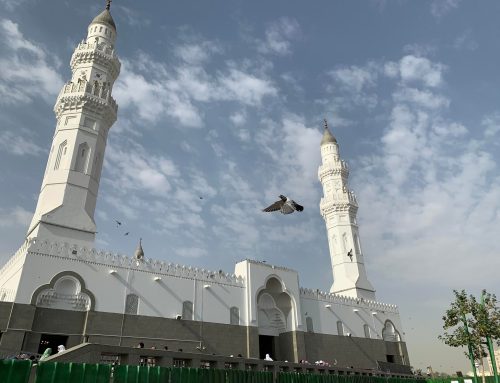
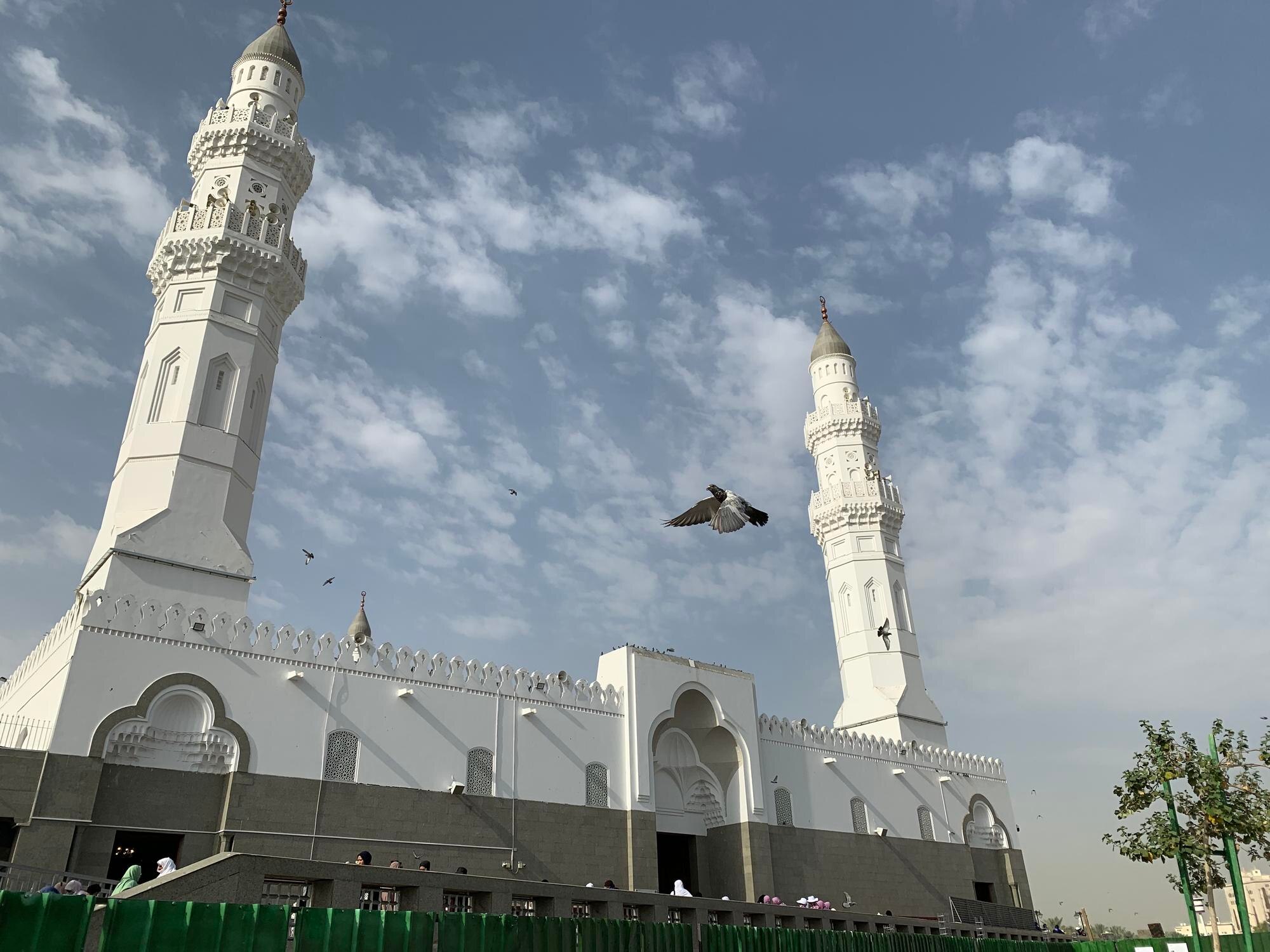
Detailed, dated architectural documentation of Masjid al-Areesh — floor plans, materials, measurements from named restoration campaigns — is not available in the sources consulted for this article, and this guide states that plainly rather than inventing description to fill the gap. What can be reported comes from photographs, brief news descriptions, and travel documentation rather than from an architectural survey. Recent photography, including a dated stock image from Shutterstock, captioned October 2025, shows a modest, single-storey mosque built in a plain modern Saudi vernacular style — light-coloured masonry, a simple minaret, and an unadorned prayer hall — consistent with the many small regional mosques rebuilt or expanded across Saudi Arabia in recent decades, rather than a structure that visibly preserves antique fabric. Visitor video from 2021 records a mosque “quite big,” with separate prayer facilities for men and women, standing near — but a short drive from — the open battlefield itself, according to a travel video, Visiting the site where the battle of Badr took place. The Madinah heritage blog cited earlier locates the mosque relative to older landmarks including “al-‘Ayn al-Qadimah” (the old spring) and two historic neighbourhood names, Harat al-Sadah and Harat al-Ashraf, according to this account, but does not supply a technical architectural description.
What is not in doubt, because the mosque’s own name preserves it, is the symbolic architecture of memory: the current building’s name commemorates a shelter that had no architecture at all in any permanent sense — palm trunks and fronds, raised for a single day and dismantled or left to the elements soon after. The modern mosque’s understated, functional style is, whether by design or by the ordinary economics of small-town Saudi mosque-building, at least consistent with the plainness of what it commemorates.
Archaeological Findings
No published, peer-reviewed archaeological excavation report specific to the site of Masjid al-Areesh or the immediate command-post location was located during research for this article, and none should be assumed to exist. The broader Badr battlefield area does contain features documented by heritage researchers rather than by formal excavation: a detailed survey by the independent research project Madain Project catalogues surface landmarks across the wider site — the martyrs’ graveyard and its boundary wall, a modern marble memorial marker, the sand dune Katheeb al-Hannan, and the hill known as Jabal al-Mala’ika — but this is topographic and historical documentation built on textual identification and site visits, not a stratified archaeological excavation with published findings. Given the ongoing regional development and tourism-infrastructure projects described above, it is possible that professional survey or excavation work is underway or planned as part of Saudi Arabia’s broader Vision 2030 heritage programme, but no such findings specific to Masjid al-Areesh were identified in the sources available for this article. This guide states plainly that there is nothing substantive to report here, rather than manufacturing an impression of archaeological depth the sources do not support.
Stories of the Companions
Sa’d ibn Mu’adh: Already Told
The fullest companion story connected to this site is Sa’d ibn Mu’adh’s, already given its own subsection above in full: his proposal of the shelter, his role in the Trench and the judgment on Banu Qurayzah, and his death. It is not repeated here.
Abu Bakr al-Siddiq at the Areesh
Abu Bakr رضي الله عنه appears in the central hadith of this article not as a bystander but as an active participant in the scene: it was he who noticed the Prophet’s ﷺ cloak had slipped during the intensity of his supplication, who physically restored it to his shoulders, and who spoke the words of comfort and reassurance recorded in Sahih Muslim 1763 — that the Prophet’s ﷺ imploring of his Lord was sufficient, and that Allah would fulfil what He had promised. This is consistent with the broader portrait of Abu Bakr in the sira and hadith literature as the Companion consistently closest to the Prophet ﷺ in moments of greatest personal danger and distress, from the Cave of Thawr during the Hijra to this scene at Badr. The same extended hadith later shows Abu Bakr’s characteristic inclination toward mercy, in his counsel to ransom rather than execute the Meccan prisoners taken after the battle — a position the Prophet ﷺ initially favoured before the revelation that followed rebuked the leniency shown, at which point, the hadith records, both men wept.
‘Umar ibn al-Khattab: The Witness Who Transmitted the Scene
Without ‘Umar ibn al-Khattab’s رضي الله عنه testimony, transmitted through Ibn ‘Abbas, the precise wording of the supplication at the areesh would not have reached later generations in the detailed, eyewitness form preserved in Sahih Muslim 1763. His account also preserves his own view during the dispute over the prisoners — favouring execution over ransom, in contrast to Abu Bakr’s mercy — and the hadith’s report that he, unlike Abu Bakr and the Prophet ﷺ, did not weep when the corrective revelation came, each man’s reaction described faithfully according to his own temperament rather than smoothed into a single uniform response.
Who Was Not There
It should be said plainly that the areesh scene involved a small circle: the Prophet ﷺ, Abu Bakr, and — standing guard at the shelter’s entrance according to some sira accounts — a small number of Ansar including Sa’d ibn Mu’adh himself. The great majority of the 313 or so Muslims present at Badr were on the battlefield itself, not inside or near the shelter, and this guide has deliberately avoided implying that a larger cast of well-known Companions gathered at the areesh; the sources place only a small number of named individuals at the shelter itself during the supplication.
Stories of Great Islamic Scholars
Ibn Ishaq and the Sira Tradition
The earliest connected account of Sa’d’s proposal and the building of the areesh comes down through Muhammad ibn Ishaq’s Sirat Rasul Allah, written in the eighth century CE and preserved in the later recension of Ibn Hisham. Ibn Ishaq compiled his account from oral reports circulating among the descendants of the Companions barely a century after the events themselves, and his Badr narrative — including the areesh episode — became the base text on which nearly all later biographers, including al-Waqidi and Ibn Sa’d, built their own fuller accounts.
Ibn Kathir
The fourteenth-century Damascene historian and exegete Ibn Kathir, in both his Qur’anic commentary and his historical work al-Bidayah wa’l-Nihayah, treated the Badr narrative — including the supplication under the areesh — as a central episode requiring careful sifting of the earlier sira and hadith material. His method, characteristic of the best classical historiography, was to give precedence to hadiths with sound chains from the canonical collections over the more loosely sourced narrative detail found in Ibn Ishaq and al-Waqidi, which is precisely the distinction this guide has tried to maintain between the areesh proposal (sira) and the supplication itself (sahih hadith).
Al-Nawawi
The great Syrian hadith scholar and jurist Yahya ibn Sharaf al-Nawawi, whose commentary on Sahih Muslim remains one of the standard references for understanding that collection, would have treated the hadith of ‘Umar’s testimony (Muslim 1763) within his broader commentary project on the Sahih, situating it among the other reports of Badr found throughout the Book of Jihad and expeditions in that collection. Al-Nawawi’s broader legal and devotional writings on visiting graves and sacred sites — cautious, sunnah-anchored, and wary of innovation — also underpin much of the theological position described later in this guide’s discussion of visiting Badr today.
Ibn Hajar al-‘Asqalani
Ibn Hajar’s monumental commentary on Sahih al-Bukhari, Fath al-Bari, is the standard reference for understanding the hadiths of Sa’d ibn Mu’adh’s death and the Throne’s shaking, and for the report of “get up for your chief.” His careful attention to chains of transmission and to explaining apparent tensions between variant wordings — of exactly the kind Jabir ibn ‘Abdullah addressed when rejecting the alternative wording “the bed shook” in Sahih al-Bukhari 3803 — exemplifies the discipline this guide has tried to apply throughout in distinguishing firmly authenticated hadith from sira narrative and popular addition.
Al-Samhudi
Nur al-Din al-Samhudi, the fifteenth-century historian of Madinah whose Wafa’ al-Wafa bi Akhbar Dar al-Mustafa remains the single most important classical source for the topography and history of Madinah and its surrounding sacred sites, wrote extensively on the mosques and landmarks associated with the Prophet’s ﷺ life in and around the city. Because Badr lies well outside Madinah proper, al-Samhudi’s direct treatment of the areesh site itself is more limited than his treatment of in-city landmarks such as Masjid Quba‘ or the mosques of the Trench, but his broader methodological caution about which sites carry a real basis for devotional visitation — a caution echoed centuries later in the fatwas discussed below — remains directly relevant to how Badr’s landmarks, including this mosque, should be approached today.
Spiritual Reflection
Stand, in imagination, where the areesh once stood. You are looking down at a plain where roughly three hundred men who have staked everything on a single unlikely campaign now face an army three times their number, better armed and mounted. You have no reserves to call on, no reinforcements marching to your aid, no fallback position beyond a headlong retreat across open desert. In that position, the man responsible for every life on that field does not draw a plan on the sand or rally his commanders with a speech. He turns to face the Qiblah, raises his hands, and asks his Lord, with such intensity that his own cloak falls from his shoulders unnoticed, not to let this be the end.
You are not asked, reading this centuries later, to relive a battle. You are asked to notice what the Prophet ﷺ did in the one moment in the whole seerah when every human resource had been exhausted and only supplication remained. He did not perform composure he did not feel. He pleaded, repeated himself, and needed his closest friend to physically steady him and fix his clothing. There is no seerah scene that more directly authorizes ordinary believers to bring their own desperation honestly before Allah, without performing calm they do not have. When you next find yourself with no plan left and no one to call, the areesh is the place in Islamic memory that tells you what to do with that helplessness: turn, raise your hands, and ask — and let someone who loves you steady your shoulders while you do.
Consider, too, that Sa’d ibn Mu’adh — the man who thought to build that shelter in the first place — did so not for his own protection but so that the Prophet ﷺ, and through him the whole of the young Muslim community, would survive even a catastrophic defeat. His proposal was an act of foresight and love that asked for no credit and expected, by his own words, that Allah might grant the very outcome that made the precaution unnecessary. When you visit or read about Badr, you are visiting the memory of a man whose greatest recorded contribution to Islam was not a sword-stroke but a plan for what to do if the swords failed — followed, only a few years later, by a wound and a final prayer that asked to die the moment his usefulness in battle was over.
Practical Visitor Guide: Masjid al-Areesh Today
This section reports as carefully as the available evidence allows on the current, as-of-July-2026 status of Masjid al-Areesh and the Badr martyrs’ cemetery. The picture that emerges from the sources is genuinely mixed, and this guide reports that mixture honestly rather than resolving it into false certainty in either direction.
Does the Mosque Still Stand and Function?
Yes — Masjid al-Areesh survives as a functioning mosque building, not a demolished or vanished site. It appears in dated 2025 photography, is listed by name on Saudi Arabia’s official tourism platform as one of the landmarks within the Badr Battle Site, and has been the subject of documented renovation and expansion work across at least two identifiable episodes (around 2017–2018, and again reported in late 2024). This puts it in a different category from sites elsewhere in the Hejaz that have been fully removed by demolition; nothing in the sources consulted here indicates that Masjid al-Areesh itself has been torn down or erased. What is genuinely uncertain, and what this guide will not paper over, is how reliably and how fully it functions as an open, accessible mosque and visitor site at any given time — the evidence here is inconsistent across sources of different dates.
The Conflicting Access Reports
Several independent sources, spanning roughly a decade, give different pictures of accessibility:
Older Tripadvisor reviews of the Mosque of Badr, dating back to around 2015, describe visitors arriving to find the mosque locked, needing to locate a caretaker to open it for prayer, and finding the adjacent martyrs’ cemetery closed and gated — one reviewer reported climbing the boundary wall and finding nothing visible on the other side. A 2021 travel video, Visiting the site where the battle of Badr took place, shows a mosque open and functioning with separate prayer facilities for men and women, but the same narrator warns that “if you come at the wrong time you might find the masjid closed, as has happened to me in previous occasions,” and separately notes that a wall was actively under construction around the open battlefield area, with the presenter predicting that “very soon you won’t be able to see the battle site” from outside it. A Wanderlog listing updated in December 2024 states that the mosque was “well-maintained and currently undergoing renovation, with prayer activities temporarily suspended,” while still listing daily hours of 3:00 a.m. to 11:00 p.m., according to the Wanderlog page for Masjid al-Areesh. An Arabic-language visitor video posted in December 2025 describes the mosque as open roughly from Fajr prayer until 9:00 p.m. daily, with restrooms and nearby kiosks serving visitors — a picture of active, ordinary function rather than closure. And Saudi Arabia’s official tourism platform, in a page checked as recently as November 2025, lists the wider “Badr Battle Site” — explicitly including “Al-Arish Mosque, the battlefield, Badr Martyrs’ Cemetery, Wadi Yalil, Jabal Al-Mala’ik, and the Badr Plain” — as open daily around the clock with no ticket required, stating that “several landmarks remain intact, preserving the memory of the historic victory,” according to VisitSaudi’s Badr Battle Site page.
Taken together, these reports do not agree, and this guide has chosen to report the disagreement rather than pick a winner. The most plausible reading is that the site’s accessibility has fluctuated over the past decade with renovation cycles and staffing — closed or restricted at some points (2015, and reportedly again around December 2024), open and staffed at others (2021, and reportedly again by December 2025) — and that a pilgrim arriving on any given day in 2026 should not assume with confidence which state they will find. Anyone planning a visit should treat the mosque’s opening as likely but not guaranteed, and should be prepared for the possibility of a locked door, exactly as travellers have reported at various points over the past ten years.
The Martyrs’ Cemetery
The Badr martyrs’ cemetery presents a starker picture of restriction. The heritage site Islamic Landmarks, in material dated May 2024, states plainly that “the site is not accessible to the public.” This is consistent with the older Tripadvisor reports of a gated, closed enclosure, and with the 2021 video’s description of a graveyard “behind” the mosque that is “concealed off.” The independent documentation project Madain Project describes the graveyard as demarcated by a boundary wall enclosing roughly 60,000 square metres, located about 550 metres west of the main battle site, with a separate modern memorial — a marble slab on a concrete pedestal — standing outside the enclosure itself and listing the names of the fourteen martyrs for visitors who cannot enter the burial ground directly. The most honest summary available from these sources is: the graveyard survives, is walled and gated, and is reported as not open to public entry as of the most recent dated source located (2024), while a separate external memorial marker naming the martyrs is accessible without entering the enclosure. This guide could not locate a source explicitly stating that this restriction has been lifted since 2024, nor could it verify a specific reason given by Saudi authorities for the closure; readers should not assume they will be able to walk among the graves themselves, though the exterior marker naming the fourteen martyrs is reported as viewable from outside the wall.
How Many Martyrs, and Who They Were
Sources also disagree on the exact count and composition of the Badr martyrs. Arabic sources including the newspaper article on the mosque’s history give a figure of thirteen Muslim martyrs at Badr, according to al-Madina; the Arabic Wikipedia entry on the mosque gives six Muhajirun and eight Ansar — fourteen in total; and Madain Project’s documentation of the modern memorial marker likewise lists fourteen names, six Muhajirun and eight Ansar. This guide follows the fourteen-name figure as the more commonly and specifically documented one, while noting the thirteen-martyr figure found in at least one Arabic source as an unresolved discrepancy rather than silently picking one number as correct.
Getting There from Madinah
Badr lies southwest of Madinah; sources differ on the exact distance, variously citing around 120, 130, and 150 kilometres, with journey times commonly reported at roughly two to three hours by road, depending on route and traffic, according to a recent general Saudi travel guide, House of Saud’s guide to Islamic historical sites, which also recommends hiring a local guide, since “sites are spread across a wide area and lack comprehensive signage.” No formal ticketing is required to enter the general Badr Battle Site area, according to the official VisitSaudi listing cited above, and organised day-trip transport from Madinah — by hired taxi or with tour operators — is commonly used by pilgrims, as reflected in multiple traveller reviews describing arrangements with local drivers for a half-day or full-day excursion.
Do Organised Tours Run?
Yes, in the sense that guided day trips and hired drivers regularly take pilgrims from Madinah to Badr, as reflected in numerous traveller accounts and tour listings, including guided ziyarah trips advertised on platforms such as Seyaha’s Badr battle-tracking programme. Separately, and on a larger scale, the regional “Badr Historical Route” and “Badr Historical Path” programmes described earlier in this guide’s Historical Development section represent an official, government-backed hiking and heritage-tourism product covering dozens of landmarks along the old road to Badr, launched in stages between 2022 and March 2026. It is not clear from the announcements reviewed for this article whether that official trail product currently includes a scheduled stop at Masjid al-Areesh itself as opposed to the wider Badr area in general, and this guide has not assumed that it does.
What You Can Realistically See and Do
Based on the sources above, a realistic 2026 visit to Masjid al-Areesh should be planned around the following honest expectations: you may be able to enter the mosque and pray there, as many recent visitors have reported doing, but you should be prepared for the possibility that it is locked or under renovation on the day you arrive, and should not build an itinerary that depends entirely on access. You should not expect to walk among the martyrs’ graves themselves; the cemetery is reported as walled and closed to public entry, though an external memorial listing the martyrs’ names is reported as viewable from outside. You can expect to see the open plain of the battlefield itself, along with nearby landmarks such as Jabal al-Mala’ika, without a ticket. And you should treat any specific claim about the site’s daily opening hours — including the ranges reported by various sources cited above — as indicative rather than guaranteed, given how much the picture has shifted even within the last two years of the sources reviewed here.
Common Misconceptions
“The Original Shelter of Palm Branches Still Exists”
It does not, and no source consulted for this article claims otherwise. The areesh was a temporary field structure — palm trunks and fronds raised for the duration of a single battle — and there is no historical claim, classical or modern, that it survived beyond that campaign. The modern mosque on or near the site is a purpose-built structure, renovated and expanded across at least two documented episodes in the past decade, and its connection to the original areesh is one of location and name, not of surviving physical fabric. Presenting the current building as if it contained or preserved the actual branches Sa’d ibn Mu’adh’s men cut and stacked would be a fabrication this guide has deliberately avoided.
“There Are Physical Relics From the Battle on Display”
No source reviewed for this article documents any authenticated physical relic — weapon, garment, or similar object — from the Battle of Badr on display at Masjid al-Areesh or anywhere at the Badr site. The modern memorial marker at the martyrs’ cemetery, as documented by Madain Project, is a contemporary marble slab inscribed with the martyrs’ names, not an artefact from the seventh century. Claims of surviving relics from Badr circulate in popular pilgrimage folklore generally, but none specific to this site were substantiated in the research for this article, and none should be assumed true without independent verification.
“Visiting Badr Is a Prescribed or Required Part of Ziyarah”
This is the point on which Saudi religious authorities have been most explicit, and it needs to be presented carefully and fairly, without this guide adjudicating who is correct. Ibn Taymiyyah, the Saudi scholar Ibn ‘Uthaymeen, and Saudi Arabia’s Standing Committee for Issuing Fatwas (al-Lajnah al-Da’imah) hold that only a short, specific list of sites in and around Madinah carries a basis in the Sunnah for intentional devotional visitation: al-Masjid al-Nabawi, the grave of the Prophet ﷺ, al-Baqi’ cemetery, the martyrs of Uhud, and the Mosque of Quba’. This position, laid out in detail in a widely cited fatwa on the site IslamQA, holds that other historical and battle-connected sites — including, by direct extension of the same reasoning, locations at Badr — are not among the places a Muslim is taught to specifically travel to or seek out with the intention of gaining religious reward through the visit itself, because no such instruction is recorded from the Prophet ﷺ or acted upon by the earliest generations of Muslims in that way. A separate and directly relevant IslamQA answer on visiting martyrs’ graves states explicitly that “there is nothing to be visited in Madinah apart from” the five sites listed above, and names “Masjid al-Ghamamah” — a name historically applied, in some sources, to the very mosque this article concerns — as an example of a site with “no basis for visiting… with the intention that this is an act of worship,” describing that intention as an innovation (bid’ah) “because that was not narrated from the Prophet ﷺ.”
The same body of fatwa literature draws a further, more specific distinction that matters directly for Badr: the Standing Committee has separately ruled, in fatwa no. 5303, that it is not permitted to climb up to the Cave of Hira’ with the intention of religious visitation, and broader fatwas on grave etiquette caution strongly against touching, rubbing, kissing, or tying cloth to stones, trees, or railings at any site associated with a Companion or a sacred event, on the grounds that such acts risk becoming a means toward shirk (associating others with Allah in worship) even when the person performing them intends no such thing. Shaykh ‘Abd al-‘Aziz ibn Baz and Shaykh Muhammad ibn ‘Uthaymeen are both cited by name in this literature as holding that there is no basis for including the so-called “seven mosques,” Masjid al-Qiblatayn, or other historical sites among the places Muslims are taught to specifically visit, beyond the five named above.
It is important to be precise about what this position does and does not say. It does not forbid a Muslim from going to Badr, praying there, or reflecting on its history — nothing in these fatwas treats mere presence at a historical site, or benefiting educationally from seeing it, as impermissible. What the position specifically addresses is the intention behind the visit: travelling to a site with the specific belief that the visit itself carries religious reward, or that the place holds a special spiritual virtue not established by the Prophet’s ﷺ own example, is treated in this view as an unwarranted innovation, distinct from visiting a place for historical or educational interest, or from praying wherever one happens to be when a prayer time arrives.
Not all scholars and communities within the broader Muslim tradition draw the line in exactly the same place. Traditionalist and Sufi-oriented scholarship in many parts of the Muslim world has historically taken a considerably more permissive view of visiting sites connected to the Prophet’s ﷺ life and to the Companions, including battlefield and martyrdom sites, regarding such visits as legitimate expressions of love for the Prophet ﷺ and the early community and, in some currents of this tradition, treating tabarruk — seeking blessing through proximity to a sacred place, object, or grave — as a permissible or even recommended practice, drawing on a different reading of the same early reports and a different assessment of which practices constitute genuine innovation versus legitimate extensions of established sunnah. This guide does not adjudicate between these positions. It reports that a real and long-standing difference of scholarly opinion exists, names the holders of the more restrictive Saudi-establishment view as explicitly as the sources allow, and leaves readers to weigh the argument according to their own school of thought and scholarly guidance.
Lesser-Known Facts
- The word areesh is an ordinary Arabic term for a hut, bower, or trellis-shelter — the same root used elsewhere in classical Arabic for a vine trellis — rather than a specialised religious or military term; the shelter’s name reflects nothing more than its humble construction.
- The mosque built to commemorate the site has, in at least some older or local usage, also been called “Masjid al-Ghamamah of Badr,” a name that appears in fatwa literature discussing sites without an established basis for ziyarah, distinct from the well-known Masjid al-Ghamamah near the Prophet’s Mosque in central Madinah.
- Jabir ibn ‘Abdullah, the narrator of the hadith that “the Throne shook” at Sa’d ibn Mu’adh’s death, explicitly and firmly rejected a rival version of the report — that it was merely “the bed” that shook — noting that longstanding tribal grudges between two groups may have motivated the substitution, a rare instance in the hadith literature of a narrator directly addressing why a variant might have circulated.
- The popular English paraphrase of the Prophet’s ﷺ Badr supplication, widely repeated online, is not the precise wording preserved in Sahih Muslim 1763; the authentic wording is shorter and more direct than the paraphrase suggests.
- A wall was reportedly under construction around the open battlefield area as early as 2021, according to traveller video from that year, suggesting that the physical enclosure and formalisation of the wider Badr site predates the most recent 2022–2026 regional development programmes by several years.
- Sources disagree by as much as thirty kilometres — between roughly 120 and 150 kilometres — on the distance from Madinah to Badr, an unusually wide spread for a route this heavily documented and travelled.
Timeline
- 17 Ramadan 2 AH (13 March 624 CE): The Battle of Badr is fought. Sa’d ibn Mu’adh proposes the areesh; the Prophet ﷺ makes his supplication inside it, recorded in Sahih Muslim 1763; Qur’an 8:9 is revealed in direct response.
- Shawwal 5 AH (627 CE): Sa’d ibn Mu’adh is wounded at the Battle of the Trench; he later delivers judgment on Banu Qurayzah and dies of his reopened wound, an episode recorded in Sahih al-Bukhari 4122, 4121, and 463, and in the “Throne shook” hadiths of Sahih al-Bukhari 3803 and Sahih Muslim 2466.
- Unknown date (classical period): A mosque is established on or near the site of the areesh; the earliest permanent structure’s exact founding date could not be established from the sources reviewed for this article.
- 1031 AH (circa 1621–1622 CE): A renovation inscription of this date is reported by a secondary Arabic-language heritage source, though not independently verified here.
- Rabi’ al-Thani 1438 AH (circa January 2017): The mosque’s eastern and western sides are expanded, according to Madinah heritage sources.
- April 2018: Madinah’s director of Islamic affairs inspects renovation, expansion, and air-conditioning works at the mosque, according to the newspaper al-Riyadh.
- October 2022: The Emir of Madinah launches a regional programme to renovate more than one hundred historic sites, including a planned pathway passing through Masjid al-Areesh, with a 2025 completion target.
- March 2024: The “Badr Historical Route” tourism and hiking project is formally launched, covering roughly forty landmarks along a 175-kilometre corridor from Madinah to Badr.
- May 2024: A heritage documentation source states that the Badr martyrs’ cemetery is not accessible to the public.
- December 2024: A travel listing reports Masjid al-Areesh under renovation with prayer activities temporarily suspended.
- November 2025: Saudi Arabia’s official tourism platform lists the wider Badr Battle Site, including Al-Arish Mosque and the martyrs’ cemetery, as open daily with no ticket required.
- December 2025: An Arabic-language visitor video reports the mosque open daily from roughly Fajr to 9:00 p.m., with visitor facilities nearby.
- March 2026: The Madinah Region Development Authority and the Pilgrim Experience Program jointly launch the “Badr Historical Path,” reviving the historic Al-Furqan trail with expanded tourism infrastructure.
Key Lessons
Historical
The areesh episode demonstrates that Islamic military leadership in its formative period combined tactical planning with contingency thinking of a very practical kind: Sa’d ibn Mu’adh’s proposal was not born of fear but of responsible foresight for the survival of the community’s leadership and mission, regardless of a single battle’s outcome. The subsequent history of the mosque — Ottoman-era renovation, twentieth-century expansion, and a still-unfolding twenty-first-century regional development programme — also illustrates how a site’s physical form can change repeatedly across fourteen centuries while its name and its historical association remain constant.
Spiritual
The central lesson of the supplication itself is that total human helplessness is not a barrier to divine aid but, in this specific and repeatedly cited case, the very occasion for it. The Prophet’s ﷺ recorded state in that moment — hands outstretched, voice raised, cloak forgotten — models an unguarded, urgent form of prayer that the tradition treats as praiseworthy rather than as a loss of composure, and Abu Bakr’s response models the value of a companion who steadies rather than judges.
Personal
Sa’d ibn Mu’adh’s arc, from proposing a shelter for another man’s safety to dying from a wound sustained defending the same community, offers a model of service that asks nothing in return and explicitly prays to be relieved of life the moment it is no longer needed for the cause. His example resists the temptation to measure a life’s value only by its most dramatic moments — the areesh proposal was quiet, precautionary counsel, not a battlefield feat, yet the tradition remembers it as one of his defining contributions.
Practical
The uncertain and shifting access picture at Masjid al-Areesh and the Badr martyrs’ cemetery is itself a lesson for pilgrims planning any ziyarah beyond the core sites of Makkah and Madinah: verify current conditions close to the date of travel rather than relying on any single source, including this one, and hold expectations loosely enough that a locked door or a restricted cemetery does not undermine the value of having gone at all. A pilgrim who reaches Badr and finds the mosque closed has still stood on ground where one of the seerah’s most important scenes took place, and has still fulfilled whatever benefit historical reflection at the site can offer independent of the mosque door being open.
Authentic Sources
Primary Islamic Sources
The Qur’an: Surah al-Anfal, verses 9 through 12 (8:9, 8:10, 8:11, 8:12), and verse 42 on the two banks of the valley (8:42).
Sahih Muslim: the supplication at the areesh and the revelation of 8:9 (Sahih Muslim 1763); the Throne shaking at Sa’d ibn Mu’adh’s death (Sahih Muslim 2466).
Sahih al-Bukhari: the Throne shaking at Sa’d ibn Mu’adh’s death (Sahih al-Bukhari 3803); Sa’d’s wounding, the tent in the mosque, the Qurayzah judgment, and his death (Sahih al-Bukhari 4122); “get up for your chief” (Sahih al-Bukhari 4121); the tent in the mosque, shorter version (Sahih al-Bukhari 463); the number of the Muslims at Badr (Sahih al-Bukhari 3958).
A note on the sira and maghazi literature: the account of Sa’d ibn Mu’adh’s proposal of the areesh and the details of its construction derive from the early biographical (sira) tradition — principally Ibn Ishaq’s Sirat Rasul Allah as preserved by Ibn Hisham, supplemented by the later maghazi historians Ibn Sa’d and al-Waqidi. These sources are indispensable for narrative and contextual detail about the Prophet’s ﷺ life that the hadith collections do not cover in comparable depth, but they were compiled without the same isnad-based verification standards applied to the hadith literature, and their narrative details — including specific wording attributed to speakers, precise topographical description, and numerical figures for troop strength — should be understood as historically valuable but not held to the same evidentiary standard as a hadith graded sahih in a canonical collection. This guide has flagged the sira-sourced material explicitly throughout rather than presenting it with the same certainty as the hadiths cited above.
Classical Scholars
Ibn Ishaq (d. 150 AH/767 CE), earliest connected sira account of the areesh episode, as preserved by Ibn Hisham. Ibn Kathir (d. 774 AH/1373 CE), al-Bidayah wa’l-Nihayah and Qur’anic commentary, careful sifting of sira and hadith material on Badr. Al-Nawawi (d. 676 AH/1277 CE), commentary on Sahih Muslim. Ibn Hajar al-‘Asqalani (d. 852 AH/1449 CE), Fath al-Bari, commentary on Sahih al-Bukhari. Al-Samhudi (d. 911 AH/1506 CE), Wafa’ al-Wafa bi Akhbar Dar al-Mustafa, the standard classical history of Madinah and its sacred topography. Mufti Muhammad Shafi’ (d. 1976 CE), Ma’arif al-Qur’an, cited above for its detailed tafsir of Surah al-Anfal verse 9, accessible via Quran.com’s presentation of this tafsir. Ibn Taymiyyah (d. 728 AH/1328 CE) and Shaykh Muhammad ibn ‘Uthaymeen (d. 1421 AH/2001 CE), cited above on the scope of sites with an established basis for ziyarah, via IslamQA’s fatwa on visiting historical sites in Madinah.
Modern Academic and Reference Sources
Saudipedia, the Saudi state encyclopedia, on Badr Governorate, the Battle of Badr site, and the Badr Historical Route. The Madinah newspaper al-Madina, on the history of Masjid al-Areesh. The Riyadh newspaper al-Riyadh, on 2018 renovation work at the mosque. Zawya, on the 2022 launch of Madinah’s regional heritage renovation programme. The Pilgrim Experience Program, on the March 2026 launch of the Badr Historical Path. VisitSaudi, the official Saudi tourism platform, on the Badr Battle Site. Islamic Landmarks, on the Badr martyrs’ burial site. Madain Project, an independent heritage documentation initiative, on the Badr battlefield and its landmarks. The Encyclopedia of Translated Prophetic Hadiths, on the grading of the hadith of Sa’d ibn Mu’adh’s death. IslamQA, on visiting places and mosques associated with the Prophet ﷺ and on visiting martyrs’ graves. Wanderlog, on Masjid al-Areesh’s location and renovation status. House of Saud, a general contemporary travel guide to Islamic historical sites.
A note on method: this article was assembled from a combination of the two most authoritative Sunni hadith collections (Sahih al-Bukhari and Sahih Muslim), accessed and quote-verified directly rather than taken from secondary paraphrase; the classical sira and tafsir tradition, clearly labelled as such wherever its lower evidentiary standard applies relative to hadith; official Saudi state and tourism sources for the current status of the site; and independent travel, heritage-documentation, and journalistic sources for details — particularly around current access — that no single official source addressed comprehensively. Where sources conflicted, on matters ranging from the exact distance from Madinah to Badr, to the precise number and identity of the martyrs, to the mosque’s current opening status, this article has reported the conflict rather than silently resolving it by choosing the most convenient or most recent figure. Where no reliable source could be found for a claim commonly repeated elsewhere — such as the number of angels said to have attended Sa’d ibn Mu’adh’s funeral, or the precise founding date of the first permanent mosque on this site — that gap has been stated openly rather than filled with invented specificity.