Masjid al-Sabaq: The Mosque of the Race and the Forgotten Fiqh of Sport in Islam
Northwest of the Prophet’s Mosque, where a bus station now stands beside the Sultana Road tunnel, there is nothing left to photograph. No dome, no minaret, no marked stone. If you go looking for Masjid al-Sabaq today expecting a ziyarah stop of any weight, you will be disappointed, and this guide would rather tell you that on the first page than let you discover it on the ground. As of July 2026, the building historically pointed to as Masjid al-Sabaq no longer stands. It was cleared during the road works that widened Abu Bakr al-Siddiq Road and King Faisal Road on the northwestern approach to the Haram, and the area it once occupied is now given over to the SAPTCO mass transit terminal and its access roads, a detail confirmed by the descriptive entry in the Madain Project’s record of the mosque and repeated across the small cluster of Arabic-language heritage sites that still catalogue it. This is, admittedly, an unusual way to open a chapter of a ziyarah guide. It is also the only honest way to open this one.
And yet the site is worth an entire long article, for a reason that has nothing to do with its architecture and everything to do with what happened on the ground it once marked. Masjid al-Sabaq — “the Mosque of the Race” — takes its name from the finishing line of a set of horse races that the Prophet Muhammad ﷺ personally organised for his community in Madinah, an event preserved with unusual precision in the most rigorously verified hadith collections in Islam: Sahih al-Bukhari 420, 2868, 2869, and 7336, together with Sahih Muslim 1870. Those narrations name real places — al-Hafya, Thaniyat al-Wada, the mosque of Banu Zurayq — and give real distances, five or six miles and one mile, with a precision that seerah material rarely offers. Attached to the same patch of ground, in the corpus of hadith concerning the Prophet’s ﷺ animals and his household, sit two further reports that this guide considers among the most quietly profound in the entire body of Prophetic tradition: the story of al-Adba, the she-camel that had never been beaten in a race until a bedouin’s young mount overtook her, and the story of Aisha رضي الله عنها racing her husband ﷺ on foot, twice, with two different outcomes, decades apart.
Around these three narrations sits a body of Islamic law that almost no ziyarah guide bothers to open: the fiqh of competition, prizes, and organised sport. This is the true subject of the pages that follow. The mosque is the pretext. The material is the reward.
History of Masjid al-Sabaq: Locating the Mosque of the Race
Any honest account of this site has to begin by admitting that the sources do not agree on exactly what the “Mosque of the Race” is, or was. There are, in the historical record, two distinct claims tangled together under one popular name, and separating them is the first task of this section.
Two mosques, one name
The hadith of Ibn Umar رضي الله عنهما, examined in full in the next section, names the finishing point of the untrained horses as Masjid Bani Zurayq — the mosque of the Zurayq clan of the Khazraj, a real neighbourhood mosque that existed in Madinah in the Prophet’s ﷺ own lifetime and is remembered independently in the historical sources as the place where the Qur’an was first recited publicly in Madinah, before the Hijra, by the companion Rafi’ ibn Malik al-Zuraqi. A number of modern popular accounts, including the widely circulated entries on Wikipedia’s As-Sabaq Mosque page and the equivalent Arabic Wikipedia article, treat “Masjid al-Sabaq” and “Masjid Bani Zurayq” as one and the same building under two names — the second name descriptive of its founding community, the first descriptive of the event that made it famous.
Local Madinan historians push back on this equivalence, and their objection deserves to be given fairly rather than smoothed over. In a widely cited piece of research reported by the Saudi newspaper al-Madinah and by the Egyptian outlet Masrawy, the Madinan historian Ahmad Yasin al-Khayari argues in his book Ta’rikh Ma’alim al-Madinah al-Munawwarah Qadiman wa Hadithan (“History of the Landmarks of Madinah, Past and Present”) that Masjid Bani Zurayq stood in a different location entirely — at the site of an enclosure that later became the shops of al-Sayyid Mahmud Ahmad, near the new gate leading into the al-Shunah quarter — and that some researchers place it instead at the site later occupied by a police post (al-qarqul) built by Khalid Pasha in the al-Manakhah district after 1290 AH. Al-Khayari cites the scholar Muhammad al-Amin al-Shanqiti, author of al-Durr al-Thamin fi Ma’alim Dar al-Rasul al-Amin, who states plainly that the mosque known as “al-Sabaq” is not among the mosques with a traceable Prophetic pedigree (al-masajid al-ma’thurah) at all — that it was built later by one of Madinah’s judges purely as a neighbourhood mosque for Friday and daily prayer, and that it acquired the name “al-Sabaq” simply because it happened to stand roughly in the middle of the horse-racing course described in the hadith, between Thaniyat al-Wada and the original Masjid Bani Zurayq. Al-Shanqiti and al-Khayari both attribute its actual construction to Sayyid Muhyi al-Din al-Hanbali, a judge of the two holy sanctuaries (qadi al-haramayn) working in the ninth century after the Hijra — roughly the fifteenth century CE, several centuries after the Prophet’s ﷺ death.
This is exactly the kind of conflict the reader deserves to see rather than have resolved for them. One line of authorities treats “Masjid al-Sabaq” as a rebuilding, over time, on the actual footprint of the Prophetic-era Masjid Bani Zurayq. Another line treats it as a much later, freestanding neighbourhood mosque that borrowed its popular name from its position inside the old racecourse, while the true Masjid Bani Zurayq quietly disappeared elsewhere in the town, unmarked and unrebuilt. Both accounts agree on the geography in broad strokes — northwest of the Prophet’s Mosque, near what became the Manakhah market district and the road out toward the Sham gate — and both agree that whatever stood there most recently is now gone. Neither can be dismissed on the evidence available in the open sources, and this guide will not pretend to adjudicate between two Madinan antiquarians using material we cannot independently check against al-Samhudi’s original manuscript pagination. The honest position is that “Masjid al-Sabaq” is a name attached with reasonable but not certain confidence to the finishing line of the Prophet’s ﷺ horse race, and that its exact continuity with the Prophetic-era Masjid Bani Zurayq is a matter on which serious Madinan historians disagree.
What the more descriptive sources record
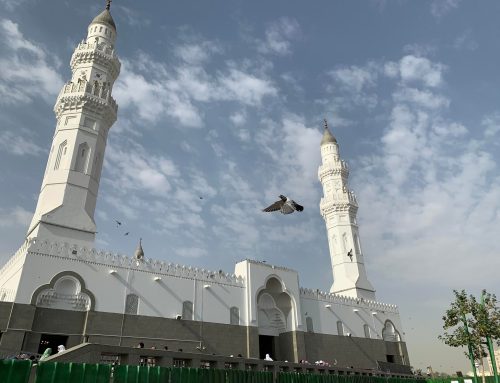
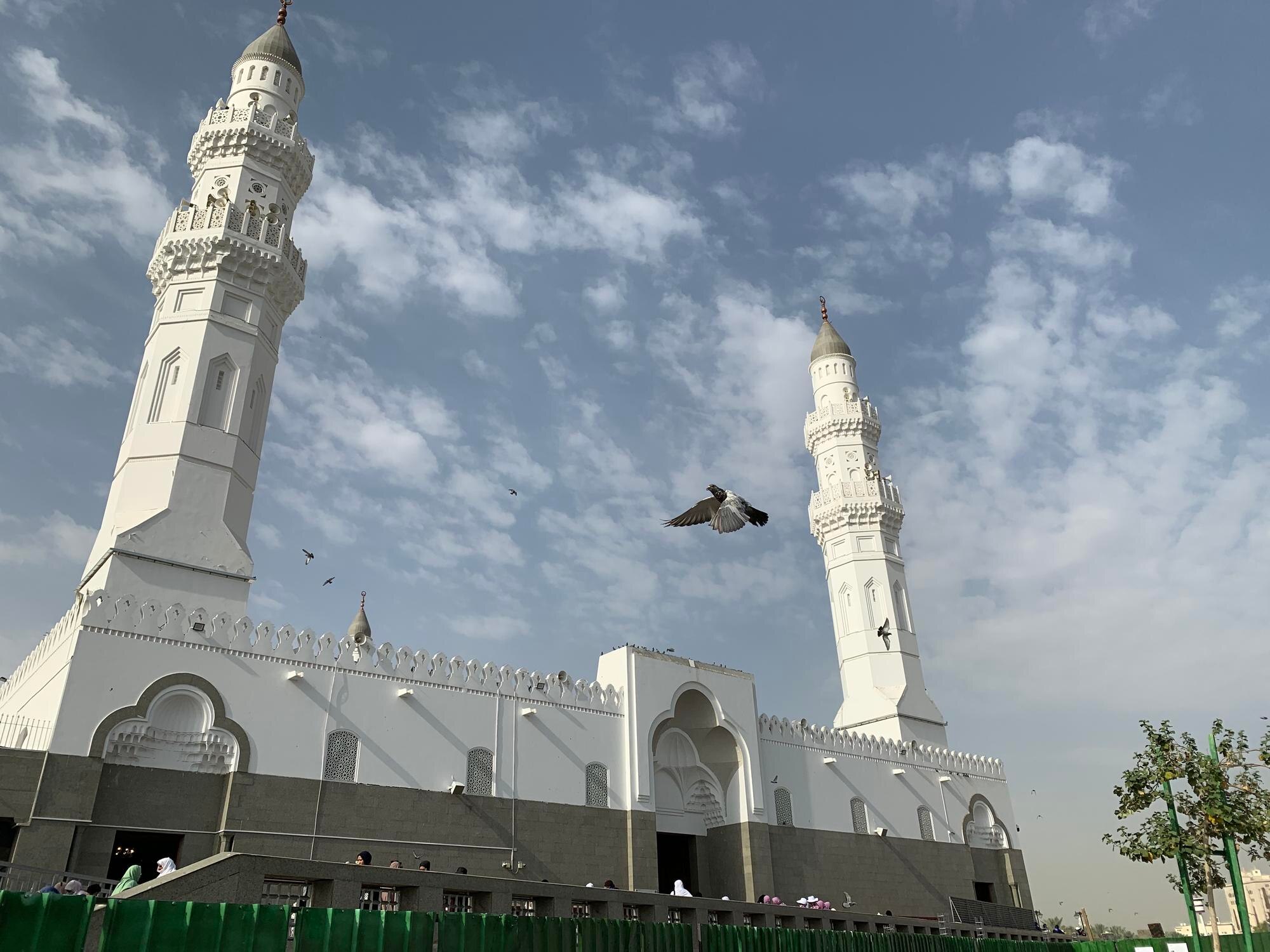
Setting the naming dispute aside, the physical description available for the building that stood until recently under the name Masjid al-Sabaq is fairly detailed, and worth recording precisely because it will soon be all that remains of it in writing. According to the Arabic Wikipedia entry, drawing on standard Madinan mosque gazetteers, the mosque was rebuilt in the reign of King Faisal bin Abdulaziz Al Saud in 1391 AH (1971 CE), raised a full storey above the surrounding street level, with a footprint of roughly 816 square metres, some 34 metres north to south and 34 metres east to west. It stood on four internal columns running north to south, with six rectangular windows in its western wall, six in the eastern wall, and three in the northern wall, the windows fitted with metal grillework and gypsum ornament, and a mihrab set in the centre of the southern wall. Its interior niches were painted in green, brown and blue, and above the mihrab, in the centre of the qiblah wall, ran the Qur’anic inscription “Indeed, prayer has been decreed upon the believers a decree of specified times” (Surah an-Nisa 4:103). The heritage catalogue Madain Project adds further architectural detail drawn from Saudi mosque-guide literature: two floors, ablution facilities and small shops built into the ground floor, and a minaret roughly thirty metres tall on the northwest corner, topped with a dome and a muezzin’s balcony, with a minbar of seven marble steps set to the right of the mihrab. King Abdulaziz is separately recorded as having built a hospital across the street from the mosque in an earlier phase of the area’s development.
None of this description reads like a building with a continuous unbroken lineage back to the seventh century. It reads like what it almost certainly was: a modest, respectable, twentieth-century neighbourhood mosque of the kind Madinah had dozens of, distinguished from its neighbours only by a name that kept alive, in the middle of a bus terminal and a market district, the memory of an event that had taken place on that ground thirteen and a half centuries earlier. That is not a small thing for a mosque to do. It is also not a shrine, and this guide has no basis for treating it as one.
What al-Samhudi records, and the limits of what can be verified here
The obligatory reference point for any topography of Islamic Madinah is Ali ibn Abdullah al-Samhudi (844–911 AH / 1440–1506 CE), the Egyptian-born, Madinah-resident historian whose Wafa’ al-Wafa bi-Akhbar Dar al-Mustafa remains the most exhaustive premodern survey of the city’s mosques, wells, valleys and named places, compiled from earlier written sources and from al-Samhudi’s own eyewitness observation over more than two decades of residence in the city, as summarised in the biographical sketch on WikiHaj’s entry on him. Al-Samhudi is the correct authority to consult on this question, and the modern secondary literature drawn on above — al-Khayari, al-Shanqiti and the Saudi mosque directories — is itself downstream of him. This guide can report with confidence that al-Samhudi devotes attention in Wafa’ al-Wafa to the district’s mosques, including the fifth chapter of the work, which specifically catalogues the minor mosques of Madinah beyond the Prophet’s Mosque. What this guide cannot do, working from the secondary literature available through standard search and the fetching tools used to build it, is quote al-Samhudi’s own words on Masjid Bani Zurayq or Masjid al-Sabaq directly from a verified page of the primary text, since the digitised editions located — including the NYU-hosted 1908 Cairo edition — are page-image scans without a searchable index by mosque name. Rather than paraphrase a source this guide has not directly verified, it states the limitation plainly: al-Samhudi is almost certainly the ultimate authority behind the modern claim that a mosque marking this racecourse existed and behind the alternative location proposed for Masjid Bani Zurayq, but this guide has not been able to locate and quote his exact wording, and the reader should treat the geographic claims in this section as resting on the modern secondary scholarship cited, not on a verified primary quotation.
What can be said with more confidence is the broader geography. The racecourse itself ran, according to the hadith examined below, from a place called al-Hafya — a name that survives today attached to a district on Madinah’s western edge, on the far side of Mount Uhud from the Haram — to Thaniyat al-Wada, the “Pass of Farewell,” a low saddle in the hills on Madinah’s northern approach where travellers were traditionally seen off and welcomed, today associated with the northern exit of the Sultana Road tunnel at the foot of Jabal Sila’. From Thaniyat al-Wada the shorter second leg of the race ran on to the mosque of Banu Zurayq, roughly one mile further into the town. This entire corridor has been built over multiple times across fourteen centuries of Madinah’s expansion, most drastically in the Saudi-era ring-road and tunnel projects of the past sixty years, and no visitor today can walk the racecourse and see open ground as Ibn Umar رضي الله عنهما once rode it. That, too, is simply the truth of the site, and it is a truth this guide’s introduction already gave you.
The pass of Thaniyat al-Wada itself carries its own separate weight in the seerah — it is the hill from which Madinah’s children are remembered coming out to sing at the Prophet’s ﷺ arrival, and it recurs across the military campaigns as the customary point where armies leaving the city took their leave of it. This guide covers that history in full in its dedicated article on Thaniyat al-Wada; here it matters only as the midpoint marker of the racecourse, the place where the trained horses reached their finish and the untrained horses began their shorter final mile.
The Founding Hadith: Ibn Umar and the Two Horse Races
Everything this site is named for comes down, ultimately, to a single event reported by a single primary witness across several near-identical narrations. The witness is Abdullah ibn Umar رضي الله عنهما, the son of the second caliph, a young man at the time and a participant in the race himself, and his report reaches us through the hadith critic’s gold-standard chain — Malik ibn Anas, from Nafi’, from Ibn Umar — the same chain al-Bukhari and Muslim treat as among the most reliable transmission lines in the entire corpus.
The hadith in full
The clearest single statement of the event is preserved in Sahih al-Bukhari 420:
“Allah’s Messenger ﷺ ordered a horse race; the trained horses were to run from a place called al-Hafya to Thaniyat al-Wada, and the horses which were not trained were to run from al-Thaniya to the mosque of Banu Zurayq. Ibn Umar was one of those who took part in the race.” — Narrated by Abdullah ibn Umar, Sahih al-Bukhari 420, Book of Prayer, Chapter 41, “Is it permissible to say ‘the mosque of Banu so-and-so’?”
The fuller, more geographically precise version, with the distances given by name, is preserved in Sahih al-Bukhari 2868, in the Book of Jihad, under the chapter heading “Racing between horses”:
“The Prophet ﷺ arranged for a horse race amongst the horses that had been made lean, to take place between al-Hafya and Thaniyat al-Wada, and the horses which had not been made lean, from Thaniyat al-Wada to the mosque of Banu Zurayq. I was also amongst those who took part in that horse race.” Sufyan, a sub-narrator in the chain, added: “The distance between al-Hafya and Thaniyat al-Wada is five or six miles, and between Thaniyat al-Wada and the mosque of Banu Zurayq is one mile.” — Sahih al-Bukhari 2868
Bukhari records the same report at least twice more with only minor variation in wording. Sahih al-Bukhari 2869, placed under the chapter “The preparation (idmar) of horses for racing,” gives the second, shorter leg alone: “The Prophet ﷺ arranged for a horse race of the horses which had not been made lean; the area of the race was from al-Thaniya to the mosque of Banu Zurayq,” again with the note that Ibn Umar took part. Sahih al-Bukhari 7336 — placed, notably, in the Book of Holding Fast to the Qur’an and Sunnah, in a chapter arguing that scholars should not needlessly dispute matters already settled by the Prophet’s ﷺ own practice — restates the full report with an added detail on method: the horses being prepared for the long course were given reduced feed for some days beforehand to sharpen them for the race, before being loosed to run from al-Hafya to Thaniyat al-Wada, while the untrained horses ran the shorter final mile from Thaniyat al-Wada to the mosque of Banu Zurayq. Sahih Muslim 1870, in the Book of Government, under the chapter “Horse races and training horses for racing,” preserves essentially the same wording via Malik’s chain through Nafi’, explicitly naming Thaniyat al-Wada as “the winning post” (al-ghayah) of the first leg.
Reading the report: what it actually describes
Read together, the four Bukhari narrations and the Muslim parallel describe not one race but a considered, two-tier competition, structured around a real veterinary and equestrian distinction that any horseman in seventh-century Arabia would have recognised immediately. Arabic sources describe two categories of horse in this context: al-khayl allati dummirat, horses that had undergone tadmir — a conditioning regime of restricted feeding over a period of weeks, intended to strip surplus weight and harden the animal for sustained speed, the rough equivalent of modern competitive conditioning — and al-khayl allati lam tudammar, horses that had not undergone this preparation and were racing, in effect, in a fitness category closer to their ordinary working condition. The Prophet ﷺ did not simply let every horse in Madinah run the same course. He set the conditioned horses a long course of some five or six miles, from al-Hafya to Thaniyat al-Wada, and the unconditioned horses a short course of about one mile, from Thaniyat al-Wada to the mosque of Banu Zurayq — a structure that reads, to modern eyes, as strikingly close to a graded handicap system, calibrating the distance to the preparation of the animal so that the race tested genuine competitive quality rather than simply rewarding whichever owner happened to have the fittest horse regardless of training category.
Ibn Umar’s presence in every version of the report is not incidental colour. He states plainly, in his own voice, preserved across four independent narrations in Bukhari alone, that he was among those who rode. The son of the caliph Umar ibn al-Khattab, a companion who would go on to become one of the most prolific transmitters of hadith in Islamic history, took part personally in a race organised by the Messenger of Allah ﷺ. That detail alone tells the reader something about how this event was regarded inside the early Muslim community: not as a frivolous distraction unworthy of a serious man’s time, but as an activity the Prophet ﷺ himself sponsored and in which the sons of his closest companions were proud to have ridden.
Variant wording and what it adds
The chapter heading under which al-Bukhari places Sahih al-Bukhari 420 is itself an argument: “Is it permissible to say ‘the mosque of Banu so-and-so’?” Al-Bukhari is using the race report to settle a point of etiquette in Arabic usage — that naming a mosque after the clan that built or worshipped in it, as in “the mosque of Banu Zurayq,” is a normal and permitted form of speech, not an act of tribal boasting. It is a reminder of how thoroughly the classical hadith scholars mined even a piece of sporting history for legal and linguistic content unrelated to its surface subject.
The placement of Sahih al-Bukhari 7336 is, if anything, more remarkable. Al-Bukhari uses this precise, repeatedly and consistently transmitted report on a horse race as his worked example, in the Book of Holding Fast to the Qur’an and Sunnah, of how the people of knowledge ought to relate to one another when reports of the Prophet’s ﷺ practice are firm and multiply attested: they should not manufacture disagreement over what is already settled. A horse race becomes, in al-Bukhari’s structuring of his own book, a case study in scholarly humility.
No authentic report in the major collections gives the outcome of either race — who won, by what margin, whose horse it was. The sources are silent on this, and this guide will not supply an ending the hadith itself does not give. What the tradition preserves is the organisation of the event, its route, its distances, and the fact that it happened more than once, since separate narrations describe it as a standing practice rather than a single unrepeated afternoon.
The Camel Race and the Hadith of al-Adba
Attached to this same world of Prophetic racing — though not necessarily to this same stretch of ground, since the hadith does not name a location — is one of the most quietly devastating short narrations in the entire body of Sahih al-Bukhari: the story of al-Adba, the Prophet’s ﷺ she-camel, and the day she lost.
The hadith in full
The report comes from Anas ibn Malik رضي الله عنه, the Prophet’s ﷺ young attendant and one of the most prolific narrators in the hadith corpus, and it is recorded in Sahih al-Bukhari 2872, in the Book of Jihad, under the chapter heading “The she-camel of the Prophet ﷺ”:
“The Prophet ﷺ had a she-camel called al-Adba which could not be outstripped in a race.” — Humaid, a sub-narrator, added: “Or could hardly be outstripped.” — “Once a bedouin came riding a young camel which surpassed her in the race. This was hard on the Muslims, so that the Prophet ﷺ noticed their distress. He then said: ‘It is a right upon Allah that He brings down whatever rises high in this world.'” — Sahih al-Bukhari 2872
The parallel version in Sahih al-Bukhari 6501, placed in the Book of Ar-Riqaq (“That Which Softens the Heart”), under the chapter on humility, preserves the same event with a small but telling addition — the Muslims’ own words of grief are quoted directly:
“The Prophet ﷺ had a she-camel called al-Adba, and it was too fast to be outstripped. There came a bedouin riding a young camel of his, and that camel outstripped her. This was hard on the Muslims, and they said, sorrowfully, ‘al-Adba has been outstripped!’ The Messenger of Allah ﷺ said: ‘It is a right upon Allah that nothing is raised high in this world except that He brings it low.'” — Sahih al-Bukhari 6501
Both narrations descend from Anas through Humaid al-Tawil, and both are rated Authentic (sahih) without qualification, appearing as they do inside Bukhari’s own collection with a sound and often-repeated chain.
Al-Adba: the Prophet’s ﷺ racing camel
Al-Adba was not an incidental animal. Classical biographical dictionaries record her as one of the Prophet’s ﷺ personal riding camels, associated in some accounts with the migration from Makkah and with several of his later journeys, and her name — meaning, roughly, “slit-eared” or “the one with a notched ear,” a common Arabian method of marking valuable livestock — recurs across the sira literature as a byword for reliability and speed. Anas’s opening line does more work than it appears to: la tusbaq, “she could not be outstripped,” is not offered as personal opinion but as settled communal knowledge, the sort of fact about a champion animal that an entire town simply knows and repeats. Humaid’s cautious amendment — “or could hardly be outstripped” — is itself a small model of hadith transmission at its most careful: even reporting an animal’s unbeaten streak, the narrator will not overstate a claim beyond what he is certain of.
The bedouin’s young camel
Into this settled reputation rides an unnamed bedouin on a qa’ud — the Arabic term used in the hadith denotes specifically a young, not-yet-fully-grown camel, an animal that by every expectation of age and training should have had no business outrunning a proven champion. The detail is not incidental. The hadith is not describing a fair fight between two elite racing camels in which the better simply won; it is describing an upset so lopsided, and involving an animal so conventionally unqualified to produce it, that the community’s shock becomes the emotional centre of the report. Bukhari’s own placement of the second version of the hadith, inside the Book of Ar-Riqaq under the chapter on humility, tells the reader exactly how the earliest transmitters of this material understood its purpose: not as sports reporting, but as a lesson in the nature of worldly standing.
The Prophet’s ﷺ words, and their commentary
The line the Muslims remembered, and Bukhari preserved twice, is this: “haqqun ‘ala Allah an la yartafi’a shay’un min al-dunya illa wada’ahu” — “It is a right upon Allah that nothing is raised high in this world except that He lowers it.” Classical commentators, chiefly Ibn Hajar al-Asqalani in his monumental commentary on Bukhari, Fath al-Bari, read the statement as the Prophet’s ﷺ own reaction to the visible grief of his companions rather than as a rebuke of them. The Muslims were not wrong to feel the loss; horses and camels of proven quality carried real economic and military value, and communal pride in a champion animal was a normal and human thing. What the Prophet ﷺ offered was not correction but reframing: he took an ordinary, almost trivial sporting reversal and used it as the occasion to state a permanent law of how Allah governs the created world — that elevation in this life, of any kind, animal or human, wealth or reputation or power, is never final, and that its opposite, humbling, is not merely a possibility built into the nature of things but something owed, a haqq, a right that will eventually be exercised. The commentarial tradition connects this directly to the Qur’anic theme of the impermanence of worldly rank, as expressed for instance in Surah Aal Imran 3:26, where Allah is described as the one who gives dominion to whom He wills and strips it from whom He wills, exalting whom He wills and abasing whom He wills.
There is also a lesson here specific to competition and sport that this guide will return to in the section that follows: the Prophet ﷺ does not, on losing, dispute the result, blame the judges, or protect his own animal’s reputation. He accepts the outcome as it stands and immediately reaches past it for a larger truth. A guide devoted to the fiqh of competition in Islam could ask for no better model of how a believer is meant to lose.
The Fiqh of Competition: Sport, Prizes and Wagers in Islamic Law
This is the section this guide considers the true reason to write about Masjid al-Sabaq at all. Islamic ziyarah literature devotes enormous attention to the physical fabric of sacred sites and almost none to the body of law that grew out of the events attached to them. The races run from al-Hafya to the mosque of Banu Zurayq generated, across the classical legal tradition, a genuinely rich and still-live discussion of when competing for a prize is a righteous and Sunnah-following act, and when it collapses into the gambling the Qur’an forbids in the clearest terms available to it. That discussion deserves to be read in full, not summarised in a paragraph and left behind.
The foundational hadith: “There is no prize except in three things”
The central legal text is a short, forcefully worded statement attributed to the Prophet ﷺ through Abu Hurayrah رضي الله عنه, preserved in near-identical wording across three of the six major collections. Sunan Abi Dawud 2574 records it as:
“La sabaqa illa fi khuffin, aw fi hafirin, aw naslin” — “There is no prize except in hoof, or hoof, or blade” — rendered in standard translation as “Wagers [prizes] are permitted only for racing camels, racing horses, or shooting arrows.” — Sunan Abi Dawud 2574, graded Authentic (sahih) by al-Albani
The same wording, with the three categories reordered, appears in Jami’ at-Tirmidhi 1700, under the chapter “What has been related about stakes and prizes,” where al-Tirmidhi himself, at the end of the hadith, records his own grading: “hadha hadithun hasan” — “this is a hasan hadith.” The report is graded Hasan by both al-Tirmidhi and the modern Darussalam editorial grading found on the Sunnah.com page. A third recension appears in Sunan an-Nasa’i 3585, in the Book of Horses, Races and Shooting, again graded Hasan: “There should be no awards for victory in a competition except for arrows, camels, or horses.” The Arabic term at the centre of all three narrations, sabaq, is precisely the word that gives Masjid al-Sabaq its name — the mosque of the prize, or the mosque of the race for a prize — which is the direct linguistic link between this fiqh discussion and the physical site this guide opened with.
Note the specific vocabulary. Khuff refers literally to the soft, padded foot of the camel, and by extension to camel racing; hafir refers to the hoof of the horse, and by extension to horse racing; nasl refers to the arrowhead, and by extension to archery. The hadith is not naming three arbitrary pastimes. It is naming, precisely, the three skills that seventh-century Arabian warfare actually depended on: mounted mobility on camel, mounted mobility and shock combat on horse, and ranged combat with the bow. This detail matters directly for the legal reasoning that follows.
Why these three, and not others: the classical reasoning
The Hanafi jurist and Qur’anic exegete al-Jassas, writing in his Ahkam al-Qur’an and cited in a detailed contemporary survey of the fiqh published by IslamOnline’s fiqh service, put the underlying logic plainly: “There is no disagreement on the prohibition of gambling, except for that kind of wager related to races — such as camel races — and spear-throwing.” The reasoning the classical scholars gave for exempting these three activities from the general Qur’anic ban on gambling is not that racing and archery are somehow inherently different in structure from a game of chance — a wager is still a wager — but that the state has a standing, continuous need for its population to be skilled in exactly these three things, since national defence in that era depended on men who could ride fast, ride a strong mount over distance, and shoot straight. A prize offered for excelling at any of the three is therefore not gambling in the morally objectionable sense; it is a state-sanctioned incentive for the cultivation of military readiness, precisely the same logic that underlies the Prophet’s ﷺ own encouragement of archery practice discussed below. This is also the reasoning behind the recurring companion hadith, found in Sunan Abi Dawud 2513 and its parallels, in which the Prophet ﷺ is reported to have said that everything with which a man amuses himself is idle except three things — training his horse, playing with his wife, and shooting his bow and arrow — because these three, unlike other amusements, double as forms of readiness for a serious purpose.
Gambling and competition: where the line falls
The Qur’an’s prohibition of gambling is unambiguous and repeated. Surah al-Ma’idah 5:90 lists maysir — gambling — alongside intoxicants, sacrificial stones and divining arrows as “an abomination from the work of Satan,” commanding believers to avoid it entirely, and Surah al-Baqarah 2:188 forbids consuming one another’s wealth unjustly. Classical exegetes including Ibn Abbas, Qatadah, Mu’awiyah and Mujahid, as summarised in the same IslamOnline survey, held that maysir in these verses refers to any transaction in which money changes hands purely on the basis of a chance outcome, with no underlying productive activity or socially useful skill being rewarded. Muslim scholars across every school hold this prohibition to be settled and unanimous.
The question the classical jurists then had to resolve was why a wager placed on a camel race is not simply gambling under a different name. Their answer rests on a distinction between money changing hands as the reward for a demonstrated skill that serves a legitimate purpose, and money changing hands purely as the settlement of a bet with no other content. Sheikh Faysal Mawlawi, deputy chairman of the European Council for Fatwa and Research, frames the distinction cleanly in the same source: a permissible competition is one between two competitors where the winner receives a prize paid by a third party uninvolved in the contest, while a prohibited bet is a wager between two spectators — or, by extension, two competitors — who have no stake in the underlying activity beyond the money itself, paid by whichever side supported the loser to whichever side supported the winner. The activity in the second case is incidental; the transfer of wealth on the toss of a coin is the entire content of the transaction. That is maysir, in its plainest form.
Who may offer the prize: competitors, third parties, and the muhallil
Having drawn that basic distinction, the classical jurists then worked through, with real care, exactly which arrangements of prize-giving inside the three permitted contests are lawful and which collapse back into gambling. The IslamOnline survey of the Hanafi position, drawing on Ahmad ibn Ali al-Jassas, sets out three lawful structures:
- The prize is given by the ruler, or the state treasury, or any outside party not competing — this is the least disputed case, and is simply called a prize (ji’alah or sabaq in the sense of an award).
- The prize is offered by one competitor to the other, conditionally: “If your horse beats mine, I owe you a sum; if mine beats yours, you owe me nothing.” Because only one side is at risk of loss, the majority of the classical jurists who accept this structure hold that it does not meet the definition of a mutual gamble, since a true gamble requires that both sides stand to lose something they would not otherwise have lost.
- Two genuine competitors each stake a sum, but a third horse or archer — the muhallil, literally “the one who makes it lawful” — is introduced into the contest with no stake of its own. If the muhallil wins, he takes both stakes and gives up nothing; if he loses, he owes nothing to either side; the original two competitors continue to wager against each other as before, but the presence of a genuinely neutral, risk-free third party is held by many jurists to purify the arrangement of the mutual-risk structure that defines gambling.
The muhallil concept is itself attached to a specific, separate hadith, preserved in Sunan Abi Dawud 2579, under the chapter heading “Regarding al-Muhallil”: “If one enters a horse between two others when he is not certain it cannot be beaten, it is not gambling; but when one enters a horse between two others when he is certain it cannot be beaten, it is gambling.” This report, however, is graded Weak (da’if) by al-Albani, and honesty requires flagging that the entire muhallil structure, elegant as the jurisprudence built on it is, rests on a hadith of contested strength rather than a clearly authentic text — a point the classical schools themselves debated, since some jurists accepted the muhallil arrangement as sound reasoning independent of this specific report’s grading, while others, chiefly within the Hanafi school as represented by al-Jassas, held that a wager between only two competitors, with no muhallil present, is gambling outright and impermissible, a position the IslamOnline survey describes as “the widely known opinion of the four imams of fiqh” in its strictest form.
Differing madhhab positions, presented fairly
On the narrow question of whether prize money may be attached to contests outside the three named in the hadith — running races, wrestling, swimming, and by extension the whole of modern organised sport — the classical schools converge more than they diverge, though not completely. The doctoral research of Dr Khalid al-Muslih, summarised in a detailed IslamWeb fatwa on prize competitions, records two positions:
- The first and majority position, held by the Hanafi, Maliki, Shafi’i and Hanbali schools and by Ibn Hazm of the Zahiri school, is that it is absolutely impermissible to offer prize money in a competition for any lawful activity that does not fall under archery, camel racing, horse racing, or their direct analogues — meaning that modern equivalents such as competitive shooting, motor racing, or equestrian sport can be brought under the ruling by qiyas (analogy) to the original three, since they train the same underlying skills of ranged and mounted combat readiness, but an activity like a video game contest, a board game tournament, or most other purely recreational competitions cannot.
- The second, minority position, reported as one view within the Maliki school, holds that prize money may be offered for competitions outside the named three, provided the prize is offered by a party who is not one of the competitors — collapsing the distinction, in effect, back to the third-party principle described above, and extending it beyond the original three contests to any lawful skill-based activity.
The contemporary Saudi scholar Muhammad ibn Salih al-Uthaymeen is recorded, in his collected sittings Liqa’ al-Bab al-Maftuh and quoted in the same IslamWeb fatwa, taking a position close to the Maliki minority view: “If there is a third party offering a prize to the winner, I hope that there is no harm in that,” reasoning that since neither competitor risks losing anything of their own, no party is harmed, though he adds an important qualification — that the lawfulness of the third party’s act of offering the prize depends on whether the underlying contest itself produces a lawful or unlawful outcome, so that a prize offered for excelling in something forbidden remains forbidden regardless of who is paying for it.
Physical training as a religious matter
Underneath all of this legal architecture sits a proposition that the hadith literature states with unusual directness: physical preparation of the body for the defence of the community is not a worldly distraction from religion but a component of it. The report catalogued in Sunan Abi Dawud 2513 has the Prophet ﷺ say that Allah admits three people to Paradise on account of a single arrow — its maker, if he made it with good intention, the one who shoots it, and the one who hands it to the archer — before adding, “shoot and ride, but your shooting is dearer to me than your riding.” The instruction to “shoot and ride” is not phrased as permission grudgingly extended to a worldly pastime; it is phrased as a command, addressed to the whole community, that stands alongside the naming of idle amusements the Prophet ﷺ considered legitimate specifically because they double as military and physical preparedness. The scholarly consensus reflected across this body of hadith treats bodily fitness, and the disciplined competitive contexts that produce it, as falling within the believer’s obligations toward the collective defence and welfare of the ummah, not outside them — a framing this guide considers one of the most under-appreciated pieces of practical theology in the entire hadith corpus, and one that the modest, vanished mosque at the finish line of a horse race preserves better than almost any grander monument could.
The Archery Hadith: Encouragement and the Cost of Abandoning a Skill
“Throw, and I am with all of you”
Alongside the horse and camel races sits a third strand of the Prophetic sunnah of competitive sport: archery, the third of the three activities named in the “no prize” hadith. The clearest narrative account of the Prophet’s ﷺ personal encouragement of archery contests comes from Salamah ibn al-Akwa رضي الله عنه, preserved in Sahih al-Bukhari 2899, under the chapter heading “Exhortation to archery”:
“The Prophet ﷺ passed by some men of the tribe of Aslam who were competing with each other in archery. The Prophet ﷺ said: ‘Shoot, O children of Isma’il, for your father was an archer. Shoot, and I am with the sons of so-and-so.’ On hearing that, one of the two competing parties stopped shooting. The Messenger of Allah ﷺ asked: ‘Why do you not shoot?’ They said: ‘How can we shoot while you are with them?’ The Prophet ﷺ said: ‘Shoot, and I am with you all.'” — Sahih al-Bukhari 2899
The scene is small and warm, and it repays close reading. The Prophet ﷺ does not walk past a competition and ignore it, nor does he stop it as a frivolous waste of time; he stops to watch, to name their ancestor Isma’il عليه السلام as the model archer of their lineage, and to declare his support for one side as a piece of good-natured encouragement. When that encouragement accidentally demoralises the other team into silence, he immediately corrects it — not by withdrawing his support, but by extending it to everyone, dissolving the very division his first remark had created. It is, among other things, one of the clearest hadith on record of the Prophet ﷺ functioning as what a modern reader would recognise instantly as a spectator and morale-builder at an amateur sporting contest, and scholars have drawn from it the settled ruling that spectating, cheering and verbally encouraging competitors in a lawful sport is itself an act with precedent in the sunnah.
The merit of learning archery, and the warning against abandoning it
A separate strand of hadith, distinct from the “no prize” text and from the Bani Aslam scene, addresses what happens after a Muslim has learned archery and later lets the skill lapse. The central report comes from Uqbah ibn Amir رضي الله عنه, preserved in Sahih Muslim 1919 and repeated in Riyad as-Salihin 1334:
“Whoever learns archery and then abandons it is not one of us,” or, in the alternative wording the narrator himself was uncertain between, “he has certainly disobeyed.” — Sahih Muslim 1919
Muslim’s own account of the hadith’s transmission is worth preserving, because it dramatises the point better than any commentary could. Uqbah ibn Amir, by then an old man, was seen going back and forth between two archery targets by a younger companion, Fuqaym al-Lakhmi, who remarked that this seemed like a great deal of exertion for a man of his age. Uqbah answered: “Were it not for something I heard from the Messenger of Allah ﷺ, I would not trouble myself with it,” and then related the hadith above. A companion in old age, decades after the Prophet’s ﷺ death, was still walking to the archery range because of a single sentence he had heard as a young man. A related and longer version of the same teaching, preserved in Sunan Abi Dawud 2513, adds the Prophet’s ﷺ description of the reward available through even a single arrow, and closes with: “If anyone abandons archery after having become skilled in it, out of distaste for it, it is a favour he has abandoned,” or, in the narrator’s alternative wording, “for which he has shown ingratitude.” This fuller version, unlike the sahih core preserved in Muslim, is graded Weak (da’if) by al-Albani in the Abu Dawud recension, and the core “not one of us” statement in Sahih Muslim should be treated as the authenticated foundation of the teaching, with the additional material on ingratitude for a lapsed blessing carrying the weaker grading and cited here as supporting colour rather than independent proof.
A note on authenticity: the “not one of us” formulation is authenticated in Sahih Muslim and does not require the weaker Abu Dawud material to stand; the additional wording about a blessing abandoned or met with ingratitude is separately transmitted and carries a weak chain according to al-Albani’s grading, though it is widely quoted alongside the sahih text because it develops the same theme rather than contradicting it.
Classical commentary, represented in the excerpts collected from al-Nawawi’s al-Minhaj commentary on Sahih Muslim and cited in the contemporary discussion at Islam Answers, reads the hadith as a severe caution (tashdid) against neglect rather than a declaration of outright sin. Al-Nawawi holds the position that abandoning archery after learning it without a valid excuse is strongly disliked (makruh karahatan shadidatan) rather than forbidden (haram), and that a person with a legitimate reason — illness, old age beyond capacity, absence of any means to practise — falls outside the censure entirely. The lesson drawn by contemporary teachers is not that every Muslim must maintain a lifelong hobby of target archery, but that a skill with genuine defensive value, once acquired, should not be allowed to atrophy through simple disinterest, since the sunnah treats readiness itself as a form of gratitude for a blessing given.
Aisha’s Race with the Prophet ﷺ: “This Is for That”
The most human of all the narrations gathered in this guide belongs to Aisah bint Abi Bakr رضي الله عنها, the Prophet’s ﷺ wife, and it is preserved in Sunan Abi Dawud 2578, under the chapter heading “Regarding foot races”:
Aisha, Mother of the Believers, said, describing a journey she undertook with the Messenger of Allah ﷺ: “I raced him and outran him, on my own feet. Then, when I had put on some weight, I raced him again, and he outran me. He ﷺ said: ‘This is for that.'” — Sunan Abi Dawud 2578, graded Authentic (sahih) by al-Albani
The report is spare, almost curt, in its wording, and its power is entirely in what it does not need to say. Two people who are married to each other, travelling together, run a footrace, and the wife wins. Years pass. She gains weight, as bodies naturally do, and they race again, and this time he wins, and instead of gloating he supplies the single sentence that turns an ordinary marital moment into a hadith: hadhihi bi-tilka, “this one is for that one” — a settling of accounts, offered with evident warmth rather than triumph, acknowledging that the first race’s result still stood in his memory and that this second race was, in some light-hearted sense, a fair return rather than a real victory demanding acknowledgment.
Classical and contemporary commentators draw several distinct lessons from this short report, and it is worth setting them out individually rather than compressing them into a single moral. First, it establishes with unambiguous textual authority that physical racing between a husband and wife is an act with direct precedent in the Prophet’s ﷺ own household, cited routinely alongside the “idle amusements” hadith of Abu Dawud 2513 as evidence that play between spouses — mula’abat ahlihi — is treated in the sunnah as a legitimate and even praiseworthy part of marital life, not a distraction from it. Second, it shows the Prophet ﷺ losing a footrace to his wife without any recorded discomfort, embarrassment, or attempt to explain the result away — the same equanimity in defeat that this guide noted in the al-Adba hadith above, here transposed into the gentlest possible domestic setting. Third, the detail of Aisha’s weight gain between the two races is preserved by the hadith itself, not inserted by later commentators, and it functions in the report as nothing more than an honest explanation of an altered result over time — the tradition treats the change in her body as a simple physical fact affecting her speed, without editorial comment of any kind, in a way that a modern reader may find refreshingly free of the anxieties later ages have attached to such details.
The hadith is graded Authentic (sahih) by al-Albani, and it stands as one of the clearest single proofs available anywhere in the corpus that competitive physical activity between a man and his wife is not merely tolerated in Islamic practice but was something the Prophet ﷺ himself did, remembered, and turned into a small, affectionate joke that Aisha herself thought worth preserving for the rest of the ummah.
Common Misconceptions About Masjid al-Sabaq
It was never a shrine, and nothing about it asks to be treated as one
The most important misconception to clear away is the simplest: that a site connected to a Prophetic event automatically carries an independent devotional pull of its own, such that visiting it, touching its remains, or seeking out its exact location becomes a rewarded act of worship in its own right. This is worth addressing directly, because Masjid al-Sabaq sits precisely in the category of site most likely to attract this kind of thinking — a real, verified hadith attaches to real, named ground, and it is a short step from there to treating the ground itself as sanctified.
Ibn Taymiyyah, Ibn Uthaymeen and the Kingdom’s Standing Committee for Islamic Research and Issuing Fatwas (al-Lajnah al-Da’imah) hold, as summarised in the widely referenced fatwa collected at IslamQA, that only a short, specific list of sites in and around Makkah and Madinah carries a basis in the sunnah for intentional devotional visitation — chiefly the two sacred mosques, the Prophet’s ﷺ grave, Jannat al-Baqi, the martyrs of Uhud, and Masjid Quba, sites where the Prophet ﷺ himself either commanded visitation or where the Companions established a clear, continuous, sanctioned practice of visiting with the intention of gaining reward. On this view, a site such as the finishing line of a horse race — however well attested the underlying hadith, however precisely the distances are recorded — was never given this status by the Prophet ﷺ himself, and travelling to it, or standing on it, with the specific intention of gaining religious merit from the visit itself would not be supported by the same evidence that supports visiting, say, Masjid Quba.
This is not the same claim as saying the site, or its history, has no value. A visit undertaken to understand the seerah — to stand where a piece of history happened, to let the historical imagination do its work, to teach a curious child what once occurred on that patch of ground — is, on this view, an entirely different act from a visit undertaken in the belief that the place itself confers reward simply by being visited. The Standing Committee has specifically and repeatedly cautioned against climbing particular hills or seeking out particular caves with devotional intent beyond their historical interest, and against the associated practices of touching, rubbing, kissing or tying cloth to stones, railings, trees or the remains of old structures in the hope of blessing (tabarruk) — practices that have attached themselves, over the centuries, to almost every site in Madinah and Makkah with a story behind it.
It is only fair to note that this is a scholarly position, held by identifiable named authorities, and not the only view within the broader Muslim tradition. Many scholars within the Sufi and broader traditionalist currents of Islamic scholarship take a wider view of tabarruk and of the legitimacy of seeking blessing through proximity to places and objects connected to righteous figures, and this guide does not adjudicate between these positions. It simply asks the reader to know, before standing at a bus terminal in northwestern Madinah and reflecting on a horse race fourteen centuries gone, that serious scholarship differs on what kind of act that standing actually is, and to make an informed choice rather than an unexamined one.
The mosque was not the finish line of a single race
A smaller, more easily corrected misconception is the tendency in some popular retellings to describe “the race to Masjid al-Sabaq” as though it were a single event with a single result. As the hadith section above makes clear, the sources describe an organised, recurring, two-tier competition with two different courses calibrated to two different categories of horse, and no surviving authentic report names a winner of either leg. Any retelling that supplies a winner, a margin of victory, or a single dramatic finish is going beyond what the hadith literature actually preserves.
Masjid al-Sabaq and Masjid Bani Zurayq are not certainly the same building
As set out at length above, this guide treats the popular equation of “Masjid al-Sabaq” with “Masjid Bani Zurayq” as a live question rather than a settled fact, on the authority of Madinan historians including al-Khayari and al-Shanqiti, who argue the two were distinct structures in distinct locations. Readers should treat confident claims in either direction — that the recently demolished building stood exactly on the footprint of the Prophetic-era mosque of Ibn Umar’s hadith, or that it definitely did not — with appropriate caution.
Spiritual Reflection
There is something worth sitting with in the fact that so much of this material survives at all. A horse race is, by any ordinary measure, among the most perishable of human events — a few minutes of hooves on packed earth, a result known to everyone present and forgotten by most of them within a season. That this particular race, run more than fourteen hundred years ago on ground now buried under a bus terminal, is preserved for you in this much specificity — the names of the two starting points, the exact distances in miles, the name of the man who rode, the very chapter heading a ninth-century scholar chose to file it under — is not an accident of record-keeping. It reflects a community that took its Prophet’s ﷺ every action seriously enough to write it down, transmit it faithfully across generations, and argue carefully, centuries later, over exactly which building stood where.
Ask yourself what it means that competition itself, ordinary human competition with all its vanity and appetite for victory, was something the Prophet ﷺ organised rather than merely tolerated. He did not simply permit his companions to race their horses when they insisted on it. He set the courses himself, calibrated the distances to the animals’ preparation, and rode among the spectators of an archery contest cheering first one side and then, catching his own mistake, all of them together. When his own camel lost a race she had never lost before, he did not defend her reputation or his own; he turned the moment, in front of a visibly disappointed crowd, into a lesson about the impermanence of every worldly height. When his wife beat him on foot, he let the record stand for years, and when he finally won, he called it even rather than calling it victory.
You might ask what your own relationship to competition looks like measured against this standard. Whether you compete, in whatever arena you compete in, in a way that keeps its true purpose in view — sharpening a skill that serves some good beyond the winning of it — or whether the winning has quietly become the whole of the point. Whether you could lose as gracefully as the man who lost a camel race and a footrace, in front of witnesses, without needing the loss to be explained away. There is no monument left to visit for any of this. Perhaps that is fitting. The lesson was never really about the ground.
Practical Guide: Visiting the Site in 2026
Begin with the plain fact, because a practical guide that buries the plain fact is not doing its job: there is no mosque called Masjid al-Sabaq standing today for you to enter or pray in. The structure described in the architectural detail above — the four-columned prayer hall, the thirty-metre minaret, the seven-step marble minbar — was cleared during the widening of the roads on the northwestern side of the Prophet’s Mosque precinct, and the ground it stood on now forms part of the access infrastructure for the SAPTCO mass transit terminal, as recorded by the Madain Project and by the independent visitor account at Audiala’s guide to the site. This is not a case of restricted access, a locked gate, or a disputed identification of an otherwise intact building. This is demolition, plainly stated.
What you will actually find
If you go looking, you will find a working transit hub — bus bays, waiting areas, the ordinary infrastructure of a busy pilgrim city — roughly 520 metres northwest of the Prophet’s Mosque’s expansion boundary, on the right-hand side as you emerge from the Abu Bakr al-Siddiq road tunnel onto Sultana Street, according to the location given by the Arabic-language visitor guide Dalilak ila al-Madinah al-Nabawiyyah. There is no historical marker, plaque, or interpretive signage confirmed at the site as of this writing. Some visitor accounts report older residents of the neighbourhood who still recall the mosque and can point out roughly where it stood, but this is oral memory, not physical infrastructure, and it will fade as that generation does.
Should you go at all
Given the honest state of the site, this guide suggests treating a visit here as an optional, minor addition to a Madinah itinerary rather than a priority stop, and certainly not as an act of ziyarah in the devotional sense discussed above. If your route already takes you past the SAPTCO terminal — many pilgrims will pass near it simply moving between hotels and the Haram — there is genuine value in pausing for a minute to recall the hadith, to picture the open ground that existed here before the city grew over it, and to let the story of Ibn Umar’s race, al-Adba’s defeat, and Aisha’s two footraces cross your mind. That is a legitimate and even beautiful use of two minutes of your itinerary. Making a dedicated trip across the city specifically to stand at a bus station is, in this guide’s judgement, not proportionate to what remains to be seen.
Practical details, as of July 2026
- Location: approximately 520 metres northwest of the Prophet’s Mosque expansion boundary, at the SAPTCO mass transit terminal on Sultana Street, near the northern mouth of the Abu Bakr al-Siddiq road tunnel.
- Access: unrestricted — it is public transit infrastructure and open street frontage, not a monument with visiting hours.
- Cost: none to view the area; standard SAPTCO fares apply if you are using the terminal for transit.
- What to expect: a functioning bus station, not a heritage site. No mosque, marker, or dedicated visitor amenity has been verified at the location.
- Combine with: this guide’s articles on Thaniyat al-Wada and on the historical geography of Madinah’s northern approaches, both of which cover ground you will pass on the way.
- Verify before travelling: Madinah’s road network around the Haram continues to change under the Rua Al-Madinah development programme, and any specific description of the terminal’s footprint should be confirmed against current signage and, where possible, the operator’s own information rather than relied upon solely from this guide.
A note on the wider area
The corridor this guide has traced — from al-Hafya on the western edge of the city, over or near Thaniyat al-Wada, down into what was once the open ground of the Manakhah market district — is now entirely urbanised, threaded through with the tunnels and ring roads that carry the millions of pilgrims who visit Madinah each year. There is a kind of honesty in that transformation that this guide does not want to sentimentalise away. The horses that once ran here were themselves preparing for war, not performing a pageant for later tourists; the ground was always going to be used for whatever the city’s living needs required next. The mosque that briefly commemorated the race was itself a comparatively late addition, built centuries after the event it named. What survives with genuine, unbroken authority is not the ground but the hadith — and the hadith travels perfectly well in a book, or a phone, or a guide like this one, without any need of a monument to carry it.
Authentic Sources
Primary Hadith Sources
- Ibn Umar’s narration of the two horse races: Sahih al-Bukhari 420, 2868, 2869, 7336; Sahih Muslim 1870.
- Anas ibn Malik’s narration of al-Adba, the outstripped she-camel: Sahih al-Bukhari 2872 and 6501.
- “There is no prize except in three things”: Sunan Abi Dawud 2574, Jami’ at-Tirmidhi 1700, Sunan an-Nasa’i 3585.
- The chapter of al-Muhallil: Sunan Abi Dawud 2579 and the related discussion at Sunan Abi Dawud 2580.
- The Prophet ﷺ encouraging an archery contest of Banu Aslam: Sahih al-Bukhari 2899.
- The merit of learning archery and the caution against abandoning it: Sahih Muslim 1919; Riyad as-Salihin 1334; the fuller and weaker-graded version at Sunan Abi Dawud 2513.
- Aisha’s footrace with the Prophet ﷺ: Sunan Abi Dawud 2578.
Qur’anic References
- Surah al-Ma’idah 5:90, on the prohibition of gambling and its companions among the “abominations of Satan’s handiwork.”
- Surah al-Baqarah 2:188, on consuming one another’s wealth unjustly.
- Surah Aal Imran 3:26, on Allah’s granting and stripping of worldly dominion, cited by commentators alongside the hadith of al-Adba.
- Surah an-Nisa 4:103, the verse recorded as inscribed above the mihrab of the rebuilt Masjid al-Sabaq.
Classical Scholars
- Ali ibn Abdullah al-Samhudi (844–911 AH / 1440–1506 CE), author of Wafa’ al-Wafa bi-Akhbar Dar al-Mustafa, the essential classical topography of Madinah, referenced here through secondary scholarship rather than a directly verified primary quotation, as noted in the text above.
- Ahmad ibn Ali al-Jassas, Hanafi jurist and Qur’anic exegete, whose reasoning on the permissibility of wagers in racing and spear-throwing is preserved in his Ahkam al-Qur’an and summarised in the modern fiqh literature cited below.
- Ibn Hajar al-Asqalani, whose commentary Fath al-Bari on Sahih al-Bukhari is the standard classical reference for the placement and meaning of the hadith discussed in this guide.
- Yahya ibn Sharaf al-Nawawi, whose commentary on Sahih Muslim, al-Minhaj, addresses the severity of the warning against abandoning archery.
- Muhammad al-Amin al-Shanqiti, author of al-Durr al-Thamin fi Ma’alim Dar al-Rasul al-Amin, and Ahmad Yasin al-Khayari, author of Ta’rikh Ma’alim al-Madinah al-Munawwarah Qadiman wa Hadithan, the two modern Madinan historians whose disagreement over the identity of Masjid Bani Zurayq and Masjid al-Sabaq is presented in this guide.
Modern Academic and Reference Sources
- Madain Project, “as-Sabaq Mosque” — architectural detail, demolition, and current site use.
- Arabic Wikipedia, “Masjid al-Sabaq” — dimensions, decoration, and the 1391 AH reconstruction under King Faisal.
- English Wikipedia, “As-Sabaq Mosque”.
- Masrawy, “Bani Zurayq or al-Sabaq? The story of the first mosque where the Qur’an was recited before the Hijrah” — the detailed presentation of the al-Khayari/al-Shanqiti identification dispute.
- Audiala, “Visiting As-Sabaq Mosque, Medina” — independent visitor-guide confirmation of the site’s demolished status.
- Dalilak ila al-Madinah al-Nabawiyyah, “Masjid al-Sabaq” — precise distance and location description.
- IslamOnline Fiqh Service, “Prizes and Betting on Sports and Games” — the Hanafi analysis of al-Jassas, the muhallil structure, and the three lawful forms of prize-giving.
- IslamWeb Fatwa 339982, “Competing in Video Games to Win a Prize” — the survey of madhhab positions on extending the “no prize” hadith to modern competitions, including Ibn Uthaymeen’s view.
- IslamQA Answer 11669 — the Standing Committee and Ibn Taymiyyah’s position on sites without a sunnah basis for devotional visitation.
- WikiHaj, biographical entry on al-Samhudi.
- Islam Answers, “Is there a Hadith about leaving archery being sinful?” — citing al-Nawawi’s commentary on the severity of the archery-abandonment hadith.
A note on method: every hadith cited in this guide has been checked directly against its collection and number on Sunnah.com rather than taken from a secondary paraphrase, and each is labelled with its grading exactly as given there — Authentic (sahih), Hasan, or Weak (da’if) — including in the two places, the muhallil report and the fuller archery-abandonment report, where the underlying text carries a weaker chain than the core teaching it supports. Where a claim about the physical site or its history could not be traced to a source this guide could directly verify — chiefly, al-Samhudi’s own wording on the mosque in question — that limitation is stated in the body of the text rather than papered over with a confident-sounding paraphrase. The dispute between Madinan historians over whether Masjid al-Sabaq and Masjid Bani Zurayq were ever the same building is presented as an open disagreement, because the sources available do not allow it to be closed.