Let’s say the quiet part plainly: almost every first-time pilgrim worries about this. Where are the toilets at Masjid al-Haram? What are they like? Will I be caught out mid-Tawaf, or stuck in a queue while the iqamah sounds? The worry is universal, it’s nothing to be embarrassed about, and — here is the good news — it’s largely unnecessary. The two Holy Mosques run what may be the largest public sanitation operation on earth, built to serve hundreds of thousands of people a day, and it works. What you need isn’t luck; it’s a mental map, a sense of timing, and a small kit in your pocket.
This guide covers all of it without squeamishness: where the facilities actually are after the great expansions, the squat-toilet reality and where to find seated ones, how the wudu areas differ from the toilets, the timing rule that dissolves most queues, what women should expect, and how to manage ihram in a cubicle without drama. Treat it as plumbing for the soul’s schedule — sorted once, then forgotten.
The system, in one view
The essential fact is scale. Following the completion of the third major expansion — with its final phases brought into service in the mid-2020s — the Grand Mosque complex is served by toilet and ablution facilities counted in the thousands, spread through vast multi-level complexes around the sanctuary. Nobody is expecting you to share one bathroom with a million people; the system is engineered for exactly the crowds you’ll be part of. Facilities are free, open around the clock, cleaned continuously by dedicated crews, and strictly separated by gender. The pressure points aren’t capacity but distribution: everyone wants the same facility at the same moment, right after prayer. Beat that rhythm and the system feels generous; fight it and you’ll queue.
Where the toilets actually are
The first surprise for new pilgrims is that the toilets are, for the most part, not inside the prayer halls. They live in large underground complexes built beneath the open courtyards and plazas that ring the mosque, reached by clearly marked stairways, ramps and escalators near the major gates. Look for the standard signage — the male and female pictograms with arrows, in Arabic and English — at the plaza edges; the entrances are numbered, and learning the number of “your” complex is the single most useful trick in this article. As of mid-2026 the busy Ajyad and King Abdulaziz Gate side, the King Fahd expansion side and the northern courtyards each have their own clusters, so the nearest facility depends entirely on which gate you use and which level you pray on.
Expect a walk. From a spot deep inside the prayer halls, the nearest toilet complex can be a few hundred metres away — one of the reasons the timing advice below matters so much. On your first day, do one deliberate piece of homework: pray where you intend to pray regularly, then find the closest toilet and wudu complex, note its number, and walk the route back. Take a photo of the gate signboard on your phone. That five-minute exercise converts a source of anxiety into a fixed point, and you’ll never think hard about it again.
Newer sections of the expansion also hold some facilities within the building levels themselves, and the surrounding streets add more — hotel lobbies, the mall levels of the tower complexes, and public blocks along the main approaches. If your hotel is close, its bathroom is the calmest facility in the entire city; many pilgrims staying within a few hundred metres simply schedule themselves to go before leaving the room.
The squat-toilet reality
Now for the detail that unsettles some travellers: the majority of toilets in the Haram complexes are squat toilets — a porcelain floor pan with footrests, flushed conventionally, with a water hose alongside. For pilgrims from most of the Muslim world this is home ground; for others it takes a visit or two to feel ordinary. Two reassurances. First, squatting is mechanically kinder than it looks — steady yourself with a hand on the wall, keep your feet flat, and rise slowly. Second, seated (Western-style) toilets do exist: the accessible cubicles at the ends of most rows are seated and larger, and newer sections include seated units among the standard rows. If you genuinely need a seat — age, knees, disability — head for the accessible cubicles, and don’t feel awkward about it; that’s what they’re for, though an able-bodied pilgrim occupying one while a wheelchair user waits is another matter. Our guide to accessibility at the Haramain maps the provision for elderly and disabled pilgrims in full.
Every cubicle has the water hose — the bidet standard of the region — and istinja with water is the norm here, not the exception. Paper runs out at peak times, which is why the pocket kit below exists.
Wudu stations and toilets are different places
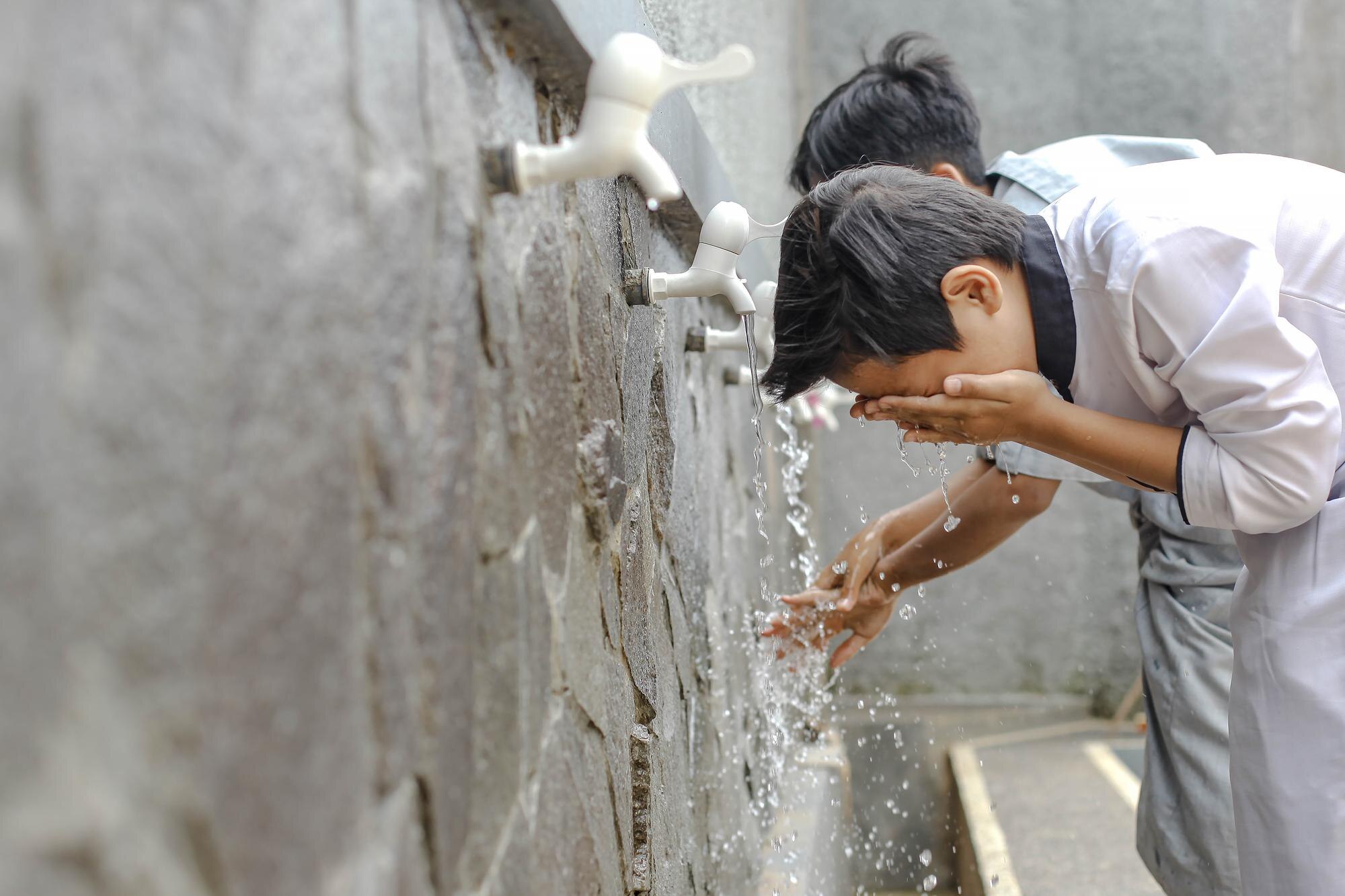
A distinction that saves confusion: the ablution areas are separate from the toilets, though they usually share the same underground complexes. Wudu halls are long rows of low taps with seats, so you can wash sitting down with dignity, and they’re sized even more generously than the toilets because every single worshipper needs them repeatedly through the day. Don’t occupy a toilet cubicle just to make wudu — you’ll queue longer and annoy everyone behind you — and don’t expect to brush your teeth at a wudu row at rush hour without collecting some pointed looks. Wash efficiently, roll your sleeves properly before you start, gather your belongings before standing, and mind the wet marble around the taps, which is the slipperiest surface in the whole sanctuary.
The peak-time maths: go before the adhan, not after the prayer
Here is the rule that does most of the work. Demand for the facilities isn’t steady; it surges in a massive wave the moment each congregational prayer ends, as tens of thousands of people head for the same escalators at once. Join that wave — especially after Dhuhr, Maghrib and Isha — and you’ll queue for a long time on wet floors in close air. The alternative costs nothing: go early. Use the toilet and renew your wudu forty-five minutes to an hour before the adhan, while the plazas are still filling, and you’ll walk into near-empty facilities. If you miss the window, wait out the first half hour after prayer rather than joining the crush. The deep lulls — late night, and the stretch between sunrise and mid-morning — are so quiet the complexes echo. Pilgrims who pace their whole day this way, folding one unhurried toilet-and-wudu stop before each block of worship, simply never experience the queues that exhaust everyone else. If quiet matters to your worship generally, the same clock-reading skill pays off everywhere — our guide to finding quiet times for worship works from the identical logic.
What women should expect
Women’s facilities are entirely separate — their own complexes and entrances, clearly marked and often screened at the doorway — and staffed by female attendants and cleaners. The honest caveat: queues on the women’s side run longer, particularly around Maghrib and Isha, partly because demand bunches at the same times and partly because wudu, hijab adjustment and children’s needs make each visit a little longer. The timing rule above is therefore worth even more to women than to men: forty-five minutes before the adhan is the difference between a five-minute stop and a forty-minute queue. Two more practicalities. Agree a fixed meeting point with your group before separating — a numbered lamp post or gate sign, not “by the escalators” — because the men’s and women’s complexes are far enough apart that you won’t simply spot each other. And if you’re managing wudu while keeping hijab among strangers, the seated rows inside the women’s halls are screened from passers-by; take your time there rather than improvising something awkward at a courtyard tap.
Ihram in the cubicle: matter-of-fact logistics
Men in ihram face a wardrobe question nobody explains in advance: what exactly do you do with two large pieces of unstitched cloth in a squat-toilet cubicle? The answer is a routine, and it takes three visits to become automatic. Take the rida — the top cloth — off before you enter, fold it lengthways, and either hang it on the door hook (most cubicles have one) or drape it around your neck like a scarf, tucked clear of everything. The izar — the waist cloth — stays on: hitch it upward and roll the top edge over its own belt-line to shorten it well clear of the floor and any water, exactly as you’d shorten it for walking on wet ground. Nothing about the ihram is invalidated by any of this; the cloths are garments, not relics, and keeping them clean and dry is the whole point. Move deliberately, use the hose and your left hand as usual, and wash your hands with unscented soap — the one detail that genuinely matters in ihram, since scented products are off-limits. Keep a small unscented bar or bottle in your kit, because dispensers rarely oblige.
Cleanliness, honestly
Set expectations accurately and you won’t be rattled. These are the most heavily used washrooms on the planet, and at the crest of the post-prayer wave they look like it: wet floors, queues, paper running low, the occasional cubicle you’ll skip. They are also cleaned relentlessly — crews mop, restock and disinfect around the clock, and in the lulls the same complexes are impressively fresh. Both things are true, an hour apart. Your part is a pocket kit that removes every dependency on perfect conditions:
- Travel tissues or a small toilet roll with the core removed
- Hand sanitiser and a small unscented soap
- Unscented wet wipes for quick freshen-ups
- Cheap waterproof flip-flops in a light drawstring bag, worn inside the complexes so your walking footwear stays dry
The flip-flop habit deserves its own sentence: polished marble plus constant water is the one genuine hazard down here, falls do end pilgrimages, and grippy wet-area footwear plus an unhurried pace removes nearly all of the risk. Keep a hand for the rail on the stairs, and keep valuables zipped and on your body — a phone left on a ledge in a crowd is a phone remembered fondly.
Don’t drink less to visit less
This section is the real reason the article exists. Every season, pilgrims quietly ration their water — especially women facing longer queues, and older travellers who dread the walk — because they want fewer bathroom trips. In Makkah’s heat, with ten kilometres of walking a day, that trade is genuinely dangerous: dehydration is behind a huge share of the collapses, headaches, confusion and hospital visits around the Haram, and it creeps up precisely on the people who think they’re being disciplined. Drink steadily, drink Zamzam freely, and let the bathroom trips come; with the timing rule above they cost you minutes, while dehydration can cost you the journey. Our guide to preventing dehydration during Umrah sets out the full drinking routine — and if your stomach rather than your schedule is the problem, the guide to managing common ailments covers that too.
Children in the facilities
Parents, three adjustments make this easy. First, run children on the pre-emptive schedule, not the on-demand one: take them before every prayer whether or not they claim to need it, because “Baba, I need the toilet” delivered mid-congregation is a fixture of family pilgrimage. Second, keep a child’s hand physically in yours on the wet floors and escalators — this is the one part of the sanctuary where letting go briefly matters. Third, pack their needs into your kit: wipes, a spare pull-up for the youngest, a small plastic bag. Children under about seven can generally accompany a parent into that parent’s facility without anyone blinking, and attendants are used to families; the accessible cubicles’ extra space is also tacitly understood to serve a parent managing a small child, outside peak demand.
The Prophet’s Mosque: the same system, calmer
Everything above transfers to Madinah with the temperature turned down. The facilities at the Prophet’s Mosque follow the same design — underground and courtyard-edge complexes, numbered entrances around the piazza with its umbrellas, separate women’s sections, rows of seated wudu taps — but the whole experience runs gentler: the crowds pulse less violently, queues clear faster, and the flat, compact piazza makes every complex easier to reach than Makkah’s multi-level sprawl. The same habits apply — learn your nearest numbered entrance on day one, go before the adhan, carry the kit — and they buy you an even smoother routine. Pilgrims who arrive in Madinah first sometimes get lulled by this and are startled by Makkah’s intensity; run the disciplined version of the routine from the start and neither city will catch you out.
Queues, patience and the etiquette of the door
Finally, the human part. Queue where the queue is, even when it’s informal; hovering at a cubicle door that isn’t next in line causes more friction down here than anywhere else in the sanctuary. Let the elderly, the visibly unwell and parents with small children go ahead — it costs you two minutes and it is exactly the character this journey is supposed to build. Keep your visit brisk at peak times, leave the cubicle as you’d wish to find it, give the hose a rinse over the pan, and thank the cleaning staff when you pass them; they do relentless work for millions of strangers and a smile in their direction is rare enough to be noticed. Then wash your hands properly, collect your flip-flops into their bag, check the signboard photo on your phone, and walk back up into the light with the one thing this whole article was for: a settled body, and a head free for the prayer you came to pray.
Leave A Comment