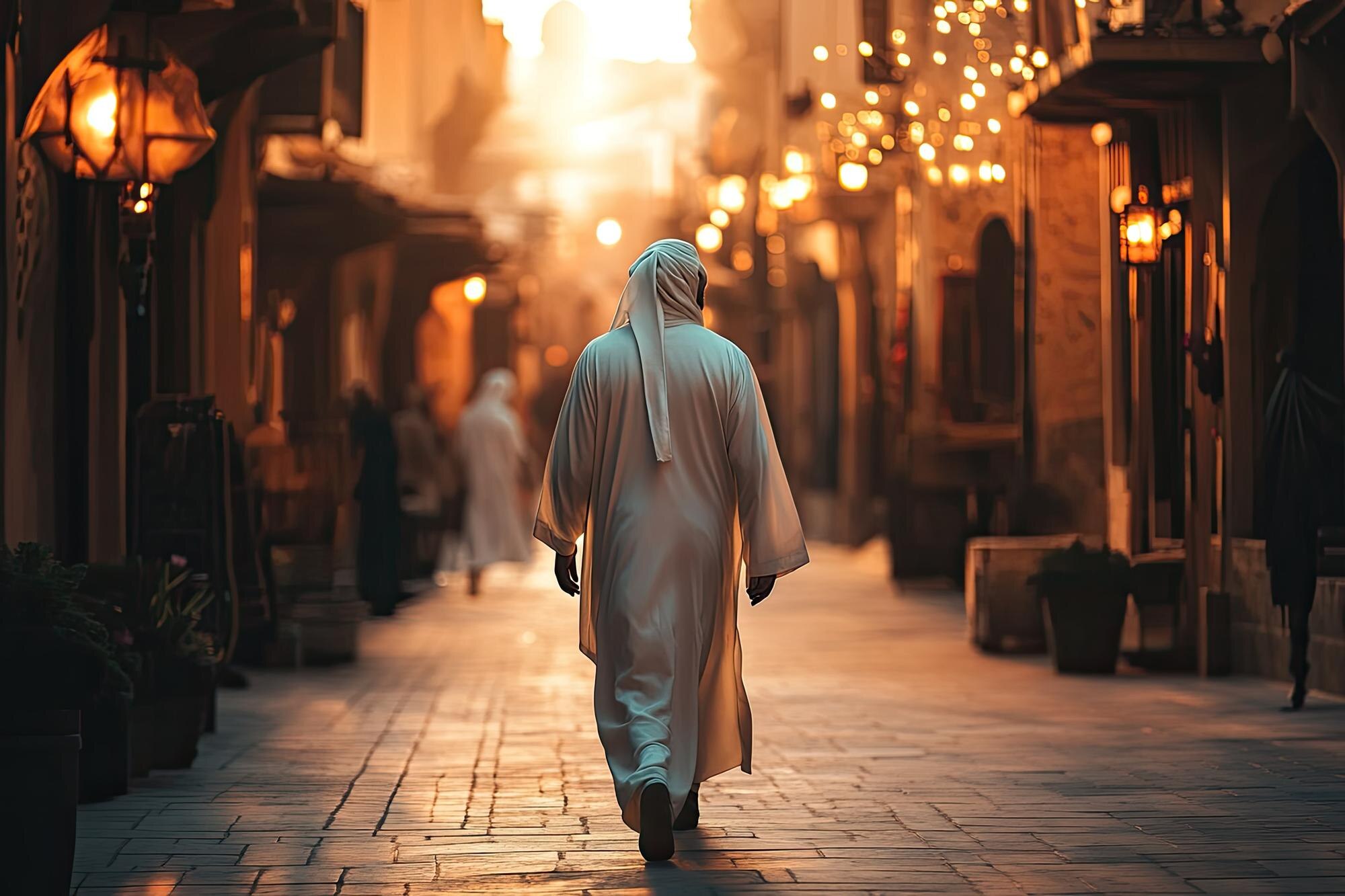
Somewhere between booking the flights and printing the visa, most first-time pilgrims have the same quiet realisation: the logistics are the easy part. Hotels can be compared, permits can be booked, suitcases can be weighed. What nobody hands you is a plan for the heart — and yet the heart is the whole reason you are going. Spiritual preparation for Umrah deserves at least as many weeks as the paperwork, and this guide sets out how to use them: what to repent of, what to learn, what to memorise, and what to honestly expect from yourself when you finally stand in front of the Kaaba.
None of it requires scholarship. It requires intention, a little study, and a willingness to arrive as a pilgrim rather than a tourist who happens to be wearing white.
Begin where every action begins: the niyyah
The Prophet (peace be upon him) said, “Actions are but by intentions, and every person shall have only what he intended” — the hadith with which Imam al-Bukhari opens his entire collection (Sahih al-Bukhari 1; Sahih Muslim 1907). For Umrah, this is not an abstract principle. Your journey is worth precisely what it is for: Allah’s pleasure, His forgiveness, His reward — or, if you let them creep in, the photographs, the status, the box ticked.
Practically, the intention for Umrah itself lives in the heart and is made at or before the Miqat, the boundary you must not cross towards Makkah without entering ihram. There is no fixed formula you must pronounce, though many pilgrims say “Labbayka Allahumma bi ‘Umrah” as they enter the state. What matters is the inward resolve: I am doing this for Allah. Start rehearsing that resolve weeks before you fly — when you book, when you pack, when you explain the trip to colleagues. Our guide to the Miqat and entering ihram covers exactly where and when the formal moment arrives.
Why this journey is worth preparing for
The Prophet (peace be upon him) said: “Umrah to Umrah is an expiation for what is between them, and the accepted Hajj has no reward except Paradise” (Sahih al-Bukhari 1773; Sahih Muslim 1349). Sit with that for a moment. The journey you are planning has been described by the Messenger of Allah as an eraser of sins — not a holiday with religious features, but an act of worship with a stated, extraordinary return.
That framing changes how you prepare. You would not walk into the most important meeting of your career having skimmed the agenda in the taxi. The weeks before departure are part of the worship: the learning, the repenting, the settling of affairs all belong to the Umrah itself, because they are done for its sake.
Repentance: pack this first
Concerning Hajj, the Prophet (peace be upon him) said that whoever performs it without obscenity or transgression “returns as the day his mother bore him” (Sahih al-Bukhari 1521). The wording concerns Hajj, and it is honest to say so; but scholars have long extended its spirit to the pilgrim setting out for Umrah, and the logic is plain either way — you are travelling to seek forgiveness, so begin by seeking it before you leave.
Make sincere tawbah in the weeks before departure: acknowledge the sin, leave it, regret it, resolve against returning to it. Then turn to the harder half, the rights of other people. Repay what you owe, return what you borrowed, and — hardest of all — repair what you broke. Phone the sibling you have not spoken to since the argument. Apologise to the colleague you wronged. Ask your parents’ forgiveness for whatever needs forgiving. Pilgrims consistently say these conversations, awkward as they are, transformed the journey: you cannot stand before the Kaaba asking Allah to overlook your faults while deliberately nursing a grudge or an unpaid debt at home.
Debts and the will: the sober paperwork of the soul
Two practical questions come up constantly. First, debt. The mainstream position of contemporary scholars is that a debt which is currently due takes priority: settle it, or obtain the creditor’s consent, before spending on Umrah. A long-term debt — a mortgage, a structured loan — does not bar the journey, provided you have the ability to keep up the repayments and travelling will not endanger them. If your instalments are paid and your creditor is not waiting on you, the road to Makkah is open.
Second, the will. The Prophet (peace be upon him) said: “It is not permissible for any Muslim who has something to will to stay for two nights without having his written will with him” (Sahih al-Bukhari 2738). This is not morbid trip admin; it is a Sunnah for daily life that travel simply makes urgent. Before any long journey, write down what you owe, what is owed to you, and any bequests, and tell someone where the document is. Many pilgrims describe the act itself as clarifying — a rehearsal of the detachment the journey is meant to teach.
Learn the rites before you fly — not in the hotel lobby
Umrah is short and its structure is simple, but the crowds are not a classroom. Learn the sequence at home until you can recite it from memory: enter ihram at the Miqat; perform tawaf, seven circuits of the Kaaba beginning at the Black Stone corner with the Kaaba on your left; pray two rak’ahs, ideally behind Maqam Ibrahim; perform sa’i, seven lengths between Safa and Marwah, beginning at Safa; and finally halq or taqsir — shaving or shortening the hair — which releases you from ihram.
How you learn matters almost as much as what you learn. Most large mosques in Britain run pre-Umrah seminars in the winter months, and an evening in a classroom with someone who has led forty groups is worth ten scrolling sessions. Failing that, read the rites aloud with whoever you are travelling with, quiz each other, and walk the sequence through in your living room — it sounds faintly ridiculous, and it works. The pilgrims who move through the Haram with calm are not braver; they simply are not learning and performing at the same time.
Alongside the sequence, learn the prohibitions of ihram before you enter it: no perfume or scented products, no cutting hair or nails, no hunting, no marital intimacy, and for men no stitched garments covering the body and nothing covering the head; for women, no niqab or gloves. It is also from the Sunnah to prepare the body before ihram — ghusl, trimmed nails, everything scented finished with beforehand — so that the state begins cleanly. Knowing all this in advance is the difference between serenity and a panicked search through fatwa websites at the airport.
The errors worth learning in advance
A handful of mistakes recur so often that they deserve their own rehearsal. Cutting through the Hijr (the semi-circular enclosure beside the Kaaba) during tawaf invalidates that circuit, because the Hijr is part of the Kaaba itself — the circuit must go around it, and one shortcut quietly voids a lap many pilgrims never realise they lost. Ramal, the brisk walk, applies only to the first three circuits of the arrival tawaf, and only for men; jogging all seven, or jogging as a woman, is a misunderstanding. Sa’i does not have to follow tawaf immediately — if you are exhausted, rest first; the rite remains valid. And sa’i begins at Safa, not Marwah: start at the wrong hill and your first length does not count. We keep a fuller catalogue in our guide to common Umrah mistakes; an hour spent with it before departure prevents most of them.
The words to carry: the Talbiyah
From the moment you enter ihram, one formula accompanies you to Makkah — the Talbiyah the Prophet (peace be upon him) taught (Sahih al-Bukhari 1549; Sahih Muslim 1184):
Labbayka Allahumma labbayk. Labbayka la sharika laka labbayk. Inna al-hamda wan-ni’mata laka wal-mulk. La sharika lak.
Here I am, O Allah, here I am. Here I am; You have no partner; here I am. Truly all praise, favour and sovereignty are Yours. You have no partner.
Men raise their voices with it; women say it quietly. Memorise it weeks ahead — not just the sounds but the meaning, so that on the aircraft or the coach it is an answer to a summons rather than a chant you are copying from your neighbour. Pilgrims who understand what they are saying describe the Talbiyah as the moment the trip stops being travel and becomes pilgrimage.
The duas of the road
The journey itself has its own worship. When the Prophet (peace be upon him) mounted his camel to travel, he would say takbir three times and then recite what the Quran teaches (43:13–14): “Subhana alladhi sakhkhara lana hadha wa ma kunna lahu muqrinin, wa inna ila rabbina la-munqalibun” — Glory be to Him who has subjected this to us, for we could never have accomplished it ourselves, and to our Lord we shall surely return — followed by a supplication for righteousness and ease in the journey (Sahih Muslim 1342). On the homeward leg he would add: “Ayibuna, ta’ibuna, ‘abiduna, li-rabbina hamidun” — returning, repenting, worshipping, and praising our Lord. Print these, or save them on your phone, and let the airport gate become a place of dhikr rather than dead time.
Arriving well: ghusl, the right foot, and no magic doors
It is Sunnah, where feasible, to perform ghusl before entering Makkah, as related from the Prophet’s practice (Sahih Muslim 1259) — many pilgrims manage it at the hotel before setting out for the Haram, which serves the same purpose of arriving clean and composed. Enter the mosque with your right foot and the supplication the Prophet (peace be upon him) taught: “Allahumma iftah li abwaba rahmatik” — O Allah, open for me the gates of Your mercy (Sahih Muslim 713).
One myth to retire before you arrive: there is no required door. Entering through Bab as-Salam is a custom with long pedigree, and there is nothing wrong with it, but no rite depends on it — on a crowded night, walk in through whichever gate is open and lose nothing.
First sight of the Kaaba: the dua nobody prescribed
Here is something that surprises almost everyone: there is no authentic dua prescribed for the first sight of the Kaaba. The famous narrations promising that supplication at that moment is guaranteed acceptance are weak or fabricated, and honesty about that protects you from building expectations on sand. What we do have is an athar — a report from Umar ibn al-Khattab, may Allah be pleased with him — that upon seeing the House he would say: “Allahumma anta as-Salam wa minka as-salam, fa-hayyina rabbana bis-salam” — O Allah, You are Peace and from You is peace, so greet us, our Lord, with peace. You may use it, attributing it to Umar rather than the Prophet.
Better still, understand why the silence of the sources is a gift: the moment is yours. Raise your hands if you wish, and speak to your Lord in your own language about your own life. That unscripted dua — not a formula read from a laminated card — is the point of the moment.
Managing expectations: the highs are not on demand
Now for the part most guides omit. Some pilgrims weep at first sight of the Kaaba; others feel strangely numb and then panic about feeling numb. Both are normal. Spiritual states are not vending machines — you cannot insert effort and collect ecstasy on schedule. You may find your most moving moment comes not at the Kaaba at all but during a quiet Fajr in Madinah, or in the taxi, or three weeks after you get home. Judge your Umrah by your sincerity and your effort, which you control, not by the intensity of your feelings, which you do not.
Expect, too, the unglamorous realities: crowds that push, queues that stall, heat, blisters, four hours’ sleep. Fatigue erodes patience precisely when patience is most needed. Plan for it — rest before rites rather than after, drink water constantly, and lower your daily ambitions so the worship you do perform is present rather than gritted-teeth.
Patience is not the obstacle — it is the worship
Reframe the difficulties before you meet them. The pilgrim who elbowed you during tawaf, the queue that swallowed an hour, the roommate who snores: none of these are interruptions to your Umrah. Responding to them with restraint is your Umrah, every bit as much as the circuits themselves. The rites of pilgrimage are, among other things, a fourteen-century-old training course in patience under crowding — and you signed up for it deliberately. Hold your tongue in the crush and you have performed an act of worship no camera will ever record.
The same applies within your travelling party. Ten days of shared rooms, early starts and missed meals will test the sweetest temper, and it is precisely the people closest to you — spouse, parent, group-mate — who will receive either your patience or your irritation. Agree in advance to excuse one another freely. A group that forgives small frictions quickly travels lighter than any economy of suitcase weight can manage.
Phone discipline and the pilgrimage performed for an audience
Decide your phone policy before you fly, because the mataf is no place to negotiate with yourself. A reasonable rule: the phone comes to the Haram for the permit QR code and emergencies, and stays in the belt pocket during tawaf, sa’i and prayer. Take a few photographs on one visit if you wish — your family will treasure them — then put the lens away for the rest.
Be ruthless with the subtler danger. A pilgrimage live-streamed, captioned and posted in real time drifts, hour by hour, from worship towards performance — and intention, as we began, is everything. If you want to share the journey, share it after you return, when the posting can no longer contaminate the doing.
Write your dua list at home
Finally, the most practical spiritual preparation of all: write your dua list before you travel. Standing in the best places on earth, minds go blank — every pilgrim confirms it. So sit down at home, unhurried, and write what you want to ask for: your faith, your parents, your children, your health, your work, your debts, the deceased, the ummah, and the specific private hopes you would tell no one but Allah. Collect requests from family and friends too; carrying someone’s dua is a lovely amanah. Keep the list on paper in your ihram belt, and it will steady you in every queue and every quiet corner.
Then let the preparation converge with the logistics: book your Nusuk permit — our step-by-step guide to booking an Umrah slot shows how — and slot the learning above into the weeks of our complete Umrah timeline. A pilgrim who has repented, settled accounts, memorised the Talbiyah and written a dua list steps onto the aircraft already mid-worship. The flight is just the next part of it.
Leave A Comment