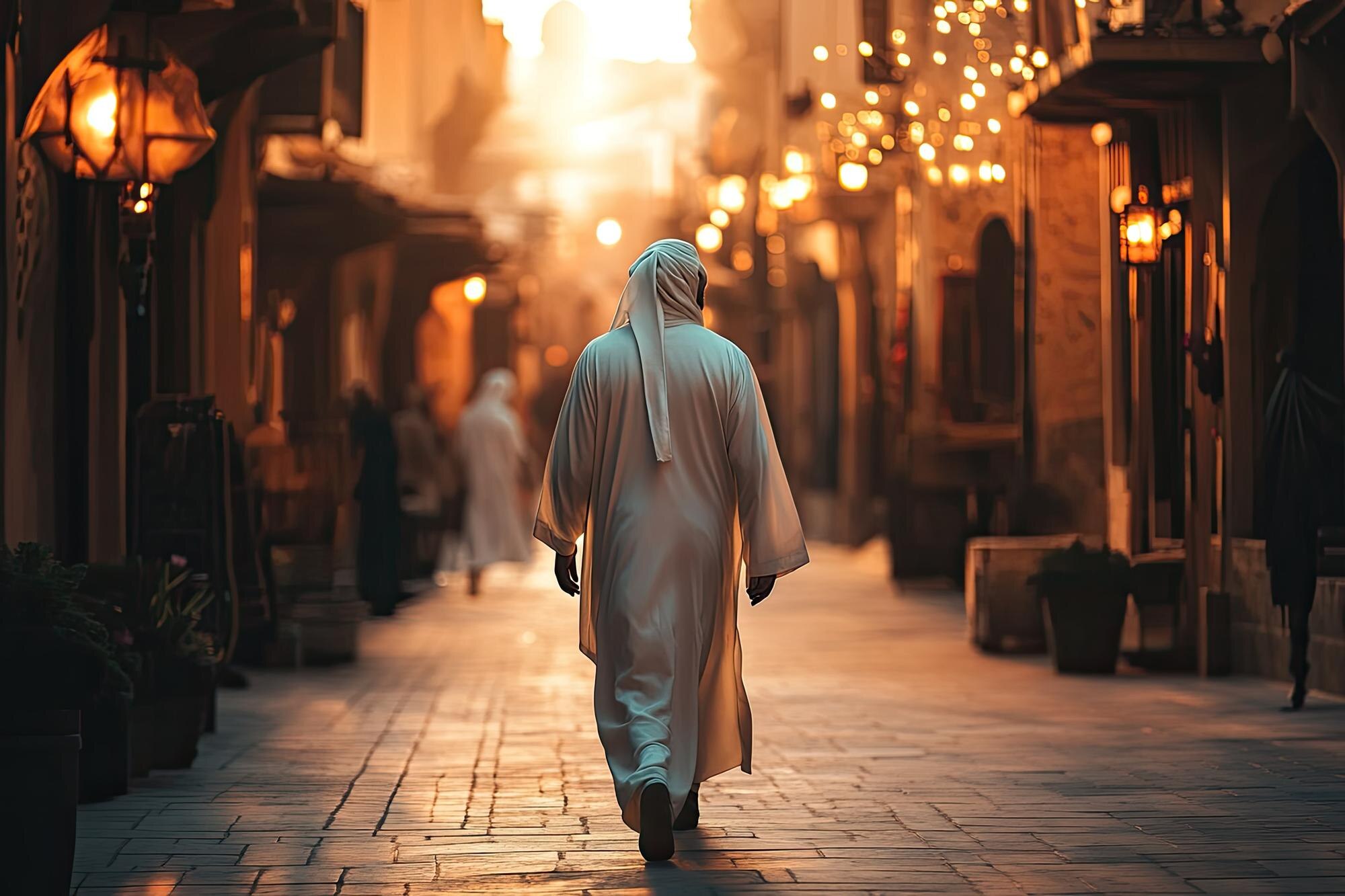
Most packing advice for Umrah is written as if men were women with shorter lists. In truth a man’s needs are different in kind, not just in quantity: he’ll spend his most important hours in two cloths with no pockets, bare-headed under a fierce sun, in sandals on marble, and he’ll want to think about none of it. The list below is short — deliberately — but every item earns its place with a reason, because knowing why something matters is what stops you leaving it in the wardrobe at home.
The Belt That Replaces Your Pockets
Start with the item first-timers most often skip and most bitterly regret skipping. The ihram has no pockets. From the Miqat until you exit ihram, everything you own must live somewhere, and that somewhere is an ihram belt: a wide elasticated or webbing band, worn over the izar at the waist, with zipped compartments. Buy one with at least two zipped pockets — one for the phone, one for cash and cards — and check the zips actually close over your phone before you fly, because plenty of cheap belts were designed around the slimmer handsets of a decade ago.
The belt does double duty. Beyond carrying your valuables, it anchors the izar itself, which is worth a great deal to a man rounding the Kaaba in a moving crowd with both hands occupied. Wear it against the outside of the cloth, keep the zips at your front where your eyes are, and put inside it only what a day requires: phone, one bank card, a modest fold of riyals, your hotel key card and a paper copy of your passport photo page. Everything else stays in the hotel. Pickpocketing is rare in the Haram but not mythical, and dense crowds anywhere on earth reward the man who carries little and zips it shut.
Two Ihram Sets, Not One
One set seems logical — Umrah’s ihram lasts hours, not weeks. Then reality arrives: turbulence spills coffee at thirty thousand feet, a first Tawaf soaks the cloth in sweat, a wet bathroom floor claims a trailing hem, or you decide, as many do, to perform a second Umrah from Masjid Aisha. A spare set turns each of these from a crisis into a shrug. Two sets is the settled wisdom of practically every experienced pilgrim, and the spare weighs a few hundred grams.
Choose medium-weight towelling if you run hot or worry about chafing, since it absorbs sweat and holds itself off the skin, or lighter cotton if you prize packability; our guide to how to wear the ihram compares fabrics, sizes and the folds that actually stay up. Whichever you buy, rehearse at home. Ten private minutes with a mirror are worth more than any diagram, and a man who has walked, sat and prostrated in his ihram once already will not be adjusting it nervously through his first Tawaf.
Sandals, and the Humble Shoe Bag
Ihram footwear for men means sandals that leave the ankle bone uncovered — the strap-over-the-instep styles sold everywhere in Makkah — and the golden rule is brutal in its simplicity: never bring new sandals. Break them in for at least a week of ordinary walking at home, because the Haram will find every stiff edge and unbroken strap within an hour. Our full guide to footwear for men covers the styles and the fiqh of what a sandal may cover.
Now the unglamorous hero: a drawstring shoe bag. Shoes come off at the mosque doors, and the racks by the gates hold thousands of near-identical sandals; pilgrims lose theirs so routinely that barefoot men padding back to their hotels are a nightly sight. A cloth bag lets you carry your sandals with you, slung from the wrist or clipped to the belt, so you exit by whichever gate the crowd flow dictates — and after prayer the crowd often does dictate — with your own shoes in hand. Pack two; they weigh nothing and one will go missing or get lent.
The Unscented Washbag and the Anti-Chafe Kit
Everything that touches your skin in ihram must be fragrance-free, so build a dedicated washbag at home, where you can read labels in your own language: unscented soap and shampoo, miswak and mild toothpaste, unscented wipes and sanitiser, plasters. The reasoning, the fiqh and the full contents are set out in our guide to grooming and hygiene in ihram — the one-line version is that the ihram prohibition is on scent, not on cleanliness.
Alongside it, the anti-chafe kit: a tub of plain unscented petroleum jelly, a balm stick for the day bag, and hydrocolloid blister plasters. Bare inner thighs plus long hot distances make chafing the most common preventable injury of a man’s Umrah, and the barrier goes on before discomfort, not after. Our guide to preventing chafing in ihram covers the technique and the scholarly position on petroleum jelly, which is reassuringly permissive for unscented products.
Electronics: Small, Charged and Cabin-Legal
Your phone works harder on Umrah than at home — navigation, Qur’an, du’a lists, family calls, photographs — and hotel returns between prayers are not guaranteed, so a power bank is essential kit. The rules changed hard in 2026. A new ICAO standard, effective 27 March 2026 and adopted worldwide, permits at most two power banks per passenger, carried in the cabin only and never in the checked case, each capped at 100Wh — roughly a 27,000mAh unit — unless the airline has separately approved something up to 160Wh. Saudi Arabia’s own aviation authority, GACA, issued a matching circular in May 2026 that applies at every Saudi airport: two power banks maximum, none in checked luggage, no recharging the power bank in flight. The detail that catches people out is the newer one — you can no longer plug your phone into a power bank in flight either, only into the aircraft’s own USB port or seat socket, and the bank itself must travel in your seat pocket or under the seat, never the overhead bin, so cabin crew can see it if it overheats. A single labelled unit of about 10,000 to 20,000mAh sails under every one of these limits, charges a phone several times over, and fits a belt pouch. A few carriers go further still — Emirates allows only one power bank, not two — so check your specific airline’s current page the week you fly.
Add a two-pin-to-your-plug adaptor — Saudi Arabia uses the British-style Type G socket, so UK travellers need nothing — a spare charging cable, and, if you sleep badly in bright shared rooms, a cheap eye mask. That’s the entire electronics list. A man does not need a tablet, a laptop or a camera drone on Umrah, and the drone in particular will be confiscated.
The Bag Question at the Haram Gates
Every gate of Masjid al-Haram has security screening, and the standing rule is that large bags don’t come in: suitcases, holdalls and full-size travel backpacks are turned away, both for crowd safety and because there’s simply nowhere to put them among worshippers. What passes without comment, as of mid-2026, is the small stuff — a modest drawstring bag, a slim sling or crossbody pouch, a small daypack of the kind that holds a water bottle, a shoe bag and a light layer. Guidance is applied by officers at the gate rather than printed on a sign with dimensions, and it tightens in peak season, so the working rule is: if it would fit under an aircraft seat with room to spare, it’s fine; if it looks like luggage, it isn’t.
Arriving straight from the airport with your case? Don’t try your luck at the gate. Leave luggage at your hotel first — reception will hold it before check-in — or use one of the paid luggage-storage points that have multiplied around the Haram district. Inside the mosque, keep the small bag on your front in dense crowds, and never leave it unattended while you pray; between your feet, strap around an ankle, is the seasoned pilgrim’s habit.
As for what goes in the day bag, think in hours, not days: a small water bottle (though the Zamzam dispensers inside make even that optional), the shoe bag, your anti-chafe balm stick, a miswak, the folded umbrella and perhaps a few dates. If a security officer can see at a glance that your bag holds nothing but a pilgrim’s afternoon, you will never be the man unpacking it at the gate while the crowd files past behind him.
Head Uncovered, Cap Packed
A man in ihram does not cover his head — no cap, no turban, and not the rida draped over the scalp. So why is a prayer cap on this list? Because ihram is a state you’ll exit within hours of arriving, and for the remaining days of your trip you’ll pray thirty-odd congregational prayers in ordinary clothes, where a light cotton cap is comfortable, customary and keeps the marble’s chill off a shaved head — a detail freshly shorn men appreciate at Fajr. Pack it in the main case, not the day bag, and it can’t tempt you at the wrong moment.
For the ihram hours themselves, the sun is managed with shade rather than cover: a compact umbrella is entirely permitted, since shade above the head is not clothing upon it, and unscented sunscreen and lip balm guard whatever the umbrella misses. That trio — umbrella, sunscreen, balm — does the work a hat would do, lawfully.
Money: Split It, Then Forget It
The system that lets you stop thinking about money is a simple split. In the belt: one card and a day’s cash, perhaps one to two hundred riyals in small notes for water, taxis, barbers and dates. In the hotel safe: the passport, the second card, and the bulk of your cash. Never all of anything in one place. Cards are accepted almost everywhere in Makkah and Madinah now, including by most taxi apps, but small traders, some barbers and the odd zamzam-adjacent kiosk remain cash-fond, and small notes spare you the ritual of a shopkeeper hunting change for a five-hundred. Withdraw riyals from an ATM on arrival rather than carrying a brick of currency through three airports, tell your bank you’re travelling, and photograph your passport and cards so a loss becomes an inconvenience rather than a catastrophe.
One further habit pays for itself: settle on a daily float and top it up each morning from the safe, rather than deciding amounts on the fly. It keeps your spending visible, keeps the belt slim against your waist, and means that losing the belt on your unluckiest day costs you a day’s money rather than a trip’s.
What to Wear on the Plane
Fly comfortable, not consecrated — at least not from your front door. The practical pattern for most men flying into Jeddah is ordinary loose clothing for the journey, with the ihram either worn underneath from a stopover or changed into before the aircraft crosses the Miqat line, which cabin crew on Saudi-bound flights announce. Airport changing rooms, a stopover hotel, or the aircraft toilet in unhurried good time all work; the announcement catching you unprepared in seat 34E does not. The full choreography — what to wear, when to change, what the intention requires and where the Miqat actually falls — is covered in our guides to the airport arrival process and the Miqat and entering ihram. The packing consequence is simple: your ihram, belt and sandals travel in your cabin bag, never in the hold, because checked luggage occasionally holidays without you.
What Not to Bring
The lightest thing you can pack is restraint. Leave the jewellery and the statement watch; ihram suits humility and hotel safes suit valuables you didn’t bring. Skip the vast wardrobe — the capsule below covers a week. No drones, no e-cigarettes in quantity, nothing that could read as merchandise to a customs officer; and if you carry anything containing a narcotic or psychotropic ingredient — codeine, tramadol, strong sleeping tablets, some anti-anxiety medicine — apply for clearance through the Saudi Food and Drug Authority’s Controlled Drug System (cds.sfda.gov.sa) before you fly. Approval is generally capped at a 30-day supply or your length of stay, whichever is shorter, and the SFDA advises applying several weeks ahead rather than at the airport counter. Leave the laptop unless work genuinely compels it, and consider leaving even the habit of reaching for your phone: the Haram deserves your eyes. Scented toiletries can stay home too — you can’t use them in ihram and every one you pack is a chance of a mix-up. And bring no food; you are travelling to one of the best-fed pilgrimage cities on earth.
Gifts for Men Who Hate Shopping
You will be expected to return with something, and the good news is that Umrah gifts are a solved problem requiring one disciplined hour. Ajwa dates from Madinah or good-quality dates from any reputable Makkah shop, a small bottle or three of attar, prayer beads, and a prayer mat or two cover every relative you have. Zamzam water needs no shopping at all: sealed five- or ten-litre containers are sold at the airport for checked transport — buy there rather than decanting your own, as airlines require the official sealed packaging. Set yourself one market hour, late in the trip so you’re not hauling gifts between hotels, list the recipients before you enter the shop, and buy dates for the many and attar for the few. Done. The man who shops nightly returns with a heavier case and no better gifts.
The Seven-Day Capsule for After Ihram
Once you’ve exited ihram, you’re simply a traveller in a hot, modest, conservative country, and a lean capsule covers a week without a thought:
- Two thobes or two pairs of lightweight loose trousers with long cotton shirts
- One light jumper or zip layer — the Haram’s air conditioning and winter desert nights both bite
- Underwear and light socks for the week, breathable everything
- One set of sleepwear, one prayer cap, one pair of sandals you already trust
Everything should be loose, cover the knees and shoulders, and survive a washing machine, because the final trick of light packing is not packing more — it’s washing what you have. Cross-check the full list against our Umrah packing checklist before you zip the case.
The Laundry Rhythm That Makes It All Work
Makkah and Madinah are dense with laundries because millions of pilgrims generate washing, and the market has answered. Same-day service by the kilogram is the norm in the hotel districts, and as of mid-2026 typical per-kilo rates run around SAR 13–18 for standard next-day or same-day service, with express options costing more; many shops collect from and deliver to hotels, and your reception desk will know the nearest reliable one. The rhythm for a week’s trip is a single drop-off around day three: wear, wash once, wear again, fly home with a case of clean clothes. Hand-washing an ihram set in the hotel basin with unscented soap and hanging it over the shower rail works perfectly well too — towelling dries slower than cotton, so give it a day. Budget a modest note or two for the whole trip’s washing, pack half the clothes you first laid out on the bed, and you’ll walk to the Haram carrying what a pilgrim should carry: almost nothing.
Leave A Comment