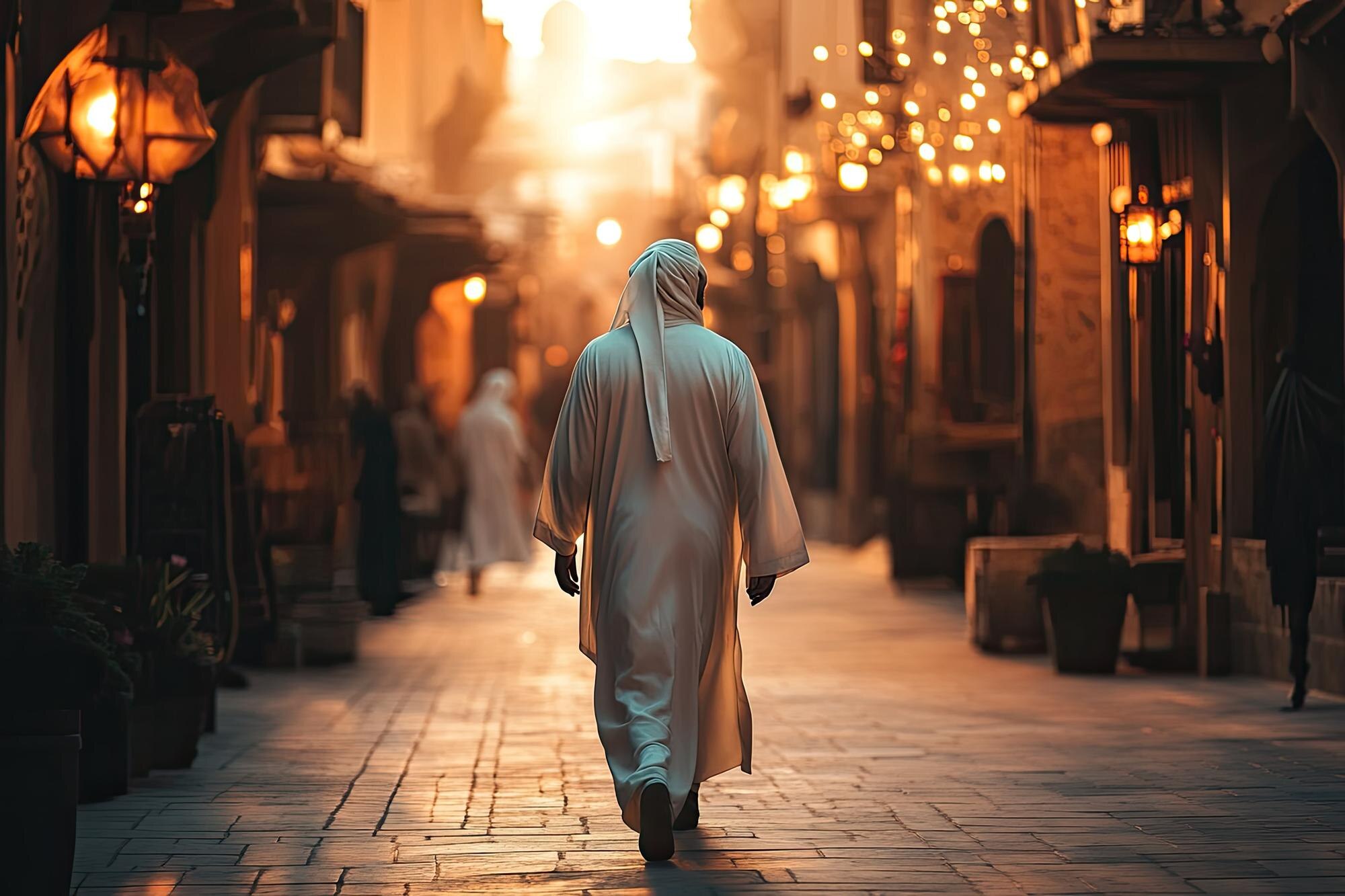
Ask returning pilgrims about arriving in Makkah and most reach for the same memory: the first time their eyes landed on the Kaaba. What they mention less often is everything wrapped around that moment — the thirty hours without proper sleep, the immigration queue that wouldn’t move, the driver circling one-way systems looking for a hotel entrance, the strange dislocation of stepping out of a cool car into desert heat beneath the largest clock face on earth. Both things are true at once. Your first arrival is likely to be one of the most moving experiences of your life, and it will almost certainly happen while you’re running on fumes.
That combination deserves honesty, because pretending the exhaustion away is precisely how first nights go wrong. Pilgrims who arrive expecting to float serenely from the airport to the Mataf often find themselves instead dazed in a marble concourse at midnight, unsure which of forty-odd gates they came through, with a phone at four percent battery. So this guide takes the first twelve hours seriously as a practical problem: the drive in, the check-in, the first entry into Masjid al-Haram, the first sight of the Kaaba, and the small habits that keep a tired pilgrim safe, oriented and spiritually present in an unfamiliar city.
The road in: what happens before you see anything
Most pilgrims reach Makkah by road from Jeddah’s King Abdulaziz International Airport, a journey of roughly 90 to 100 kilometres that takes somewhere between an hour and ninety minutes depending on traffic and how your driver handles the final approach. The route itself is unremarkable motorway through rock and sand, which is part of why the arrival lands so hard: there’s no gradual build-up, just desert, then tunnels, then suddenly the Clock Tower rising ahead of you like something from another century grafted onto this one. If you’re in ihram, the passing of the miqat happens in the air or on the road long before this, so by now your state is settled and your talbiyah is company for the drive. We’ve covered the transfer options, costs and pitfalls in detail in our guide to getting from the airport to Makkah.
A growing share of pilgrims now come in on the Haramain High-Speed Railway instead, which runs from the airport terminal to Makkah’s Rusayfah station in around fifty minutes. It’s comfortable and air-conditioned, though the station sits a few kilometres from the Haram, so you’ll still need a taxi for the last leg. Our Haramain railway guide explains booking, luggage rules and how the station transfer works. Either way, keep your hotel name saved on your phone in both English and Arabic, along with a screenshot of its location on a map. Streets in the central area close and reverse without much warning, and even experienced drivers sometimes need the exact building name rather than a rough district.
Hotel first, then Umrah — and why that order is allowed
If you’ve arrived in ihram intending to perform Umrah, every instinct will pull you straight towards the mosque. It’s a beautiful instinct, and performing Umrah promptly after arrival follows the Prophet’s practice, peace be upon him, of not delaying the rites without reason. But be honest about the state you’re in. There is no ruling anywhere in fiqh that requires you to perform tawaf on no sleep. Checking in first, showering, eating something light and resting for an hour or three before walking to the Haram is entirely permissible — your ihram restrictions simply continue in the meantime, so no scented soap, no cutting hair or nails, and for men no stitched clothing until the Umrah is complete.
The difference this makes is hard to overstate. A drained, jittery tawaf performed through a fog of jet lag becomes a physical ordeal you white-knuckle through; the same tawaf after rest becomes the present-hearted act of worship you crossed the world for. Plenty of pilgrims land at dawn, sleep until midday, and perform a calm, unhurried Umrah in the afternoon lull — one of the quieter windows in the mosque’s day. The full sequencing, including what to do if your room isn’t ready and how to handle ihram at the hotel, is in our guide to performing Umrah after arrival.
Check-in near the Haram can be slow, especially when several tour groups land at once and the lobby fills with luggage trolleys and overtired children. Use the wait to fix three anchors in your mind, because they’ll matter more than anything in your suitcase:
- Your hotel’s exact name and street, photographed on a business card from reception and saved as a pinned note on your phone.
- The Haram gate nearest your door, by number and name, so you always exit the mosque on the correct side.
- One visual landmark — a distinctive sign, tower colour or shopfront — that tells you you’re on the right street when everything looks identical at night.
Your first entry into Masjid al-Haram
When you’re rested and ready, give the first entry the unhurried attention it deserves. If your Umrah can wait a few more hours, consider timing this first visit for a gentler period — mid-morning after the post-Fajr crowds have thinned, or the deep hours after midnight when the courtyards breathe again. Arriving twenty minutes before a congregational prayer, by contrast, means entering against a tide of hundreds of thousands of people with the same idea.
Choosing your gate
Masjid al-Haram has dozens of numbered entrances, and as of mid-2026 the numbering runs around the perimeter with the three great ceremonial gates as its landmarks: King Abdulaziz Gate (Gate 1) on the side facing the Clock Tower and Ajyad Street, King Fahd Gate (Gate 79) beneath its twin minarets on the western side, and Bab al-Umrah (the Umrah Gate) on the north-western flank, traditionally associated with the direction from which the Prophet, peace be upon him, entered for his own Umrah. For a first visit, these big three are the ones to use. They’re wide, clearly signed, staffed, and — unlike some of the smaller side entrances — they deliver you onto broad internal avenues that lead logically towards the Mataf rather than into a maze of columned halls.
King Abdulaziz Gate is the natural choice if you’re staying in the Clock Tower or Ajyad direction, and it gives the most theatrical first approach: the Kaaba becomes visible ahead of you as you come through the concourse. Whichever gate you use, look up and memorise its number before you step inside. That number is your way home tonight and every night after; our guide to finding your way around the Haram is built around exactly this habit.
The threshold: right foot and du’a
Masjid al-Haram is entered like any mosque, only more so. Step in with your right foot, and say the du’a for entering a mosque that the Prophet, peace be upon him, taught: Allahumma iftah li abwaba rahmatik — O Allah, open for me the doors of Your mercy. There’s no special extra formula required for this mosque in particular; the ordinary sunnah of entry, performed with an extraordinary heart, is exactly right. Walk slowly. The Prophet approached sacred moments with calm dignity, and the crowd around you will be moving at every speed at once — you don’t have to match any of them.
Managing the first sight of the Kaaba
Many pilgrims deliberately keep their gaze lowered as they move through the pillared halls, so that the first thing they properly see is the Kaaba itself, rising in its black and gold kiswah above the white marble of the Mataf. It’s worth knowing that no specific du’a is authentically prescribed for this moment — the narrations offering set words for the first sight of the Kaaba are weak — but scholars have long encouraged pilgrims to treat it as a moment of personal supplication, and generations have found it a time when the heart pours out easily. So don’t reach for a booklet. Ask in your own language for what you actually need: forgiveness, healing, guidance, the people you love, the people who pressed your hands before you left and said pray for me there.
And be gentle with yourself about what you feel. Some pilgrims weep before they’ve fully rounded the corner. Others feel a strange numbness and panic that something is wrong with their faith — nothing is. You’re sleep-deprived, overstimulated and standing in the most visually overwhelming building you’ve ever entered; emotion doesn’t perform on demand. The sincerity is in your having come. Many people find the feelings arrive later, quietly, halfway through a tawaf on the third night when nobody is watching.
One small discipline pays off here: don’t reach for your phone in the first minutes. There will be hundreds of chances to photograph the Kaaba. There is exactly one chance to see it for the first time, and it belongs to your memory before it belongs to your camera roll.
Reading the building: a bowl with the Kaaba at its base
The simplest way to understand Masjid al-Haram is as a vast bowl. At the bottom sits the open Mataf courtyard with the Kaaba at its centre, where tawaf flows anticlockwise day and night. Rising around it are tiers: a mezzanine level, a first floor, and the roof, each with its own circular route for tawaf when the ground level is full, all connected by escalators and lifts set back in the halls. Around and behind the Mataf stretch the prayer halls of successive expansions, and off to one side runs the Mas’aa, the long enclosed gallery between Safa and Marwah where sa’i is performed on multiple levels of its own. Once you hold that bowl shape in your head, a building that swallows crowds the size of cities becomes legible: wherever you are, the Kaaba is at the centre and downhill, and the gates are at the rim.
The scale takes deliberate effort to absorb. The third Saudi expansion — begun under King Abdullah in 2011 and inaugurated in 2015, which is why you’ll hear it called the King Abdullah expansion — pushed the complex to a footprint of roughly one and a half million square metres, and official Saudi figures as of mid-2026 describe a mosque that can accommodate well over two million worshippers at peak. During Ramadan 2026, Saudi authorities reported the expansion areas receiving more than half a million worshippers an hour at the busiest times. Numbers like that explain something you’ll feel physically: this is not a building you wander, it’s a building you learn.
So on this first visit, don’t try to learn it all. See the Kaaba, pray two rak’ahs wherever there’s space, note your gate number, and go back to bed if you need to. The geography of the wider sacred zone — and why the whole city, not just the mosque, is called the Haram — is its own subject, covered in our guide to understanding the Haram area.
First-night mistakes worth avoiding
The most common first-night error is attempting Umrah in the crush around Isha. It feels logical — you’ve rested through the afternoon, you’re fed, the evening is cooler — but the hours from Maghrib through the end of Isha are among the densest of the entire day, when day visitors, hotel guests and prayer congregations stack on top of one another. A tawaf begun in that window can take double the time and triple the energy, particularly near the Black Stone corner. If evening is your only option, wait until an hour or two after Isha has finished, when the Mataf loosens noticeably. Our guide to managing crowds in the Haram maps the quiet and busy hours across the day.
The second classic mistake is walking out of the mosque with no idea where you are. The Haram has dozens of exits, and leaving by a different gate from the one you entered can put you a twenty-five-minute walk from where you expected to be, in a ring of near-identical illuminated towers. This is why the hotel card and the gate number matter so much. If you do get lost, don’t wander: show your hotel card to any of the security staff or to a taxi driver, or walk back to a main gate and reorient from there. Parents should agree a meeting point with older children before entering — a named gate, not just somewhere obvious, because nowhere is obvious to everyone.
The third mistake is simple overexertion. Pilgrims routinely cover ten to fifteen kilometres a day here on hard marble, and a full Umrah — tawaf plus sa’i — adds up to roughly five kilometres on its own. Broken-in footwear, deliberate pacing and constant water are not optional extras; our packing guide explains why your most important item costs the least.
Your first taste of Zamzam
At some point in your first visit — ideally after those two rak’ahs — make your way to one of the Zamzam stations. They’re everywhere: ranks of dispensers with disposable cups stand along the halls and courtyards on every level, marked in Arabic and English, with taps labelled chilled and not chilled. If you’re tired or unwell, the room-temperature taps are kinder on a travel-worn stomach. Drink sitting or standing as you find space; both are reported from the Prophet, peace be upon him, and neither should become a point of anxiety.
What’s worth bringing to the moment is intention. The Prophet, peace be upon him, is reported to have said that the water of Zamzam is for whatever purpose it is drunk — a narration recorded by Ibn Majah and graded acceptable by many scholars — and pilgrims through the centuries have drunk it while asking for knowledge, healing and forgiveness. Drink your fill, face whatever direction you happen to face, and ask. Then note where that station is, because Zamzam stops become a fixture of your daily rhythm here.
The city outside: Ajyad, Misfalah and the ring around the Haram
Step out of the mosque and you’re in one of the most compressed urban environments on earth. The geography is easier than it looks. On the southern side, facing King Abdulaziz Gate, rises the Clock Tower complex with Ajyad Street running beneath it — the highest concentration of five-star hotels, malls and pharmacies. Continue round to the south-west and Ibrahim al-Khalil Street runs down into Misfalah, a denser, cheaper district of mid-range hotels, small restaurants and shops that stays awake all night. To the north and east, hillside neighbourhoods and newer developments climb away from the mosque. Where your hotel sits in this ring shapes your entire stay, which is why we’ve given hotel distances in Makkah a full guide of their own.
Traffic works differently here than anywhere you’ve lived. The immediate ring around the Haram is heavily pedestrianised, and around prayer times the police close approach roads entirely, so taxis and buses drop passengers at points several hundred metres out — sometimes further. Expect to walk the last stretch, and expect the walk after Isha to be a slow river of people. It’s good-natured, but it’s not fast. If you’re arranging a taxi onward, agree the pickup point by landmark rather than assume the car can reach your hotel door.
Everything a tired new arrival needs sits within a few hundred metres of the main gates: late-night food from Pakistani, Turkish, Indonesian and fast-food kitchens (our food guide covers the reliable options), pharmacies, SIM card counters and cash machines. Public restrooms and ablution complexes ring the mosque underground and around the courtyards — locations and etiquette are covered in our restrooms guide, and they’re worth locating before you need them.
Permission to acclimatise
Finally, a ruling of common sense that pilgrims seem to need spelled out: you are allowed to take a day to land. Jet lag is a physiological fact, not a spiritual failure, and the heat — regularly north of forty degrees in summer — compounds it. The pilgrims who thrive over a ten-day stay are almost never the ones who attempted everything in the first twenty-four hours; they’re the ones who slept properly, drank constantly, performed their first Umrah in a calm window, and let their bodies find the local rhythm of prayer times before adding long night vigils on top.
So plan your first full day lightly. Fajr in the Haram if you wake naturally for it, rest afterwards, your Umrah in a quiet window if you haven’t yet performed it — the step-by-step walkthrough is in our guide to Umrah after arrival — then an early night. Before you sleep, do the small things that make tomorrow easier: charge your phone and power bank, refill your water, lay out tomorrow’s clothes, and check the prayer timetable posted in your hotel lift or lobby. Makkah will still be there in the morning, and you’ll meet it with far more strength than you had tonight.
Leave A Comment