Masjid al-Dirar and the Verse of Qur’an 9:107: The Mosque Condemned by Revelation
Historical Background
In the last months before the expedition to Tabuk, in the ninth year after the migration, a small group of men from Madinah built a mosque. It stood close to Masjid Quba, the first mosque of Islam, in the settlement of the Banu Ghanm b. ‘Awf and Banu ‘Amr b. ‘Awf on the southern edge of the city. To any passer-by it would have looked like an ordinary act of piety: a modest building of palm trunks and mud brick, raised for prayer in a town already filling with mosques. It was nothing of the kind. Within weeks of its completion, the Qur’an itself named it, condemned it, and forbade the Prophet Muhammad ﷺ from ever setting foot in it. He had it burned to the ground on his return from Tabuk, and its site was afterwards reported to have been used as a dump for refuse. This is the history of Islamic Madinah’s most notorious building: a mosque that was not a mosque, built to divide rather than gather, and struck from sanctioned use by direct revelation.
The story belongs to the final phase of the Prophet’s ﷺ Madinan life, a period defined by the hardening confrontation between the young Muslim state and the party of the hypocrites, the munafiqun, led in the city by ‘Abdullah ibn Ubayy. The Tabuk campaign of Rajab 9 AH (October 630 CE) was the largest mobilisation the Muslims had yet undertaken, a march of some thirty thousand men north toward Byzantine territory in the height of a punishing Arabian summer. It exposed, more starkly than any previous campaign, the fault line between sincere belief and outward conformity. Men who found reasons not to march, men who mocked those who did, and men who saw in the Prophet’s ﷺ absence an opportunity to build a rival centre of gravity for the Muslims of Quba – all surface in the Qur’anic and biographical record of this expedition. Masjid al-Dirar, the “Mosque of Harm,” was the boldest and most calculated of these moves: an attempt to give the hypocrites of the city a fixed, respectable institution of their own, sanctified in appearance by the Prophet’s ﷺ presence, but built in fact as a forward base for a man who had gone over to the Byzantines and hoped to return at the head of an army.
This guide already has a full account of Masjid Quba, the mosque this one was built to rival, so only the context needed to understand the rivalry is repeated here. Likewise, the Tabuk expedition itself is treated elsewhere in outline; what follows gives only the frame the reader needs – the march, the return, and the stop at Dhu Awan where the revelation came – and no more. The subject of this article is narrower and, in its way, sharper: a single building, condemned in four verses of Surah al-Tawbah, and the centuries of jurisprudence that grew out of the Prophet’s ﷺ response to it.
The wider hypocrite faction
Masjid al-Dirar’s builders did not act in isolation from the broader party of the hypocrites in Madinah, led by ‘Abdullah ibn Ubayy ibn Salul, the Khazraji chief whose ambitions to a kind of kingship in Madinah had been eclipsed by the Prophet’s ﷺ arrival and growing authority after the Hijrah. Ibn Ubayy’s own relationship to Abu ‘Amir al-Rahib is described with some variation across the secondary literature – some accounts describe a family connection between the two men, though this article treats that specific claim with caution, since the precise nature of the relationship is not stated with consistency across the sources consulted, and it has not been possible to verify it against a primary text with confidence. What is clear and consistently reported is that Ibn Ubayy and his circle represented the broader political current from which the mosque’s builders emerged: men who had outwardly accepted Islam, retained standing within their own clans, and periodically acted to undercut the Prophet’s ﷺ authority without ever declaring open opposition. The Tabuk campaign, more than any previous expedition, drew a sharp line through this group, since it demanded a level of sacrifice and commitment – a gruelling march deep into hostile territory in extreme heat – that exposed half-hearted commitment more starkly than earlier, shorter campaigns closer to home had done. Surah al-Tawbah as a whole, of which the Masjid al-Dirar verses form only one part, is largely concerned with cataloguing the various forms this half-hearted commitment took during the Tabuk campaign, from those who asked for exemption, to those who mocked the expedition privately, to the builders who tried to give their faction a permanent institutional home.
The Story Behind the Place
The story cannot be told without Abu ‘Amir ‘Abd ‘Amr ibn Sayfi, known to the Muslims by the bitter epithet Abu ‘Amir al-Fasiq, “the Reprobate,” though before the rupture he had been known as al-Rahib, “the Monk.” He belonged to the Aws, to the Banu ‘Amr ibn ‘Awf, the same clan that had built Masjid Quba, and in the pre-Islamic period he had achieved real standing as a Christian ascetic and scholar, a man who fasted, wore rough wool, and was looked to for religious knowledge among the Aws. According to the account preserved by Ibn Kathir in his commentary on Surah al-Tawbah, when the Prophet ﷺ arrived in Madinah, Abu ‘Amir went to him and challenged his message directly; the encounter ended with the Prophet ﷺ invoking that Abu ‘Amir die rejected and alone in a foreign land. Abu ‘Amir would not accept Islam. He left Madinah for Makkah, joined the Quraysh, and became one of the fiercest instigators of war against his own former townsmen.
He was not present at Badr, but he fought at Uhud, and the classical sources credit him with the ruse that turned the battle – digging pits along the Muslim line into which the Prophet ﷺ himself fell, breaking a tooth and cutting his face. When the Quraysh fell back after Uhud, Abu ‘Amir tried to rally his own former people, the Ansar, to his side; they cursed him and refused. After the conquest of Makkah closed off Arabia to his cause, he made his way to Heraclius, the Byzantine emperor at Constantinople, presenting himself as a leader who could raise support against the Muslims from within Madinah itself. Heraclius, by the account Ibn Kathir transmits, gave him promises and provisions. Abu ‘Amir did not return to Arabia. He remained in Byzantine territory, corresponding with sympathisers inside Madinah, until his death there, reported at nine or ten years after the Hijra – dying, as the Prophet ﷺ had said he would, an outcast far from home.
The bitterest irony of the story is genealogical. Abu ‘Amir’s own son, Hanzala ibn Abi ‘Amir, had accepted Islam and was among the Ansar who fought at Uhud against his father’s cause. Hanzala was killed in that battle – newly married, he had left his wedding bed to join the fighting without time to perform ritual purification – and the Prophet ﷺ reported that he had seen the angels washing Hanzala’s body between heaven and earth, giving him the title that has followed him ever since, Ghasil al-Mala’ika, “the one washed by the angels.” Father and son stood, in the space of one battle and one family, on opposite sides of the line this whole affair would eventually be about: sincerity of intention before God, against calculation and enmity dressed in the outward form of piety.
It was from exile that Abu ‘Amir set the mosque plot in motion. He wrote to his remaining sympathisers among the Madinan hypocrites, instructing them, in the words preserved by Ibn Kathir’s citation of Ibn ‘Abbas, to “build a mosque and prepare whatever you can of power and weapons, for I am headed towards Caesar, emperor of Rome, to bring Roman soldiers with whom I will expel Muhammad and his companions.” A functioning mosque, standing in the same neighbourhood as Masjid Quba, would give his party a legitimate gathering place, a claim to piety that would deflect suspicion, and – if his Byzantine venture succeeded – a ready-made garrison point for troops he hoped to land on the coast and march inland. This is the background the Qur’an addresses when it calls the building “an outpost (irsad) for those who had already made war on God and His Messenger.”
The building itself went up quickly, timed to be ready before the Prophet ﷺ left for Tabuk. When it was finished, its builders came to him and made their request.
The Prophet ﷺ and This Place
The request the builders brought to the Prophet ﷺ was carefully framed to sound unimpeachable. Al-Tabari’s history preserves their words directly: “O Messenger of God, we have built a mosque for the sick and needy and for rainy and cold nights, and we would like you to visit us and pray for us in it” (al-Tabari, Tarikh al-Rusul wa’l-Muluk, the account of the year 9 AH). Ibn Kathir’s version of the same approach, transmitted through Ibn ‘Abbas, has them say: “We finished building our Masjid and we would like you to pray in it and invoke Allah for us for His blessings.” Either way, the appeal was to compassion and to legitimacy at once – a mosque for the old, the sick, and the exposed, needing only the Prophet’s ﷺ blessing to become, in effect, sanctified ground.
He did not refuse outright, and he did not agree. By both accounts he told them that he was engaged in preparations for a journey – Tabuk lay immediately ahead – and that he would pray in their mosque when he returned, God willing. This deferral, ordinary enough on its face, is the hinge of the whole story. It meant that no visit took place before he marched north with the army, and it left the question open for revelation to close on his way home.
That closure came at Dhu Awan, a small settlement al-Tabari describes as lying about an hour’s journey from Madinah, where the returning army made a stop. It was there, according to Ibn Kathir’s account, that Jibril informed the Prophet ﷺ of the true character of the building the men of Quba’s neighbourhood had asked him to bless: that it had been raised in disbelief, to divide the believers, and to serve as a base for Abu ‘Amir’s return. The Qur’an’s own language – “never stand you therein” – closed the question the deferral had left open. Whatever the Prophet ﷺ might have been prepared to do out of simple courtesy to a request to pray for the sick and the needy, revelation now made it impossible for him, or for any believer after him, to pray in that building at all. He did not go to Masjid al-Dirar on his return, as he had once suggested he might. He sent men ahead of him to destroy it before he reached the city.
The demolition itself
The order to destroy the mosque was given at Dhu Awan, before the army had even completed its return to Madinah – a measure of how urgent the Prophet ﷺ considered the matter once revelation disclosed it. Al-Tabari’s history names the two men sent: Malik ibn al-Dukhshum, a member of the Banu Salim ibn ‘Awf, and Ma’n ibn ‘Adi, or, in an alternative report carried in the same account, Ma’n’s brother ‘Asim ibn ‘Adi, both of the Banu al-‘Ajlan. The instruction given to them was direct and left no room for half-measures: “Go to this mosque whose owners are unjust people and destroy and burn it.” Both clans named – the Banu Salim and the Banu al-‘Ajlan – had settlements near the mosque’s location, and the choice of men from these clans, rather than strangers to the district, suggests a deliberate decision to use local knowledge and local standing to carry out an order that might otherwise have provoked resistance from the builders’ own kinsmen.
Al-Tabari’s account preserves an oddly practical detail in the middle of this otherwise weighty episode: the two men did not set out already carrying fire. On the way to the mosque, Malik asked Ma’n to wait for him while he went to his own kinsfolk to obtain it, returning with a lit palm branch. Only then did the two men proceed together, enter the mosque while its people were still inside, set it alight, and pull it down, after which – in al-Tabari’s words – “the people dispersed.” No source consulted for this article reports any resistance offered by the builders at the moment of destruction, nor any casualties; the impression given by the earliest accounts is of a swift, essentially unopposed action rather than a violent confrontation.
A footnote to the English translation of al-Tabari’s history raises a further possibility that the primary text itself does not state outright: the translator speculates that the mosque’s people may have been connected to a separate plot against the Prophet’s ﷺ life during the return march from Tabuk – an alleged attempt, reported in other strands of the sira literature, by a group of hypocrites to startle his mount at a mountain pass in the dark and cause him to fall. Al-Tabari’s own narrative of the mosque’s destruction does not make this connection explicitly, and this article treats it as a later interpretive suggestion rather than part of the original report; readers should note that this link between the two episodes is speculative rather than textually established, and no source available for this research resolves the question either way.
Qur’anic Connections
The condemnation is carried in four consecutive verses of Surah al-Tawbah, the ninth chapter of the Qur’an, verses 107 to 110. They are usually read as a single unit, since verse 107 names the offence, 108 delivers the ruling and the contrast, and 109-110 generalise the lesson into a permanent principle about the foundations on which anything – a building, an allegiance, a life – can be raised.
Qur’an 9:107
وَٱلَّذِينَ ٱتَّخَذُوا۟ مَسْجِدًۭا ضِرَارًۭا وَكُفْرًۭا وَتَفْرِيقًۢا بَيْنَ ٱلْمُؤْمِنِينَ وَإِرْصَادًۭا لِّمَنْ حَارَبَ ٱللَّهَ وَرَسُولَهُۥ مِن قَبْلُ ۚ وَلَيَحْلِفُنَّ إِنْ أَرَدْنَآ إِلَّا ٱلْحُسْنَىٰ ﷺ وَٱللَّهُ يَشْهَدُ إِنَّهُمْ لَكَـٰذِبُونَ
“There are also those [hypocrites] who set up a mosque [only] to cause harm, promote disbelief, divide the believers, and as a base for those who had previously fought against Allah and His Messenger. They will definitely swear, ‘We intended nothing but good,’ but Allah bears witness that they are surely liars” (Qur’an 9:107).
Qur’an 9:108
لَا تَقُمْ فِيهِ أَبَدًۭا ۚ لَّمَسْجِدٌ أُسِّسَ عَلَى ٱلتَّقْوَىٰ مِنْ أَوَّلِ يَوْمٍ أَحَقُّ أَن تَقُومَ فِيهِ ۚ فِيهِ رِجَالٌۭ يُحِبُّونَ أَن يَتَطَهَّرُوا۟ ۚ وَٱللَّهُ يُحِبُّ ٱلْمُطَّهِّرِينَ
“Do not [O Prophet] ever pray in it. Certainly, a mosque founded on righteousness from the first day is more worthy of your prayers. In it are men who love to be purified. And Allah loves those who purify themselves” (Qur’an 9:108).
Qur’an 9:109
أَفَمَنْ أَسَّسَ بُنْيَـٰنَهُۥ عَلَىٰ تَقْوَىٰ مِنَ ٱللَّهِ وَرِضْوَٰنٍ خَيْرٌ أَم مَّنْ أَسَّسَ بُنْيَـٰنَهُۥ عَلَىٰ شَفَا جُرُفٍ هَارٍۢ فَٱنْهَارَ بِهِۦ فِى نَارِ جَهَنَّمَ ۗ وَٱللَّهُ لَا يَهْدِى ٱلْقَوْمَ ٱلظَّـٰلِمِينَ
“Which is better: those who laid the foundation of their building on the fear and pleasure of Allah, or those who did so on the edge of a crumbling cliff that tumbled down with them into the Fire of Hell? And Allah does not guide the wrongdoing people” (Qur’an 9:109).
Qur’an 9:110
لَا يَزَالُ بُنْيَـٰنُهُمُ ٱلَّذِى بَنَوْا۟ رِيبَةًۭ فِى قُلُوبِهِمْ إِلَّآ أَن تَقَطَّعَ قُلُوبُهُمْ ۗ وَٱللَّهُ عَلِيمٌ حَكِيمٌ
“The building which they erected will never cease to fuel hypocrisy in their hearts until their hearts are torn apart. And Allah is All-Knowing, All-Wise” (Qur’an 9:110).
The occasion of revelation
The classical exegetes are largely agreed on the circumstances behind these verses, differing only in points of detail. Ibn Kathir’s tafsir gives the fullest connected narrative: Abu ‘Amir al-Rahib, after his flight to Byzantine territory, wrote to the hypocrites of Madinah instructing them to raise a mosque and prepare strength and weapons in anticipation of his return at the head of a Roman force. The men who complied built their mosque beside Masjid Quba, asked the Prophet ﷺ to sanctify it with his prayer, and were exposed by revelation while the Prophet ﷺ was on the road back from Tabuk. Al-Tabari’s history, cited above, supplies the specific words of their request and situates the revelation at the stop of Dhu Awan. The commentators differ over exactly how much the Prophet ﷺ suspected before Jibril’s disclosure – some reports imply he had misgivings from the start, given that the request came so soon before the Tabuk march – but none dispute the substance: that the mosque was raised as a political and religious counter-institution to the sincere and long-established Masjid Quba, under cover of ordinary piety.
The four charges of verse 107
Verse 107 does not accuse the builders of one wrong but stacks four charges, each naming a distinct dimension of the offence. Ibn Kathir’s commentary sets them out explicitly, and later exegetes largely follow his division:
- Dirar (harm): the mosque was built to injure the standing and the congregation of Masjid Quba, the genuine mosque already established in the same district. This is the charge that gives the building its name in the historical and legal literature – masjid al-dirar, “the mosque of harm.”
- Kufr (disbelief): the enterprise was rooted in unbelief rather than faith, whatever pious language its builders used to describe it. The Qur’an does not treat the mosque as a sincere but misguided effort; it treats the intention behind it as itself a form of disbelief.
- Tafriq bayn al-mu’minin (division among the believers): a second, rival mosque in the same small district could only draw the Muslims of Quba’s community away from a single point of gathering, splitting a congregation that had prayed as one body since the earliest days of the Hijra.
- Irsad (lying in wait, or an outpost): the building was to serve as a forward base – literally, a place of ambush or waiting – for Abu ‘Amir and the forces he hoped to bring against the Muslims. This is the charge tied most directly to Abu ‘Amir’s correspondence with the builders and his mission to the Byzantines.
The verse then adds a fifth element that is not a separate charge so much as an aggravation: the builders would swear that they had intended only good – “We intended nothing but good” – and God bears witness that they lie. The Qur’an is explicit that the outward profession of pious intention does not alter the legal and moral reality of the act; a mosque built for these purposes remains condemned regardless of the oaths sworn over it. This point becomes central to everything the jurists later build on this passage: intention, not appearance, is what a mosque’s status turns on, and intention is precisely the thing hardest for outsiders to verify and easiest for interested parties to claim falsely on either side.
The contrast of verse 108: which mosque was founded on taqwa?
Verse 108 pivots from condemnation to contrast: “a mosque founded on taqwa (God-consciousness, piety) from the first day is more worthy of your standing in it.” Which mosque does the verse mean? Here the classical tradition divides, and the division has never been closed by later consensus.
The majority of the early exegetes named in the surviving commentary literature – including, per al-Qurtubi’s own report of the position, Ibn ‘Abbas, al-Dahhak, and al-Hasan al-Basri – held that “the mosque founded on taqwa” is Masjid Quba, precisely because the verses are addressing the mosque built to rival it, and because Quba was the very first mosque founded by the Muslim community in Madinah, built in the earliest days after the Hijra before the Prophet ﷺ had even entered the city proper. Ibn Kathir’s own commentary follows this reading, and he supports it by citing the hadith on the reward of prayer in Masjid Quba: “One prayer in Masjid Quba’ is like an ‘Umrah,” which he treats as authentic, and by noting that the Prophet ﷺ habitually visited Quba, riding or walking, throughout his life in Madinah. That hadith is recorded in Sunan Ibn Majah 1411 and Sunan Ibn Majah 1412, both graded hasan by the Darussalam editors, and in Jami’ al-Tirmidhi 324. Al-Qurtubi, reviewing the same dispute in his own tafsir, records the same majority attribution to Ibn ‘Abbas, al-Dahhak, and al-Hasan, and concludes on the strength of the immediate context – the verses are, after all, contrasting the false mosque with the genuine one it was built beside – that Masjid Quba is meant, though he notes that Masjid an-Nabawi has its own undoubted claim to having been founded on piety.
Set against this is a hadith tradition that names the Prophet’s ﷺ own mosque in Madinah, Masjid an-Nabawi, as the one intended. Sahih Muslim 1398 reports that Abu Sa’id al-Khudri was asked how he came to know which mosque was founded on taqwa, and answered that he had gone to the Prophet ﷺ and asked him directly which of the two mosques – Quba or the mosque of Madinah – was meant; the Prophet ﷺ took a handful of pebbles, threw them to the ground, and said, “This is the very mosque of yours,” meaning the mosque of Madinah. A closely related report in Jami’ al-Tirmidhi 323, graded hasan sahih by al-Tirmidhi himself, has a man of the Banu Khudra disputing with a man of the Banu ‘Amr ibn ‘Awf over which mosque the verse meant, one insisting it was the Prophet’s ﷺ mosque, the other insisting it was Quba; brought before the Prophet ﷺ to settle it, he replied, “It is this” – meaning his own mosque – “and in that one (Masjid Quba) there is much good.” Both hadiths, then, have the Prophet ﷺ identifying Masjid an-Nabawi as the mosque referred to by the verse, while still affirming Quba’s own great merit.
This guide’s article on Masjid Quba does not adjudicate the question, and neither does this one. The classical scholars themselves left it open, and the two positions rest on different kinds of evidence: the majority tafsir position rests on context and the report of early authorities like Ibn ‘Abbas, while the minority position rests on hadith in the two most authoritative collections outside the Qur’an, Sahih Muslim and (with a hasan sahih grading) Jami’ al-Tirmidhi. A reader should hold both in mind rather than expect a single resolved answer.
Verses 109-110: the foundation and the fracture
Verses 109 and 110 generalise the specific case into a permanent principle, a move typical of the Qur’an’s rhetorical method – a single historical episode becomes the occasion for a statement about human motivation as such. Verse 109 poses a rhetorical question: is the one who founds his building on taqwa and God’s good pleasure better, or the one who founds it “on the edge of a crumbling cliff (shafa jurf harin), so that it collapses with him into the fire of Hell”? The image is deliberately physical and unstable – a structure raised on ground that is already giving way beneath it, so that its very foundation guarantees its collapse. Al-Razi’s discussion of the verse, as reflected in the broader commentary tradition on Mafatih al-Ghayb, treats this as an extended metaphor for any project – not only a building – erected on a corrupt intention: however solid it looks from outside, its foundation is unsound, and given time it brings down whatever was built upon it.
Verse 110 closes the passage with a psychological diagnosis rather than a further legal ruling: “the building which they erected will never cease to be a source of doubt (ribah) in their hearts, unless their hearts are cut into pieces.” Ibn Kathir and the other commentators read this as meaning that the guilt and anxiety attached to the project would gnaw at its builders for as long as they lived, a torment ending only with their deaths – “until their hearts are torn apart” being read as a reference to death itself, or, in some reports, to sincere repentance so complete that it dissolves the guilt entirely. Either way, the verse denies the builders even the comfort of forgetting what they had done. The passage’s final words, that God is All-Knowing and All-Wise, return the whole episode to its underlying theological point: intentions that men can disguise from one another are never hidden from God, and a mosque – the most visibly pious of all structures – offers no exception to that rule.
Hadith References
The hadith literature relevant to Masjid al-Dirar clusters around three subjects: the virtue of Masjid Quba, the identity of the mosque founded on taqwa, and the general principle against building in order to cause harm.
On the virtue of Masjid Quba
Sunan Ibn Majah 1411 reports on the authority of Usayd ibn Zuhayr al-Ansari that the Prophet ﷺ said, “One prayer in the Quba’ Mosque is like ‘Umrah” (graded hasan by the Darussalam editors). Sunan Ibn Majah 1412 reports on the authority of Sahl ibn Hunayf that the Prophet ﷺ said, “Whoever purifies himself in his house, then comes to the Quba’ Mosque and offers one prayer therein, will have a reward like that for ‘Umrah” (also graded hasan by Darussalam; al-Albani graded the substance of this narration sahih in Sahih al-Targhib). A closely related report is preserved in Sunan al-Nasa’i. These hadiths underlie the tafsir tradition’s identification of Quba as the mosque “founded on taqwa from the first day,” since it was the very first mosque the Muslim community built after the migration.
On the identity of “the mosque founded on taqwa”
Sahih Muslim 1398 records Abu Sa’id al-Khudri’s report that he asked the Prophet ﷺ directly which of the two Madinan mosques – Quba or the Prophet’s ﷺ own mosque – was founded on piety, and that the Prophet ﷺ indicated his own mosque in Madinah. Jami’ al-Tirmidhi 323, graded hasan sahih by al-Tirmidhi, records a dispute between a man of the Banu Khudra and a man of the Banu ‘Amr ibn ‘Awf over the same question, resolved by the Prophet ﷺ in favour of his own mosque, while affirming that “in that one” – Masjid Quba – “there is much good.” These two hadiths, from two of the six canonical Sunni collections, stand as the strongest textual support for reading verse 108 as referring to Masjid an-Nabawi, against the majority tafsir position that favours Quba.
On harm through construction
A broader principle sometimes invoked in the jurisprudence of masjid dirar is the hadith “la darar wa la dirar” – “there should be neither harming nor reciprocating harm” – recorded in Sunan Ibn Majah 2341 on the authority of Ibn ‘Abbas, though this particular chain is graded da’if (weak) by the Darussalam editors; a second chain through ‘Ubadah ibn al-Samit, recorded as hadith 2340 in the same collection, is likewise graded weak by several muhaddithun even though the principle it states is treated by the jurists as sound in substance, supported by its wide transmission through multiple weak chains that collectively strengthen it in the view of many scholars, and by its consonance with the Qur’an’s own treatment of Masjid al-Dirar. A reader should note plainly that the specific wording is weakly attested even though the legal principle it expresses is not seriously disputed.
Historical Development
Masjid al-Dirar has almost no institutional history in the ordinary sense, because it was destroyed within weeks or months of its construction and was never rebuilt. Its entire “development,” if the word can even apply, spans a single season in 9 AH (630 CE): construction in the run-up to the Tabuk campaign, the deferred request to the Prophet ﷺ, the revelation at Dhu Awan on the return march, and the burning of the structure that followed almost immediately, all inside the same year.
No source in the classical record describes a Rashidun, Umayyad, Abbasid, Mamluk, or Ottoman phase of this site, for the simple reason that there was never a sanctioned building there to develop. What the later sources do record is what became of the ground itself. According to the report preserved by the Madinan historian al-Samhudi, transmitted through the seventeenth-century Moroccan traveller and scholar Abu Salim al-Ayyashi, the site was afterward left as a dumping ground on the eastern side of the vicinity of Masjid Quba, and later topographers and pilgrims passing through the district identified the rubbish heap there as the place the Mosque of Dissent had stood. The tenth-century geographer al-Muqaddisi likewise reported, in his description of the Hijaz, that near Quba once stood “the mosque of mischief,” destroyed by the Prophet’s ﷺ order, and that in pulling it down “the people performed a pious deed.” No standing structure, foundation, or marker from any subsequent Islamic period is attested at the site in the sources consulted for this article. This is, in other words, one of the few sites in this guide whose entire historical development consists of erasure rather than construction – a fact that itself carries meaning, discussed further below.
Where al-Samhudi and modern surveys differ
Al-Samhudi’s Wafa’ al-Wafa, the standard classical topography of Madinah, places the mosque’s site near Masjid Quba, and the specific report transmitted through Abu Salim al-Ayyashi’s travel account locates the subsequent rubbish ground on the eastern side of the Quba vicinity. This places the site within easy walking distance of Quba itself, consistent with the Qur’an’s own framing of the dispute as a rivalry between two mosques serving the same small community. Modern academic surveys of the early Madinan mosques, including the paper on Masjid Quba published through the International Islamic University Malaysia’s repository, repeat this identification without offering a more precise modern coordinate or archaeological confirmation, relying on the same classical textual chain rather than independent physical evidence. This guide has not located a modern survey that contradicts al-Samhudi’s general placement outright; the difference, such as it is, lies not in competing claims about which side of Quba the site stood on, but in the precision with which any source – classical or modern – is willing to fix the site. Al-Samhudi and al-Ayyashi describe a district and a general reputation (the refuse ground associated with the old mosque); no source available to this research offers a specific plot, structure, or coordinate with the confidence that would allow a modern visitor to stand on a particular spot with real assurance that it is the place in question. Given the total absence of any archaeological survey specific to this site, discussed above, this gap should be read as an honest limitation of the sources themselves rather than a live scholarly dispute between named authorities holding opposing positions.
Architecture
Almost nothing is recorded of the building’s physical design, and what can be inferred is modest. The sources describe it only as a masjid in the ordinary Madinan style of the period – a modest enclosure most likely built, like Masjid Quba and the Prophet’s ﷺ own mosque in their earliest form, of palm trunks, palm-branch matting, and mud brick, with an open prayer area rather than any elaborate structure. Ibn Ishaq’s account, transmitted through Ibn Hisham’s Sirah, notes that it was built as an extension onto the house of one of the twelve builders, Khidham ibn Khalid, which places it as a private, house-adjacent structure rather than a free-standing public building of any scale. No dimensions, no description of a mihrab or minbar, and no account of interior features survive in the classical sources reviewed here. Given that the building stood for only a matter of weeks before its destruction, this absence of architectural detail is unsurprising – there was neither time nor motive for the kind of elaboration or repair history that accumulates around a mosque in continuous use across generations. Nothing is on record here beyond this basic description, and this guide will not speculate further.
The refuse-ground report and its transmission
The claim that the demolished mosque’s site became a rubbish ground is worth tracing through its sources with some care, since it is one of the more vivid details attached to this story and one that recurs across independent lines of transmission. The report is preserved by al-Samhudi, transmitted onward through Abu Salim al-Ayyashi’s account, and stated plainly: near Masjid Quba, on its eastern side, “there was a huge dumping ground. It marked the place of the mosque of mischief,” as the academic paper drawing on this material summarises the classical report. The tenth-century geographer al-Muqaddisi, writing independently and considerably earlier than al-Samhudi in relative chronological terms, corroborates the same basic memory: that the mosque had been destroyed on prophetic order and that its removal was remembered locally as a righteous act. Modern secondary summaries of the episode – including WikiShia’s account, which draws on the broader hadith and sira tradition – likewise state that the Prophet ﷺ ordered the site turned into a place for garbage collection following the demolition, treating this as a deliberate mark of the site’s disgrace rather than an incidental afterthought.
Whether the order to use the site for refuse was an explicit, separate instruction from the Prophet ﷺ or simply what happened to abandoned, burned ground in a settled district over time is not entirely clear from the sources consulted for this research; the reports describe the outcome consistently but do not all specify the mechanism in the same terms. What is consistent across every source found in this research is the basic fact: no attempt was made to preserve, repurpose respectfully, or rebuild on the site, and its subsequent association with waste and disgrace, rather than any form of memorial, was remembered and repeated by writers across several centuries. This stands in deliberate contrast with the treatment other early mosques received – Masjid Quba, standing nearby, was expanded and maintained by successive caliphs, discussed in this guide’s separate article on that mosque, while Masjid al-Dirar was left to accumulate the town’s waste.
Archaeological Findings
No archaeological excavation or published survey identifying and examining the specific site of Masjid al-Dirar is on record in the sources available for this article. The Quba district has received scholarly and governmental attention because of Masjid Quba itself, and colonial-era and modern topographical studies of Madinah’s early mosques (the so-called masajid al-fath and related sites clustered around the city) have mapped the general area, but none of the material reviewed here reports a controlled excavation, a dated stratigraphic finding, or a published archaeological report specifically addressing the Mosque of Dissent’s foundation, building materials, or extent. This should be stated plainly rather than glossed over: the site’s location is known only approximately, from textual topography rather than material evidence, and readers should treat any claim of a precisely surveyed archaeological footprint with real caution.
Stories of the Companions
The account of Masjid al-Dirar is unusual among the sites in this guide because its central cast is not a roster of companions to be honoured, but a list of men whose actions the Qur’an itself condemns. Even so, the sira sources name them, and the men named deserve to be identified precisely – and with the same caution about chains of transmission that would apply to any other sira material.
Ibn Ishaq’s list, transmitted through Ibn Hisham’s recension of the Sirah and echoed with variation by al-Tabari, names twelve men as the builders. Al-Tabari’s history gives the fullest version available in translation: Khidham ibn Khalid of the Banu ‘Ubayd ibn Zayd, a branch of the Banu ‘Amr ibn ‘Awf, in whose house the mosque was built as an extension; Tha’labah ibn Halib (given elsewhere as Tha’labah ibn Hatib) of the Banu ‘Ubayd, attributed to the Banu Umayyah ibn Zayd; Mu’attib ibn Qushayr of the Banu Qubay’ah ibn Zayd; Abu Habibah ibn al-Az’ar of the Banu Jubay’ah ibn Zayd; ‘Abbad ibn Hunayf, brother of the well-known companion Sahl ibn Hunayf, from the Banu ‘Amr ibn ‘Awf; Jariyah ibn ‘Amir and his two sons Mujammi’ and Zayd; Nabtal ibn al-Harith of the Banu Qubay’ah; a man named Bahzaj (or Balizaj) of the Banu Jubay’ah; Bijad ibn ‘Uthman of the Banu Qubay’ah; and Wadi’ah ibn Thabit of the Banu Umayyah, of the same clan as the companion Abu Lubabah ibn ‘Abd al-Mundhir. A footnote to the English translation of al-Tabari’s history notes that al-Waqidi gives the number of builders as fifteen rather than twelve – a discrepancy the sources do not resolve.
Among this list, one name recurs with a specific role attached: Mujammi’ ibn Jariyah is identified in several accounts as the man the builders intended to lead prayer in the new mosque, in anticipation of Abu ‘Amir’s eventual return. A further, uncomfortable detail appears in al-Waqidi’s account as transmitted in later sources: that Abu Lubabah ibn ‘Abd al-Mundhir, a companion otherwise remembered for his role in the Banu Qurayza affair and for his dramatic repentance after it, is reported to have supplied timber used in the building’s construction, and, according to one report, later built a house from the wood salvaged after its demolition – a claim attached to a legendary and unverifiable embellishment, found in some later retellings, that no child was ever born and no bird ever nested near that house afterward. This last detail has no sound chain behind it that this guide’s research has located, and it is repeated here only to flag it clearly as folklore rather than history; readers should not treat it as an authenticated report.
It is essential to be exact about what kind of source this builder list is. Ibn Ishaq’s Sirah, from which most of these names descend, is a work of history and biography, not a hadith collection, and it does not transmit its material through the isnad-verification standards that hadith criticism applies. The list of twelve names is not hadith in the technical sense; it carries no chain that has been graded sahih, hasan, or otherwise by the hadith-critical tradition, and readers should understand it as historical reportage – valuable, and widely repeated by later historians including al-Tabari, but not held to the same evidentiary standard as a graded prophetic hadith. The discrepancy between Ibn Ishaq’s twelve and al-Waqidi’s fifteen is itself a symptom of this: sira sources frequently disagree on precisely this kind of detail in a way that hadith transmission, with its formal chain-checking, is designed to control for.
Two other companions appear in this story from the opposite side of the line. Malik ibn al-Dukhshum and Ma’n ibn ‘Adi (or, in an alternative report, Ma’n’s brother ‘Asim ibn ‘Adi) were the men the Prophet ﷺ sent from Dhu Awan to destroy the building, discussed in full below. Sahl ibn Hunayf, whose brother ‘Abbad appears among the builders, is remembered instead as the narrator of the hadith on the virtue of Masjid Quba cited above – a reminder that the line between the sincere and the hypocritical in this episode ran, in at least one case, through a single household.
Stories of Great Islamic Scholars
Masjid al-Dirar’s afterlife belongs less to biography than to jurisprudence, and the scholars whose names attach most firmly to this site are jurists working centuries after its destruction, extracting a legal category from the Qur’an’s treatment of it.
Al-Qurtubi (Abu ‘Abdullah Muhammad ibn Ahmad al-Qurtubi, d. 671 AH/1273 CE), the Andalusian-born Maliki exegete whose Qur’an commentary al-Jami’ li-Ahkam al-Qur’an remains one of the standard references for the legal content of the Qur’an, treated Masjid al-Dirar as the foundation of a general rule: any mosque built for harm, ostentation, or the pursuit of status – not only the specific historical building of 9 AH – falls under the same ruling. His commentary, cited by later scholars including in the fatwa literature discussed below, holds that it is not permitted to build a mosque beside an existing one where the purpose or effect is to draw worshippers away and leave the first mosque empty, “unless the neighbourhood is large and one mosque is not enough for its residents” – a proportionality test that later jurists across the schools would echo.
Ibn Taymiyyah (Taqi al-Din Ahmad ibn Taymiyyah, d. 728 AH/1328 CE), the Hanbali jurist whose legal opinions are collected in al-Fatawa al-Kubra and reported by his student Ibn Muflih in Kitab al-Furu’, took a stricter position than the bare majority Hanbali view he inherited. Ibn Muflih records a discussion in which Salih, a son of Imam Ahmad ibn Hanbal, asked his father how much distance ought to separate two mosques if a second were to be built beside an existing one; Ahmad’s own answer was that a mosque must not be built with the intent of harming (dirar) a neighbouring mosque, though if the existing mosque had become too small for a growing population, building a second nearby – even close by – was permitted. Where no such need existed and no harmful intent was proven either, the Hanbali school records two transmitted positions from Ahmad himself: one report, from Muhammad ibn Musa, holds that such a mosque may still not be built, and this is the position Ibn Taymiyyah is reported to have selected and strengthened, adding that such a mosque, if built, must be demolished – a ruling he is said to have applied to a mosque built adjacent to the Umayyad congregational mosque in Damascus in his own time. The alternative position, apparent from the wording Salih transmits, would permit it. Al-Mardawi, in his work checking the strongest transmitted opinions of the Hanbali school, states that the correct position is the one Ibn Taymiyyah chose.
Ibn Qudamah (Muwaffaq al-Din ‘Abdullah ibn Ahmad ibn Qudamah al-Maqdisi, d. 620 AH/1223 CE), the great systematiser of Hanbali fiqh in al-Mughni, is regularly cited alongside Ibn Taymiyyah in later fiqh literature discussing masjid dirar, and secondary sources attribute to al-Mughni the general Hanbali principle that a mosque proven to have been built with intent to harm or divide a community must be demolished, its remains treated as forfeit rather than preserved, on the analogy of what the Prophet ﷺ himself did to the original Masjid al-Dirar – burning and levelling it rather than merely closing it. This guide has not been able to locate and verify the precise passage and volume reference in al-Mughni itself with full confidence; the attribution appears consistently in secondary fiqh literature discussing this topic, but the primary Arabic text was not independently confirmed against a verified edition in the course of this research, and that limitation is noted here rather than papered over.
Al-Samhudi (‘Ali ibn ‘Abdullah al-Samhudi, d. 911 AH/1506 CE), the Egyptian-born historian of Madinah whose Wafa’ al-Wafa bi-Akhbar Dar al-Mustafa is the single most important classical topography of the city, is the primary source behind the location tradition discussed below – his account of the refuse heap on the eastern approach to Quba is transmitted to later readers through the seventeenth-century North African traveller Abu Salim al-Ayyashi, whose own rihla (travel account) preserves and repeats al-Samhudi’s identification.
The fiqh category of masjid dirar across the schools
The jurisprudential category built from this episode is, in the assessment of this guide’s research, the most consequential legacy of the whole story, since it continues to be invoked in real disputes over mosque-building many centuries after the original event. The four Sunni schools of law converge on the core principle – a mosque proven to have been built with intent to harm an existing mosque, divide a congregation, or serve some purpose other than sincere worship loses its protected status as a mosque – while differing in emphasis and in the precise conditions under which the ruling applies.
The Maliki treatment is the most fully documented in the sources available for this research, chiefly through al-Qurtubi, himself writing within the Maliki tradition. His position, cited above and repeated in later fatwa literature, holds that building a second mosque beside an existing one is not permitted where the intention or the effect is to draw worshippers away from the first and leave it deserted, “unless the neighbourhood is large and one mosque is not enough for its residents.” Where the harmful intent is established, al-Qurtubi’s position, as transmitted through later citation, is unambiguous: the second mosque must be demolished and its construction forbidden going forward. Ibn Rushd al-Jadd, the Maliki jurist and grandfather of the philosopher Averroes, is likewise cited in later compilations as holding that where harmful intent toward an existing congregation is confirmed, the offending structure must be burned, demolished, and its remains treated as refuse – explicitly invoking the Prophet’s ﷺ own treatment of Masjid al-Dirar as the operative precedent.
The Hanbali treatment, discussed above through Ibn Muflih’s transmission of Imam Ahmad’s rulings and Ibn Taymiyyah’s selection among them, adds a distinct feature: a live internal disagreement, transmitted within the school itself, over what happens when a second mosque is built with no proven harmful intent but also no genuine need. One transmitted position from Ahmad permits it; another, favoured by Ibn Taymiyyah and later confirmed as the stronger view by al-Mardawi’s authoritative review of Hanbali positions, forbids it and requires demolition even absent proven malicious intent, on the reasoning that an unnecessary second mosque still produces the practical harm – division of a congregation – that the Qur’an condemns, regardless of what its builders privately intended.
Hanafi and Shafi’i treatments of the same question, as reflected in later comparative fiqh literature and fatwa responses drawing on all four schools, generally align with the same underlying test – genuine need against proven or reasonably inferred harmful intent – without introducing a materially different standard from the Maliki and Hanbali positions described above. This guide’s research was not able to locate a primary Hanafi or Shafi’i text treating masjid dirar with the same depth of direct citation available for the Maliki and Hanbali material, and that gap is noted here rather than filled with unsupported generalisation; the comparative fatwa literature consulted treats the four schools as substantially converging on this question rather than sharply dividing.
A further point of internal juristic disagreement concerns the status of prayer performed in a mosque later shown to be a masjid dirar. Some jurists, according to the fiqh literature reviewed for this article, held that such prayer is merely disliked (makruh) but valid, since the physical space itself does not invalidate an otherwise correctly performed prayer; others held the stronger position that such prayer is void (batil) entirely, treating the corrupted purpose of the space as vitiating worship performed within it. The Qatar-based Islamweb fatwa service, drawing on the Hanbali reference work Mataalib Uli al-Nuha, records the more lenient position explicitly: prayer performed in a mosque built with harmful intent is valid, though disliked, so long as the land itself was not usurped from its rightful owner. This article reports the disagreement rather than resolving it, consistent with the sources’ own lack of consensus.
Modern applications and their risks
The masjid dirar category has not remained a matter of historical interest alone; it continues to be applied by contemporary religious authorities and invoked in contemporary disputes, in ways that illustrate both the sound and the strained ends of its use.
Among the more straightforward modern applications, Egypt’s official fatwa body, Dar al-Ifta, has ruled that mosques constructed specifically to exploit legal loopholes – for instance, to prevent land from being reclassified or redeveloped under building and zoning law, by giving it the protected status of a mosque – fall under the masjid dirar principle, since the structure’s true purpose is not sincere worship but circumvention of secular regulation, and Islamic law does not permit the form of a mosque to be used as a shield for an unrelated worldly purpose. Malaysia’s state Islamic authority, JAKIM, has issued comparable rulings addressing the establishment of additional places of Friday prayer without the permission of the ruling authority (wali al-amr), treating unauthorised proliferation of prayer sites, where it works against communal cohesion, as falling within the same category. These applications sit close to the original case: a demonstrable, structural misuse of a mosque’s protected status for a purpose other than sincere worship.
A harder and more sensitive set of modern applications arises in disputes between rival congregations or factions within a single town or neighbourhood, where one group builds a new mosque and members of an existing congregation label it a masjid dirar, sometimes seeking religious and even legal sanction for its closure, while the new mosque’s founders maintain their motives were sincere – relief of overcrowding, accommodation of a different school of practice, or simple convenience of distance. Fatwa literature responding to disputes of this kind, and independent religious advice addressing specific local situations such as the construction of a second mosque within a short distance of an existing one in a single town, consistently returns to the same tests developed by the classical jurists: is there a genuine, provable need; is the harmful intent established or merely suspected; would the existing mosque be left empty and abandoned as a direct result. Where these tests are not clearly met, religious authorities responding to such disputes have cautioned against invoking the masjid dirar label loosely, noting the gravity of accusing fellow Muslims of building a mosque in bad faith and the risk of using a Qur’anically severe category as a tool in an ordinary communal disagreement.
This guide names no living individual, community, or sect in connection with any specific instance of this pattern, and takes no position on any particular dispute in which the label has been invoked. What can be said, descriptively, is that the same feature which makes the Qur’an’s original ruling so clear-cut – direct revelation disclosing an otherwise hidden intention – is precisely what later human application of the same category lacks. Judging a mosque’s foundation to be corrupt requires knowledge of intention that, outside the specific and unrepeatable circumstance of prophetic revelation, is available to no human authority with certainty; the classical jurists’ insistence on proportionality, genuine need, and provable rather than presumed intent reflects an awareness of exactly this gap, and it is a caution worth remembering wherever the term surfaces in contemporary religious argument.
Spiritual Reflection
There is a discomfort particular to this site that most places in this guide do not carry. Elsewhere you are asked to stand where sincerity was tested and proved – where a companion’s courage or a Prophet’s ﷺ endurance left something worth remembering. Here you are asked to sit with the opposite: a place built to look like devotion and revealed to be something else entirely. It is worth asking what made the disguise so effective. The builders did not claim to be starting a new religion or renouncing Islam outright. They built something indistinguishable, on its surface, from every other mosque – walls, a direction of prayer, a request for the Prophet’s ﷺ blessing, even a claim to serve the sick and the elderly. The Qur’an’s answer is that none of this mattered, because the intention beneath the structure was corrupt, and a mosque, of all buildings, cannot be separated from the intention that raises it.
You might ask yourself, honestly, how much of what you build in your own life – a habit that looks like discipline, a gathering that looks like community, a project that looks like service – would survive the same test, if the intention behind it were laid bare the way Dhu Awan laid bare Abu ‘Amir’s letter. The verses do not ask you to distrust every outward form of goodness you encounter; that would make ordinary life with other people impossible. But they do insist that outward form is not self-authenticating, that “we intended nothing but good” can be sworn sincerely by people who are, in fact, lying to themselves as much as to anyone else, and that God’s knowledge of the heart is the only measure that finally holds. There is mercy in this too, rarely noticed: if intention is what God judges, then the plainest, least architecturally impressive act of devotion, undertaken honestly, outweighs the grandest structure raised on hollow ground. Masjid Quba, a few hundred metres from where the false mosque stood, was built of the same humble materials and by ordinary, tired men newly arrived from persecution – and the Qur’an calls it the mosque founded on taqwa from the first day. The difference was never the palm trunks or the mud brick. It was, and remains, the heart that raises them.
What a visit to Masjid Quba offers instead
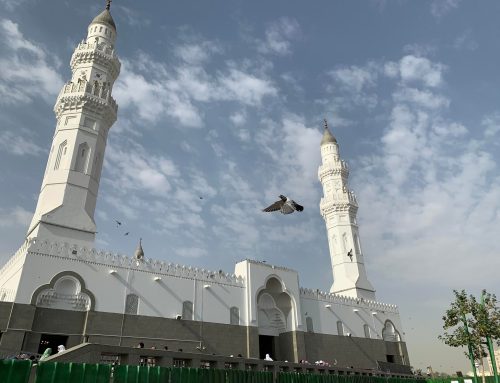
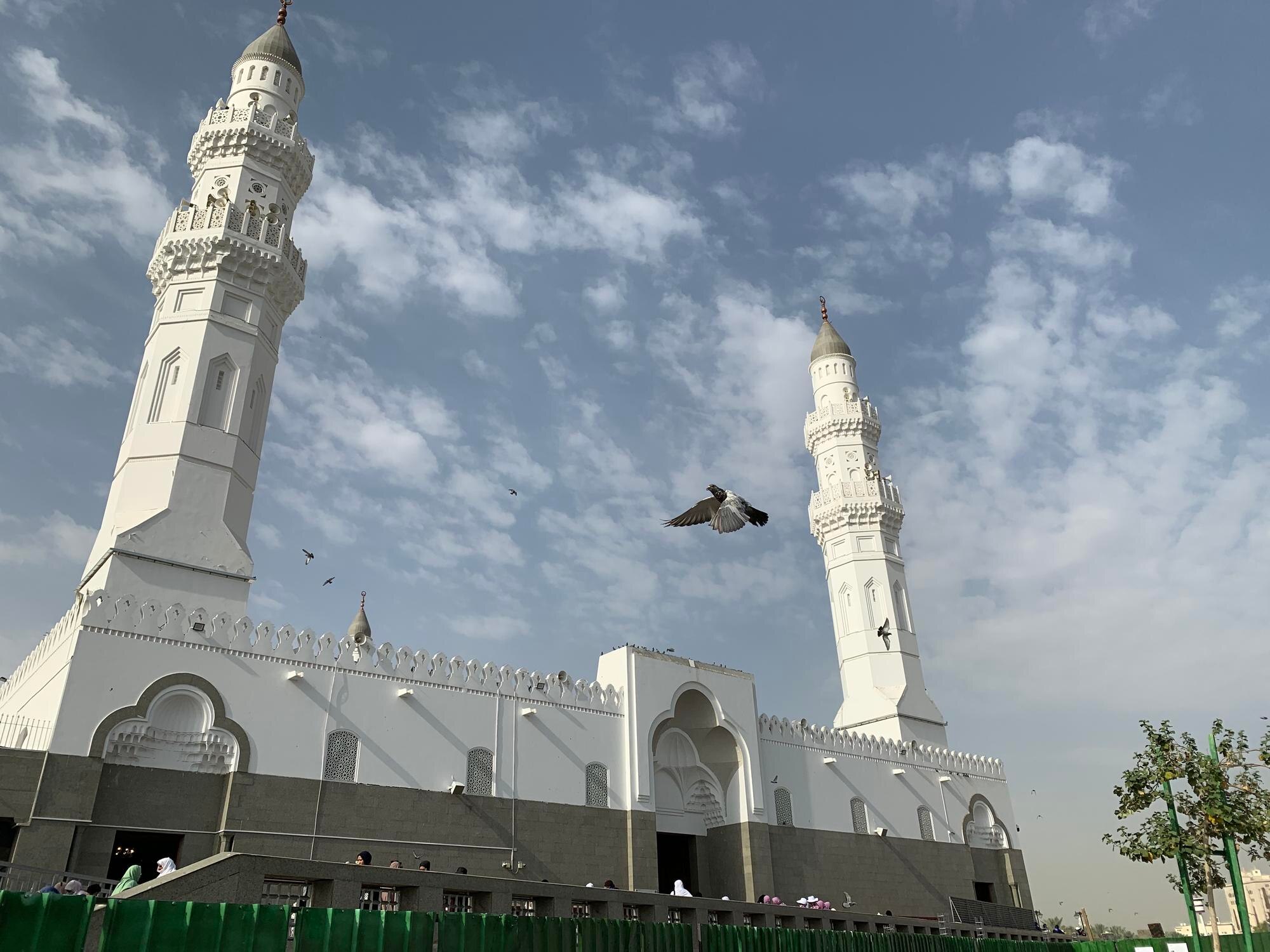
Because this article leads firmly with the fact that there is nothing to see at Masjid al-Dirar’s own site, it is worth setting out concretely what a visit to Masjid Quba involves, since that is the recommended destination for anyone drawn to this part of the seerah. The mosque as it stands today, as of July 2026, is a large, modern structure built around and expanded far beyond its original modest footprint, with capacity reported at around sixty-six thousand worshippers following the expansion carried out under King Salman, itself built on earlier expansions dating to the caliphates of ‘Uthman ibn ‘Affan and the Umayyad governor ‘Umar ibn ‘Abd al-‘Aziz, and further renovation under King Fahd. It is open for the five daily prayers and receives visitors throughout the day; many pilgrims aim to arrive on a Saturday, in keeping with the reported pattern of the Prophet’s ﷺ own visits, though there is no requirement to visit on that day specifically and the reward described in the hadiths above is not restricted to it. The walk or short drive from Masjid an-Nabawi covers the same general ground the returning Tabuk army would have crossed on its way back into the city after the stop at Dhu Awan and the destruction of the rival mosque – a detail that gives the walk a certain narrative continuity for a visitor who has read this article and the guide’s separate treatment of Quba together.
What not to expect
Visitors sometimes arrive at Quba expecting a preserved, ancient structure comparable to what survives at some other early Islamic sites; almost nothing of the seventh-century building remains visible in the heavily rebuilt modern mosque, and the historical value of a visit lies in the mosque’s continuous identity and location across fourteen centuries rather than in any surviving physical fabric from the Prophet’s ﷺ own time. This is worth saying plainly so as not to create a disappointed expectation, and it applies with even greater force to any search for Masjid al-Dirar’s location, where not even a rebuilt structure exists to visit.
Practical Visitor Guide
Begin with the plain fact: there is nothing to visit. Masjid al-Dirar has not existed as a standing structure since the year 9 AH, when the Prophet ﷺ ordered it burned and pulled down on his return from Tabuk, and no mosque, marker, or ruin has occupied a confirmed identification of its site in the centuries since. The classical topographers placed it near Masjid Quba, on ground that was afterward used, by report, as a dumping ground; the modern city of Madinah has grown up over and around that entire district, and nothing in the area’s current urban fabric is reliably identified with the original site by scholarly consensus. If a guide, driver, or fellow traveller in Madinah points to a specific plot of ground, a wall, or an unmarked structure near Quba and states with confidence that it is the site of Masjid al-Dirar, that claim should be treated with real scepticism. It is very unlikely to rest on anything more solid than local tradition passed between guides, and this guide has found no scholarly survey that fixes the site with precision sufficient to support such a claim.
The honest and worthwhile alternative is Masjid Quba itself, which stands a short distance away – commonly given as approximately three to four kilometres from Masjid an-Nabawi in the city centre, connected today by a paved pedestrian route that many pilgrims walk directly between the two mosques. Quba is not simply a nearby site; it is the very mosque this one was built to rival and to divide worshippers away from, and visiting it – and reading its own history, which this guide covers separately – gives you the genuine counterpart to everything discussed in this article. Many pilgrims and residents of Madinah make a point of visiting Quba to pray two rak’ahs there, following the hadith recording that the Prophet ﷺ did so habitually, and hoping for the reward likened to an ‘Umrah described in the hadiths cited above. There is no comparable devotional practice attached to the site of Masjid al-Dirar, and none should be invented or sought there; the entire point of its history is that it was removed from sanctioned devotional use by revelation, permanently.
If your itinerary in Madinah includes the cluster of early mosques around Quba – a common stop for visitors interested in the seerah – treat any specific claim about Masjid al-Dirar’s location as background history rather than a site to seek out, take photographs of, or treat with any devotional expectation.
Common Misconceptions
The location shown to tourists
The most common misconception a visitor to Madinah is likely to encounter is a confident, specific pointing-out of “the site of Masjid al-Dirar” somewhere in the streets around Quba. As stated in the practical guide above, no scholarly source consulted for this article fixes the location with the precision such claims imply. Local guides sometimes repeat older oral traditions with more confidence than the underlying sources support. This is not a claim of deliberate deception – it is simply how local tradition tends to work at sites with no surviving physical remains – but visitors should recognise the difference between a plausible general area, attested by al-Samhudi and other classical topographers, and a specific plot of ground, which is not attested with the same certainty.
The fiqh label used as a weapon
A second and more serious misconception concerns how the term masjid dirar is used today. Because the Qur’an’s condemnation of the original mosque is so total and its demolition so clearly commanded, the label carries unusual force: to call a mosque a masjid dirar is to invoke prophetic precedent for its demolition. This makes the label attractive in exactly the situations where it is hardest to apply correctly – disputes between rival congregations, competing factions within a single Muslim community, or arguments over whether a newly built mosque was raised out of genuine need or out of rivalry and spite.
Islamic legal literature, including fatwa forums and answers from recognised fiqh authorities, shows this pattern recurring in various local disputes: one group builds a second mosque in a town or neighbourhood already served by an existing one, and members of the original congregation label the new mosque a masjid dirar, sometimes calling for its closure or demolition, while the builders of the new mosque insist their motive was genuine need – overcrowding, doctrinal difference in matters of permissible practice, distance, or simple convenience – and reject the accusation entirely. Fiqh authorities responding to such disputes have generally been cautious on exactly this point: the ruling on Masjid al-Dirar in the Qur’an rested on a directly revealed disclosure of intention, communicated to the Prophet ﷺ by Jibril himself. No later authority has access to comparable certainty about any individual’s or any group’s hidden motive. Jurists writing on this subject, from al-Qurtubi onward, have therefore built proportionality and genuine need into the test – is the district large enough to need a second mosque, would the existing mosque be left empty and abandoned, is there an identifiable and provable intention to harm – precisely because the bare fact of a second mosque being built near a first one is not, on its own, evidence of the kind of intention the Qur’an condemned.
This guide takes no position on any specific dispute, historical or contemporary, in which the masjid dirar label has been invoked, and names no living party, community, or sect in connection with it. The point worth understanding is structural: a legal category defined by an unusually severe and rare form of proof – direct revelation – has, in ordinary human hands, sometimes been applied on the basis of suspicion, rivalry, or sectarian disagreement instead. Readers encountering the term used polemically, in any context, should recognise that its correct application requires a standard of evidence about intention that is rarely available to human judges, however contested by a mosque’s origins.
The ziyarah-legitimacy question
Because Masjid al-Dirar’s site lies near Masjid Quba and within the general cluster of early Islamic sites in Madinah that draw visitor interest, it is worth setting out plainly what the mainstream scholarly position holds about visiting historical sites in Madinah and Makkah for spiritual reasons, since the same question arises at nearly every site in this guide besides the handful with clear standing in the sunnah.
Ibn Taymiyyah, and in the modern period Ibn ‘Uthaymeen and the Permanent Committee for Islamic Research and Ifta (al-Lajnah al-Da’imah) in Saudi Arabia, have held that only a short, specific list of sites carries a basis in the sunnah for intentional devotional visitation with the expectation of religious reward: the Sacred Mosque in Makkah, the Prophet’s ﷺ Mosque in Madinah, the Prophet’s ﷺ grave, Jannat al-Baqi, the graves of the martyrs of Uhud, and Masjid Quba itself, all of which the Prophet ﷺ is reported to have visited or instructed his companions to visit with clear devotional intent (see, for a representative statement of this position, Islam Question and Answer, answer 11669). Other historical sites connected to the seerah – including the site associated with Masjid al-Dirar – are treated by scholars holding this view as historically and educationally valuable, worth knowing about and understanding as part of the Prophet’s ﷺ biography, but not as places where visiting itself, or performing acts at the site, carries a distinct religious reward. The Permanent Committee has specifically cautioned against travelling to climb mountains or seek out caves associated with the seerah with the intention of ziyarah, and against touching, rubbing, or tying cloth to stones, trees, or railings at historical sites in the hope of blessing (barakah).
This is a position held by a particular body of scholarship, named here as such, and it is not universal. Many scholars in the broader Sufi and traditionalist currents of Islamic thought take a wider view of tabarruk – seeking blessing through proximity to places and objects connected to righteous people and events – and would not draw the line as narrowly. This guide does not adjudicate between these positions. What can be said plainly is that Masjid al-Dirar’s own history makes the question almost moot in its specific case: there is no structure, no marker, and no reported practice of devotional visitation attached to its site in any source consulted here, on either side of this scholarly debate. Interest in the location is properly understood as historical curiosity about the seerah, not as a devotional practice with disputed legitimacy in the way climbing a mountain or seeking a cave might be.
The idea that this event condemns mosque-building generally
A further misconception worth heading off is the idea that the Masjid al-Dirar episode casts general suspicion on the building of new mosques, or on more than one mosque existing in the same town. It does not. The Qur’an’s condemnation targets a specific, proven set of intentions – harm, disbelief, division, and service as a hostile outpost – not the act of mosque-building itself, which the Qur’an and hadith praise extensively elsewhere; a well-known hadith recorded in the collections states that whoever builds a mosque for God, God builds for him a house in Paradise. The jurists who built the fiqh category of masjid dirar out of this episode were careful, as shown above, to require genuine evidence of harmful intent or the absence of real need before applying the ruling, precisely so that the exception did not swallow the general rule that building mosques is a praiseworthy act.
How the story reached the exegetes
It is worth noting briefly how the tafsir tradition itself came to record this episode in such consistent detail across independent commentators. Ibn Kathir’s account, the fullest available in accessible English translation, draws on earlier reports transmitted through Ibn ‘Abbas via ‘Ali ibn Abi Talhah’s recension of his exegetical teaching, a chain frequently used in early tafsir compilation and generally regarded by hadith critics as containing acceptable, if not the strongest, transmission for exegetical rather than legal material. Al-Qurtubi, writing roughly two centuries after Ibn Kathir’s own sources but drawing on much the same body of early reports, arrives independently at the same core narrative – Abu ‘Amir’s instigation, the builders’ request, the deferral, and the revelation at Dhu Awan – which is one reason the broad outline of the story is treated by the exegetical tradition as settled even though it does not carry the isnad-by-isnad certification of a hadith proper. Al-Razi, writing in the Persian and Arabic philosophical-theological tradition of tafsir rather than the more purely narrative-historical tradition of Ibn Kathir, engages the same events more briefly, focusing his attention on the theological weight of the crumbling-cliff metaphor in verse 109 rather than on narrative reconstruction, which is why this article draws more heavily on Ibn Kathir and al-Tabari for narrative detail and on al-Razi chiefly for the closing verses’ theological interpretation.
Lesser-Known Facts
- The number of builders is disputed even within the earliest sources: Ibn Ishaq’s list, as transmitted by Ibn Hisham and largely followed by al-Tabari, names twelve men, while al-Waqidi’s account gives fifteen – a discrepancy the classical historians never resolved.
- One of the builders’ relatives, ‘Abbad ibn Hunayf, was the brother of Sahl ibn Hunayf, the companion who later transmitted the hadith praising the virtue of prayer in Masjid Quba – meaning the story of the false mosque and the story of the genuine one’s reward passed, in this one case, through the same family.
- Abu ‘Amir al-Rahib’s own son, Hanzala ibn Abi ‘Amir, fought and died on the Muslim side at the Battle of Uhud and became known as Ghasil al-Mala’ika, “the one washed by the angels,” after the Prophet ﷺ reported seeing angels washing his body – one of the more striking father-son contrasts in the entire sira.
- The request the builders brought to the Prophet ﷺ was framed, according to al-Tabari’s history, as a mosque built specifically “for the sick and needy and for rainy and cold nights” – a charitable justification that made the request harder to refuse outright and gave the Prophet ﷺ grounds for a polite deferral rather than immediate suspicion.
- The two men sent to burn the mosque, Malik ibn al-Dukhshum and Ma’n ibn ‘Adi, were drawn deliberately from the same clans as the builders – Malik from the Banu Salim ibn ‘Awf and Ma’n (or his brother ‘Asim) from the Banu al-‘Ajlan – a detail suggesting the Prophet ﷺ chose men who could act with the local knowledge and standing needed to carry out the order swiftly and without wider clan conflict.
- According to al-Tabari’s account, Malik ibn al-Dukhshum did not carry fire with him from the outset; he stopped at his own clan’s quarter along the way specifically to obtain a lit palm branch before proceeding to the mosque.
- The tenth-century geographer al-Muqaddisi, writing more than three centuries after the event, still recorded local memory of the site as the place of “the mosque of mischief,” describing its destruction as an act in which “the people performed a pious deed” – showing that the site’s association with condemnation persisted in local memory for generations after the physical structure was gone.
- The fiqh category built from this episode has been invoked by state religious authorities in the modern period for purposes unrelated to sectarian rivalry: Egypt’s Dar al-Ifta, for instance, has applied the masjid dirar concept to mosques built specifically to circumvent secular land-use and building regulations, treating the misuse of mosque status as a form of the same underlying wrong the Qur’an condemned.
Timeline
- Pre-Islamic period: Abu ‘Amir ‘Abd ‘Amr ibn Sayfi, later known as Abu ‘Amir al-Rahib, establishes himself as a Christian ascetic and respected religious figure among the Aws of Madinah.
- 1-2 AH (622-624 CE): Following the Hijrah, Abu ‘Amir rejects the Prophet’s ﷺ message after a direct confrontation and leaves Madinah for Makkah, joining the Quraysh against his own former people.
- 3 AH (625 CE): Abu ‘Amir takes part in the Battle of Uhud on the Quraysh side, reportedly devising the pit trap that injures the Prophet ﷺ; his son Hanzala ibn Abi ‘Amir fights and is killed on the Muslim side in the same battle.
- 8 AH (630 CE): Following the conquest of Makkah, Abu ‘Amir flees to Byzantine territory and seeks the support of Emperor Heraclius for a future campaign against the Muslims.
- Early-to-mid 9 AH (630 CE), shortly before the Tabuk expedition: Acting on Abu ‘Amir’s instructions sent from exile, a group of Madinan hypocrites construct a mosque near Masjid Quba and ask the Prophet ﷺ to pray in it before he departs for Tabuk; he defers the request until his return.
- Rajab 9 AH (October 630 CE): The Tabuk expedition itself takes place while the new mosque stands unused by the Prophet ﷺ.
- On the return march, at Dhu Awan, 9 AH (630 CE): Revelation discloses the true purpose of the mosque; Qur’an 9:107-110 is revealed, and the Prophet ﷺ dispatches Malik ibn al-Dukhshum and Ma’n ibn ‘Adi (or ‘Asim ibn ‘Adi) to destroy it before he reaches Madinah.
- 9 AH (630 CE), shortly after the return from Tabuk: The mosque is burned and demolished; its site is afterward reported to have been used as a dumping ground.
- 9 or 10 AH (630-631 CE): Abu ‘Amir al-Rahib dies in exile in Byzantine territory, having never returned to Arabia.
- Ninth/tenth century CE: The geographer al-Muqaddisi records local memory of the site’s history in his description of the Hijaz.
- Fifteenth-sixteenth century (d. 911 AH/1506 CE): Al-Samhudi documents the Madinan topographical tradition placing the site near Quba in his history of the city, Wafa’ al-Wafa.
- Seventeenth century: The North African traveller Abu Salim al-Ayyashi transmits and repeats al-Samhudi’s identification of the site in his own travel account.
- Present day (as of July 2026): No structure, marker, or confirmed archaeological identification of the site survives; the area lies within the built-up urban fabric of modern Madinah near Masjid Quba, and any specific identification offered to visitors should be treated with caution.
Key Lessons
Historical
The Tabuk campaign exposed fault lines within the Madinan community that had been building for years, and Masjid al-Dirar represents the most institutionally ambitious response the hypocrite faction ever attempted – not open rebellion, but the construction of a parallel, respectable religious institution designed to consolidate their position while appearing entirely conventional. Understanding this episode helps explain why the Qur’an’s treatment of the hypocrites throughout Surah al-Tawbah is so unusually direct and detailed: this was a real, organised, and nearly successful attempt to establish an alternative centre of religious authority within the Muslim community itself, backed by a leader in active contact with a foreign power.
Spiritual
The episode establishes, with unusual clarity, that outward religious form carries no independent value or protection when the intention behind it is corrupt – a mosque, the most visibly sacred kind of building in Islam, offered its builders no shelter once their intention was disclosed. The lesson is not that religious institutions or buildings are suspect, but that sincerity of intention is the measure God applies, regardless of how convincing or charitable the outward justification appears to human observers.
Personal
Verse 109’s image of a building founded “on the edge of a crumbling cliff” applies well beyond the specific case of a mosque: any project, relationship, or commitment built on a foundation that will not bear examination – however well-constructed it appears on the surface – carries the same instability within it. The episode invites honest self-examination of the intentions underlying one’s own commitments, not as an exercise in scrupulosity, but as recognition that foundations matter more than appearances in the long run.
Practical
For a visitor to Madinah, the practical lesson is straightforward: this is a site defined by absence, and that absence is itself the point. There is no reward, blessing, or historical value to be gained from seeking out an unmarked plot of ground on the strength of an uncertain identification. The site’s entire significance lies in the story and the revelation attached to it, not in any physical remains, and that story is best engaged through the text of the Qur’an, the tafsir tradition, and a visit to the genuine, nearby alternative of Masjid Quba.
Authentic Sources
Primary Islamic Sources
The Qur’anic text of 9:107-110, cited above from Quran.com, is the foundational source for this article and is not subject to the same evidentiary caveats as historical or hadith material. Hadith cited in this article are drawn from Sahih Muslim, Jami’ al-Tirmidhi, and Sunan Ibn Majah, with gradings noted individually in the Hadith References section above. Sira and historical narrative material is drawn principally from Ibn Ishaq’s Sirah as preserved in Ibn Hisham’s recension, and from al-Tabari’s Tarikh al-Rusul wa’l-Muluk (History of the Prophets and Kings), consulted in the English translation published as The History of al-Tabari, Volume 9. Readers should bear in mind, as this article has flagged at each relevant point, that sira material of this kind is transmitted as historical reportage rather than as chain-graded hadith; Ibn Ishaq’s list of the twelve builders in particular carries no isnad verified to hadith-critical standards, and al-Waqidi’s alternative figure of fifteen builders illustrates the kind of discrepancy this transmission method produces. Al-Waqidi’s own historical reliability has long been questioned by hadith critics including Ahmad ibn Hanbal, al-Bukhari, and al-Nasa’i, who considered him weak as a transmitter, even though his historical compilations remain widely used as a source of narrative detail alongside Ibn Ishaq and al-Tabari.
Classical Scholars and Commentators
The tafsir material in this article draws on Ibn Kathir’s Tafsir al-Qur’an al-‘Azim, consulted via its English rendering on Quran.com; al-Qurtubi’s al-Jami’ li-Ahkam al-Qur’an, consulted through secondary academic and fatwa-literature citation where the primary text was not directly accessible in full; and al-Razi’s Mafatih al-Ghayb, referenced for its treatment of the crumbling-cliff metaphor in verse 109. The jurisprudential discussion draws on Ibn Muflih’s al-Furu’, which preserves Imam Ahmad ibn Hanbal’s rulings on building mosques near existing ones and records Ibn Taymiyyah’s selection among the transmitted Hanbali positions, and on secondary literature attributing a parallel position to Ibn Qudamah’s al-Mughni, a specific attribution this article was not able to verify directly against a confirmed primary edition and flags accordingly. Al-Samhudi’s Wafa’ al-Wafa bi-Akhbar Dar al-Mustafa is the source, transmitted through Abu Salim al-Ayyashi’s travel account, for the topographical identification of the site near Quba.
Modern Academic and Reference Sources
Modern discussion of the site’s location and of Masjid Quba’s development draws on an academic paper on Masjid Quba’ published through the International Islamic University Malaysia’s institutional repository, which transmits al-Samhudi’s account of the refuse ground near Quba via Abu Salim al-Ayyashi and cites al-Muqaddisi’s geographic description. The discussion of modern fiqh applications and the risk of the masjid dirar label being misapplied in communal disputes draws on published fatwa literature including a ruling from Egypt’s Dar al-Ifta on mosques built to circumvent building regulations and a fatwa from Islamweb (Qatar’s Ministry of Awqaf and Islamic Affairs) on building a new mosque next to an existing one, both of which set out the proportionality and genuine-need tests jurists apply. The ziyarah-legitimacy position of Ibn Taymiyyah, Ibn ‘Uthaymeen, and the Permanent Committee is represented by Islam Question and Answer, answer 11669. Background on Abu ‘Amir al-Rahib and his son Hanzala ibn Abi ‘Amir was cross-checked against the general historical summaries at Wikipedia’s article on the Demolition of Masjid al-Dirar and WikiShia’s article on Masjid al-Dirar, both of which were used only to cross-reference names and sequence against the primary sira and tafsir material cited above, not as standalone authorities. Current distances between Masjid Quba and Masjid an-Nabawi were checked against contemporary Madinah visitor-information sources current as of July 2026.
A Note on Method
This article distinguishes deliberately between three tiers of material. The Qur’anic text and its classical tafsir form the first and most secure tier, followed closely by the two authenticated hadiths bearing on the identity of “the mosque founded on taqwa,” both drawn from canonical Sunni collections with explicit gradings given above. The second tier is sira material – the sequence of events, the names of the builders, and the account of the demolition – which this article treats as historically reliable in its broad outline, since it is corroborated across Ibn Ishaq, al-Tabari, and the tafsir tradition, but which does not carry the same chain-verified certainty as hadith, and where the sources themselves visibly disagree (twelve builders against fifteen, Ma’n ibn ‘Adi against his brother ‘Asim) this article has reported the disagreement rather than silently choosing one figure. The third tier is legendary or folkloric embellishment – such as the report about Abu Lubabah’s house built from the demolished mosque’s timber and the claim that no bird nested near it – which this article has flagged explicitly as unverifiable rather than presenting as established history. Where this research could not verify a specific claim, such as the precise primary-text location of Ibn Qudamah’s treatment of masjid dirar in al-Mughni, or could not locate a direct English rendering of al-Razi’s full commentary on these verses, that limitation has been stated directly rather than smoothed over.