Thaniyat al-Wada: The History of Madinah’s Pass of Farewell and the Song of the Full Moon
On the edge of old Madinah, where the built-up streets give way to the dark basalt of the surrounding harrah, travellers once climbed a rise in the road, looked back at the palm groves and the mosque of the Prophet ﷺ, and said their goodbyes. This rise was called Thaniyat al-Wada, the Pass of Farewell. It is one of the most quoted place names in the entire seerah, sung about, wept over, and argued over for fourteen centuries, and yet it is also one of the least settled. Any honest history of Islamic Madinah has to begin with an uncomfortable admission: no one today can say with certainty which physical hill the earliest Muslims meant when they used the name.
This article is a ziyarah guide to Thaniyat al-Wada in the fullest sense of the word — not only a description of what a visitor to Madinah can see today, but an account of how classical Muslim topographers argued about the location, what the authentic hadith literature actually says happened there, and what should honestly be said about the famous song Tala al-Badru Alayna, which every visitor to Madinah has heard and which almost every guidebook mis-describes. It draws on the Sahih collections, on the Madinan topographical tradition beginning with al-Samhudi, and on the work of later historians and researchers who have tried, and largely failed, to resolve the dispute definitively. Where the sources disagree, this guide reports the disagreement rather than manufacturing a false certainty. That is the only way to write an honest history of Madinah historical places.
Two Passes, One Name: The Unresolved Location of Thaniyat al-Wada
The word thaniyyah in classical Arabic topography means a mountain pass, a track cut through high ground, or simply a rise where the land folds back on itself — from the root th-n-y, “to bend” or “to double.” A thaniyyah is not a proper name in itself; it is a landform, and Madinah had several of them ringing the city, each known by its own qualifier: Thaniyat Ath’ath near Jabal Sulay, Thaniyat al-Hawd on the Aqiq watercourse, Thaniyat al-Sharid between Jabal Ayr and al-Fara. The one that concerns this guide is the thaniyyah that came to be known, before and after Islam, as the place of farewell — where those leaving Madinah were accompanied by their families to the edge of the settled land, and where those returning were met and welcomed. Almost every historian agrees on this basic sense of the name. Almost none of them agrees on exactly where it was.
The medieval and modern sources converge on a striking fact: Madinah appears to have had two locations called Thaniyat al-Wada, on opposite sides of the city, and both names survived into the topographical literature side by side. The disagreement is not about whether one existed — it is about which of the two, if only one, is the Thaniyat al-Wada of the sirah reports, and in particular the Thaniyat al-Wada from which the Ansar are said to have watched for the Prophet ﷺ.
The northern pass sat on the Syria road, close to the area historians call the “Shami” (northern) approach to Madinah, near Bab al-Shami and running toward Jabal Sil. It stood, by the description preserved in the Madinan topographical tradition, between a small hill called al-Jareen al-Foqani and a larger rise called al-Jareen al-Tahtani, also known as Jabal al-Rayah because a mosque called Masjid al-Rayah stood on it. Both of these small mosques were, according to the sources, first established by the Umayyad-era governor and later caliph Umar ibn Abd al-Aziz, which if accurate would put a formal religious structure at the northern pass by the early second century after the Hijrah. This is the pass most closely tied in the hadith literature to two specific events: the horse race the Prophet ﷺ organised between Al-Hafya and Thaniyat al-Wada, and the reception of returning raiding parties and armies, including, on the well-known account, the Prophet’s ﷺ own return from the campaign of Tabuk.
The southern pass sat on the road toward Makkah, close to Masjid Quba, on the approach a traveller from the direction of Makkah would use to enter Madinah. The medieval geographer Yaqut al-Hamawi, in his dictionary Mu’jam al-Buldan, describes a Thaniyat al-Wada as a pass overlooking Madinah, trodden by “whoever wants Makkah” — that is, on the Makkah-facing side of the city. In the Ottoman period a castle, now called Qal’at Quba (Quba Castle), was built on or near this southern site using stone brought partly from the Jamawat hills in the Urwah area and partly from red rock in the Sultanah area; the fortress is still standing and is now the feature most often pointed to when people speak of the “southern Thaniyat al-Wada.”
Both locations are called by the same name in the sources, and both have serious classical advocates. This guide will not adjudicate between them — no ziyarah article honestly can — but it will set out, as fully as the sources allow, why each has been argued for, because both possibilities matter to how the reader understands the famous accounts of the Prophet’s ﷺ arrival at Madinah and the songs sung about it.
Al-Samhudi and the Case for the Northern Pass
Nur al-Din Ali al-Samhudi (d. 911 AH / 1506 CE), the Mamluk-era Madinan scholar whose Wafa al-Wafa bi-Akhbar Dar al-Mustafa remains the single most authoritative topographical history of Madinah ever written, addressed this dispute directly and came down firmly on the side of the northern pass. Al-Samhudi placed Thaniyat al-Wada in what he called the “Shami” — the northern — quarter of Madinah, specifically between Masjid al-Rayah, which stood on the hill called Dhubab, and a site called Mashhad al-Nafs al-Zakiyyah. He described the pass as the point where a traveller walks between two raised flanks of ground close to Jabal Sil, entering the city from the north. Al-Samhudi did not merely record this as one opinion among several; later Madinan historians report that he actively argued against the alternative identification, marshalling what one modern researcher summarised as “compelling evidence” for the northern site. Two later topographers who followed him on this point by name are al-Khiyari and al-Ansari, both of whom are recorded as agreeing with al-Samhudi’s placement.
The strongest textual support cited for al-Samhudi’s northern identification is a passage from Ibn Qayyim al-Jawziyyah’s Zad al-Ma’ad, in which Ibn al-Qayyim states plainly that “from the direction of Syria are the Thaniyyat al-Wada, and one coming from Makkah never treads it at all.” Later scholars who favoured the northern identification, including the compilers of the Madinan topographical tradition represented in works such as al-Maghanim al-Mutabah fi Ma’alim Tabah, cited this line as decisive: if the pass on the Syria road is never touched by a traveller coming up from Makkah, then the two “Thaniyat al-Wada” locations must be genuinely distinct places that happen to share a name, and the well-attested hadith material — the horse race, the reception of the Tabuk expedition — clearly belongs to the northern one. The Hijazi topographer Muhammad al-Bilaadi, in his modern reference work Mu’jam Ma’alim al-Hijaz, reached the same conclusion after reviewing al-Samhudi’s arguments, describing the northern pass as lying at the northeastern edge of Jabal Sil, from which roads ran toward al-Uyun, al-Ghabah, and Sultan, and concluding that al-Samhudi’s evidence made the northern identification the preferable one for the Prophet’s ﷺ Hijrah arrival as well — though, as will be discussed below, this last point is exactly where the argument becomes most contested.
The Case for the Southern Pass, and the Weight of “The People of Sirah and History”
Against al-Samhudi’s preference stands an older and, in terms of sheer citation count, more heavily attested tradition that places the historically significant Thaniyat al-Wada — the one tied to the Hijrah and to the song sung for the Prophet ﷺ — on the Makkah side of the city, near Quba. Yaqut al-Hamawi’s description, already quoted, explicitly locates it on the side “trodden by whoever wants Makkah.” The Madinan scholar al-Majd (Majd al-Din al-Fayruzabadi, author of al-Maghanim al-Mutabah) reproduces Yaqut’s wording verbatim and then adds his own gloss: “This is what the people of sirah and history and the writers on routes (ashab al-masalik) say — that it is on the side of Makkah. But the people of Madinah today think it is on the side of Syria.” Al-Majd goes on to suggest that this popular shift in belief followed Ibn al-Qayyim’s statement in Zad al-Ma’ad, and he proposes the same reconciliation that later writers would repeat: both places are legitimately called Thaniyat al-Wada, so Madinah in effect has two Thaniyat al-Wada passes, and reports naming the location do not necessarily contradict one another.
Twentieth- and twenty-first-century Madinan researchers have continued this argument in print. The historian Abdullah ibn Mustafa al-Shanqiti, writing in Madinah’s local press, argued that the historically significant Thaniyat al-Wada lies not merely broadly to the south but specifically in the Harrat al-Asbah southwest of Quba, along the route he identifies as the path the Prophet ﷺ actually walked on his approach to Quba from Makkah — a route with, he notes, multiple genuine thanaya (the plural form), which he argues matches the plural “Thaniyyat” used in the song lyric, whereas the northern site is a single pass and would properly take the singular. Al-Shanqiti also pointed to the wide scholarly acceptance of the “Tala al-Badru Alayna” report itself as corroborating evidence for a southern location, notwithstanding the separate and serious question — addressed fully later in this guide — of whether that report’s chain is sound enough to settle a historical or geographical question at all.
Other Madinan researchers have pushed back hard on al-Shanqiti’s southern relocation. Dr Tunaydib ibn Awadah al-Faydi, a former director of boys’ education in Madinah, is on record rejecting the idea of any historical pass south of the city outright, arguing that Madinah’s only historically attested entrances were from the north — because harrah lava fields close off the other approaches — and that the shepherds and old topographers of the region never spoke of any thaniyyah to the south. On this view there were multiple named rises east of Jabal Sil forming the northern pass complex — one where a small hill and mosque once stood at what is now the mouth of the al-Manakhah tunnel, and a second behind it formed by Jabal al-Rayah — but nothing comparable in the south. Al-Faydi accepts that a descent called al-Mudarraj exists in the western harrah leading down to Wadi al-Aqiq, but denies this is the Thaniyat al-Wada of the sources, and he argues that the famous song, if it is accepted as a real historical event at all, belongs to the reception of the Prophet ﷺ on his return from Tabuk at the northern site — the “well-known” position, in his phrase, requiring “no further proof.”
A third position, attempting to split the difference, comes from Dr Sulayman ibn Dafi al-Ruhayli, dean of the College of Arts at Taibah University, who has suggested that Madinah likely had farewell points in both directions for different kinds of journeys — one for travellers heading toward Makkah in the south, another for those heading toward Syria in the north — and that the historical evidence is strong enough to support the “Tala al-Badru Alayna” report having been recited on at least two separate occasions: once for the Prophet’s ﷺ arrival from Makkah during the Hijrah, and again for his return from the campaign of Tabuk. Al-Ruhayli has stated a personal inclination toward the view that the Prophet ﷺ entered Madinah from the south during the Hijrah, but frames this as a leaning rather than a settled conclusion.
What Exists Today, as of July 2026
Whatever the ancient dispute, modern Madinah has physically resolved a good part of the question by demolition and urban growth, and any visitor guide has an obligation to say so plainly rather than sending readers to look for something that is no longer there.
The Saudi government’s own historical-sites reference work states in direct terms that the hillock associated with the northern pass — the small basalt rise, no more than about five metres high, that once carried a small mosque called Masjid Thaniyat al-Wada on its summit — was completely removed in 1406 AH (1985–86 CE), in order to widen the town square and extend the exit of the al-Manakhah road tunnel. Nothing of the original landform survives at that spot today. What stands in the area now is modern city fabric: the junction of Sayyid al-Shuhada Road and the road known locally as Sultanah (formally Abu Bakr al-Siddiq Road), around 1,100 metres northwest of the Prophet’s ﷺ Mosque, in the district where Sultanah Road’s markets and shopping frontage now run. A second, taller rise behind the demolished one, associated with Jabal al-Rayah and the mosque of the same name, is reported by Madinah’s local press to still exist along with its mosque, though heavily built around by the modern city. A separate small mosque, called Masjid al-Sabaq (the Mosque of the Race), was constructed roughly in the middle of the old plain to mark the site of the Prophet’s ﷺ horse race to Thaniyat al-Wada; the current building dates to the reign of King Faisal ibn Abd al-Aziz, rebuilt in 1391 AH, and stands about 520 metres from the Prophet’s Mosque’s expansion boundary, visible from the inside of the Abu Bakr al-Siddiq (Sultanah) road tunnel.
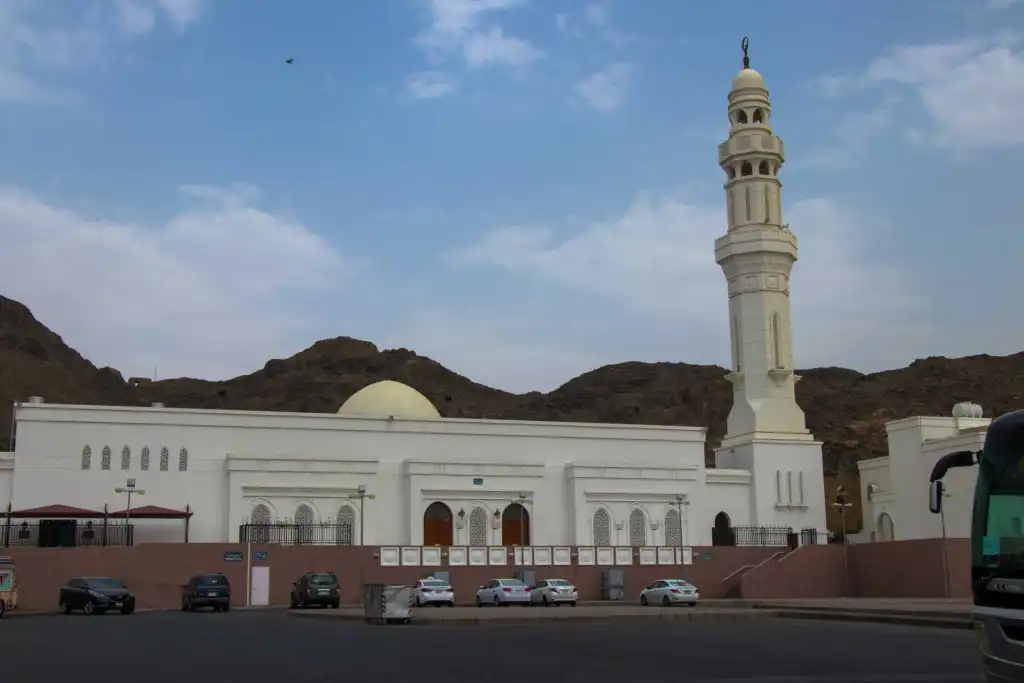
At the southern site, near Masjid Quba, the Ottoman-era fortress known today as Quba Castle stands on or beside the location historians associate with the southern Thaniyat al-Wada. This structure survives and is physically visitable as part of the wider Quba precinct, though it is presented to visitors primarily as an Ottoman fortification and way-station rather than as a marked “Thaniyat al-Wada” ziyarah site in its own right.
In practice, this means a visitor to Madinah in 2026 will not find a signed, universally agreed “Thaniyat al-Wada” monument comparable to the clarity of, say, Masjid Quba or Jabal Uhud. What exists is: a demolished landform at the traditionally cited northern site, now under city streets and a shopping district; a second, lesser-known northern rise with its old mosque, standing but unmarked for tourism; a horse-race memorial mosque nearby; and, several kilometres south, an Ottoman castle popularly but not universally identified with the second, older Thaniyat al-Wada. Signage, where it exists at all, is inconsistent — some local guiding companies and Madinah heritage tour operators refer to “Thaniyat al-Wada” stops in their walking itineraries, but these are guide-narrated identifications rather than government historical markers, and different guides point to different spots depending on which topographical tradition they follow. This guide reports that state of affairs honestly rather than pretending a settled site exists.
The Pass in the Topography of Madinah: Roads, Farewells, and a Pre-Islamic Legend
To understand why a hilltop on the edge of town mattered enough to be remembered for fourteen centuries, it helps to picture pre-modern Madinah as it actually sat in its landscape. The settled oasis occupied a basin ringed by black volcanic rock fields, the harrat, with two dominant lava flows — Harrat al-Wabarah to the west and Harrat Waqim to the east — pressing close against the city on either side. Palm groves and the built quarters of the Aws and the Khazraj filled the middle ground. Roads leaving the city had to find their way through gaps in this ring of stone, and the point where a road crested the final rise before the harrah opened out into open desert or onto the routes toward other towns was, by long-standing Arabian custom, the natural place to say goodbye. This is the plain sense of the word thaniyyah in its everyday use across the Hijaz: not a monument but a geographical bottleneck, the last visible high point from which a traveller could look back at home.
Madinah had several such points, but two carried the specific name Thaniyat al-Wada because of the customs attached to them. Along the northern approach, the road running past Jabal Sil toward Khaybar and, further on, toward Tabuk and Syria, climbed through the pass associated with al-Jareen al-Foqani and al-Jareen al-Tahtani before dropping toward the open country beyond. Along the southern and western approach, travellers heading toward Makkah crossed a comparable rise near Quba, on the edge of Harrat al-Asbah, before beginning the long desert road south. Arabian custom, well attested across pre-Islamic and early Islamic sources, held that those seeing off a departing traveller — a raiding party, a trade caravan, a family member undertaking Hajj or a journey for any other reason — would walk with him as far as the edge of the settlement, and no further; the thaniyyah, the last rise before open country, became the conventional stopping point for that farewell. The reverse held for arrivals: children and young people in particular would run out to the thaniyyah to catch the first sight of returning travellers, camel-riders visible from a distance against the horizon, and would escort them back into the town. Several classical glossators make this the plain, most probable etymology of the “Wada” (farewell) name, ahead of the more colourful alternative explanations discussed below.
One alternative explanation ties the name to the Prophet ﷺ himself: the claim that he personally bade farewell at this spot to certain people he was leaving behind in Madinah during one of his final campaigns, or that he saw off a particular expeditionary force there. A further explanation ties the older name, Thaniyat al-Rikab (the Pass of the Mounts, or of the Riding-Beasts), to companions meeting their temporary wives under the practice of mut’ah marriage before it was prohibited — on this account, the name changed from Thaniyat al-Rikab to Thaniyat al-Wada once that practice ended and the site became associated with more general farewells. This explanation, reported in the Saudi historical-sites reference on Madinah’s landmarks, is presented there as one of three competing theories about the name’s origin rather than as an established fact, and this guide reports it in the same spirit — a tradition worth recording, not a settled etymology.
The Pre-Islamic Legend of the Braying Traveller
A third explanation, and the one most classical sources treat as the actual origin of the name in the southern, Makkah-facing pass, is neither romantic nor pious: it is a superstition. Arabic sources describe a belief, said to have been spread by Jews and polytheists resident in pre-Islamic Yathrib, holding that anyone entering the town for the first time had to stop at this particular thaniyyah and “bray” — ya’shur, literally to make the sound of a donkey, ten times — before descending into the settlement, and that anyone who failed to do this before entering the town would be struck by Madinah’s endemic fever and might die of it before ever leaving again. The belief was evidently taken seriously by a good many people; sources report that the poet Urwah ibn al-Ward deliberately refused to perform the ritual on entering Madinah, was not struck by the feared fever, and thereby helped discredit the superstition in the eyes of at least some of his contemporaries. Whether or not the story of Urwah’s defiance is itself reliably transmitted, the underlying belief in a pass one must pause at before completing entry to the town — under threat of illness or death — is recorded as the reason the site was called a place of “farewell” in the first place, on this etymology: one who paused there and performed the ritual was, in effect, saying goodbye to the risk of the town’s fever before it was lifted from him. This piece of pre-Islamic folklore has nothing to do with the Prophet ﷺ or with any authentic Islamic teaching, and no reputable source suggests otherwise; it is included here only because it is part of the honest history of how the name itself came to exist and to carry a certain menace in the pre-Islamic imagination, a menace Islam simply dissolved rather than adopted.
The Hijrah, Quba, and the Final Approach to Madinah
The events of the Hijrah itself are told at length in the article on Masjid Quba elsewhere in this guide, and this section does not repeat that fuller account. Only the part of the story that touches directly on Thaniyat al-Wada is treated here. After the Prophet ﷺ and Abu Bakr al-Siddiq (may Allah be pleased with him) completed the journey from Makkah — by way of Thawr, then the long detour along the coastal route, then up through the country south and west of Madinah — they reached Quba first, on the southern edge of the Madinan oasis, and stayed there for a number of days before the final short journey into the city itself. It is this final stretch, from Quba into the built-up quarters of Madinah, that some sources place directly through a thaniyyah — a rise in the ground from which the waiting people of the city could see the approaching party.
The seerah reports describing this arrival, taken as a whole, agree that word of the Prophet’s ﷺ approach had spread through Madinah in the preceding days, that the Ansar had been going out daily to the edge of the town to watch for him, and that on the day he did arrive there was a crowd waiting, men, women and children, in a state the sources uniformly describe as joyful anticipation. Where the sources genuinely diverge is on the precise geography of that welcome: whether the crowd gathered at a thaniyyah on the southern, Quba-facing side of town — which would fit naturally with an arrival from Quba — or whether the memorable singing associated with a Thaniyat al-Wada belongs to an entirely different, later occasion, as discussed fully in the section on the song below. A number of sources, including material collected by al-Samhudi himself, describe the Prophet ﷺ as passing near land belonging to Banu Sa’idah in the northern part of the oasis before reaching his eventual halting place at the site of what would become his mosque — a detail some later writers have used to argue that even an arrival from the south might have brought him close to the vicinity of the northern pass before the final stop, since Madinah’s inhabited quarters did not sit in a straight line from Quba to the mosque site. This is offered by those writers as a possible reconciliation of the northern and southern claims, not as a proven itinerary, and it should be read with that caution.
What is not in dispute is the emotional core of the story: this was the end of the most consequential journey in Islamic history, the Hijrah that gives the Islamic calendar its epoch, and the reception the Ansar gave the Prophet ﷺ was remembered by every generation after them as a moment of unrestrained collective joy — captured, whatever its precise location, in the enduring image of ordinary people running out to a rise on the edge of their town to watch the horizon for the man who would change the course of their history.
What the Authentic Hadith Literature Actually Says: Thaniyat al-Wada in the Sahih Collections
Separate from the disputed song and the disputed location is a body of material about Thaniyat al-Wada that is on entirely solid ground: a handful of reports in Sahih al-Bukhari, Sahih Muslim, and Sunan Ibn Majah that name the pass directly, each with a full chain of transmission and an explicit grading by the scholars of hadith. None of these reports mentions a song. All of them are worth knowing in full, because together they show what the pass actually meant in the lived experience of the first Muslim generation: a place of racing, of military send-offs and welcomes, of a boy twice presented for war service, and of the Prophet’s ﷺ own visible love for his adopted city.
The Prophet’s Mount, Urged Forward Out of Love for Madinah
Anas ibn Malik (may Allah be pleased with him) reported a habit of the Prophet ﷺ that, while it does not name Thaniyat al-Wada specifically, is always read alongside the pass narratives because it describes precisely the moment of approach to the city that the pass represents. In Sahih al-Bukhari 1802, in the Book of Umrah, Anas said: “Whenever Allah’s Messenger ﷺ returned from a journey and his eyes fell upon the high ground of Madinah, he would make his she-camel go faster, and if he was on a mount he would urge it on, out of his love for Madinah” (Sahih al-Bukhari 1802). A close variant appears in Sahih al-Bukhari 1886, in the Book of the Virtues of Madinah, where Anas says that whenever the Prophet ﷺ returned from a journey and caught sight of the walls (judurat) of Madinah, he would speed up his riding animal, “because of his love for Madinah” (Sahih al-Bukhari 1886). Both reports are graded sahih without qualification. Neither names the pass, but both describe exactly the emotional charge that later attached itself to the moment of cresting a rise and seeing the city again — which is precisely why storytellers and topographers alike have always folded this habit of the Prophet ﷺ into their accounts of arrivals at Thaniyat al-Wada, even where the hadith text itself is more general.
The Horse Race From Al-Hafya to Thaniyat al-Wada
The single clearest authentic mention of the pass by name concerns a organised horse race. Abdullah ibn Umar (may Allah be pleased with him and his father) reported that “Allah’s Messenger ﷺ ran a race between horses which had been made lean [by training] from a place called Al-Hafya, and its limit was Thaniyat al-Wada, and he ran a race between horses which had not been made lean from Al-Thaniyah to the mosque of Banu Zurayq; and Abdullah bin Umar was among those who took part in the race” (Sahih al-Bukhari 2868, Book of Jihad, chapter on horse races; a parallel report is found at Sahih al-Bukhari 420 in the Book of Prayers). Al-Hafya, per the classical geographers, lay some five to six miles from the pass, so the “conditioned” horses ran the longer distance while unconditioned horses ran only the short final stretch from the pass itself to the mosque of Banu Zurayq. This report is graded sahih, and it is the report most commonly cited to fix the pass at the specific northern location later marked, according to Madinah’s local historians, by the small commemorative Masjid al-Sabaq near the mouth of the modern Sultanah road tunnel.
As-Sa’ib ibn Yazid: Going Out With the Boys to Receive the Prophet ﷺ
The companion As-Sa’ib ibn Yazid (may Allah be pleased with him), who was a young boy during the Prophet’s ﷺ lifetime, left a report that captures precisely the “welcome” side of the pass’s function. In Sahih al-Bukhari 3083, in the Book of Jihad, chapter on the reception of fighters returning from battle, As-Sa’ib said simply: “I along with some boys went out to receive Allah’s Messenger ﷺ at Thaniyat al-Wada” (Sahih al-Bukhari 3083). The hadith itself, in this wording, does not specify which campaign the Prophet ﷺ was returning from. Historians and hadith commentators, including the compilers of Madinah’s topographical literature, generally connect this report to the Prophet’s ﷺ return from the expedition to Tabuk, on the grounds that other historical material places As-Sa’ib’s reception at that specific homecoming; readers should note that this connection to Tabuk comes from the surrounding historical context rather than from an explicit statement inside this particular hadith text. The report is graded sahih regardless of which campaign is meant, and it stands as first-hand testimony, from someone who was there as a child, that ordinary Madinans — not just soldiers or officials — used the pass as a reception point for a returning Prophet ﷺ.
Ibn Umar at Uhud and at the Trench: Rejected at Fourteen, Accepted at Fifteen
Thaniyat al-Wada does not appear in this next report either, but it belongs in any serious account of the pass’s era because it involves the same generation of Madinan children who are said to have gathered there, and because it fixes, with unusual precision, the age at which a boy of the Ansar or Muhajirun was considered old enough for war — a detail directly relevant to imagining the “boys” repeatedly mentioned as present at the pass in the reception reports above. Abdullah ibn Umar (may Allah be pleased with him and his father) reported: “Allah’s Messenger ﷺ presented me for [service in the battle of] Uhud when I was fourteen years old, and he did not accept me [as a combatant], but he presented me on the day of the Trench when I was fifteen years old, and he accepted me” (Sahih al-Bukhari 2664, Book of Witnesses; also recorded at Sahih al-Bukhari 4097, Book of Military Expeditions, and at Sahih Muslim 1868, Book on Government). All three narrations are graded sahih. Nafi, the narrator from Ibn Umar, adds that when Umar ibn Abd al-Aziz later became caliph, he was told this report and used it as the legal basis for setting fifteen as the boundary between a minor and an adult for the purposes of military service and state stipends, instructing his governors accordingly. The same Umar ibn Abd al-Aziz is independently credited, in the Madinan topographical sources discussed above, with establishing the first small mosques at the northern Thaniyat al-Wada site — so his name threads through both the legal history of Muslim youth and the physical history of the pass itself.
The End of Days: Two Shepherds and the Pass
Among the eschatological hadiths concerning Madinah, one names Thaniyat al-Wada explicitly as the setting for the very last human departure from the city before the Hour. Abu Hurairah (may Allah be pleased with him) reported the Prophet ﷺ as saying that people will one day abandon Madinah despite it being in its best state, and that it will be visited only by wild animals and birds of prey, “until, finally, two shepherds from [the tribe of] Muzaynah, intending to [enter] Madinah, driving their sheep, will find it full of wild beasts, and when they reach Thaniyat al-Wada they will fall down on their faces [dead]” (Sahih al-Bukhari 1874, Book of the Virtues of Madinah). This report is agreed upon by al-Bukhari and Muslim (muttafaq alayhi) and is graded sahih. It gives the pass a place not only in Madinah’s remembered past but in its prophesied future: the very last threshold anyone will ever try to cross into the city.
Farewell to an Army: Abu Hurairah’s Report on the Send-Off
Away from the pass’s name specifically, but squarely within the tradition of military farewells that gave the site its meaning, Sunan Ibn Majah 2825 preserves the words the Prophet ﷺ used when he personally saw off a fighter: Abu Hurairah (may Allah be pleased with him) reported, “The Messenger of Allah ﷺ gave me a send-off and said: ‘I commend you to Allah, Whose trust is never lost'” (Sunan Ibn Majah 2825, chapter on bidding farewell to warriors). This hadith is graded sahih by the muhaqqiqun of the Darussalam edition. It does not mention the pass by name, but Madinah’s local historical sources connect this style of personal farewell directly to the customary practice of accompanying a departing fighter as far as Thaniyat al-Wada, citing in particular the accounts of the Prophet’s ﷺ own send-off of the army bound for Mu’tah, when he is reported to have walked with the departing force until he reached the pass, stopped there, and bade them farewell before they made camp for the night at a nearby place called al-Jurf. This specific detail about Mu’tah is preserved in the Madinan historical-topographical literature rather than in a hadith collection graded to Sahih standard, so it is reported here as historical narrative rather than as an authenticated hadith text, in keeping with the more cautious sourcing this guide applies throughout.
Taken together, these reports show a pass used, in verified fact, for training races, for the reception of returning fighters and of the Prophet ﷺ himself, for a legal ruling on the age of military service, and, in prophetic report, for the final human departure from Madinah at the end of time. That is a substantial and well-attested history in its own right — which makes it all the more important to be precise about where the far more famous story of the singing children does, and does not, rest on comparably solid ground.
Tala al-Badru Alayna: The Song of the Full Moon, and the Truth About Its History
No article on Thaniyat al-Wada could honestly avoid this song, because for most Muslims today the pass is known almost entirely through it. The opening line is sung at weddings, at Mawlid gatherings, on the return of pilgrims from Hajj, and in countless recordings across every language Muslims speak. It is one of the most beloved pieces of devotional poetry in the entire Islamic tradition. It is also, on the specific historical claim usually attached to it — that it was sung by the children of Madinah as the Prophet ﷺ arrived from the Hijrah — a claim that the classical hadith and history scholars themselves have found impossible to verify. Both of those things are true at once, and a guide that only reports one of them is not telling the whole story.
The Report and Its Chain
The earliest surviving version of the story is attributed to Ubaydullah ibn Muhammad ibn Aisha (d. 228 AH), a Basran scholar of the third Islamic century, who is reported to have said: “When the Prophet ﷺ came to Madinah, the women, boys, and young girls started to sing: Tala al-badru alayna, min thaniyyat al-wada. Wajaba ash-shukru alayna, ma da’a lillahi da’” — “The full moon has risen upon us, from the pass of farewell. Gratitude has become due upon us, for as long as anyone calls to Allah.” This account is preserved by three routes: by Abu’l-Hasan al-Khala’i in his collection al-Fawa’id; by al-Bayhaqi in his Dala’il al-Nubuwwah (Proofs of Prophethood); and, per Ibn Hajar al-Asqalani’s citation in Fath al-Bari, by a further route through Abu Sa’id in a work called Sharaf al-Mustafa. All of these routes converge on a single narrator, Abu Khalifah al-Fadl ibn al-Habbab (d. 305 AH), reporting from Ibn Aisha.
The problem scholars of hadith immediately identify is a straightforward matter of chronology. Ibn Aisha died in 228 AH, and he was himself a teacher of scholars as senior as Imam Ahmad ibn Hanbal and Abu Dawud — meaning he belongs to a generation two full centuries after the Hijrah. For him to report what “the women, boys, and young girls” sang on the day of the Prophet’s ﷺ arrival, without naming a single intermediate transmitter between himself and that day, leaves an enormous and unexplained gap in the chain. This is not a minor technicality: it means the story, however old it may genuinely be, cannot be traced back to an eyewitness by any documented route.
The Verdicts of the Scholars — Reported Without Adjudication
Three of the most authoritative names in the science of hadith criticism have examined this specific chain and recorded their judgment on it, and their verdicts agree closely with one another. Al-Hafiz al-Iraqi, in his Takhrij al-Ihya (his critical sourcing of al-Ghazali’s Ihya Ulum al-Din), described it as “a problematic report” (fihi inqita). Al-Hafiz Ibn Hajar al-Asqalani, in Fath al-Bari, his monumental commentary on Sahih al-Bukhari, likewise called it “a problematic isnad” (isnaduhu munqati). In the twentieth century, Shaykh Muhammad Nasir al-Din al-Albani examined the same chain in his Silsilat al-Ahadith al-Da’ifah (The Series of Weak Hadiths) and was the most direct of the three: “This is a weak chain (isnad da’if)… three or more narrators are missing between Ibn Aisha and the event he describes… the entire story is not established (ghayr thabit).” These are not fringe or minority voices; they are among the most cited authorities in the entire discipline of hadith verification, and their agreement that the chain is broken is about as close to scholarly consensus on a technical point as this kind of question ever produces.
It is worth being precise about what this verdict does and does not mean. None of these three scholars is saying the underlying story is impossible, nor that the verses themselves are objectionable. They are saying, specifically, that the chain of transmission connecting the story to an actual eyewitness of the Hijrah does not exist in any form that a hadith critic can verify. A story can be old, beloved, and completely unproven by the standards used to authenticate hadith, all at the same time — and this is exactly that kind of story.
Hijrah or Tabuk? The Geography Objection
A second, independent problem was raised by Ibn Qayyim al-Jawziyyah in Zad al-Ma’ad, and it is a geographical rather than a chain-of-transmission objection. Ibn al-Qayyim pointed out that, on the topographical tradition he followed, Thaniyat al-Wada lies in the direction of Syria — the northern pass — and “one who is coming from Makkah to Madinah will not see it or pass through it, unless he carries on towards Syria.” If Ibn al-Qayyim’s geography is accepted, then a story that has the Prophet ﷺ arriving at Thaniyat al-Wada immediately upon completing the Hijrah from Makkah contains “something clearly wrong,” in his words, because the Hijrah route from Makkah would never have brought him near that particular pass at all.
Ibn Hajar al-Asqalani, confronting the same difficulty, proposed a resolution: “Perhaps that incident happened when he came back from the campaign to Tabuk” — that is, Ibn Hajar suggested the entire episode of the singing children should be relocated, in time, from the Hijrah of 622 CE to the Prophet’s ﷺ return from the expedition to Tabuk many years later, an expedition whose return route genuinely would have brought him through the northern pass. This is a significant proposal, because it would mean the single most famous “Hijrah song” in Islamic devotional culture was not, on this reading, about the Hijrah at all.
Al-Bayhaqi, whose own Dala’il al-Nubuwwah is one of the three routes preserving the story in the first place, implicitly pushed back against relocating it to Tabuk. As cited in Ibn Kathir’s al-Bidayah wa’n-Nihayah, the point made in defence of the traditional Hijrah setting is that the classical scholars who transmitted this account did so specifically in the context of the Prophet’s ﷺ arrival in Madinah from Makkah, and did not present it as something that happened on his return from Tabuk. Other historians attempted a middle path: some argued that Thaniyat al-Wada properly belongs to the Makkah road, and that a separate, similarly named pass existed on the Syria road, so there is no real contradiction; others pointed out, as discussed earlier in this guide, that the Prophet’s ﷺ actual route on arrival may have taken him close to the northern quarter of Madinah near Banu Sa’idah’s land even on an approach from the south, which would soften the force of Ibn al-Qayyim’s objection. These reconciliation attempts are recorded in works including Yaqut al-Hamawi’s Mu’jam al-Buldan, al-Iraqi’s Tarh al-Tathrib, al-Salihi al-Shami’s Subul al-Huda wa’l-Rashad, and Abu Turab al-Zahiri’s al-Athar al-Muqtafa. None of them has produced anything close to scholarly consensus. This guide reports both the Hijrah attribution and the Tabuk relocation as live positions held by named classical authorities, and does not resolve the dispute between them.
The Traditionalist Position: Well Known Among the People of Madinah
Set against this catalogue of technical objections is a real and long-standing traditionalist position, which holds that the story is well known and reliably enough transmitted in the histories that it does not need to clear the same bar as a hadith bearing legal weight. This position does not typically deny the weakness of the specific chain through Ibn Aisha; rather, it argues that the standard being applied to it is the wrong standard. Historical reports of this kind — describing communal customs, popular reactions, and atmosphere rather than legal rulings or matters of creed — have traditionally been transmitted by Muslim scholars with real leniency. The modern historian Dr Akram Diya al-Umari, in his Dirasat Tarikhiyyah, made this argument in general terms: insisting on full hadith-level chain criticism for every historical narration that does not touch matters of halal, haram, or belief is an unwarranted extremism, since the entire discipline of Islamic historical writing, from the earliest maghazi literature onward, was built on a more relaxed evidentiary standard, even as al-Umari also cautions that some baseline of critical judgment should still be kept, especially where reports genuinely contradict one another or contain something implausible.
This leniency toward historical narration, as distinct from legal hadith, has real classical precedent. Scholars have noted that authorities such as Sufyan al-Thawri, Ibn al-Mubarak, and Yahya ibn Ma’in — figures central to the strict discipline of hadith criticism in matters of law — were on record taking a visibly more relaxed approach when the material in question concerned history and battle narratives (maghazi) rather than rulings, and that Imam Ahmad ibn Hanbal himself said of the early biographer Ibn Ishaq: “Accept from him reports about the maghazi.” On this reasoning, a report about a joyful communal welcome — not a legal ruling, not a matter of creed, and not something attributed to a statement or action of the Prophet ﷺ himself, since the words are put in the mouths of the Ansar’s women and children rather than in his — sits in exactly the category where this looser standard has always been considered acceptable, even by scholars who would reject a similarly weak chain if it were being used to establish a point of law.
Both positions are held today by identifiable, serious scholars, and neither is a fringe view. The hadith-critical position — that the Hijrah attribution “is not established by any authentic chain,” to use the phrasing preferred by modern researchers reviewing this material — is associated with al-Iraqi, Ibn Hajar, and, most bluntly, al-Albani. The historical-leniency position, that the story is well known among the people of Madinah and reliably enough transmitted in the histories to be told as history even without a sound chain, draws on the older maghazi tradition and on scholars such as al-Umari who have defended a distinct evidentiary standard for this category of report. This guide presents both, names who holds each, and does not adjudicate between them.
What This Does, and Does Not, Mean for Reciting the Verses
None of the foregoing makes the verses of Tala al-Badru Alayna objectionable to recite, sing, or teach to children, and no scholar cited on either side of this debate has argued that it does. The distinction scholars draw is precise: the weakness lies in the historical claim that these specific words were sung at this specific moment by named categories of people in the year of the Hijrah — a factual claim about an event in history. It does not lie in the content of the verses themselves, which contain nothing false, nothing contrary to belief, and nothing inappropriate; the meaning is sound, the sentiment is one of gratitude to Allah for sending His Messenger ﷺ, and the words are not presented as the speech of the Prophet ﷺ or as revelation, only as a popular expression of joy attributed to the Ansar. On this basis, the weight of considered opinion has always been that there is nothing wrong with singing, quoting, or teaching these lines, whether or not the specific chain that first recorded the story of their origin can be authenticated. A note on authenticity, in short: the song may be recited in good conscience; only the historical claim that it was first sung at the Prophet’s ﷺ arrival from the Hijrah remains unverified by any sound chain, a claim some scholars would instead relocate to his return from Tabuk, and which others defend as reliable on looser historical grounds.
The Full Text: What Is Early, and What Was Added Later
The earliest and most secure four lines of the song — the only ones present in the report attributed to Ibn Aisha discussed above — read, in Arabic, English translation, and transliteration:
﴿طَلَعَ الْبَدْرُ عَلَيْنَا مِنْ ثَنِيَّاتِ الْوَدَاعْ وَجَبَ الشُّكْرُ عَلَيْنَا مَا دَعَا لِلَّهِ دَاعْ﴾
Tala al-badru alayna, min thaniyyati al-wada. Wajaba ash-shukru alayna, ma da’a lillahi da’.
“The full moon has risen upon us, from the passes of farewell. Gratitude has become due upon us, for as long as anyone calls to Allah.”
Even these four lines carry a small grammatical puzzle worth noting honestly: the Arabic uses the plural “thaniyyat” (passes), not the singular “thaniyyah” (pass). Some modern researchers have taken this plural as a hint that the poem may not be referring to one single, fixed geographical point at all, which would somewhat undercut attempts — on either the northern or southern side of the location dispute — to use the song as decisive geographical evidence for one specific hill over the other.
The version most commonly sung today continues a good deal further, and the additional verses have a much later and better-documented history than the opening four lines. Classical sources agree that only the first four lines have any claim to being part of the original report; everything after that was composed over the following centuries by various poets who extended the qasidah in the same metre and rhyme. A widely circulated modern extended version continues:
﴿أَيُّهَا الْمَبْعُوثُ فِينَا جِئْتَ بِالْأَمْرِ الْمُطَاعْ﴾
Ayyuha al-mab’uthu fina, ji’ta bi’l-amri al-muta’.
“O you who has been sent among us, you came with the command to be obeyed.”
﴿جِئْتَ شَرَّفْتَ الْمَدِينَةَ مَرْحَبًا يَا خَيْرَ دَاعْ﴾
Ji’ta sharrafta al-madinah, marhaban ya khayra da’.
“You came and honoured Madinah; welcome, O best of callers to God.”
Further verses in circulation today — for instance those beginning “Tala’a al-nuru al-mubin” (The clear light has risen) and continuing through further praise of the Prophet ﷺ — are, by the account given on specialist devotional-poetry reference sites, poetic additions composed by later, largely anonymous authors across the centuries, forming a cumulative devotional tradition rather than a single fixed text. One specific block of additional verses, beginning “Bayna katfahi alamah, khatimu al-rusli al-kiram” (Between his shoulders is a mark, the seal of the noble messengers), is attributed in some modern published lyric sheets to the Yemeni scholar and saint Habib Ali al-Habashi (d. 1915 CE), illustrating how actively later generations, right up to the early twentieth century, kept adding new material to this song rather than treating it as a closed historical text. Readers should treat any verse beyond the first four as devotional poetry composed well after the Prophet’s ﷺ lifetime, beautiful and blameless to recite, but historically distinct from the fragment that even the weak original chain claims to record.
The Song’s Afterlife: From Madinah’s Streets to the Global Ummah
Whatever the truth of its origin, Tala al-Badru Alayna has had one of the longest and most geographically extensive afterlives of any piece of Islamic devotional poetry, and that afterlife is itself a subject worth treating with the same care as the song’s disputed origin, because it shows how a historically unverified but spiritually resonant text can become genuinely central to Muslim devotional life across very different cultures and centuries.
Within the classical tradition, the verses became a fixture of gatherings held to commemorate the birth of the Prophet ﷺ, the Mawlid, where they are recited or sung as part of the broader celebration of his life and mission; compilers such as al-Ghazali, in the Ihya Ulum al-Din, and the later Ottoman-era scholar Yusuf al-Nabhani, in his Anwar al-Muhammadiyyah, both preserved and transmitted versions of the story alongside related material describing women of the Ansar clan of Banu al-Najjar going out with hand-drums (duff) to sing for the Prophet ﷺ, with the added detail that he told them, “Beat your drums, and may Allah bless you.” This detail about the daff is transmitted through the same weak historical channel as the main song narrative and should be read with the same caution, but it helped anchor an association, in later practice, between this song specifically and the permissibility of using the hand-drum in Mawlid celebrations — an association that has itself become a live point of discussion in some circles about permissible forms of religious celebration, separate from the question of the song’s own historical accuracy.
Beyond the Mawlid, the song became attached in popular practice to weddings, where it is often sung during the groom’s procession or during the walima celebration as a general expression of joy and of blessing on a happy occasion, its imagery of a “rising full moon” transferring naturally to praise of a bridegroom or, in some regional traditions, the bride. It is also widely sung to welcome pilgrims home from Hajj or Umrah, where friends and family gathering at an airport or a family home will sing the opening lines as the returning pilgrim arrives — a modern, informal echo of the very reception-at-the-threshold custom that gave Thaniyat al-Wada its name in the first place, even though almost none of the people singing it in this context are thinking about the specific historical dispute over the Hijrah or Tabuk.
The song’s musical life has been extraordinarily active in the modern era. The British-born singer Yusuf Islam (formerly known by his pre-conversion name Cat Stevens) recorded an English-inflected version, with his own English lyrics layered around the Arabic original, first for his 1995 album The Life of the Last Prophet and again in a separate 2008 recording; his own artist page describes the song’s continuing place in his repertoire as a piece he associates directly with the Hijrah story. The Kuwaiti reciter Mishary Rashid Alafasy has released widely viewed recordings of the piece; the Swedish-Lebanese singer Maher Zain and the American nasheed group Native Deen have both performed or recorded versions aimed at younger, English-speaking Muslim audiences; the Kuwaiti-American reciter Khaled Siddiq released an adaptation titled “The Moon,” built around the same melodic and lyrical core; the Macedonian-Australian artist Mesut Kurtis has likewise recorded a version; and the Pakistani singer Junaid Jamshed included a rendition, with additional Urdu verses folded into the arrangement, on his 2007 album Badr-ud-Duja. The song has crossed even further afield than the world of nasheed specifically: the Australian singer Olivia Newton-John used the opening verse as a musical interlude on her 2006 album Grace and Gratitude. In Southeast Asia, Indonesian artists including Sabyan, Opick, D’Masiv, and the Malaysian group Raihan have released their own recordings, and the song has entered public civic life there directly — Indonesian President Joko Widodo and Vice President Ma’ruf Amin have both been reported performing it at public functions, a striking sign of how completely the piece has moved from a disputed seventh-century anecdote into contemporary national culture. The song has also appeared on screen, reenacted in the 1976 film The Message and in the animated feature Muhammad: The Last Prophet, in both cases dramatising the Hijrah arrival exactly as the traditionalist version of the story describes it, without any on-screen acknowledgement of the underlying chain-of-transmission debate — which is itself a useful illustration of how thoroughly the popular imagination has settled on the Hijrah setting, whatever the hadith critics have said about it.
None of this popularity resolves the historical question addressed earlier in this guide. If anything, the song’s global spread makes it more, not less, important to separate the two questions clearly: as a piece of devotional culture, Tala al-Badru Alayna is a living, beloved, and entirely legitimate part of how Muslims across dozens of countries and languages express joy at the Prophet’s ﷺ mission and at happy occasions in their own lives; as a piece of historical reportage about a specific afternoon during the Hijrah of 622 CE, it rests on a chain of transmission that the most careful scholars of hadith have been unable to verify, and on a geography that at least one major classical scholar considered internally inconsistent. Both statements can, and should, be held at the same time.
Historical Development: From a Bare Hillside to a City Tunnel
The physical history of Thaniyat al-Wada tracks the physical history of Madinah itself, moving from an unmarked landmark on the edge of a small oasis town to a demolished footnote beneath a modern shopping district. In the pre-Islamic and earliest Islamic period, the sources describe it as nothing more than a natural rise in the ground, unmarked by any structure, known only by local custom as the place where travellers were farewelled and welcomed. During the Prophet’s ﷺ own lifetime it functioned, on the evidence of the authentic hadiths already discussed, as a training-race finish line, a military assembly and reception point, and, according to the historians, the spot he personally used to see off and welcome major expeditions such as Mu’tah and Tabuk.
In the Umayyad period, the site received its first known religious structures. Madinah’s topographical sources credit Umar ibn Abd al-Aziz, governor of Madinah before his later caliphate (which ran 99–101 AH / 717–720 CE), with establishing the first mosques associated with the northern pass complex — small structures on al-Jareen al-Foqani and on the adjacent Jabal al-Rayah, apparently intended to mark and dignify a site already significant in the Prophet’s ﷺ biography. This period also produced the legal application of the Ibn Umar report on the age of military service discussed earlier, when the same Umar ibn Abd al-Aziz used the fourteen-versus-fifteen distinction to set policy for stipends across the wider Muslim state — a reminder that this was a period actively engaged in converting Prophetic-era memory into administrative practice.
Later Islamic periods left comparatively little independent record of building work at the pass itself, though the wider Madinan townscape around it grew steadily across the Abbasid, Mamluk, and Ottoman centuries, with the old road network that met at the pass gradually becoming absorbed into the expanding town. It was in the Ottoman period that the site received its most concrete and lasting transformation: around 1214 AH (approximately 1799–1800 CE), an Ottoman official remembered in Madinah’s local histories as Yusuf Pasha is credited with cutting through and levelling the northern pass to ease travel, and paving its road — the same period in which the southern site, near Quba, received its Ottoman fortress, built partly from stone quarried in the Urwah and Sultanah areas, which stands today as Quba Castle. Following this levelling, the northern site became known locally by the name al-Qurayn, and later, from the small ornamental structure Yusuf Pasha’s project left behind, as Kushk Yusuf Basha — Yusuf Pasha’s Kiosk — a name still found in Madinah’s older topographical literature for the area now behind the Abu al-Ala transport station outside the old Bab al-Shami.
The most consequential change came in the modern Saudi period. Madinah underwent large-scale urban redevelopment across the twentieth century to accommodate the enormously increased number of pilgrims arriving for Hajj and Umrah, and the area around the old northern pass was swept up in this process. Saudi Arabia’s own historical-sites reference records that, since 1406 AH (1985–86 CE), the pass has been completely removed, its basalt hillock levelled to widen the town square and to extend the exit of what is now the al-Manakhah road tunnel. Where a modest rise with a small mosque on its summit once stood, there is now a road junction and shopping frontage on Sultanah Road, part of the dense modern commercial fabric of central Madinah. This is a stark, honest fact that any visitor guide must state plainly: for anyone hoping to stand on the actual ground the Prophet’s ﷺ contemporaries called Thaniyat al-Wada at its most historically cited northern location, that ground, in its original form, no longer exists.
Archaeological Findings
There is, on the record available to this guide, no dedicated modern archaeological excavation or published survey specifically targeting either the northern or southern Thaniyat al-Wada sites. The basalt rise at the traditionally cited northern location was removed for road and square construction in 1406 AH before any systematic archaeological documentation of the kind now standard for heritage sites appears to have been carried out, and no published excavation report on the site has been located for this guide. The Ottoman fortress at the southern, Quba-adjacent site has received some architectural and historical documentation as an Ottoman-period structure — including academic study of the wider network of Ottoman waystations and fortifications along the pilgrim road between Madinah and Makkah — but this documentation addresses the standing castle as an Ottoman monument, not as physical evidence bearing on the seventh-century location dispute itself. Readers should therefore understand the entire location debate covered in this guide as a matter of textual and topographical argument among historians, not one that has been, or currently can be, resolved by archaeological evidence.
Companions and Scholars Associated With the Pass
Several named companions appear directly in the authentic reports already discussed: Abdullah ibn Umar, present both as a boy twice presented for military service and as a grown participant in the Thaniyat al-Wada horse race; As-Sa’ib ibn Yazid, who as a child went out with other boys to receive the Prophet ﷺ at the pass; Anas ibn Malik, who preserved the Prophet’s ﷺ own visible eagerness on sighting Madinah after a journey; and Abu Hurairah, source of both the end-of-times report naming the pass and the account of the Prophet’s ﷺ personal words of farewell to a departing fighter. Later tradition also places Abdullah ibn Rawahah, the poet-companion who marched with the doomed expedition to Mu’tah, at the pass on the day that army departed, reciting verses of his own composition and, on the account preserved in seerah literature rather than in a graded hadith, quoting the Qur’anic verse from Surah Maryam that “there is not one of you but shall come to it” (Qur’an 19:71) as a meditation on the mortality he and his companions were riding out to meet — a moving scene, but one this guide is careful to flag as seerah narrative rather than authenticated hadith, in keeping with the sourcing standard applied throughout.
Among the scholars, the towering figure for this entire topic is Nur al-Din Ali al-Samhudi (d. 911 AH / 1506 CE), whose Wafa al-Wafa bi-Akhbar Dar al-Mustafa remains the essential reference for Madinah’s historical topography and the primary source for the northern-pass identification discussed at length above; nearly every modern discussion of the location dispute, on either side of the argument, works from al-Samhudi’s material even when disagreeing with his conclusion. Ibn Qayyim al-Jawziyyah (d. 751 AH / 1350 CE), through his Zad al-Ma’ad, supplied the single most influential textual argument in the entire dispute, and his brief comment on the geography of the pass has shaped Madinan popular belief about its location down to the present day, according to the sixteenth-century Madinan scholar al-Majd al-Fayruzabadi’s own testimony. Ibn Hajar al-Asqalani (d. 852 AH / 1449 CE), in Fath al-Bari, provided both the clearest hadith-critical verdict on the song’s chain and the influential proposal to relocate the episode to the Prophet’s ﷺ return from Tabuk. In the modern period, Shaykh Muhammad Nasir al-Din al-Albani (d. 1420 AH / 1999 CE) gave the most forthright verdict on the song’s unreliability in his Silsilat al-Ahadith al-Da’ifah, while contemporary Madinan researchers such as Abdullah al-Shanqiti, Dr Tunaydib al-Faydi, and Dr Sulayman al-Ruhayli have kept the location debate alive in Saudi print media well into the twenty-first century, each marshalling a different reading of the same classical sources.
Spiritual Reflection: Standing at a Threshold That May, or May Not, Still Exist
There is something quietly instructive in the fact that Thaniyat al-Wada, of all the sites tied to the Prophet’s ﷺ biography, resists being pinned down. You cannot stand at a single, agreed spot and know for certain that you are where the Ansar once strained their eyes toward the horizon. You are left, instead, with a choice about how to hold that uncertainty. One response is frustration: a wish that the historians had simply settled the matter, that a plaque somewhere said “here” with confidence. A different response, and the one this guide would gently suggest, is to let the pass’s very unresolved geography sharpen rather than dilute what it was for. A thaniyyah, wherever exactly it stood, was never really the point. It was the last high ground before the open road — a place people used to mark the beginning and end of separation from those they loved. Every farewell walked out to it, and every welcome ran back from it, was really about the people, not the hill.
If you visit the area today — whether you follow the case for the northern site near Sultanah Road and the al-Manakhah tunnel, or the case for the southern site by Quba Castle, or, as this guide suggests you should, hold both possibilities in mind without insisting on either — you are standing somewhere close to ground that carried the weight of the Hijrah’s ending and of countless partings before and after it. You are also standing near the site of a much-loved song whose history turns out to be far less certain than its melody suggests. That combination, a real place with a contested location and a beautiful story with a contested chain, is not a flaw in the tradition. It is the tradition being honest with you. The scholars who said “this chain is broken” and the scholars who said “this is well known among the people of Madinah” were both trying to protect something true: one group protecting the integrity of what can be attributed to the Prophet ﷺ and his immediate community with confidence, the other protecting the lived memory of a people who have sung these words for over a thousand years and found them true to their own hearts regardless of the chain. You do not have to choose a side in that argument to be moved by standing near the ground it is about.
Visiting Thaniyat al-Wada Today: A Practical Guide for 2026
Anyone planning to visit the area associated with Thaniyat al-Wada as part of a wider Umrah or ziyarah itinerary in Madinah should set expectations correctly before going, precisely because of everything described above. As of July 2026, here is what a visitor will realistically encounter.
At the northern site, near the junction of Sultanah Road (Abu Bakr al-Siddiq Road) and Sayyid al-Shuhada Road, roughly 1.1 kilometres northwest of the Prophet’s Mosque, there is no preserved hillock and no dedicated Thaniyat al-Wada monument to see; the original basalt rise and its small mosque were removed in 1406 AH to build the road and tunnel infrastructure now in place. What is there instead is a busy, commercially developed stretch of the city — Sultanah Road is in fact one of Madinah’s best-known shopping streets, lined with local and international retail, restaurants, and cafes, and is itself worth a visit for entirely different reasons than ziyarah. A short distance away, the nearby Masjid al-Sabaq, rebuilt in the reign of King Faisal in 1391 AH, marks the site associated with the Prophet’s ﷺ horse race to the pass, and is a two-storey building with shops at street level and a small prayer hall above, visible from inside the road tunnel on Abu Bakr al-Siddiq Road; it is a genuine, standing structure connected to an authentic hadith, and is a more concrete stop for a visitor who wants tangible continuity with the verified reports than any attempt to locate the vanished pass itself. Some local guides also point to the taller rise behind the demolished hillock, associated with Jabal al-Rayah, as a further, less-visited northern-pass site, though it is not developed for tourism and stands largely obscured by surrounding modern buildings.
At the southern site, near Masjid Quba, the standing structure most visitors are shown is Quba Castle (Qal’at Quba), the Ottoman-era fortress popularly, though not universally, identified with the historical southern Thaniyat al-Wada. This is a genuinely visitable, physically intact structure and a natural stop for anyone already visiting Masjid Quba, which sits close by and is one of the most confidently authenticated and universally recommended ziyarah sites in all of Madinah.
Practically speaking: do not expect uniform, government-issued signage identifying either site definitively as “Thaniyat al-Wada.” Where signage or guide commentary exists, it varies according to which topographical tradition — the al-Samhudi-descended northern view or the Yaqut-al-Hamawi-descended southern view — the source in question follows, and different Madinah tour operators and local guides will point confidently in different directions. Treat any single confident claim you hear on the ground, from a guide or a signpost, as one voice in a genuine and unresolved scholarly conversation, not as an established fact. The most historically well-founded way to include this site in an Umrah historical sites itinerary is to combine it with an already-planned visit to Masjid Quba (for the southern claim) or with a walk along Sultanah Road and a stop at Masjid al-Sabaq (for the northern claim), rather than to make a special trip in search of a single marked “Thaniyat al-Wada” location that, in its original form, may simply no longer exist.
Common Misconceptions About Thaniyat al-Wada
Three misunderstandings recur often enough among visitors and even among some guidebooks that they are worth correcting directly.
The first, and most consequential, is the belief that Tala al-Badru Alayna was definitely sung at the Prophet’s ﷺ arrival from the Hijrah, presented as settled historical fact rather than as one contested possibility among several. As this guide has shown at length, the chain behind this specific attribution is judged broken by al-Iraqi, Ibn Hajar, and al-Albani among others, and Ibn Hajar himself proposed that the episode more likely belongs to the Prophet’s ﷺ return from Tabuk. The song remains beautiful and entirely appropriate to sing; the historical claim that ties it to one specific afternoon in 622 CE does not rest on a verified chain, and visitors should hold the story with that qualification rather than repeating it as settled fact.
The second is the assumption that Thaniyat al-Wada is a formally marked, government-designated ziyarah site that a visitor can simply look up and find sign-posted. As detailed in the practical guide above, the most historically cited location was physically removed in 1985–86, and no single, universally agreed, clearly marked site exists today. Visitors who go looking for a dedicated monument comparable to Masjid Quba or Jabal Uhud will likely be disappointed, and should adjust their expectations accordingly.
The third is confusion between the two separate passes — the northern one on the Syria and Uhud-adjacent road, and the southern one on the Quba and Makkah road — treating references to “Thaniyat al-Wada” in different sources as if they must all describe the same physical place. As this guide has shown, Madinah’s own classical topographers were divided on exactly this point, and a great deal of apparent contradiction in the sources dissolves once a reader recognises that two genuinely distinct locations shared the same name and, arguably, the same general historical function.
A further point of caution applies to how any visit to this area should be understood in terms of religious merit, and it deserves its own clear statement. Thaniyat al-Wada is not among the small number of Madinan sites for which mainstream scholarship recognises a specific sunnah basis for intentional devotional visitation. That short list, as scholars such as Ibn Taymiyyah and Muhammad ibn Salih al-Uthaymeen, and the Saudi Standing Committee for Scientific Research and Issuing Fatwas, have set out, is limited to Masjid al-Haram, Masjid an-Nabawi, the grave of the Prophet ﷺ, Jannat al-Baqi, the martyrs of Uhud, and Masjid Quba (see the Standing Committee’s own guidance at IslamQA). Thaniyat al-Wada does not appear on that list. This does not mean the area is unimportant or that visiting it is discouraged — it is historically and educationally significant, and walking the ground associated with such a well-attested part of the Prophet’s ﷺ biography can be a genuinely moving experience — but scholars holding this position are clear that visiting a site of this kind for its history is a different thing from visiting a site with the specific intention of seeking religious reward through the visit itself, and that the second category should be reserved for the sites named above. The same body of scholarship cautions specifically against climbing hills or seeking out particular rocks, caves, or ruins with devotional intent, and against touching, rubbing, or tying cloth to stones, trees, or railings at historical sites in the hope of blessing. This is the position held by these named scholars and by the Standing Committee; it is worth noting plainly that Sufi and other traditionalist scholars have historically taken a broader view of tabarruk, or seeking blessing through proximity to places and objects connected to righteous figures, and would not necessarily apply the same restriction. This guide reports both positions and does not adjudicate between them, in keeping with its approach throughout.
Lesser-Known Facts About Thaniyat al-Wada
- The word “thaniyyah” is not a proper name at all but a common topographical term for any mountain pass or rise, which is why Madinah had several other named thanaya — Thaniyat Ath’ath, Thaniyat al-Hawd, and Thaniyat al-Sharid among them — entirely separate from the two called Thaniyat al-Wada.
- The pre-Islamic legend that travellers had to “bray like a donkey” ten times at the pass before entering Madinah, or risk being struck by the city’s fever, is recorded by multiple classical sources as a belief spread by pagan and Jewish residents of pre-Islamic Yathrib, and is credited with giving the southern pass its early reputation, quite apart from any Islamic-era association.
- The famous horse race the Prophet ﷺ organised at the pass, recorded in Sahih al-Bukhari 2868, was run in two separate categories — trained (“lean”) horses over the long five-to-six-mile course from Al-Hafya, and untrained horses over a shorter final stretch — an early example of handicapping by conditioning rather than simply racing all horses over the same distance.
- Abdullah ibn Umar’s twice-repeated presentation for military service, once rejected at Uhud and once accepted at the Trench, became the direct legal basis, a century later, for Caliph Umar ibn Abd al-Aziz’s policy fixing fifteen as the age of majority for state stipends — meaning a hadith about a boy’s disappointment at being turned away from battle ended up shaping Umayyad administrative law.
- The same Umar ibn Abd al-Aziz who set that legal precedent is separately credited with founding the first mosques at the northern Thaniyat al-Wada site, linking the same historical figure to both the legal and physical history of the pass.
- Only four lines of the song sung today are considered by classical sources to have any claim to being part of the original report; a widely circulated extended version continues for over twenty additional lines, composed by different poets across many centuries, with one identifiable block credited to the Yemeni scholar and saint Habib Ali al-Habashi, who died as recently as 1915 CE — meaning the “ancient” song most people know today is, in its most commonly sung full form, partly a product of the early twentieth century.
- Indonesian President Joko Widodo and Vice President Ma’ruf Amin have both been reported publicly performing the song at official functions, illustrating how far this originally local Madinan story has travelled into contemporary national civic culture on the other side of the world.
- The Arabic word used in the earliest surviving version of the song is the plural “thaniyyat” (passes), not the singular “thaniyyah” — a small grammatical detail some modern researchers have cited as evidence that the poem may never have referred to one single, fixed geographical location at all.
- The northern pass site was not lost to time or neglect but was deliberately and completely removed as recently as 1406 AH (1985–86 CE) as part of a specific, dated municipal infrastructure project — the widening of a town square and the extension of a road tunnel — making its disappearance a matter of recent public record rather than ancient obscurity.
Timeline
- Pre-Islamic period: Both the northern and southern rises near Madinah are already known locally as farewell and reception points; the southern pass in particular carries the pre-Islamic legend of the required “braying” ritual said to ward off Madinah’s fever.
- 1 AH / 622 CE: The Hijrah. The Prophet ﷺ and Abu Bakr al-Siddiq arrive at Quba, then proceed into Madinah; classical sources disagree on whether this final approach passed a Thaniyat al-Wada, and if so, which one.
- Uncertain date, before 5 AH: Abdullah ibn Umar is presented for service at the Battle of Uhud (3 AH / 625 CE) aged fourteen and rejected (Sahih al-Bukhari 2664).
- 5 AH / 627 CE: Ibn Umar is presented again at the Battle of the Trench, aged fifteen, and accepted (Sahih al-Bukhari 2664; Sahih Muslim 1868).
- 8 AH / 629 CE: The expedition to Mu’tah departs; Madinan historical sources describe the Prophet ﷺ personally escorting the army as far as Thaniyat al-Wada before bidding them farewell there and returning, while the army camped at al-Jurf.
- 9 AH / 630 CE: The Prophet ﷺ returns from the campaign of Tabuk; As-Sa’ib ibn Yazid and other boys go out to receive him at Thaniyat al-Wada (Sahih al-Bukhari 3083); Ibn Hajar al-Asqalani would later propose this occasion, rather than the Hijrah, as the true setting for the “Tala al-Badru Alayna” episode.
- Undated, within the Prophet’s ﷺ lifetime: The horse race from Al-Hafya to Thaniyat al-Wada and onward to the mosque of Banu Zurayq (Sahih al-Bukhari 2868).
- 99–101 AH / 717–720 CE: Umar ibn Abd al-Aziz, as governor and then caliph, establishes the first mosques at the northern pass and applies the Ibn Umar report to set fifteen as the legal age of majority for stipends.
- 3rd century AH: Ubaydullah ibn Muhammad ibn Aisha (d. 228 AH) transmits the earliest recorded version of the “Tala al-Badru Alayna” story, without naming any intermediate source between himself and the event.
- Circa 1214 AH / 1799–1800 CE: The Ottoman official Yusuf Pasha levels and paves the northern pass, after which it becomes known locally as al-Qurayn or Kushk Yusuf Basha.
- 852 AH / 1449 CE: Death of Ibn Hajar al-Asqalani, whose Fath al-Bari records both the “problematic isnad” verdict on the song and the proposed Tabuk relocation.
- 911 AH / 1506 CE: Death of al-Samhudi, whose Wafa al-Wafa remains the foundational source for the northern-pass identification.
- 1333 AH / 1915 CE: Death of Habib Ali al-Habashi, to whom a block of later-added verses in the extended modern version of the song is attributed.
- 1391 AH / 1971 CE: Masjid al-Sabaq, marking the horse-race site near the northern pass, is rebuilt in its current form during the reign of King Faisal ibn Abd al-Aziz.
- 1406 AH / 1985–86 CE: The basalt hillock and small mosque at the traditionally cited northern Thaniyat al-Wada site are completely removed for road and square widening.
- 1420 AH / 1999 CE: Death of Shaykh al-Albani, whose Silsilat al-Ahadith al-Da’ifah gave the most direct modern verdict that the Hijrah attribution of the song “is not established.”
- As of July 2026: No government-issued monument marks either site as “Thaniyat al-Wada”; the northern location is a commercial road junction on Sultanah Road, and the southern location is popularly, though not universally, associated with the standing Ottoman fortress of Quba Castle.
Key Lessons
Historical Lessons
Thaniyat al-Wada demonstrates how a single place name can genuinely refer to two distinct locations across a single small city, and how a matter this basic — where, exactly, is the place this famous story happened — can remain unresolved even after fourteen centuries of careful Muslim scholarship, including the sustained attention of a dedicated Madinan topographer of al-Samhudi’s calibre. It is a reminder that historical uncertainty is not the same as historical carelessness; the sources disagree because the sources themselves, transmitted across centuries by careful people, genuinely preserved two competing memories, and no amount of later argument has fully dissolved either one.
Spiritual Lessons
The story of Tala al-Badru Alayna, weak chain and all, has carried real spiritual weight for over a thousand years because its content is true even where its historical attribution is contested: gratitude is due whenever someone calls people to Allah, and the joy of welcoming a beloved arrival, or of blessing a departure with a sincere prayer of protection such as the words recorded in Sunan Ibn Majah 2825, is worth preserving regardless of whether a specific historical claim about who first said it can be verified.
Personal Lessons
Anas ibn Malik’s report that the Prophet ﷺ would urge his mount faster at the first sight of Madinah’s skyline (Sahih al-Bukhari 1802; Sahih al-Bukhari 1886) is a small, human detail worth sitting with: even the Prophet ﷺ, at the height of his mission, felt and showed open eagerness to return to a place and people he loved. There is permission in that example to feel, and to show, genuine longing for the people and places that matter most.
Practical Lessons
Visitors researching Madinah historical places should learn, from this site specifically, to distinguish clearly between a place’s historical and spiritual significance and its status as a recognised site of devotional ziyarah, and to treat confident-sounding claims from any single guide, signpost, or website with the same caution this guide has applied throughout — checking, where possible, whether a claim rests on a named classical source with a clear chain, or simply on repeated modern assertion.
Authentic Sources
Primary Islamic Sources
The hadith material in this guide is drawn directly from Sahih al-Bukhari 1802, 1886, 2664, 4097, 2868, 420, 3083, and 1874; Sahih Muslim 1868; and Sunan Ibn Majah 2825, all consulted via sunnah.com. The Qur’anic verse referenced in connection with Abdullah ibn Rawahah’s farewell at Mu’tah is Surah Maryam 19:71, consultable at Quran.com. Early historical and topographical material on the location dispute and the song comes from classical works including al-Samhudi’s Wafa al-Wafa, Ibn Qayyim al-Jawziyyah’s Zad al-Ma’ad, Ibn Hajar al-Asqalani’s Fath al-Bari, al-Bayhaqi’s Dala’il al-Nubuwwah, and Yaqut al-Hamawi’s Mu’jam al-Buldan, as cited and summarised in the secondary sources below. Readers should note that early maghazi and sirah works such as those of Ibn Ishaq, al-Waqidi, and al-Tabari are foundational to Islamic historical writing but are treated by later hadith critics with more caution than the Sahih hadith collections, and material drawn from them in this guide — such as the Mu’tah farewell narrative — is flagged accordingly rather than presented as hadith-grade.
Classical and Modern Scholarly Analysis
The detailed breakdown of the chain behind Tala al-Badru Alayna, including the verdicts of al-Iraqi, Ibn Hajar, and al-Albani, and the counter-arguments from al-Bayhaqi and the historical-leniency tradition, draws on the analysis published by IslamQA, “Was this poem recited when the Prophet arrived in Madinah?” and the parallel Hanafi-oriented treatment at IslamQA.org (Hanafi Answers). The Standing Committee’s position on the limited list of Madinan and Makkan sites recognised for intentional devotional ziyarah is set out at IslamQA, “Which places is it permissible to visit in Makkah and Madeenah”. The wider English-language history of the song’s text, its plural “thaniyyat,” and the debate over its geography is discussed at the Wikipedia entry on Tala al-Badru Alayna, and the fuller Arabic-language topographical dispute, including al-Samhudi’s northern identification and the competing Makkah-road tradition, is documented at the Arabic Wikipedia entry on Thaniyat al-Wada and in the Saudi government’s own Madinah historical-sites reference at mawsuea.mrsc.org.sa. The modern press debate among Madinan researchers al-Shanqiti, al-Faydi, and al-Ruhayli is reported in al-Madina newspaper, “A researcher locates Thaniyat al-Wada southwest of Quba” and al-Madina newspaper, “The location of Thaniyat al-Wada remains a point of dispute among Madinah’s historians”, with a further summary at al-Madina, “The Truth About Thaniyat al-Wada”. Details on the northern site’s landmarks, its two mosques, and Sultanah Road are drawn from Visit Al Madinah, “A Guide to Mountains, Valleys, and Prophetic Landmarks” and from Your Guide to the Prophet’s Madinah, entry on the northern Thaniyat al-Wada and its parallel entry on the southern Thaniyat al-Wada, as well as the same site’s entry on Masjid al-Sabaq. The identification of Quba Castle with the southern pass is documented at Prophetic Landmarks, “Quba Castle – Southern Farewell (Thaniyat al-Wada)”. The full modern lyric text and the attribution of later verses to Habib Ali al-Habashi are drawn from Salawat.com, “Tala al-Badru Alayna”.
A Note on Method
This guide has tried throughout to keep two categories separate that popular retellings often blur together: what a graded hadith collection actually records, and what later historical, topographical, or devotional literature has added around it. Where a hadith is quoted, its collection and number are given so a reader can verify the text directly. Where a story is beloved but rests on a weak or broken chain — as with the specific Hijrah attribution of Tala al-Badru Alayna — that weakness is stated plainly, the named scholars on each side of the argument are identified, and the guide does not choose a side. Where a location is genuinely disputed among serious classical and modern topographers, both candidate sites are described, with their supporting arguments, and no single site is presented as definitively correct. And where a physical site has simply been demolished or built over, that fact is reported without embellishment, because an honest ziyarah guide owes its reader the truth about what can, and cannot, still be seen.