وَأَذِّن فِى ٱلنَّاسِ بِٱلْحَجِّ يَأْتُوكَ رِجَالًۭا وَعَلَىٰ كُلِّ ضَامِرٍۢ يَأْتِينَ مِن كُلِّ فَجٍّ عَمِيقٍۢ
“And proclaim to the people the pilgrimage; they will come to you on foot and on every lean camel; they will come from every distant pass.”
— Surah al-Hajj 22:27
I know what you may believe: that this journey began the day the flight was booked, the visa approved, the suitcase pulled down from the top of the cupboard. But the truth is far more beautiful than that, and far more tender. Your Umrah began on the day Allah allowed your heart — your particular, weary, hopeful heart — to stir in answer to a call first raised thousands of years ago by Ibrahim, peace be upon him. Long before you opened the booking page, long before you counted the money, long before your family began asking about dates, something in you had already begun to lean toward His House. You felt it, didn’t you? That quiet, unexplained pull. Guard it. It may be the most precious thing in this entire journey: that of all the calls Allah sent out across the earth, one of them had your name folded inside it.
Sit with this: you are among the chosen
Stop for a moment. Put the planning down. And let this settle into the deepest part of you.
Of all the people alive on the earth tonight — in every city, every village, every language — your Lord allowed your name to be written among those who will stand before His House. Think of how many long for this their whole lives and never go. Some saved for thirty years and the door never opened. Some had the money but never the health. Some tried and tried and could not secure a place. Some closed their eyes in death with the Ka’bah still only a picture on their wall. And you — you — were called. The invitation went out across centuries and oceans, and out of all the hearts it could have reached, it reached yours. That is not a small thing. That is mercy with your name on it.
And listen to what your Beloved ﷺ promised about the very journey you are taking: “From one Umrah to the next is an expiation for whatever sin came between them.” Sit with the weight of that. Not a partial cleaning. Not a small improvement. A washing-away of what gathered in the dark, so that you may begin again as though newly born. Through this journey, Allah is offering you something that no doctor, no therapist, no fresh start in any city of the world could ever give you: a true new beginning. This is not a poet’s exaggeration. It is a promise from the One who has never once broken His word.
And in a sacred hadith, He tells you Himself: “I am to My servant as he expects of Me.” So come carrying your hopes openly. Do not shrink them. Believe that He will forgive you. Believe that He will receive you. Believe that He called you precisely because He wishes to place in your hands something you did not even know you were missing. The pilgrim who travels with a heart full of hope in Allah’s mercy is already, before the plane has left the ground, moving toward an open door.
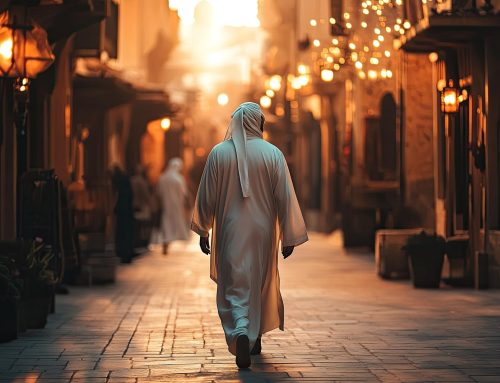
They say that when Ibrahim, peace be upon him, was commanded to proclaim the pilgrimage, he stood bewildered: how could my voice possibly reach all of humanity? He was told only to call out — the carrying of the call was never his concern. And Allah carried it further than any human voice could go: across the deserts of time, over seas that had not yet been named, down through the generations, until it slipped quietly into your own chest. So when you travel, do not think of yourself as a customer who bought a package. You are something far greater. You are an answer.
I know it is easy to lose this. We live in a world that explains everything through plans and logistics and control — confirmations, receipts, schedules, systems. Umrah needs these too; the modern journey cannot move without them. But the meaning of Umrah will slip straight through the fingers of anyone who grips only the logistics. You can have every document in perfect order and still arrive with an empty heart. And you can feel like a trembling, inadequate mess — and arrive carrying a gratitude so deep it brings you to tears.
So if right now you feel a strange mixture inside — joy and fear, longing and a guilty conscience, excitement and a small voice whispering you are not good enough for this — do not be afraid of it. That ache is not a sign that something is wrong with you. It may be the surest sign that your heart is alive. Umrah was never meant for those who feel finished and clean. It is for those who know, in their bones, that they need their Lord. The one who marches toward the Ka’bah certain that he has everything under control will, sooner or later, feel the ground move beneath him. This is not a journey you can fully steer. It is only when you finally loosen your grip — when you place your whole fragile self into the hands of Allah — that Umrah truly opens to you, with all the grace and wonder it has been holding in store.
So come as one who needs mercy, and you will not merely be walking toward a place — you will be walking toward the truth about yourself. And when your heart finally admits its own weakness, its need, its dependence, the veils begin to lift one by one. What once seemed so solid loses its weight; what truly matters comes quietly into focus. A heart like that does not come home empty. It comes home carrying treasures no suitcase could ever hold: a peace it cannot explain, a softness it had forgotten, a nearness to Allah that no words will ever quite reach.
Do not think, then, that Umrah is only about your body reaching Makkah. It is a journey from illusion to truth — from believing you own your life, to understanding that you only ever held it on loan for a few short breaths; from imagining you stand at the centre of everything, to seeing, with relief, that the centre already exists, and it was never you. This is why your Umrah began long before you will ever see the Ka’bah. It began the night you whispered into the dark: Yā Allah, if You open the door, I will come.
And sometimes that whisper is born in the most ordinary moment — at your desk when your heart finds no rest in any of it; after a funeral, after an illness, after a child is placed in your arms; in the middle of a grey, unremarkable afternoon when something in you suddenly aches and says, surely life is meant to be more than this. Do not rush past such moments. They may be the small, secret openings of an invitation.
So before you travel, make this one sentence your companion, and return to it whenever your heart begins to scatter: I am not merely going to a place. I am going to the House of Allah, because He allowed my heart to answer. Keep it close when the problems come — when sleep is short, when the group moves too fast, when the heat steals your breath, when you feel like nothing in an ocean of people. It will remind you that you were not carried here by chance, or by your own cleverness, but by a call that had your name in it from the beginning.
“I thought my Umrah began at the airport. But I see now that it began years earlier, on a night I cannot even fully remember, when Allah let me long for something I had no words for. I thought it was only a wish. Now I know it was an answer — already making its way out of my heart.”
Pause here, and hold one image before we go on. A circle has a centre, and every point on its rim is exactly the same distance from it — none favoured, none forgotten. When Allah proclaimed the pilgrimage “from every distant pass,” He was describing a circle whose centre is His House and whose edge is the whole wide earth. You are standing on that edge. And the distance you feel tonight — the cost, the years, the long cold road that lies between you and Makkah — is not proof that you were placed too far away. It is the very line along which the call travelled to reach you. When you finally walk your Umrah, you are simply tracing that line back inward — from the rim of the world to the centre of your worship. Hold that picture close. Everything that follows is your heart, learning to move from the edge to the centre.
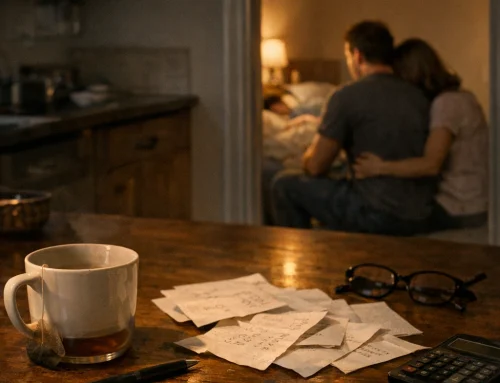
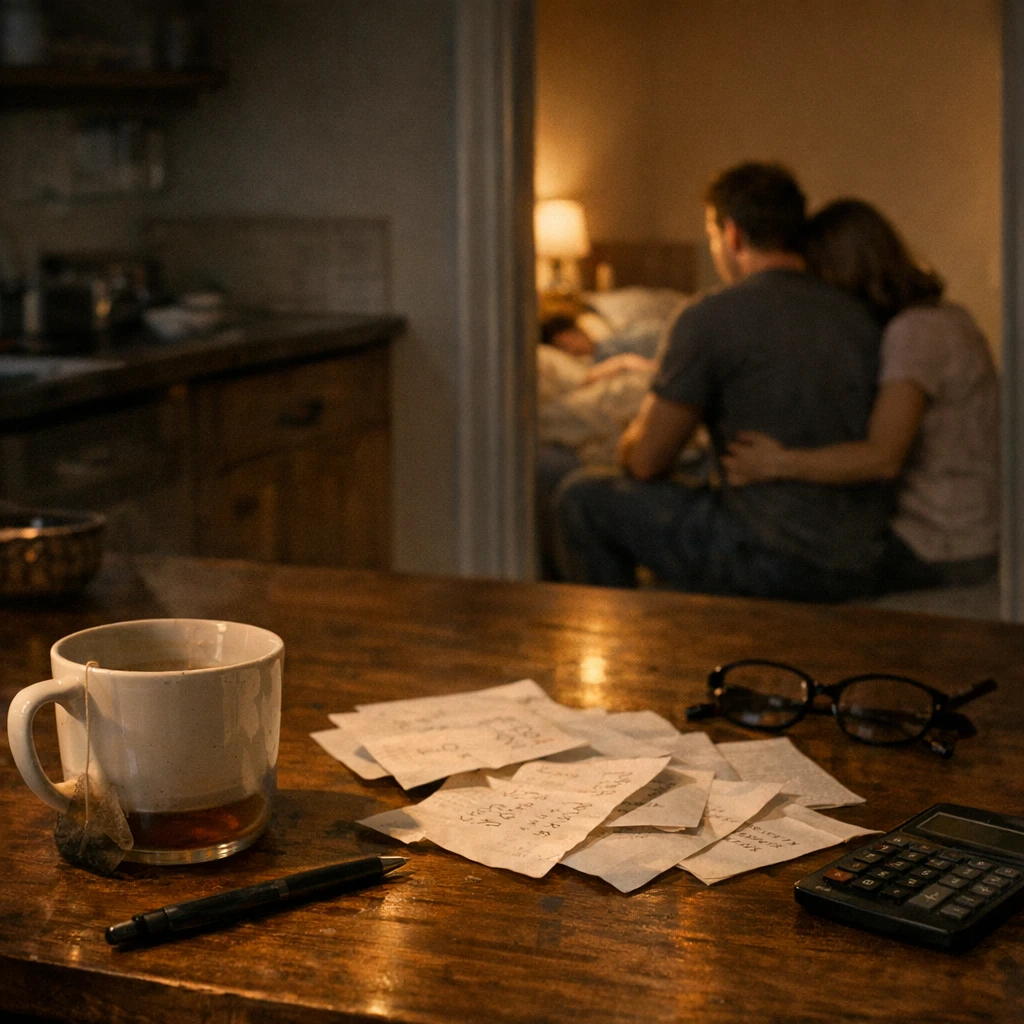
For so many of us, this journey does not begin in some grand or holy place. It begins at home, late at night — at the kitchen table after ’isha, with a cup of tea gone cold beside you, a sum of money that does not quite add up, and a heart that dares to hope anyway. Perhaps the children are asleep in the next room. Perhaps your husband or wife looks at you and asks, softly, whether you really should be doing this now. Perhaps your mother’s eyes fill when she hears. All of this is already part of your Umrah. Because Allah does not call only your body to Makkah — He calls your whole life into a new and better order.
So begin with gratitude, even here, even now, with the cold tea and the uncertain numbers. Thank Him that you have lived long enough to see this. Thank Him for opening a door that was shut for so long. Thank Him that, of all the names He could have written, He wrote yours. So many longed and never reached it. So many saved and never had the health. So many dreamed, and the door simply never opened. You have been handed something countless hearts wept for and never held — so carry it humbly, with a bowed head, never pleased with yourself.
And please — do not be afraid of your own joy. Some hearts hold back their happiness before Umrah, as though too much joy might make them less serious. But hope has never been the enemy of seriousness; hope is part of the beautiful manners we keep with Allah. You are allowed to count the days. You are allowed to feel a child’s pure excitement. You are allowed to look at a picture of the Ka’bah and weep without quite knowing why. You are allowed to long. Your heart was never made to stay hard when it has been invited to the most beloved place on the face of the earth.
“Everything around me carried on exactly as before — the work, the bills, the messages, the school run — but somewhere inside me, something had already started to pack. It was as if my heart was standing at the door long before the suitcase ever reached it.”
Umrah is small in what the eye can see, and vast in what it does to the soul. You will enter the sacred state before the boundary; you will answer your Lord with the Talbiyah; you will come to His House and circle it; you will pray, and drink of Zamzam, and walk between Safa and Marwah; and then you will lay down your old self with the cutting of your hair. A handful of hours — and inside them, the work of years. For Allah can fold an ocean of meaning into the smallest of acts.
He commands you, gently and clearly: “And complete the Hajj and the Umrah for Allah” (al-Baqarah 2:196). Feel where the whole matter rests — on those two words, for Allah. Your Umrah is not tourism. It is not a beautiful photograph. It is not one more achievement to collect. It is a gift, carried in your two hands and laid before Allah alone. If your body crosses the world but your heart is performing for the admiration of people, the journey has lost its centre before it began. But if your body is exhausted and your intention is pure, then even your tiredness becomes worship, and your aching feet become a prayer.
Let me give you a map you can hold in the dark. The soul of Umrah moves in five quiet steps. Ihram teaches you to surrender. Talbiyah teaches you to answer. Tawaf teaches you that your heart was made to turn around one centre. Sa’i teaches you to keep running between fear and hope. And Halq — the cutting of the hair — teaches you renewal: you leave something of the old self on the ground, so that you can walk out lighter than you came. Memorise these, before you travel. When the crowds overwhelm you and you forget where you are, come back to them like a hand finding a railing in the dark: surrender, answer, centre, effort, renewal. They are not only the steps of Umrah. They are the steps of a believing life.
And here is something I do not want you to miss. Every Umrah begins as travel — but it must not stay there. Travel only carries your body from one place to another. The real journey is when your heart travels too. It is possible, may Allah protect us, to cross the whole world, pass the boundary, enter Makkah, and stand before the Ka’bah itself while the heart is still back home — busy with comparisons, with shopping, with discomfort, with the wish to be seen. Such a one has travelled, but his heart has not yet arrived.
So come not as a tourist at a famous site, nor as a customer expecting good service. Come as what you truly are: a servant your Lord has allowed to approach His Sacred House. And watch how that one change transforms everything you touch. The airport becomes a place of remembrance. The long flight becomes a corridor of intention. The waiting — and there will be so much waiting — becomes a quiet school of patience. Your hotel room becomes a place to make wudu, lower your voice, and gather your scattered heart before you walk into the Haram.
This is why the distance you have come is never meaningless. Every mile is part of your answer. Every mile asks you the same searching question: Are you only going somewhere — or are you going to Allah? Two people can sit in the same row of the same plane, wear the same white cloth, walk the same Tawaf, and fly home on the same day — and in the sight of Allah their two journeys can be as far apart as the east is from the west. Because one came to say “I went,” and the other came, with a breaking heart, to whisper: Yā Allah, I have come home.
Before another page turns, sit with these questions, just you and your Lord: What kind of traveller am I becoming? What do I truly want from Allah? What am I finally ready to leave behind? Do not pack only the suitcase. Pack the heart — with intention, with repentance, with gratitude, with hope. Your body will reach Makkah by aeroplane. Your heart reaches it only by sincerity.
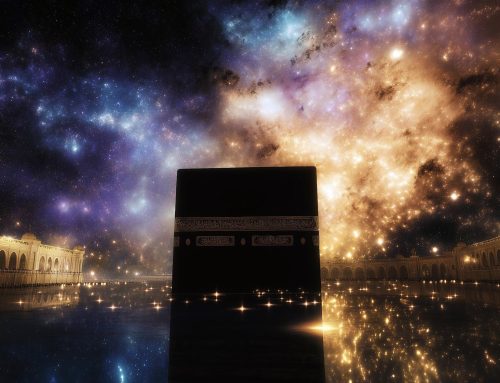
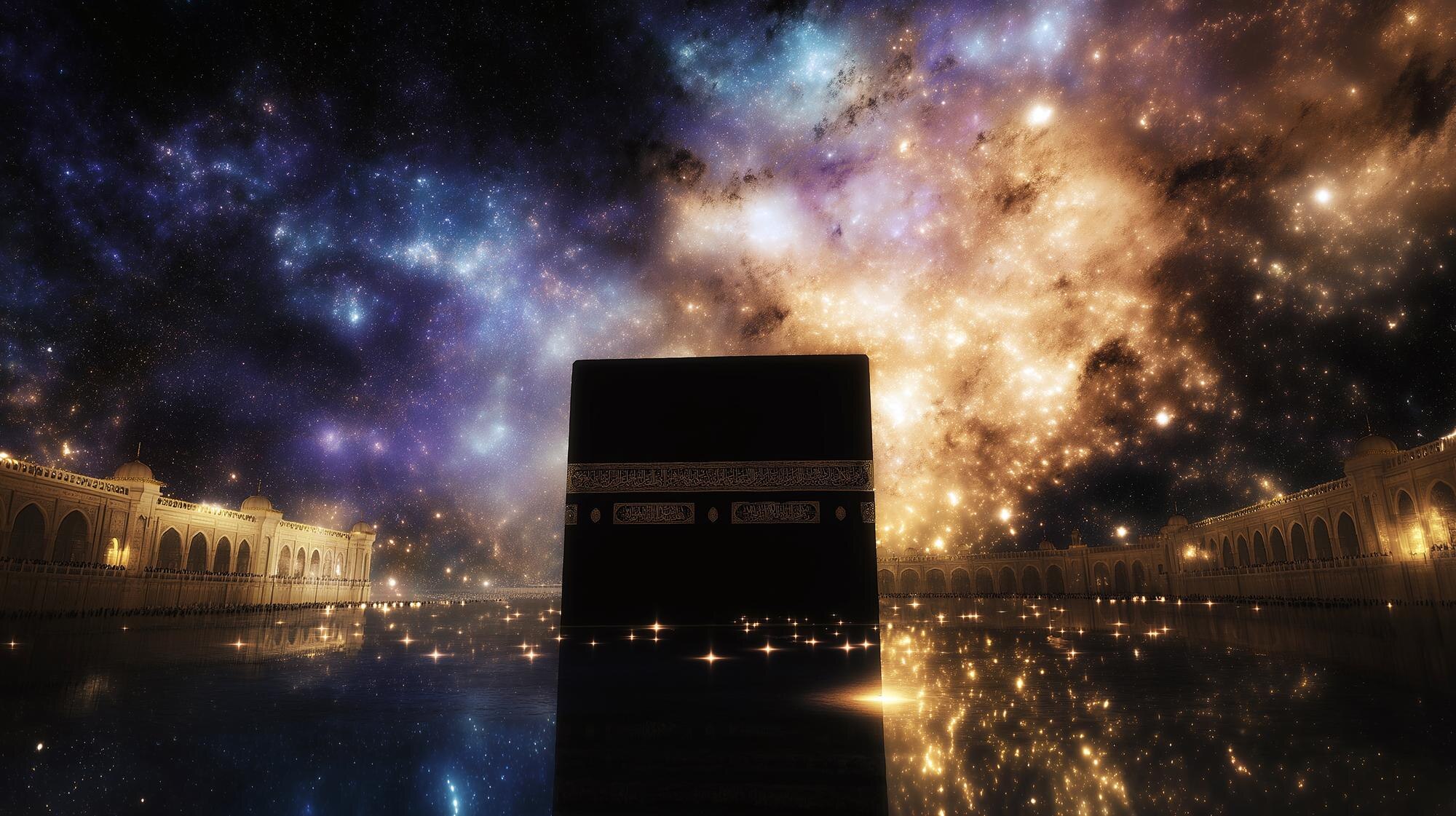
Let me say one thing clearly at the very start, because everything else depends on it, and because your heart deserves to be free of confusion: we do not worship the Ka’bah. We do not worship stone, or walls, or a black cloth, or a direction. We worship Allah alone. The Ka’bah is the qiblah — the direction of our prayer, the House He honoured, the centre around which we turn — and every ounce of its greatness comes from the One who chose it. Hold that truth gently, and your love for the House will always be safe.
And yet, in His wisdom, your Lord gave you something to turn toward. He gave the believers a visible centre, so that hearts everywhere would learn not to scatter. This is one of the quiet mercies of the qiblah: it gathers a whole Ummah on the outside, and it disciplines a single soul on the inside. He tells us the first House ever built for mankind was the one at Bakkah, “blessed, and a guidance for the worlds” (Āl ’Imrān 3:96). Notice that word — guidance. The House guides without ever speaking. It teaches you, simply by standing there, that your life cannot be built around your ego, your career, your wealth, your reputation, or even the people you love. These are gifts; they are trusts; but they were never meant to be the centre. The centre belongs to Allah alone.
This is the secret hidden inside Tawaf, and we will return to it when you stand there. For now, only hold this: when you circle the House, your body will confess what your heart so often forgets — I am not the centre of existence. My Lord is greater. My longings were made to orbit Him, not the other way around. So a question begins here, quietly, and the whole journey will keep asking it of you, circuit after circuit, day after day: Around what centre has my life truly been turning? And every time you ask it, you will be given the chance to answer — Allah is my Lord; to Him I return; and around His will, from now on, my life will turn.