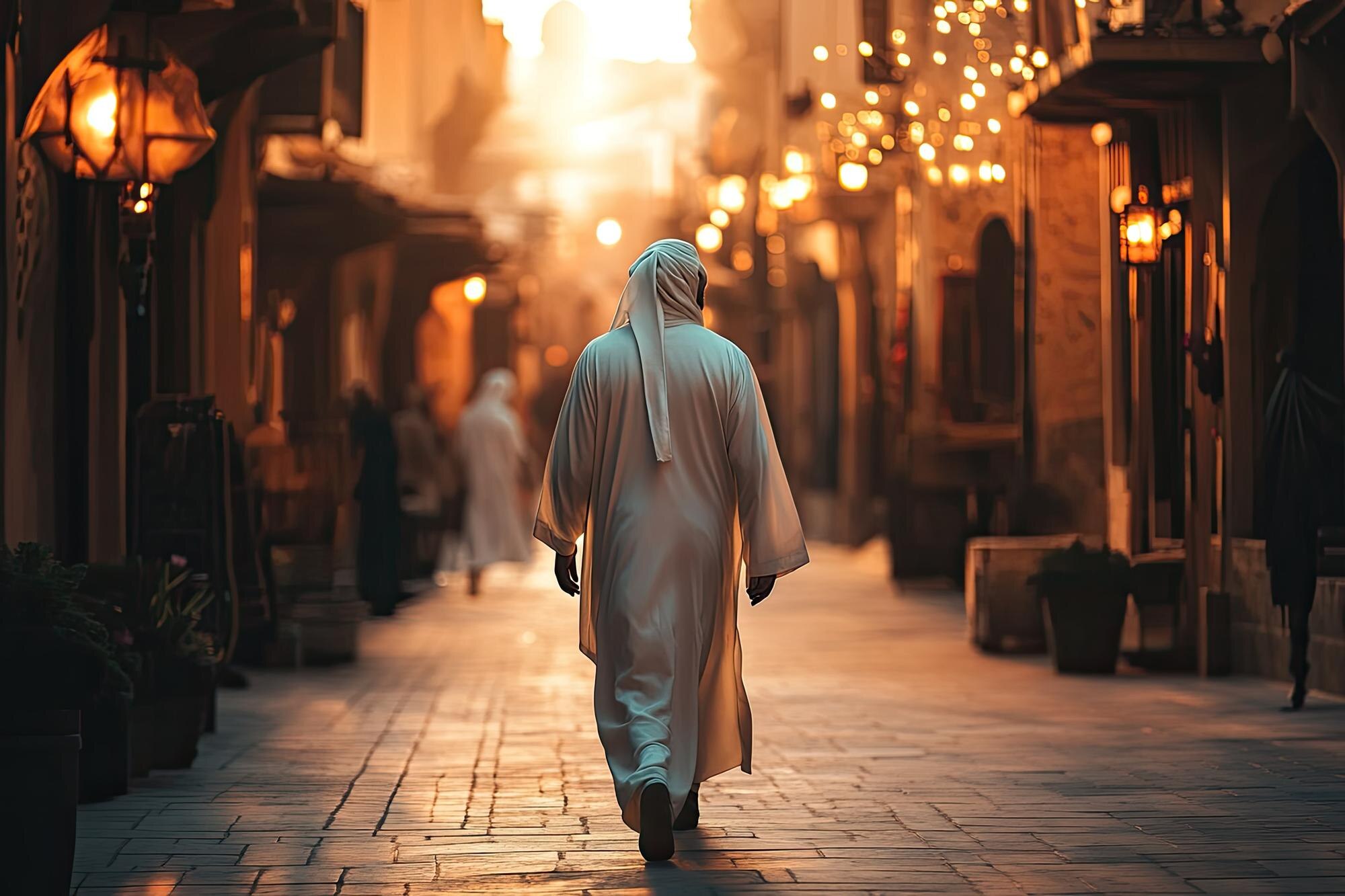
Now come back, and take them one at a time. Read the question again, close your eyes for a breath, and only then read the reflection beneath it. Let it soften you. Let it search you. And then answer — not to me, and not to anyone — but to the One who already knows.
One — What first woke this longing in me?
Trace it back, as far as you can — and you will find that the longing came before the plan. Before the money, before the dates, before the booking, there was a quiet pull you could not quite explain. That pull was not yours. It was His mercy, reaching for you first. We so easily believe that we decided to go — but the believer knows that the wanting itself was already an answer, already an invitation slipped into the heart. So name the beginning of your longing, and you will see something that should bring you to tears: you were being carried toward His House long before you ever lifted a finger to come.
Two — What do I most hope to leave behind?
Do not answer this one in a fog of general words. Be specific, even when it shames you — because a sin you can name is a sin you have half-confronted, and a sin you keep vague is a sin you are quietly protecting. Bring the real name of it before Allah, and ask Him not only to forgive it, but to give you a door out of it — a practical change, a wall, a new habit. Umrah was never a magic that erases a life without your hands; it is a beginning, and a beginning lives or dies by a single real decision. What is the one decision this journey is asking of you?
Three — Around what centre has my life truly been turning?
Here is how to find the honest answer: watch what you fear losing most, what you obey most quickly, what you protect before anything else. That — not what you say — is your true centre. For so many of us, without ever admitting it, the centre has quietly become our reputation, our comfort, our control, or our fear. This was the whole correction of Tawaf: you walked, with your own body, around a centre that was not you. So let the circling finish its work. Let Allah, gently, take back the place in your heart that was always meant to be His.
Four — What is the Talbiyah still asking of me?
Labbayk — Here I am. You said it with your tongue at the boundary. But the real question is where your “yes” is still only partial. When Allah calls you to Fajr in the cold dark — here I am? When He calls you to forgive the one who wronged you — here I am? When He calls you to lower your gaze, to leave the thing you love that He dislikes — here I am? The Talbiyah did not end when your voice went quiet on the plain. It became the question your whole life is meant to answer, one obedience at a time.
Five — What does Hajar’s running teach me?
She did not sit and wait, and she did not believe her running made the water — she ran and she trusted, both at once, with everything in her. That, is the trust Allah loves: neither lazy nor frantic, neither giving up nor seizing control. So look honestly at your life and ask: where am I sitting still, calling it tawakkul, when Allah is asking me to run? And where am I running myself to exhaustion, gripping the outcome as though it were mine to force, when He is asking me to leave the opening to Him? Run like Hajar — and then, like Hajar, leave the miracle to your Lord.
Six — What did the journey reveal about my patience, my tongue, and my pride?
Tiredness tells the truth about us that comfort hides. So remember honestly: what came out of you when you were hot, and delayed, and pushed, and exhausted? Did you complain more than you remembered Allah? Were you quick to be wounded, slow to forgive? Did you, somewhere inside, look down on the people around you? Do not drown in shame over what you saw — be grateful that Allah let you see it. You cannot heal a wound you refuse to look at, and He showed it to you precisely because He wants to heal it.
Seven — Which openings must I protect now?
Somewhere on this journey, your Lord may have opened a door in you — a new softness, a love for the prayer you did not have before, tears that came easily, a sudden hatred for a sin you used to excuse. These are not small things. They are trusts, handed to you, and they must be guarded. Shaytan cannot erase Makkah from your memory — so he will try, instead, to cut it loose from your ordinary Monday morning, until the journey becomes only a beautiful story you once lived. Do not let him. Guard the opening the way you would cup your hand around a small flame in the wind.
Eight — What one small, steady deed can I keep?
Not a mountain of resolutions — one deed. One that you can keep even on a hard day, even when the feeling is gone, even when no one is watching. Two rak’ahs before Fajr. Ten minutes of Qur’an. A daily seeking of forgiveness. A nightly du’a for your family. Because your Beloved ﷺ told you that the deeds most loved by Allah are the constant ones, even when they are small — and a small deed you guard for years will do more for your soul than a great resolution you abandon in a week. Choose it now, while your heart is still soft. Let it be the thread that keeps you tied to the Haram for the rest of your life.
Nine — How should my family feel the change in me?
They should not only hear your stories of Makkah. They should feel what it did to you. If the journey was real, the people closest to you will be the very first to taste it — in a calmer voice, a quicker apology, a gentler patience, less of your ego in every disagreement. It is easy to weep before the Ka’bah; it is far harder, and far truer, to come home soft with the people who know all your faults. So let your home be the place where your Umrah is proven. Let the ones who waited for you be the first to receive its mercy.
Ten — If Allah invites me again, what heart do I want to bring back?
This last question, closes one journey by quietly opening the next. If Allah writes another Umrah for you — and oh, may He write many — what kind of heart would you want to carry to His House that time? A cleaner one? A softer one? A heart less hungry for the praise of people, quicker to forgive, more faithful to the prayer? Then do not wait for the next invitation to begin building it. Begin tonight. Live in such a way that, when the call comes again, it does not find you standing exactly where this journey left you — but a few steps closer to Him than you were before.
And one last prayer, as you close these pages: May Allah accept your Umrah, write you among the guests whom He forgave, and return you home — not as you came, but lighter, and truer, and nearer to Him. May He keep these questions alive in your heart long after the journey has faded into memory. And may He call you back, again and again, to His House and to the city of His Beloved ﷺ, until the day He calls you home to Himself. Āmīn.
Leave A Comment