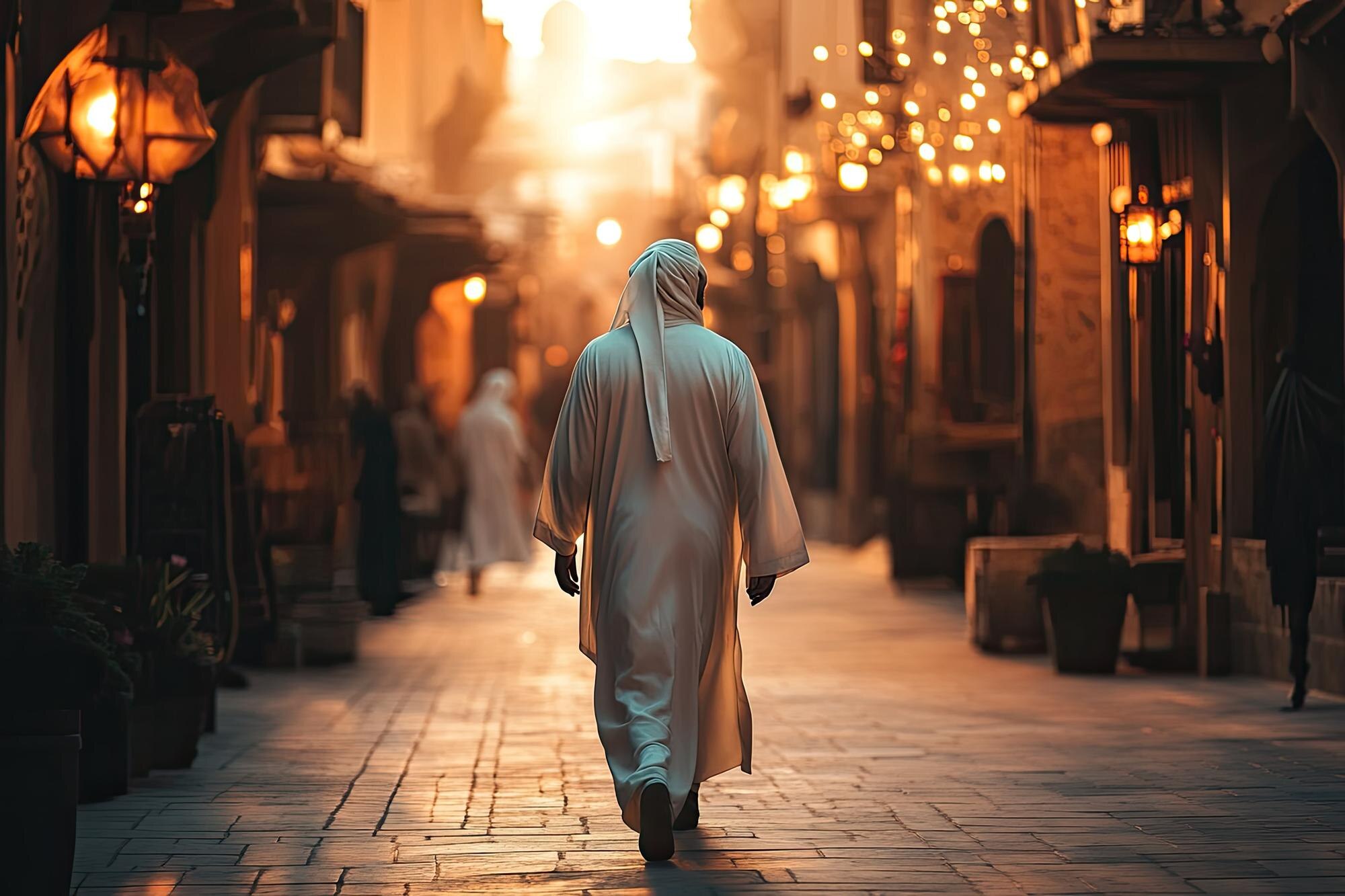
The heat of the Hijaz is not an inconvenience to be endured; it’s a genuine hazard to be respected. A Makkah afternoon in summer regularly reaches 42–43°C, and on the worst days the region climbs higher still. Heat illness runs along a spectrum — from mild cramps you can walk off, through exhaustion that flattens you, to heat stroke that can kill within minutes. Knowing the difference between the stages, and what to do at each, is knowledge that can save a life. It might be your own; more often it’s a companion’s, and you’ll be the one who has to act while everyone else stands frozen.
Makkah’s particular heat
Understand what you’re walking into. Many pilgrims land at Jeddah, where the Red Sea coast is humid — often above fifty per cent — so even before you reach Makkah your body is already working to cool itself in muggy air, and the long wait at the airport and the coach transfer can leave you dehydrated before the pilgrimage has properly begun. Makkah itself sits inland in a bowl of dark hills, drier than the coast but hotter, and its great courtyards are paved in pale marble that throws the sun’s heat straight back up at you. On a still afternoon the open sahn around the Ka’bah can feel like standing inside an oven, the radiant heat rising through your feet as much as beating down from above.
The lower humidity inland is a mixed blessing. Dry air lets sweat evaporate freely, which cools you well — but it also means you lose fluid so fast you may not notice, because the sweat vanishes before it can bead on your skin. You feel dry rather than drenched, and it’s easy to underestimate how much water and salt you’re shedding with every hour in the sun.
The authorities have done a great deal to soften all this. Vast stretches of the mataf and the surrounding plazas are now laid with heat-reflective cooled flooring that stays walkable barefoot even at midday, retractable umbrellas shade parts of the courtyards, and misting fans and cooled colonnades line many routes. These help enormously, but they don’t abolish the danger — they simply mean the danger concentrates on those who ignore the shade, walk at the wrong hours, or push a tired body too far. Our companion guide to preventing dehydration and heat illness covers the fluid side; this one is about recognising and treating heat illness when it takes hold.
The spectrum, stage by stage
Heat illness isn’t one condition but a ladder, and catching it on the lower rungs is what stops it reaching the top.
Heat cramps
The mildest form is painful muscle spasms, usually in the calves, thighs or belly, brought on by the salt lost in heavy sweating. The muscle knots and grips, sometimes hard enough to stop you walking. The response is simple: stop, get into shade, gently stretch and massage the muscle, and take fluids with electrolytes — not plain water alone, since it’s salt you’ve lost. Our guide to electrolytes and hydration explains why. Cramps are a warning shot; heed them and you may never see the worse stages.
Heat syncope and dizziness
In the heat, blood pools in dilated vessels near the skin and in the legs, and when you stand up quickly — after a long sitting dua, or rising from sujood — too little reaches the brain for a moment and you feel faint, grey-visioned, or actually black out briefly. This heat syncope is frightening but usually brief. Sit or lie the person down, raise their legs, get them into shade and give cool electrolyte fluids once they’re fully alert. Someone who has fainted in the heat should rest properly and not simply press back into the crowd — a faint is the body’s way of forcing the rest you wouldn’t take voluntarily.
Heat exhaustion
This is the serious warning stage, and it’s common. The picture is heavy sweating, weakness, dizziness, headache, nausea and sometimes vomiting, with skin that is cool, pale and clammy, and a fast, weak pulse. The person is drained and unwell but still lucid — they know where they are and can answer you clearly. Act promptly. Move them at once to the coolest place you can reach: an air-conditioned prayer hall, a shaded colonnade, a hotel lobby. Loosen or remove outer clothing, cool the skin with water or a wet cloth and fan them, and have them sip oral rehydration salts and rest. If they don’t clearly improve within about thirty minutes, or if they start to get worse, get medical help without delay — because the next rung is the one that kills. Heat exhaustion, left to smoulder in the sun, is the doorway to heat stroke.
Heat stroke — the emergency
Heat stroke, often called sunstroke, is a true medical emergency in which the body’s cooling has failed and the core temperature climbs dangerously high, typically to 40°C or above. The signs that set it apart from exhaustion are neurological: confusion, agitation, slurred or nonsensical speech, stumbling, seizures, or collapse into unconsciousness. The skin may be flushed and hot, and can be either drenched or, ominously, dry — a person who was pouring with sweat and then stops sweating in the heat is a red flag, not a relief. This is life-threatening, brain-threatening, and every minute counts. Do not wait to see whether they perk up. Treat it as the emergency it is.
The first ten minutes: what a bystander does
If someone near you collapses with confusion or unconsciousness in the heat, what you do in the first ten minutes matters more than anything a hospital can do later. Body temperature can climb catastrophically fast, and rapid cooling on the spot is what protects the brain. Move through these steps without hesitation.
- Call for help immediately. Dial 997 for a Saudi ambulance, or 911, which now operates as a unified emergency number in Makkah and Madinah. Send someone to fetch the nearest Red Crescent point or Haram medical staff — they are stationed throughout the mosque and the courtyards.
- Get them into shade or cool air. Out of the sun, onto cool flooring, into a colonnade or an air-conditioned space if one is close.
- Strip off layers. Remove the ihram’s upper cloth, outer garments, anything trapping heat, to let the skin shed warmth.
- Cool aggressively, targeting the big vessels. Pour or spray cool water over them and fan hard to speed evaporation. Place cold wet cloths, cold water bottles or ice — whatever you can get — against the neck, the armpits and the groin, where large blood vessels run close to the surface, so you cool the blood itself. Keep the water coming; don’t stop after one splash.
- Do not force fluids into someone confused or unconscious. They can choke or inhale it. Fluids by mouth are only for a person who is fully alert and able to swallow safely.
- Keep cooling until help arrives. Don’t stop because they seem a little better; hand over to the medics still cooling.
The public guidance from bodies like the CDC and OSHA is blunt on this point: cool first, cool fast, and never leave the person alone. The single biggest mistake bystanders make is standing back to “let them rest” while the core temperature keeps climbing. Cooling in those first minutes is the treatment, and getting them cool quickly is what prevents lasting harm to the brain and organs. If you’re travelling in a group, agree in advance who does what — one person cools, one calls, one clears space and flags down help — so nobody freezes when it counts.
Who is most at risk
Heat doesn’t strike everyone equally. Some pilgrims carry a much higher risk and should be watched — and should watch themselves — with real care.
The elderly feel thirst less keenly, sweat less efficiently, and often carry the heart and kidney conditions that make heat dangerous, so age alone raises the stakes sharply. Young children overheat fast and can’t always say what’s wrong. Pregnant women, and anyone with a chronic illness — diabetes, heart disease, kidney disease — need extra caution. And crucially, pilgrims arriving from cool northern climates carry bodies simply not built for this heat; the traveller stepping off a flight from a British winter into a Makkah summer is at higher risk than a local, precisely because they’re unacclimatised. Overweight pilgrims and those who are less fit generate more heat and shed it less easily, and anyone who arrives already run-down from a long journey starts on the back foot.
Certain medicines add their own danger by blunting the body’s ability to cool itself, and this is under-appreciated. Diuretics (“water tablets”) drive fluid loss and dehydration. Beta blockers slow the heart and cut blood flow to the skin, limiting how fast you can shed heat. Anticholinergic drugs — found in some allergy, bladder, stomach and psychiatric medicines — reduce sweating outright. Several psychiatric medicines interfere with the brain’s own temperature control. None of this means stopping your medication — never do that without advice — but if you take any of these, you must be far more disciplined about shade, timing and fluids, and you should raise it with your doctor before you travel. Our guide to managing chronic illness goes into this further.
Preventing it in the first place
Nearly all heat illness is avoidable, and prevention comes down to timing, shade, fluid and honesty about your limits.
Timing is your strongest tool. Keep non-essential walking out of the fierce midday window — roughly late morning to mid-afternoon — and shift errands, ziyarah trips and any optional Tawaf to the early morning or the evening. The Haram is open around the clock, and there is real wisdom in doing a fresh Tawaf and Sa’i in the cool of the night. The upper floors and the roof of the mosque, reached by escalator, are less crowded and let you perform Tawaf away from the packed, radiant heat of the ground-level mataf; at night, up there, the difference is enormous. The circuit is longer on the upper levels, so allow more time and pace yourself, but the trade of a longer walk for cooler, less crowded air is usually worth it in summer.
Use the shade the mosque provides. Carry a lightweight umbrella for portable shade on the walk in — permitted for men in ihram since it doesn’t cover the head directly — and route yourself through the colonnades, misting stations and cooled flooring rather than straight across the open sun. Rest in air-conditioned halls between prayers rather than baking in the courtyard waiting for the next one. A damp cloth or scarf on the back of the neck, refreshed at a misting station, buys you real cooling on a long walk. Light-coloured, loose clothing helps too, and for women not in ihram, breathable natural fabrics beat synthetic ones in this heat.
Drink and salt steadily, as our hydration guide sets out — not plain water by the litre, but fluid paired with electrolytes and meals. Skipping food to spend longer in the Haram quietly raises your heat risk, because it’s the salt in your meals that helps hold fluid in your body.
Acclimatise over the first three to five days. Your body genuinely adapts to heat — you begin to sweat sooner and more efficiently, and conserve salt better — but it takes several days, and that adaptation is exactly why the first days are the most dangerous. Go gently at the start. Don’t attempt back-to-back Umrahs or marathon days in the sun in your first forty-eight hours, when you’re also jet-lagged and unadjusted. Build up as your body catches up. Our note on performing Umrah soon after arrival and the guide to managing fatigue both bear on this.
Above all, know your own limits and don’t let zeal override them. There is no reward in collapsing, and no shame in resting, sitting, or using a wheelchair to complete a rite with dignity. Guarding your body against the heat is not a failure of trust in Allah; it is taking the means He commanded you to take.
Why the courtyard feels hotter than the forecast
Pilgrims are often surprised that a 42-degree day feels far worse in the sahn than the same temperature would at home. Two things are at work. First, the marble and stone store and re-radiate heat, so you are heated from below as well as above — the effective temperature your body experiences is higher than the air reading. Second, you are surrounded by a dense crowd of warm bodies, each shedding heat, so the little pockets of air between worshippers barely move and barely cool. Add the physical effort of Tawaf and Sa’i, and your own muscles are generating heat on top of everything else. This is why a rite that feels trivial in the abstract can floor a fit adult in the wrong hour: the load is cumulative, and the courtyard amplifies it.
Watching a companion you are responsible for
If you are travelling with a parent, a grandparent, a young child or anyone frail, appoint yourself their quiet monitor and check on them more often than they check on themselves. The people most at risk are often the least willing to complain, because they don’t want to slow the group or interrupt the worship. Look for the early tells — unusual quietness, a flushed or grey face, stumbling, confusion, snapping at people, or simply going very still. Offer water and shade before they ask, and route the whole group by the cooler paths for their sake. It is far easier to prevent a collapse than to manage one in a packed courtyard, and a companion who feels watched over is a companion who will tell you sooner when something is wrong.
If you or a companion goes down
Keep the plan simple enough to recall under stress. Cramps or dizziness: shade, rest, electrolytes. Exhaustion — pale, clammy, weak but lucid: cool them, rest them, ORS, and get help if they don’t improve in half an hour. Confusion, slurred speech or collapse: this is heat stroke, so call 997 or 911, strip layers, and cool hard at the neck, armpits and groin until medics take over. Know where the nearest Red Crescent post is from the day you arrive, keep the emergency numbers in your phone, and read our guide to medical emergencies before you need it. The heat is manageable when you respect it — walk in the cool hours, keep to the shade, drink and salt steadily, and act fast when someone is in trouble.
Leave A Comment