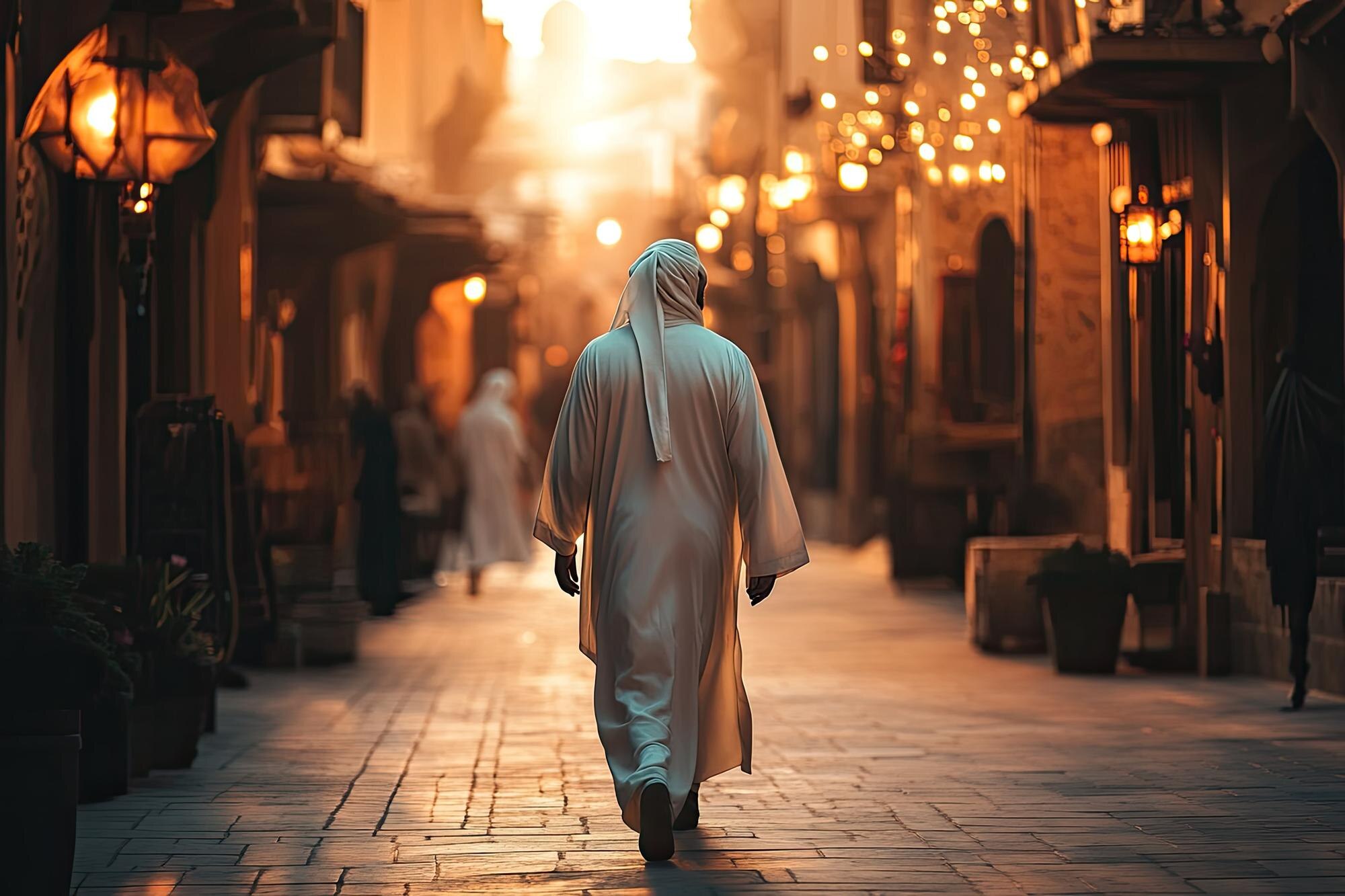
The Garden of Salman al-Farisi in Madinah: The Complete History of Bustan Salman al-Farisi and Bi’r al-Fuqayr
Four kilometres southwest of al-Masjid an-Nabawi, past the palm rows of the al-‘Awali district and within easy reach of Masjid Quba, an old well still draws water from beneath the sand of the Shuraybat quarter. Its name is Bi’r al-Fuqayr — the Well of the Poor Man — and it sits inside a modest, half-forgotten orchard on Tariq ‘Ali ibn Abi Talib, a street of ordinary Madinah traffic, fuel stations and school buildings. No dome marks it. No minaret rises over it. A wire fence, installed years ago by the kingdom’s heritage authorities, runs around a patch of open ground that most pilgrims driving past would take for unused farmland. Behind it stands a secondary school named for Prince Muhammad ibn ‘Abd al-‘Aziz. Nothing about the scene announces that this is one of the most emotionally significant addresses in the entire seerah — the ground on which a Persian seeker, having crossed an empire and buried three faiths in his own biography before finding the fourth, was made a free man by the hands of the Messenger of Allah ﷺ himself.
This is the Garden of Salman al-Farisi — Bustan Salman al-Farisi, or, in the fuller Arabic of the classical topographers, Mazra’at Salman al-Farisi. It is not, strictly, a monument. It has no architecture to speak of, no dated inscriptions, no continuous building history running through the Rashidun, Umayyad, Abbasid, Mamluk and Ottoman periods of the kind that other Madinah sites can show. What it has instead is a story — one of the great stories of the sirah, a first-person account of a man’s decades-long search for truth that ends, quite literally, in this soil, with three hundred date palms planted one at a time by the hand of the Prophet ﷺ and forty ounces of gold weighed out to buy back a human life. This guide sets out that story in full, with every hadith graded and referenced, every historical claim tied to a source, and — because this particular site attracts more confusion than almost any other in Madinah — a clear, honest untangling of what is verified, what is popularly assumed, and what is simply wrong. Along the way it addresses the history of the place before and after Islam, the Prophet’s ﷺ documented connection to it, the Qur’anic verse that immortalizes Salman by name in effect if not by name in the text, the companions and scholars whose lives intersect with this land, and a practical, honest visitor’s guide for anyone travelling to Madinah who wants to stand where this happened — while also stating plainly, more than once, what this site is not: it is not Salman’s grave, it is not the mosque at the Trench that shares his name, and it is not, whatever a phone camera might suggest, a living witness of fourteen centuries in the shape of a palm tree.
Historical Background: The Land Before It Was Salman’s Garden
Every historical site carries two histories at once: the history of what happened there, and the history of the ground itself — who owned it, who farmed it, how it was described by the generations that followed. For most of the great sites of Prophetic Madinah, these two histories are relatively easy to separate and each has its own rich documentation. For the Garden of Salman al-Farisi, they are almost impossible to separate, because the ground’s entire claim to memory rests on a single, if immense, event rather than on a long institutional or architectural life. That makes this a different kind of site to write about than Masjid Quba or the battlefield at Uhud, and this guide has tried to be honest about that difference at every stage, rather than manufacturing a grander material history than the sources will bear.
Geography and Location
The site sits in the al-‘Awali (العوالي) district of Madinah, in the Shuraybat quarter (حي الشريبات), on Tariq ‘Ali ibn Abi Talib, roughly four kilometres southwest of al-Masjid an-Nabawi and a short distance from Masjid Quba, the first mosque built in Islam (Saudipedia, “Bi’r al-Fuqayr”). A travel-listing aggregator gives a street address of “4369 Ali Ibn Abi Talib, Ash Shuraybat, Madinah 42316,” which is broadly consistent with the Saudipedia description (cross-checked via a Wanderlog listing). Older travel accounts sometimes give looser, larger figures for the distance from the Prophet’s Mosque — as much as nine kilometres or roughly five and a half miles — but Saudipedia, a Saudi state-linked reference platform, is treated here as the more authoritative figure for both distance and direction, and its number is the one used throughout this guide.
Al-‘Awali is the historic upland district south and southeast of the old town of Madinah, an area of higher, well-watered ground that has always supported palm cultivation. It sits along the drainage of Wadi Buthan (وادي بطحان), one of the historic seasonal watercourses of the Madinah oasis, and the site’s defining physical feature — a well called Bi’r al-Fuqayr (بئر الفقير), also known historically as Bi’r al-Muthayyib (بئر الميثب) — draws its groundwater from that same wadi system (Saudipedia). Two names for one well is not unusual in Madinah’s toponymy; wells, gardens and orchards across the oasis frequently carried more than one name across different periods and different oral traditions, and both “al-Fuqayr” and “al-Muthayyib” refer to the same physical water source at the centre of this story.
The land around the well is, or was until recently, a working or semi-working palm orchard — a farm plot rather than a preserved archaeological park. Dr. ‘Abd al-‘Aziz Ka’aki, in his book on the landmarks of Prophetic-era Madinah, al-Durr al-Manthur fi Bayan Ma’alim Madinat al-Rasul fi al-‘Ahd al-Nabawi, states — as reported in a 2019 Arabic press account — that “the orchard remains in its place to this day, with an ancient water well” (Masrawy, 15 January 2019). That same account is the most detailed physical description available of the site as it exists in the modern city: the plot lies behind a fuel station east of al-Kharijiyyah; the Prince Muhammad ibn ‘Abd al-‘Aziz secondary school was built immediately beside it; a small mosque once associated with the site has, over time, been effectively absorbed into the school’s own grounds; and what open land remains is enclosed by a wire fence put up by the (then) Tourism and Antiquities Authority. Read plainly, this is the clearest evidence available that a historically important plot of Prophetic-era Madinah has been physically fragmented by twentieth-century urban growth — its core, the well and part of the grove, survives and remains publicly identifiable, but it is no longer a single, intact piece of ground in the way it would have been in the Prophet’s ﷺ own lifetime.
What Cannot Be Said About the Pre-Islamic Period
It would be easy, writing about a site this evocative, to reach for a grander pre-Islamic backstory than the sources actually support. No source consulted for this guide places any pre-Islamic Arabian remains, inscriptions, or distinct occupation layer specifically on this plot. Madinah’s palm-growing oasis belt, of which this land was always a part, long predates Islam as irrigated agricultural ground — Yathrib, as the oasis was known before the Hijrah, had been farmed by its Jewish clans and Arab tribes for generations before the Prophet ﷺ arrived in 622 CE. But that general fact about the oasis is not the same as site-specific evidence, and none should be implied. The honest position, and the one this guide takes throughout, is that the plot enters the historical record as ordinary Madinan farmland, and its significance begins not in antiquity but in a single, dateable, human transaction in the early Islamic period.
The Land’s First Owner: Mukhayriq the Rabbi
That transaction has a prologue, and it is one of the most under-told pieces of the whole story. Before this land was Salman’s garden, it belonged to Mukhayriq (مخيريق), a wealthy and learned Jewish scholar of Madinah — described in the sources transmitted from Ibn Ishaq via al-Samhudi as “حبراً عالماً,” a rabbi and man of learning, and among the richest men in the oasis in date palms (guidetomedina.com, summarizing al-Samhudi’s Wafa’ al-Wafa, itself drawing on Ibn Ishaq). Mukhayriq is reported to have recognized Muhammad ﷺ as a true prophet from his own religious learning, yet he remained, outwardly, on the religion of his ancestors — a detail the sources do not attempt to explain away or soften, and which this guide repeats as reported rather than resolved.
On the day of the Battle of Uhud — a Saturday, in the third year after the Hijrah (3 AH/625 CE) — Mukhayriq told his fellow Jews of Madinah: “By God, you know that supporting Muhammad is incumbent upon you.” They answered that the day was the Sabbath. He replied, “You have no Sabbath,” took up his weapons, and went out to fight alongside the Muslims. Before he left, he made a declaration: “If I am killed today, my property goes to Muhammad ﷺ to dispose of as God shows him.” He fought at Uhud and was killed there. When the Prophet ﷺ was told of his death, he is reported to have said, “Mukhayriq is the best of the Jews” (خير يهود). Mukhayriq’s seven properties passed to the Prophet ﷺ as a charitable endowment (sadaqah), forming the core of the Prophet’s ﷺ waqf holdings in Madinah — and one of these seven plots is identified as the very land later known as al-Fuqayr, or al-Muthayyib: the future site of Salman’s manumission garden (guidetomedina.com, citing al-Samhudi’s Wafa’ al-Wafa).
This single fact changes how the whole site should be read. The ground on which Salman al-Farisi was freed was not simply available land the Prophet ﷺ happened to use. It was already sacred by an earlier act of sacrifice and generosity — the bequest of a Jewish scholar who died defending the Prophet’s ﷺ city on the very day his own community told him he was exempt. Two extraordinary conversion-adjacent stories, one of a man who died affirming a truth he had recognized late, and one of a man who lived to be freed by the truth he had spent his youth pursuing, are bound together in the same patch of earth. It is one of the quieter, more moving coincidences in the topography of Prophetic Madinah, and it deserves to be far better known than it is.
It is also worth pausing on what a waqf endowment of this kind actually meant in the earliest Islamic community, because the concept sits at the centre of why this land later became available for the specific purpose it served. A sadaqah of this type was not simply a gift transferred from one owner to another; it was a dedication of the land’s produce to charitable and communal purposes, administered by the Prophet ﷺ himself as trustee, with no single individual thereafter entitled to claim it as personal property. That structure is precisely why the land could later be used to help satisfy the price of Salman’s manumission contract: it was not the Prophet’s ﷺ private wealth being spent, in the strict sense, so much as a charitable trust being directed toward one of the purposes charitable trusts in Islam are for — the freeing of the enslaved, a category of recipient named explicitly among the eight in the Qur’anic verse on the distribution of zakat (Surah al-Tawbah 9:60), even though the manumission narrative itself, as will be shown below, describes companions personally contributing saplings rather than the waqf land being used for that specific purpose in the surviving account. The two histories — Mukhayriq’s charitable bequest and Salman’s manumission — sit beside each other on the same ground without the sources drawing an explicit causal line between them beyond simple geographic identity; this guide reports that relationship as the sources present it, without overstating a legal connection the texts do not spell out.
The Land’s Role Before and After Islam
Before Islam, then, this plot was simply Mukhayriq’s — productive palm ground, part of the ordinary agricultural wealth of a Jewish landowner in a mixed, tribally organized oasis town. After Uhud, it entered Islamic history twice over: first as an act of charity from a man who died for the Muslims without ever formally becoming one of them, and second, built on that same charitable foundation, as the ground where a Persian slave crossed the final threshold into freedom. In the years after the Prophet’s ﷺ death, the record goes quiet on this specific plot. Unlike Masjid Quba, Masjid Qiblatayn, or the martyrs’ cemetery at Uhud, no continuous building or restoration history survives for this piece of ground through the Rashidun, Umayyad, Abbasid, Mamluk or Ottoman periods. It persisted, so far as the available sources show, exactly as what it had always been: agricultural land and a water source, not a monument. That absence of a grand architectural story is treated at length later in this guide (see Historical Development and Archaeological Findings below); it is a genuine gap in the record, not a shortfall of this guide’s research, and it should be stated to the reader plainly rather than papered over with invented detail.
The Story Behind the Place: Salman’s Search for the Truth
Every historical site in Madinah has a story attached to it. Few have a story as long, as personal, or as psychologically vivid as this one. It survives in a single continuous narration, told by Salman himself in his own words to Ibn ‘Abbas, and preserved in the Musnad of Imam Ahmad ibn Hanbal, hadith no. 23737 (also cited by the older page reference 5/441 in the Cairo printing). Shaykh Shu’ayb al-Arna’ut, the modern critical editor of the Musnad, graded its chain of narration Hasan (good) — a grading stated explicitly in an islamweb.net fatwa: “Shaykh Al-Arna’oot classified the chain of narration of this Hadeeth as Hasan (Good).” The same number and grading are independently repeated in unrelated secondary sources (ummmuawiyah.wordpress.com), and al-Dhahabi is separately cited as calling the isnad of the story “salih,” or acceptable (mahajjah.com).
A verification note belongs here, stated honestly and up front rather than buried in a footnote. Direct attempts to fetch this hadith from sunnah.com, at both the address `sunnah.com/ahmad:23737` and a neighbouring number, returned page-not-found errors during the research for this guide; sunnah.com’s indexing of the Musnad Ahmad is incomplete for a number of hadith in that collection. The number and its Hasan grading are nonetheless corroborated across three independent secondary sources with consistent wording, so this guide reports it as Musnad Ahmad hadith 23737, per islamweb.net’s citation of al-Arna’ut’s grading — but readers should understand this as verified through trusted secondary citation, not through direct confirmation on sunnah.com’s own platform. A reader who wants primary-source certainty should consult a printed critical edition of the Musnad with al-Arna’ut’s takhrij directly. This caveat is repeated later in the Hadith References section, because it matters enough not to state only once.
With that grading established, the story itself can be told in full — because it deserves the full documentary treatment, not a summary.
A Boy Named Ruzbih, Near Isfahan
Before he was Salman al-Farisi — “Salman the Persian” — he was Ruzbih, the son of a dihqan, a local Zoroastrian notable, in a village near Isfahan, Persia. Modern biographical estimates place his birth around 568 to 570 CE (Wikipedia, “Salman the Persian”), which would make him a close contemporary of the Prophet ﷺ himself, though the exact year is not fixed with certainty in the sources. His father, by Salman’s own account in the Musnad Ahmad narration, loved him “with a love greater than he had for anyone else,” and kept him, in the manner of the Zoroastrian household, tending the sacred fire that Zoroastrian religious practice required never be allowed to go out. Ruzbih’s father owned a large estate, and the boy’s early life was defined by two things: his father’s intense attachment to him, and the confining, fire-tending religious duty that structured his days.
Then his father sent him on an errand to one of the estates, and everything changed. On the way, Ruzbih passed a Christian church, and the sound of the worshippers at prayer inside stopped him. He went in. He watched. He was struck — the narration makes this plain in his own words — by something in their manner of prayer that felt truer than anything the fire temple had shown him. He asked where this religion had come from, and was told: Syria. He did not finish his father’s errand that day. He stayed until evening, and when he finally went home, his father asked him where he had been, and Ruzbih told him the truth: he had found people who prayed better than his own people did, and had stayed to watch. His father was appalled. “My son, there is no good in that religion. Your religion and the religion of your forefathers is better than it.” Ruzbih answered that he did not think so. Fearing what his son might do, the father had him chained by the leg inside the house, to stop him leaving.
The Escape and the Chain of Monks
Ruzbih did not stay chained forever. He managed to get word to the Christians he had met, asking them to tell him if a merchant caravan should come through bound for Syria — the land, he now believed, of the true faith. Word came. He broke his chains and fled, arriving in Syria and asking to be taken to the most learned man in that religion. He was directed to a bishop attached to a particular church, and he attached himself to that man’s service, learning from him and worshipping under his instruction.
This first bishop, however, was not what he seemed — the narration is candid about this, and it is one of the details that gives the whole account its human, unsentimental texture. He used to encourage his congregation to give in charity, then keep the money for himself rather than distribute it to the poor, amassing seven jars of gold and silver in secret. When the man died, Ruzbih exposed the hoard to the people who came to bury him, and they were so outraged that they refused to bury the man at all, crucifying his body instead and stoning it. A new man was appointed in his place, and Salman’s own verdict on him, preserved in his own words, is a small masterpiece of understatement: “I never saw a man who did not pray the five [prayers], who more hated this lower world and more desired the next world, more diligent by night and day, than him.” Ruzbih attached himself to this second man, and stayed with him until he was dying — at which point Ruzbih asked him the question that structures the rest of the whole account: to whom should he go next?
What follows is a chain, monk after monk, each recommending the next before dying, each better in some way than the description could capture: a bishop in Mosul, then a bishop in Nisibis, then a monk in Ammuriyah (Amorium, in Byzantine Asia Minor). It is this last man, dying, who finally gives Ruzbih something more than another name to travel to. There is no one left to recommend, he says — but the time is near. A prophet is about to be sent, following the religion of Ibrahim, who will appear in the land of the Arabs, migrate to a land between two lava fields where date palms grow, and carry unmistakable signs: he will accept a gift but refuse to eat anything given to him as charity, and between his shoulders will be the seal of prophethood.
Sold Into Slavery
Ruzbih went toward Arabia. He hired a group of Bedouin traders to take him there, giving them what he had in exchange for passage — and they betrayed him. They sold him into slavery to a Jewish man, who in turn sold him to a cousin of his, a man of the Banu Qurayzah of Madinah. It was this final sale that, in a way neither Ruzbih nor his captors could have understood at the time, delivered him precisely where the dying monk had told him to go: to the city between the two lava fields, to the oasis of palm groves that was still, at that point, called Yathrib.
Consider what this sequence actually cost him, stage by stage, because it is easy to read the story quickly and miss how much of it is loss rather than discovery. He left a father who loved him more than anyone else in the world, and who chained him rather than lose him — an act that reads, even across fourteen centuries, as its own kind of grief. He attached himself to teacher after teacher, each one earning his trust over years, only to watch each one die and leave him to start again from a single recommendation and no more. And at the very last stage of the journey, having survived every earlier test, he was betrayed by the very people he had paid to deliver him safely — stripped not only of his freedom but of the money he had used to purchase what should have been a straightforward passage. By the time Ruzbih reached Madinah, he had been failed, in different ways, by his family, by fortune, and by strangers he had trusted with money. The narration does not dwell on his despair in these moments; it simply reports the facts, and lets the facts carry the weight. That restraint is part of what makes the account so powerful when it is finally read in full, rather than in the fragments most retellings offer.
He worked as an enslaved labourer in the palm groves of his Jewish owner, and it was there — still enslaved, still years from his freedom, still carrying every sign the dying monk had described to him — that Muhammad ﷺ arrived from Makkah, having completed the Hijrah.
The Test, and the Seal of Prophethood
Salman’s own account of the moment of recognition is precise and almost clinical, the testimony of a man who had spent years training himself to look for exact, verifiable signs rather than to be moved by feeling alone. Working up in a palm tree one day, he heard his owner’s cousin bring news: a man had arrived in Quba claiming to be a prophet. Salman’s whole body, in his own description, began to shake, so violently that he nearly fell from the tree onto his owner sitting below. He climbed down and asked, urgently, what had been said. His owner struck him and told him to mind his own work.
That evening, Salman gathered what food he had and went to the Prophet ﷺ, who was at that time in Quba. He said: “I have heard that you are a righteous man and that you have companions with you who are strangers and needy. This is something I had for charity, and I see that you are more deserving of it than others.” The Prophet ﷺ told his companions to eat, and did not eat from it himself. Salman recognized the first sign — the refusal of charity.
Later, when the Prophet ﷺ had moved to Madinah, Salman came again, this time bringing food explicitly as a gift rather than charity, and the Prophet ﷺ ate from it, and told his companions to eat as well. Salman recognized the second sign — the acceptance of a gift.
The third test required more than watching. Salman came to a funeral the Prophet ﷺ was attending, wearing two garments, and circled around behind him, trying to see his back without being seen to be looking — hoping to glimpse the seal of prophethood between his shoulders that the dying monk in Ammuriyah had described. The Prophet ﷺ understood immediately what Salman was doing. He let his cloak fall from his shoulders, so that Salman could see the seal for himself. Salman, by his own account, fell upon it, kissing it and weeping. The Prophet ﷺ asked him to tell his story, and Salman told it — the same story preserved for us today in this hadith — from the beginning, in full, to the assembled companions.
Why This Story Matters Beyond Its Details
It is worth pausing on what this narration actually is, because its category matters as much as its content. As a hadith transmitted in the Musnad Ahmad, it carries the Hasan grading given above. But considered as a piece of history transmitted through the sira tradition — it is also preserved via three separate Kufa-based transmitters of Ibn Ishaq’s material (al-Bakka’i, d. 183 AH; ‘Abdullah ibn Idris, d. 192 AH; and Ibn Bukayr, d. 199 AH), and in Ibn Hisham’s recension of Ibn Ishaq’s Sira — it is best understood as a companion’s own first-person testimony rather than a legal-ruling hadith in the strict sense, since there is, by its nature, no isnad running back through multiple transmitters to a saying of the Prophet ﷺ himself; it is Salman recounting his own life. That does not weaken it. It is precisely the kind of report the biographical (sira) tradition is built to carry, and its Hasan grading in the Musnad Ahmad chain reinforces rather than substitutes for its wide and early acceptance across the seerah literature. Ibn Kathir references the episode in his historical writing citing these same lines of transmission, though a precise volume and page citation in al-Bidayah wan-Nihayah could not be confirmed in the research for this guide and should be treated as unverified pending direct access to the text.
What makes the story remarkable, read as a whole, is not any single miracle but its patience. Ruzbih did not stumble into faith. He tested it, at every stage, against evidence he had been given by people he trusted, over a span of years, at real personal cost — chains, betrayal, slavery. By the time he stood in front of Muhammad ﷺ in Madinah, he was not a man swept up in a moment. He was a man who had spent the better part of his youth building a method for recognizing truth, and who applied that method to the last and most important test of his life. The manumission that follows — told in full in the next section — is not a separate story. It is the same narration continuing, because Salman’s search for the truth did not end with recognition. It ended with freedom.
It is also worth noticing what the narration does not claim, because the restraint is part of what makes it credible. Salman does not claim to have known, with certainty, from the very first church he entered, that he had found the truth in full. He describes a process of accumulating partial confirmations across a chain of teachers, each one an improvement on the last, each one dying before the search could be completed. He does not claim visions, and he does not claim that any of the three signs he tested for the Prophet ﷺ — the refusal of charity, the acceptance of a gift, the seal of prophethood — arrived to him in a dream or an unverifiable inner conviction. Each was something he could have checked, and did check, with his own eyes, over repeated encounters. A narrative willing to describe this much patient verification, rather than a single moment of overwhelming certainty, is doing something different from typical hagiography, and that difference is itself part of why this account has been treated with the seriousness it has across fourteen centuries of transmission.
The Prophet ﷺ and This Place: Every Authentic Event, Graded
This section gathers, in one place, every event that authentically or traditionally connects the Prophet Muhammad ﷺ to the garden site and to Salman al-Farisi more broadly — with each one graded honestly, because that is the standard this guide holds itself to throughout.
The Manumission: Three Hundred Palms and Forty Uqiyahs of Gold
The core event is the manumission itself, continuing directly from the recognition scene told above. Having heard Salman’s story, the Prophet ﷺ told him to arrange a contract of manumission — mukatabah — with his owner.
It is worth explaining this legal mechanism before returning to the narrative, because the word names something specific in Islamic law, not a loose or informal promise. A mukatabah is a written contract between an enslaved person and their owner, setting a price — in money, goods, or labour — for that person’s freedom, to be paid according to agreed terms. Once the terms are fulfilled, the owner is legally and religiously bound to manumit the person; there is no discretion left to withhold it afterward. The Qur’an itself commends this practice directly, instructing believers to enter into such contracts with those who request them if good is known in them, and to help them with wealth Allah has given (Surah al-Nur 24:33) — a verse that, while not specifically tied by any source in this guide’s research to Salman’s case, describes precisely the kind of transaction his own manumission represents: a contract, a fixed price, and a community expected to help meet it.
Under this arrangement, Salman’s owner set his price high and specific: three hundred date-palm saplings, planted for him, plus forty uqiyahs (ounces) of gold. By any measure available to a small, still-poor community of new believers, this was an enormous sum — an entire orchard’s worth of trees, plus a substantial weight of gold, demanded in exchange for a single man’s freedom.
The Prophet ﷺ turned to his companions and said, in effect, “Help your brother” — and they responded. The Musnad Ahmad narration specifies the contributions with the precision of a man who remembered exactly what each gift meant to him: thirty saplings from one man, twenty from another, fifteen from a third, ten from a fourth, and so on, until three hundred had been gathered. The text does not name every contributor, and this guide does not invent names where the source is silent; it is enough, and more moving for being true, that a community of new believers with little wealth of their own assembled an entire orchard, tree by tree, to buy a stranger’s freedom — a stranger, moreover, who had arrived in their city as another man’s property, with no family, no tribe, and no wealth of his own to offer in return beyond his story and his sincerity.
Salman himself dug the planting holes. And then, in the detail that gives this story its most singular claim to a place in the physical geography of Madinah: the Prophet ﷺ planted every single sapling with his own hands. Salman’s own words, preserved in the narration, are unambiguous about the result: “by the One who sent him with the truth, not a single one of them died.” Three hundred trees, planted in one place, all of them taking root — an outcome remarkable enough on ordinary agronomic terms that Salman singled it out for emphasis in his own retelling decades later. Anyone who has tried to establish even a handful of young trees in arid, sandy ground knows how easily transplant shock, inconsistent watering, or simple bad luck can kill a meaningful fraction of a new planting. Three hundred for three hundred, in Salman’s own telling, was not the ordinary outcome of ordinary labour.
The gold came next, and came, in the narration’s telling, almost providentially. An egg-sized nugget of gold arrived at Madinah from a military expedition. The Prophet ﷺ called Salman and handed it to him, saying: “Take it, and God will help you discharge your debt with it.” Weighed out, the nugget came to exactly forty uqiyahs — the precise sum required, no more and no less. Salman was freed. He went on to be present with the Prophet ﷺ at the Battle of the Trench and every major event of the Prophet’s ﷺ life thereafter, the first major engagement he was able to join as a free man, since he had missed both Badr and Uhud while still enslaved (Al Jumuah Magazine). The full narration, in English, sourced as “Ahmad, al-Musnad 5/441,” can be found at ilmfeed.com.
This is the event that gives the garden its name and its sanctity: not a visit, not a sermon, but an act of physical, personal labour by the Prophet ﷺ himself, tree by tree, on this ground, to purchase a single man’s liberty. It stands almost alone in the sirah as an episode in which the Prophet’s ﷺ role is defined by manual, repetitive, unglamorous physical work rather than by speech, judgment, or command — kneeling in the dirt three hundred separate times so that a man he had known only a short while could stop being someone else’s property.
A Detail That Must Be Corrected: The “One Tree That Died” Story
A popular retelling in circulation states that of the palms planted, all took root except one, planted by someone other than the Prophet ﷺ, which failed — and that the Prophet ﷺ then personally replanted it, at which point it too took hold. It is a lovely detail, and it would fit naturally into the emotional arc of the story, adding a small human failure that the Prophet’s ﷺ intervention then corrects. It does not, however, match the primary narration as verified for this guide. The Musnad Ahmad text states plainly and without qualification that none of the three hundred palms died once the Prophet ﷺ planted them. A separate, much less reliable paraphrase circulating online — an evidently AI-generated summary on a hadith-aggregation website, citing “Ahmad §13.71” — gives a different figure of five hundred plants, “all grew except one,” with the Prophet ﷺ personally replanting the exception. This figure and this detail could not be traced to any citable primary or classical secondary source in the research for this guide, and appear to be either a conflation with an unrelated report or an artifact of poor machine translation. A separate non-Sunni source, a forum citation of the Shi’i work al-Kharai’j, gives yet a third variant figure of five hundred palms plus forty uqiyahs of gold. These variants are noted here only to show that numeric embellishments exist in circulation, not because any of them carries independent authority. The reliable figure, on the Hasan-graded Musnad Ahmad text, is three hundred palms, all of which lived. This detail should not be repeated as fact in its embellished form, however satisfying the embellishment might feel.
Bukhari 4897: The Prophet’s ﷺ Hand on Salman and Surah al-Jumu’ah 62:3
Separate from the manumission narrative — and considerably better attested, since it comes through Bukhari’s own chain rather than through Salman’s autobiographical report — is one of the most striking hadiths in the entire collection concerning any single companion.
Sahih al-Bukhari 4897, narrated by Abu Hurairah: while sitting with the Prophet ﷺ, Surat al-Jumu’ah was revealed, including the verse describing “others among them who have not yet joined them” (62:3). Abu Hurairah asked three times who these “others” were and received no answer — until, with Salman al-Farisi present among the gathering, the Prophet ﷺ placed his hand on Salman and said: “If faith were at the place of al-Thurayya (the Pleiades), even then some men — or a man — from these people would attain it.”
Grading: Authentic (sahih) — it is a Bukhari narration, and Bukhari’s own inclusion is the highest standard of authenticity in the Sunni hadith tradition, requiring no separate external grading. Parallel narration: Sahih Muslim 2546, in the Book of the Merits of the Companions, chapter on the merit of Persia (confirmed text via Daily Hadith Online, citing “2546 صحيح مسلم كتاب فضائل الصحابة باب فضل فارس”). The hadith is also transmitted by al-Tirmidhi, and it is reproduced at length by Ibn Kathir in his tafsir of 62:3, where he explicitly quotes the Bukhari chain — through ‘Abd al-‘Aziz ibn ‘Abdullah, then Sulayman ibn Bilal, then Thawr, then Abu al-Ghayth, then Abu Hurairah — and notes that the hadith was also related by Muslim, al-Tirmidhi, al-Nasa’i, Ibn Abi Hatim and Ibn Jarir through other routes from Thawr ibn Zayd al-Dili (Ibn Kathir’s tafsir of 62:3 via quran.com).
This hadith is not tied to the garden site itself — there is no report that it was spoken there — but it belongs in any full account of Salman’s connection to Madinah, because it is the single strongest, most explicitly graded authentic hadith naming Salman by name and honouring him directly, with the Prophet’s ﷺ own hand resting on him as he spoke. Picture the scene as the hadith describes it: a gathering of companions, a question asked three times and left unanswered, and then, with no further explanation needed, the Prophet’s ﷺ hand coming to rest on the shoulder of the one man in the room whose own biography — Persian by birth, a seeker across three religions, enslaved and then freed on the outskirts of this very city — made him the living answer to Abu Hurairah’s question.
A Layered Scholarly Application: Abu Hanifah and the Pleiades
One further point belongs here, carefully separated from the hadith’s own wording. A number of classical commentators — reported as the majority view among Hanafi scholars specifically — have held that “a man from among these people” who would “attain faith even were it at the Pleiades” refers, by implication, to Imam Abu Hanifah, himself of Persian descent, on the reasoning that no one else of Persian origin is judged to have achieved comparable stature across the Islamic sciences. This is a matter of later scholarly interpretation layered onto the hadith, not part of the Prophet’s ﷺ own words, and this guide presents it as exactly that: an interpretive tradition, not a textual fact (source: Muftisays.com, and the Urdu tafsir Bayan al-Qur’an, excerpted via Quran.com, which describes this as the essentially unanimous view among Hanafi scholars). It is worth noting how this interpretive tradition itself extends the hadith’s original logic: if the hadith honours Salman as proof that faith is not bound by ethnicity or geography, later scholars honouring Abu Hanifah under the same verse are, in effect, applying that same principle a second time, a century or more after Salman’s own death.
Bukhari 3946 and 3947: Salman’s Enslavement and Origin, in His Own Words
Two further authentic hadiths, both narrated by Salman himself, confirm details of his biography directly from his own testimony rather than through the sira tradition alone.
Sahih al-Bukhari 3946 — verified verbatim: “Narrated Salman al-Farisi: that he was sold (as a slave) by one master to another for more than ten times (i.e. between thirteen and nineteen).” This hadith appears in the chapter on the conversion of Salman al-Farisi to Islam (باب إسلام سلمان الفارسي), within the Book of the Merits of the Ansar. Grading: Authentic. This single line, spoken by Salman himself, deserves to be read slowly. Between thirteen and nineteen separate sales — a number given as a companion’s own recollection, not an approximation supplied by a later historian — means Salman passed through more than a dozen different owners before the mukatabah at Madinah finally ended the cycle. Each sale would have meant a new household, new demands, and no guarantee of decent treatment. The manumission story gains its full weight only against this backdrop: freedom, when it finally came, arrived after more transactions than most modern readers will encounter in an entire lifetime of ordinary commerce.
Sahih al-Bukhari 3947 — verified verbatim: “Narrated Salman: I am from Ram Hurmuz (a Persian town).” Same book and chapter. Grading: Authentic. Note that this specific detail about Ram Hurmuz sits alongside the more commonly cited tradition that Salman’s origin was near Isfahan; both details rest on the strength of his own testimony and the sources reviewed for this guide do not attempt to adjudicate between the two toponyms further than to note that Persia in this period was a large and internally varied land, and that both traditions place him firmly within it.
A third related hadith, cited via a secondary mirror site as “Sahih al-Bukhari 3948” — “Narrated Salman: The interval between Jesus and Muhammad ﷺ was six hundred years” — was confirmed only through that secondary mirror rather than a direct sunnah.com fetch during the research for this guide, and should be treated as provisionally rather than definitively verified.
The Trench: Salman’s Suggestion, Honestly Graded
It is one of the best-known details of Salman’s life: that he suggested digging a defensive trench around the exposed northern approach to Madinah before the siege by the Confederate tribes in 5 AH/627 CE, drawing on Persian military practice he had witnessed in his years abroad. It is also, on the best chain-critical analysis available, not an authenticated Prophetic hadith, and this guide states that plainly rather than repeating the story as though its sourcing were beyond question.
Per Ibn Hajar al-‘Asqalani in Fath al-Bari — in his commentary preceding hadith 4097, cited via islamqa.org — the report of Salman’s suggestion is traced to Abu Ma’shar Najih ibn ‘Abd al-Rahman al-Sindi (d. 171 AH) as a mursal report: one missing the companion-level link in its chain, since Abu Ma’shar simply states what Salman said without naming who told him. Abu Ma’shar is judged a weak narrator by the majority of hadith critics — though Imam Ahmad ibn Hanbal is reported to have accepted his material specifically for maghazi (battle-narrative) purposes, an area where the traditional standards applied to legal hadith have historically been relaxed somewhat, since the goal of maghazi literature is historical reconstruction rather than the derivation of religious rulings. Ibn Hisham, for his part, reports the same story with no chain of narrators at all — “it is said that it was Salman al-Farisi who advised…” — which is about as weak a form of historical transmission as exists.
Grading: historical report (khabar) with a weak/mursal chain. The story is near-universally accepted and repeated by seerah writers — it appears in Ibn Hajar’s own Fath al-Bari, in al-‘Ayni’s ‘Umdat al-Qari, and in Ibn Kathir’s al-Bidayah wan-Nihayah, volume 4, page 97 — despite the weakness of its chain. This is not a contradiction. It reflects how seerah scholarship has always worked: a report can be judged reliable enough to build the historical narrative of the sirah while still falling short of the rigorous chain-standard required to attribute a specific saying to the Prophet ﷺ as an authenticated hadith. Source for the grading detail: islamweb.net Fatwa 384112.
It is worth adding a word here about why the trench tactic itself mattered so much, independent of the question of who suggested it. Arabian warfare, as practised by both the Quraysh-led confederacy and the Muslims up to this point, had been built around open engagements — infantry lines, cavalry charges, single combat before the general clash. A dug fortification of this kind, wide and deep enough to stop cavalry and disrupt a direct infantry assault, was unfamiliar to the Arabian tribes besieging Madinah, and its unfamiliarity was itself part of its effectiveness: the confederate armies spent weeks unable to force a decisive engagement, and the siege eventually broke apart from logistical strain, weather, and internal discord rather than from a pitched battle. Whoever first proposed it — and the chain-critical evidence, again, does not allow certainty on that point beyond the widely repeated attribution to Salman — the tactic itself is one of the best-documented turning points of the entire Madinan period.
“Salman Is One of Us, the People of the House” — A Saying That Requires Careful Grading
No account of Salman and the Trench is complete without addressing the saying most often quoted in connection with it, and this guide addresses it here with the full care its contested status demands.
The traditional narrative context is the digging of the Trench itself: when the Prophet ﷺ organized work parties of ten men to dig forty-cubit sections of the ditch, both the Ansar and the Muhajirun are said to have claimed Salman as one of their own — the Ansar because he lived among them, the Muhajirun because he, like them, had come to Madinah from elsewhere. The Prophet ﷺ is reported to have settled the dispute by saying: “Salman is one of us, the People of the House” (سلمان منّا أهل البيت).
As a marfu’ (Prophetic) hadith, this saying is graded da’if jiddan (very weak) by al-Albani, in Silsilat al-Ahadith al-Da’ifah, number 3704 (cited via islamweb.net Fatwa 384112). Al-Dhahabi likewise weakened it in his commentary on al-Hakim’s al-Mustadrak. A detailed Arabic chain-analysis — found, unusually, in a declassified document from the CIA Library’s Abbottabad Compound materials, an Arabic-language religious research document that happened to be archived there — traces the report to al-Hakim’s al-Mustadrak, 3/598, and to al-Tabarani’s al-Mu’jam, 6/261, via the narrator Kathir ibn ‘Abdullah al-Muzani, who is weakened by the majority of hadith scholars, though al-Tirmidhi is reported by al-Haythami’s Majma’ al-Zawa’id, 6/130, to have graded a related chain Hasan.
As a mawquf (companion-level) statement, however, the picture changes: al-Albani found the saying authentically established as words spoken by ‘Ali ibn Abi Talib about Salman — meaning it is sound as ‘Ali’s own personal assessment of his companion, but not as something the Prophet ﷺ himself is reliably reported to have said.
The bottom line, stated as plainly as the brief for this guide requires: the phrase “Salman is one of us, the People of the House” should not be presented as an authentic saying of the Prophet ﷺ. It is best described as a very weak marfu’ report that is nonetheless authentically attested as ‘Ali’s own statement about Salman. A note on authenticity: this saying is beloved, widely quoted, and captures something true about how the early community regarded Salman — a man claimed by both the Ansar and the Muhajirun as their own. But loved is not the same as authenticated. As a hadith of the Prophet ﷺ it is graded very weak (da’if jiddan) by al-Albani; as a statement of ‘Ali ibn Abi Talib about his companion, it stands on solid ground. Readers and speakers should attribute it correctly: to ‘Ali, not to the Prophet ﷺ.
Qur’anic Connections
Surah al-Jumu’ah 62:3 — “Others Among Them Who Have Not Yet Joined Them”
﴿وَآخَرِينَ مِنْهُمْ لَمَّا يَلْحَقُوا بِهِمْ ۚ وَهُوَ الْعَزِيزُ الْحَكِيمُ﴾
“And [He sent] to others among them who have not yet joined them. And He is the Exalted in Might, the Wise.” — Surah al-Jumu’ah 62:3
This is the only direct Qur’anic connection identified in the sources for this guide, and it reaches Salman not by naming him — the Qur’an does not name him — but through the authentic hadith discussed above (Bukhari 4897), in which the Prophet ﷺ placed his hand on Salman while explaining who these “others” were. The asbab al-nuzul, as preserved in that hadith, is precise: Abu Hurairah asked three times who was meant by the phrase, and the Prophet ﷺ gave no answer until Salman was present among them, at which point he identified him — and, by extension, people like him — as its referent.
Ibn Kathir’s tafsir of this verse states that this hadith proves the surah is Madinan, revealed after the Hijrah when Persians and other non-Arabs had begun entering Islam in numbers, and that it demonstrates the universality of the Prophet’s ﷺ mission beyond the Arabs: “ولهذا كتب كتبه إلى فارس والروم” — “and it was for this reason that he sent his letters to Persia, Byzantium, and other nations” (Ibn Kathir’s tafsir of 62:3 via quran.com). Read this way, the verse and its hadith are not simply a tribute to one companion. They are a statement about the scope of the message itself — that faith was never intended to remain the possession of the Arabs alone, and that a Persian slave, freed on a small plot of land outside Madinah, stood as living proof of that claim within the Prophet’s ﷺ own lifetime.
The broader context of Surah al-Jumu’ah reinforces this reading. The surah opens by describing Allah’s sending of an unlettered messenger among the unlettered Arabs to recite His verses, purify them, and teach them the Book and wisdom (62:2) — and then, immediately, verse 3 extends that same mission to “others among them who have not yet joined them.” Classical exegesis, as summarized in Ibn Kathir’s treatment, reads this juxtaposition as deliberate: the very next verse after describing the Arab recipients of revelation widens the frame to include those not yet present, not yet born into the community, or not yet arrived — an early Qur’anic anticipation of Islam’s expansion beyond the Arabian Peninsula that the Prophet ﷺ then made concrete, in the hadith, by resting his hand on the one man in the room who embodied it.
The modern lesson many contemporary speakers draw from this verse and its hadith is a lesson about belonging: that no distance of geography, language, or origin places a sincere seeker outside the reach of guidance, and that the measure of a believer’s standing is not ancestry but faith itself — “even were it at the place of the Pleiades.” No other Qur’anic verse is traditionally tied to the specific garden or manumission plot itself in any source consulted for this guide; the Qur’anic connection to this site runs entirely through the person of Salman, not through any verse describing the land.
Hadith References: Salman al-Farisi’s Garden and Life, Consolidated and Graded
What follows draws together, in one place, every hadith and historical report addressed in this guide, organized by subject, with its grading repeated for ease of reference. Where a well-known detail rests on a weak chain, or could not be verified directly against a primary source, that is stated here again rather than allowed to blur.
The Manumission and Salman’s Search for Truth
- The full conversion and manumission narration — Salman’s own account, from Persia through Christianity, slavery, and freedom in Madinah — Musnad Ahmad ibn Hanbal 23737 (5/441). Hasan, per Shaykh Shu’ayb al-Arna’ut’s critical edition. Al-Dhahabi separately described the isnad as “salih” (acceptable). Verification note: this hadith could not be directly located on sunnah.com during the research for this guide; its number and grading are corroborated across three independent secondary sources rather than confirmed on that specific platform.
- Three hundred palms planted by the Prophet ﷺ, none of which died — contained within the same Musnad Ahmad 23737 narration. Hasan. The popular variant describing “one tree that died and was replanted” does not match this text and should not be repeated as fact.
- Forty uqiyahs of gold from an egg-sized nugget — contained within the same narration. Hasan.
Salman’s Life and Origin, in His Own Words
- “He was sold by one master to another for more than ten times” — Sahih al-Bukhari 3946. Authentic (sahih).
- “I am from Ram Hurmuz, a Persian town” — Sahih al-Bukhari 3947. Authentic.
- “The interval between Jesus and Muhammad ﷺ was six hundred years” — cited as Sahih al-Bukhari 3948 via a secondary mirror source. Provisionally verified — not confirmed by direct sunnah.com fetch in this research.
The Hand on Salman and Surah al-Jumu’ah
- “If faith were at the place of al-Thurayya, even then some men from these people would attain it” — Sahih al-Bukhari 4897. Authentic. Parallel: Sahih Muslim 2546 (Book of the Merits of the Companions, chapter on the merit of Persia). Also transmitted by al-Tirmidhi and quoted at length by Ibn Kathir in his tafsir of 62:3.
The Trench and Its Attached Sayings
- Salman’s suggestion to dig the Trench — traced by Ibn Hajar (Fath al-Bari) to Abu Ma’shar al-Sindi. Mursal / weak historical report, not an authenticated Prophetic hadith, though accepted by the seerah tradition as historical narrative (Ibn Kathir, al-Bidayah wan-Nihayah, vol. 4, p. 97; al-‘Ayni’s ‘Umdat al-Qari).
- “Salman is one of us, the People of the House” — as a marfu’ hadith: da’if jiddan (very weak), graded by al-Albani in Silsilat al-Ahadith al-Da’ifah no. 3704, and separately weakened by al-Dhahabi. Chain traced through al-Hakim’s al-Mustadrak 3/598 and al-Tabarani’s al-Mu’jam 6/261, via Kathir ibn ‘Abdullah al-Muzani. As a mawquf statement of ‘Ali ibn Abi Talib about Salman: authentically established, per al-Albani.
A Note on Method for This Section
The pattern across all of these reports is consistent, and it is worth naming directly. Where a report touches Salman’s own testimony and reaches us through a named collection with a documented chain — the Musnad Ahmad narration, the Bukhari hadiths — this guide can assign a clear, sourced grade with confidence. Where a report is a historical claim about tactics or sayings surrounding a battle, transmitted through the maghazi literature rather than through a legally rigorous chain — the Trench suggestion, the “People of the House” saying — the honest grading is weaker, and this guide says so without hesitation, even where the story is beloved and constantly repeated. Nothing here is invented, and nothing here is quietly upgraded past what its actual sourcing supports. A reader who finishes this section should be able to repeat any of these stories in a gathering or a khutbah and attach the correct grading to each one without having to guess.
It is worth adding a word about why these two categories of report — personal testimony on one hand, battlefield tactics and honorific sayings on the other — tend to diverge so sharply in their grading. A companion’s first-person account of his own life, transmitted through a single continuous narration to a known recipient (in Salman’s case, Ibn ‘Abbas), is a relatively contained thing to evaluate: the question is simply whether the chain from that telling to the collector is sound. A battlefield tactical suggestion, by contrast, is exactly the kind of detail most likely to accumulate embellishment across generations of retelling in gatherings, campfires, and later written maghazi compilations, precisely because it is dramatic, memorable, and flattering to the man credited with it. Hadith scholars have long been more cautious with this second category for exactly that reason, and the mursal grading Ibn Hajar assigns to the Trench-suggestion report reflects that caution rather than any specific doubt about Salman’s character or his role in the battle more broadly, which is separately and securely established by other means, including his active presence in the fighting itself.
The same caution applies, with even more force, to honorific sayings like “Salman is one of us, the People of the House.” Honorific statements about beloved companions are, historically, among the categories of report most vulnerable to later invention or unconscious upgrading — a mawquf statement of a companion, spoken in praise of another companion, can drift over generations of retelling into something popularly remembered as words of the Prophet ﷺ himself, without any single transmitter intending to deceive. Al-Albani’s project across his multi-volume Silsilat al-Ahadith al-Da’ifah was substantially devoted to identifying and correcting exactly this kind of drift, and this particular saying is one of his most frequently cited examples precisely because it illustrates the pattern so clearly: a real, authentic statement (‘Ali’s own words about Salman) sitting directly alongside a much weaker, and popularly much more widely repeated, version attributed instead to the Prophet ﷺ.
Taken together, the hadith and historical material gathered in this section tell a story with two distinct registers, and it is worth naming both before moving on. In one register sits the authenticated core: Salman’s own testimony of his search and manumission, graded Hasan; the Prophet’s ﷺ hand resting on him at the revelation of 62:3, graded sahih without qualification; his own words about his enslavement and origin, likewise sahih. This register can be quoted, taught, and repeated with full confidence. In the second register sits the beloved penumbra that has grown up around that core over fourteen centuries of retelling: the Trench suggestion, the “People of the House” saying, the numeric embellishments of five hundred palms or a single dying tree. This second register is not to be despised or discarded — it reflects the affection an entire tradition has felt for this one companion — but it is to be labelled honestly, every time, as resting on weaker ground than the first. A reader who leaves this section holding both registers clearly apart, rather than blended into a single undifferentiated “the sources say,” has understood exactly what this guide is trying to model throughout.
Historical Development: Two Different Sites, Told Separately
This section requires an unusual amount of care, because it must keep apart two things that popular tourism material constantly runs together: the actual manumission garden at Bi’r al-Fuqayr in al-‘Awali, and an entirely different small mosque bearing Salman’s name among the “Seven Mosques” cluster at the Trench battlefield. Both are told here, period by period where the record allows it, but they are never to be read as one continuous history of one site. They are not, and this guide repeats that warning at the start of this section because it is precisely the kind of detail that tourism writing has a habit of blurring once a reader’s attention has moved past the introduction.
The Garden and Well (Bi’r al-Fuqayr): The Prophetic Era, 1 AH–11 AH / 622–632 CE
In the first Islamic decade, the land was, in sequence: Mukhayriq’s charitable bequest following his death at Uhud in 3 AH/625 CE; then, at some point before the Battle of the Trench in 5 AH/627 CE — the exact year is not fixed in the sources reviewed — the site of Salman’s manumission planting. The chronological anchor that can be stated with confidence is this: Salman’s freedom, and therefore the planting of the three hundred palms, must have occurred before 5 AH, because the Musnad Ahmad narration and the wider seerah tradition agree that Salman fought at the Trench as a free man, having missed both Badr (2 AH/624 CE) and Uhud (3 AH/625 CE) while still enslaved.
This narrow window — sometime after Mukhayriq’s death at Uhud in 3 AH and sometime before the Trench in 5 AH — is as precise as the sources allow this guide to be. It is worth resisting the temptation, which some retellings do not resist, to assign the manumission a specific year within that window; no source consulted for this guide narrows it further, and inventing a more specific date than the evidence supports would violate the basic standard this guide has tried to hold throughout.
The Garden and Well: Rashidun Through Ottoman Periods
Here the historical record falls silent in a way that is worth stating plainly rather than working around. No period-specific building history for the garden or well itself could be confirmed in the research for this guide, across the Rashidun, Umayyad, Abbasid, Mamluk, or Ottoman periods. The site appears in the sources consulted primarily as agricultural land and a water source — an active, working plot rather than a monument with a documented construction record.
This is a genuine gap in the historical record, not a shortfall of research effort: unlike Masjid Quba, Masjid Qiblatayn, or the martyrs’ cemetery at Uhud, all of which accumulated inscriptions, expansions, and named building phases across the centuries as their sanctity drew continual investment, the garden of Salman appears to have simply remained what it had always been — good, working palm ground, valued for its produce and its well rather than rebuilt as a shrine. That, in itself, tells a story: not every sacred place in Islamic history was monumentalized, and the absence of a grand building record does not diminish the authenticity or importance of what happened there. It may also reflect something about how the earliest generations understood this particular kind of site — a place commemorating an act of manumission and charity, rather than a place of revelation, prayer, or burial, may simply not have generated the same instinct toward architectural commemoration that mosques and cemeteries did. This is offered as a plausible explanation rather than a documented fact, since no source consulted addresses the question of why directly.
The Garden and Well: The Modern and Saudi Period
The clearest modern description available comes from the 2019 Arabic press account discussed earlier, citing Dr. ‘Abd al-‘Aziz Ka’aki’s historical-geography research. It places a secondary school, named for Prince Muhammad ibn ‘Abd al-‘Aziz, immediately adjacent to the historic plot, with the older ground fenced off by the kingdom’s (then) Tourism and Antiquities Authority (Masrawy, 15 January 2019). Saudipedia, describing the well of Bi’r al-Fuqayr directly, states that the Saudi government “seeks to rehabilitate the land and activate it, as part of a campaign concerned with the Islamic heritage sites of Madinah” — تسعى إلى تأهيل الأرض وتفعيلها، ضمن حملة تُعنى بالآثار الإسلامية في المدينة المنورة (Saudipedia).
This is phrased, in the original, as an ongoing or intended effort — a statement of aspiration and interest, not a named, dated, and completed restoration project specific to this plot. No Ministry of Culture or Heritage Commission press release naming this exact site by a specific project title or completion date was located anywhere in the research for this guide. Readers should not assume that active or completed restoration work is currently underway at the garden site without further confirmation from an official government source; the honest, current status, as of the sources reviewed, is a fenced, partly fragmented but still identifiable historic plot, subject to a stated general intention of future rehabilitation rather than a documented finished project. This distinction matters practically as well as historically: a visitor who arrives expecting a recently restored heritage park, on the strength of a vague government statement of intent, will be met instead with a working orchard behind a wire fence next to a school.
The Separate Site: Masjid Salman al-Farisi at the Trench (Seven Mosques Cluster)
For contrast and clarity only — and not, under any circumstance, to be read as part of the garden’s own history — a different structure entirely bears Salman’s name in Madinah: a small mosque sited near Masjid al-Fath, south of Mount Sala’, among a row of six or seven small mosques historically understood to mark the positions of various companions during the Battle of the Trench in 5 AH/627 CE. This mosque commemorates Salman’s tactical role in suggesting the trench itself, not his manumission, and it stands on the battlefield at the Trench — a genuinely different location, several kilometres from the al-‘Awali garden described throughout this guide.
This Trench-site mosque is reported to have been built during the governorship of ‘Umar ibn ‘Abd al-‘Aziz over Madinah, in the early second century AH (early eighth century CE), though the exact year of that original construction could not be confirmed in the sources reviewed. It was rebuilt in 575 AH/1179 CE on the order of the minister Sa’id al-Din Abu al-Haija, and rebuilt again under the Ottoman Sultan ‘Abd al-Majid I, who reigned from 1839 to 1861 CE. These dates are carried over from broader research into Madinah’s Seven Mosques cluster and should be treated as provisionally, rather than freshly, sourced for this specific guide, since a direct re-confirmation of the exact page reference could not be completed in this research pass.
What matters for this guide’s purpose is simpler and firmer: this mosque and the manumission garden are not the same place, do not share a building history, and commemorate two different episodes in Salman’s life — one his tactical suggestion at the Trench, the other his liberation from slavery, years earlier, on an orchard plot near Quba. A visitor who has time to see only one of the two should understand clearly which story each site tells, rather than assuming a single visit covers both.
It is also worth noting how the Seven Mosques cluster as a whole reflects a broader pattern in how the Trench battlefield was commemorated by later generations: rather than a single monument marking the ditch itself, or the general area of the confrontation, later Muslims marked the specific defensive positions of individual companions and commanders with small, separate mosques — Masjid al-Fath at the highest point, associated with the Prophet’s ﷺ own supplication during the siege, and the smaller surrounding mosques, including Salman’s, marking the positions attributed to other leading figures. This pattern of commemorating a single extended battle through multiple small, individually named structures, rather than one large one, is itself a piece of Madinan urban and religious history worth understanding on its own terms, separate from anything to do with the garden at al-‘Awali.
The distinction between the two sites also has a practical bearing on how confidently each one’s history can be told. The garden and well at Bi’r al-Fuqayr benefit from a continuous, traceable identification running from Ibn Ishaq through al-Samhudi to the present-day Saudipedia entry — a single, if thin, thread of textual transmission connecting the ground itself across fourteen centuries. The Trench-site mosque’s building history, by contrast, is documented through the more general literature on Madinah’s historic mosques, where the chain of attribution for specific building and rebuilding dates is, as flagged above, less precisely sourced for this guide’s purposes. Neither gap should be treated as license to speculate further than the evidence allows; both are stated here exactly as strongly, or as weakly, as the underlying sources support.
Architecture
There is little to describe here, and this guide will not manufacture architectural detail that does not exist in the sources. For the actual garden and well site, no architectural description beyond “a fenced orchard plot with a well” appears in any source consulted. There is no mosque, dome, or monumental structure documented specifically for the manumission garden itself as it stands today — the small mosque mentioned in the 2019 press account is described as having ended up inside the grounds of the adjacent secondary school, not as a preserved, independently accessible historic structure open to visitors in its own right. What a visitor encounters, based on the available descriptions, is an open plot of ground bounded by a wire fence, a working or semi-working stand of palm trees, and the well itself, Bi’r al-Fuqayr, drawing on the groundwater of Wadi Buthan.
Compare this, for a moment, to what a visitor finds at other Madinah sites connected to major sirah events: paved plazas, signage, dedicated visitor facilities, sometimes an on-site museum or interpretive centre. None of that exists here. The contrast is not a criticism of this particular site’s importance; it is simply a fact about how Saudi heritage development has, to date, allocated its resources, prioritizing the sites that draw the largest volumes of organized ziyarah traffic. A site connected to Salman’s manumission, however moving its story, has not yet received that level of investment.
No detailed architectural survey, ground plan, or formal heritage-listing documentation for this site was located in the research for this guide. This is itself a notable gap, worth stating directly to the reader: for a site connected to one of the most emotionally significant episodes in the sirah, there is no published architectural record of the kind that exists for Madinah’s mosques. The land’s significance rests entirely on its documented history and its physical continuity as a place, not on any structure standing upon it.
It is worth thinking through, briefly, what an architecturally significant treatment of this site might even look like, if the political and institutional will existed to build one. Other sites of comparable historical weight elsewhere in the Islamic world have been marked with a range of approaches: a simple low wall and signage preserving the footprint of a historic structure without reconstructing it; a small interpretive pavilion explaining the site’s history without imposing a large new building on ground whose value lies partly in its rural, agricultural character; or, at the more elaborate end, a fully rebuilt commemorative structure in the style of the surrounding heritage architecture. Saudipedia’s stated general intention to “rehabilitate and activate” the site does not specify which, if any, of these approaches is contemplated, and this guide does not speculate further than that. What can be said is that the current state of the site — fenced, agricultural, structurally unmarked — represents the most minimal end of that spectrum, preservation of the ground itself without any interpretive or architectural overlay.
Archaeological Findings
This guide’s standard throughout has been to report real findings only, and to say plainly when none exist. On this site, none do. No dedicated archaeological excavation and no peer-reviewed academic archaeological publication specific to the Bi’r al-Fuqayr or Salman’s-garden site was found in the research conducted for this guide. The only academic-adjacent material located is Dr. ‘Abd al-‘Aziz Ka’aki’s historical-geography work on the landmarks of Prophetic-era Madinah, cited secondhand via the Masrawy press account, and the broader scholarly literature on Madinah’s early waqf system and oasis topography — such as Harry Munt’s The Holy City of Medina, which was consulted for its general framework on assessing pre-Islamic and early Islamic evidence in Madinah but does not appear, in the material reviewed, to discuss this specific plot by name.
This should be stated to the reader plainly: no archaeological or peer-reviewed academic study of this specific site was identified in this research, and readers should not assume such scholarship exists simply because the site’s story is well known. The strength of this site’s claim on our attention rests on the textual record — the graded hadith, the sira transmission, the classical topographical work of al-Samhudi — not on any excavated or scientifically dated physical evidence. That is not unusual for sites of this kind in Madinah, where continuous habitation and agricultural use over fourteen centuries has generally made controlled excavation both impractical and, until recently, a low priority relative to preserving active urban and agricultural land. But it should not be papered over, and a reader who searches for a published archaeological report on this garden will not find one.
It is worth explaining briefly why this matters for how a visitor or reader should hold the site’s history. Archaeology, where it exists, can independently corroborate or complicate a textual tradition — carbon dating a well’s construction, for instance, or identifying agricultural features consistent with a described period. Its absence here does not mean the textual tradition is wrong; it simply means that the tradition currently stands on textual transmission alone, without an independent scientific check. For a reader trained to expect archaeological confirmation of every historical claim, that may feel like a weakness. For a reader familiar with how much of early Islamic history necessarily rests on carefully graded textual transmission rather than excavated evidence, it is simply the ordinary condition of the field, and this particular gap is neither unusual nor disqualifying.
There is also a practical dimension to why a well like Bi’r al-Fuqayr resists the kind of excavation that might otherwise clarify its age and construction history. A well that has remained in active or semi-active agricultural use across many centuries is, by definition, a working piece of infrastructure rather than a sealed archaeological layer; each period of continued use — redigging, relining, deepening, repair — potentially disturbs or overwrites evidence of earlier phases, in a way that a site abandoned and buried after a single period of use would not. This is a genuine methodological complication common to continuously used wells and irrigation infrastructure throughout the Arabian Peninsula, not a problem unique to this site, and it is one of the practical reasons why so much of Madinah’s early physical infrastructure — wells, irrigation channels, agricultural terracing — has received comparatively less formal archaeological attention than its standing monuments, mosques, and cemeteries.
Stories of the Companions Connected to the Site
The Prophet Muhammad ﷺ
Every account of this site begins and ends with the Prophet ﷺ himself, and it is worth stating his role here in its own right, separate from the narrative told earlier. He is the one who instructed Salman to seek a contract of manumission in the first place; he is the one who called on the companions to help gather the three hundred palms; and he is the one who planted every single sapling with his own hands, an act of direct physical labour on this exact ground that has few parallels anywhere else in the Prophet’s ﷺ biography. Most of what we know of the Prophet ﷺ in the sirah concerns his speech, his judgment, his worship, and his leadership in battle. Here, uniquely, we have him digging in soil, kneeling repeatedly over three hundred separate holes, to free one man. It is difficult to think of another single episode in the entire sirah where the Prophet’s ﷺ role is defined so completely by sustained physical labour undertaken for the benefit of one specific individual.
Salman al-Farisi (Ruzbih)
Salman’s own biography insofar as it touches this place has already been told in full above; what belongs here is the wider arc of his life once his connection to the garden ends. He fought at the Battle of the Trench (5 AH/627 CE) as a free man — the first major engagement of his life as a Muslim not spent in slavery — where his suggested trench tactic, discussed above with its mursal grading, proved decisive in repelling the Confederate siege. Later tradition credits him as the first person to render parts of the Qur’an into Persian, a claim that belongs to historical tradition rather than to any graded hadith, and is presented here as such rather than as an established, independently verified fact (Al Jumuah Magazine). His later governorship of al-Mada’in, his asceticism, and his death and burial in Iraq — a fact many visitors to Madinah do not expect — are addressed in full in the Common Misconceptions section below, because so much popular confusion surrounds exactly where his story ends.
It is worth noting, too, how unusual Salman’s overall trajectory is within the wider company of the sahabah. Most of the Prophet’s ﷺ companions came to him from within the existing tribal and social structures of Makkah or Madinah — the Muhajirun as fellow Qurayshis who emigrated, the Ansar as members of the Aws and Khazraj who received them. Salman belonged to neither category in any straightforward sense. He arrived a Persian, entered as another man’s property, and was freed by an act of collective charity rather than by birth into a tribe that could vouch for him. His eventual honour — a companion mentioned by name in an authenticated hadith, credited by later tradition with the tactic that saved Madinah from the Confederate siege, and appointed by ‘Umar to govern one of the great capitals of the fallen Sasanian Empire — makes his story one of the clearest illustrations in the entire sirah of how thoroughly the early Muslim community’s hierarchy of honour was reordered around faith and service rather than lineage.
Salman’s Companions in Suffering: The Wider Context of Slavery in Early Islam
Salman was not the only companion to reach Islam by way of enslavement, and it is worth placing his story briefly alongside the others, not to diminish his own account but to show how it fits within a wider pattern the earliest Muslim community faced directly and repeatedly. Bilal ibn Rabah, tortured in the burning sand of Makkah by his owner Umayyah ibn Khalaf for refusing to renounce his faith, was purchased and freed by Abu Bakr. Ammar ibn Yasir’s family suffered some of the earliest and most severe persecution of the Makkan period. Zayd ibn Harithah, enslaved as a child and later freed and adopted by the Prophet ﷺ himself before adoption in that form was abrogated by revelation, became one of the most trusted companions of the entire sirah. Salman’s manumission belongs to this same broader moral pattern — a community that treated the liberation of the enslaved not as an occasional act of individual charity but as a recurring communal priority, embedded in its earliest practice well before it was formally codified into the zakat categories and the encouragement of manumission found throughout the Qur’an and sunnah.
What distinguishes Salman’s case within this pattern is the sheer specificity of its price and its documentation: a named contract, a named sum of palms and gold, and a Prophet ﷺ who did not merely authorize or bless the transaction but personally performed the physical labour it required. Other manumission accounts in the sirah are told more briefly, often summarized in a single sentence about a purchase price paid. Salman’s is preserved as a full narration, in his own voice, with enough specific, checkable detail — the exact numbers of saplings from each contributor, the exact weight of the gold nugget — that a hadith critic centuries later could examine its chain and assign it a specific grade. That level of preserved detail is itself part of why this particular manumission account has become so central to how Muslims remember the value of freeing the enslaved.
Mukhayriq, the Jewish Scholar Whose Bequest Preceded Salman’s Story
Mukhayriq deserves to be named again in this section, not as a footnote to Salman’s story but as a companion of a different, earlier kind — a man who never formally accepted Islam, yet who is honoured by the Prophet’s ﷺ own words as “the best of the Jews,” and whose charitable bequest, offered before he died fighting for a community he was not himself a member of, provided the very ground on which Salman’s freedom was later purchased. His story deserves to be told alongside Salman’s far more often than it currently is. Two men, from two different faiths, both tested by the arrival of Islam in Madinah — one who died affirming a truth he recognized late, one who lived long enough to be transformed by the truth he had spent his youth pursuing — and the same patch of earth carries both of their names in its history.
The Companions Who Contributed Palms
The Musnad Ahmad narration is specific about the mechanics of the collection — contributions of thirty, twenty, fifteen, and ten saplings per man, gathered until three hundred were reached — but it does not name the individual companions who gave them. This guide will not invent names to fill that gap. It is unverified which specific companions contributed, and it should remain so rather than be dressed up with plausible-sounding names drawn from elsewhere in the sirah. What can be said with confidence is that this was a collective act, drawing on the young Muslim community’s still-modest resources, organized at the Prophet’s ﷺ own direct request — a small but real demonstration of the principle that a community’s obligations to its most vulnerable members are shared rather than left to any one person.
This anonymity is, in its own way, instructive. Much of the sirah’s most memorable material survives because a particular companion’s individual heroism, wit, or suffering was preserved by name — Hamzah’s ferocity, Mus’ab’s transformation from Makkan luxury to martyrdom, Bilal’s endurance under torture. The palm contributors, by contrast, are remembered only as a collective quantity: thirty here, twenty there. Their individual identities did not survive transmission, but the fact of their collective generosity did — and perhaps that is exactly as it should be for an act whose entire meaning was cooperative rather than individual.
Consider, too, what this collective effort actually required of the early Muslim community in purely practical terms. Madinah in this period was not a wealthy city; its Muhajirun had arrived from Makkah with little beyond what they could carry, and its Ansar, however generous, were themselves managing the ordinary economic pressures of supporting a rapidly growing community of new arrivals. Three hundred palm saplings, gathered in batches of thirty, twenty, fifteen, and ten, represented a genuinely significant transfer of agricultural capital — saplings that would otherwise have been planted on a contributing family’s own land, for that family’s own eventual harvest, redirected instead toward the freedom of one man many of the contributors likely barely knew. This is easy to read past quickly in the retelling; it should not be. It is one of the earliest recorded instances of the Muslim community organizing a collective act of material sacrifice for the specific, individual benefit of one of its most vulnerable members, and it set a pattern — communal responsibility for manumission and debt relief — that would later be formalized within the zakat system itself, which explicitly designates a share for exactly this purpose: freeing those in bondage.
Companions Present but Not Directly Involved: A Note on Chronology
It is worth pausing to note which major companions were, and were not, part of the Muslim community by the time of Salman’s manumission, since the chronology matters for understanding who could plausibly have contributed a sapling. By the likely window of the manumission — after Uhud in 3 AH and before the Trench in 5 AH — the community in Madinah included the surviving Muhajirun from Makkah, the Ansar of Aws and Khazraj, and a steadily growing number of new converts, but had not yet absorbed the wave of later arrivals who would enter Islam after the conquest of Makkah in 8 AH. This means the pool of possible contributors, whoever they specifically were, was drawn from the earlier, smaller core of the Madinan community — a detail that underscores just how significant a three-hundred-sapling contribution actually was, proportionate to the size and resources of the community making it at that early date.
Stories of Great Islamic Scholars and Their Treatment of This Site
The scholars who touch this story do so mostly through their treatment of its hadith and historical reports rather than through direct rulings on the physical land itself, and this guide follows that same division — naming who said what, where they disagreed, and being honest about where the classical giants of Islamic law are simply silent in the sources available.
Ibn Ishaq (d. 150 AH) and Ibn Hisham (d. 218 AH): The Earliest Transmitters
Ibn Ishaq is the earliest identifiable transmitter of Salman’s conversion narrative within the sira literature, and his material was later incorporated into Ibn Hisham’s recension of the Sira. It is Ibn Hisham’s text that preserves, without any chain of narrators at all, the report that Salman suggested digging the Trench — “it is said that it was Salman al-Farisi who advised…” As discussed in the Hadith References section, this chainless transmission is precisely why the Trench-suggestion story, however widely believed, cannot be treated as an authenticated Prophetic hadith. Ibn Ishaq and Ibn Hisham’s contribution here is genuinely foundational — without their preservation of this material, much of Salman’s biography as popularly known today would not exist in written form at all — but foundational is not the same as rigorously chained, and this guide holds that distinction throughout.
It is worth adding that Ibn Ishaq’s material reaches later generations through several distinct transmission lines, three of which surface directly in this dossier’s sourcing: al-Bakka’i (d. 183 AH), ‘Abdullah ibn Idris (d. 192 AH), and Ibn Bukayr (d. 199 AH), all Kufa-based scholars who each carried forward Ibn Ishaq’s Sira material independently. The existence of multiple, geographically dispersed transmission lines for the same underlying material is one of the reasons historians have continued to treat Ibn Ishaq’s biographical work as valuable despite its chain-level weaknesses by strict hadith-critical standards: independent transmission through several routes reduces, though it does not eliminate, the risk of a single narrator’s error or invention going undetected.
Ahmad ibn Hanbal (d. 241 AH): Preserving the Manumission Narration
Ahmad ibn Hanbal preserved the long manumission and conversion narration in his Musnad, as hadith number 23737 — the single most important textual source for everything told in this guide’s central story. He is also reported to have accepted Abu Ma’shar’s narrations specifically for maghazi material, despite Abu Ma’shar’s general weakness as a narrator, a methodological choice that reflects Imam Ahmad’s broader approach to historical reports: more permissive standards for reconstructing what happened, stricter standards for establishing what should be legally binding. This distinction between historical and legal standards of evidence, applied consistently by Imam Ahmad across his enormous Musnad, is part of why his collection remains such a valuable resource for exactly the kind of biographical material this guide has drawn on so heavily.
Al-Bukhari (d. 256 AH) and Muslim (d. 261 AH): The Authenticated Core
Al-Bukhari and Muslim together transmitted the authenticated hadiths that anchor Salman’s biography in the highest tier of Islamic source material: the 62:3 “hand on Salman” hadith (Bukhari 4897, parallel Muslim 2546) and the enslavement and origin reports (Bukhari 3946, 3947). Where this guide can say “Authentic” without qualification, it is because of the work of these two scholars and their exacting standards for chain criticism, applied a full two centuries after the events themselves, sifting an enormous body of orally transmitted material down to what could be verified against the strictest available criteria. It is a measure of how carefully these two men worked that, of the sixty hadiths al-Dhahabi records Salman as having transmitted in total, only four made it into Bukhari and three into Muslim — a ratio that reflects rigorous selection rather than any doubt about Salman’s own reliability as a narrator.
Al-Tirmidhi (d. 279 AH): A Parallel Chain and a Contested Grading
Al-Tirmidhi transmitted a parallel chain of the 62:3 hadith, and is also cited, via al-Haythami, as grading a related chain of the “Salman minna ahl al-bayt” report as Hasan — a grading that sits in tension with al-Albani’s much later and much harsher da’if jiddan assessment of the same saying as a Prophetic report. This guide does not attempt to adjudicate between al-Tirmidhi’s earlier, more permissive assessment and al-Albani’s later, stricter one; it simply reports both, as the brief for this guide requires wherever scholars differ.
Al-Hakim (d. 405 AH) and al-Tabarani (d. 360 AH): Recording the Weaker Chain
Al-Hakim, in al-Mustadrak (3/598), and al-Tabarani, in his Mu’jam (6/261), both recorded the “Salman minna ahl al-bayt” report via the narrator Kathir ibn ‘Abdullah al-Muzani — the same chain that later critics, including al-Dhahabi and al-Albani, would identify as carrying a weak narrator at its centre. Their inclusion of the report in their respective collections reflects the broader, more inclusive collecting standards of hadith compilers of their era, which later critical scholarship would go on to sift and grade individually.
Ibn Hajar al-‘Asqalani (d. 852 AH): The Critical Chain Analyst
Ibn Hajar, in his monumental commentary Fath al-Bari, provides the single most important piece of chain-critical analysis in this entire dossier: his identification of the Trench-suggestion report as mursal, transmitted via Abu Ma’shar al-Sindi without a companion-level link. This is the kind of careful, technical work that separates a beloved story from an authenticated one, and it is precisely the standard this guide has tried to apply throughout — telling the story, because it is worth telling, while stating exactly where Ibn Hajar’s own scholarship places its evidentiary weight.
Al-Dhahabi (d. 748 AH): Weakening, Grading, and Recording the Extraordinary Claims
Al-Dhahabi appears in this dossier in three distinct roles, and each is worth naming separately. He weakened the “Salman minna ahl al-bayt” marfu’ report in his commentary on al-Hakim’s al-Mustadrak. He separately graded the manumission narration’s isnad “salih” (acceptable) in other work. And in his great biographical dictionary Siyar A’lam al-Nubala, he recorded Salman’s genuinely disputed lifespan and hadith count — including the striking, and striking to al-Dhahabi himself, claims that Salman lived anywhere from 200 to 350 years, a claim al-Dhahabi records while noting scholarly disagreement over it rather than simply endorsing it (Siyar A’lam al-Nubala via Arabic Wikisource). Al-Dhahabi’s own treatment of this claim is itself a lesson in scholarly honesty: he records what earlier sources report, flags that it is disputed, and does not pretend to more certainty than the material allows — the same posture this guide has tried to take throughout.
Ibn Kathir (d. 774 AH): Tafsir, History, and an Honest Gap
Ibn Kathir cites the Bukhari 62:3 hadith directly and at length in his Qur’anic tafsir of Surah al-Jumu’ah, and references the Trench-suggestion report and Salman’s role in the Persian conquest in his historical writing, al-Bidayah wan-Nihayah (volume 4, page 97 for the Trench material; volume 5, pages 135–140 for the Persian conquest and governorship material, though even these page references reach this guide via a secondary citation rather than direct examination of the text, and should be treated accordingly). The precise volume and page citation for Ibn Kathir’s treatment of the long conversion narrative itself could not be pinned down in the research for this guide, and is marked here, honestly, as unverified pending direct access to the full text.
Al-Samhudi (d. 911 AH): The Key Source for the Land Itself
Of all the classical scholars named in this dossier, al-Samhudi — in his monumental topographical history of Madinah, Wafa’ al-Wafa bi Akhbar Dar al-Mustafa — is the one whose work is most directly load-bearing for this specific site. It is al-Samhudi, transmitting via Ibn Ishaq, who preserves the identification of Mukhayriq’s bequest and its connection to the specific plot later known as al-Fuqayr or al-Muthayyib — without his topographical work, the link between Mukhayriq’s charity and Salman’s manumission ground would not be traceable at all. This is precisely the kind of careful, place-specific scholarship that makes a guide like this one possible, and it deserves explicit credit. Al-Samhudi’s larger project — compiling, centuries after the Prophet’s ﷺ death, the precise locations of every significant site in Madinah before their memory could fade further — is one of the great acts of historical preservation in the Islamic tradition, and this particular site is a direct beneficiary of that labour.
Al-Albani (d. 1420 AH/1999 CE) and Shu’ayb al-Arna’ut (d. 1438 AH/2016 CE): The Modern Critical Voices
Two twentieth-century scholars do more than anyone else in this dossier to establish the specific gradings this guide relies on throughout. Al-Albani graded the “Salman minna ahl al-bayt” marfu’ report da’if jiddan in his Silsilah al-Da’ifah, number 3704, while separately accepting it as an authentic mawquf statement of ‘Ali. Shu’ayb al-Arna’ut graded the Musnad Ahmad manumission and conversion narration, hadith 23737, as Hasan in his critical edition of the Musnad — the single grading on which this entire guide’s central story rests for its authenticity. Both men represent a modern tradition of returning to the classical chains with fresh, systematic rigor, re-examining reports that had circulated for centuries with looser or inconsistent grading, and it is thanks to their twentieth-century labour that a guide written today can state, with real confidence, exactly how strong or weak each of these reports actually is.
An Honest Gap: Malik, Abu Hanifah, al-Shafi’i, al-Nawawi, and Ibn Taymiyyah
The brief for this guide calls for the treatment of rulings by the founding jurists and by al-Nawawi and Ibn Taymiyyah wherever they touch a given site. In this case, honesty requires stating that no direct discussion of this specific site by Malik, Abu Hanifah, al-Shafi’i, al-Nawawi, or Ibn Taymiyyah was located in the research for this guide — setting aside, of course, the later interpretive tradition connecting the 62:3 hadith to Abu Hanifah’s person rather than to this land, discussed above. Their absence from the sources reviewed here should not be read as confirmed silence on their part; it may simply reflect the limits of this particular research pass rather than the true extent of the wider classical literature. This guide would rather say plainly “not located” than imply a ruling that cannot be sourced. A reader with access to the full printed corpus of these scholars’ works may well find passing references not captured by the sources consulted here; until such a reference is found and verified, this guide will not assert one.
It is worth noting, however, why this particular kind of site would be less likely than others to draw direct treatment from the great jurists in the first place. Malik, Abu Hanifah, al-Shafi’i, and Ahmad ibn Hanbal built their respective schools of law around questions of ritual practice, transactional law, family law, and criminal law — the kinds of questions that arise repeatedly in a functioning community and require settled rulings. A specific plot of historic land connected to a companion’s manumission does not, by its nature, generate the same volume of recurring legal questions that a mosque’s prayer direction, a marketplace’s contract disputes, or a family’s inheritance case would. Al-Nawawi and Ibn Taymiyyah, writing centuries later and dealing extensively with questions of ziyarah etiquette and the proper limits of visiting graves and historic sites, might plausibly have had occasion to discuss a site like this one in the course of that broader discussion — but if either did, this guide’s research did not surface it, and it is better to say so than to imply a source that cannot be produced.
Spiritual Reflection
Stand, for a moment, at the edge of that wire fence in Shuraybat, with the traffic of modern Madinah behind you and a stand of palms in front of you, and ask yourself what it actually took for one man to end up free on this ground.
You are looking, if the historians are right about the location, at the descendant soil of an orchard planted by hands you would recognize instantly if you could see them: the hands of the Messenger of Allah ﷺ, kneeling in dirt, three hundred separate times, for a man who had been enslaved, deceived, and sold more than ten times over before he ever reached this city. Ask yourself how much you have been willing to give, physically, personally, with your own hands and your own time, for the freedom or the relief of someone who could offer you nothing in return. Salman offered the Prophet ﷺ nothing but his story and his sincerity. The Prophet ﷺ answered with an entire afternoon, or many afternoons, of manual labour most of us would consider beneath us.
Consider, too, the years that came before this ground: a boy chained by his own father for the crime of wanting to know the truth; a series of monks, each one trusted completely and each one dying, leaving Ruzbih to start his search over from nothing but a recommendation; a betrayal by hired guides who sold him into slavery rather than delivering him to the very land he was searching for. How many of us would have stopped — at the chains, at the second monk’s death, at the moment the Bedouin traders took his money and his freedom in the same transaction? Salman did not stop. He kept applying the same method — testing, watching, waiting for confirmation rather than settling for a feeling — until the method itself delivered him to the man he had spent a lifetime looking for. There is a lesson here about patience that has nothing sentimental in it: patience, in Salman’s story, is not passive waiting. It is active, repeated testing, sustained across decades, refusing to accept a shortcut to certainty.
And then ask yourself the harder question the garden poses, the one about your own gratitude. Salman describes reciting, from memory, decades later, the story of every mistreatment and every betrayal he suffered before he found Islam — and yet the emotional centre of his own account is not his suffering. It is the moment three hundred trees took root and did not die, and a nugget of gold appeared that weighed exactly what was needed. Do you tell the story of your own life that way — dwelling less on what was taken from you, more on what was, eventually, provided? Do you recognize provision when it takes the specific, physical, unglamorous shape of manual labour and borrowed saplings, rather than the shape you might have hoped for?
There is also a quieter reflection available here, easy to miss if you only remember the headline story. This ground was Mukhayriq’s before it was Salman’s — the charity of a man who was never, by any account, a Muslim, and who died holding to a truth he had recognized without fully embracing the form it demanded of him. You might ask yourself whether you have ever recognized a truth clearly enough to act on it at real cost, even while some part of you held back from its full implications. Mukhayriq’s story does not resolve neatly. Neither, always, will yours. What matters, the ground seems to say, is what you do with the truth you have already recognized, however incompletely you have embraced it.
Think, finally, about how long Salman’s search actually took, measured against the short span most of us allow ourselves before giving up on a difficult question. From the day he first stood in a Christian church and felt something true in it, to the day he finally saw the seal of prophethood between the Prophet’s ﷺ shoulders, years passed — years spent in chains, in service to dying teachers, in slavery under multiple owners. If your own search for meaning, for guidance, for certainty about the questions that matter most has felt slow, or interrupted, or repeatedly set back by circumstances outside your control, Salman’s story does not promise you an easy resolution. It promises you that the search itself, conducted honestly and patiently, is not wasted — that the years in chains and the years in slavery were not separate from his eventual freedom but led directly to it, step by step, teacher by teacher, test by test.
Make du’a, if you visit, or even if you do not: for the countless people in the world today who are, in one sense or another, still in Ruzbih’s position — searching, uncertain, tested by loss and betrayal, waiting for the confirmation that will let them finally rest in what they have found. And make du’a of gratitude, too, for whatever in your own life has already taken root the way those three hundred palms took root — quietly, completely, without a single failure, because a hand you could not always see was tending it the entire time.
There is one more layer to sit with, if you are willing to sit with it honestly. Salman’s freedom did not come cheap, and it did not come quickly, and it did not come by his own effort alone. He could test the monks. He could recognize the seal of prophethood. He could recite the signs he had been told to look for. But he could not free himself. His freedom required the combined, physical, sustained labour of the Prophet ﷺ and an entire community of companions, given without any guarantee of return. Ask yourself, honestly, whether you have ever needed that kind of help — not advice, not sympathy, but literal, costly, physical intervention on your behalf — and whether you received it, and from whom, and whether you ever thanked them the way the moment deserved. And ask yourself, just as honestly, whether you have ever been the one asked to give that kind of help to someone else, and what you did with the asking.
You might also let yourself sit, briefly and without discomfort, in the strangeness of how little of this story depends on drama in the way we usually expect our most treasured stories to. There is no battle here, no miracle in the conventional sense, no dramatic reversal of fortune in a single moment. There is a man kneeling in soil, over and over, three hundred times, and a piece of gold that happened to weigh exactly enough. The lesson embedded in that plainness may be the most demanding one the site has to offer: that the sacred, in Islam, is not confined to the spectacular. It can look like an afternoon of manual labour. It can look like an ordinary well, still drawing water, still standing, long after everyone who dug it has been gone for fourteen centuries.
Practical Visitor Guide
Getting There
The site sits in the al-‘Awali district, in the Shuraybat quarter, on Tariq ‘Ali ibn Abi Talib, roughly four kilometres southwest of al-Masjid an-Nabawi and a short distance from Masjid Quba (Saudipedia). If you are already planning to visit Masjid Quba — and almost every Madinah ziyarah itinerary includes it — this site is a realistic, short additional stop by taxi or private car, rather than a separate half-day excursion. A commonly cited street address, from a travel-listing aggregator rather than an official source, is “4369 Ali Ibn Abi Talib, Ash Shuraybat, Madinah 42316” (Wanderlog) — useful for entering into a ride-hailing app or navigation tool, though you should treat it as a general locator rather than a guaranteed precise pin, since this guide could not independently verify it against an official government source.
What You Will Actually See
Be honest with yourself before you go about what this visit is and is not. You will not see a shrine, a mosque built for the occasion, or a marked historical monument with descriptive signage of the kind you might find at Masjid Quba or the martyrs’ cemetery at Uhud. Based on the most detailed available descriptions, what you will find is an open plot of ground enclosed by a wire fence, a stand of palm trees that are almost certainly later-generation descendants of any original planting rather than the original trees themselves (see Common Misconceptions below), and the well of Bi’r al-Fuqayr itself, drawing on the groundwater of Wadi Buthan. The plot sits near a fuel station and immediately beside the grounds of a secondary school. This is not a criticism of the site. It is simply what is actually there, and a visitor who arrives expecting a monument will be disappointed in a way a visitor who arrives informed will not be.
Where to Stand
There is no single marked spot corresponding precisely to “here the Prophet ﷺ planted the three hundredth palm.” What you can do, standing anywhere within the fenced plot or at its perimeter, is orient yourself honestly: you are standing on ground identified by classical Madinan topography — through al-Samhudi’s transmission of Ibn Ishaq’s material — as part of Mukhayriq’s original seven properties, on the same general plot later known as al-Fuqayr or al-Muthayyib, where the manumission planting is understood to have taken place. That is a real and meaningful claim, even without a precise marker. Stand near the well if you can access it; it is the single most concretely continuous physical feature connecting today’s visible site to the Prophetic-era land beneath it.
Best Time to Visit
A travel-listing aggregator gives approximate hours of 9:00 AM to 5:00 PM, with reduced Friday hours of 1:00 to 5:00 PM, for the adjacent “Well of Salman al-Farisi,” while separately noting that the well itself may at times be closed to visitors even as the surrounding farmland remains accessible (Wanderlog). This is an informal listing, not confirmed against an official Saudi government tourism or Heritage Commission source, and should be treated as indicative rather than authoritative. If you are visiting during summer, plan for the same intense midday heat that affects every outdoor Madinah site; an early morning visit, ideally combined with your trip to nearby Masjid Quba, will be considerably more comfortable than an afternoon one.
Etiquette
Treat the site with the same quiet respect you would bring to any place connected to the Prophet’s ﷺ life, while recognizing that it is not a mosque and carries none of the specific etiquette requirements — wudu, appropriate mosque dress, prayer-space conduct — that apply inside a place of worship. There is no formal ritual associated with visiting this site, and none should be invented; simply being present, reflecting on the story, and making du’a is the appropriate response. If the plot is fenced and you cannot enter, do not attempt to climb the fence or trespass onto the adjacent school grounds; view and reflect from the accessible perimeter instead.
Do and Do Not
- Do combine this visit with Masjid Quba, given the short distance between them, to make efficient use of your time in Madinah.
- Do read or recall Salman’s own account of his search for truth before you arrive, so that the visit carries the weight of the story rather than arriving as an unexplained stop.
- Do not assume any specific palm tree you see is one the Prophet ﷺ personally planted — see Common Misconceptions below for why this cannot be true.
- Do not confuse this site with the separate Masjid Salman al-Farisi at the Trench battlefield, several kilometres away — they commemorate two different events in Salman’s life.
- Do not treat this as Salman’s grave. He is buried in Iraq, not Madinah — see below.
- Do not expect an organized tour guide or official signage; this is a self-directed stop, not a staffed heritage site.
Photography
No source consulted indicates any special restriction on photography at this site beyond the general norms that apply to private agricultural land and the grounds of a functioning school nearby — be mindful not to photograph the school itself, its students, or its staff, out of ordinary courtesy and respect for an active educational institution operating next to a historic site.
Accessibility
As an open, unpaved agricultural plot rather than a purpose-built heritage site, this location has no documented accessibility accommodations — ramps, paved paths, or seating — in any source consulted. Visitors with mobility limitations should be prepared for uneven, informal ground rather than the paved plazas found at sites like Masjid Quba or the Uhud martyrs’ cemetery.
Visiting With Children
This is, in some ways, an excellent site for older children and teenagers precisely because its story is so vivid and so different from the battle narratives that dominate most Madinah ziyarah stops: a boy roughly their own age, chained by his father, choosing a long and difficult search for truth over the comfort of staying put. Younger children may find an unmarked orchard plot underwhelming without that story told to them beforehand; consider narrating the story of Salman’s search for truth in the car on the way, so that the visit itself has meaning rather than arriving as an unexplained patch of palm trees.
Common Mistakes Visitors Make
The single most common mistake, based on the pattern of confusion this guide has had to untangle throughout, is conflating this site with the Masjid Salman al-Farisi at the Trench, or assuming that either site is Salman’s grave. A close second is treating tourism-blog or social-media captions describing “the historic palm trees planted by the Prophet ﷺ, still standing today” as literal fact, rather than as loose, uncorrected language describing trees that occupy historic ground but cannot themselves be fourteen centuries old. A third, more forgivable mistake is expecting a staffed, signed heritage site of the kind found elsewhere in Madinah, and being caught off guard by how quiet and undeveloped the actual location is. Knowing all three of these in advance will make your visit considerably more meaningful than arriving without this context.
A fourth, subtler mistake worth naming is treating a short visit to this site as a substitute for actually learning Salman’s story before arriving. Because the physical site offers so little in the way of interpretive signage or on-site narrative, a visitor who has not already read or heard the manumission account in some detail will gain very little from standing at the fence — the experience depends almost entirely on the visitor bringing the story with them, rather than the site supplying it on arrival. This is the opposite of the experience at, say, Uhud or Masjid Quba, where guided commentary and signage typically provide at least a basic narrative framework on site. Here, the preparation has to happen beforehand, in the car, in a book, or in a guide exactly like this one, if the visit is to carry any of the emotional or spiritual weight the story deserves.
Common Misconceptions
Few sites connected to the sirah generate as much confusion as this one, and this guide’s obligation — stated in its brief and repeated throughout — is to untangle that confusion respectfully rather than mockingly, while never softening the correction itself.
“These Are the Very Palm Trees the Prophet ﷺ Planted”
Several casual tourism sources and social-media posts — Instagram reels, general travel-blog copy — describe the palms visible on the site today in language that implies direct physical continuity with the Prophet’s ﷺ original planting: phrases like “historic palm trees planted by the Prophet ﷺ” or “still exists today,” offered without qualification. This is almost certainly false, and should be explicitly corrected. Date palms, Phoenix dactylifera, do not remain alive and productive for roughly fourteen hundred years. Commercial, productive palm lifespans are typically measured in decades, and even exceptionally long-lived specimens fall enormously short of fourteen centuries. Whatever palms stand on this plot today are, with near certainty, later generations of trees grown on the same historic ground — replanted, replaced, and cultivated across many intervening centuries of ordinary agricultural life.
The location is authentic and well attested through the chain of transmission from Ibn Ishaq through al-Samhudi. Any specific standing tree being the Prophet’s ﷺ original hand-planted specimen is not credible, and it is not claimed by any serious historical source reviewed for this guide. Tell visitors: the ground is the same. The trees are not. This distinction — between an authenticated location and an inauthentic claim about a specific object within it — is one of the most important intellectual habits a serious student of Islamic heritage can develop, because the same pattern recurs at sites across the Muslim world: a well, a cave, a stretch of ground can plausibly retain its identity across fourteen centuries in a way that a living organism, subject to ordinary biological limits, simply cannot.
It is worth adding a note on why this particular myth is so persistent and so easy to accidentally repeat, even for otherwise careful writers and guides. A palm tree is visually dramatic in a way a fenced plot of otherwise unremarkable ground is not; a photograph of a specific tree, captioned with a story about the Prophet ﷺ planting palms on this very ground, is a more compelling piece of content than a photograph of an empty, fenced field. That basic incentive — toward the more vivid, more shareable claim — operates on tourism copywriters and social-media accounts the same way it operates everywhere else online, and it is worth naming plainly as a driver of exactly the kind of unintentional embellishment this guide has tried to correct throughout. The corrective is not to stop visiting or photographing the palms; it is simply to describe them accurately, as descendants of the historic planting growing on the historic ground, rather than as the original trees themselves.
“Salman al-Farisi Is Buried in Madinah”
This is factually incorrect, and it is one of the most important corrections this guide can offer. Salman died and was buried in al-Mada’in, in what is now the town of Salman Pak, roughly thirty kilometres southeast of Baghdad, in Iraq — not in Madinah. His shrine sits inside the Mosque of Salman al-Farisi, at coordinates 33.0982656° N, 44.5809823° E, a structure whose current form dates to 1950 CE, built over an earlier mausoleum, historically administered as a Sunni mosque before later coming under Shi’ite management, with a new grave enclosure (zarih) installed in 2017 (Wikipedia, “Mosque of Salman al-Farsi”).
Visitors to Madinah should not conflate the garden site — which commemorates a real event that happened in Madinah, his manumission — with a burial site. There is no grave of Salman al-Farisi anywhere in Madinah to visit, and no source consulted for this guide suggests otherwise. If your itinerary or your guide implies that you are visiting “Salman’s tomb” in Madinah, that claim should be corrected on the spot: you are visiting the site of his freedom, roughly nine hundred kilometres from the site of his death. It is worth adding that Salman’s death date itself is genuinely disputed across the sources — variously given as 32, 33, 35, or 36 AH — with 35 AH (655–656 CE), during ‘Uthman’s caliphate, the most commonly cited figure. This guide reports that range honestly rather than picking a single year and presenting it as beyond dispute.
It is worth understanding, briefly, why Salman ended his life so far from the city of his freedom in the first place, since the geography can otherwise feel arbitrary or confusing. Following the Muslim conquest of Persia and the fall of the Sasanian capital at Ctesiphon in 637 CE, the caliph ‘Umar ibn al-Khattab appointed Salman — by most Sunni accounts — as governor of al-Mada’in, the very region of the former Persian empire from which he himself had originally come as a boy named Ruzbih. There is a certain symmetry in this appointment that the sources do not editorialize on but that is hard not to notice: a man who had crossed an empire in chains and in slavery to reach Madinah in search of a prophet returned, decades later, in a position of governing authority, to administer the very civilization he had left behind. He remained there, by most accounts living with pronounced simplicity despite his rank, until his death and burial on that same ground — which is why his story belongs to two very different regions of the early Islamic world, Arabia and Persia, in a way surprisingly few other companions’ biographies do.
Conflating Two Different “Salman al-Farisi” Sites
This has been emphasized throughout this guide because it is, by a wide margin, the most common single error surrounding this subject: the manumission garden in al-‘Awali and Shuraybat, near Quba, is a physically different location from the small Masjid Salman al-Farisi among the Seven Mosques cluster at the Trench battlefield, near Masjid al-Fath. The garden commemorates his manumission. The Trench-site mosque commemorates his tactical advice during the siege of Madinah, a separate episode from a later point in his life, at a different location several kilometres away. Tourism material — guidebooks, travel-blog copy, and casual online summaries — routinely blurs these into a single undifferentiated “Salman al-Farisi site” narrative, sometimes describing the manumission story while showing a photograph of the Trench-site mosque, or vice versa. A careful visitor, or a careful writer, should keep the two permanently distinct: different events, different locations, one name shared between them.
The “Salman Minna Ahl al-Bayt” Saying, Treated as a Certain Hadith
As detailed at length in the Hadith References section above, the saying “Salman is one of us, the People of the House” is frequently repeated as though it were a settled, authentic saying of the Prophet ﷺ. It is not. As a Prophetic (marfu’) report it is graded da’if jiddan — very weak — by al-Albani, and separately weakened by al-Dhahabi. It is authentically established only as a statement of ‘Ali ibn Abi Talib about Salman. This is not a minor technicality; attributing a very weak report directly to the Prophet ﷺ, rather than correctly to ‘Ali, is exactly the kind of quiet upgrading this guide’s brief specifically warns against, and it is worth correcting whenever the saying comes up in conversation or in print.
The “Five Hundred Palms, All But One Survived” Variant
A retelling circulating in some secondary and online sources claims that of the palms planted for Salman’s manumission, all but one survived, with the Prophet ﷺ personally replanting the exception — sometimes attached to a figure of five hundred palms rather than three hundred. As discussed above, this detail could not be traced to any credible primary or classical secondary source in the research for this guide, and the primary Musnad Ahmad text states plainly that none of the three hundred palms died. This variant should be treated as an unreliable embellishment rather than a documented historical fact, however often it is repeated.
Assuming the Site Is on the Standard Ziyarah Circuit
A more subtle misconception, though a genuinely common one, is simply assuming that because this story is well known, the site itself must be a standard stop on organized Madinah ziyarah tours, the way Masjid Quba or Mount Uhud are. It is not. A general ziyarah-planning guide describing a typical Madinah pilgrimage day lists Masjid Quba, Mount Uhud, and Masjid al-Qiblatayn as the standard stops on a guided tour; Salman’s garden and well were not mentioned in that itinerary. This indicates that the site is not part of the mainstream package-tour ziyarah circuit, though it remains visitable independently given its public accessibility and proximity to Masjid Quba. Visitors who assume their tour operator will automatically include it should check in advance and, if necessary, arrange an independent visit.
Treating Salman’s Story as Legend Rather Than Sourced History
A final, opposite-direction misconception is worth naming: some readers, encountering how cinematic and emotionally satisfying Salman’s search-for-truth narrative is — the chained boy, the string of dying monks, the caravan betrayal, the recognized seal of prophethood — assume it must be pious legend rather than documented history, assembled well after the fact to flatter a beloved companion. This guide’s own repeated grading exercise throughout should stand as the answer to that assumption: the core narrative rests on a named, chained, gradable hadith — Musnad Ahmad 23737, graded Hasan by a specific, identifiable modern scholar using the standard tools of hadith criticism — not on undocumented legend. The story’s emotional power and its evidentiary status are two separate questions, and this guide has tried to answer both honestly rather than letting the strength of one substitute for scrutiny of the other.
Lesser-Known Facts
- The land of the manumission garden was, before Salman’s story ever touched it, part of the charitable bequest of a Jewish scholar, Mukhayriq, who died fighting alongside the Muslims at the Battle of Uhud — a detail rarely mentioned alongside the Salman story despite being well documented in al-Samhudi’s Wafa’ al-Wafa (guidetomedina.com).
- The Musnad Ahmad text explicitly states that none of the three hundred palms died once the Prophet ﷺ planted them with his own hands — the popular “one tree died and was replanted” detail circulating in some retellings does not match the primary narration located in the research for this guide.
- The famous “hand on Salman’s shoulder” hadith, Bukhari 4897, has, in later scholarly tradition — chiefly among Hanafi scholars — been specifically applied to Imam Abu Hanifah as its intended referent, a scholarly interpretation layered onto the hadith many centuries after it was spoken, not part of the Prophet’s ﷺ own words.
- The oft-quoted “Salman is one of us, the People of the House” is, on the best available grading, not authentically a saying of the Prophet ﷺ at all, but a statement of ‘Ali ibn Abi Talib about Salman that later popular tradition folded into what is presented, incorrectly, as a Prophetic hadith.
- Salman is credited in later historical tradition with being the first person to render parts of the Qur’an into Persian, connecting the same man honoured at this garden to the much larger story of Islam’s spread beyond Arabia and into the heart of the former Sasanian Empire (Al Jumuah Magazine).
- Despite Salman’s deep and lasting association with Madinah — the city of his liberation — his actual grave lies roughly nine hundred kilometres away, in present-day Iraq.
- Some later sources report exaggerated lifespans for Salman of between two hundred and three hundred and fifty years; al-Dhahabi records this claim in Siyar A’lam al-Nubala while explicitly noting scholarly disagreement over it, rather than simply endorsing an extraordinary figure (Siyar A’lam al-Nubala via Arabic Wikisource).
- Al-Dhahabi also records that Salman transmitted sixty hadiths in total, according to Baqi ibn Makhlad’s Musnad, of which al-Bukhari extracted four and Muslim three — a modest number for a companion whose personal story looms so large in the collective memory of the early Muslim community.
- Salman was sold as a slave, by his own testimony in Sahih al-Bukhari 3946, “more than ten times” — a phrase the hadith itself glosses as somewhere between thirteen and nineteen separate transactions, a detail that underscores just how long and unstable his path to Madinah actually was.
- A Shi’i tradition, distinct from the mainstream Sunni account followed throughout most of this guide, holds that Salman withdrew from public life after the Prophet’s ﷺ death and was appointed governor of al-Mada’in only later, by ‘Ali, in 656 CE at the age of 88 — a chronology at odds with the more commonly cited Sunni account of his governorship beginning under ‘Umar.
- No archaeological excavation or peer-reviewed academic study specific to this exact site has been published, so far as this research could establish — a genuinely unusual gap for a location tied to such a well-known episode in the sirah.
Timeline
- c. 568–570 CE — Birth of Ruzbih, later known as Salman al-Farisi, near Isfahan, Persia (Wikipedia).
- Pre-Islamic era – 3 AH/625 CE — The land later used for the manumission garden is held by Mukhayriq, a Jewish scholar of Madinah.
- 3 AH/625 CE — Battle of Uhud. Mukhayriq is killed fighting for the Muslims; his seven properties, including the future garden plot, pass to the Prophet ﷺ as a charitable endowment (sadaqah).
- Before 5 AH/627 CE — Salman’s manumission: three hundred palm saplings are planted by the Prophet ﷺ with his own hands; forty uqiyahs of gold are paid; Salman is freed (Musnad Ahmad 23737, graded Hasan).
- 5 AH/627 CE — The Battle of the Trench (al-Khandaq). Salman’s suggestion of a defensive ditch is traditionally set here (a weak/mursal report); the “Salman minna ahl al-bayt” episode is also traditionally set in this context.
- 11 AH/632 CE — Death of the Prophet Muhammad ﷺ.
- 637 CE — Fall of Ctesiphon (al-Mada’in) to Muslim forces during the conquest of Persia.
- c. 637–644 CE, during ‘Umar’s caliphate — Salman is appointed the first Muslim governor of al-Mada’in, according to most Sunni sources.
- 32–36 AH / 652–657 CE — Salman’s death and burial at al-Mada’in, Iraq; the exact year is disputed across the sources, with 35 AH/655–656 CE, during ‘Uthman’s caliphate, the most commonly cited date.
- Early 2nd century AH / early 8th century CE — The separate Masjid Salman al-Farisi, among the Seven Mosques at the Trench site, is reportedly built during the governorship of ‘Umar ibn ‘Abd al-‘Aziz over Madinah.
- 575 AH/1179 CE — Rebuilding of that Trench-site mosque, on the order of the minister Sa’id al-Din Abu al-Haija.
- 1839–1861 CE — Ottoman-era rebuilding of the Trench-site mosque, under Sultan ‘Abd al-Majid I.
- 1950 CE — The current structure of the Mosque of Salman al-Farisi is built over his tomb at Salman Pak, Iraq.
- 2017 CE — A new grave enclosure (zarih) is installed at Salman’s tomb in Salman Pak.
- 15 January 2019 — A Masrawy press account, citing Dr. ‘Abd al-‘Aziz Ka’aki’s research, describes the garden and well site as fenced off, adjacent to a secondary school, with the orchard and well still extant.
- 2025–2026 — The site remains accessible informally to visitors; it is not part of the standard organized ziyarah circuit; the Saudi government states a general intention, not a completed or dated project, to rehabilitate and activate the site as part of a broader Madinah Islamic-heritage campaign (Saudipedia).
Key Lessons
Historical Lessons
The manumission of Salman al-Farisi is a documented case study in how the earliest Muslim community treated the obligation to free the enslaved as a communal, not merely individual, responsibility — the Prophet’s ﷺ own call to “help your brother” produced a collective response, gathered tree by tree from companions who mostly had little wealth of their own. The story also demonstrates how thoroughly interwoven Madinah’s Jewish and Muslim communities were in the earliest Islamic period: the very ground on which Salman was freed had been, only recently, the charitable bequest of a Jewish scholar who died defending the same city. Neither of these historical facts is often taught together, and both deserve wider attention. The site’s very lack of a monumental building history is itself a historical lesson: sanctity in the earliest Islamic understanding of Madinah’s geography did not require architecture, only memory and transmission.
Spiritual Lessons
Salman’s decades-long search for truth stands as one of the clearest models in the sirah of what patient, evidence-based seeking looks like in practice: testing claims against specific, verifiable signs rather than settling for emotional conviction alone, and being willing to accept the cost — chains, betrayal, slavery — of following the search wherever it led. The authenticated hadith of Bukhari 4897 delivers a spiritual lesson of its own: that faith is not bound by geography, ancestry, or distance, “even were it at the place of the Pleiades.” And the honest grading exercise this guide has performed throughout carries its own spiritual lesson: that loving a story and telling the truth about its sourcing are not in tension, but are, properly understood, the same act of respect toward both the story and its subject.
Personal Lessons
Ruzbih’s story is, among other things, a lesson in what to do when a trusted guide fails you or dies — the string of monks he followed, each recommending the next before their own death, models a kind of resilience that keeps searching rather than giving up when a single source of guidance is lost. His willingness to test the Prophet ﷺ directly, cautiously and specifically, before accepting him — refusal of charity, acceptance of a gift, the physical seal of prophethood — is a lesson in the difference between credulity and genuine conviction. And Salman’s later life, governing al-Mada’in ascetically, weaving baskets to support himself rather than living off his stipend, is a lesson in how a man who once had nothing chose, once he had everything a governorship could offer, to keep living as though he still had nothing.
Practical Lessons
For the modern visitor, this site teaches a practical lesson about the limits of expectation in ziyarah travel: not every site connected to a major event in the sirah has been preserved as a monument, and a site’s spiritual and historical weight is not measured by the grandeur of what stands on it today. It also teaches the practical necessity of checking sources before repeating a popular claim — about the palms, about the “People of the House” saying, about where Salman is actually buried — since so much of what circulates about this particular site does not hold up against the graded, sourced record.
There is a further practical lesson specific to how this guide itself was assembled, worth stating directly for any reader who plans further research of their own: a site’s importance and the depth of its published documentation do not always move together. This is among the most consequential episodes in a beloved companion’s life, and yet it has no architectural survey, no archaeological study, and, for its most emotionally central hadith, no primary-platform confirmation beyond secondary citation. The practical lesson is to keep searching, keep verifying, and keep the gaps visible rather than quietly filling them in — exactly the discipline this guide has tried to model from its first paragraph to its last.
Authentic Sources
Primary Islamic Sources
- The Noble Qur’an — Surah al-Jumu’ah 62:3.
- Sahih al-Bukhari — hadiths 4897 (the hand on Salman and 62:3), 3946 and 3947 (Salman’s enslavement and origin), and 3948 (the interval between Jesus and Muhammad ﷺ, provisionally verified via secondary mirror).
- Sahih Muslim — hadith 2546, the parallel narration to Bukhari 4897, in the Book of the Merits of the Companions.
- Musnad Ahmad ibn Hanbal — hadith 23737 (also cited as 5/441 in the Cairo printing), the full narration of Salman’s search for truth and his manumission, graded Hasan by Shu’ayb al-Arna’ut. Verification note: this hadith could not be located directly on sunnah.com during the research for this guide and is confirmed here via corroborating secondary citation rather than direct primary-platform confirmation.
- Ibn Ishaq’s Sira, as preserved via Ibn Hisham’s recension — the foundational narrative source for both Salman’s conversion story and the (chainless) report of his Trench suggestion.
Caution on Ibn Ishaq, al-Waqidi, and al-Tabari: these are indispensable historical sources for the sirah, but their material frequently reaches us through mursal or otherwise incomplete chains. Hadith scholars have long treated their work as valuable for historical reconstruction while declining to treat it as a basis for religious rulings in the way an authenticated hadith would be. This guide follows that same distinction throughout, and readers should too.
Classical Scholars
- Al-Samhudi, Wafa’ al-Wafa bi Akhbar Dar al-Mustafa — the essential source, transmitted via Ibn Ishaq, for Mukhayriq’s bequest and its identification as the manumission-garden plot.
- Ibn Kathir, tafsir of Surah al-Jumu’ah 62:3, and al-Bidayah wan-Nihayah (vol. 4, p. 97 on the Trench; vol. 5, pp. 135–140 on the Persian conquest and governorship, both cited via secondary sources).
- Ibn Hajar al-‘Asqalani, Fath al-Bari — the critical chain analysis identifying the Trench-suggestion report as mursal.
- Al-Dhahabi, Siyar A’lam al-Nubala and his commentary on al-Hakim’s al-Mustadrak — Salman’s biography, disputed lifespan and hadith count, and the weakening of the “People of the House” marfu’ report.
- Al-Hakim, al-Mustadrak (3/598), and al-Tabarani, al-Mu’jam (6/261) — chains for the “Salman minna ahl al-bayt” report.
- Al-Albani, Silsilat al-Ahadith al-Da’ifah, no. 3704 — the da’if jiddan grading of the “People of the House” marfu’ report, and its acceptance as an authentic mawquf statement of ‘Ali.
- Shu’ayb al-Arna’ut, critical edition of the Musnad Ahmad — the Hasan grading of hadith 23737.
Modern Academic and Reference Sources
- Saudipedia, “Bi’r al-Fuqayr” — saudipedia.com
- Masrawy.com, Arabic article on Salman al-Farisi’s garden, 15 January 2019 — masrawy.com
- Wikipedia, “Salman the Persian” — en.wikipedia.org
- Arabic Wikipedia, “سلمان الفارسي” — ar.wikipedia.org
- Wikipedia, “Mosque of Salman al-Farsi” — en.wikipedia.org
- Wikipedia, “Muslim conquest of Persia” — en.wikipedia.org
- WikiShia, “Salman al-Farsi” — en.wikishia.net
- Al Jumuah Magazine, “The Checkered Life of Salman Al Farsi (RA)” — aljumuah.com
- islamweb.net, Fatwa 191649, on the grading of the manumission narration — islamweb.net
- islamweb.net, Fatwa 384112, on the Trench-suggestion and “Salman minna ahl al-bayt” gradings — islamweb.net
- islamqa.org, “Who suggested digging the trench?” — islamqa.org
- Muftisays.com, “The Persians & Hidden Knowledge” — muftisays.com
- Mahajjah.com, biography of Salman al-Farisi — mahajjah.com
- ilmfeed.com, “Salman al-Farisi’s Quest for the Truth” — ilmfeed.com
- guidetomedina.com, landmark page on Salman’s palms and Bi’r al-Fuqayr — guidetomedina.com
- Daily Hadith Online, on the parallel Muslim 2546 narration — abuaminaelias.com
- Arabic Wikisource, Siyar A’lam al-Nubala, entry on Salman al-Farisi — ar.wikisource.org
A Note on Method
This guide has tried, throughout, to hold two things together that are not always easy to hold together: the tremendous emotional and spiritual weight of Salman al-Farisi’s story, and a strict, source-by-source honesty about exactly what can and cannot be verified. Where a hadith is authentic and agreed upon, this guide says so without hedging — Bukhari 4897 and its parallel in Muslim 2546 are among the strongest single testimonies to any companion’s merit in the entire hadith corpus. Where a hadith rests on a Hasan grading reached through secondary citation rather than direct primary confirmation, as with the Musnad Ahmad manumission narrative, this guide has said that too, repeatedly, rather than letting the story’s beauty smooth over a real research gap. Where a beloved detail — the “People of the House” saying, the Trench suggestion, the “one tree that died” variant — does not hold up to the grading it is popularly given, this guide has told the story anyway, because these stories matter to how Muslims understand their own history, and then graded it honestly, because a story is not improved by a false certainty. And where the physical site itself has left almost no architectural or archaeological trace, this guide has said exactly that, rather than inventing a grander material history than the sources support. That, in the end, is the only kind of guide worth writing about a place this important: one that trusts the reader enough to tell them precisely where the ground is solid, and precisely where it is not.
It is worth closing with a final word on why this method matters specifically for a story like Salman’s, more perhaps than for many other sirah episodes. Salman’s own life was, by his own testimony, a decades-long exercise in exactly this kind of discipline: refusing to accept a claim on feeling alone, testing each teacher and each sign against something concrete and checkable, and only accepting a conclusion once the evidence actually supported it. A guide to his story that abandoned that same discipline — that upgraded weak reports to authentic ones because the upgrade felt satisfying, or that smoothed over research gaps because admitting them felt untidy — would betray the very method that defines its subject. Salman spent his youth learning to distinguish a true sign from a false one. The least this guide can do, in telling his story, is apply that same distinction to its own sources, one hadith and one historical claim at a time, exactly as it has tried to do from the first paragraph to this one.
Frequently asked questions
Image gallery