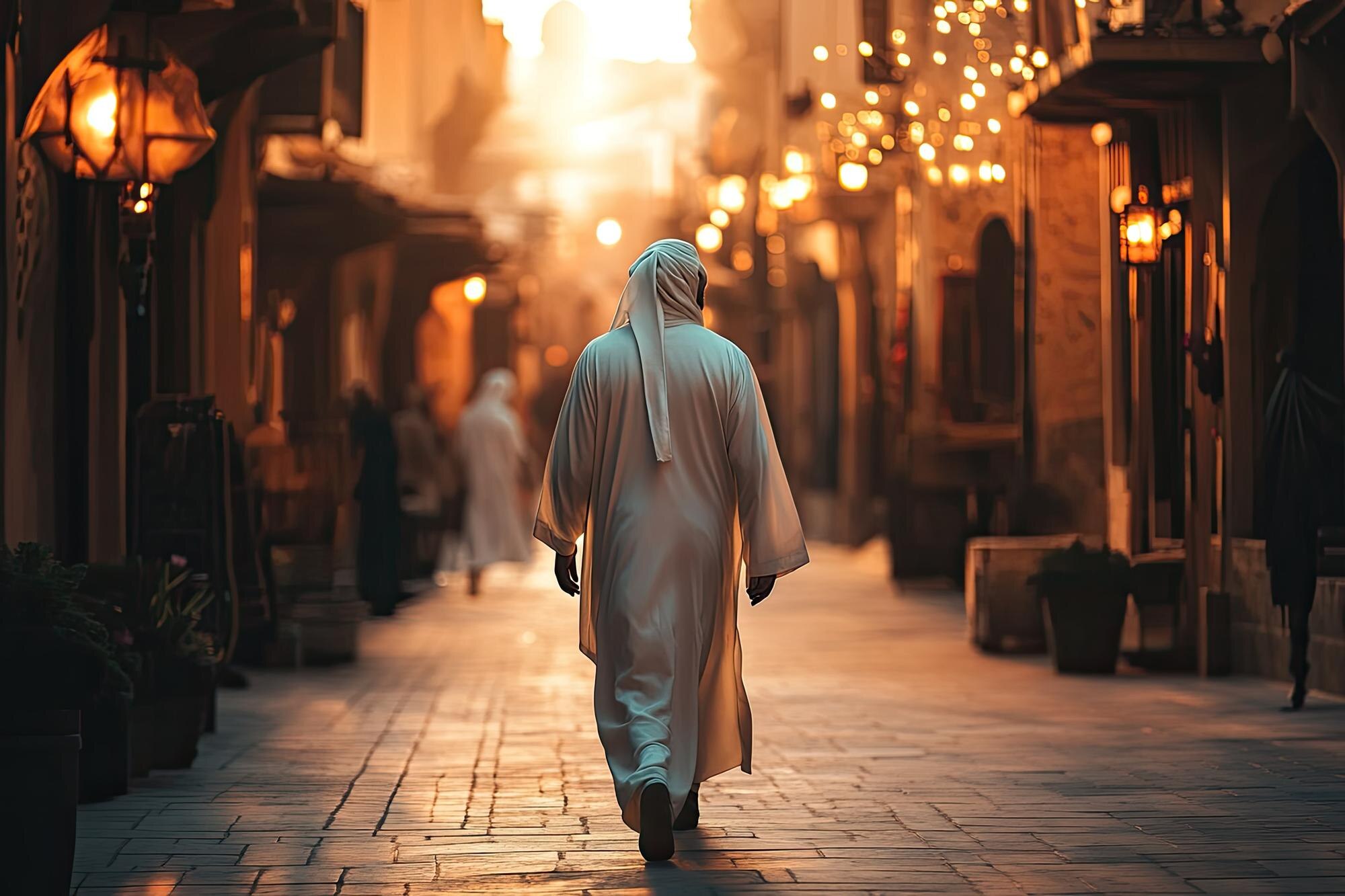
There’s a moment most pilgrims come to know. You’ve crossed continents to stand before the Kaaba, you finally raise your hands for the du’a you’ve been saving up for years — and an elbow lands in your ribs, a tour group surges past behind a raised flag, and the thought you were shaping dissolves before it reaches your lips. Supplication needs attention. Scholars have always taught that du’a made with a present, gathered heart is a different act from words recited while your senses are busy defending your footing. And the mataf at Maghrib, magnificent as it looks from above, is simply not where hearts settle. It’s where the whole Muslim world converges at once. There’s genuine reward in patience amid that press, but it isn’t the setting for the slow, unhurried conversation with Allah that you travelled for.
The encouraging truth is that quiet at the two Holy Mosques isn’t a matter of luck. Masjid al-Haram can hold hundreds of thousands of worshippers, yet it also holds pockets of near-silence at predictable hours and in predictable places. Finding them is a learnable skill. This guide maps it — first the clock, because timing matters more than geography, and then the floors, corners and courtyards where stillness tends to live, in Makkah and Madinah both.
Start with the clock, not the map
Ask experienced pilgrims where they find peace and they’ll usually answer with a time rather than a place. The Haram runs on a tidal rhythm: it fills towards each of the five prayers, holds its crowd for a stretch afterwards, then slowly drains. Learn the tide and you can walk into stillness on the ground floor itself, without climbing a single escalator.
Post-Fajr to mid-morning: the mosque at its gentlest
The kindest stretch of daylight begins about an hour after Fajr. The dawn congregation drifts back to hotels for breakfast and sleep, because a large share of them have been awake most of the night. From roughly seven until eleven in the morning the mosque exhales. The marble is still cool, the light through the high windows is soft, and you can often find a pillar to lean against within sight of the Kaaba — something unthinkable at sunset. If you can adjust your body clock to nothing else, adjust it to this: pray Fajr, stay put or return after a short rest, and give the mid-morning to Qur’an and du’a. Many pilgrims discover that two unhurried hours here are worth more to their hearts than eight distracted ones at peak times.
The small hours
Deeper still is the window between about one and three in the morning. The Isha crowds have gone, the Tahajjud regulars haven’t yet arrived in force, and a hush settles over the sanctuary that daytime visitors would scarcely believe. This is the hour made for long prostration and private weeping, and it comes at an honest price: real sleep, which your body needs for the walking that fills an Umrah day. You don’t need to do it nightly. Once or twice in a trip, planned deliberately — an early night before, a lie-in after — gives you the experience without wrecking the rest of the journey. Older pilgrims and anyone managing a health condition should weigh this trade honestly rather than romantically.
The geography of calm in Makkah
When the hours are against you, move through space instead. The rule of thumb is simple: density drops with every metre of height and every metre of distance from the mataf. You trade physical closeness to the Kaaba for the ability to actually concentrate, and that’s usually a trade worth making for everything except the tawaf itself — and sometimes even for that.
Up is the direction of quiet
The mosque rises in layers — ground floor, mezzanine, first floor and roof — and each one is calmer than the last. The roof deserves special mention. At night it’s noticeably cooler than the enclosed halls, the breeze is real, and from the inner edge you keep what matters most: sight of the Kaaba below, lit and serene, with a fraction of the crowd around you. Contemporary scholars broadly agree that tawaf performed on the upper levels and roof is valid, so a pilgrim who finds the ground-floor mataf overwhelming loses nothing in correctness by circling higher up — though the circuit is much longer, which matters for anyone with tired knees. For sitting, reading and du’a rather than tawaf, the upper floors are, hour for hour, the most reliably peaceful prayer space in the building. Lifts and escalators run at multiple points around the mosque, so getting up there doesn’t demand stairs.
The mezzanine’s overlooked bays
Between the ground floor and the first floor sits a mezzanine level that many first-time visitors never register at all, which is precisely its charm. Its moving lanes carry tawaf traffic, especially wheelchair users at busy periods, but set back from those lanes are recessed bays and colonnaded pockets where worshippers sit with the mataf visible below and the noise strangely muffled. Honest caveat: as of mid-2026, access arrangements on the mezzanine shift with crowd-management plans, and stewards sometimes close sections or reserve lanes without notice, particularly in Ramadan. Treat it as a level to explore when you’re there rather than a spot you can promise yourself in advance — and if a steward waves you on, go graciously and try one floor higher.
Far corners, expansion halls and the courtyards
Horizontal distance works too. The vast halls of the newer expansions to the north stay air-conditioned, carpeted and remarkably serene outside the surge around each prayer — you lose sight of the Kaaba, but you gain silence and space to spread a mushaf properly. Outside, the outer courtyards and plazas have their own character: harsh at midday in summer, but genuinely lovely from late evening onwards, when the marble has cooled and families thin out. The far corners of the courtyards, away from the main gate axes, are where you’ll find locals doing exactly what you’re trying to do. One orientation point worth knowing: the whole sanctuary, not just the building, carries special status — our guide to what counts as the Haram area explains the boundaries, which is comforting when you find your quiet spot a courtyard’s width from the nearest door.
Madinah’s quiet map
The Prophet’s Mosque is gentler than Makkah’s Haram to begin with — the rites don’t revolve around it in the same way — but it has its own geography of calm. The most atmospheric quiet sits in the older section of the mosque, the part nearest the Rawdah with its distinctive pillars and low, ornate ceilings. Its front rows fill fast, but the back rows of that old section, a few minutes’ walk from the busiest gates, soften noticeably between prayers. Sit there mid-morning and you get the historic mosque almost to yourself, with the newer marble halls buffering the crowd noise behind you.
Outside, the great courtyard umbrellas are Madinah’s signature gift. At dawn, just after Fajr, sitting beneath them as the sky lightens is as peaceful as any experience the two cities offer — cool air, doves, the murmur of dhikr around you. By mid-morning in summer the courtyard becomes an oven, so this is strictly an early and late pleasure. For women, timing matters doubly: the women’s sections have their own rhythm, filling hard around Rawdah visiting slots and prayer times and emptying generously in between, so a little observation on your first day pays off for the rest of the stay. Booking the Rawdah itself runs through Nusuk, and the quietest women’s-section hours tend to mirror the men’s: after Fajr and in the late morning. Our guide to women’s safety and comfort at the Haramain covers the practical side in more depth.
Reading beats roaming: claim a personal spot
There’s a strong pull, especially on a first visit, to keep moving — to sample every hall and photograph every corridor. Resist it, at least partly. Pilgrims who choose one spot and return to it daily report something the wanderers miss: the place starts to work on them. The same pillar, the same patch of carpet, the same angle on the minarets — familiarity strips away the novelty that keeps your attention on your surroundings, and frees it for the worship you came for. A fixed spot also makes you findable if you’re travelling with family, simplifies your route in and out (our guide to finding your way around the mosques helps with that), and turns worship into habit rather than event. Choose somewhere sustainable: near a Zamzam station, within reach of the facilities, and not in a walkway. Then keep the appointment with yourself every day.
I’tikaf-style sessions for the visiting pilgrim
Formal i’tikaf — secluding yourself in the mosque for a set period, classically the last ten nights of Ramadan — is tightly organised at the Haramain these days. As of mid-2026, official i’tikaf places are allocated through the General Presidency’s online portal, the permits are free, and eligibility has been limited to citizens and residents aged eighteen and over, with expatriate residents needing their sponsor’s approval. A short-stay visitor on an Umrah visa generally can’t register for the formal programme, and overnight sleeping in the mosque outside it is discouraged by stewards.
None of that closes the door on the spirit of the practice. Many scholars hold that a voluntary i’tikaf can be made for any period you spend in a mosque, even an hour, simply by forming the intention as you enter. So build i’tikaf-style sessions into your trip: pick an off-peak block of two or three hours, make the intention, switch the phone off entirely, and structure the time — a portion of Qur’an, a cycle of dhikr, unhurried du’a, two rak’ahs to seal it. Bring water, sit near your fixed spot, and tell a companion when to expect you back. It’s the concentrated stillness of i’tikaf scaled to a visitor’s reality, and it may be the most valuable habit you take home.
The real noise is in your pocket
Be honest about what actually breaks your concentration at the Haram. It’s rarely the crowd, which becomes white noise within minutes. It’s the phone. The group chat asking how the trip is going, the urge to film the moment instead of living it, the reflexive scroll while you wait for the iqamah — these follow you to the quietest bay on the roof and defeat the whole point of being there. A workable discipline: flight mode the moment you enter the mosque, with a fixed slot afterwards for messages and photos. If family at home worry, tell them your mosque hours in advance so silence doesn’t alarm them. Take a handful of photos on one visit, deliberately, and then let the camera rest for the remainder. Nobody on their journey home wishes they’d filmed more and prayed less.
Your hotel room counts too
Some pilgrims feel guilty for every rak’ah prayed away from the mosque, and the guilt deserves gentle correction. The famous hadith — that prayer in Masjid al-Haram is better than a hundred thousand prayers elsewhere, narrated in the collections of Ibn Majah and Ahmad — is real encouragement to pray the obligatory prayers in congregation at the mosque whenever you reasonably can. But the Prophet (peace be upon him) also taught, in a hadith recorded by al-Bukhari, that the best prayer is a person’s prayer where they are lodging, apart from the prescribed ones — a standing endorsement of voluntary worship in your own room. Both texts are honest, and together they sketch a sane rhythm: strive for the fard in the mosque, and feel no loss making your night prayers, Qur’an reading and long du’a in the hotel when your body or the crowds demand it. A quiet room with the Kaaba a few streets away is not exile from worship. For the exhausted, the unwell, mothers with sleeping children and women in the days when they aren’t praying, it’s often exactly where the most heartfelt worship of the trip happens.
When the seasons squeeze the quiet
Everything above needs scaling to the calendar. In Ramadan — above all in the last ten nights — the tidal rhythm flattens: the mosque stays substantially full around the clock, the roof and mezzanine fill like the ground floor, and stewards channel movement along fixed routes. The weeks around Hajj transform the city similarly, and school-holiday periods send noticeable surges through both cities. In those seasons, adjust expectations rather than abandoning the search: quiet migrates outward to the far courtyards and to the expansion halls’ deepest rows, and later into the night. Arrive earlier than feels necessary, accept a spot without a view, and treat any calm you find as a bonus. Our guide to dealing with crowds at Masjid al-Haram covers the mechanics of moving through peak density safely; the two skills — handling crowds and escaping them — belong together.
The discipline of leaving when it’s full
One last skill, and it may be the hardest: knowing when to walk away. You’ll sometimes climb to a favourite corner and find it packed, or step into the mataf for a voluntary tawaf and realise the density is beyond what you can bear with presence of mind. The temptation is to push on because you’re already there — the sunk-cost tawaf, ground out shoulder to shoulder with a pounding heart and no attention left for remembrance. It serves no one. A voluntary tawaf can be postponed to a gentler hour; a du’a session can move to the roof, the courtyard or your room without losing its worth. Leaving calmly, with the intention of returning at a better time, is not weakness but planning — the same judgement that sent you to the mosque after Fajr instead of at Maghrib. Keep a short written list of your essential du’as, keep your fixed spot and your two golden windows — mid-morning and the small hours — and let the crowded hours go. The quiet will still be there tomorrow, in the same places, at the same times, waiting for you to keep the appointment.
Leave A Comment