
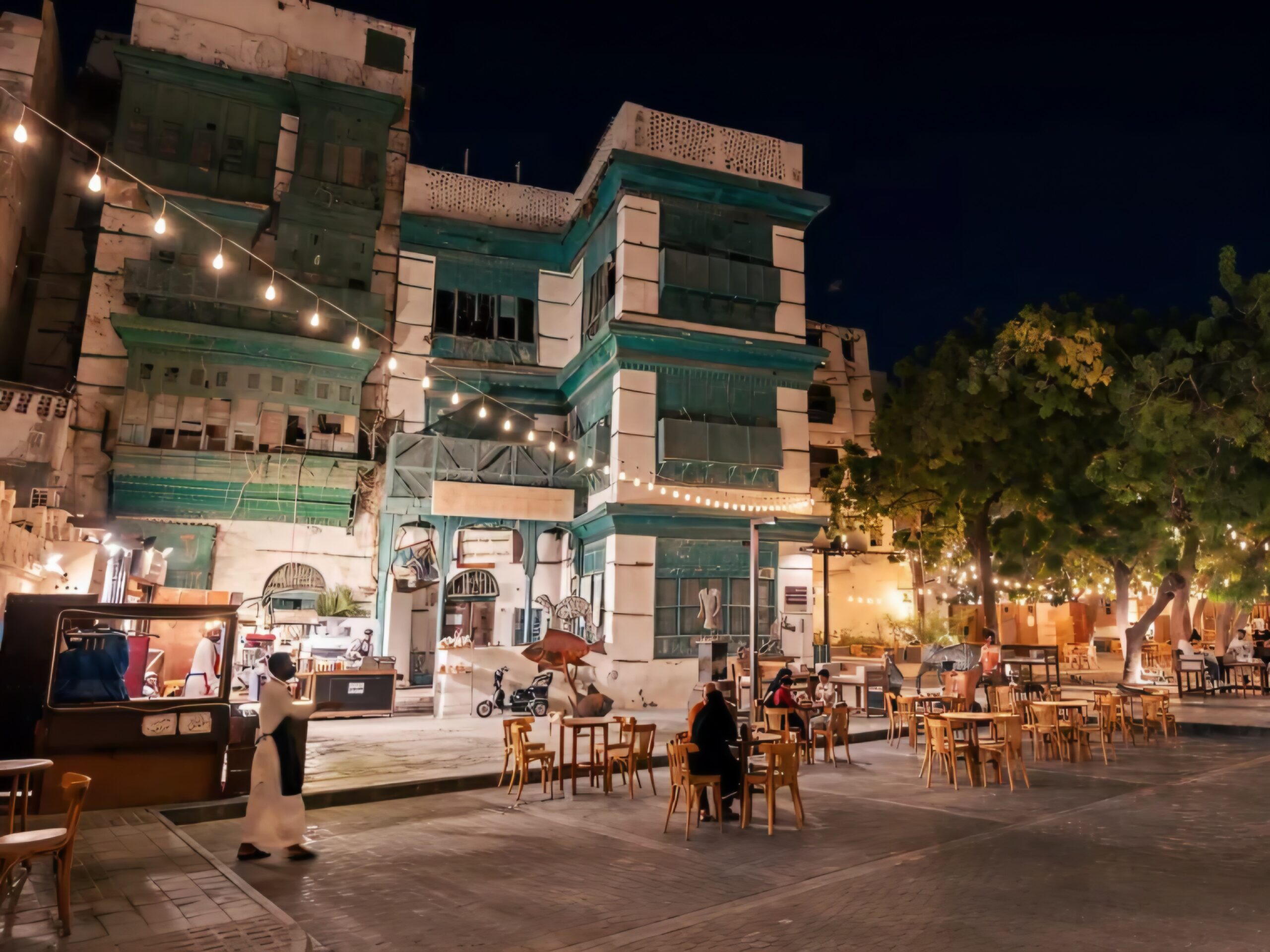
Al-Balad: The Soul of Jeddah, The Bride of the Red Sea
The air in Historic Jeddah tastes of salt and frankincense. It clings to the skin, a warm, humid embrace carried on a breeze that has whispered secrets across the Red Sea for centuries. Here, in the labyrinthine heart of Saudi Arabia’s great port city, the modern world of glass towers and six-lane highways recedes, replaced by the hushed echoes of footsteps on stone, the murmur of the afternoon call to prayer weaving through narrow alleyways, and the intricate dance of light and shadow across the carved wooden facades of ancient tower houses. This is Al-Balad, which simply means “The Town.” Yet, for those who walk its streets, it is anything but simple. It is a living chronicle, a testament to faith, trade, and a uniquely resilient culture forged at the crossroads of civilizations.
The Gateway to the Holiest City
Long before it earned its title as the “Bride of the Red Sea,” the coastline where Jeddah now stands was a modest fishing outpost, a place known to the ancient Quda’a tribe who cast their nets into the turquoise waters. Its destiny, however, was not to remain a quiet hamlet. The pivotal moment arrived in 647 AD, a decision that would forever alter its trajectory. The third Caliph of Islam, Uthman ibn Affan, seeking a more suitable and sheltered harbor for the growing number of pilgrims journeying to Makkah, cast his eyes upon this location. He officially designated Jeddah as the primary seaport for the Hajj, replacing the smaller, more exposed port of Al Shoaiba to the south. This singular decree transformed Jeddah from a fishing village into the official gateway to Islam’s holiest city.
Suddenly, the small settlement was inundated with the world. Ships from Egypt, Syria, Africa, Persia, and the Indian subcontinent dropped anchor in its harbor. They carried not only pilgrims but also goods, ideas, and customs. The town began to swell, its identity shaped by the constant ebb and flow of humanity. To protect this burgeoning wealth and its pious visitors from pirates and foreign powers, a formidable defensive perimeter was required. In the early 16th century, as Portuguese fleets began to threaten Red Sea trade routes, the Mamluk Sultan Qansuh al-Ghuri commissioned the construction of a great wall. Built from the very coral stones harvested from the sea, the wall encircled the town, punctuated by watchtowers and massive gates that became the arteries of the city. There was Bab Makkah, the eastern gate through which the great pilgrim caravans would depart on their final, dusty trek to the holy city. To the south, Bab Sharif controlled access to the main market, while other gates like Bab Al Madinah and Bab Jadid opened to the north and the sea, each a portal to a different facet of Jeddah’s life.
An Architecture of Wind and Coral
The city that grew within these walls was an marvel of environmental and cultural adaptation. Confined by its fortifications, Jeddah had to grow upwards, giving rise to its most iconic feature: the magnificent tower houses, or bayt. These multi-storied structures, some reaching five or six floors, were built from mangabi, the fossilized coral stone cut from the nearby reefs. This porous material, when plastered with clay, was remarkably effective at insulating against the searing Arabian heat. But the true genius of Hejazi architecture is revealed in the Rawashin (singular: Roshan), the ornate, projecting wooden casement windows that adorn these homes like intricate pieces of jewelry.
These were not mere decorations. The Rawashin were sophisticated climate-control systems, their latticework designed to catch the sea breeze and funnel it through the home while providing deep shade from the relentless sun. They also offered a crucial element of privacy, allowing the women of the household to observe the bustling street life below without being seen. Walking through Al-Balad is to be in a gallery of these masterpieces, each Roshan a unique expression of the carpenter’s art and the owner’s status. The most famous of these homes, the majestic Bayt Nassif, stands as a monument to this architectural heritage. Built in the late 19th century for a powerful merchant and governor, its 106 rooms hosted dignitaries from across the globe. When King Abdulaziz Al Saud, the founder of modern Saudi Arabia, entered Jeddah in 1925, he made this house his temporary residence. A lesser-known but remarkable feature of Bayt Nassif is its wide, gently sloping staircase, ingeniously designed so that messengers on camelback could ride all the way up to the grand reception hall on the upper floor to deliver their news. Today, it serves as a museum and cultural center, its vast, airy rooms a silent testament to a bygone era of influence and opulence.
The Souqs: A Symphony of Commerce and Culture
The lifeblood of Al-Balad has always been its markets, or souqs. These are not sterile shopping arcades but vibrant, chaotic, and utterly immersive ecosystems of commerce. The main artery, Souq Al Alawi, twists and turns through the heart of the district, its narrow lanes shaded by the towering houses above. Here, the air is thick with the competing aromas of exotic perfumes—the deep, woody scent of oud, the sharp sweetness of amber, and the sacred perfume of frankincense burned in clay censers. Shops overflow with shimmering textiles, hand-woven rugs, and glistening piles of spices: saffron from Iran, cardamom from India, and cinnamon from Ceylon. The soundscape is a constant hum of bartering in a dozen languages, the clinking of coffee cups, and the rhythmic tap of a craftsman’s hammer.
Deeper within the warren of alleyways, one finds more specialized markets. Souq Al Nada is famed for its traditional clothing and fragrant herbal remedies, while Souq Al Khaskiyah has historically been the center for groceries, where one can find barrels of golden Sidr honey from Yemen and pyramids of glistening dates from the oases of Al-Qassim. These souqs catered not just to locals but to the legions of pilgrims who would spend weeks or even months in the city awaiting the Hajj. For them, Jeddah was a vital provisioning stop and a place to purchase gifts to take home. This constant interaction infused the local population, the Jeddawis, with a uniquely cosmopolitan and famously tolerant character, creating a melting pot of ethnicities and traditions that endures to this day.
A Renaissance in the Heart of the City
For a time, the story of Al-Balad mirrored that of many historic city centers. With the oil boom of the mid-20th century, wealth soared, and Jeddah expanded outward at a breathtaking pace. Families moved to spacious modern villas in the northern suburbs, and the old city, with its lack of parking and modern amenities, was left behind. The great coral houses fell into disrepair, their Rawashin crumbling, their silent rooms gathering dust. The great city walls, once a symbol of security, were torn down in 1947 to make way for urban expansion, a decision that symbolically and physically opened Al-Balad to a new, uncertain era.
But the soul of Jeddah refused to be extinguished. A powerful movement, driven by both the government and passionate locals, began to reclaim this priceless heritage. In 2014, Historic Jeddah was inscribed as a UNESCO World Heritage site, a recognition that catalyzed a massive and meticulous restoration effort. Today, Al-Balad is in the midst of a remarkable renaissance. Cranes and scaffolding are as common a sight as historic mosques, as craftsmen trained in ancient techniques painstakingly restore the coral stone walls and intricately carved Rawashin of one historic home after another.
This revival is not about creating a sterile museum. It is about breathing new life into the old city’s veins. The restored buildings now house boutique hotels, offering visitors a chance to sleep within walls that have stood for centuries. Contemporary art galleries, such as the influential Athr Gallery located just on the periphery of the old town, have brought a modern creative energy, while smaller studios tucked away in the alleys showcase the work of emerging Saudi artists. Artisan coffee shops like Medd Cafe have sprung up, where young Jeddawis and curious tourists sit on reclaimed wooden furniture, the aroma of specialty coffee mingling with the ancient scents of the souq. The historic heart of Jeddah is beating strongly once again, its rhythm a fusion of past and present, a place where you can buy a traditional miswak (a teeth-cleaning twig) from a street vendor and then turn a corner to find a pop-up contemporary art installation. During the city-wide festivals, the ancient lanes are illuminated with light shows, and the quiet squares fill with music, proving that Al-Balad is not a relic, but a vibrant stage for the future of Saudi culture.
To walk through Al-Balad is to walk through time itself. It is a journey that engages all the senses, a place where every carved doorway, every weathered stone, and every shadowed alley holds a story. It is the story of pilgrims and merchants, of builders and artists, of a city that welcomed the world and, in doing so, forged an identity all its own. The Bride of the Red Sea has awakened, her historic beauty lovingly restored, ready once more to enchant all who come to her shores.