Beit Al Matbouli (Matbouli House Museum): The Complete History and Visitor Guide to Jeddah’s Oldest Merchant House
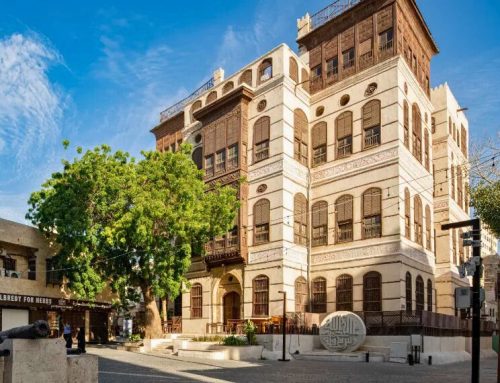
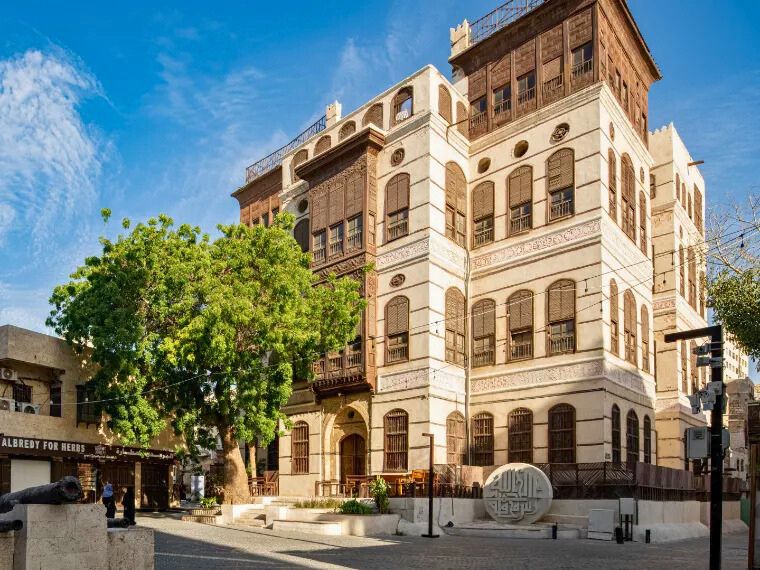
In the narrow lanes behind Souq Al-Alawi, where the coral-stone facades lean close enough to shade the street from the worst of the Red Sea sun, a four-storey house stands with its wooden screens catching whatever breeze survives the walk in from the water. This is Beit Al Matbouli — the Matbouli House Museum — and it is one of the most consistently recommended stops in Historic Jeddah’s Al-Balad district, cited by the official Saudi tourism authority, by Google’s Arts & Culture platform, and by nearly every guidebook to the old city as one of its “most famous historical houses.” Its rawasheen, the projecting carved wooden window screens that define the skyline of old Jeddah, are described by Visit Saudi as furnished in “classical brown,” and its two street-level entrances, its stacked living quarters, and its worn stone thresholds are offered to visitors as a rare chance to walk through a working Hijazi merchant household rather than a roped-off exhibit case (Visit Saudi).
This guide takes Beit Al Matbouli seriously enough to interrogate it. It asks what can actually be verified about its age, distinguishes tradition from documentation, and lays out the coral-stone building science that makes the house — and the entire district around it — both remarkable and fragile. It describes the restoration that turned a family home into a public museum, what is actually on display inside, and what a visit looks like in practice, including the parts of the experience that are inconsistent from one week to the next. It draws, carefully and only where genuinely apt, on Islamic teaching about hospitality, honest trade, and the ethics of the household, because Beit Al Matbouli was built by a trading family whose religious and commercial lives were inseparable — while being clear throughout that this is a heritage house and a family museum, not a site of prophetic or companion history, and that no sacred status should be read into it. Article 84 in this series covers Historic Jeddah and the UNESCO World Heritage inscription of Al-Balad as a whole; Article 85 covers Nassif House, the grandest of the district’s roshan mansions. This guide keeps its focus tightly on Beit Al Matbouli itself and cross-references those companion pieces rather than repeating their ground.
Historical Background: Al-Balad, Souq Al-Alawi, and the House’s Place in the District
Where the House Sits
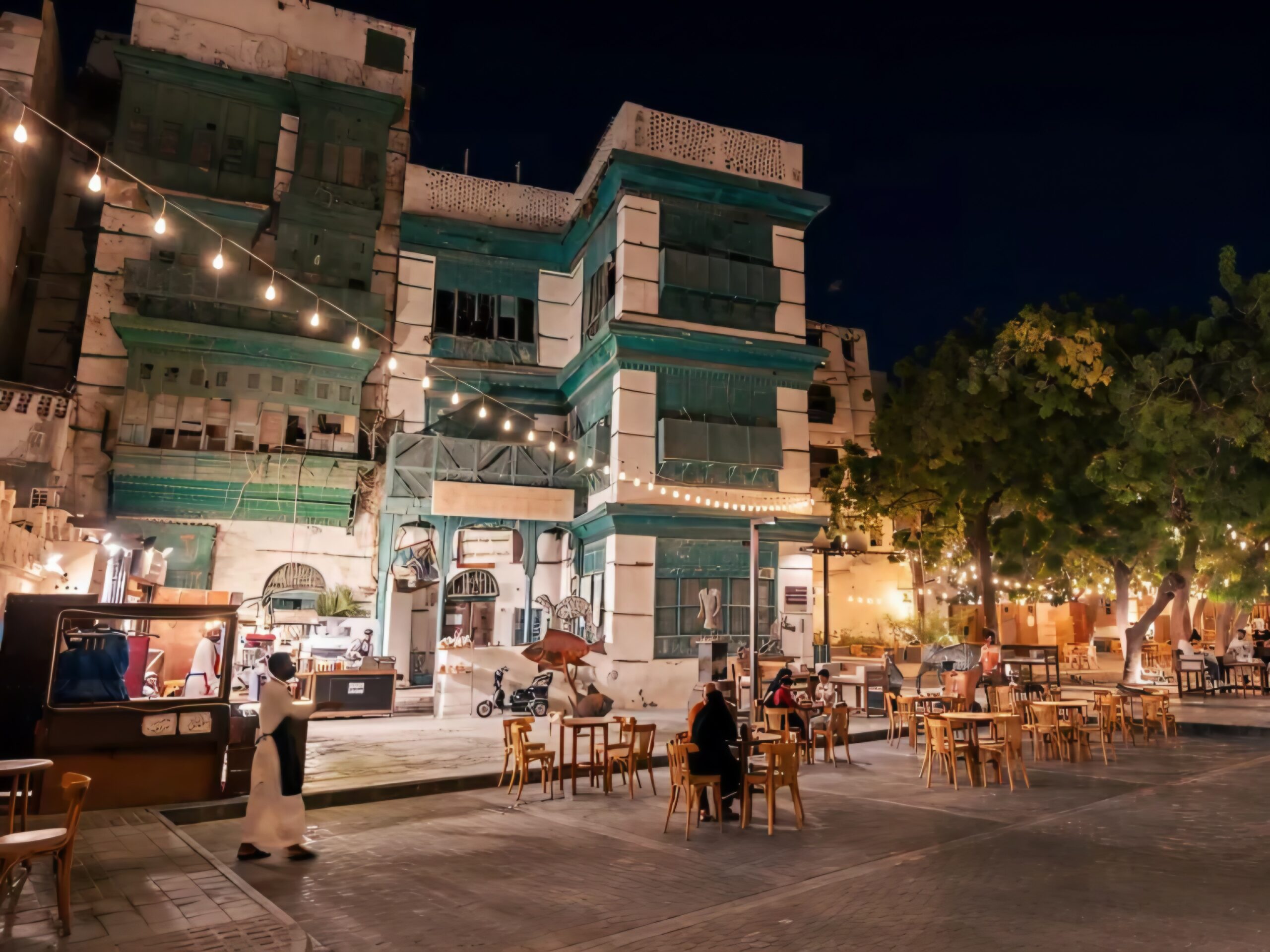
Beit Al Matbouli stands in Harat al-Yaman, the Yemen Quarter, one of the four historic residential quarters into which old Jeddah was traditionally divided, at the edge of Souq Al-Alawi — a market whose own documented history reaches back to 1716 and which the official Visit Saudi platform calls the largest, oldest, and liveliest of Historic Jeddah’s markets, “a major stopping point for pilgrims heading to Makkah” (Visit Saudi, Souq Al-Alawi). The house’s exact address today is 3352 Zuqaq al-Qumsani (Qamsani Alley), in the Al-Balad district, Jeddah 22236 — a location so deep inside the old city’s lane network that most visitors reach it on foot, threading past textile stalls, incense sellers, and spice merchants who occupy the same alleys the Matbouli family’s own caravans and customers would once have used.
Al-Balad itself — the word means simply “the town” — is the walled historic core of Jeddah, a city whose origins the Ministry of Culture and academic sources trace to the seventh century CE, when the third Caliph, Uthman ibn Affan, designated it the official port for pilgrims and goods bound for Makkah. That designation is the single fact that explains almost everything else about the district: its wealth, its cosmopolitanism, its architecture, and ultimately the Matbouli family’s own trade. Article 84 in this series treats Historic Jeddah’s founding, its UNESCO World Heritage inscription in 2014, and the wider district’s urban form in full, and readers wanting that context should turn there; what matters for this guide is narrower — where, within that larger fabric, one particular merchant house came to stand, and what its own four centuries look like up close.
Souq Al-Alawi and the Life Around the House
Souq Al-Alawi is not a backdrop to Beit Al Matbouli; it is the reason the house exists where it does and largely why the family who built it prospered. The market’s stalls today sell traditional clothing, incense, spices, herbs, and folk remedies, much as they would have sold provisions, cloth, and trade goods to pilgrims and residents alike for three centuries (Visit Saudi). A commercial architecture practice that has worked on a building within the same Al-Matbouli House complex describes Souq Al-Alawi as dating to 1716 and still functioning as “a hub for local trade, particularly during the Hajj season, when the area takes on a cosmopolitan intensity” (Bricklab). A merchant household built its fortunes, quite literally, on the other side of the wall from this market, and the house’s main entrance was oriented to open directly onto it — a detail worth holding onto, because it shapes almost every architectural decision inside, from where the reception rooms sit to how the ground floor was used.
Historic Jeddah’s Architectural Character in Brief
UNESCO’s own description of Historic Jeddah, cited in the World Heritage List entry, frames the district’s built fabric as “an outstanding reflection of the Red Sea architectural tradition,” combining “imposing tower houses decorated by large wooden Roshan,” built mainly in the late nineteenth century by the city’s mercantile elite, with “lower coral stone houses, mosques, ribat-s, suqs and small public squares” from earlier periods (UNESCO World Heritage Centre). Beit Al Matbouli belongs to the older, lower stratum of this fabric rather than to the flamboyant nineteenth-century roshan towers such as Nassif House — its documented four floors and roughly 350 square metres of built area make it a substantial merchant house, but not one of the seven-storey giants that define postcards of Al-Balad (Alshawabkeh et al., Journal of Architecture and Planning, King Saud University). If its traditional dating is accepted, it predates the roshan tower boom that UNESCO associates with the post-1869 Suez Canal trade surge by more than two centuries, making it a survivor from an earlier, humbler phase of the same coral-building tradition — a claim this guide examines in detail in the next section, because “if its traditional dating is accepted” is doing real work in that sentence.
The Age Question: What the Evidence Actually Supports
The Claim as It Is Repeated
Ask almost any source about Beit Al Matbouli and the same figure comes back: around four hundred years old, built in 1022 AH, corresponding to 1613 CE, by Sheikh Mahmoud Al-Matbouli. A visitor account posted after a Friday visit in 1446 AH (2024–2025) gives the claim in its fullest form: “Matbouli House is the oldest house in Historic Jeddah. It was built in the historic area of Souq Al-Alawi inside Harat al-Yaman by Sheikh Mahmoud al-Matbouli, and the house is approximately 400 years old, having been built in 1022 AH” (visitor account, Matbouli House Museum). Google’s Arts & Culture platform, produced in partnership with UNESCO’s Historic Jeddah documentation project, states flatly that the house was “Built in 1613,” describing four centuries of continuous family history (Google Arts & Culture, “Bayt Al-Matbouli: Four Centuries of Life in Historic Jeddah”). The official Saudi tourism platform repeats the same date: “Beit Al Matbouli, built in 1613, is one of Historic Jeddah’s most famous historical houses” (Visit Saudi). An architecture practice that worked on an adjoining building within the same family complex likewise describes “the nearly 400-year-old building” as an established fact of the site (Bricklab). Saudi Arabia’s state-run encyclopedic reference, Saudipedia, lists Beit Al Matbouli among the buildings of Historic Jeddah as “consisting of four floors, built more than four hundred years ago” (Saudipedia).
What Is Actually Being Cited
Read closely, however, none of these sources cites an independent form of physical or documentary evidence for the 1613/1022 AH date — no foundation inscription, no waqf deed, no Ottoman-era property register, no radiocarbon or dendrochronological dating of the timber tie-courses, no archaeological excavation report. What is being repeated, consistently and across many outlets, is a single family tradition: that the house was built by Sheikh Mahmoud Al-Matbouli around that date. The academic case study of the museum published in the Journal of Architecture and Planning at King Saud University states the same figure — “built more than 400 years ago… by Sheikh Mahmoud Al-Matbouli” — while citing it to a 2021 heritage-buildings survey and a 2023 secondary account of the family’s oral history, not to a primary documentary source (Alshawabkeh et al., JAP-KSU). This is not unusual for vernacular houses in Al-Balad generally — the district’s own nomination file to UNESCO, discussed in Article 84, relies heavily on a 1980s built-heritage inventory by the architect Robert Matthews and on family testimony rather than archival property deeds for most individual houses, because Ottoman-era Jeddah simply did not keep the kind of centralised municipal building records that would let a modern historian verify a construction date to the year.
Honest Interrogation of the Claim
None of this means the four-hundred-year tradition is false. Harat al-Yaman is generally understood, including by the UNESCO documentation for Historic Jeddah, to be among the oldest of the city’s quarters, predating the grand roshan tower houses that the World Heritage listing dates specifically to “the second half of the 19th century” and to the trading boom that followed the 1869 opening of the Suez Canal (UNESCO World Heritage Centre). A house in this quarter being centuries older than the famous roshan towers is entirely plausible on architectural-historical grounds, and Beit Al Matbouli’s comparatively modest four-storey scale, its lack of a grand projecting roshan balcony of the Nassif House type, and its layout — described by visitors as favouring simpler seating alcoves (maq’ad) with rawasheen rather than a full cantilevered balcony — are consistent with an earlier, plainer phase of Red Sea coral construction rather than the showpiece architecture of the nineteenth century. What responsible reporting requires, though, is saying plainly that “around four hundred years old” is a transmitted family date, treated as reliable by the family, by Saudi tourism authorities, and by at least one UNESCO-affiliated cultural documentation project, but not corroborated in the sources available by an independent archival or scientific dating method. It should be presented to readers as traditional history, honestly labelled, rather than as an established archaeological fact — precisely the same caution this guide applies, in its Qur’anic and hadith sections below, to reports whose isnads are contested.
A Genuine Point of Confusion: The “Eight Hundred Years” Error
Readers researching the house before a visit will also encounter a very different number circulating in aggregated review platforms: claims that the building is “almost 800 years old, dating back to the Ottoman Empire” (Wanderlog, aggregated visitor reviews; Airial Travel). This figure does not withstand basic scrutiny and is addressed at length in the misconceptions section of this guide, but it is worth flagging here because it illustrates exactly the kind of numeric drift that happens when a spoken guide’s estimate, or a mistranslated caption, gets copied from one travel-aggregation site to another without anyone checking it against the more carefully sourced 1613 figure used by Visit Saudi and Google Arts & Culture.
The Matbouli Family and Their Trade
Sheikh Mahmoud Al-Matbouli, the Builder
Every source on the house agrees on the builder’s name: Sheikh Mahmoud Al-Matbouli, a merchant of Harat al-Yaman who built the house that bears his family’s name in what would become one of Al-Balad’s busiest commercial lanes, immediately behind Souq Al-Alawi (Alshawabkeh et al., JAP-KSU; Arabisk London). Beyond the name and the trading location, the documentary record available for this guide does not preserve a detailed personal biography of the historical Sheikh Mahmoud — no dated correspondence, no customs ledgers, no travelogue mentioning him by name has surfaced in the sources consulted. What can be said with more confidence is the kind of merchant he was, because the house itself, and the family’s later documented activities, describe a family whose business was diversified general trade tied to Jeddah’s role as the gateway to Makkah.
A Trading Family, Not a Single Commodity House
Google’s Arts & Culture feature on the house, produced with UNESCO’s Historic Jeddah documentation partners, describes the Al Matbouli family’s trade as spanning “from grains to modern appliances like radios and refrigerators, reflecting a dynamic chapter in the region’s economic and social development” (Google Arts & Culture, “Walking Through Historic Jeddah”). That range — grain in the earlier period, then twentieth-century household appliances — is a useful illustration of how a merchant family in the port city serving Makkah’s pilgrimage economy needed to be commercially flexible across generations, rather than committed to a single fixed trade good the way a specialised spice or textile house might be. Arabisk London’s account of the museum adds that the family were, at one stage, formally “employed by the Hajj Agency,” a role that explains the house’s second and better-documented function: for a month each year, during the Hajj, the family “used to welcome pilgrims at their home for a whole month at their expense” (Arabisk London). This detail is corroborated independently by Google Arts & Culture’s account of the house’s diwan (reception hall), which it describes as having “hosted notable figures” and having “played a crucial role hosting pilgrims” during the Hajj season (Google Arts & Culture).
The Modern Matbouli Business Dynasty — A Distinct but Related Story
It is worth being precise about a separate, modern chapter of the same family name, because it is easy to conflate with the historic house and does real disservice to both if blurred together. In 1952, Sheikh Mahmoud Matbouli — a later namesake or descendant bearing the founder’s honorific and given name, according to the corporate history, not the seventeenth-century house-builder himself — co-founded a trading partnership in Jeddah with Sheikh Sulaiman Zagzoug. That partnership grew, was restructured in 1997 into the United Matbouli Group with eighty million Saudi riyals of paid-up capital, signed a major agency agreement with Samsung Electronics, and by 2007 reported annual revenues of 597 million Saudi riyals (United Matbouli Group corporate history). This is a genuine, and by any measure highly successful, twentieth and twenty-first century commercial dynasty carrying the Matbouli name in Jeddah, and it is plausible that the family’s move into “radios and refrigerators” mentioned in the Google Arts & Culture feature reflects exactly this branch of the family’s documented shift from traditional trade into modern electronics distribution. But the museum’s non-negotiable historical anchor remains the seventeenth-century house and its builder, Sheikh Mahmoud Al-Matbouli of Harat al-Yaman — and this guide keeps that distinction clear rather than letting the corporate success of one twentieth-century branch of the family stand in for four centuries of undocumented household history.
Architecture in Technical Detail: Coral Stone, Timber, and the Hijazi Tower House
Why Coral Stone at All
The single most important fact to understand about Beit Al Matbouli’s construction is that its builders had almost no choice of material. The Hejazi coastline around Jeddah offers essentially no conventional quarry stone — no accessible granite, sandstone, or limestone outcrops of the kind that supplied builders in Makkah or Madinah. What the Red Sea did provide, in effectively inexhaustible supply, was coral: fossilised reef limestone, known locally as mangabi stone, sitting in shallow water and along the shoreline within easy reach of the town (House of Saud, “Jeddah Coral Architecture”). Builders quarried large blocks of this fossilised coral reef, then shaped and dried them before use. UNESCO’s own description of Historic Jeddah calls this “coral masonry construction” one of the defining, character-giving attributes of the entire World Heritage property, alongside the “precious woodwork decorating the facades” and the “specific technical devices to aid internal ventilation” that coral construction made possible (UNESCO World Heritage Centre).
The Physical Properties That Made It Work
Coral limestone is not simply a cheap substitute for “real” building stone — it possesses genuine, climate-specific advantages that made it well suited to the Red Sea coast. Its structure is porous and comparatively lightweight, which gives it natural thermal insulation, keeping interior temperatures significantly cooler than the outside air even as Jeddah’s summer heat regularly passes 45°C (House of Saud). That same porosity lets the stone absorb and release ambient moisture, a genuinely useful property in a city that sits barely a kilometre from the Red Sea and endures some of the highest relative humidity levels of any Arabian coastal settlement. In simple terms: a material dense and heavy enough to bear structural load, but porous enough to breathe with the surrounding air, is close to an ideal passive-climate-control building material for this specific environment — which is precisely why the coral tradition persisted here for centuries, resisting the introduction of imported fired brick or dressed stone even after they became commercially available.
How the Walls Were Actually Built
Construction began below ground. Foundations were typically excavated to roughly a metre in depth, built up from compacted layers of coral stone and clay bound tightly together, providing a stable base on ground that, this close to the sea, could otherwise be sandy and unstable (House of Saud). Above the foundation, the load-bearing walls were built from coral blocks roughly 50 to 60 centimetres thick at the base — a substantial mass of masonry — tapering thinner on the upper storeys to reduce the load each successive floor placed on the one below it. This tapering profile, standard across Al-Balad’s coral houses, is one reason the district’s most dramatic tower houses could rise five, six, or even seven storeys without their lower walls collapsing under their own weight; Beit Al Matbouli’s own four floors sit comfortably within this engineering logic without needing the most extreme tapering seen in the tallest roshan towers.
The mortar binding the coral blocks together was not cement — nothing resembling modern cement mortar was available or used. Instead, builders used a dark-brown clay drawn from the shallow al-Manqabah lagoon, mixed with lime, to bind the coral blocks (House of Saud). This mud-and-lime mortar shares the coral stone’s breathability: unlike cement, which seals moisture inside a wall and can trap salt-laden damp against the stone, a lime-and-clay mortar allows moisture to migrate and evaporate through the wall surface — a property that becomes critically important when considering why later, well-intentioned but poorly executed cement repairs have often accelerated the decay of coral buildings elsewhere in Al-Balad, a point this guide returns to below.
The Timber Tie-Course System: The Structural Innovation That Made Multi-Storey Building Possible
Coral stone alone, no matter how carefully mortared, cannot safely support four, five, or seven storeys of masonry — it lacks the tensile strength and crack-resistance of stone or fired brick used in comparable multi-storey construction elsewhere in the pre-modern world. The solution that Hejazi builders developed, and that appears throughout Al-Balad’s historic building stock including in houses of Beit Al Matbouli’s type, was a system of horizontal timber tie-courses known locally by terms including taklilat for the wooden beams themselves (Alshawabkeh et al., JAP-KSU) and referred to in some technical literature as the gandal system: courses of hardwood timber, imported from India, laid horizontally through the coral masonry at intervals of roughly every 1.2 metres up the height of the wall (House of Saud). These timber courses act like the steel reinforcement bars in modern reinforced concrete — they bind the masonry together laterally, distribute load and stress across a wider area, resist the cracking that would otherwise propagate through a tall coral wall, and give the structure enough flexibility to tolerate minor settlement and thermal movement without catastrophic failure. Without this innovation, the House of Saud’s architectural survey of the district notes plainly, “coral walls could not support the five-to-seven-storey heights that define Al Balad’s skyline” (House of Saud) — and by extension, a four-storey house like Beit Al Matbouli would not have been structurally viable without the same timber-course technique running through its coral walls.
Structural timber beams — sourced not only from India but also imported from East Africa and Indonesia — supported the wooden floor platforms between storeys, meaning that even the horizontal floor structure of a house like this one, not just its vertical walls, depended on maritime trade networks stretching across the Indian Ocean. A house built from local Red Sea coral was, in that sense, never purely local: it was a hybrid structure assembled from Hejazi stone and imported hardwood, exactly mirroring the “exchange of human values, technical know-how, building materials and techniques” that UNESCO’s Historic Jeddah citation identifies as the district’s defining historical character (UNESCO World Heritage Centre).
Exterior Finish and Weather Protection
Once the coral masonry and timber tie-courses were in place, the exterior was typically coated with a lime plaster finish, referred to in some sources by the Arabic term nura, protecting the porous coral beneath from direct weathering and, crucially, from the corrosive effect of salt-laden sea air (House of Saud; Alshawabkeh et al., JAP-KSU). This lime render is not a cosmetic afterthought. Left unprotected, coral stone this close to the sea absorbs airborne salt, and the repeated cycle of salt crystallisation and dissolution inside the stone’s pores — driven by Jeddah’s daily humidity swings — physically breaks the stone apart from the inside, a process conservation scientists call salt weathering. The lime plaster coating is the building’s first line of defence against exactly this mechanism, and its regular maintenance and renewal was, in the pre-modern city, a routine and necessary part of a homeowner’s upkeep responsibilities — one that, as later sections of this guide discuss, has not always continued once ownership and residency patterns in Al-Balad began to change across the twentieth century.
The Roshan and Mashrabiya Woodwork
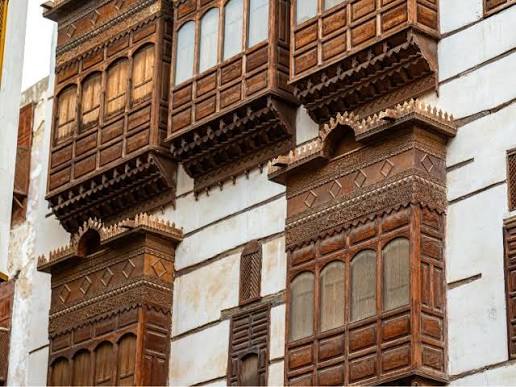
The carved wooden window screens that give Al-Balad its most recognisable visual identity go by several names — rawasheen (plural), roshan (singular), and mashrabiya, a term used more broadly across the Arab and Islamic world for the same general device — and the term itself is thought to derive from the Persian word rosen, meaning balcony (House of Saud). Architectural surveys of Al-Balad distinguish at least three grades of this screen technology by degree of projection and ornament. Al-masmat is the simplest form: a minimal wooden covering with little or no projection from the facade, typically found on smaller residential buildings through the Al-Sham and Al-Yaman quarters — precisely the kind of quarter in which Beit Al Matbouli sits. Al-bariz is more ornate, carved into complex geometric patterns and topped with a decorative crown known as a taj, projecting moderately from the wall, and associated specifically with merchant houses along Souq Al-Alawi. The fullest expression, the true balcony-style roshan, projects significantly from the facade in an elaborate, glazed or louvred bay and is associated with the grandest nineteenth-century mansions such as Nassif House and Sharbatly House (House of Saud). Visit Saudi’s own description of Beit Al Matbouli’s “classical brown rawasheen” and multiple visitor accounts describing “two seating areas with traditional rawasheen” flanking the main entrance suggest the house’s screens sit closer to the al-bariz or al-masmat end of this spectrum than to the full projecting roshan balconies of the grandest tower houses — consistent with its identity as a solid merchant house of the older quarter rather than one of the district’s showpiece nineteenth-century mansions (Visit Saudi; visitor account).
Functionally, the rawasheen were the building’s primary climate-control and privacy technology, operating on principles independent of, and centuries older than, mechanical air conditioning. The fine wooden lattice catches whatever breeze reaches the house from the Red Sea and channels it into the room behind while simultaneously blocking direct sunlight; the carved geometric openwork filters harsh daylight into a soft, diffused interior glow rather than admitting it directly; hinged lower shutter panels let residents adjust the balance of light and airflow by hand as conditions changed through the day (House of Saud). In a city that had no mechanical air conditioning until the mid-twentieth century, this lattice screen was, in the House of Saud’s phrase, “the primary cooling system” for every household wealthy enough to build one (House of Saud). Some rawasheen additionally incorporated small stone or brick benches, called dekka, built into the screened bay — effectively creating a shaded, ventilated seating nook cantilevered out over the street.
The privacy function mattered just as much as the cooling function, and the two were engineered together rather than treated as separate problems. The lattice is dense enough, and the light differential between the shaded interior and the bright street strong enough, that a resident sitting behind the screen can see pedestrians and neighbours passing below in full clarity, while those same pedestrians looking up see only an opaque, patterned wooden surface. This is worth dwelling on because it is not an incidental feature of Hijazi domestic architecture — it is arguably the central design problem the roshan was built to solve, and it connects directly to the household-privacy customs discussed later in this guide’s section on daily life and the role of women in the house.
Layout and Floor Plan
Beit Al Matbouli’s floor plan, as documented by the King Saud University case study and corroborated by visitor accounts and the Google Arts & Culture feature, follows the standard Hijazi merchant-house logic of stacking public, semi-private, and private functions vertically rather than spreading them horizontally around a courtyard. The house has two separate entrances rather than one — a detail every source agrees on. The principal entrance opens directly onto Souq Al-Alawi and leads into two distinct seating alcoves (maq’ad), each fitted with traditional rawasheen and high ceilings: one reserved for the men and senior elders of the Matbouli household, the other, positioned lower in the house, for younger male family members and guests of a different social standing (visitor account). This ground-floor arrangement reflects the wider Hijazi convention, confirmed by the King Saud University case study, that “the ground floor was strictly for welcoming guests and was typically occupied by men to offer privacy to the rest of the family in higher levels” (Alshawabkeh et al., JAP-KSU).
Moving upward, the Google Arts & Culture feature on the house describes the first floor as “dedicated to receiving guests,” while the second floor housed storage rooms known as Bayt al-Khazin — literally, “the house of stores” — stocked with the household’s provisions for the season, an important detail given the family’s grain trade and their responsibility for provisioning pilgrim guests for weeks at a time during Hajj (Google Arts & Culture). A travel account in Wanderlust magazine adds a further architectural detail worth noting for its rarity: a sitting room toward the back of the house features “intricately carved niches made from al-mangabi stones that have been excavated from the Red Sea,” alongside ebony chairs carved from wood imported from East Asia, and — unusually for a coral house of this scale — “an old well” located to one side of the living room (Wanderlust). The presence of niches carved directly into the coral stone, rather than added as separate wooden fittings, is a nice illustration of how workable a material coral limestone was for interior masonry detail as well as structural walling.
Courtyard, Light-Well, and Roof
Beit Al Matbouli does not follow the classical Arab or Levantine courtyard-house model, in which rooms are arranged around a large open central court. This is consistent with UNESCO’s own characterisation of Jeddah’s roshan tower house typology more broadly as defined partly by the “absence of courtyard” — a deliberate adaptation, in UNESCO’s account, to the narrow urban plots and dense street pattern of the walled city, where land inside the fortifications was too valuable to devote to open courtyard space, and where vertical building, not horizontal spreading, was the only way to expand (UNESCO World Heritage Centre). In place of a full courtyard, houses of this type typically relied on narrow internal light-wells or shafts, stacked window openings, and the roshan screens themselves to draw daylight and moving air down through the building’s interior stairwell and circulation spaces — a compact, vertical solution to the same climatic problem that a courtyard house solves horizontally.
The roof itself, like the floors below it, was framed in timber and finished with a mixture of packed earth, lime, and coral rubble, providing thermal mass that absorbed the day’s heat and released it slowly overnight — a passive-cooling strategy that complemented the roshan screens below. Visitors today, however, cannot verify most of this directly at Beit Al Matbouli: Lonely Planet’s guide entry for the museum notes plainly that “there’s no access to the rooftop,” and Wanderlust magazine’s account of the house independently confirms the same restriction, noting it as “the only downside” of an otherwise unusually authentic visit (Lonely Planet; Wanderlust).
Water Management: The Cisterns
Two features of the house’s water infrastructure recur across almost every account: cisterns built into the basement to collect and store rainwater, and, per the Wanderlust account above, a well inside the ground-floor living space. Visitor descriptions describe “two of the cisterns that were used to store the abundant rainwater of that time” (visitor account), and the King Saud University case study confirms the house “has cisterns to collect rainwater” as one of its documented architectural features (Alshawabkeh et al., JAP-KSU). This is a meaningful detail for understanding pre-modern household life in a city that, as this guide’s later section on daily life explains, had no piped water supply for most of its history and depended on rainwater harvesting, wells, and water carried in from outlying sources.
Why the Coral Tradition Matters — and Why It Is Fragile
All of this technical detail matters for a reason beyond architectural curiosity: it explains both why UNESCO regards Historic Jeddah’s coral building tradition as globally significant, and why that same tradition sits permanently on the edge of physical collapse. UNESCO’s nomination language describes the coral-and-timber construction system, together with the roshan woodwork, as “an outstanding building typology unique within the Arab and Muslim world,” and states that Historic Jeddah is “the last surviving urban site along the Red Sea coast that still preserves the ensemble of the attributes of this culture” (UNESCO World Heritage Centre). In plain terms: this specific combination of quarried Red Sea coral, mud-and-lime mortar, imported timber tie-courses, and carved wooden screens does not survive as a living urban tradition anywhere else. Comparable coral-building towns on Saudi Arabia’s northern Red Sea coast — Yanbu al-Bahr, Umluj, al-Wajh, Duba — have suffered even greater losses, and an academic survey of coral conservation along that coast concludes that those towns’ coral buildings “face neglect and deterioration, risking complete collapse,” while noting that Jeddah’s historic core itself “shows significant loss of building stock and is at risk of deterioration” (“The Conservation of Coral Buildings on Saudi Arabia’s Northern Red Sea Coast”).
The fragility is built into the material itself. Coral limestone’s porosity — the very property that makes it thermally comfortable to live inside — is also what makes it chemically vulnerable to salt-driven decay, especially once its protective lime render fails or is replaced with incompatible modern materials such as cement, which traps moisture rather than letting it breathe and accelerates internal cracking. A peer-reviewed materials-science study of coral stone used in a historical monument in a saline coastal environment documents exactly this deterioration mechanism in technical detail (“Characteristics and deterioration mechanisms in coral stones used in a historical monument in a saline environment,” ScienceDirect). The timber tie-courses that give the walls their structural integrity are just as vulnerable in a different way: humidity, insect attack, and decades of neglect can weaken or rot the hardwood bands running through a coral wall, and once a tie-course fails, the wall above it loses the lateral reinforcement that was keeping the whole structure from cracking apart — a slow-motion failure mode that, as the next section documents in hard numbers, has already claimed dozens of buildings across Al-Balad. This is the conservation crisis that gives Beit Al Matbouli’s own careful restoration, discussed next, its real significance: it is not a cosmetic makeover of an old house, but a rescue of a specific, irreplaceable, and structurally fragile building technology.
Roshan Versus Mashrabiya: A Technical Distinction Worth Making Precisely
Two Related but Different Terms
This guide has used the terms roshan and mashrabiya somewhat interchangeably in places, following the common usage of most tourism and travel sources describing Beit Al Matbouli, but a more precise technical distinction is worth setting out clearly, since the two terms are not simply regional synonyms for identical objects. In the specific architectural vocabulary used for Hijazi coastal houses, the roshan properly refers to a projecting timber bay window — a box-like structure cantilevered out from the building’s facade on carved wooden brackets, creating additional interior floor space at that level while allowing light and air into the room from three exposed sides rather than one flat wall opening. The mashrabiya, in the narrower technical sense, refers specifically to the fine latticework screen itself — the turned or carved wooden grille, often assembled from small individually turned wooden pieces fitted together without nails, that covers the roshan’s window openings and provides the light-filtering, privacy-preserving, and ventilating function this guide has already described in detail (House of Saud, “Jeddah Coral Architecture”). In practice, a roshan is very often fitted with mashrabiya latticework, which is why the two terms are so frequently used together or interchangeably in everyday and even scholarly usage — but the roshan is the projecting bay structure, and the mashrabiya is, strictly, the screen covering it.
Named Sub-Types of Screen
Within this broader mashrabiya screening tradition, Hijazi builders developed several named sub-types suited to different positions and functions on a building’s facade, distinctions documented in detailed architectural surveys of Jeddah’s coral-stone building tradition. The al-bariz type describes a screen fitted to a projecting roshan bay of the kind just described. The al-masmat type describes a flatter, non-projecting lattice screen set directly into a wall opening without the cantilevered bay structure, typically used where a full projecting roshan was not structurally practical or was not needed for the room’s function (House of Saud). These distinctions were not arbitrary stylistic variation; they reflected genuine differences in structural loading, in the amount of additional interior space a given room needed or could support, and in exactly how much airflow, light, and street visibility a particular room’s function called for — a family’s private upper-floor sitting room might call for a different screen type than a ground-floor reception room intended to project a certain formal presence toward the street.
Seating Built Into the Screen: The Dekka
A further refinement worth noting is the dekka, a built-in bench or seating ledge frequently incorporated directly into the base of a roshan bay, allowing household members to sit within the projecting window space itself, positioned to catch whatever breeze the mashrabiya screen was channeling while remaining comfortably seated rather than standing at the opening (House of Saud). This detail reinforces a point this guide has made about the mashrabiya more generally: these were not passive architectural features glimpsed only from the street, but actively used household furniture in their own right, spaces where the women of a household like the Matbouli family’s could comfortably spend real time — reading, sewing, minding children, or simply observing the life of Souq Al-Alawi below — rather than merely functional apertures glanced through occasionally.
Why This Precision Matters for Understanding Beit Al Matbouli Specifically
Visitor accounts of Beit Al Matbouli consistently praise its “beautiful Hejazi mashrabiyya” as one of the building’s most visually striking surviving features, as Wanderlog’s account does explicitly (Wanderlog), and Lonely Planet independently highlights the building’s “beautiful wood ceilings” alongside its other period features (Lonely Planet). A visitor equipped with the more precise vocabulary set out in this section — able to distinguish a projecting roshan bay from a flatter al-masmat screen, and to recognise a dekka seating ledge when they see one — will get considerably more out of studying the house’s surviving woodwork than a visitor who registers only an undifferentiated impression of “nice carved wooden screens.” Given that this woodwork represents, alongside the coral masonry itself, the most skilled and labour-intensive craft investment in the entire building — carved and assembled by hand from imported hardwood, using joinery techniques that in many cases required no metal fasteners at all — it rewards this closer, more technically informed attention more than almost any other single feature of the house.
The Sensory Experience of a Visit
Arriving from the Souq
Because Beit Al Matbouli sits directly on Souq Al-Alawi, a visitor’s first sensory impression of the house is inseparable from the market around it — the specific mix of spice, incense, and cooked-food smells characteristic of Hijazi souqs, the layered sound of vendors, conversation, and traffic, and the visual density of a street lined with shopfronts and overhanging balconies. Stepping through the house’s main entrance from this environment produces an immediate, deliberate contrast: the street noise recedes, the light dims and becomes filtered and patterned as it passes through the mashrabiya screens described above, and the air itself changes, cooler and calmer than the street outside thanks to the thermal-mass and stack-ventilation effects this guide’s climate section explained in technical detail.
Moving Through the House
Ascending through the four floors, a visitor moves through a sequence of spaces with markedly different characters: the more formal, semi-public maq’ad reception rooms at ground level, furnished today with the gramophones, telephones, and period furniture described in this guide’s museum-display section; narrower connecting stairwells, deliberately preserved in their original uneven, worn condition rather than levelled or modernised, as Lonely Planet and Wanderlog both specifically note; the Bayt al-Khazin storage rooms on the upper floors, more utilitarian in character, reflecting their original provisioning function; and, on the upper sitting-room level, the more intimate domestic space with its coral-stone wall niches and imported ebony furniture that Wanderlust magazine describes in detail. Each of these spaces carries a distinct sensory and spatial character shaped directly by its original household function, and a visitor moving through them in sequence experiences, in compressed form, the same public-to-private spatial gradient that this guide’s daily-life section explained was fundamental to how the household actually operated.
Leaving with a Concrete Impression
Most visitors describe leaving Beit Al Matbouli with a specific, concrete, textured impression rather than a diffuse general sense of “an old house” — the particular carved pattern of a mashrabiya screen, the sound and feel of an uneven seventeenth-century stair tread underfoot, the sight of an old gramophone sitting incongruously but naturally beside a carved coral wall niche. This specificity is, in many respects, the house’s greatest strength as a heritage site, and it is a direct product of the restoration choices this guide’s restoration section described: a family that chose to preserve genuine wear and genuine period objects rather than polish the house into an idealised, sanitised version of its own past has given visitors something more valuable than a pristine but generic historical stage set — an actual, particular, still slightly rough-edged seventeenth-century Hijazi merchant house that happens to remain standing, and open, in the middle of a still-working market street, four centuries after a family named Al-Matbouli is said to have first built it.
How the Building Handles Heat, Humidity, and the Red Sea Climate
The Climate Problem Jeddah’s Builders Faced
Jeddah’s climate is among the most physically demanding in which any pre-modern building tradition had to function: a coastal desert city on the Red Sea combines high year-round temperatures with unusually high humidity for a desert setting, since the sea itself sits immediately adjacent to the built-up area and drives moisture into the air even as the surrounding landscape remains arid. A building tradition that solved only for heat, as many purely desert vernacular traditions do, would have failed badly in Jeddah, because trapped humidity inside thick masonry walls encourages exactly the salt-crystallisation decay processes in coral stone that this guide’s architecture section already described as the material’s central vulnerability. The coral-stone tower house tradition that produced Beit Al Matbouli therefore had to solve two problems simultaneously and, to some degree, in tension with each other: keeping interior spaces cool despite intense sun and heat, while also allowing enough airflow and moisture evaporation through the wall fabric to prevent the coral masonry itself from failing.
Thermal Mass and the Coral Wall
The thick coral-stone walls described in the architecture section — 50 to 60 centimetres at the base, tapering with height — function as a passive thermal mass system. Coral stone, like most masonry, absorbs and stores heat slowly during the hottest part of the day and releases it slowly overnight, which flattens the daily temperature swing experienced inside the house relative to the swing outside. In a climate where daytime temperatures regularly exceed the high thirties Celsius and can reach into the mid-forties during the hottest summer months, this thermal lag is not a minor comfort feature but a genuinely necessary strategy for making the interior of a four-storey masonry tower habitable without any mechanical cooling, which, as this guide’s architecture section noted, the house did not have until air-conditioning units became available in the mid-twentieth century (House of Saud, “Jeddah Coral Architecture”). The coral stone’s own cellular, porous structure — the fossilised skeletal remains of reef organisms, as this guide’s earlier discussion of the material’s origins explained — likely also contributes a degree of insulating air-pocket structure within the stone itself, beyond what a fully solid, non-porous stone of the same thickness would provide, though the primary cooling mechanism remains simple thermal mass rather than any more exotic insulating property.
Vertical Stack Ventilation and the Role of Height
The house’s four-storey vertical form, driven partly by the constrained footprint available within Al-Balad’s dense urban fabric, also served a genuine ventilation function. Hot air rises; a tall, narrow tower house with openings at multiple levels allows warmer air accumulating on upper floors to escape through upper openings, drawing cooler air in through lower openings and creating a continuous, passive stack-ventilation effect without any mechanical assistance. The roshan and mashrabiya screens discussed at length in the architecture section were central to this system, not incidental to it: their fine timber latticework was specifically designed to admit air freely while blocking direct sun, meaning the screens functioned simultaneously as a privacy device, a light-control device, and a ventilation device, three functions bundled into a single architectural element in a way that reflects real sophistication in the vernacular tradition rather than a simple decorative flourish. Wanderlust magazine’s specific observation, cited earlier, that “the mashrabiya cools these traditional buildings while providing privacy” captures this dual role in a single sentence, though the ventilation mechanism itself deserves the fuller technical explanation given here (Wanderlust).
Orientation, Shading, and the Absence of a Courtyard
UNESCO’s own citation for Historic Jeddah specifically identifies the “absence of a courtyard” as one of the distinguishing features of the district’s Red Sea tower-house typology, contrasting it with the courtyard-centred house traditions found in much of the rest of the Arab and Islamic world (UNESCO World Heritage Centre). Article 84 in this series addresses this typological distinction at the district level in more depth; for Beit Al Matbouli specifically, the practical consequence is that the house’s climate strategy could not rely on the shaded, cooler courtyard microclimate that a Damascene or Cairene courtyard house of the same era would have used as its primary cooling mechanism. Instead, the house depended more heavily on wall mass, the mashrabiya’s combined shading-and-ventilation function, and orientation of window openings to prevailing sea breezes and away from the most intense direct afternoon sun — a climate-adaptation strategy built entirely into the building’s external envelope and vertical section rather than into an internal open-air void.
Humidity, Salt, and the Long-Term Trade-Off
The same features that made the house liveable also, over centuries, worked against its long-term structural survival, in a trade-off this guide’s earlier discussion of coral stone’s fragility already introduced in general terms and is worth restating specifically in relation to climate. The high ambient humidity that the ventilation strategy was designed to keep moving through the building also carries dissolved salts, drawn up from the Red Sea’s proximity and from the coral stone’s own marine origin, into the wall fabric. As humid air moves through a porous coral wall and then evaporates, it can leave dissolved salts behind within the stone’s pore structure; repeated cycles of this process, over decades and centuries, cause the salt-crystallisation decay that gradually breaks down coral masonry from within, the same fundamental process this guide’s architecture section described as the reason coral-stone buildings are inherently fragile regardless of how well they are otherwise maintained. This means the very ventilation strategy that kept the house’s interior habitable for a Hijazi merchant family across four centuries was also, slowly and unavoidably, contributing to the same long-term material vulnerability that eventually made the family’s careful, natural-materials restoration necessary. There is no purely comfortable resolution to this tension available within the coral-and-lime building tradition itself — only, as the restoration section of this guide described, careful periodic maintenance using breathable, moisture-permeable materials that slow the decay process without attempting to stop it outright through sealing methods that would ultimately make the underlying decay worse.
The Hajj Economy and Hijazi Merchant Families: A Deeper Look
Jeddah’s Structural Position in the Hajj System
To understand why a household like the Matbouli family’s built its entire domestic architecture and seasonal rhythm around pilgrim hospitality, it helps to see Jeddah’s position within the historical Hajj system in more structural terms than this guide’s earlier treatment allowed space for. Jeddah functioned, across the many centuries covered by UNESCO’s own citation, as the single most important maritime gateway for pilgrims travelling to Makkah from outside the Arabian Peninsula — a role formally established, per that citation, since the seventh century AH when Caliph Uthman ibn Affan designated the city as Makkah’s official port (UNESCO World Heritage Centre). This designation meant that, for the entire population of Muslims travelling to Hajj from India, Southeast Asia, East Africa, and other regions accessible primarily by sea, Jeddah was not merely a convenient stopover but the mandatory, structurally unavoidable point of arrival before the final overland leg to Makkah. This concentrated an enormous, predictable, annually recurring seasonal demand for lodging, food, currency exchange, transport arrangement, and general provisioning into a single city and a compressed window of weeks around Dhul Hijjah each year — precisely the demand that gave rise to the dense concentration of merchant houses, guesthouses, and market infrastructure that Historic Jeddah’s surviving building stock, including Beit Al Matbouli, still physically represents today.
The Economic Logic of Family-Based Pilgrim Hospitality
Formal institutions did exist to manage this seasonal demand — Article 84 in this series discusses Historic Jeddah’s ribats and wakalas, purpose-built lodging structures distinct from private houses, in more depth. But alongside this formal lodging infrastructure, a parallel and less formally documented system operated through individual merchant households like the Matbouli family’s, whose specific, sourced role as an operator “employed by the Hajj Agency” hosting pilgrims “for a whole month at their own expense” (Arabisk London) reflects a recognisable historical pattern across the wider Hijaz: individual families, often with some formal or semi-formal accreditation from Hajj-related authorities, took personal responsibility for specific pilgrims or pilgrim groups, frequently organised by region or language of origin, providing lodging, food, guidance, and practical support for the duration of their stay in the Hijaz. This pattern, sometimes associated with the historical mutawwif system of Hajj guides and their extended households, meant that a pilgrim arriving in Jeddah from, say, the Indian subcontinent or the Malay world might be met, housed, and guided not by an anonymous commercial hotel operator but by a specific merchant family with whom their community had an established, sometimes multi-generational, relationship of trust. Read within this pattern, Beit Al Matbouli’s documented month of free pilgrim hosting each year looks less like isolated individual generosity and more like the ordinary operation of a specific, recognised institutional role that Hijazi merchant families of a certain standing were expected, and in some cases formally credentialed, to perform.
Trade and Pilgrimage as a Single Economic System
It is worth being explicit about how tightly bound trade and pilgrimage were as a single economic system in a city like historic Jeddah, rather than treating them as two separate activities that happened to coexist in the same buildings. Souq Al-Alawi, the market street on which Beit Al Matbouli sits, is described by Visit Saudi’s own listing as having functioned historically as “a major stopping point for pilgrims heading to Makkah” (Visit Saudi) — meaning the same market street served, in the same physical space, both the year-round commercial trade that sustained families like the Matboulis across the other eleven months of the year, and the intense seasonal surge of pilgrim provisioning and trade that peaked during Hajj. A merchant family’s regular trading relationships, credit networks, and market reputation, built up across the ordinary trading year, would have directly underpinned its capacity to absorb and provision a sudden month-long influx of pilgrim guests each year — meaning the “honest, trustworthy merchant” ideal discussed in this guide’s Islamic-context section was not an abstract piety detached from commercial practicality but a genuinely load-bearing reputational asset: a merchant family known for honest dealing across the trading year would also have been the family pilgrims’ home communities trusted to recommend for lodging and care during Hajj, linking the trade-ethics hadith literature and the hospitality hadith literature discussed earlier into a single, mutually reinforcing practical system rather than two separate moral themes.
What This Meant for the Physical House
This integrated trade-and-pilgrimage economic system explains, in functional terms, several specific architectural features already described in this guide. The Bayt al-Khazin storage rooms served double duty as commercial trade inventory space and Hajj-season provisioning stockpile. The two ground-floor maq’ad reception rooms accommodated both ordinary trading-partner visits across the year and the concentrated pilgrim hospitality of Hajj season, without requiring separate dedicated spaces for each. The two-cistern water system provided resilience against exactly the kind of demand spike that a month of hosting additional guests would create. None of these features were built as narrowly single-purpose “trade” or “hospitality” infrastructure; they were built as flexible domestic and commercial infrastructure capable of absorbing the sharp seasonal swing between ordinary household life and the intensified demands of Hajj season, and that underlying flexibility is, in many respects, the single most functionally important characteristic of the entire house, more so than any individual decorative or structural feature considered in isolation.
Souq Al-Alawi and the Immediate Neighbourhood Today
A Working Market, Not a Museum Piece
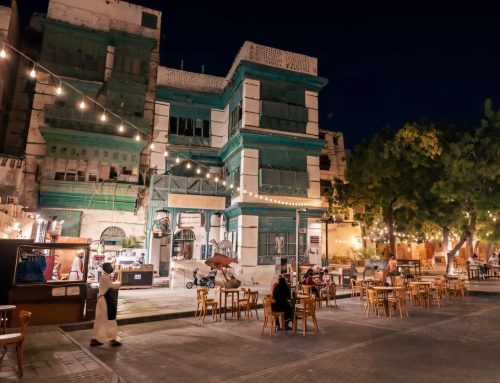
One detail worth stating plainly for visitors: Souq Al-Alawi, immediately outside Beit Al Matbouli’s main entrance, remains a working, trading market today, not a preserved museum street. This matters directly for how a visit to the house should be understood and planned. Rather than stepping out of a quiet museum into an equally quiet historic streetscape, a visitor leaving Beit Al Matbouli steps directly back into an active, noisy, commercially functioning souq, still selling textiles, spices, household goods, and a wide range of other merchandise much as it has for centuries, if with a thoroughly modern twenty-first-century inventory. This continuity is, in its own way, as historically significant as the house itself: the market that the Matbouli family traded in and that brought pilgrim customers to their door has never stopped operating, even as the individual buildings lining it have followed such different fates, from Beit Al Matbouli’s careful private restoration to the collapse and demolition documented elsewhere in this guide’s conservation-crisis section.
Practical Implications for a Visit
Because the souq remains a genuine working market, visitors should expect the immediate approach to Beit Al Matbouli to be crowded, especially in the evening hours that most sources identify as the house’s most reliable opening window, and should be prepared for the ordinary friction of navigating an active market street — vendors, foot traffic, parked vehicles, and the general sensory intensity of a functioning Middle Eastern souq — rather than the hushed approach typical of a purpose-built museum precinct. This is, for most visitors, part of the appeal rather than a drawback: experiencing Beit Al Matbouli as a building still embedded in an active commercial street, exactly as it always has been, arguably communicates the house’s original character more effectively than a sanitised, traffic-free heritage-precinct approach would.
The Conservation Crisis Behind the Restoration
The Scale of the Problem in Numbers
Before turning to what was done inside Beit Al Matbouli, it is worth setting the scale of the district-wide problem the family’s restoration was responding to, because the numbers are stark. A comprehensive survey of Historic Jeddah’s building stock carried out by the Al-Turath Foundation and cited in UNESCO’s own state-of-conservation documentation found 608 historic buildings still standing across the city, of which around 400 sit within the boundary of the inscribed World Heritage property. Of the buildings newly identified beyond the district’s earlier 1980s inventory, 52 were found to be in bad condition and 38 were partially collapsing. Separately, 77 buildings originally recorded in that 1980s inventory had already collapsed and been rebuilt, and 38 more had been demolished and left as empty plots since the 1980s (UNESCO World Heritage Centre, state of conservation documentation). A 2015 report in Arab News, reflecting a municipal safety committee’s assessment, found 90 old buildings in Al-Balad classified as a public safety hazard — 38 partially collapsed and 52 in near-total disrepair — with officials in several cases unable even to trace the buildings’ legal owners in order to compel repairs (Arab News, “90 Al-Balad buildings ‘public safety hazard'”). UNESCO’s own decisions on the property’s conservation status describe the core long-term threat in equally blunt terms: “the reduction of the rate of decay of the historic houses, which are often abandoned and squatted by poor immigrants,” alongside speculative pressure on land values that discourages owners from investing in repair (UNESCO World Heritage Committee, Decision 38 COM 8B.21).
Fire and Collapse as Ongoing Events, Not Historical Footnotes
These are not abstract statistics from a decade-old report; they describe an ongoing condition. In August 2017, a fire broke out in a four-storey building described by the Al-Balad district’s mayor as “made of mud and coral limestone drawn from the Red Sea and roofed with wood” — precisely the construction system detailed in the previous section of this guide — and spread through wooden beams at the buildings’ fronts to two neighbouring structures, both of which collapsed; sixty residents had to be evacuated (reporting on the 2017 Al-Balad fire). An Arab News opinion piece written after Historic Jeddah’s 2014 UNESCO inscription described walking through the district and finding that, despite the new World Heritage status, “many buildings are in an advanced state of decay,” noting that while showpiece houses such as Nassif House had been “beautifully restored,” “other poorer buildings are literally falling to pieces,” their owners lacking either the money or, in some cases, the will to save them (Arab News, “Preserving Jeddah’s history”). A separate academic study of Old Jeddah’s urban character similarly concludes that “the built environment in the Historic District of Jeddah is deteriorating,” that “many buildings are deserted and lack maintenance,” and that numerous structures show serious structural cracking (“The Character of Old Jeddah and Place Identity,” University of Jordan). As recently as 2023, travel writers visiting the district were still being told by local guides that “56 buildings are at imminent risk of collapse in Al-Balad” (visitor account citing local guide figures).
Why This Context Matters for Beit Al Matbouli
Set against this backdrop, Beit Al Matbouli’s survival and restoration is not simply a nice story about one family’s heritage pride — it is one of a genuinely limited number of successful outcomes in a district where the more common trajectory for an old coral house has been slow abandonment, structural failure, and eventual collapse or demolition. Article 84 in this series discusses the district-wide restoration programme in full, including the government-led Jeddah Historic District Program and the Public Investment Fund-owned Al-Balad Development Company that now oversees large-scale conservation and adaptive-reuse projects across the district, including the 2024 conversion of several historic houses — Jokhdar House, Al-Rayyis House, and Kedwan House — into luxury hotels (Wikipedia, “Al-Balad, Jeddah,” citing Jeddah Historic District Program announcements). Beit Al Matbouli’s restoration predates and stands apart from that state-led hotel-conversion wave: it was a private, family-funded intervention, undertaken specifically to keep the house as a museum reflecting the family’s and the neighbourhood’s own history, not to convert it into commercial hospitality space.
The Restoration of Beit Al Matbouli: Who, When, and to What Standard
A Family-Led Restoration
The restoration of Beit Al Matbouli was carried out by the Matbouli family itself, led and supervised by Engineer Samir Asaad Matbouli, a member of the family with professional engineering training, who oversaw the entire process from start to finish (Alshawabkeh et al., JAP-KSU, citing an interview with Eng. Samir Asaad Matbouli). This detail matters for understanding both the restoration’s strengths and its limits. On the one hand, having a family member with direct personal and financial stake in the house’s authenticity supervise the work meant decisions were made with an intimate, first-hand knowledge of the building’s history and prior condition, rather than by an outside contractor working from a generic heritage-conservation brief. On the other hand, this was explicitly a private undertaking — the house is described consistently across sources as “a privately owned property,” not a state heritage asset, which is directly relevant to the irregular opening hours and informal ticketing discussed later in this guide’s practical visitor section (Rehlat; Lonely Planet).
Timeline and Method
The restoration itself took nearly a full year to complete, according to Eng. Samir Asaad Matbouli’s own account of the project (Alshawabkeh et al., JAP-KSU). The same source records that Saudi Press Agency reporting from 2016 recorded UNESCO representatives visiting the completed restoration and praising the standard of the work — a detail that, while it does not amount to a formal UNESCO conservation certification of the individual house, does indicate the restoration was substantially finished and considered presentable to international heritage observers by around 2016, a useful anchor point for a project whose exact start date is not independently documented in the sources available (Alshawabkeh et al., JAP-KSU, citing spa.gov.sa, 2016).
On method, the case study is specific and, measured against the conservation science outlined in the previous section, genuinely significant: “only natural materials were used” in the restoration, and “no contemporary materials like metal or cement were used” (Alshawabkeh et al., JAP-KSU). Given what this guide has already established about why cement mortar is actively harmful to coral masonry — because it seals in moisture that a lime-and-clay mortar would allow to evaporate, accelerating salt-driven decay from within — this is not a minor stylistic preference. It represents a conservation approach broadly aligned with best practice for coral and lime-based vernacular structures, even if the restoration was not necessarily conducted under a formal internationally accredited conservation charter. To support this traditional approach, Eng. Samir specifically sought out and engaged an older, experienced contractor still familiar with the traditional Hijazi building techniques used historically in Al-Balad — recognising that this specialist knowledge, of how to correctly proportion and apply a lime-and-coral mortar mix or how to properly seat a replacement timber tie-course, was not something a modern general contractor could be expected to know (Alshawabkeh et al., JAP-KSU).
Where Modern Technology Assisted the Traditional Work
The restoration was not a purely nostalgic exercise in old craft for its own sake. The King Saud University case study records that scanning technology and construction software were used alongside traditional building methods to aid the restoration process — documenting the building’s existing condition precisely before intervention and modelling proposed repairs before they were carried out on the actual fabric of the house (Alshawabkeh et al., JAP-KSU). The same study includes a specific, granular example of this documentation in practice: dated elevation drawings comparing the house’s maq’ad (seating alcove) before and after renovation. Before the work, one wall in this room had a hollow recess that had been adapted, in more recent decades, to hold a television set, while a household desk occupied the space beside the door. After the renovation, the recess was filled back in and furnished with sofas, an air-conditioning unit, and a painting, and the space beside the door was reopened as a glass window looking onto the hallway (Alshawabkeh et al., JAP-KSU). This small, carefully documented example is a useful corrective to any assumption that “restoration” here meant turning the clock back to some imagined seventeenth-century original state with no trace of the twentieth century allowed to remain — in practice, the restoration negotiated between removing later ad hoc modifications (the television recess) and accepting later comforts appropriate to a functioning museum (the air-conditioning unit), a pragmatic approach visible throughout much of the house today.
A Related but Separate Project: The Ministry of Culture Offices
Readers researching the house online will also encounter a 2022 architecture project by the Jeddah-based studio Bricklab, which converted a building within the wider “Al-Matbouli House complex,” adjacent to Souq Al-Alawi, into contemporary office space for the Ministry of Culture, following a design competition Bricklab won (Bricklab, “Al Matbouli House”). It is important not to conflate this project with the museum restoration described above: Bricklab’s own account describes working on “the nearly 400-year-old building” that “had been structurally restored” already, with their own scope limited to “carefully overlaying a functional, modern workplace without compromising historical integrity” — meaning Bricklab’s intervention came after the core structural restoration, addressed a different building within the same family complex, and served an entirely different purpose (a government cultural-management office, spanning some 611 to 744 square metres across five levels including a mezzanine and rooftop kitchen, according to the practice’s own figures), not the household museum that visitors walk through today (Bricklab). Bricklab’s approach is nonetheless a useful illustration of the same conservation ethic in a different register: reversible, minimal interventions; independent new structures such as the mezzanine kept physically separate from the historic walls; surface-mounted rather than embedded services, so that everything added could in principle be removed without damage; and the deliberate reuse of original shutters, balustrades, and carved doors wherever the building fabric allowed it (Bricklab). This adjoining office project is a genuinely separate building and a genuinely separate story from the museum this guide is about, and the two should not be described interchangeably.
Beit Al Matbouli as a Museum Today
From Family Home to Public Heritage Museum
The Matbouli family’s stated purpose in restoring the house was explicit and is repeated consistently across sources: to preserve the legacy and history of the Matbouli family and of the original inhabitants of the neighbourhood from being lost, and to convert the house into a heritage museum representing Historic Jeddah more broadly (visitor account summarising the family’s stated aim). This framing is worth taking at face value: unlike Nassif House, which passed into government ownership and museum administration (a distinction Article 85 in this series covers in detail), Beit Al Matbouli remains a privately owned family museum, run by the family that has occupied the house across the generations, opened to the paying public as an act of heritage preservation rather than as a nationalised or municipally administered cultural institution.
What Kind of Museum Experience This Is
Multiple independent visitor accounts converge on the same overall impression: this is a modestly, even minimally, curated museum, and that restraint is treated by most visitors as a genuine strength rather than a shortcoming. Lonely Planet’s guide entry describes the house as having been “minimally refurbished to present rooms and decor that feel more authentic than what’s found in some of the more polished examples” of restored Al-Balad houses, adding that “old gramophones and telephones complement uneven floors, stairwells and beautiful wood ceilings” (Lonely Planet). A Wanderlog-aggregated visitor account echoes this closely, describing “a stunning three-storey property adorned with beautiful Hejazi mashrabiyya” that has been “minimally refurbished to maintain an authentic feel,” where visitors “can admire old gramophones and telephones amidst uneven floors, stairwells, and exquisite wood ceilings” (Wanderlog). The retained “uneven floors” mentioned independently by both accounts are a small but telling detail: rather than levelling the floors during restoration for visitor convenience, the family evidently chose to preserve the building’s genuine, centuries-worn irregularities — a curatorial choice that favours authenticity over polish, consistent with the conservation ethic described in the restoration section above.
Beit Al Matbouli Among Al-Balad’s Other Historic Houses
A Crowded Field of Similar Names
Part of the confusion this guide’s misconceptions section already flagged around opening hours and pricing is compounded by a simpler problem: Historic Jeddah contains a genuinely large number of named historic houses, several with similar-sounding Hijazi merchant-family names, and online listings for these houses are inconsistently maintained, making it easy for a visitor doing quick research to conflate one with another. Beyond Beit Al Matbouli and Nassif House, Article 84 in this series discusses the wider set of Al-Balad’s named historic houses, several of which — Jokhdar House, Al-Rayyis House, Kedwan House, Baeshen House, Al-Zahid House among others — appear regularly in general guides to the district, each with its own distinct ownership history, condition, and public accessibility status. A visitor who has read a general “top historic houses in Al-Balad” listicle before arriving, without cross-checking which specific houses are actually open on which specific terms, risks arriving at the wrong address, or arriving at Beit Al Matbouli with expectations shaped by a different house’s opening hours, pricing, or collection entirely.
What Makes Beit Al Matbouli Specifically Identifiable
Three details reliably distinguish Beit Al Matbouli from other Al-Balad houses for a visitor trying to confirm they have found the right building. First, its specific address and location directly on Souq Al-Alawi at Zuqaq al-Qumsani, distinct from Nassif House’s own separate, well-documented location elsewhere in the district (KSA Journeys). Second, its distinctive combination of a family-run, minimally curated interior featuring gramophones, old telephones, and deliberately preserved uneven floors — a specific combination noted independently by Lonely Planet and Wanderlog, and distinct from Nassif House’s more formally administered, government-museum character (Lonely Planet; Wanderlog). Third, its specific and well-documented family history and trade background, tracing to Sheikh Mahmoud Al-Matbouli and continuing through to the modern United Matbouli Group, distinct from the equally well-documented but entirely separate history of the Nassif family covered in Article 85 of this series.
Why the Nassif House Comparison Is the Most Useful One
Of all the possible points of comparison available among Al-Balad’s historic houses, Nassif House is the most useful and most frequently drawn by visitor accounts, precisely because the two houses’ differences illuminate what each represents. Nassif House, covered fully in Article 85 of this series, passed into government ownership and operates today as a formally administered museum with the more consistent public programming that typically comes with state administration. Beit Al Matbouli, by contrast, remains a privately owned family museum, run directly by descendants of the family that built and occupied it, funded and restored through private family investment rather than government heritage budgets, and consequently operating on the less predictable, informally enforced hours and pricing this guide has documented candidly throughout its practical visitor section. Neither model is straightforwardly “better” for a visitor: Nassif House offers reliability and a more polished museum experience; Beit Al Matbouli offers intimacy, authenticity of untouched detail such as its uneven floors, and a more direct, unmediated connection to a single family’s continuous, living relationship with their own ancestral home. A visitor who has time for only one Al-Balad house museum should choose based on which of these two experiences — polished civic heritage administration, or intimate family-run authenticity — they are actually looking for, and a visitor with time for both, as this guide’s combining-your-visit section recommended, gets the benefit of experiencing the genuine contrast between them directly.
The Matbouli Family’s Continuing Relationship with the House
Restoration as an Act of Family Memory
It is worth returning, in closing, to a detail already introduced earlier in this guide but worth drawing out more fully: the restoration of Beit Al Matbouli was carried out not by an anonymous heritage contractor working from a generic conservation brief, but by a descendant of the same family that built the house roughly four centuries ago, according to family tradition, and that occupied it across the generations in between. Engineer Samir Asaad Matbouli’s stated motivation, as reflected in the King Saud University case study, was explicitly to preserve the legacy of the family and of the wider neighbourhood’s original inhabitants from being lost (Alshawabkeh et al., JAP-KSU). This framing matters because it positions the museum visitors walk through today not as a piece of nationalised or municipalised civic heritage infrastructure, but as a specific family’s ongoing, self-funded act of memory-keeping — a distinction that helps explain both the museum’s particular character, discussed throughout this guide, and its particular limitations, including the informal, sometimes inconsistent hours and pricing that a privately funded family project, without a government heritage budget or fixed institutional staffing roster behind it, is always likely to have relative to a state-run counterpart like Nassif House.
A Family That Still Trades
The continuity between the historic house and the modern United Matbouli Group, discussed in this guide’s lesser-known-facts section, is worth returning to here as well, because it changes how a visitor might reasonably understand the museum’s purpose. This is not a family whose commercial fortunes ended with the house’s original trading era, preserved now only as an archaeological curiosity by descendants with no ongoing connection to trade. The same family name attached to this seventeenth-century coral house today sits atop a substantial, actively operating regional trading and consumer-goods agency business, founded in 1952 and restructured in 1997 with SAR 80 million in capital, reporting SAR 597 million in revenue as of 2007 according to the company’s own published history (United Matbouli Group). Visiting Beit Al Matbouli, in this light, is not simply visiting the relic of an extinguished merchant dynasty; it is visiting the ancestral home of a merchant family whose trading activity, in a transformed but genuinely continuous form, persists into the present day — a detail that gives the museum’s stated preservation mission a more grounded, less purely nostalgic character than it might otherwise carry.
What This Means for How the Museum Should Be Understood
Taken together, the picture this guide has built across its research is of a house that is genuinely old, though not verifiably as old as the most confident tourism claims suggest; genuinely significant as a rare, still-functioning example of Historic Jeddah’s coral-stone merchant-house tradition, in a district where the majority of comparable buildings have not survived in equally presentable condition; genuinely connected, through documented family practice, to the broader historical role Hijazi merchant families played in the Hajj economy; and genuinely still cared for by the same family whose ancestors, according to their own tradition, built it four centuries ago. None of these individual facts depends on inflating the house’s age beyond what the evidence supports, or on manufacturing a religious significance the house does not actually carry. The house’s real significance — as a rare surviving example of a specific vernacular building tradition, as a window into the concrete daily mechanics of Hajj-era hospitality, and as a still-living expression of one family’s commercial and domestic continuity — is substantial enough to stand on its own, without embellishment, and this guide has tried throughout to present it on exactly that honest footing.
What Is Actually Displayed: A Room-by-Room Guide to the Collection
The Overall Character of the Collection
Beit Al Matbouli’s collection is domestic rather than curatorial in the museum-professional sense: it is largely composed of the family’s own household possessions, left in place or arranged within the rooms where they were once used, rather than acquired specimens displayed behind glass with interpretive labelling. A Safarway visitor guide to the museum summarises the collection as including “many furniture and old furnishings such as chairs, sofas and furnishings decorated with traditional inscriptions, as well as rooms specialised in displaying tools and the artifacts of copper, bronze and distinctive pottery,” alongside the “wonderful architecture of the walls and ceiling” and the carved wooden window screens themselves (Safarway). Rehlat’s visitor guide gives a similarly concrete list: “antique gramophones, classic stairwells, intricate wooden ceilings, and local artifacts,” alongside “a bureau for senior guests, showcasing the hospitality of the past,” and the rainwater-collection cisterns in the basement (Rehlat).
Furnishings and Domestic Objects
The most frequently mentioned single category of object across visitor accounts is old gramophones — mentioned independently by Lonely Planet, Wanderlog, Rehlat, and Fact Magazine’s roundup of Jeddah museums, which describes the museum as offering “a glimpse of some classic Saudi antiques, such as old gramophones, wooden ceilings, and local artefacts” (Fact Magazine). Old telephones are mentioned alongside the gramophones in multiple accounts, situating the collection’s material culture broadly in the early-to-mid twentieth century alongside older pieces, which fits neatly with the documented history of the Matbouli family’s own commercial evolution from grain trading toward twentieth-century consumer goods including radios. The Wanderlust magazine account adds specific furniture detail from the back sitting room: ebony chairs carved from wood imported from East Asia, set beside the wall niches carved directly into the coral stone described earlier in this guide’s architecture section (Wanderlust).
Household Tools, Metalwork, and Pottery
Beyond furniture, the Safarway account specifically mentions rooms dedicated to displaying tools and artefacts made of copper, bronze, and pottery — the ordinary working material culture of a pre-modern Hijazi household, including cooking vessels, storage containers, and household implements that would have been used daily rather than reserved for display (Safarway). This category of object connects directly to the house’s kitchen and provisioning functions: a household large enough to host pilgrim guests for a full month at its own expense during Hajj, as this guide’s earlier section on the Matbouli family’s trade documented, would necessarily have required substantial cooking and storage capacity, and the copper and pottery vessels on display are the physical residue of exactly that scale of domestic operation.
The Bureau for Senior Guests
Rehlat’s account specifically highlights “the bureau for senior guests, showcasing the hospitality of the past” as one of the notable features worth visiting for (Rehlat). Read alongside the architecture section’s description of the two separate ground-floor maq’ad seating alcoves — one for the men and elders of the household, one for younger family members — this bureau likely corresponds to the more senior of those two reception spaces, furnished specifically to receive guests of standing: family associates, trading partners, or distinguished pilgrims during the Hajj season.
Bridal and Wedding Material
The King Saud University case study documents a genuinely distinctive function of the house that goes beyond ordinary domestic display: a dedicated room used historically for preparing brides for their wedding celebrations, including the making of bridal gowns and intricate embroidery, with a bride reportedly able to stay in this room for up to seven nights around her wedding (Alshawabkeh et al., JAP-KSU, citing Tchalabi, 2023). Wanderlust magazine’s account of the house independently confirms that this tradition has not entirely lapsed into pure museum display: the house “does occasionally host ‘bride nights,’ so visitors can see traditional bridal preparations for themselves,” suggesting that at least some of the museum’s cultural programming keeps this specific domestic ritual alive as a demonstrated practice rather than only a static exhibit of preserved gowns and embroidery (Wanderlust).
Trade Goods and Pilgrimage-Related Material
Given the family’s documented history as grain traders, general merchants, and hosts to pilgrims during Hajj, visitors should expect the collection to include objects connected to trade and to the reception of pilgrim guests, though the specific sources available for this guide describe this material in general terms — “local artifacts,” trade-related tools, and the storage room (Bayt al-Khazin) itself as an architectural space illustrating the provisioning function — rather than cataloguing individual trade-goods items by name. What can be said with confidence, because it follows directly from the house’s documented history rather than from an item-by-item inventory, is that a visit to Beit Al Matbouli should be understood as a visit to the material remains of a household that was simultaneously a home, a trading office, a provisioning depot, and — for one month each year — a guesthouse for pilgrims travelling toward Makkah. The rooms, furnishings, and storage spaces described throughout this section reflect all four of those overlapping functions at once, rather than functioning as separable “trade wing” and “domestic wing” displays.
What a Visit Concretely Looks Like
Put together, a visitor entering from Souq Al-Alawi first passes through the main entrance into one of the two rawasheen-screened maq’ad seating alcoves, moves up through the four storeys past the first-floor guest-reception rooms and the second-floor Bayt al-Khazin storage rooms, and reaches, on an upper floor, the sitting room with its coral-carved niches, imported ebony furniture, and old well. Along the way, cabinets and furnished rooms display gramophones, telephones, copper and bronze household tools, and pottery, while the bridal preparation room preserves a specific and still occasionally re-enacted household ritual. The rooftop remains closed to visitors. Most accounts describe this as a compact but memorable visit, generally completed within thirty minutes to an hour depending on how much a guide or staff member is available to explain individual rooms (Airial Travel).
Islamic Context: Hospitality, Honest Trade, and the Ethics of the Household
A note on framing before this section begins: Beit Al Matbouli is a heritage house and a family museum. It has no documented connection to any event in the life of the Prophet Muhammad ﷺ, no companion association, and no sacred status in Islamic law or tradition. Nothing in this section should be read as claiming otherwise. What follows is general Islamic teaching on hospitality, trade ethics, and the private household — teaching that is genuinely and directly relevant to understanding a merchant’s home in a pilgrimage city, because the family who built and lived in this house were themselves practising Muslims whose trade, their hosting of pilgrims, and their domestic arrangements would have been shaped by exactly these teachings. This is supplied context, not site-specific evidence, and it is labelled as such throughout.
Hospitality as an Explicit Religious Duty
Islamic teaching treats the generous reception of a guest not as a cultural nicety but as a marker of faith itself. Abu Hurairah reported that the Prophet ﷺ said: “Whoever believes in Allah and the Last Day should entertain his guest generously… and whoever believes in Allah and the Last Day should speak good or remain silent” — a hadith recorded in Sahih al-Bukhari 6018 (Sunnah.com, Sahih al-Bukhari 6018). This hadith is one of the most widely cited textual foundations for the broader Arab and Islamic culture of hospitality toward guests and travellers, and it sits in direct, illuminating relationship with what this guide’s architecture and daily-life sections describe about Beit Al Matbouli: a household that built two separate formal reception rooms specifically for receiving guests of different rank, kept a dedicated bureau for senior visitors, and — for one month every year — extended exactly this kind of hospitality to travelling pilgrims at the family’s own expense, according to the Google Arts & Culture and Arabisk London accounts cited earlier in this guide. No source claims the Matbouli family cited this specific hadith as their motivation; the connection offered here is interpretive, drawing a general and well-attested Islamic teaching alongside a documented family practice that visibly embodies it.
Honest Trade: A Hadith Worth Grading Carefully
Because Beit Al Matbouli was, before anything else, a merchant’s house, Islamic teaching on the ethics of trade is directly on point — but it is also an area where this guide’s commitment to honest grading matters most, because the most commonly quoted hadith on this theme is not straightforwardly authentic, and different scholars have reached different conclusions about it.
The most famous report states, on the authority of Abu Sa’id al-Khudri, that the Prophet ﷺ said: “The truthful, trustworthy merchant is with the Prophets, the truthful, and the martyrs,” recorded in Jami’ at-Tirmidhi 1209 (Sunnah.com, Jami’ at-Tirmidhi 1209). Sunnah.com’s own Darussalam grading marks this hadith Weak (da’if). At the same time, other respected scholarly assessments treat it more favourably: al-Tirmidhi himself called it “a hasan hadith, though we know it only through this chain,” Ibn Taymiyyah described its chain as jayyid (good), and al-Albani, working from supporting evidence elsewhere, graded it Sahih li ghayrihi (authentic due to corroborating evidence) in his Sahih al-Targhib (Daily Hadith Online, citing al-Albani’s grading). A closely related report on the authority of Ibn ‘Umar, “The trustworthy, honest Muslim merchant will be with the martyrs on the Day of Resurrection,” recorded in Sunan Ibn Majah 2139, carries the same Darussalam grading of Weak (da’if) on Sunnah.com (Sunnah.com, Sunan Ibn Majah 2139), though at least one other hadith reference platform lists a hasan grading for the same report under a different numbering convention — a genuine and worth-noting instance of scholarly and editorial disagreement rather than a settled question.
A note on authenticity: readers should take from this that the beautiful and frequently quoted image of the honest merchant standing “with the prophets and the martyrs” rests on a hadith that the most widely used online grading (Sunnah.com’s Darussalam annotations) marks as weak, even though it has respected defenders, including al-Albani, who consider it authentic through supporting chains. This guide states both positions rather than picking one, in keeping with the principle that where scholars differ, both sides should be presented fairly.
A closely related but independently and more strongly graded hadith exists on the same theme, and is worth setting alongside the more famous but weaker report. Rifa’ah ibn Rafi’ narrated that the Prophet ﷺ, addressing a group of merchants directly, said: “The merchants will be raised on the Day of Resurrection as evildoers, except for those who fear Allah, are honest, and speak the truth,” recorded in both Jami’ at-Tirmidhi 1210 and Sunan Ibn Majah 2146. Al-Tirmidhi and Ibn Hibban both graded this report authentic; al-Hakim judged its chain sound, a judgment al-Dhahabi endorsed; and al-Albani classed it as authentic (sahih) in Sahih al-Targhib 1785 (Islam Q&A, citing gradings for Tirmidhi 1210 and Ibn Majah 2146). This hadith carries the same essential ethical message as the more famous, more contested report — that honesty is what redeems the merchant’s trade in the eyes of God — on a considerably firmer authenticating footing, and it is the more defensible hadith to lean on if a single well-graded textual anchor for “honest trade in Islam” is needed.
A third, unambiguously authentic hadith rounds out the picture with a specific, practical commercial ruling rather than a general exhortation. Hakim ibn Hizam reported that the Prophet ﷺ said: “The two parties to a transaction have the option of cancelling it until they part. If they are honest and disclose any defects, their transaction will be blessed, but if they lie and conceal defects, the blessing of their transaction will be erased,” recorded in both Sahih al-Bukhari 2110 and Sahih Muslim 1532 (Islam Q&A, citing Bukhari 1973/2110 and Muslim 1532). This hadith is Authentic (sahih) by the consensus grading of both Bukhari and Muslim, and it is the single most solidly attested textual statement available on the ethics of buying and selling in Islamic tradition — squarely relevant to a house built and sustained by generations of trade in a pilgrimage city’s central market.
Modesty in the Home and the Function of the Screen
The Qur’an addresses the privacy of the household directly. Surah an-Nur states: “O believers! Do not enter any house other than your own until you have asked for permission and greeted its occupants. This is best for you, so perhaps you will be mindful” (Qur’an 24:27) (Quran.com, Surah An-Nur 24:27). This verse, addressing the etiquette of entering another household, sits in useful conceptual relationship — again, as supplied general context rather than site-specific commentary — with the architectural function of the roshan and mashrabiya screen described earlier in this guide: a lattice designed specifically to let a household observe the street while remaining unseen from it, extending the Qur’anic concern for domestic privacy into physical, load-bearing architecture. The screen does not enforce the verse’s rule about seeking permission before entering, but it enacts the same underlying value — that a household’s interior life, and particularly the presence and activities of its women, should not be visible to passers-by in the street — through timber and carved lattice rather than through social convention alone.
Hijazi Merchant Families and the Hajj Economy
The broader historical role of Hijazi merchant families within the Hajj economy is well documented independently of any single house, and it is directly, not speculatively, relevant to Beit Al Matbouli given the family’s own confirmed role as Hajj-season hosts. Jeddah’s entire historical function, as UNESCO’s own citation states, was as the maritime gateway through which pilgrims from across the Indian Ocean world reached Makkah, a role formalised since the seventh century AH when Caliph Uthman ibn Affan designated the city as Makkah’s official port (UNESCO World Heritage Centre). That designation created, over the following thirteen centuries, an entire urban economy organised around the seasonal arrival of pilgrims — lodging houses, provisioning merchants, currency exchangers, guides, and transport agents, many of them organised through hereditary family firms that specialised in caring for pilgrims from particular regions or language communities. Arabisk London’s account of the Matbouli family’s documented role as an operator “employed by the Hajj Agency” who hosted pilgrims “for a whole month at their own expense” situates the family squarely within this specific and well-attested Hijazi institution: the merchant household that doubled, every Hajj season, as an informal hostel and provisioning centre for arriving pilgrims (Arabisk London). Souq Al-Alawi’s own role, described earlier in this guide as “a major stopping point for pilgrims heading to Makkah,” reinforces the same picture: the market, the merchant houses lining it including Beit Al Matbouli, and the seasonal rhythm of the Hajj were three faces of a single integrated economic and social system (Visit Saudi).
The Daily Life of a Hijazi Merchant Household
A House Organised Around a Seasonal Calendar
To understand what daily life inside a house like Beit Al Matbouli actually looked like, it helps to abandon the idea of a household running on a uniform, unchanging routine year-round. A Hijazi merchant family in Jeddah lived on two distinct calendars superimposed on each other: the ordinary rhythm of trade, prayer, and domestic life that governed most of the year, and the intense, compressed rhythm of the Hajj season, when the household’s entire structure and purpose temporarily reorganised itself around the reception of pilgrims. The documented fact that the Matbouli family hosted pilgrim guests “for a whole month at their own expense” during Dhul Hijjah (Arabisk London) means that roughly one month in twelve, the house functioned less as a private residence and more as an informal guesthouse — a transformation with real consequences for cooking, cleaning, water use, sleeping arrangements, and the privacy customs discussed later in this section.
The Rhythm of the Hajj Season
In the weeks before Dhul Hijjah, a household of this kind would have needed to prepare in ways directly visible in the house’s own architecture. The storage rooms on the second floor — the Bayt al-Khazin described earlier in this guide’s architecture section — existed precisely to hold provisions “for the season,” in the words of the Google Arts & Culture account of the house (Google Arts & Culture), which strongly implies a period of pre-Hajj stockpiling: grain, dried foodstuffs, and other provisions bought in bulk and stored against the sudden, sharp rise in the household’s own consumption and its guests’ needs once pilgrims began arriving. Given the family’s documented trade in grain, this stockpiling would also have doubled as commercial inventory — the same storeroom likely served both the family’s trading business and its own domestic hospitality obligations, a dual function that made perfect sense in a household where trade and home life were never fully separated.
Once pilgrims began arriving by sea at Jeddah’s port — historically the landing point for the overwhelming majority of pilgrims travelling from India, Southeast Asia, East Africa, and beyond, as UNESCO’s own citation for Historic Jeddah documents in describing the city’s function “as the landing harbour for all the pilgrims that reached Arabia by sea” (UNESCO World Heritage Centre) — a household like the Matbouli family’s would have received guests directly into the ground-floor maq’ad reception rooms described in this guide’s architecture section, feeding them from the household kitchen, housing them for some portion of their stay in Jeddah before they continued on to Makkah, and, in the family’s specific documented case, doing all of this at the family’s own expense rather than for a fee (Arabisk London). Article 84 in this series discusses the broader Hajj infrastructure of Historic Jeddah, including the district’s ribats and wakalas — dedicated pilgrim lodging structures distinct from private houses — and readers wanting the full picture of how Jeddah collectively absorbed and processed the annual pilgrim influx should look there. What matters here is narrower: one particular household’s documented, specific practice of hosting pilgrims inside its own private reception rooms, a more personal and direct form of hospitality than the more commercial ribat and wakala lodging system operating alongside it.
Food in the Merchant Household
None of the sources available for this guide provide a detailed, itemised account of what the Matbouli household specifically ate day to day, and this guide will not invent one. What can be said with confidence, drawing on the house’s own documented architecture and the family’s documented trade, is structural rather than anecdotal: a household with a dedicated seasonal storage room (Bayt al-Khazin), a family trade rooted partly in grain, and an obligation to feed a house full of pilgrim guests for a full month each year would have required cooking and food-storage capacity well beyond an ordinary single-family household of the same era. The copper, bronze, and pottery vessels documented in the museum’s current collection — described in the previous section’s account of the house’s displayed artefacts — are the physical trace of exactly this scale of provisioning: large-capacity cooking vessels, storage jars, and serving ware suited to feeding extended family and substantial numbers of guests rather than a small nuclear household. Historic Jeddah’s broader food culture, as described in general accounts of the district, drew on both local Hijazi staples and imported goods brought in via the same maritime trade routes that supplied the house’s own timber, so a merchant household’s table would plausibly have combined regional dishes with imported spices, dried fruits, and grains sourced through the family’s own trading connections — though again, this is a reasonable inference from documented trade patterns rather than a specific, sourced account of the Matbouli table.
Water Before Piped Supply
Jeddah had no piped municipal water supply for most of Beit Al Matbouli’s documented history — this is one of the defining practical challenges of pre-modern life in the city, and it explains directly why the house’s own water infrastructure, described in the architecture section above, mattered as much as it did. The two rainwater cisterns built into the house’s basement, mentioned by visitor accounts and confirmed in the King Saud University case study (Alshawabkeh et al., JAP-KSU), were not decorative architectural flourishes; they were essential household infrastructure in a coastal desert city where seasonal rainfall, however limited, needed to be captured and stored efficiently rather than left to run off into the streets or evaporate. The well documented by Wanderlust magazine inside the ground-floor living space provided a second, independent water source, presumably drawing on the local water table rather than depending solely on rainfall (Wanderlust). Beyond the house’s own cisterns and well, Historic Jeddah as a whole depended for centuries on wells and cisterns distributed through the district and, for a larger and more reliable supply, on water brought overland from sources outside the city — a broader infrastructure history that Article 84 in this series addresses in more depth. For a household the size of the Matbouli family’s, especially during the added strain of a month of pilgrim hospitality each year, having two independent in-house water sources — rainwater cisterns and a private well — would have been a meaningful practical advantage, reducing dependence on water carried in from outside during exactly the season when demand on the wider city’s water supply was at its highest.
The Roles of Women in the House
The documentary record available for this guide does not preserve detailed personal accounts of specific women who lived in Beit Al Matbouli across its history — no diaries, no named biographies of the sort that exist for some of Jeddah’s more prominent merchant families. What can be said, carefully and without inventing specific individuals, draws on two kinds of evidence: the house’s own architecture, and the one specific, well-documented household ritual this guide has already described — the bridal preparation room.
The house’s vertical stacking of public and private space, discussed in the architecture section, placed the ground-floor reception rooms — the space where male guests, trading partners, and pilgrims were received — furthest from the upper floors where the family’s private domestic life took place. The King Saud University case study’s observation that “the ground floor was strictly for welcoming guests and was typically occupied by men to offer privacy to the rest of the family in higher levels” describes precisely this architectural logic (Alshawabkeh et al., JAP-KSU). In practical terms, this meant that the women of the household could move through the upper floors, manage the household’s storage and provisioning in the Bayt al-Khazin, oversee cooking and domestic labour, and receive female relatives and guests, largely without direct contact with the male visitors, trading partners, and pilgrims received on the ground floor below — a spatial separation that gave women of the household a private domestic domain functionally separate from, though physically stacked directly above, the commercial and hospitality functions of the house.
The bridal preparation room is the clearest specific evidence available of a formally recognised female domestic role within the house. A bride staying in this room for up to seven nights, with the room specifically equipped for making bridal gowns and intricate embroidery (Alshawabkeh et al., JAP-KSU, citing Tchalabi, 2023), describes a household in which the female relatives of the family — mothers, aunts, sisters, and likely also skilled needlewomen from the wider neighbourhood — carried out a substantial, time-intensive, skilled craft practice inside the house as a normal part of family life. This was not an incidental domestic task; producing an embroidered bridal gown by hand over the course of a week or more represents a serious investment of skilled female labour, and the fact that the house preserved a dedicated room for this purpose, still referenced today in the museum’s occasional “bride night” demonstrations noted by Wanderlust magazine (Wanderlust), indicates that this craft and ritual role for women was treated as significant enough to warrant its own dedicated architectural space within an already space-constrained four-storey house.
The Mashrabiya and the Architecture of Privacy
The roshan and mashrabiya screens described in technical detail earlier in this guide were not simply a climate-control technology incidentally useful for privacy — for the women of a household like the Matbouli family’s, the screen’s privacy function was arguably its primary social purpose, with the cooling benefit a valuable but secondary effect. The lattice allowed women inside the house to observe the street, the market, arriving guests, and the general life of the neighbourhood in full detail, while remaining entirely unseen themselves by anyone outside. In a household whose ground floor, as already discussed, was dedicated to receiving male guests and trading partners, and whose family religious practice would have been shaped by the general Islamic teaching on modesty and household privacy discussed in the previous section — including the Qur’anic instruction not to enter another’s home without seeking permission (Qur’an 24:27) — the mashrabiya functioned as an architectural solution allowing women to remain fully aware of, and even socially present to, the life of the household and the street below, without compromising the privacy that the family’s religious and cultural norms expected of them. This is precisely why the roshan and mashrabiya tradition, discussed at length in this guide’s architecture section, developed its most elaborate and highest-value expressions specifically on the upper floors of merchant houses in cities like Jeddah, where the tension between commercial life conducted at street level and private family life conducted above needed an architectural, not merely social, solution.
Children and the Wider Household
The Google Arts & Culture feature on the house closes its account of Beit Al Matbouli’s domestic life with a brief but evocative detail: “Bayt Al-Matbouli was always full of life. During Ramadan, children’s laughter echoed through its halls, the sounds of nightly prayers rose from within, and the scent of oud drifted through its rooms to welcome Eid” (Google Arts & Culture). This is a lightly narrated, atmospheric account rather than a documented historical record of specific events, and it should be read as such — an evocation of the kind of household life the building’s scale and function make plausible, produced by a UNESCO-affiliated cultural documentation project, rather than a transcribed family testimony with named individuals and dated events. Taken at that level, it is a reasonable closing image for this section: a house that functioned, across most of the year, as an ordinary family home with its own religious observances and domestic warmth, and that transformed for one intense month each year into a working center of pilgrim hospitality — the two rhythms this section has traced throughout.
Reflection: What a Merchant’s House Can Teach a Visitor
Standing inside Beit Al Matbouli today, you are not visiting a shrine, a mosque, or a site associated with any event in prophetic or early Islamic history. You are visiting the material remains of an ordinary, prosperous trading family’s home — and it is worth pausing on why that ordinariness is itself the point. Historic Jeddah’s UNESCO inscription rests substantially on the argument that its merchant houses represent “an outstanding example of a coastal Red Sea urban settlement” shaped by the specific overlap of maritime trade, Hajj pilgrimage traffic, and multi-ethnic commercial life (UNESCO World Heritage Centre). Beit Al Matbouli is one of the relatively few surviving physical examples of exactly that overlap, still standing, still furnished, still narratable room by room. Article 84 in this series discusses that broader UNESCO framing at length; what this house offers you specifically is a chance to feel that history at the scale of a single family rather than as an abstraction about a district.
You might reasonably reflect, walking through the ground-floor maq’ad where the family once received pilgrims free of charge for a month at a stretch, on the specific and well-attested Islamic teaching about hospitality discussed earlier in this guide — the Prophet’s ﷺ statement, recorded in Sahih al-Bukhari, that generosity toward one’s guest is bound up with belief itself (Sunnah.com, Sahih al-Bukhari 6018). You do not need to believe the family consciously quoted this hadith to find the connection meaningful; what the house demonstrates, through its architecture and its documented practice, is a household whose religious culture and commercial culture reinforced rather than contradicted each other. The same is true of the trade-ethics hadith discussed above: a family whose wealth came from generations of buying and selling grain and goods in a market town built around a religious pilgrimage would have understood, in a very immediate and practical way, what was at stake in the Qur’anic and prophetic emphasis on honesty in trade — not as abstract piety, but as the actual functioning currency of their reputation and livelihood in a market like Souq Al-Alawi, where a merchant’s word was frequently the only guarantee a buyer or trading partner had.
There is also a quieter, more personal reflection available here, about permanence and its absence. This was, by the most honestly interrogated reading of the evidence available, very likely a seventeenth-century house — old, genuinely old, but not the eight-hundred-year survivor that some tourism copy claims. Its coral-stone walls, as this guide’s architecture section explained in technical detail, are dissolving slowly and continuously back toward the sea they were quarried from, a process that no restoration, however careful, permanently halts — only slows. The family’s own choice to restore the house using natural, breathable materials rather than sealing it in modern cement was, in effect, an acknowledgment of this fragility rather than a denial of it: a decision to let the house continue ageing on its own terms, at its own pace, rather than freezing it artificially. There is something worth sitting with in that: a merchant family whose trade was built on impermanent, perishable goods — grain, textiles, provisions consumed within a season — chose, in restoring their ancestral house, to work with rather than against the equally impermanent nature of the material their ancestors had built with. Few visitor experiences in Historic Jeddah offer that specific, layered reflection on trade, hospitality, and the acceptance of impermanence quite as directly as a quiet hour spent inside Beit Al Matbouli.
Common Misconceptions About Beit Al Matbouli
Misconception One: The House Is Reliably “Four Hundred Years Old”
The single most commonly repeated fact about Beit Al Matbouli — that it dates to 1613 or is “more than four hundred years old” — is, as this guide’s earlier interrogation of the age claim established in detail, a figure repeated consistently by tourism bodies and general reference sources including Visit Saudi and Saudipedia (Visit Saudi; Saudipedia), but it is not corroborated in the sources available for this guide by an independently published archival document, dated inscription, or scientific dating study specific to this house. The claim should be understood as a strongly and consistently held family and civic tradition, repeated by credible state and tourism institutions, rather than as an archaeologically or archivally proven date. This does not mean the house is not old — its documented architectural features, materials, and its place within a district whose oldest surviving fabric plausibly reaches back centuries all support real antiquity — but readers and visitors should hold the specific “1613” or “four hundred years” figure a little more loosely than the confident tone of most tourism copy suggests.
Misconception Two: The House Is “Eight Hundred Years Old” and “Ottoman”
A second, more clearly erroneous claim circulates on some travel aggregator sites, including Wanderlog and Airial Travel, describing the house as roughly eight hundred years old and dating it to the Ottoman period (Wanderlog; Airial Travel). This claim is internally self-contradictory and should be treated as a straightforward error, not a competing scholarly position worth weighing seriously. Ottoman rule over the Hejaz, including Jeddah, began only in 1517 CE, following the Ottoman conquest of Mamluk Egypt and the subsequent extension of Ottoman authority over the Hejaz — meaning no Ottoman-era building anywhere in the region can be eight hundred years old, since eight hundred years before the present would place a building’s construction centuries before the Ottoman period even began. This error most likely originated as a simple compounding mistake in aggregator copywriting — possibly conflating the roughly four-hundred-year figure with the district’s much older pre-Islamic and early Islamic history as a settlement, or simply an uncorrected transcription error copied from site to site — but it should not be repeated as fact.
Misconception Three: Confusing the Museum with the Adjoining Ministry of Culture Office
As this guide’s restoration section explained, the wider “Al-Matbouli House complex” adjoining Souq Al-Alawi includes a separate building converted in 2022 by the architecture studio Bricklab into contemporary office space for Saudi Arabia’s Ministry of Culture (Bricklab). This is a distinct structure serving a government administrative function, not open to public museum visits in the way the household museum is, and it should not be confused with — or assumed to be part of the same visitor experience as — the historic house museum this guide describes. A visitor searching for “Al-Matbouli House” online may encounter architecture-press coverage of this office conversion and mistakenly assume it describes the museum experience; it does not.
Misconception Four: All Restored Al-Balad Houses Are Open to the Public
Historic Jeddah contains, per the Al-Turath Foundation’s survey cited in UNESCO’s own conservation documentation, some 608 historic buildings, of which around 400 sit within the inscribed World Heritage boundary (UNESCO World Heritage Centre). Only a small handful of these — Beit Al Matbouli and Nassif House prominent among them — function as visitable museums with any regularity. The great majority of the district’s historic houses are either privately occupied, vacant, in poor structural condition, or undergoing restoration for future hotel or commercial use, as with the 2024 conversions of Jokhdar House, Al-Rayyis House, and Kedwan House into hotel properties (Wikipedia, “Al-Balad, Jeddah”). A visitor who assumes that any attractively restored coral-stone facade glimpsed while walking through Al-Balad represents an accessible museum is very likely to be disappointed; the district’s restoration successes, while real and growing, remain a minority of its total historic building stock, and this guide’s earlier section on the conservation crisis behind the restoration explains why that gap between “restored” and “open to the public” persists.
Practical Visitor Guide: Visiting Beit Al Matbouli in 2025 and 2026
Exact Location
Beit Al Matbouli sits on Souq Al-Alawi within Al-Balad, Jeddah’s historic district, at an address given by multiple sources as 3352 Zuqaq al-Qumsani (also transliterated Qamsani or Qumusani Alley), postal code 22236 (KSA Journeys; Arabisk London). Its position directly on Souq Al-Alawi, the historic market street dated by Visit Saudi’s own listing to 1716 as a formalised marketplace (Visit Saudi), makes it easy to find on foot for any visitor already exploring the souq, and it is a short, walkable distance from Nassif House, discussed in the combining-your-visit section below.
Opening Hours: A Genuinely Inconsistent Picture
This guide’s research turned up real, unresolved discrepancies across sources regarding Beit Al Matbouli’s opening hours, and candor about that inconsistency is more useful to a prospective visitor than false precision. Visit Saudi’s official listing, checked as recently as November 2025, states the house is open daily from 5:00 PM to 10:00 PM (Visit Saudi). Multiple independent travel-guide sources — KSA Journeys and Arabisk London among them — corroborate this same daily 5:00 PM to 10:00 PM window (KSA Journeys; Arabisk London). At least one other aggregator, TripXL, lists a different and internally unusual split schedule of 9:00 AM to 12:00 PM and 5:00 PM to 10:00 PM (TripXL), which may reflect either an error, a seasonal variation, or a genuine but under-documented staffing pattern. General guides to Al-Balad’s museums more broadly describe a more conventional daytime pattern of roughly 9:00 AM to 5:00 PM, Sunday through Thursday, for “most” small house museums in the district (Audiala), though this source does not speak to Beit Al Matbouli specifically and appears to describe a more generic pattern that may not apply here. The most consistent, best-corroborated answer across the specific sources naming Beit Al Matbouli by name is the evening window of 5:00 PM to 10:00 PM, daily — but given that this is, as established earlier, a privately run family museum rather than a government-administered institution with fixed published hours enforced by a ministry, prospective visitors should treat any hours found online, including in this guide, as indicative rather than guaranteed, and should be prepared for the possibility of finding the house closed, or staff unavailable, on any given visit. This kind of irregularity is, per this guide’s own research into the wider district, a recognised characteristic of Al-Balad’s smaller privately run museums generally, not a defect unique to this particular house.
Ticket Price
Here too, sources genuinely diverge, and this guide reports both positions rather than asserting false certainty. Visit Saudi’s official listing states plainly, “You don’t need tickets to enter the house,” implying free entry, in the version of the listing checked on 2 November 2025 (Visit Saudi). Several independent travel-guide sources, however — including KSA Journeys, Arabisk London, and the crowd-sourced Wanderlog listing — describe a modest entry fee of 10 Saudi riyals, described by Wanderlog as informally collected rather than ticketed through a formal box office (KSA Journeys; Arabisk London; Wanderlog). The ListMag roundup of Jeddah’s best museums independently corroborates the same SAR 10 figure (ListMag). Reading these sources together, the most plausible picture is a small, informally collected entry contribution of around 10 SAR at the door, which may sometimes be waived, inconsistently enforced, or simply not requested depending on who is staffing the house on a given day — again consistent with this being a privately run family museum without the fixed, published, uniformly enforced pricing structure of a government-run institution. Prospective visitors in 2025 and 2026 should budget for the possibility of a small cash payment (10 SAR, and carrying small Saudi riyal notes is sensible) while not being surprised if none is requested.
Whether the House Is Reliably Open
This guide’s broader research into Al-Balad’s small museums, discussed in the misconceptions section above, found that irregular opening is a genuine, recognised characteristic of the district’s smaller privately run heritage houses, Beit Al Matbouli included. Visitors should treat a visit to this house as an opportunistic addition to an Al-Balad walking itinerary rather than as the fixed centrepiece of a tightly scheduled day, and should have a backup plan — such as visiting Nassif House, or simply continuing to explore Souq Al-Alawi and the surrounding streets — in case the house is closed or unstaffed on arrival. Asking at a nearby shop in the souq, many of whose keepers know the informal rhythms of the neighbouring house museums well, is a practical way to check same-day status before making a special trip.
Guided Tours and Staff Language
The museum does not appear, from the sources available, to operate a formal, bookable guided-tour program of the kind found at larger state-run museums. Visitor accounts describe staff on site able to answer questions and, in at least some cases, walk visitors through the rooms informally, but at least one source — Wanderlog — notes that English is not widely spoken by staff (Wanderlog). Visitors who do not speak Arabic should not expect a formal narrated tour and may get more out of the visit by pairing it with this guide or another written account read beforehand, so the rooms and objects can be recognised and understood without relying on on-site interpretation.
How Long to Allow
Given the house’s compact four-storey, roughly 350-square-metre footprint, most visitor accounts describe a visit lasting between thirty minutes and an hour, with Airial Travel specifically estimating thirty to sixty minutes depending on staff availability and the visitor’s own pace (Airial Travel). This makes the house an easy addition to a longer Al-Balad walking itinerary rather than a half-day destination in its own right.
Photography
Airial Travel’s guide notes that photography is generally allowed inside the house (Airial Travel), consistent with the informal, family-run character of the museum overall. As with any privately operated heritage site, visitors should still ask on-site staff before photographing individuals present in the house, out of ordinary courtesy, even where photographing the rooms and objects themselves is uncontroversial.
Accessibility
Accessibility is a genuine limitation of this site and should be stated plainly rather than glossed over. The house is arranged across four storeys connected by the original, narrow historic stairwells, explicitly preserved in their original, uneven form as part of the restoration’s commitment to authenticity, as multiple visitor accounts including Lonely Planet and Wanderlog independently note (Lonely Planet; Wanderlog). There is no elevator, and the rooftop is not accessible to visitors at all. This means the house is not practically accessible to visitors who are unable to use stairs, and even able-bodied visitors should exercise care given the uneven, centuries-worn floor surfaces mentioned repeatedly in visitor accounts. This is a structural limitation of preserving a genuine seventeenth-century vertical tower house rather than a deliberate exclusion, but it is a real constraint that should factor into any visit planning for travellers with mobility considerations.
Combining a Visit with Nassif House and the Souqs
Beit Al Matbouli’s location directly on Souq Al-Alawi makes it naturally easy to combine with a wider Al-Balad walking itinerary. Nassif House, covered in full in Article 85 of this series, sits a short walk away and offers a useful complementary experience precisely because of the contrasts between the two: Nassif House is state-owned and museum-administered with more consistent public opening hours, while Beit Al Matbouli remains privately run by the family with the less predictable hours and informal ticketing discussed above; Nassif House is generally considered the more architecturally grand and formally curated of the two, while Beit Al Matbouli’s minimally refurbished interior, preserved uneven floors, and family-run character give it the more intimate, lived-in atmosphere noted by Lonely Planet and Wanderlog. Visiting both on the same walking loop through Al-Balad, alongside Souq Al-Alawi’s shops and the district’s other historic facades discussed in Article 84’s district-wide treatment, gives a visitor a genuinely rounded sense of Historic Jeddah’s range, from grand civic-scale restoration to modest, family-preserved heritage. Given the evening opening hours most consistently reported for Beit Al Matbouli, an itinerary that visits Nassif House and the souqs during the day and times a visit to Beit Al Matbouli for the early evening — coinciding with the souq’s own more atmospheric evening trading hours — is likely to work well practically, though as this guide has stressed throughout, confirming same-day opening status on arrival remains the most reliable approach.
Lesser-Known Facts About Beit Al Matbouli
The Well Inside the Living Room
Most visitors expect a historic house’s water infrastructure, if it survives at all, to be tucked away in a basement or courtyard. Beit Al Matbouli’s well sits inside the ground-floor living space itself, immediately beside the sitting area with its coral-carved niches and imported ebony furniture, according to Wanderlust magazine’s visitor account (Wanderlust). This placement is a small but telling detail about the priorities of pre-piped-water domestic design: rather than treating water access as a peripheral utility, the household kept it within easy reach of the room where family and guests actually spent their time, alongside the two rainwater cisterns in the basement documented elsewhere in this guide. Few visitors expect to find a working household water source standing this close to the family’s own furniture and seating.
Two Entrances, Two Social Registers
The house’s two separate entrances, discussed in this guide’s architecture section, were not a redundant design feature but a genuine social mechanism. One entrance, facing directly onto Souq Al-Alawi, brought the public commercial and hospitality life of the household — trading partners, market business, pilgrim guests — directly into the maq’ad reception rooms without those visitors ever needing to penetrate deeper into the house. A second, more private entrance allowed the family itself, and particularly its female members, to move in and out of the house without necessarily passing through, or being seen from, the public reception spaces. This dual-entrance arrangement is a physical, load-bearing expression of exactly the privacy logic this guide’s daily-life section discussed in relation to the mashrabiya screens — a house quite literally built with two different social registers running through it in parallel, rather than a single shared threshold serving both.
The House Predates Photography and Most Written Hijazi Family Records
A detail easy to overlook: if Beit Al Matbouli genuinely dates to the early seventeenth century, as the family tradition holds, then the house is considerably older than photography itself, older than most surviving written Hijazi merchant-family business records, and older than the vast majority of documentary techniques historians would now use to verify a building’s age precisely. This is precisely why, as this guide’s age-interrogation section explained at length, establishing a confident, independently corroborated construction date for a house like this is genuinely difficult — not because the family’s tradition is implausible, but because the documentary tools that would let a modern historian confirm or precisely date it either did not exist, or have not survived, for most of the house’s claimed lifespan.
A Living, Not Only a Preserved, Domestic Ritual
Most historic house museums display domestic rituals as static, past-tense exhibits — a room labelled “the kitchen was here,” a mannequin dressed in period clothing. Beit Al Matbouli is unusual in that at least one of its historic domestic functions, the bridal preparation tradition discussed earlier in this guide, is still occasionally reenacted for visitors as an actual demonstrated practice through the museum’s “bride nights,” according to Wanderlust magazine (Wanderlust). This makes the house one of the relatively few sites in Historic Jeddah where a documented historical domestic ritual survives as a living demonstration rather than purely as an inert historical description.
The Family’s Trade Outlived the House’s Original Commodity
This guide’s earlier section on the Matbouli family and their trade traced a specific, documented evolution: a household whose historic trade in grain and general goods grew, in the twentieth century, into the modern United Matbouli Group, founded in 1952 and now, according to the company’s own corporate history, an agent for major international consumer brands including Samsung, with reported 2007 revenue of SAR 597 million (United Matbouli Group). Few visitors browsing gramophones and old telephones inside a seventeenth-century coral house are likely to realise, without being told, that the same family name attached to the house they are standing in now sits atop a substantial modern regional trading conglomerate — a genuinely striking illustration of long-run commercial continuity within a single Hijazi merchant family, even as the specific goods traded changed completely across four centuries.
A Timeline of Beit Al Matbouli and Its Context
A note on this timeline: dates before the twentieth century for this specific house rest on family tradition and the tourism and reference sources that repeat it, not on independently verified archival or scientific dating, as this guide’s age-interrogation section explained in detail. Dates are presented here for orientation, with that caveat firmly in mind rather than as settled historical fact.
- 1517 CE: The Ottoman Empire extends its authority over the Hejaz, including Jeddah, following the Ottoman conquest of Mamluk Egypt — the starting point of Ottoman-era rule in the region, and the reference point that makes the erroneous “eight hundred years old, Ottoman” claim discussed in this guide’s misconceptions section internally impossible.
- Traditionally dated to 1613 CE (per family tradition and tourism sources): Sheikh Mahmoud Al-Matbouli, a resident of Harat al-Yaman (the Yemen Quarter) within Al-Balad, builds the house that becomes known as Beit Al Matbouli, according to Visit Saudi’s official listing and the King Saud University case study (Visit Saudi; Alshawabkeh et al., JAP-KSU).
- 1716 CE: Souq Al-Alawi, the market street on which the house sits, is dated by Visit Saudi’s own listing to this year as a formalised marketplace (Visit Saudi), providing an independent, if still tourism-sourced, anchor point for the antiquity of the immediate neighbourhood.
- Seventeenth through nineteenth centuries: The house functions as a family residence and trading base, its ground-floor rooms and Bayt al-Khazin storage rooms serving the family’s commercial life, while the household participates in the seasonal rhythm of Hajj-season pilgrim hospitality described throughout this guide.
- 1980s: Robert Matthews’ architectural survey of Historic Jeddah’s building stock, cited in UNESCO’s later conservation documentation, records the district’s historic buildings in the inventory that later comparative surveys would measure decline against (UNESCO World Heritage Centre).
- 1952: Sheikh Mahmoud Matbouli and Sheikh Sulaiman Zagzoug found the commercial enterprise that becomes the United Matbouli Group, marking the family’s formal entry into modern twentieth-century trading and agency business (United Matbouli Group).
- 1997: The family business restructures as the United Matbouli Group with SAR 80 million in capital, according to the company’s own corporate history (United Matbouli Group).
- 2014: Historic Jeddah, including the district containing Beit Al Matbouli, is inscribed on the UNESCO World Heritage List under criteria (ii), (iv), and (vi) (UNESCO World Heritage Centre).
- 2015: A municipal safety assessment reported by Arab News finds ninety old buildings in Al-Balad classified as a public safety hazard, underlining the conservation crisis discussed earlier in this guide (Arab News).
- Circa 2015–2016: Engineer Samir Asaad Matbouli leads the family’s roughly year-long restoration of the house, using only natural materials and traditional building techniques supplemented by 3D scanning and construction software, according to the King Saud University case study (Alshawabkeh et al., JAP-KSU).
- 2016: Saudi Press Agency reporting records UNESCO representatives visiting the completed restoration and praising its standard, per the same case study (Alshawabkeh et al., JAP-KSU).
- 2017: A fire destroys or triggers the collapse of several mud-and-coral-limestone buildings elsewhere in Al-Balad, an ongoing reminder of the fragility discussed in this guide’s architecture and conservation sections (contemporary reporting on the 2017 Al-Balad fire).
- 2022: The architecture studio Bricklab completes the adaptive reuse of a separate building within the wider Al-Matbouli House complex into offices for Saudi Arabia’s Ministry of Culture, a distinct project from the household museum, as this guide’s restoration section explained (Bricklab).
- 2024: Several other historic Al-Balad houses — Jokhdar House, Al-Rayyis House, and Kedwan House — are converted into hotel properties under the state-led Jeddah Historic District Program, illustrating the alternative, commercially driven restoration pathway that Beit Al Matbouli’s private family-museum model stands apart from (Wikipedia, “Al-Balad, Jeddah”).
- 2025–2026: Beit Al Matbouli continues to operate as a privately run family museum, with opening hours and ticketing that remain, per this guide’s practical visitor section, genuinely variable and best confirmed on the day of any planned visit.
Key Lessons from Beit Al Matbouli
Historical Lessons
Beit Al Matbouli demonstrates how thin the line can be between a well-preserved heritage landmark and a collapsed, forgotten ruin — a line that, as this guide’s conservation-crisis section documented, a substantial fraction of Historic Jeddah’s roughly six hundred surviving historic buildings has already crossed onto the wrong side of (UNESCO World Heritage Centre). The house’s survival was not automatic or guaranteed by its age or its UNESCO-district location; it depended on a specific family choosing, at a specific moment, to commit money, time, and inherited technical knowledge to a genuinely difficult conservation intervention, using materials and methods aligned with the building’s original construction logic rather than convenient modern substitutes. The broader historical lesson is that heritage authenticity, in a climate and construction tradition as demanding as coral-stone Jeddah, is not a passive inheritance but an active, ongoing labour, one that most of the district’s building owners have not been able to sustain.
Spiritual and Ethical Lessons
Approached honestly, as this guide has tried to do throughout, Beit Al Matbouli offers ethical rather than sacred lessons — a distinction worth holding onto given this guide’s earlier insistence that the house has no religious status. The strongest of these lessons concerns trade: the well-attested hadith recorded in Tirmidhi 1210 and Ibn Majah 2146, graded authentic by al-Albani among others, that merchants will be raised on the Day of Judgement as sinners “except those who fear Allah, are honest, and speak the truth” (Islam Q&A, citing Tirmidhi 1210 and Ibn Majah 2146), sits in genuine, illuminating tension with the reality that a house like this one was built and sustained by centuries of buying and selling — an activity the Qur’an and hadith literature treat with real moral seriousness precisely because commerce creates so many opportunities for both integrity and its opposite. The second lesson concerns hospitality: a family that hosted pilgrim strangers in its own home for a month each year, at its own expense, embodied in concrete practice the value that the Prophet’s ﷺ statement in Sahih al-Bukhari 6018 attaches to the treatment of guests (Sunnah.com, Sahih al-Bukhari 6018) — not as an abstract virtue but as a costly, repeated, and materially demanding household commitment.
Personal Lessons
On a more personal register, the house’s preserved uneven floors, worn stairwells, and unglamorous household objects — gramophones, old telephones, copper cooking vessels — offer a useful corrective to a common, over-tidied image of “heritage” as something necessarily grand, polished, and monumental. Beit Al Matbouli’s value lies substantially in its ordinariness: it documents how a genuinely prosperous, historically significant merchant family actually lived, worked, and hosted guests, at the scale of everyday domestic objects rather than only through grand architectural statements. There is a personal lesson available in that ordinariness about the value of preserving the unremarkable alongside the monumental — the well beside the sofa, the storage room beside the guest room — because it is often the unremarkable domestic detail that tells a fuller, more honest story than the impressive facade alone.
Practical Lessons
For any visitor, the most immediately practical lesson from researching this house is the value of approaching claims about age, hours, and pricing with active scrutiny rather than passive acceptance — precisely the approach this guide has tried to model throughout. A visitor who arrives expecting a confirmed eight-hundred-year-old Ottoman house with fixed published hours and a formal ticket booth, based on some of the less careful tourism copy in circulation, will be recalibrating their expectations on arrival. A visitor who arrives understanding the house as a plausibly seventeenth-century, family-run museum with informally enforced hours and pricing, best combined flexibly with a wider Al-Balad itinerary including Nassif House and the souqs, will have a far more accurately calibrated, and likely more satisfying, visit.
Authentic Sources on Beit Al Matbouli
Primary and Traditional Sources
The most direct available “primary” source on the house’s history is the Matbouli family’s own oral tradition and testimony, transmitted through Engineer Samir Asaad Matbouli’s account of the restoration and reflected in the King Saud University academic case study drawing on that testimony (Alshawabkeh et al., JAP-KSU). Readers should treat this as valuable, first-hand family testimony rather than as an independently corroborated archival record, in keeping with this guide’s earlier interrogation of the specific dating and founder claims it contains. UNESCO’s own World Heritage nomination documentation and state-of-conservation reports for Historic Jeddah provide the most authoritative available framing for the district’s broader historical and architectural significance, even where they discuss the district collectively rather than this house specifically (UNESCO World Heritage Centre, Historic Jeddah listing; UNESCO World Heritage Centre, state of conservation documentation; UNESCO World Heritage Committee, Decision 38 COM 8B.21).
Modern Academic and Reference Sources
The single most substantive academic source available for this guide is Alshawabkeh et al.’s case study published in the Journal of Architecture and Planning at King Saud University, which draws directly on an interview with Engineer Samir Asaad Matbouli and provides the most detailed technical and restoration-specific information used throughout this guide (Alshawabkeh et al., Journal of Architecture and Planning, King Saud University, Vol. 36-4, December 2024. Detailed technical accounts of Jeddah’s coral-stone building tradition, cited extensively in this guide’s architecture section, come from House of Saud’s “Jeddah Coral Architecture” feature (House of Saud) and from academic studies of coral building conservation, including work available via Academia.edu on coral building conservation on Saudi Arabia’s Red Sea coast (“The Conservation of Coral Buildings on Saudi Arabia’s Northern Red Sea Coast”) and a ScienceDirect study of coral stone deterioration mechanisms (ScienceDirect). Saudi Arabia’s official tourism authority provides the most commonly cited figures for the house’s traditional founding date and current opening arrangements through its Visit Saudi platform (Visit Saudi, Beit Al Matbouli; Visit Saudi, Souq Al-Alawi), while the state-run reference platform Saudipedia offers an independent, if similarly tradition-based, confirmation of the district’s building ages (Saudipedia). Google Arts & Culture, produced in partnership with UNESCO’s cultural documentation initiatives, supplies the most detailed narrative account of the house’s domestic life and floor functions used in this guide’s sections on daily life and museum display (Google Arts & Culture, “Bayt Al-Matbouli: Four Centuries of Life in Historic Jeddah”; Google Arts & Culture, “Walking Through Historic Jeddah: Landmarks and Mosques”). Independent travel and museum-review platforms — Lonely Planet, Wanderlust magazine, Rehlat, KSA Journeys, Arabisk London, Wanderlog, Airial Travel, Safarway, ListMag, and TripXL among them — together provide the visitor-experience detail, ticketing information, and collection descriptions used throughout this guide’s museum-display and practical-visitor sections, and are cited individually at the relevant points above (Lonely Planet; Wanderlust; Rehlat; KSA Journeys; Arabisk London; Wanderlog; Airial Travel; Safarway; ListMag; TripXL). Hadith gradings throughout this guide were verified directly against Sunnah.com’s own collection pages (Sunnah.com, Tirmidhi 1209; Sunnah.com, Ibn Majah 2139; Sunnah.com, Bukhari 6018) and cross-checked against scholarly discussion on Islam Q&A (Islam Q&A; Islam Q&A) and Daily Hadith Online (Daily Hadith Online), while the Qur’anic citation was verified directly against Quran.com (Quran.com, Surah An-Nur 24:27). Corporate history for the modern Matbouli business dynasty comes from the United Matbouli Group’s own published company history (United Matbouli Group), and the Bricklab architecture studio’s own project page provided the detail on the separate Ministry of Culture office conversion discussed in this guide’s restoration section (Bricklab).
A Note on Method
This guide has tried, throughout, to distinguish clearly between three different kinds of claim: facts independently corroborated across multiple credible sources, facts resting on a single well-documented source such as the King Saud University case study’s interview material, and widely repeated tourism claims — particularly regarding the house’s exact age — that could not be independently verified through archival or scientific evidence in the sources available. Where sources genuinely conflicted, as with opening hours, ticket pricing, and hadith gradings, this guide has reported the conflict honestly rather than silently choosing one figure and presenting it as settled. Readers planning an actual visit should treat the practical information in this guide as a well-researched starting point current as of mid-2026, not as a permanent guarantee, and should expect to confirm specifics, especially opening hours, on the day.