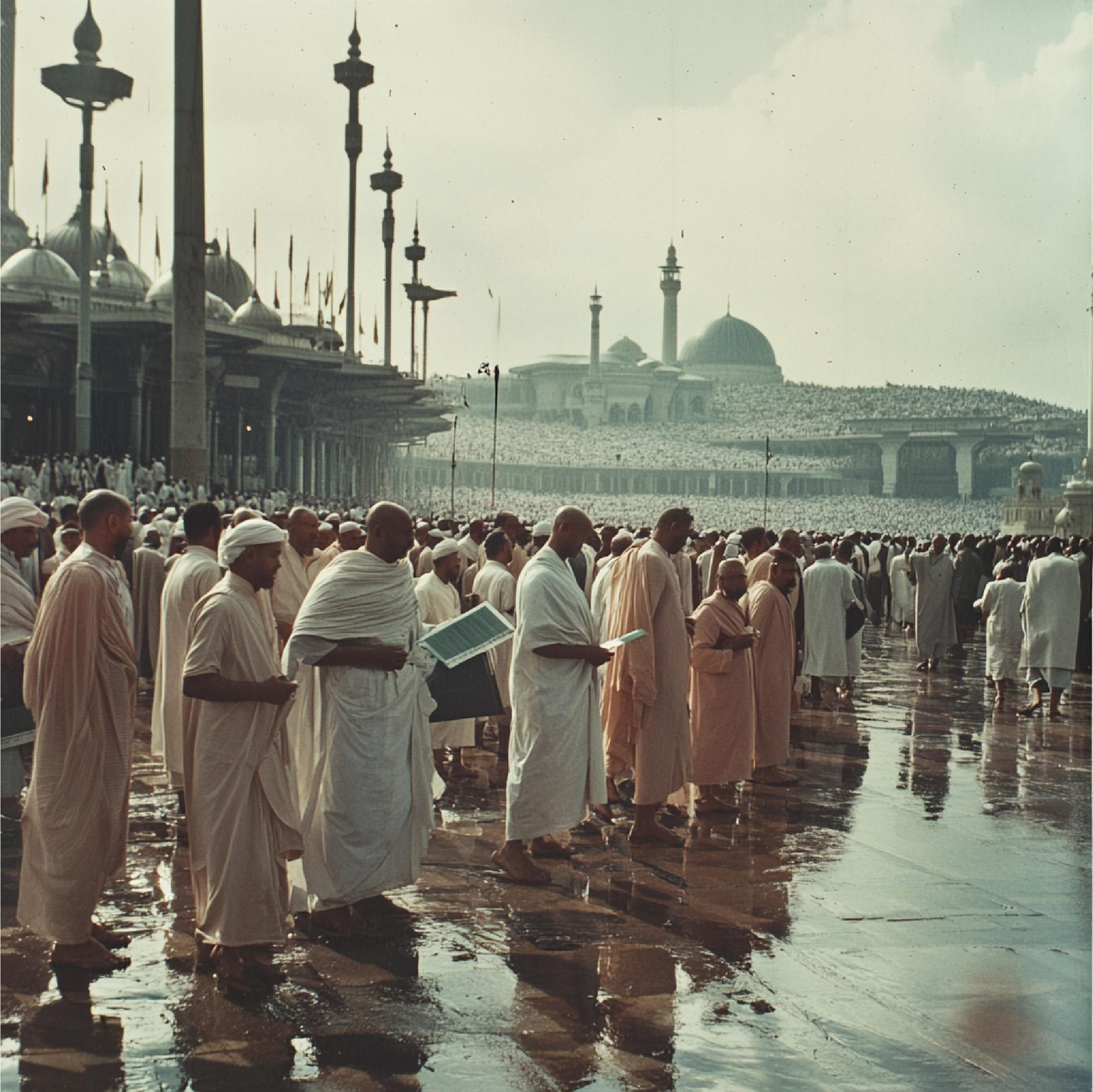
Let me tell you a story the early Muslims used to tell one another — not as a ruling, but as a mirror held up to the heart. So receive it the way they did: gently, and let it search you.
There was a great scholar named Abdullah ibn al-Mubarak, who one year, after completing his pilgrimage, fell asleep near the Ka’bah. And in his sleep he dreamed of two angels descending, speaking to one another about the pilgrims of that year. One asked how many had come; the other answered that there were many hundreds of thousands. Then the first asked the question that should make all of us tremble: how many of them had their pilgrimage accepted? And the answer came: in truth, not one — except that, for the sake of a single man who never even arrived, Allah had accepted them all. “There is a cobbler in Damascus,” the angel said, “named Ali ibn al-Muwaffaq. He could not come this year. Yet Allah accepted his intention — and for his sake, accepted the pilgrimage of every soul here.”
The scholar woke, shaken, and travelled all the way to Damascus to find this man and learn his secret. And the cobbler, bewildered to be asked, told him the truth. For thirty years he had saved, coin by coin, until at last he had just enough to make the journey of his life. But shortly before he was to leave, he learned that his neighbour’s children were crying through the night from hunger — and when he went to them, the mother confessed they had not eaten in days, and in her desperation had taken meat that was lawful for them only because they were starving. The cobbler looked at that family, and his heart broke. And he gave them everything — the whole of his thirty years of saving — and said quietly, this will be my pilgrimage.
Sit with what this overturns. We tend to imagine that the deed is the body of worship and the intention is just a little label we attach so the deed “counts.” This story turns that upside down. The intention was the body all along; the journey was only ever its garment. That man never saw the Ka’bah — yet his pilgrimage was the most beloved of that entire year, because the pilgrimage had already happened where it always happens first: in a heart that chose Allah over its own dearest dream. He gave up not a sheep, but thirty years of longing — and Allah received his heart as the most beautiful offering on the earth that season.
So before you travel, ask yourself the question this story is really asking: What is my heart willing to sacrifice? Not only my money — but my pride? My comfort? My need to control? The habits I keep choosing over Allah? Because in the end, that is what this whole journey is for: loosening your grip, finger by finger, on everything that has been quietly competing with Allah for the centre of your heart. Settle your intention — and even an imperfect, stumbling Umrah becomes alive. Neglect it, and the most flawless Tawaf is only a beautiful body with no breath in it.
Leave A Comment