The Window on the Green Dome of Masjid an-Nabawi: The Complete History, Story and Ziyarah Guide to the Aperture Above the Sacred Chamber
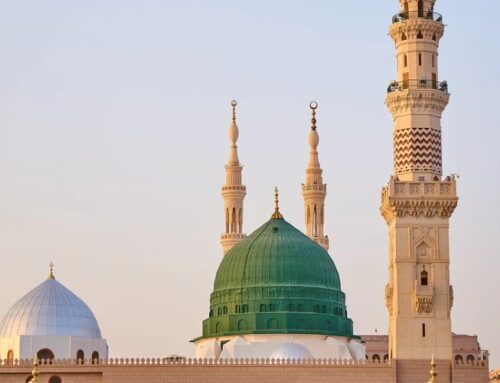
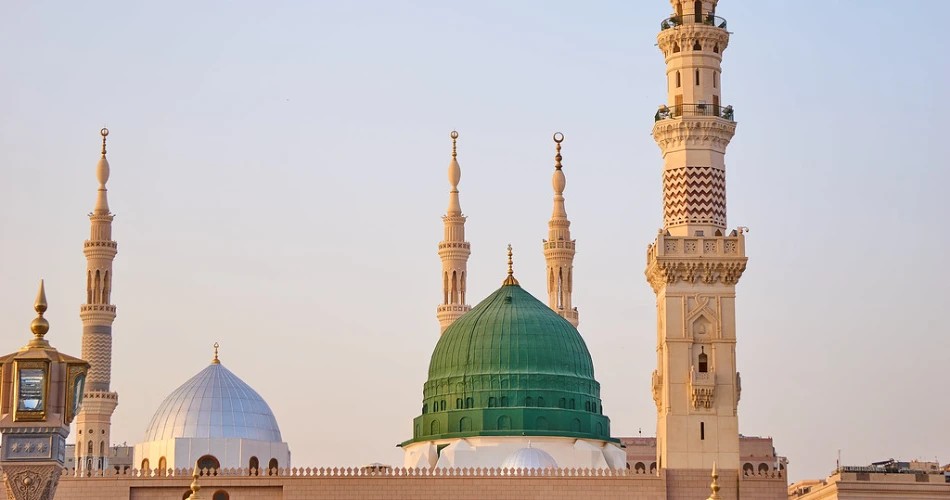
High on the northern slope of the Green Dome, where the great emerald cladding curves down toward the roofline of Masjid an-Nabawi, there is a small protrusion — a hump, a raised housing, a shape that breaks the smoothness of the dome’s skin. Millions of pilgrims have looked up at it from the courtyards below, in the white heat of the afternoon and in the cool blue hour before Fajr, and asked their guide the same question: what is that. The answer they are usually given arrives as a single, seamless story — a drought, a dream, a woman who ordered a hole cut in a roof so that mercy could fall directly onto a grave. It is one of the most beloved tales told in Madinah, and it is also, on close examination, two entirely different reports with two entirely different chains of transmission, two entirely different gradings, and two entirely different fates in the hands of the scholars who examined them. This article exists to separate what can be verified from what cannot, to give every scholar on every side of every dispute attached to this small architectural feature their actual words, and to leave the reader exactly where the sources leave us: with a real hadith graded sahih by a towering authority and rejected on technical grounds by another; with a second hadith graded weak by the very scholar most associated with rigorous grading, and rejected on chronological grounds by one of Islam’s most formidable jurists, who nonetheless left room for a narrower version of the same story; and with a centuries-long argument about whether any of this licenses asking the deceased Prophet ﷺ for anything at all — an argument that has never been settled and is not settled here.
This is, by any honest reckoning, the most theologically sensitive site covered anywhere in this series of guides to the historical and sacred places of Madinah. It sits at the exact intersection of three of the most contested questions in Islamic theology: the authenticity of isolated Companion-era reports, the permissibility of tawassul through the deceased, and the physical realities of a burial chamber that most pilgrims will never see and about which even the best modern architectural references remain silent. A guide that resolves any of these questions for the reader — that quietly picks a side while pretending to describe — would not be doing its job. What follows tries, section by section, hadith by hadith, scholar by scholar, to do the harder and more honest thing: to show the reader the entire shape of the disagreement, in the actual words of the people who held it, and to trust the reader to sit with an unresolved question the way the scholars themselves did.
Historical Background: The Chamber, the Roof, and the Ventilation Aperture Before the Domes
What Existed Before Any Dome Existed
To understand the window, it helps to understand what the space above the Prophet’s ﷺ grave looked like before it was a “window” at all — before it was even, in any meaningful architectural sense, a dome. When the Prophet ﷺ died in 11 AH / 632 CE, he was buried inside the room of his wife Aisha رضي الله عنها, a modest chamber attached to the mosque she had lived in during his lifetime. This was not a mausoleum built to house a body. It was a home, with the ordinary features of a seventh-century Hijazi dwelling: mudbrick walls, a roof of palm trunks and fronds, and — crucially for the story that follows — a structure that was only partially covered. Some portion of the room was roofed, and some portion was open to the sky, a common arrangement in the hot, dry climate of Madinah, where courtyards and partially open rooms allowed air to move and light to enter without the expense of full timber roofing throughout.
This detail is not incidental folklore. It is preserved in the two most rigorously authenticated collections in Sunni Islam. It is established in al-Sahihayn — Sahih al-Bukhari and Sahih Muslim together — from Aisha herself, that the Prophet ﷺ used to pray the Asr prayer while the sun was still shining directly into her room, before its shadow had lengthened, meaning the chamber had no full ceiling blocking the sky at that hour. This single detail becomes the load-bearing evidence in one of the two central disputes of this article, because it is the fact Ibn Taymiyyah later reaches for when he argues that a specific popular narration about Aisha ordering “an opening toward the sky” cannot be true — not because her chamber lacked an opening, but because, in his reading, it barely had a closed roof to open in the first place.
The Room Becomes Part of the Mosque
For the length of Aisha’s own lifetime, the chamber remained essentially as it had been: a private room, partially roofed, standing adjacent to but outside the body of the mosque proper. This changed only decades later, during the reign of the Umayyad caliph al-Walid ibn Abd al-Malik, who ordered a major expansion of Masjid an-Nabawi that absorbed Aisha’s former room — and with it, the graves of the Prophet ﷺ, Abu Bakr, and Umar — into the enclosed body of the mosque itself. High walls were raised around what had once been an open-sided dwelling. What had been informal and domestic became formal and enclosed. It is only after this Umayyad-era construction, on the account preserved and argued by Ibn Taymiyyah, that an opening of the kind described in the popular story — a deliberate hole cut through a now-solid ceiling, specifically so that maintenance staff could enter to clean the chamber — makes architectural sense. The companion dossier on the domes of Masjid an-Nabawi covers this expansion and the long building history of the Green Dome itself in full; this article is concerned only with the aperture, and touches the wider construction history solely where it is needed to make sense of the aperture’s own story.
Centuries Without a Dome, and the First Documented Ventilation Hole
For roughly the first six hundred years of Islam, there was no dome over the Sacred Chamber at all — a fact this article shares with its companion piece on the domes, because it matters here too. The chamber sat beneath the general roof of the mosque, marked only by a low enclosure, until the Mamluk Sultan al-Malik al-Mansur Sayf al-Din Qalawun al-Salihi built the first covering dome in 678 AH / 1279–80 CE. It is in the centuries after this — as the dome was rebuilt, enlarged, and eventually doubled into the two-layer, dome-within-a-dome structure that stands today — that the classical sources begin to describe, with real specificity, a small grated ventilation hole known in Arabic as a kuwa, cut through both the inner ceiling of the chamber and the lower part of the outer dome, aligned so that the two openings sat one above the other. This is the physical feature this article calls “the window,” though the Arabic sources are careful to call it something humbler: not a window in the sense of a source of light or a view, but a vent, a hole, a kuwa — a term that carries none of the grandeur that centuries of pilgrim storytelling have since attached to it.
The clearest classical description comes by way of the historian Sayyid Ja’far al-Barzanji, in his work Nuzhat al-Nazirin, quoting the earlier scholar Zain al-Din al-Maraghi: “Opening a ventilation hole (kuwa) during times of drought is a tradition of the people of Madinah, and they still practice it to this day. They open a ventilation hole in the lower dome of the sacred chamber (the inner dome) from the direction of the Qiblah, even though the ceiling stands between the noble grave and the sky.” A second, closely related description is attributed to the great Mamluk-era historian of Madinah, al-Samhudi, author of the monumental Wafa’ al-Wafa, as it has been excerpted in later compilations: “When al-Shuja’i Shahin al-Jamali constructed the upper parts of the Green Dome, he placed a ventilation hole covered with an iron grate. He also made an aligned opening in the lower dome, which replaced the ceiling of the noble chamber, and fitted it with a similar grate. Furthermore, he installed a door over this grate, which was opened during prayers for rain. Hence, there is no other opening in the inner dome except for this specified ventilation hole.” This dossier’s research was not able to independently pin down the precise volume and page of Wafa’ al-Wafa from which this second passage is drawn — it survives only in a secondary compilation rather than a directly verified primary citation, and that gap is worth stating plainly rather than dressing the citation in false precision.
Read together, these two classical citations describe something specific and credible: not a window in any ordinary sense, but a small, deliberately engineered, grated aperture — fitted with an iron grille and, per al-Samhudi’s account, a door — aligned vertically through both the inner ceiling of the chamber and the base of the outer Green Dome, and historically opened only on the specific ritual occasion of a rain-prayer during drought. It was not, on this reading, a permanent opening admitting daylight or air on an ordinary day. It was a feature with one narrow, occasional, and specific purpose, kept closed the rest of the time. This distinction — between a real, historically documented, occasionally opened vent, and the far grander image of “the window of mercy” that circulates in popular retellings today — is the single most important thing to hold onto as you read the rest of this guide.
Geography and the Setting of the Chamber
The Sacred Chamber containing the graves of the Prophet ﷺ, Abu Bakr, and Umar sits in the south-eastern quadrant of Masjid an-Nabawi, beneath the Green Dome, adjacent to the Rawdah — the section of the mosque the Prophet ﷺ himself described as being between his grave and his pulpit. The chamber is enclosed on all sides by a black metal grille, itself surrounded by a further perimeter wall, and it has, for well over a century, admitted no pilgrim inside it. No visitor today walks into the room where the graves lie. Whatever exists at the level of the ceiling and the dome above it — including the ventilation aperture this article is about — sits entirely out of reach and, for the ordinary pilgrim, entirely out of sight. This single physical fact — the total inaccessibility of the chamber and everything above it — will recur throughout this guide, because it is the reason so much of what can be said about the window rests on classical text rather than modern observation.
Importance Before and After the Story Attached to the Aperture
The aperture’s importance to the Islamic imagination is almost entirely retrospective. There is no reason to think the small grated vent, in itself, held any special status in the earliest generations; it appears in the sources as a practical architectural feature, mentioned by historians of Madinah’s topography in the same descriptive register they use for doors, walls, and staircases. Its fame arrives later, and by a specific route: through two hadith-literature reports — one concerning a man’s dream during a drought in the caliphate of Umar, and one concerning Aisha ordering an opening cut toward the sky — that later generations of pilgrims and storytellers folded together with the physical vent described by al-Maraghi and al-Samhudi, producing the composite, largely uncontested “miracle of the window” now told across popular Umrah literature. Separating the architectural fact from the narrated story, and separating the two narrations from each other, is the task of the sections that follow.
The Story Behind the Window: A Drought, a Dream, and a Roof
The Story as Pilgrims Hear It Today
The story, in the form most pilgrims encounter it, runs roughly like this: during a severe drought in the caliphate of Umar ibn al-Khattab, the people of Madinah suffered terribly. A man came to the grave of the Prophet ﷺ and asked him, directly, to pray to Allah for rain on behalf of his community. That night, the Prophet ﷺ appeared to the man in a dream, with an instruction to carry to Umar: that rain would come, and that Umar must “be clever” — attend to the practical duties of leadership as well as trust in divine mercy. Separately, in many popular tellings, Aisha رضي الله عنها is said to have ordered an opening made in the roof directly above the grave, declaring that no barrier should stand between the Prophet ﷺ and the sky above him, so that when rain finally came, it could fall unobstructed onto the very spot where he lay. The rains came in such abundance, the story continues, that the year became known as the Year of the Exceedingly Fat Animals, because the livestock grew so plump on the returning grass.
Told this way, in a single unbroken breath, the story feels like one event: a plea, a dream, an opened roof, a flood of mercy. It is not one event. It is two separate reports, with two separate chains of narrators, two separate gradings by two separate sets of scholars, and — this is the part popular retelling erases almost entirely — two very different levels of scholarly confidence attached to them. The drought-and-dream report is transmitted through Ibn Abi Shaybah, and a serious scholar of the stature of Ibn Hajar al-Asqalani called its chain sahih, even as a serious modern critic mounted a real, technical case against relying on it. The roof-opening report is transmitted through al-Darimi, and it was graded weak by al-Albani for three specific, stated reasons, and rejected outright on chronological grounds by Ibn Taymiyyah — who nonetheless, in the same breath, left the door open to a narrower version of the same idea. Merging the two, as popular retelling does, borrows the comparative strength of the first report to paper over the real weakness of the second. This article treats them exactly as separately as the classical sources themselves do, and gives each its own full and fair hearing in the Hadith References section below.
Why the Story Endures
It is worth pausing on why this story, weak parts and all, has traveled so far and lodged so deeply in the popular imagination of Madinah’s pilgrims. Part of the answer is architectural: there really is, on the strength of classical sources like al-Maraghi and al-Samhudi, a real ventilation aperture in the dome above the chamber, and a real feature invites a real story to explain it. Part of the answer is emotional: the image of a grieving, thirsting community turning toward the grave of the man they loved, and being answered, is an image of almost unbearable tenderness, and tenderness travels faster than footnotes. And part of the answer, less comfortably, is that popular religious storytelling has never been especially interested in the difference between a sahih chain and a da’if one, particularly when the two reports arrive bundled together and pointed at the same beloved conclusion. None of this makes the story false in every particular. It makes it a story that deserves to be taken apart, piece by piece, exactly as the scholars who examined it took it apart — which is the work of the rest of this guide.
The Prophet ﷺ and This Place: What Can and Cannot Be Said
The Limits of What the Sources Actually Report
Because this article concerns events that, on the reports available, occurred after the Prophet’s ﷺ death — a drought during Umar’s caliphate, an opening said to have been ordered by Aisha — there is no authentic account of the Prophet ﷺ interacting with this specific aperture during his lifetime, for the simple reason that the aperture, on the best classical dating, did not exist during his lifetime. This must be stated as plainly as the popular story is usually told, because it is the single most important corrective this section can offer: nothing in the verified sources places the Prophet ﷺ himself opening, describing, or commanding any ventilation hole above his own future grave. What the sources do report, and report with strong authentication, is the Prophet’s ﷺ own instruction, given during his life, about how his grave and burial should be approached after his death — instructions that bear directly on how a pilgrim should understand the window story even though they do not mention any window at all.
The Prophet ﷺ on Being Greeted After Death
The hadith most directly relevant to everything this article discusses is not about a window or a drought. It is about greeting. The Prophet ﷺ said, as preserved in Sunan Abi Dawud 2041, narrated by Abu Hurairah: “If any one of you greets me, Allah returns my soul to me and I respond to the greeting.” This hadith is graded Hasan by al-Albani on sunnah.com’s indexing, with al-Nawawi separately describing its isnad as sahih in al-Majmu’, Ibn Hajar describing its narrators as reliable (thiqat) while flagging a minor point about one narrator’s mode of transmission, and the official, Saudi-affiliated Encyclopedia of Translated Prophetic Hadiths likewise grading its isnad hasan. This is the hadith that underlies the entire practice of standing before the grave and offering salam, and it is worth naming here, before the drought and roof narrations are examined, because it is independently and solidly authenticated in a way that neither of those two more famous stories can claim outright. Whatever a pilgrim believes about the drought and the roof, the belief that the Prophet ﷺ hears and responds to a greeting given at his grave rests on ground considerably firmer than either.
The Prophet ﷺ on the Reach of Salutations
A second, closely related hadith extends this principle beyond the boundary of physical presence. In Sunan Abi Dawud 2042, again narrated by Abu Hurairah, the Prophet ﷺ said: “Do not make your houses graves, and do not make my grave a place of festivity (eid). But invoke blessings on me, for your blessings reach me wherever you may be.” This hadith is graded Sahih by al-Albani per sunnah.com, and separately graded hasan li ghayrihi by the contemporary hadith scholar Shu’ayb al-Arna’ut. It supplies two distinct pieces of guidance that this article will return to more than once: first, a caution against treating the grave as a site of recurring, festival-like gathering; and second, an assurance that blessings upon the Prophet ﷺ reach him regardless of the sender’s physical distance from Madinah. Read together with Abu Dawud 2041, the two hadiths resolve what might otherwise look like a tension: physical presence at the grave is not required for a greeting or a blessing to reach the Prophet ﷺ, but it remains, in the etiquette tradition built on these two hadiths, the fullest and most complete form of it. Neither hadith says anything about a window. Both are essential background for understanding what a pilgrim is actually doing, religiously, when standing before the Sacred Chamber — an act whose validity does not depend in the slightest on which way the drought and roof narrations are ultimately judged.
An Early Precedent on Approaching the Grave Itself
A further, closely connected report bears directly on the question of openings and gaps near the grave, though it concerns a different physical feature from the roof-level vent this article is chiefly about. Ibn Abi Shaybah’s Musannaf (no. 7542) preserves an account of Ali ibn al-Husayn — known as Zayn al-Abidin, the Prophet’s great-grandson through al-Husayn — seeing a man entering through a furja, a gap or opening, near the grave in order to supplicate there, and stopping him, citing the same “do not take my grave as an eid” instruction preserved in Abu Dawud 2042. This report is graded sahih by the Encyclopedia of Translated Prophetic Hadiths on the strength of multiple corroborating chains, and is also reported to have been graded sahih by al-Maqdisi. Because this report concerns a gap that people were physically climbing through, rather than the sealed, grated roof-vent described by al-Maraghi and al-Samhudi, this dossier’s research urges a specific caution before treating the two as interchangeable: they may be, in the loose language of popular retelling, “openings near the grave,” but they appear to be physically different features serving different purposes, and the verification route for the furja report — via secondary compilation and the Encyclopedia of Translated Hadiths rather than a direct sunnah.com listing, since Ibn Abi Shaybah’s Musannaf is not indexed there in the same way as the six canonical collections — should be understood as somewhat less direct than the sunnah.com-verified Abu Dawud references. It is used here, as the underlying dossier instructs, with that caveat attached rather than as an equivalent-strength citation.
What this early report does establish, at whatever level of confidence its verification route allows, is a documented precedent — from a member of the Prophet’s own family, in the generation immediately following the Companions — for actively discouraging the practice of entering any gap or opening near the grave specifically in order to supplicate there. This precedent sits on the same side of the ledger as the restrictive position described at length in the Stories of Great Islamic Scholars section below, and readers should hold it in mind as they read that section’s account of the tawassul debate.
Qur’anic Connections: What the Qur’an Says, and What It Does Not
No Direct Qur’anic Verse About the Window
It should be said plainly, at the start of this section, that no verse of the Qur’an refers to the window, the ventilation aperture, the drought narration, or the roof-opening narration. This is not a gap in this article’s research; it is a straightforward feature of how the story has always been transmitted. The drought-and-dream report and the roof-opening report both belong to the literature of hadith and historical narration — Ibn Abi Shaybah’s Musannaf and al-Darimi’s Sunan — not to the literature of Qur’anic revelation or classical tafsir. No classical exegete, in the sources gathered for this article, connects any specific ayah to this specific story. A pilgrim should not expect, and should be wary of any guide who claims, a direct Qur’anic basis for the window itself.
Rain as Mercy: The Qur’an’s General Theology of Rain
What the Qur’an does supply, in abundance, is a general theology of rain as divine mercy — the backdrop against which the entire drought story, whatever one concludes about its two component narrations, makes sense to a believing audience. The Qur’an repeatedly describes rain as a sign (ayah) of Allah’s power and compassion, sent down after need and hardship as a demonstration of His care for creation:
﴿وَهُوَ الَّذِي يُنَزِّلُ الْغَيْثَ مِن بَعْدِ مَا قَنَطُوا وَيَنشُرُ رَحْمَتَهُ ۚ وَهُوَ الْوَلِيُّ الْحَمِيدُ﴾
“And it is He who sends down the rain after they had despaired, and spreads His mercy. And He is the Protector, the Praiseworthy.”
— Surah al-Shura 42:28
This verse is not cited by any classical source in connection with the window narration specifically, and this article does not claim otherwise; it is offered here as the wider Qur’anic frame within which any story about drought, supplication, and rain would have been heard by the earliest Muslims, Umar’s generation included. The association of rain with mercy specifically — rather than merely with agricultural relief — is a repeated Qur’anic motif, and it is the same association that later, in the popular retelling of the roof-opening story, gets attached specifically to the idea of rain falling “directly” onto the grave, as though proximity to the grave intensified the mercy of the rain itself. That specific inference — that rain falling through an opening onto the grave carries a distinct, elevated spiritual significance beyond rain falling anywhere else — is a popular embellishment, not a textual claim made by either the Ibn Abi Shaybah or the al-Darimi report, and it is not supported by any classical tafsir located in this research.
The Prayer for Rain as an Institution: Istisqa’
The Qur’an and the wider hadith corpus establish the rain-prayer, istisqa’, as a legitimate and recurring Islamic institution, independent of any connection to a grave or a window. The clearest Qur’anic precedent invoked in the classical discussions of drought and supplication is the story of Musa striking the rock for his people in their thirst, and the broader Qur’anic pattern of prophets interceding for their communities during hardship through supplication directed to Allah — always to Allah, never a formula of direct address to the deceased. This is the theological backdrop against which Ibn Taymiyyah and the restrictive-position scholars discussed later in this article draw their sharpest distinction: between asking Allah for rain, which is the unambiguous institution of istisqa’, and asking a deceased person — however beloved, however honoured — to act as an independent source of that rain, which they regard as a different matter altogether. That distinction, and the disagreement it produces, is treated in full in the Stories of Great Islamic Scholars section below; it is flagged here only because its roots are visible already in how differently the Qur’an’s teaching on rain can be read depending on which side of the tawassul debate a reader stands.
A Modern Lesson from the Absence of a Direct Verse
There is a lesson worth drawing from the very absence documented at the start of this section. A story can be beloved, widely told, architecturally plausible, and partially well-attested in the hadith literature, without ever having been the subject of a single verse of revelation or a single line of classical tafsir. That is not a mark against the story’s emotional power for the community that has carried it for centuries. It is, however, a useful caution against treating popular retellings — which sometimes speak as though the window and its story carry a kind of scriptural weight — as though they occupied the same category as the Qur’an itself. They do not, and no classical or contemporary scholar consulted in this research has claimed that they do.
Hadith References: Every Narration Attached to the Window, Fully Graded
This section consolidates, in one place, every hadith and hadith-adjacent report this article discusses, with its exact reference, its text, and every grading offered by the scholars who examined it. Nothing here should be taken as settled beyond what the grading itself states. Where scholars disagree about a grading, both gradings are given.
The Malik al-Dar / Bilal ibn al-Harith Drought Narration
Reference: Ibn Abi Shaybah, al-Musannaf, no. 32665, in the chapter on what is narrated concerning drought.
Text, as transmitted: “The people suffered a drought during the successorship of Umar, whereupon a man came to the grave of the Prophet and said: ‘O Messenger of Allah, ask for rain for your Community, for verily they have but perished,’ after which the Prophet appeared to him in a dream and told him: ‘Go to Umar and give him my greeting, then tell him that they will be watered. Tell him: you must be clever!’ The man went and told Umar. The latter said: ‘O my Lord, I spare no effort except in what escapes my power.'”
Chain: The report runs through Abu Salih al-Samman, from Malik al-Dar, who is described in the sources as Umar’s storekeeper (khazin). The identification of the dreaming man as the Companion Bilal ibn al-Harith al-Muzani comes from a separate, later transmission by the historian Sayf ibn Umar al-Tamimi, in al-Futuh al-Kabir, as cited by Ibn Hajar in al-Isaba. This detail therefore rests on a different, and considerably weaker, route than the core Ibn Abi Shaybah report itself. Popular retellings that simply state “Bilal ibn al-Harith reported this” collapse a distinction that the classical sources keep separate, and a careful reader should keep it separate too.
Grade: Ibn Hajar al-Asqalani, in Fath al-Bari, discussing the Book of Istisqa’ (rain-prayer), writes: “Ibn Abi Shaybah narrated it with an authentic (sahih) chain, via the route of Abu Salih al-Samman, from Malik al-Dar.” This grading is quoted directly, in the Arabic, in the secondary literature that has examined it closely, and it is treated by this article as Ibn Hajar’s own considered judgment: a sahih isnad, as reported by one of the most exacting hadith critics in Islamic history — though see below for a serious, named technical objection to what that grading actually establishes. Ibn Hajar repeats the identification of the dreaming man as Bilal ibn al-Harith in al-Isaba fi Tamyiz al-Sahaba, there explicitly attributing that detail to Sayf ibn Umar’s separate account. Ibn Kathir, in al-Bidayah wa’l-Nihayah, citing al-Bayhaqi’s transmission, likewise states “isnaduhu sahih,” and in his hadith-compilation work Jami’ al-Masanid wa’l-Sunan (Musnad ‘Umar) calls it “isnaduhu jayyid qawi” — its chain is good and strong.
Scholars who cite or rely on the report without objection, or with explicit authentication: a substantial roster spanning the classical period — Ibn Abi Shaybah himself as the original transmitter, Ibn Abi Khaythama, Abu Ya’la al-Khalili, Ibn Abd al-Barr, al-Bayhaqi, Ibn Asakir, Ibn Kathir, Ibn Hajar al-Asqalani, al-Dhahabi, al-Samhudi, al-Qastallani, al-Subki, al-Hisni, al-Suyuti, Ali al-Muttaqi al-Hindi, al-Zarqani al-Maliki, and Ibn Hajar al-Haytami — with the later Indian scholar Shah Waliullah al-Dehlawi also citing it approvingly. It is worth noting, in fairness to how these scholars actually used the report, that most of them treat it as one data point within a broader argument about the permissibility of tawassul, rather than resting an entire doctrine on this single narration alone.
The specific technical objections raised against it, in full: Nasir al-Din al-Albani, in al-Tawassul: Anwa’uhu wa Ahkamuhu, sets out a sustained rejection of the narration’s evidentiary value, on four grounds that deserve to be given in full rather than summarised into a single line:
- First, al-Albani argues that Malik al-Dar’s own reliability is unestablished — majhul al-hal, of unknown status. He cites Ibn Abi Hatim’s al-Jarh wa’l-Ta’dil, which records no one narrating from Malik al-Dar except Abu Salih al-Samman. A single transmitter reporting from an otherwise unknown figure is, on standard hadith-critical grounds, insufficient by itself to establish that figure’s reliability.
- Second, and this is a more technical point about how Ibn Hajar’s own wording should be parsed: later Salafi-aligned writers have argued that Ibn Hajar’s phrase “an authentic chain… from the route of Abu Salih al-Samman, from Malik al-Dar” authenticates the transmitters down to and including Abu Salih, but does not, on a careful reading, resolve the separate question of Malik al-Dar’s own individual standing — since it is Malik al-Dar, not Abu Salih, whose status is actually in dispute. This is presented as a genuine argument about how the Arabic sentence should be construed, not merely a restatement of the first objection.
- Third, al-Albani and later writers in the same tradition argue that even granting the chain’s full authenticity, the report is not binding as a source of general religious practice: it documents, at most, one Companion-era man’s personal action — going to the grave to ask the Prophet ﷺ to intercede — an act that was neither commanded by the Prophet ﷺ nor replicated by Umar himself, who instead organised a rain-prayer through the living supplication of al-Abbas in the mosque. A single individual’s own initiative, on this view, cannot establish a rule binding on the wider community.
- Fourth, the identification of the dreaming man as “Bilal ibn al-Harith” rests, as already noted, on Sayf ibn Umar al-Tamimi, a historian whom the hadith-critical tradition — including al-Bukhari, al-Nasa’i, and Ibn Hibban — considers weak, and in some assessments a fabricator of historical narrative. Al-Albani’s camp argues this specific detail should not be treated as established even by scholars who accept the core Ibn Abi Shaybah report.
The counter-rebuttals to al-Albani, given in full: defenders of the narration — chiefly the treatise The Blazing Star in Defence of a Narration from Malik al-Dar, circulated by Darul Tahqiq, and cross-checked in this research against a separate compiled response — reply that no reputable hadith critic or jurist prior to al-Albani is on record weakening this specific report, despite the long list of major names above who cited or relied on it across many centuries. They also point to what they describe as an internal tension within al-Albani’s own body of work: in his edition of al-Targhib wa’l-Tarhib, al-Albani reportedly grades a different narration transmitted through the same Malik al-Dar as “hasan” — a grading critics argue sits awkwardly beside declaring Malik al-Dar majhul in this context. This article does not adjudicate which side of this specific exchange has the better of the argument. Both readings are defended by named scholars using genuine hadith-critical method, and the disagreement is substantive: it concerns how much weight a single “sahih isnad” attribution can bear, and how heavily an isolated Companion-era report should be weighed against later, better-attested normative practice — not a simple factual error on either side.
A note on authenticity: this narration occupies real, contested, and unusually well-documented middle ground. Ibn Hajar al-Asqalani, one of the most exacting hadith critics in Islamic history, called its chain sahih, and a long roster of major classical scholars — Ibn Kathir, al-Dhahabi, al-Samhudi, al-Subki, and Ibn Hajar al-Haytami among them — cited it without objection. Al-Albani, writing centuries later, raised specific and technical objections to what that grading actually proves and to the reliability of Malik al-Dar himself. Both positions are held by named, serious scholars using real hadith-critical argument. This article states the dispute; it does not resolve it.
The Aisha “Opening in the Roof” Narration
Reference: al-Darimi, Sunan, 1/56, hadith no. 92, in the chapter “How Allah honoured His Prophet after his death.”
Text: “The people of Madinah were faced with a severe drought. They complained to Aisha, who said: ‘Look at the grave of the Prophet ﷺ and make an opening facing the sky, so that there will be no barrier between him and the sky.’ They did that, and then it rained until the plants grew and the camels grew exceedingly fat, and it was called the Year of the Exceedingly Fat Animals.”
Chain: Abu’l-Nu’man, from Sa’id ibn Zayd, from ‘Amr ibn Malik al-Nakri, from Abu’l-Jawza’ Aws ibn Abdullah.
Grade: Da’if (weak), per al-Albani in al-Tawassul, for three cumulative reasons, given here in full as the task requires:
- The first reason concerns the narrator Sa’id ibn Zayd, who is rated inconsistently across the hadith-critical tradition: Ibn Hajar calls him “sadooq [truthful] but confused [in memory]”; al-Dhahabi, quoting Yahya ibn Sa’id al-Qattan, calls him weak; al-Sa’di states that his narration is “not evidence”; and al-Nasa’i describes him as “not strong.”
- The second reason is that the report is mawquf — it stops at Aisha’s own statement and action, and is not attributed to the Prophet ﷺ himself. Even granting a fully sound chain, this would establish only one Companion’s personal ijtihad, not a Prophetic instruction or a binding ruling.
- The third reason concerns Abu’l-Nu’man (Muhammad ibn al-Fadl, known as “Aarim”), a narrator who was reliable for most of his career but became confused (mukhtalit) later in life. It is not established whether al-Darimi heard this particular report from him before or after that decline set in, and per the standard hadith-critical rule associated with Ibn al-Salah, narrations of uncertain timing from a narrator known to have become confused are not admissible as proof.
Ibn Taymiyyah’s rejection, quoted directly: In his refutation of Ibn al-Bakri, Ibn Taymiyyah writes: “The report narrated from Aisha (may Allah be pleased with her) about the opening of a hole towards the sky so that rain could fall onto the grave of the Prophet is not sahih, and its isnad is not proven. Among the things which prove that it is false is the fact that during the lifetime of Aisha the house did not have any opening, rather it remained as it was during the life of the Prophet: some of it was roofed over and some of it was open, and the sun used to shine into it, as it is proven in al-Sahihayn from Aisha that the Prophet ﷺ used to pray Asr with the sun shining into her room when the shadow had not yet appeared. The apartment remained like that until al-Walid ibn Abd al-Malik expanded the mosque when he was governor, at which time the apartments were added to the mosque… At that time the room in which the Prophet is buried was incorporated into the mosque and a high wall was built around the apartment of Aisha… After that the opening was made so that people could enter it when necessary in order to clean it. As for the opening being made during Aisha’s lifetime, this is an obvious lie.”
Ibn Taymiyyah’s argument here is chronological, not merely a matter of isnad criticism: he holds that the physical opening described in the popular story — whatever its later purpose — postdates Aisha’s death by decades, which makes an account of her personally ordering it during her own lifetime impossible on architectural-historical grounds, independent of whatever else might be said about the chain’s other weaknesses.
The nuance within Ibn Taymiyyah’s own position, given in full because most treatments omit it: in the same discussion, Ibn Taymiyyah does not flatly deny every tradition connecting Aisha to uncovering the grave for rain. He states separately: “Indeed it was narrated from Aisha that she uncovered the grave of the Prophet ﷺ so that rain might fall on it, because it (rain) is a mercy, but she did not pray for rain there, or seek divine help there.” This is a real concession, and it should not be edited out of the story for the sake of a cleaner narrative. Ibn Taymiyyah rejects, specifically, the al-Darimi chain’s claim that an opening “toward the sky” was made at Aisha’s instruction, during her own lifetime. He allows, separately, a narrower report that she uncovered the grave itself — which, before the mosque’s later Umayyad-era expansion, would have been architecturally plausible, since her chamber was not yet fully enclosed at that stage. What he denies is the specific, chronologically impossible version. What he does not deny outright is a more modest kernel involving Aisha, rain, and mercy at the grave.
The asymmetry between popular and scholarly treatment: popular pilgrim-guide material and heritage websites generally present the al-Darimi report as settled historical fact underlying the physical ventilation-aperture tradition, without engaging either al-Albani’s isnad-critical objections or Ibn Taymiyyah’s chronological objection. The scholarly hadith-critical literature that has actually examined this chain — al-Albani directly, and Ibn Taymiyyah on independent, non-isnad grounds — leans toward weak or rejected, while popular devotional literature repeats the story uncritically as settled fact. Both camps are reported here. Readers should not assume that a story’s popularity is evidence of its authentication; the two have never been the same thing in the Islamic scholarly tradition, and they are not the same thing here.
A note on authenticity: this narration is weaker than the Malik al-Dar report, on two independent grounds — al-Albani’s isnad criticism and Ibn Taymiyyah’s chronological argument — and Ibn Taymiyyah’s rejection is not merely a matter of preference but a specific historical claim about when the physical opening in the roof could first have existed. At the same time, Ibn Taymiyyah’s own qualified concession, that Aisha may have uncovered the grave itself for the sake of rain as mercy without founding any practice of supplication there, means the honest position is not “this story is entirely invented,” but rather “the specific, popularly told version is not established, while a narrower kernel is treated by at least one major critic as plausible.” This is still told in full above, exactly as it is popularly known, because a weak narration is not a narration to be hidden — it is a narration to be told honestly, with its actual standing attached.
Why These Two Narrations Must Not Be Treated as a Single Package
The single most important corrective this Hadith References section can offer is structural rather than textual: the Malik al-Dar narration and the Aisha/al-Darimi narration are not the same report, do not share a chain, and do not share a grading. The Malik al-Dar report has a real, if contested, claim to a sahih isnad per Ibn Hajar al-Asqalani, one of the most exacting critics in the tradition, with a long roster of major scholars citing it without objection across many centuries, and with al-Albani’s objections themselves being answered by named counter-arguments. The Aisha/al-Darimi report is graded weak by al-Albani on three independent grounds and rejected on entirely separate chronological grounds by Ibn Taymiyyah, who nonetheless leaves room for a narrower version of the same idea. Treating the two as a single, equally authenticated miracle — as most popular retellings do — overstates the weaker of the two reports and quietly borrows credibility that belongs, if anywhere, only to the stronger one. This distinction is returned to at length in the Common Misconceptions section below, because it is one of the most consequential and most frequently blurred points in the entire subject.
Abu Dawud 2041 and 2042, Consolidated
These two hadiths, already introduced in the previous section, are consolidated here for reference alongside the drought narrations, because they are frequently confused with them in popular teaching despite having nothing directly to do with the window or the drought story.
Sunan Abi Dawud 2041, narrated by Abu Hurairah: “If any one of you greets me, Allah returns my soul to me and I respond to the greeting.” Grade: Hasan (al-Albani, per sunnah.com’s indexing); al-Nawawi calls its isnad sahih in al-Majmu’; Ibn Hajar describes its narrators as reliable while flagging a minor transmission-mode point; the Encyclopedia of Translated Prophetic Hadiths grades its isnad hasan. This hadith underlies a further exegetical question, treated fairly among the classical commentators: whether it applies only to someone physically present at the grave, or more broadly. Mulla Ali al-Qari leans toward the more general reading; the majority of scholars, per the sources gathered here, read it in the first instance as referring to greeting given at the grave specifically. Both readings are attested and neither is asserted here as the sole correct one.
Sunan Abi Dawud 2042, narrated by Abu Hurairah: “Do not make your houses graves, and do not make my grave a place of festivity (eid). But invoke blessings on me, for your blessings reach me wherever you may be.” Grade: Sahih (al-Albani, per sunnah.com); also graded hasan li ghayrihi by Shu’ayb al-Arna’ut.
Ibn Abi Shaybah 7542 on the Furja, With Its Attached Caveat
As introduced above, Ibn Abi Shaybah’s Musannaf no. 7542 preserves Ali ibn al-Husayn’s rebuke of a man entering a gap (furja) near the grave to supplicate, citing the same “do not take my grave as an eid” instruction. This is graded sahih by the Encyclopedia of Translated Prophetic Hadiths on the strength of multiple corroborating chains, and reportedly also by al-Maqdisi — but, consistent with the caution this article inherited from its source dossier, its verification here rests on secondary compilation and the Encyclopedia of Translated Hadiths rather than a direct sunnah.com listing, since Ibn Abi Shaybah’s Musannaf is not indexed there the way the six canonical collections are. It should be used, as it is used throughout this article, with that caveat explicitly attached.
A Minority Reading of “Do Not Make My Grave an Eid”
One further interpretive note belongs in this consolidated section. A minority interpretation, attributed to al-Hafiz al-Sakhawi in older secondary literature, reads the phrase “la tattakhidhu qabri ‘eidan” not as a prohibition on festive or ritual treatment of the grave, but as an encouragement to visit it frequently, rather than only occasionally the way one visits an annual festival. This is a genuine, named minority reading, and it deserves to be recorded rather than erased. The mainstream reading, reflected in virtually every source consulted for this article, including the official Encyclopedia of Translated Hadiths, takes the hadith as a prohibition on treating the grave as a site of recurring ritual congregation — and that mainstream reading should not be presented as the only one, even though it is clearly the dominant one among the scholars who have written on the subject.
A Closer Look at Why the Chain of the Malik al-Dar Narration Matters So Much
It is worth pausing, in a way most popular retellings never do, on why hadith scholars invest so much energy in the specific question of a chain’s reliability, because the intensity of the argument over Ibn Abi Shaybah 32665 can look, from the outside, like pedantry over a beautiful story. It is not pedantry. In the discipline of hadith criticism, a report’s authority to establish a point of belief or practice rests entirely on the reliability of the named individuals who passed it from one generation to the next, each of whom must be shown, through independent biographical scrutiny, to have been trustworthy in character and precise in memory, and each of whom must be shown to have plausibly met and directly heard the report from the person before him in the chain. Ibn Hajar al-Asqalani’s judgment that the Malik al-Dar narration carries a sahih isnad is not a vague expression of approval; it is a technical claim that every individual in that specific chain met this standard, link by link, all the way back to the unnamed man’s own testimony. This is precisely why al-Albani’s objections, examined in this article’s Hadith References section, engage the chain at exactly this level of granularity — disputing whether a particular figure in the chain is sufficiently known, or whether the report can be classified as connected in the technical sense required — rather than simply asserting that the story feels implausible. Both men, defender and critic, are playing by the same rules; they disagree about how those rules apply to this specific chain, not about whether the rules matter.
This same discipline explains why this article has repeatedly insisted on treating the Malik al-Dar narration and the Aisha/al-Darimi narration as two entirely separate cases rather than as variations on a single theme. In hadith criticism, two reports about superficially similar subject matter — one about a drought and a dream, one about an opening cut into a roof — share nothing evidentially unless they share an actual chain of transmission, which these two reports do not. A pilgrim who has absorbed this one methodological point — that a hadith’s strength travels with its specific chain, not with how well it fits a beloved narrative — has understood something that took centuries of scholarly labour to formalise, and that remains the single most useful tool available to anyone trying to sort reliable tradition from embellished tradition in Madinah’s wider store of pilgrim stories.
How the Story Likely Spread: Oral Transmission, Scholarly Compilation, and Popular Retelling as Three Separate Channels
It is useful, in trying to understand why the drought story and the roof story survive so vividly in pilgrim culture today, to think of the story’s transmission as running through three distinct channels that only partly overlap. The first channel is the formal hadith-compilation tradition — Ibn Abi Shaybah’s Musannaf, al-Darimi’s Sunan — where reports are recorded with their chains attached, subject to the technical scrutiny described above, and preserved primarily for scholars rather than general audiences. The second channel is the historical and biographical literature — works like Ibn Kathir’s al-Bidayah wa’l-Nihayah, al-Samhudi’s Wafa’ al-Wafa, and later compilations like al-Barzanji’s Nuzhat al-Nazirin — which draw on the hadith-compilation tradition but present it in a more narrative, less technically hedged form, often citing a chain’s grading without reproducing the chain itself for readers to inspect. The third channel is oral and popular transmission among pilgrims and guides, which draws loosely on the second channel but is not itself subject to any scholarly review at all, and where a story’s dramatic and emotional power, rather than its technical grading, determines how faithfully or how embellished it survives from one telling to the next. Much of the confusion this article has worked to correct — the conflation of two separately graded narrations, the unverified claim of three stacked windows, the folklore of a permanently open aperture — belongs almost entirely to this third channel, and understanding that the three channels exist, and that they do not automatically correct each other, is itself part of what it means to hear this story responsibly.
The Broader Pattern: Grave-Adjacent Miracle Stories in Islamic History
The drought-and-window story does not stand alone in Islamic historical literature as an account of a miraculous or unusual event connected to a grave or relic. Reports of this general character — a needed outcome following supplication at or near the resting place of a revered figure — recur across the biographical and historical literature associated with many periods and regions of Islamic history, with widely varying degrees of authentication attached to individual instances. This article takes no position on that broader pattern as a category, because doing so would require research well beyond the specific dossier this article is built on. What can be said, staying strictly within the sources gathered here, is that the Malik al-Dar narration is unusual within that broader pattern specifically because of the strength of scholarly attention it has received — few comparable reports have been subjected to the same degree of chain-by-chain scrutiny, across so many centuries, by scholars as significant as Ibn Hajar al-Asqalani, Ibn Kathir, al-Samhudi, al-Subki, and, in the modern period, al-Albani and his various interlocutors. Whatever conclusion a reader draws about the report’s ultimate reliability, the sheer density of serious scholarly engagement it has attracted is itself a notable historical fact about how this particular story has been received.
The Chamber’s Physical Isolation as a Theological Fact, Not Only an Architectural One
This article’s Architecture section has already described, in physical terms, how the Sacred Chamber came to be enclosed within high walls, set apart from the main prayer hall, with no public access to its interior. It is worth adding, in this expanded discussion, that this physical isolation is not merely an inherited accident of construction history; it reflects a deliberate and repeatedly reaffirmed decision, across many centuries and many different ruling authorities, to prevent direct public access to the grave itself. The walls raised in the Umayyad period, the further enclosures added under Mamluk and Ottoman rule, and the modern grille and barriers maintained by Saudi authorities today, all serve the same underlying function regardless of the different eras and different governments responsible for them: keeping a clear, physical distance between the visiting public and the grave, permitting the visual and devotional experience of nearness while preventing direct physical contact or entry. This continuity of purpose, maintained across radically different political and theological periods, is itself suggestive of a broad and long-standing consensus — regardless of where any given scholar or ruler stood on the tawassul debate examined at length in this article — that some degree of physical restraint around the grave is appropriate. Even scholars on the permissive side of that debate, so far as the sources gathered here show, are not recorded as objecting to the principle of physical enclosure and restricted access itself; the disagreement concerns what may be said and asked at the point of nearest permitted approach, not whether that approach should be limited in the first place.
What a Ventilation Aperture Would Have Meant Practically, Independent of the Drought Story
It is worth setting aside the drought narrative for a moment and considering the aperture purely as a piece of practical building design, because doing so helps explain why such a feature would have been built at all, independent of any miraculous association. A domed masonry chamber of the kind built over the Sacred Chamber from the Mamluk period onward would, in the ordinary run of hot-climate construction, accumulate heat and stale air with no means of escape unless some opening were deliberately provided. A small, controllable, grated vent positioned at the apex of an inner structure and aligned through an outer dome is a perfectly ordinary architectural solution to this problem, found in domed construction across many regions and periods entirely unconnected to Madinah or to any miracle story. This does not mean the aperture described by al-Maraghi and al-Samhudi had no connection to the rain-prayer tradition also attached to it — the classical sources are explicit that it was deliberately opened specifically on drought and rain-prayer occasions, which is a ritual use layered onto what may originally, or additionally, have served a practical ventilation purpose. But it is worth the reader knowing that the aperture’s existence is fully explicable on ordinary architectural grounds alone, which if anything strengthens rather than weakens the classical sources’ credibility: they are describing a real, functionally sensible building feature, not an item invented purely to serve a legend.
On the Word “Kuwa” and Its Wider Usage in Classical Arabic
Returning to a point introduced earlier in this article’s Lesser-Known Facts section, it is worth expanding briefly on why the classical Arabic term kuwa, rather than the grander word for a window proper (nafidha or shubbak in various registers of Arabic), is the term actually used in the sources describing this feature. Kuwa in classical usage denotes a small aperture or gap, often unglazed, used for light, air, or occasional access, of the kind commonly found in domestic walls and ceilings throughout the pre-modern Arabian built environment. Its use here, rather than a grander architectural term, is consistent with the aperture being understood by the classical sources themselves as a modest, functional feature rather than an ornamental or monumental one. This linguistic detail matters for calibrating expectations: a modern reader encountering the English word “window,” with its associations of glass panes and deliberate viewing, risks imagining something considerably grander and more prominent than what the classical Arabic term actually describes.
A Wider Note on How This Article Has Handled Disputed Attribution
Several individual pieces of this article’s account rest on attributions that are themselves disputed within the sources — the specific sultan responsible for painting the dome green, the exact page reference for al-Samhudi’s description of the aperture’s construction, the disputed report attributed to Imam Malik regarding intercession. In each case, this article’s method has been the same: state the attribution as it appears in the available sources, name the dispute explicitly where one exists, and avoid silently picking the version that makes for the smoothest narrative. This approach occasionally produces a less satisfying read than a version that simply asserted one answer with false confidence. It is, however, the only approach consistent with the fairness this subject demands, and it is offered to the reader as a conscious choice rather than an oversight: where the sources disagree, this article has tried to let that disagreement remain visible rather than resolving it on the reader’s behalf.
Revisiting the Rain-and-Mercy Folklore: What Modern Umrah Material Adds Beyond the Classical Sources
It is worth returning, in more depth than the Common Misconceptions section allowed, to the specific question of what modern Umrah-preparation websites and pilgrim guides add to the classical account of rain, mercy, and the aperture, because the gap between classical restraint and modern elaboration is itself instructive. The classical sources — al-Maraghi and al-Samhudi as this article has quoted them — describe a specific, bounded ritual practice: a grated vent opened during prayers for rain, understood within the broader Qur’anic theology of rain as mercy already examined in this article’s Qur’anic Connections section. They do not describe rain visibly falling onto the grave as an ongoing sign, nor do they attach any claim that rain falling through this specific aperture carries a spiritual quality distinct from rain falling anywhere else. Modern popular material, by contrast, sometimes elaborates considerably beyond this bounded classical picture — describing the aperture in terms that imply an ongoing or symbolic function, or attaching to it a general sense of blessing untethered from the specific historical drought episode the classical sources describe. This article does not treat such elaboration as necessarily malicious or even consciously dishonest; it is the natural product of a beautiful story being retold, generation after generation, by people who love the subject and are not primarily trained as hadith critics or architectural historians. But the gap is real, and a fair account of this subject has to name it rather than let modern elaboration quietly stand in for classical attestation.
These threads — the strength of a chain, the separateness of two narrations that popular memory tends to merge, the honest gaps in the architectural record, and the folklore that has grown up around a real but modest ventilation feature — all return in different forms across the sections that follow, particularly where this article turns to the site’s architectural development and, later, to the scholarly debate over what any of this should be taken to permit.
Historical Development: From Open Room to Grated Aperture Across Fourteen Centuries
The Rashidun Period: An Open Chamber, No Aperture Yet Needed
During the caliphates of Abu Bakr, Umar, Uthman, and Ali, the chamber containing the Prophet’s ﷺ grave remained essentially as it had been during his life: a modest room, partially roofed and partially open, standing beside rather than inside the body of the mosque. If the drought during Umar’s caliphate that the Malik al-Dar narration describes did occur substantially as reported, it occurred against this architectural backdrop — a chamber that, on Ibn Taymiyyah’s own account of Aisha’s later lifetime, still let the sun shine directly onto part of its floor. There was, in this period, no dome, no grated vent, and by definition no “window” in any structural sense; whatever occurred in this era occurred in an open or semi-open space, not through a deliberately engineered aperture cut into a solid roof.
The Umayyad Period: Enclosure and the First Possible Opening
The decisive architectural turning point, for the purposes of this article, is the expansion of Masjid an-Nabawi under the Umayyad caliph al-Walid ibn Abd al-Malik, which absorbed Aisha’s former room into the mosque proper and raised high walls around the chamber containing the three graves. It is only after this point, on Ibn Taymiyyah’s own chronological argument, that a deliberately cut opening — of the kind popularly attributed to Aisha’s personal instruction decades earlier — becomes architecturally coherent, since before this expansion there was no fully enclosed ceiling to cut a hole through in the first place. Ibn Taymiyyah’s own account states that after the enclosure was built, “the opening was made so that people could enter it when necessary in order to clean it” — locating the origin of any such aperture in this later, Umayyad-driven phase of construction, as a maintenance feature rather than a devotional one.
The Abbasid Period: General Silence on the Aperture
The sources gathered for this research do not identify a specific, dated Abbasid-era intervention concerning the aperture itself, as distinct from the broader Abbasid-era rebuilding of the mosque and chamber structure covered in the companion dossier on the domes. This should be recorded plainly as a gap in the available material, rather than papered over with invented detail: the aperture’s documented history, as this article’s sources allow it to be told, effectively skips from the Umayyad-era enclosure directly to the Mamluk period, where the first genuinely detailed classical descriptions appear.
The Mamluk Period: Qalawun’s First Dome and the Detailed Description of the Vent
The first dome over the chamber was built by the Mamluk Sultan al-Malik al-Mansur Sayf al-Din Qalawun al-Salihi in 678 AH / 1279–80 CE — a wooden structure on a square base rising to an octagonal drum, covered in lead plates and a waterproof layer, standing only about 2.2 metres high. It is in the Mamluk period that the clearest classical descriptions of the ventilation aperture itself appear, through the historian al-Maraghi’s account, later quoted in al-Barzanji’s Nuzhat al-Nazirin: “Opening a ventilation hole (kuwa) during times of drought is a tradition of the people of Madinah, and they still practice it to this day. They open a ventilation hole in the lower dome of the sacred chamber (the inner dome) from the direction of the Qiblah, even though the ceiling stands between the noble grave and the sky.” This description situates the aperture specifically in “the lower dome of the sacred chamber,” a phrase that becomes especially significant once the chamber acquires a genuine double-dome structure later in the Mamluk period, under Sultan Qaytbay.
A second, closely related Mamluk-era description, attributed to al-Samhudi in his monumental Wafa’ al-Wafa, credits the specific construction of the grated aperture to a named builder: “When al-Shuja’i Shahin al-Jamali constructed the upper parts of the Green Dome, he placed a ventilation hole covered with an iron grate. He also made an aligned opening in the lower dome, which replaced the ceiling of the noble chamber, and fitted it with a similar grate. Furthermore, he installed a door over this grate, which was opened during prayers for rain. Hence, there is no other opening in the inner dome except for this specified ventilation hole.” Al-Shuja’i Shahin al-Jamali’s construction work is associated with the Mamluk-era rebuilding programme that also produced, under Sultan Qaytbay, the double-dome (dome-within-a-dome) arrangement that still defines the chamber’s structure today: an inner dome directly over the burial space, and a larger outer dome — what pilgrims today call the Green Dome — built over and around it. Al-Samhudi’s account describes the aperture as running through both layers, aligned so that one small grated opening in the inner dome corresponded to a matching grated opening in the outer dome, allowing a line of sight — or, on drought occasions, a line of falling rain — to run from the sky, through the outer dome, through the inner dome, into the airspace directly above the chamber.
This article’s research was not able to independently confirm the precise volume and page of Wafa’ al-Wafa from which this second passage is drawn; it survives only in a secondary compilation of excerpts, and that limitation is recorded here rather than concealed. Both classical descriptions agree, however, on the essential architectural point: a real, deliberately engineered, grated aperture, aligned vertically through two domes, fitted with a door, and opened specifically and only for the ritual of rain-supplication — not a permanently open window, and not a source of ordinary daylight or air on an ordinary day.
The Fire of 886 AH and the Qaytbay Reconstruction
In 886 AH / 1481 CE, a major fire — reportedly caused by a lightning strike, according to several secondary accounts — badly damaged the mosque and destroyed the wooden dome. Sultan Qaytbay ordered a full rebuild the following year, replacing the wooden substructure with brick and stone, raising the surrounding walls by roughly 1.5 metres, and, crucially for this article’s subject, erecting a second, larger dome over the first — establishing the double-dome arrangement referenced by al-Samhudi’s account of the aligned ventilation apertures. The companion dossier on the domes of Masjid an-Nabawi covers this reconstruction, and the subsequent Mamluk-era repairs to cracking in the upper dome, in full architectural detail; this article notes it only to the extent that it explains how a single vertical shaft could plausibly run through two separate domed structures.
The Ottoman Period: Rebuilding, Repainting, and Continued Silence on the Vent’s Fate
The Ottoman era saw the dome rebuilt more than once — a mid-eighteenth-century reconstruction associated with renewed cracking, in which a wooden screen was reportedly erected between the outer and inner domes during the works specifically so that labourers would not see the grave; a further rebuilding under Sultan Abdulhamid, after which the dome was painted either blue or purple, with sources disagreeing on the exact shade; and the reconstruction most often credited with producing essentially the dome structure that stands today, undertaken by Sultan Mahmud II around 1817–1818 CE. It was under Ottoman rule, in 1253 AH / 1837 CE, that the dome was painted green for the first time — the origin of the name by which the structure, and this article’s subject, are now universally known. None of the sources gathered for this research offer a specific, dated Ottoman-era statement about the fate of the ventilation aperture itself during any of these rebuildings — whether it was preserved, relocated, resealed, or reopened at each stage. This is a real and significant gap in the documented history of the aperture specifically, distinct from the well-documented history of the dome’s structure and colour more broadly, and it should be named as such rather than filled with plausible-sounding invention.
1805 CE: The Saudi-Wahhabi Occupation and the Dome’s Survival
When Saudi-Wahhabi forces took control of Madinah in 1805 CE, nearly every dome and shrine structure in the city was demolished on religious grounds, as the companion dossier on the domes documents at length. The Green Dome itself narrowly escaped this fate. Because the aperture this article is concerned with sits within the surviving dome structure, its own continuity was never separately at risk in this episode in the way the wider Baqi’ cemetery’s domed shrines were; but the episode is worth naming here because it is the single moment in this history where the entire physical premise of this article — a dome, and an aperture within it — came closest to being erased altogether.
The Modern Saudi Period: Silence, and an Unverified Popular Claim of Sealing
Under King Abdulaziz in the early Saudi era, only minor internal repairs to cracked plaster inside the chamber are recorded, reportedly carried out at night. No official Saudi statement, heritage survey, or architectural record located in this research addresses the ventilation aperture’s status during the twentieth or twenty-first centuries. A widely circulated Umrah-guide article claims that the visible external protrusion on the Green Dome’s northern slope is the weatherproof housing for a vertical shaft running through both domes to the grave; that this shaft was maintained through the successive Mamluk and Ottoman reconstructions; and that it was sealed shut in the modern Saudi period “in line with contemporary Salafi theology,” today standing, on this account, as “a historical architectural element rather than a functional religious feature.” This claim is a tertiary synthesis. It is directionally consistent with the classical al-Maraghi and al-Samhudi citations discussed above, but it is not independently corroborated by Madain Project, by any official Saudi heritage source, or by an academic architectural survey located in this research, and the specific claim that it was sealed “in line with contemporary Salafi theology” in particular should be treated as unverified rather than repeated as settled history. This article reports the claim, with that attribution and that caution attached, rather than either asserting it as fact or silently deleting it.
Architecture: The Physical Feature Behind the Story
Terminology: Kuwa, Not Window
It is worth stating clearly, for a pilgrim-facing audience, that the Arabic classical sources describe this feature with a humbler term than “window.” The word used is kuwa (plural kawa) — a small opening, hole, or vent, the same term Arabic uses for a ventilation gap in an ordinary domestic wall or roof. “Window on the Green Dome” is the English phrase that has become standard in pilgrim-guide and Umrah-preparation writing, and this article uses it because it is now the universally recognised name for the subject — but readers should understand that the underlying Arabic sources are describing something closer to a grated vent than to a window in the sense of admitting light or a view.
Location and Alignment
Per the classical descriptions of al-Maraghi and al-Samhudi, the aperture sits specifically in the lower, inner dome directly above the Sacred Chamber, aligned toward the direction of the Qiblah, with a matching, aligned opening in the outer dome above it — the structure now known as the Green Dome. The two openings, one above the other, would together have allowed a vertical line running from the sky, through the outer dome’s opening, through the inner dome’s opening, into the space directly above the graves. Al-Samhudi’s account adds a specific engineering detail: each opening was fitted with an iron grate, and a door was installed over the grate, opened specifically during prayers for rain.
Materials and Construction, So Far as the Sources Describe Them
The materials described are modest and functional: iron grating over each opening, and a door mechanism allowing the aperture to be opened and closed as needed. This is consistent with the aperture’s apparent purpose — controlled, occasional ventilation and ritual access, not decorative or symbolic display. No classical source located in this research describes the aperture as glazed, painted, or otherwise treated as an architectural feature meant to be seen or admired; every description available treats it as a strictly functional element, in sharp contrast to the elaborate decorative treatment lavished on the dome’s exterior across its many historical repaintings.
The External Protrusion Visible Today
Pilgrims and photographers today can observe, from the courtyards around the mosque, a raised protrusion or hump on the northern slope of the Green Dome’s exterior, breaking the smoothness of its curve. Popular sources — most substantively the umrah.guide article discussed above, and a separate blog post describing “three windows one above the other directing towards the sacred grave” — connect this visible exterior feature to the aperture described in the classical sources. The umrah.guide account, describing a single shaft with a weatherproof housing, is broadly consistent with the classical picture of one aligned opening running through two domes. The claim of three separate windows, one above another, is a more elaborate description than anything in the classical sources, which describe a single aligned aperture through two domes rather than three; this claim could not be corroborated elsewhere in this research and should be treated as unverified. A pilgrim looking up at the visible protrusion today is looking, most plausibly on the weight of the classical sources, at the external housing for a single historically documented ventilation shaft — but the exact current internal condition of that shaft, whether it still functions as an openable aperture or has been permanently sealed, cannot be confirmed from any source available to this research.
What Modern Structural Reference Sources Say — and Do Not Say
Madain Project, the most detailed modern structured reference for the architecture of Masjid an-Nabawi, makes no mention whatsoever of any window, opening, or ventilation hole in its entry on the Green Dome. Its description of the chamber states that the space is not accessible to the public and is enclosed with no doors or windows permitting entry for general visitors — a statement about public accessibility, not a direct denial of a small, non-public ventilation aperture used only occasionally for a specific ritual. This silence is nonetheless a genuine and significant gap in the most authoritative easily available tertiary source on the mosque’s architecture, and it should be read exactly as that: an absence of confirmation, not a confirmation of absence. A pilgrim-facing article owes its reader the honest statement that the single best modern structured architectural reference available does not corroborate the aperture’s continued existence, even as the classical historical sources document its having existed at some point in the past with real specificity.
Symbolism: What the Aperture Has Come to Represent, Apart From What It Physically Is
Separately from the unresolved question of its present physical status, the aperture has acquired, in the pilgrim imagination, a symbolic weight far beyond its modest original function as a ventilation and maintenance feature. It has come to represent, in popular storytelling, an image of unmediated mercy — a direct channel between the sky and the grave, unblocked by stone or lead or tile, through which divine compassion is imagined to flow with special immediacy toward the Prophet ﷺ. This symbolic reading is not attested in the classical architectural sources themselves, which describe the aperture in the plain, practical language of builders and historians rather than the poetic language of pilgrims. The symbolism is a later, popular accretion — not fabricated maliciously, and not without its own emotional integrity, but distinct from, and considerably grander than, the modest grated vent that al-Maraghi and al-Samhudi actually describe.
What Was Lost: The Limits of What Can Be Reconstructed
Because the chamber has never been opened to archaeological inspection in the modern era, and because no Ottoman-era or modern Saudi-era source located in this research documents the aperture’s fate through the successive rebuildings after the Mamluk period, a great deal of the aperture’s own specific history has simply not survived in any form this research could locate. What is lost is not necessarily the physical feature itself — it may well still exist in some form, given the persistent visible protrusion on the dome’s exterior — but the documentary record of exactly what happened to it at each subsequent stage of construction: whether the Ottoman rebuilds preserved the original Mamluk-era alignment, whether it was resized, whether it was ever fully sealed, and if so, precisely when. This article does not attempt to fill that silence with invented certainty in either direction.
Archaeological Findings: A Section Defined Mostly by Absence
No Dedicated Excavation or Structural Survey Located
This section must, in fairness to the reader and to the brief this article follows, be shorter and more modest than a reader might hope, because the honest archaeological record on this specific feature is thin. No dedicated archaeological excavation or structural survey of the ventilation aperture itself was located anywhere in this research. This is consistent with the wider finding, documented in the companion dossier on the domes, that no dedicated archaeological excavation of the Green Dome structure as a whole — as opposed to historical and architectural description — has been located either. The Sacred Chamber has not been opened to modern archaeological inspection, and the aperture, sitting as it does within the domes’ upper structure, has correspondingly never been the subject of any published excavation-based study this research could find.
What Exists Instead: Historical-Architectural Description, Not Excavation
What this article has been able to draw on throughout is historical and architectural description — the classical accounts of al-Maraghi and al-Samhudi, and the modern structural silence of Madain Project — rather than anything resembling a stratigraphic or excavation-based archaeological study. This is an important distinction for a reader to hold onto: a building’s documented construction history, however detailed, is not the same evidentiary category as an archaeological survey, and this article has not conflated the two at any point. Where this article uses words like “documented” or “described,” it means documented and described in written historical sources, not confirmed by physical archaeological examination.
Early Photography and Its Limits for This Specific Question
The Ottoman-Egyptian army engineer and surveyor Muhammad Sadiq Bey is credited as the first person to photograph Madinah and the Prophet’s Mosque, including the Green Dome, with his successful 1880–1881 expedition producing the first published photographs of the city. These photographs, and the wider photographic record of the mosque that followed across the twentieth century, document the dome’s exterior appearance at various points in its history — but no photograph or photographic study located in this research offers any detailed, close-range documentation of the small aperture or its external housing specifically, as opposed to the general silhouette of the dome. This is, again, a gap worth naming rather than a gap this article can fill.
The Honest Position on the Archaeological Question
The honest summary, and the one this article commits to rather than any more confident-sounding alternative, is this: there is credible classical architectural documentation, through named historians describing named builders, for a real ventilation aperture having been deliberately constructed in the domes above the Sacred Chamber, at least as of the Mamluk period. There is no modern archaeological or authoritative structural survey — from Madain Project, from an official Saudi heritage body, or from an academic architectural study — that confirms, denies, or otherwise addresses this feature’s present-day condition. A pilgrim, or a careful reader, should take from this section exactly that, and no more: a real historical claim, and a real modern silence, standing side by side, neither one erasing the other.
Stories of the Companions: Who Was Present, Who Was Not, and Who Only Appears in Later Reports
Umar ibn al-Khattab: The Caliph at the Centre of the Drought Story
Umar ibn al-Khattab is the Companion around whom the Malik al-Dar narration turns. The report places him receiving, via an intermediary’s dream, a message from the Prophet ﷺ instructing him to attend to the practical business of leadership — “you must be clever” — while trusting that rain would come. Umar’s own recorded response, as the narration preserves it, is a supplication rather than a triumphant acceptance: “O my Lord, I spare no effort except in what escapes my power” — a statement of humility from a man acknowledging the limits of his own agency even as he is told good news is coming. It is worth stating plainly what the restrictive-position scholars discussed below emphasise about Umar’s own independently attested behaviour during this same drought: rather than himself going to the grave to ask the Prophet ﷺ to intercede, Umar organised a formal rain-prayer in the mosque and asked al-Abbas ibn Abd al-Muttalib, the Prophet’s living uncle, to lead the supplication — a documented act of seeking the prayer of a living, present person, rather than direct petition at a grave. Both facts — the Malik al-Dar report describing an unnamed man’s visit to the grave, and Umar’s own separately documented practice of turning instead to al-Abbas’s living supplication — belong to the historical record, and both are cited by different sides of the debate that follows, for different reasons.
Al-Abbas ibn Abd al-Muttalib: The Uncle Whose Living Prayer Was Sought
Al-Abbas, the Prophet’s paternal uncle, is a significant figure in this story precisely because of what his role illustrates by contrast. When drought struck, the historically documented civic response led by Umar was to ask a living relative of the Prophet ﷺ to pray publicly for rain, not to petition the Prophet’s ﷺ grave directly. This detail is central to Ibn Taymiyyah’s argument, discussed at length below, that the Companions’ own practice draws a clear line between honouring and invoking the Prophet’s ﷺ memory and standing, and directly petitioning him after his death. Al-Abbas’s role in this history is genuinely well documented and uncontroversial; what is contested is only what conclusion should be drawn from it, a question this article leaves to the Stories of Great Islamic Scholars section that follows.
Bilal ibn al-Harith al-Muzani: A Name Attached by a Weaker, Separate Chain
Popular retellings of the Malik al-Dar narration routinely name the man in the dream as the Companion Bilal ibn al-Harith al-Muzani. As this article’s Hadith References section has already explained, this identification does not come from the Ibn Abi Shaybah report itself, but from a separate and considerably weaker transmission by the historian Sayf ibn Umar al-Tamimi, later cited by Ibn Hajar in al-Isaba. Bilal ibn al-Harith was a genuine, attested Companion of the Prophet ﷺ; what is not equally well attested is that he specifically was the man in this particular dream. A fair telling of this story names him, because the sources do, but attaches the qualification that this specific identification rests on weaker ground than the core report about the drought and the dream themselves.
Aisha bint Abi Bakr: The Central Figure of the Second Narration
Aisha رضي الله عنها stands at the centre of the second narration this article has examined at length — the account, transmitted by al-Darimi, of her ordering an opening made toward the sky above the grave. As the Hadith References section has shown, the specific claim that she did this during her own lifetime, in the form popularly told, is rejected by Ibn Taymiyyah on chronological grounds, and the report itself is graded weak by al-Albani on three separate technical grounds. What should not be lost in the necessary correction of the popular version is Aisha’s own extraordinarily close relationship to this chamber across her lifetime: she lived beside the grave for decades after the Prophet’s ﷺ death, in the very room that would eventually become the Sacred Chamber, and it is her own testimony — preserved in the rigorously authenticated collections, not in the contested al-Darimi report — that establishes the physical detail on which Ibn Taymiyyah’s own chronological argument depends: that during her lifetime, part of her room remained open to the sky, and the sun shone directly onto part of its floor during the Asr prayer. Aisha’s testimony, in other words, is doing real evidentiary work in this story on both sides of the argument — supplying, through an entirely different and well-authenticated hadith, the very architectural fact that undermines the specific popular claim about her later, more famous instruction.
Ali ibn Abi Talib: Absent from This Specific Story, Present in the Wider Pattern
No source located in this research places Ali ibn Abi Talib as a direct participant in either the Malik al-Dar narration or the Aisha/al-Darimi narration. He belongs to this article only through Zayn al-Abidin — his grandson through al-Husayn — whose rebuke of the man entering the furja near the grave (Ibn Abi Shaybah 7542) is discussed above and returns in the scholarly section below. It would be a distortion to place Ali himself inside this specific story; he simply is not part of the reports this article has been able to verify, and an honest article says so rather than assuming his presence because of his general prominence in the era.
Zayn al-Abidin (Ali ibn al-Husayn): A Later Generation, Not a Companion, but Directly Relevant
It should be stated clearly that Ali ibn al-Husayn, known as Zayn al-Abidin, was not a Companion of the Prophet ﷺ — he was the Prophet’s great-grandson through al-Husayn, belonging to the generation immediately following the Companions, known in the tradition as the Tabi’in. His rebuke of the man entering the furja near the grave to supplicate, discussed in the Prophet ﷺ and This Place section above, is not, strictly speaking, a “story of the Companions,” and this article does not misrepresent it as one. It is included in this article because it is directly and specifically relevant to the debate over approaching and petitioning at the grave, and because its early date — one generation removed from the Companions themselves, from within the Prophet’s own household — gives it particular weight in the eyes of scholars who cite it, whatever caveat attaches to its verification route.
Those Who Were Not Yet Born, and Why That Matters Here
Because the two central narrations of this article both concern events after the Prophet’s ﷺ death — one during Umar’s caliphate, one at an unspecified but, per Ibn Taymiyyah, necessarily later date — this article has no occasion to discuss Companions “not yet Muslim” or “not present” in the way an article about a Prophetic-era battle or expedition would. The relevant honesty here runs the other direction: several of the scholars discussed at length in the next section — al-Nawawi, Ibn Qudamah, Ibn Taymiyyah, al-Subki, Ibn Hajar al-Haytami, al-Albani, Ibn Baz, al-Uthaymeen — lived centuries or, in the modern cases, well over a millennium after the events this article describes. Their authority in this article rests entirely on their scholarship and their engagement with the sources, not on any personal proximity to the events themselves, and this article does not blur that distinction.
Stories of Great Islamic Scholars: The Tawassul Debate, Set Out in Full
This is the section the task behind this article treats as its single most important test of fairness. The debate concerns whether it is permissible to seek intercession or aid (tawassul, or in its more intensified form, istighatha) through a deceased prophet or righteous person — most acutely, whether the Malik al-Dar narration sanctions asking the deceased Prophet ﷺ directly to pray for rain, and whether visiting the grave to address him in this way is legislated practice or later innovation. Every scholar below is named. Every scholar’s actual reasoning, not a paraphrase designed to make one side look weaker, is quoted directly from the sources available. No verdict is offered at the end of this section, and none should be inferred from its ordering — the restrictive position is given first only because it engages most directly with the Malik al-Dar narration examined immediately above, not because the sequence carries any evaluative weight.
The Restrictive Position
Ibn Taymiyyah is the foundational voice of this position, and it is important to state, in fairness to him, that his own view is a careful distinction rather than a blanket prohibition. In Majmu’ al-Fatawa (3/276) he writes: “This way of seeking means by him [i.e., mentioning the Prophet’s rank or asking Allah for his sake] is good. As for calling upon him directly and seeking his aid, it is forbidden.” He is explicit that this is a subtle matter, not a simple one: in Majmu’ al-Fatawa (1/106) he states that no earlier scholar considered the opposing, permissive view to amount to disbelief, calling it “a subtle issue without clear and apparent evidences” — his own words framing this as a genuine scholarly dispute, not, in his estimation, a matter of clear-cut kufr on the part of those who disagreed with him.
On the specific question raised by the Malik al-Dar narration, Ibn Taymiyyah addresses it directly, in Majmu’ al-Fatawa (27/76): “As for the deceased among the prophets, the righteous, and others, it is not legislated for us to say, ‘Call upon Allah for us’… This was never done by any of the Companions… They did not go to the grave of the Prophet to say, ‘O Messenger of Allah, call upon Allah for us and ask for rain for us.’ Rather, it is an innovation for which Allah has not sent down any authority.” His decisive counter-example is the very Umar/al-Abbas episode discussed in the Companions section above: “Umar went out with al-Abbas and sought rain through him, i.e., through his supplication; he did not pray for rain by the grave of the Prophet.” In al-Istighatha (1/105) he generalises the point: “Seeking aid from the deceased and absent, either a prophet or a saint, is not legislated and is not part of righteous actions… it is not authentically narrated from any of them [the Salaf] that they did so.”
Ibn Abd al-Hadi, Ibn Taymiyyah’s student, extends this argument in al-Sarim al-Munki (1/136): “As for calling upon him… after his death, this was not transmitted from any of the Imams of the Muslims, not by the Four Imams or any others.”
Among earlier Hanafi jurists cited on this side of the debate: al-Kasani, in Bada’i al-Sana’i (5/126), disapproves of the specific supplication formula “I ask You by the right of Your prophets…”; and al-Haskafi, in al-Durr al-Mukhtar (1/662), states that one should not call on Allah except by Him alone.
Muhammad ibn Abd al-Wahhab and the later Najdi-Salafi scholarly tradition adopted and sharpened Ibn Taymiyyah’s restrictive reading, treating direct petition of the deceased at the grave as a major avenue toward shirk. This sharpened reading fed directly into the historical episode, covered in full in the companion dossier on the domes of Masjid an-Nabawi, of dome demolitions in Madinah in 1805 CE and again in the 1920s.
Ibn Baz’s official fatwa states the modern restrictive position in its clearest form: “It is not permissible to seek tawassul by the very person of the Prophet ﷺ, nor by any of the other prophets or the righteous… because that is an innovation not transmitted from him or his Companions.” Ibn Baz cites the same Umar/al-Abbas episode as Ibn Taymiyyah, arguing that the Companions’ shift — from asking the Prophet ﷺ to pray for rain during his lifetime, to asking his living uncle al-Abbas after his death — proves “they knew it is not permissible” to seek tawassul through the deceased Prophet directly, and that permissible tawassul operates only through his teaching, his example, love of him, belief in him, or through Allah’s own names and attributes. The Permanent Committee for Islamic Research and Ifta, of which Ibn Baz was longtime chairman, has issued fatwas in the same vein, treating grave-side petition of the dead as impermissible innovation bordering on shirk specifically when the deceased is asked to independently grant benefit.
Ibn al-Uthaymeen, in al-Arba’un al-Aqadiyah (2/714), draws a distinction often conflated in popular practice: between asking a deceased person to directly fulfil a need oneself — which he classifies as major shirk — and asking them to pray to Allah on one’s behalf, which he classifies instead as bid’ah, an innovation, on the reasoning that, per Sahih Muslim 1631, the deeds of the dead have ceased, meaning they can no longer newly originate a supplication on behalf of a living person.
Other restrictive-side voices identified in this research include al-Shawkani (al-Fath al-Rabbani, 1/341), Ibn Rajab al-Hanbali (Jami al-Ulum wal-Hikam), and al-San’ani (Tathhir al-I’tiqad). One further name matters especially for how this debate should be framed: al-Alusi, a scholar generally counted within the Maturidi tradition rather than the Salafi current, states in his Qur’an commentary Ruh al-Ma’ani (3/298) that calling out “O my master, help me” to saints is impermissible and verges on shirk. This detail matters because it shows that the restrictive position is not simply a marker of Salafi identity set against an Ash’ari or Maturidi mainstream; at least one prominent Maturidi-affiliated exegete lands, independently, on the restrictive side of this specific question.
The Permissive Position
Imam al-Nawawi, in al-Majmu’ Sharh al-Muhadhab (8/274), gives a recommended form of words for a visitor standing at the grave: “I have come seeking forgiveness for my sin, seeking your intercession with my Lord.” His reasoning, as preserved in that same discussion, treats the Prophet ﷺ as occupying a unique and unrepeatable station of honour among creation, such that seeking his intercession — asking Allah, for the Prophet’s ﷺ sake and status, to grant a request — falls for al-Nawawi within the same broad category as other forms of tawassul already agreed upon by the great majority of jurists, such as asking Allah by His own beautiful names or by a righteous deed one has performed; the disputed step, for al-Nawawi’s own line of reasoning as reported in this formula, is not whether a deceased, honoured person’s status may be invoked in speech addressed to Allah, but whether that invocation slides into address directed at the deceased person himself, a line al-Nawawi’s actual wording is careful to keep on the permitted side of by phrasing the request as intercession sought from Allah rather than a request made of the Prophet ﷺ directly. Ibn Qudamah, the great Hanbali jurist, records an essentially identical recommended formula in al-Mughni (3/478) — a point worth pausing on, because it shows a mainstream Hanbali authority, writing well before the Ibn Taymiyyah and Ibn Abd al-Wahhab current arose within that same school, endorsing intercession-language at the grave without apparent hesitation, and treating this formula as unremarkable, standard etiquette for a visitor rather than as a contested innovation requiring special justification.
A report attributed to Imam Malik, transmitted by al-Qadi Iyad in al-Shifa bi-Ta’rif Huquq al-Mustafa (2/41) — and whose authenticity is itself disputed in the wider literature, a caveat this article states as clearly as the report itself — has Malik telling the caliph al-Mansur: “Do not turn your face from him, as he is your means [wasilah]… Rather, face him and seek intercession by him, so Allah will grant you his intercession.” This report is presented here exactly as the dossier behind this article presents it: as a genuinely disputed attribution, not as settled proof of Imam Malik’s personal position.
Taqi al-Din al-Subki wrote the classical formal defence of grave-visitation practice, Shifa’ al-Siqam fi Ziyarat Khayr al-Anam, and engaged Ibn Taymiyyah directly and critically during his own lifetime, specifically over Ibn Taymiyyah’s position on travelling for the purpose of visiting the Prophet’s grave — a documented historical dispute between two serious contemporaries, not a later, retrospective disagreement. Within Shifa’ al-Siqam, al-Subki is reported to have argued for the recommendedness (istihbab) of visiting the grave partly on the strength of the “no one greets me but Allah returns my soul” hadith — independently verified in this article’s own Hadith References section as Sunan Abi Dawud 2041, graded hasan. Al-Subki’s broader argument, as it is described in the secondary literature engaging his work, treats the practice of seeking intercession at the grave as continuous with the practice, uncontroversial among earlier generations, of seeking the supplication of righteous and elevated people during their lifetimes; his position holds that death does not sever the legitimacy of turning to such a person’s exalted standing, particularly in the specific case of the Prophet ﷺ, whose life the Qur’an and hadith literature already describe in terms of a continuing existence and awareness after death, a premise al-Subki treats as the load-bearing foundation beneath the entire practice he is defending.
Ibn Hajar al-Haytami’s position deserves to be presented with more internal complexity than a simple “permissive” label would suggest. He is reported to have treated a form of istighatha — seeking aid — specifically at the Prophet’s grave as a permissible mode of tawassul, a reading that is itself described, even by sources sympathetic to citing him, as controversial and criticised by other scholars; while elsewhere, Ibn Hajar al-Haytami himself explicitly warns that believing a saint or prophet possesses independent power to benefit or harm, apart from Allah, constitutes disbelief or major shirk. This article reports him, therefore, as holding a nuanced and qualified position, not an unqualified endorsement of direct petition, and flags that his exact formulation is itself a matter of scholarly disagreement about how to read him correctly.
A Summary of Positions, Offered Without a Verdict
The following names and positions are gathered here as a reference, not as a scorecard. Ibn Taymiyyah holds that tawassul by mention of the Prophet ﷺ is permitted, but that direct petition or istighatha of the deceased is forbidden, and that a grave-side rain-request specifically is an unattested innovation. Ibn Abd al-Hadi holds that calling on the deceased after death was not transmitted from any of the Four Imams. Muhammad ibn Abd al-Wahhab and the later Najdi-Salafi tradition sharpened this restrictive reading, treating direct petition at the grave as a route toward shirk. Ibn Baz holds that tawassul by the Prophet’s person is an impermissible innovation, with permissible tawassul restricted to love, following, belief, or Allah’s own names. The Permanent Committee holds the same restrictive line as its longtime chairman, Ibn Baz. Ibn al-Uthaymeen distinguishes shirk — asking the dead to act directly — from bid’ah — asking the dead to pray on one’s behalf. Al-Alusi, writing from within the Maturidi tradition, holds that calling on saints for help is impermissible and verges on shirk.
Against this, Imam al-Nawawi recommends intercession-language when visiting the grave. Ibn Qudamah records a similar recommended formula within the Hanbali school. Imam Malik is reported, in a disputed transmission, to have said “face him and seek intercession by him” — a report this article does not treat as settled. Al-Subki wrote a formal defence of grave-visitation and intercession practice and directly disputed Ibn Taymiyyah in his own lifetime. Ibn Hajar al-Haytami is reported to have permitted a form of istighatha at the grave specifically, while elsewhere condemning belief in the independent power of saints — a nuanced and contested position rather than a simple one.
One further honest limitation belongs here. The broader claim, sometimes made in popular teaching, that “the majority of the four madhhabs” fall on the permissive side is well supported for the specific practice of using intercession-language in grave-visitation formulas — al-Nawawi representing mainstream Shafi’i practice, Ibn Qudamah representing mainstream Hanbali practice, and the Maliki tradition represented, with the stated caveat, by the disputed Qadi Iyad report. This research was not able to locate equally specific, individually named mainstream Hanafi authorities explicitly endorsing tawassul by the deceased Prophet ﷺ in comparable terms — the Hanafi citations available on this subject, al-Kasani and al-Haskafi, in fact lean toward the restrictive side on specific formulas. This asymmetry in available sourcing is flagged here as a genuine gap: the “majority of four madhhabs” framing is on solid ground for Shafi’i, Hanbali, and, with its caveat, Maliki opinion, but considerably less clearly supported for a mainstream Hanafi position specifically, on the sources gathered for this article.
No verdict is offered here. Both positions are held by named, serious, learned scholars, reasoning from real texts and real historical precedent, across many centuries. A reader who finishes this section understanding exactly why sincere and learned people land in opposite places — rather than believing one side has simply failed to notice an obvious point the other side has seen — has understood this section correctly.
Ibn Hajar al-Asqalani: A Scholar Present on Both Sides of This Article’s Story
It is worth drawing attention, in this section on great scholars, to the particular position occupied by Ibn Hajar al-Asqalani, because his role in this article is unusually double-edged in an instructive way. It is Ibn Hajar who transmits and endorses the “sahih isnad” grading of the Malik al-Dar narration in Fath al-Bari — the single strongest piece of textual ammunition available to those arguing for the permissibility of some form of engagement with the deceased Prophet ﷺ at moments of communal need. Yet Ibn Hajar is not recorded, in the sources gathered for this research, as using that grading to argue for the broader permissibility of istighatha or direct petition in the way al-Subki or Ibn Hajar al-Haytami do. His contribution to this debate is narrower and more technical: an assessment of a chain’s reliability, not a ruling on what that chain, once accepted, should be taken to permit. This distinction — between authenticating a report and adjudicating its legal implications — is itself one of the quieter, more important lessons embedded in how this entire debate has unfolded across the centuries, and it is a distinction this article has tried to preserve throughout rather than blur for the sake of a simpler story.
Al-Samhudi and al-Maraghi: Historians of the Building, Not Combatants in the Doctrinal Dispute
Finally, it is worth noting that al-Samhudi and al-Maraghi, whose accounts anchor this article’s Historical Development and Architecture sections, do not appear in the sources gathered here as participants in the tawassul debate at all. Their contribution is historical and architectural — describing what was built, by whom, and for what stated purpose — not doctrinal. It would be a distortion of their actual scholarly role to enlist them on either side of the tawassul argument; this article has kept their historical testimony about the physical aperture separate from the doctrinal dispute over what, if anything, its associated narrations should be taken to permit, and readers should keep that same separation in mind.
Spiritual Reflection: Standing Where the Story Cannot Be Verified, and Believing Anyway
You will likely stand in the courtyards of Masjid an-Nabawi at some point, look up at the Green Dome, and find your eye drawn to that small, stubborn protrusion on its northern slope. You may already know, by the time you look, that the story you were told about it — the drought, the dream, the roof cut open toward the sky — is not one story but two, and that the two do not stand or fall together. What do you do with that knowledge, in the moment your eyes are actually lifted toward the dome and your heart is doing whatever your heart does in the presence of that place?
You do not need the window to be exactly as the story tells it in order for your presence there to mean something. This is worth sitting with, because it is easy, once you have learned to distinguish a sahih chain from a da’if one, to feel as though you have lost something — as though the correction has taken a piece of wonder away from you. Consider instead what remains untouched by any of the technical disputes examined in this article: the certainty, established on the strongest possible authority, that a greeting offered at that grave is heard and answered (Sunan Abi Dawud 2041); the certainty that a blessing sent from wherever you happen to be reaches him regardless of distance (Sunan Abi Dawud 2042). Nothing in the argument over Malik al-Dar’s reliability, or over whether Aisha’s roof was open in her own lifetime, touches either of those two foundations. You do not need the window story to be true in order for your salam to matter.
Ask yourself, standing there, what you actually want from that dome and the man resting beneath it. If what you want is a channel — a shortcut, a special conduit through which your own need might travel more directly than through ordinary supplication to Allah — then you have arrived at exactly the question the scholars in this article’s Stories of Great Islamic Scholars section spent centuries answering in two different ways, and you should know that your answer, whichever way you incline, places you in the company of serious, learned, sincere people on either side. If what you want, instead, is simply nearness — the chance to stand where love has stood for fourteen centuries, to say the words the Companions themselves are recorded as having said, to feel your own smallness beside a life that reshaped the world — then the entire theological argument becomes, for your purposes in that exact moment, almost beside the point. You are not there to litigate a hadith. You are there to say peace be upon you, ya Rasul Allah, and to mean it.
There is a kind of humility available to you here that the technical debate itself models, if you let it. Ibn Hajar al-Asqalani called a chain sahih and did not use that grading to build a whole doctrine on top of it. Ibn Taymiyyah rejected a popular story on chronological grounds and, in the same breath, preserved a narrower version of it rather than discarding Aisha’s memory altogether. Al-Subki disputed with Ibn Taymiyyah directly, in his own lifetime, over a genuine difference of conviction — and neither man, on the evidence available, treated the other as outside the fold of sincere scholarship for holding a different view. If scholars of that calibre could hold their disagreements with that much care, you can afford to hold your own uncertainty, standing in that courtyard, with the same care. You do not have to resolve the tawassul debate in your own heart before you are permitted to feel what you feel when you see that dome.
What you can allow yourself, honestly and without any theological risk at all, is gratitude — for a religion that has kept such careful, argued, centuries-long custody of even its smallest architectural details; for scholars who cared enough about a single grated vent in a roof to argue about it for a thousand years rather than simply accept whatever felt good; and for a grave that, whatever the final truth about drought and dreams and opened roofs, still draws you, a stranger from some far country, to stand before it and say words of peace to a man who never met you and who nonetheless, on the strongest and least disputed authority available, hears you say them.
Practical Visitor Guide: What You Can Actually See, and What You Cannot
Getting There
The Green Dome, and the small aperture this article concerns, sit above the Sacred Chamber in the south-eastern quadrant of Masjid an-Nabawi, adjacent to the Rawdah. You reach the mosque through any of its numbered gates; Bab as-Salam, on the western side, is the gate most commonly used by pilgrims specifically oriented toward visiting the area of the grave and the Rawdah, and it opens onto a courtyard with a clear sightline toward the dome between the minarets.
What You Will Actually See
You will not see the aperture itself, in any detailed or close-range way, no matter where you stand. The chamber beneath the Green Dome is fully enclosed, with no public entry, and the dome’s interior structure — including whatever remains of the historically documented ventilation aperture — is not visible or accessible to any visitor. What you will see, from the courtyards, is the exterior silhouette of the dome, and, if you look carefully at its northern slope, the raised protrusion that popular sources associate with the housing of the historical shaft. This article’s own Architecture section has already given you the honest limits of what can be said about that protrusion’s current internal condition: it is a visible exterior feature with a plausible, if not fully confirmed, connection to a real historical aperture. Do not expect, and be gently sceptical of any guide who promises, a view of “the window itself” from ground level. There is no such view available to a pilgrim today.
Where to Stand
There is no dedicated, separate viewing arrangement for the aperture distinct from general viewing of the Green Dome as a whole. Pilgrims wishing to see the dome’s exterior — within which the aperture is historically situated — use the same vantage points as anyone viewing the dome generally: the courtyards around Bab as-Salam, which offer a clear sightline between the minarets; the southern walkways, which give a view of the dome rising above the mosque’s roofline; and the edge of al-Baqi’ cemetery, looking back toward the mosque, which offers a different angle on the same silhouette. No source consulted in this research identifies a viewing angle specific to the aperture as opposed to the dome in general, and this article does not invent one.
Best Time to Visit
The calmest and most reflective times to be in the courtyards near the dome are before Fajr, when the crowds have not yet built and the pre-dawn quiet suits the kind of reflection this article’s Spiritual Reflection section describes; shortly after Fajr, before the day’s crowds arrive in full; and in the hour before Maghrib, when low, warm light is often described as the most striking on the mosque’s domes and minarets generally. None of these recommendations are specific to the aperture; they are the same recommendations that apply to viewing and appreciating the Green Dome as a whole, and this article inherits them from that broader context rather than duplicating a claim of aperture-specific timing that no source supports.
Etiquette at the Sacred Chamber
When you approach the area of the grave itself, within the Rawdah, mainstream etiquette guides converge on a broadly similar sequence: intending the visit as an act of devotion and respect; approaching calmly, without pushing or raising your voice; offering salam in the words preserved in the authenticated tradition — peace be upon you, O Messenger of Allah — understanding, on the strength of Sunan Abi Dawud 2041, that this greeting is heard and answered; and then moving on rather than lingering in a way that obstructs other pilgrims waiting behind you. A Maliki-transmitted convention, echoed in some later Shafi’i and Maliki etiquette writing, distinguishes between facing the Prophet ﷺ specifically for the moment of greeting and facing the qiblah for any personal supplication you make afterward — a practical convention widely followed, though this article’s research was not able to locate a single canonical text stating this synthesis as a formal, named ruling common to all four schools. It is offered here as the practical convention reflected across etiquette literature, not as a documented cross-madhhab consensus text.
You should not touch, kiss, or attempt to reach through the grille surrounding the chamber. You should not linger to perform extended ritual supplication specifically oriented toward the grave itself, in light of the “do not take my grave as an eid” instruction (Sunan Abi Dawud 2042) and the early precedent of Zayn al-Abidin’s rebuke of the man entering the furja (Ibn Abi Shaybah 7542, used here with its attached verification caveat) — both of which caution against treating the grave as a site of recurring ritual gathering or petition. Whatever your own view on the tawassul debate examined at length in this article, the etiquette of moving calmly through the area, offering salam, and continuing on is not itself contested among mainstream scholars.
Do and Do Not
- Do offer salam using the words preserved in the authenticated tradition, and trust, on the strength of Sunan Abi Dawud 2041, that it is heard.
- Do send abundant blessings on the Prophet ﷺ, both at the mosque and from wherever you find yourself afterward, on the strength of Sunan Abi Dawud 2042’s assurance that such blessings reach him regardless of distance.
- Do move calmly and continue on rather than obstructing the flow of other pilgrims at the Rawdah and the chamber’s perimeter.
- Do not expect to see, or ask a guide to show you, “the window” itself from ground level; no such view exists for a pilgrim today.
- Do not treat the drought-and-window story, in either of its two component narrations, as necessary belief for a valid or complete ziyarah; the core acts of ziyarah rest on independently and solidly authenticated hadith that do not depend on this story at all.
- Do not touch, kiss, or reach through the grille, or attempt to pass objects, cloth, or money into the enclosure.
- Do not linger at the grille for extended personal petition; offer salam, make any personal du’a facing the qiblah, and move on.
Photography
Casual photography of the dome’s exterior from the outer courtyards is generally tolerated. Photography is discouraged or prohibited during active prayer times, inside the prayer halls, and near the Rawdah and the grave’s grille specifically; drones and tripods or professional equipment are typically restricted. Because the aperture itself is never visible at close range in any case, there is no meaningful photographic opportunity specific to it beyond the same distant, exterior dome photography any visitor to the mosque’s courtyards can take.
Accessibility and Visiting with Children
The courtyards from which the dome is visible are part of the mosque’s general, accessible outdoor areas, served by the same walkways, ramps, and assistance arrangements as the rest of the complex. Visiting with children in this specific context requires no special preparation beyond the general etiquette of calm, unhurried movement near the Rawdah; a child old enough to understand the idea of a greeting that is heard can be told, simply, that this is why pilgrims say peace be upon him at that spot, without needing to be introduced to the technical hadith-critical debate that occupies most of this article.
Common Mistakes
The most common mistake, documented implicitly throughout this article, is treating the drought-and-window story as a single, uncontroversial miracle rather than two separately sourced and separately graded reports. A second common mistake is assuming that because a guide points confidently at the visible protrusion on the dome’s exterior and says “that is the window,” the protrusion’s current internal function has been confirmed by some authoritative source — it has not, and this article’s Architecture section has already explained why. A third common mistake, addressed at length in the Common Misconceptions section below, is treating the tawassul debate as though it were settled in either direction, rather than as the genuinely open, multi-century scholarly disagreement this article has tried to document fairly.
Common Misconceptions: What Should Be Corrected, and Why
“There Is a Second Grave on Top of the Dome”
A persistent rumour holds that a body or a grave sits atop the Green Dome itself, sometimes attached to a story that a person was struck by lightning while attempting to demolish the dome and was buried there as a result. This rumour is addressed and rejected in the sources gathered for this research, which note an internal inconsistency in the rumour’s own account: some versions describe two men dying in the attempted demolition, which would imply two graves rather than one, undermining the story’s own internal logic. The visible external protrusion on the dome’s slope, which this rumour sometimes points to as evidence, is explained far more plausibly, on the classical architectural sources examined throughout this article, as the housing for the historically documented ventilation aperture — not a burial site. This article treats the “second grave” claim as an unsubstantiated popular rumour, not a documented historical event, and encourages you to correct it gently, without mockery, if you hear it repeated.
“The Window Is Currently Open and Rain Still Visibly Falls Through It as an Ongoing Sign”
No source located in this research — classical, modern-academic, or official Saudi — documents the aperture as currently open, or as the site of any ongoing, observable phenomenon today. The classical sources themselves describe a historical practice of deliberately opening a grated aperture specifically during drought and rain-prayer occasions, which implies, by its own logic, that the aperture was normally kept closed and only operated ritually rather than left permanently open. Claims that it remains a permanently open, visibly functioning feature today are not supported by any source found in this research and should be treated as unsubstantiated. If you hear a guide describe watching rain fall visibly through the aperture in the present day, you are hearing an embellishment with no documentary basis this research could locate.
“The Malik al-Dar and Aisha Narrations Are Equally and Uncontroversially Authentic”
This article’s own Hadith References section has already dismantled this misconception in detail, but it belongs here as well, because it is arguably the single most consequential and most frequently repeated error in popular treatment of this subject. The Malik al-Dar narration has a real, if contested, claim to a sahih chain, per one of the most exacting hadith critics in Islamic history, cited without objection by a long roster of major scholars across many centuries. The Aisha/al-Darimi narration is graded weak by al-Albani on three independent, stated grounds, and rejected on separate chronological grounds by Ibn Taymiyyah, who nonetheless preserved a narrower version of the underlying idea. Treating the two as a single, equally authenticated package — as most popular retelling does — overstates the weaker of the two reports and obscures a genuine, named scholarly dispute that deserves to be seen clearly rather than smoothed over for the sake of a better story.
“Tawassul Through the Prophet ﷺ at His Grave Is Either Flatly Forbidden or Flatly Obligatory”
As this article’s Stories of Great Islamic Scholars section has shown at length, this is a live, multi-century dispute among named major scholars on both sides, not a settled question in either direction. Ibn Taymiyyah, Ibn Abd al-Hadi, Ibn Baz, al-Uthaymeen, and al-Alusi hold a restrictive position, with real and stated reasoning. Al-Nawawi, Ibn Qudamah, al-Subki, and Ibn Hajar al-Haytami hold, with real and stated reasoning of their own, a more permissive position, alongside a disputed report attributed to Imam Malik. Presenting either side as though it were simply correct, and the other side simply mistaken or ignorant, misrepresents the actual state of the scholarship, and this article has deliberately avoided doing so at every stage.
“The Drought Story and the Roof Story Stand or Fall Together”
This misconception deserves its own separate heading, distinct from the previous one about equal authenticity, because it is a slightly different error: not merely that the two narrations are equally strong, but that they are logically bound to each other, such that accepting one requires accepting the other, or rejecting one requires rejecting both. They do not stand or fall together. The Malik al-Dar narration could be entirely sound — as Ibn Hajar’s grading suggests it may be — while the Aisha/al-Darimi narration remains entirely unsound, exactly as Ibn Taymiyyah’s chronological argument suggests it is. The two reports have different chains, different narrators, different types of weakness or strength, and different scholarly receptions. A reader is fully entitled to hold, for instance, that the Malik al-Dar report reflects a genuine Companion-era episode while the specific claim about Aisha personally ordering an opening during her own lifetime does not — this is, in fact, close to the position Ibn Taymiyyah himself models, accepting a narrower Aisha-related tradition while rejecting the specific al-Darimi version. Treating the two narrations as a single package that must be accepted or rejected in its entirety is a false equivalence this article has worked throughout to avoid, and it is worth naming as its own, distinct misconception here.
“No Real Ventilation Feature Ever Existed — the Whole Thing Is a Later Invention”
The opposite error is equally worth correcting. Some sceptical retellings, reacting against the excesses of popular devotional storytelling, swing to the other extreme and suggest that no physical aperture of any kind ever existed — that the whole feature is a later devotional invention with no architectural basis at all. This, too, overstates the case. The classical historical sources — al-Maraghi as preserved in Nuzhat al-Nazirin, and the al-Samhudi-attributed passage from Wafa’ al-Wafa — describe a real, specific, named construction: a grated ventilation hole, built by a named craftsman, aligned through two domes, fitted with a door, opened during rain-prayer. This article’s Architecture section has already laid out the honest limits of what can be confirmed about its present-day status, but the existence of a real historical aperture, documented by named classical historians, should not be dismissed simply because the modern popular retelling of its associated stories has become exaggerated or under-sourced.
“Modern Reference Sources Confirm the Window Still Exists and Functions”
As this article’s Architecture section has already stated plainly, Madain Project — the most detailed modern structured reference for the mosque’s architecture — makes no mention of the aperture at all. This silence should not be misread, in either direction, as either a confirmation or a denial. It is simply a gap. Presenting the modern, popular claims about the aperture’s current sealed or open status as though they carried the weight of an official architectural survey would be a misrepresentation of how thin that particular part of the sourcing actually is, and this article has tried, throughout, to keep that thinness visible rather than papered over.
Lesser-Known Facts About the Window on the Green Dome
- The word “window” is a translation choice, not the original term. The Arabic sources call the feature a kuwa — a vent or small opening — the same word used for an ordinary ventilation hole in a domestic wall. The grander English word “window,” now standard in pilgrim-guide writing, imports an association with light, glass, and view that the underlying Arabic term does not carry.
- The man in the drought-dream story is named through a completely different chain than the story itself. The core Ibn Abi Shaybah report about the drought and the dream does not name the dreaming man. His identification as Bilal ibn al-Harith al-Muzani comes from a separate, later, and considerably weaker transmission by the historian Sayf ibn Umar al-Tamimi, cited by Ibn Hajar in a different book, al-Isaba, than the one in which he grades the core report sahih.
- Umar’s own recorded response to the good news was not celebration but a prayer about the limits of his own power. “O my Lord, I spare no effort except in what escapes my power” is a statement of humility, not triumph, and it is often left out of abbreviated retellings that focus only on the dream itself.
- Al-Albani, the scholar most associated with weakening the roof-opening narration, may have graded a different report from the same disputed narrator as hasan elsewhere in his own body of work. Defenders of the Malik al-Dar narration point to this as an internal tension worth noting, though this article does not resolve which reading of al-Albani’s overall corpus should be preferred.
- Ibn Taymiyyah, the scholar most associated with rejecting the roof-opening story outright, did not reject every version of it. His own writing preserves a narrower report that Aisha uncovered the grave itself so that rain, understood as mercy, could reach it — while denying specifically that an opening “toward the sky” was cut into a roof during her own lifetime. This nuance is omitted from most popular treatments of his position.
- The clearest classical description of the aperture’s construction names a specific builder. Al-Samhudi’s account, as preserved in secondary compilation, credits al-Shuja’i Shahin al-Jamali by name with constructing the grated opening and its matching door — a level of specificity rarely mentioned in popular retellings, which tend to speak only vaguely of “the window” without naming anyone associated with actually building it.
- The aperture, on the classical description, was fitted with a door and opened only for a specific ritual occasion. It was not, on the best available classical evidence, a permanently open feature admitting daylight or air on an ordinary day; it was a controlled, occasionally opened vent, closed the rest of the time.
- A popular claim of “three windows one above the other” has no classical precedent. The classical sources describe a single aligned aperture running through two domes, not three separate windows; this more elaborate modern claim could not be corroborated in this research and should be treated as unverified.
- The most detailed modern structured architectural reference for the mosque says nothing at all about the aperture. Madain Project’s entry on the Green Dome does not mention any window, opening, or ventilation hole, a silence that is itself a notable and rarely acknowledged fact about how thin the modern documentary record on this specific feature actually is.
- The hadith usually cited for “the salam reaches the Prophet ﷺ” is not about the window at all, and does not require it. Sunan Abi Dawud 2041 and 2042 establish the reach and reception of greetings and blessings independently of any physical feature of the dome, chamber, or roof — a fact that is easy to lose sight of amid the drama of the drought story.
- A member of the Prophet’s own family, one generation after the Companions, is recorded rebuking a man for entering a gap near the grave to supplicate. Zayn al-Abidin’s action, preserved in Ibn Abi Shaybah 7542, is an early, high-status precedent for caution around exactly the kind of practice the popular window story might seem to encourage — though it concerns a different physical feature (a furja people were climbing through) than the roof-level vent this article is chiefly about.
- Al-Subki and Ibn Taymiyyah disputed this exact area of theology directly, in person, as contemporaries. This was not a later, retrospective disagreement invented by later partisans on either side; it was a real, documented dispute between two serious scholars who knew of each other’s work during their own lifetimes.
- No fabricated hadith text uniquely about the window was identified in this research, beyond the two contested-but-real narrations already examined in full. The problem with popular treatment of this subject, on the evidence gathered here, is not a third invented hadith, but the conflation and overstated certainty applied to the two genuine, differently-graded reports that do exist.
Timeline: The Window on the Green Dome Across Fourteen Centuries
Before and During the Prophet’s ﷺ Lifetime
- Before 11 AH / 632 CE — Aisha’s room, later to become the Sacred Chamber, stands beside the mosque, partially roofed and partially open to the sky, in the ordinary domestic style of the period.
- 11 AH / 632 CE — the Prophet ﷺ is buried within this room, alongside Abu Bakr and Umar in the years that follow.
The Rashidun Period
- Caliphate of Umar ibn al-Khattab (13–23 AH / 634–644 CE) — on the account preserved by Ibn Abi Shaybah (no. 32665) and graded sahih in isnad by Ibn Hajar al-Asqalani, a severe drought strikes Madinah; a man visits the grave and asks the Prophet ﷺ to pray for rain; he reports a subsequent dream in which the Prophet ﷺ instructs him to convey a message to Umar. Separately, Umar organises a formal rain-prayer through the living supplication of al-Abbas ibn Abd al-Muttalib.
- Same general period, chamber still partially open — Aisha’s own later-attested testimony (preserved independently in al-Sahihayn) that the sun shone directly into part of her room during Asr prayer describes the physical condition of the chamber during this broad period of her life, prior to any Umayyad-era enclosure.
The Umayyad Period
- Reign of al-Walid ibn Abd al-Malik (governor, then caliph, late first century AH / early eighth century CE) — the mosque is expanded, absorbing Aisha’s former room, and with it the graves, into the enclosed body of the mosque; high walls are raised around the chamber. Ibn Taymiyyah’s own account places the origin of any deliberately cut maintenance opening in the chamber’s ceiling only after this point.
The Abbasid Period
- No specific dated intervention concerning the aperture itself located in this research — the documentary trail, as available to this article, effectively passes from the Umayyad-era enclosure to the Mamluk period without a specific Abbasid-era waypoint concerning the vent.
The Mamluk Period
- 678 AH / 1279–80 CE — Sultan Qalawun builds the first covering dome over the chamber.
- Mamluk period, precise date not independently pinned down — al-Maraghi, as later quoted in al-Barzanji’s Nuzhat al-Nazirin, describes the tradition of opening a ventilation hole in the lower dome of the sacred chamber during times of drought as an established practice of the people of Madinah.
- 886 AH / 1481 CE — a major fire, reportedly caused by lightning, destroys the wooden dome.
- 887 AH — Sultan Qaytbay orders a full rebuild in brick and stone, erecting a second, larger dome over the first — the origin of the double-dome structure to which al-Samhudi’s account of the aligned ventilation apertures refers. Al-Samhudi credits al-Shuja’i Shahin al-Jamali with constructing the grated aperture and its matching door, opened during prayers for rain.
- 892 AH — cracks in the upper dome lead to its demolition and rebuilding in white plaster.
The Ottoman Period
- Roughly mid-18th century — a further rebuild follows renewed cracking; a wooden screen is reportedly erected between the outer and inner domes during the works so labourers would not see the grave. No source located in this research specifies the aperture’s fate during this rebuild.
- Reign of Sultan Abdulhamid (date approximate in the sources) — the dome is rebuilt again and painted either blue or purple; sources disagree on the exact shade.
- 1817–1818 CE / c. 1233 AH — Sultan Mahmud II undertakes the reconstruction that produces essentially the dome structure standing today.
- 1253 AH / 1837 CE — the dome is painted green for the first time, giving rise to the name by which it and this article’s subject are now known; sources disagree on whether this order should be attributed to Mahmud II, a sultan referred to as “Abdulhamid,” or Abdulmejid I, and this article does not adjudicate between them.
The Early Saudi Period
- 1220 AH / 1805 CE — Saudi-Wahhabi forces occupy Madinah; nearly every dome and shrine structure in the city is demolished on religious grounds, but the Green Dome itself narrowly escapes destruction.
- Reign of King Abdulaziz, early 20th century — only minor internal repairs to cracked plaster inside the chamber are recorded, reportedly carried out at night. No source addresses the ventilation aperture specifically during this period.
The Modern Period
- 20th–21st centuries — no official Saudi statement, heritage survey, or academic architectural study located in this research addresses the aperture’s status. Madain Project’s detailed modern entry on the Green Dome does not mention it at all.
- Date unconfirmed — a widely circulated Umrah-guide source claims the aperture’s shaft was sealed in the modern Saudi period; this claim is not corroborated by any authoritative source and is treated in this article as unverified.
- 2025–2026 — pilgrims continue to view the exterior of the Green Dome, including the visible protrusion popularly associated with the aperture, from the courtyards around Bab as-Salam and the mosque’s southern walkways; no dedicated viewing arrangement specific to the aperture exists, and the chamber and dome interior remain fully inaccessible to the public.
Key Lessons
Historical Lessons
A single architectural feature can carry six centuries of contested history without ever being resolved. The aperture’s construction is documented by named classical historians describing a named builder, and its present-day condition remains genuinely unconfirmed by any modern authoritative source. Both of these facts are true at once, and a serious historical account has to hold them together rather than resolving the tension for the sake of a tidier story.
Popular storytelling and hadith-critical scholarship do not always move at the same speed, or in the same direction. The drought-and-window story has travelled through pilgrim culture largely undisturbed by the technical disputes over its two component narrations’ chains and gradings. This is not a scandal; it is simply how popular religious memory tends to work, and it is precisely why a careful article such as this one has a role to play alongside, not instead of, the beloved oral tradition.
Spiritual Lessons
Uncertainty about a story’s authenticity need not diminish the sincerity of standing where the story is told. You can know that the Aisha/al-Darimi report is graded weak, and still feel the full weight of standing near the place where her memory and the Prophet’s ﷺ grave are joined. Weakness of chain is not the same as absence of meaning.
The strongest ground is often the least dramatic ground. Sunan Abi Dawud 2041 and 2042 do not involve a drought, a dream, or a dramatic opening in a roof. They simply state that a greeting is heard and a blessing arrives. They are also the most solidly authenticated texts in this entire article, and they are sufficient, on their own, to ground everything a pilgrim actually needs to do and believe when standing at that grave.
Personal Lessons
Learning to separate two similar-sounding stories from each other is itself a spiritual discipline. The instinct to merge the Malik al-Dar narration and the Aisha/al-Darimi narration into one seamless miracle is an understandable human instinct — stories are more satisfying whole than in pieces — but resisting that instinct, and holding each report to its own actual standing, is a small, real act of intellectual honesty that this article has tried to model throughout, and that you can carry with you into how you receive other stories told to you in Madinah and elsewhere.
You are allowed to hold an unresolved question without anxiety. The tawassul debate examined in this article has not been resolved in fourteen centuries by scholars far more qualified than any pilgrim standing in the courtyard today. You are not required to settle it in your own heart before your visit can count. You are required only to be honest about what you believe and why, and gentle toward those who, with equal sincerity, believe differently.
Practical Lessons
Do not let a guide’s confidence substitute for a source. If a guide tells you, with total certainty, that the window is currently open, or that rain visibly falls through it today, or that three windows sit one above another, you now know enough from this article to recognise those specific claims as unverified, and you can receive the rest of the tour with appropriately calibrated trust.
Grade what you repeat. If you choose to tell this story to someone else after your own visit — and it is a story worth telling, weak parts and all — tell it the way this article has tried to: with its actual gradings attached, so that the story you pass on carries forward not just its beauty but its honesty.
Authentic Sources
Primary Islamic Sources
- Sunan Abi Dawud 2041 and 2042 (sunnah.com) — independently verified directly against sunnah.com’s indexing.
- Sahih Muslim 1631 (deeds of the dead having ceased); Sahih al-Bukhari and Sahih Muslim (al-Sahihayn) on Aisha’s testimony that the sun shone into her room during Asr prayer — referenced contextually for the chronological argument concerning the chamber’s condition during her lifetime.
- Ibn Abi Shaybah, al-Musannaf, no. 32665 (the Malik al-Dar drought narration) and no. 7542 (the Ali ibn al-Husayn/furja report) — verified via secondary compilation and the official Encyclopedia of Translated Prophetic Hadiths, since Ibn Abi Shaybah’s Musannaf is not indexed on sunnah.com in the same way as the six canonical collections; this distinction is stated here explicitly rather than presented as an equivalent level of verification.
- Al-Darimi, Sunan, 1/56, no. 92 (the Aisha “opening in the roof” narration).
Classical Scholars
- Ibn Hajar al-Asqalani, Fath al-Bari (grading of the Malik al-Dar narration) and al-Isaba fi Tamyiz al-Sahaba (identification of Bilal ibn al-Harith).
- Ibn Kathir, al-Bidayah wa’l-Nihayah and Jami’ al-Masanid wa’l-Sunan.
- Ibn Taymiyyah, Majmu’ al-Fatawa (1/106, 3/276, 27/76) and al-Istighatha (1/105), including the refutation of Ibn al-Bakri on the Aisha roof-opening narration.
- Ibn Abd al-Hadi, al-Sarim al-Munki (1/136).
- Imam al-Nawawi, al-Majmu’ Sharh al-Muhadhab (8/272, 8/274).
- Ibn Qudamah, al-Mughni (3/478).
- Al-Qadi Iyad, al-Shifa bi-Ta’rif Huquq al-Mustafa (2/41), for the disputed Imam Malik report.
- Taqi al-Din al-Subki, Shifa’ al-Siqam fi Ziyarat Khayr al-Anam.
- Ibn Hajar al-Haytami, position discussed via secondary literature on istighatha.
- Al-Kasani, Bada’i al-Sana’i (5/126); al-Haskafi, al-Durr al-Mukhtar (1/662).
- Al-Alusi, Ruh al-Ma’ani (3/298).
- Zain al-Din al-Maraghi, as quoted in Sayyid Ja’far al-Barzanji’s Nuzhat al-Nazirin.
- Al-Samhudi, Wafa’ al-Wafa bi-Akhbar Dar al-Mustafa (passage on the aperture’s construction quoted secondarily; primary volume and page not independently confirmed).
- Ibn Baz, official fatwa, binbaz.org.sa/fatwas/3008.
- Ibn al-Uthaymeen, al-Arba’un al-Aqadiyah (2/714).
Modern Academic and Reference Sources
- Nasir al-Din al-Albani, al-Tawassul: Anwa’uhu wa Ahkamuhu (pp. 69, 128, 130–131).
- IslamQA, answer 103585, on the al-Darimi “opening above the grave” narration.
- Encyclopedia of Translated Prophetic Hadiths, hadith 3346 (the furja report) and hadith 6222 (the salam-at-the-grave hadith).
- Madain Project, “Green Dome” — the modern structured architectural reference whose silence on the aperture is discussed at length in this article.
- Darul Tahqiq, “The Blazing Star in Defence of a Narration from Malik al-Dar”.
- salafiaqeedah.blogspot.com, response compilation on the Malik al-Dar narration.
- salafiri.com, evidence compilation and weakness analysis.
- systemoflife.com, refutation series on the Malik al-Dar hadith and discussion of Ibn Hajar al-Haytami’s position on istighatha.
- hadithproofsfortawassul.blogspot.com, reply to al-Albani.
- taymiyyun.wordpress.com, on the historical al-Subki/Ibn Taymiyyah dispute.
- abuaminaelias.com, on the salam-at-the-grave hadith and on the furja report.
- Dar al-Ifta Egypt, “The Etiquette of Visiting the Tomb of the Prophet”.
- en.tohed.com, on the Ahl-e-Hadith position on grave visitation.
- sunnafiles.com, compiled classical excerpts on the ventilation aperture.
- umrah.guide, “Window on the Green Dome” — a tertiary source whose lower-confidence claims are explicitly flagged throughout this article rather than repeated as fact.
- sunnitigerscamp.blogspot.com, on the exterior protrusion and the “second grave” rumour.
- alsunna.net, hadith commentary compilation on Abu Dawud 2041.
A Note on Method
This article has tried, at every stage, to keep four categories separate and clearly labelled: what is authentic on the strength of a direct sunnah.com verification (Sunan Abi Dawud 2041 and 2042); what is graded sahih by a major named critic but genuinely disputed on separate technical grounds (the Malik al-Dar narration); what is graded weak, and separately rejected on chronological grounds, while still preserving a narrower defensible kernel (the Aisha/al-Darimi narration); and what is a live, multi-century scholarly disagreement with no consensus verdict (the tawassul debate as a whole). Where classical sources are quoted through secondary compilation rather than a directly verified primary-edition page — as with certain citations of Ibn Hajar’s Fath al-Bari and al-Samhudi’s Wafa’ al-Wafa — this article has said so explicitly rather than dressing the citation in false precision. Where a popular claim circulating on modern Umrah-preparation websites could not be corroborated by an authoritative architectural or academic source — the current sealed or open status of the aperture chief among them — this article has flagged the claim as unverified rather than either repeating it as settled fact or deleting it from the record altogether. The reader who finishes this article should understand not only what is known about the window on the Green Dome, but precisely how well each piece of it is known, and by whose authority.