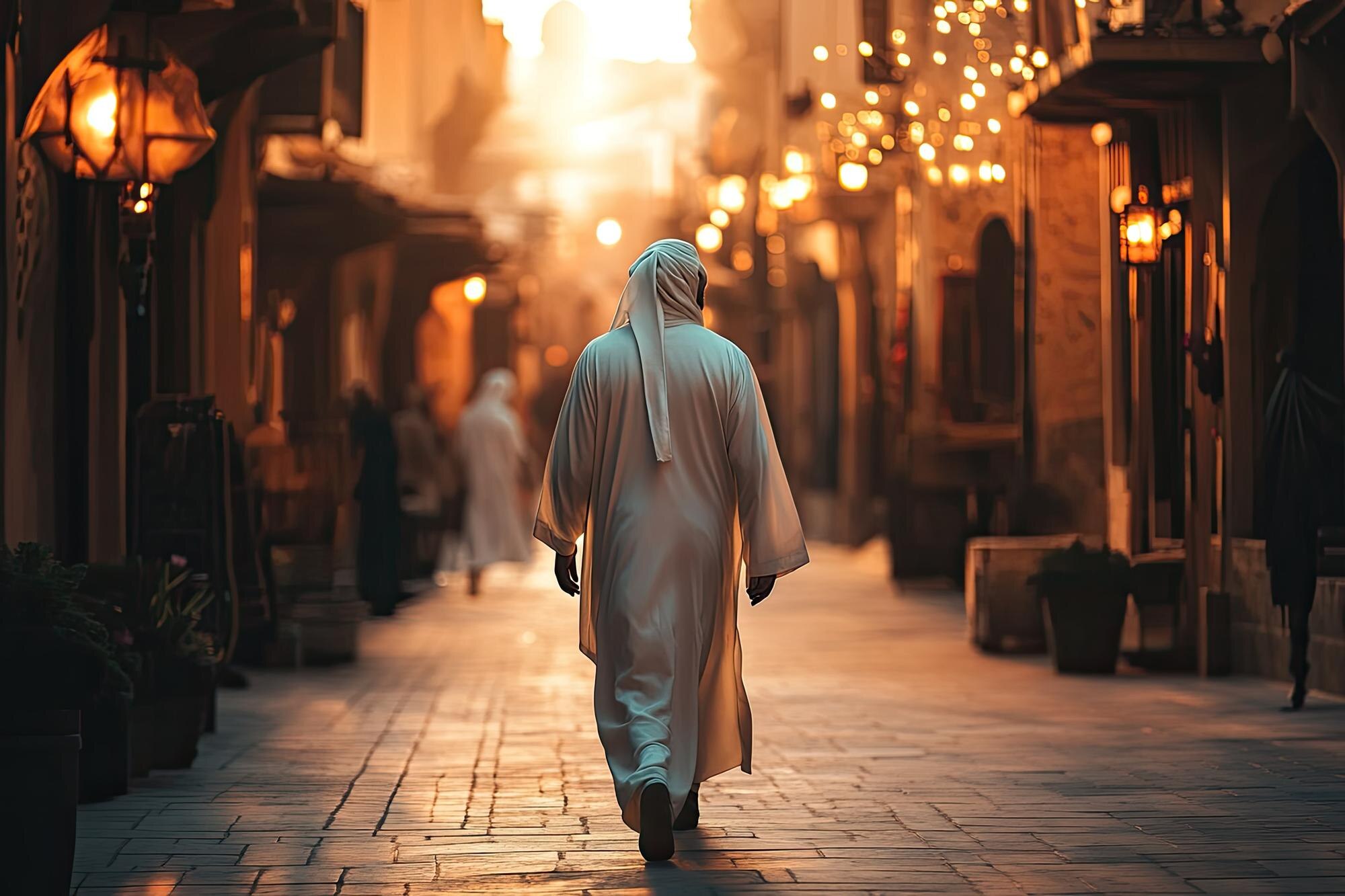
You cannot drift toward Makkah like an ordinary traveller. Before you cross the line your Beloved ﷺ drew around the sacred precinct, you must enter Ihram. These lines are called the Mīqāt — and they are not only marks on a map. They are a threshold for the soul: the moment the ordinary becomes the consecrated, the everyday becomes the holy, the trip becomes a pilgrimage. There is a quiet lesson hidden in them, and it is this: you do not enter the sacred on your own terms. Before you may reach the Ka’bah, you must first bow to a boundary. Before you arrive at the place, your heart must learn to obey.
The five gates of entry
The Prophet ﷺ fixed five great Mīqāt boundaries for those coming from every direction. Dhul-Hulayfah — also called Bir ’Ali — lies just outside Madinah, about 450 kilometres north of Makkah; it is the boundary for those coming by way of Madinah, the farthest of them all, and the very place the Prophet ﷺ himself entered Ihram. Al-Juhfah, around 187 kilometres to the northwest, serves those coming from the direction of Syria, Egypt and beyond; today many use nearby Rabigh. Qarn al-Manazil (as-Sayl al-Kabir), about 94 kilometres to the east, is for those coming from Najd and the Gulf, and by way of Ta’if. Yalamlam, about 92 kilometres to the south, is for those from Yemen and the south — and many flight paths from South and Southeast Asia pass right over it. Dhat ’Irq, about 94 kilometres to the northeast, is for those coming from Iraq. If you live nearer to Makkah than these, your own home is your Mīqāt; and if you are already in Makkah and wish to make Umrah, you go out to the boundary — many to Masjid ’A’ishah at Tan’im — and enter Ihram from there.
How you cross over
It is beautiful to prepare well before the boundary arrives, because entering Ihram is both an inward turning and a few simple outward steps. First, the ghusl — the full washing — a sunnah, and such a tender way to begin: water over the body as the heart prepares to be cleaned. (If you cannot, make wudu.) Before you begin, see to the small things you cannot do afterward — trim the nails, tidy the hair. Then you dress: for men, the two white cloths, the izar around the lower body and the rida over the shoulders; for women, simply your modest, covering clothing. And then, as the boundary nears, you make the intention in your heart, and you begin to call out the Talbiyah. Do not let this pass as a line on a checklist. This is the threshold. This is where the journey becomes real.
A practical word for those flying from far away, because I do not want the moment to catch you unready. If you fly straight to Jeddah for Umrah, you will most likely cross the Mīqāt while still in the air — often around half an hour before landing. So prepare in good time. Make ghusl before you leave home, or as close to it as you can. Many put the Ihram on at home or at the airport, before the cabins grow cramped and the small washrooms fill with anxious pilgrims. Listen for the announcement that the boundary is near — but do not depend on it entirely; the one travelling to the House of Allah should be awake and ready of his own accord. And carry a few small kindnesses for your body: a second set of Ihram, since the first grows damp; a little pouch for your passport and phone, since the cloth has no pockets; and an unscented balm for the places that chafe. These are not unspiritual concerns. A body in needless pain makes a noisy, distracted heart.
Leave A Comment