
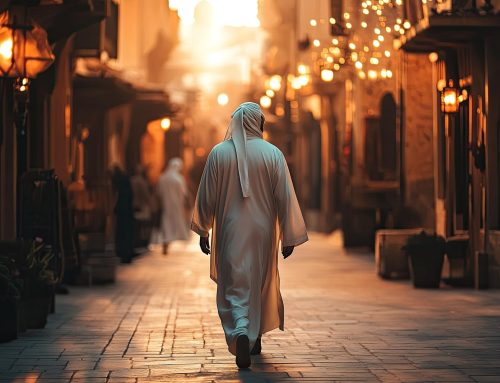
Picture it. The plane is humming somewhere over the dark, or the bus is rolling through the dry hills, and the moment is coming. You take off the clothes you have worn your whole life — the clothes that told the world who you are, what you do, what you can afford — and you wrap yourself in two plain pieces of white cloth, or you draw your simple covering close around you. And in that small, awkward, fumbling moment, something far larger than fabric is happening. You are stepping out of one world and into another.
Because Ihram was never really about the cloth. The white garments are only the visible shadow of a deeper thing. Ihram is a sacred state that wraps around the whole of you, in which things ordinarily permitted are, for a little while, set aside — because you are walking into the space of worship, and you are no longer your own. Feel the cloth against your skin; feel how strange and bare it is. It is meant to feel that way. For my brother in those two white sheets, so much of what the world used to build your identity upon is suddenly gone — no label, no status, no way to tell the rich from the poor when you all stand together before the House. And for my sister, drawn into the same simplicity and restraint, the journey stops asking who received the most attention, and begins asking only who came the most truly.
And there is something else you will feel, perhaps with a small shiver, the first time you wear it: this is what they will wrap me in when I die. The white cloth is so much like the shroud. Many pilgrims feel it in their body before their mind catches up — one day I will be carried out of this world in cloth very like this, with nothing in my hands but my deeds. Do not run from that thought. It was not sent to frighten you, but to make you true. Ihram is letting you rehearse the final meeting while you still have breath, while the door of return is still wide open.
“When I first put on the Ihram, all I could think about was whether the cloth was sitting right. But after a while something else came over me. I had less to hide behind. I looked simpler than I had ever let myself look — and somehow that made my heart more honest, too.”
So before another step, hold this one mercy close. The shroud is wrapped around you by other hands, once, when nothing can be changed any longer. But the Ihram you wrap around yourself now — while you are still alive, still able to weep, still able to return. Your Lord is letting you practise your own death while the door is still open. So do not waste the rehearsal. Every comfort you set down, every sharp word you swallow inside that white cloth, is a small death of the self that must one day die completely. And whoever learns to die a little here — to the ego, the status, the endless need to be seen — discovers something astonishing: that what is left, when the world is stripped away, is not a smaller person, but the truest part of you. A servant. Empty hands. An open heart. Standing exactly where you were always meant to stand.
Leave A Comment